Sales pitch email examples that actually work (and why)
Looking for sales pitch email examples? We’ve compiled ready-to-use templates, subject lines, and CTAs. You'll also learn how to scale your outbound with AI.
Generating leads consistently from cold email is hard. Most campaigns never get off the ground.
But hard doesn’t mean impossible.
Cold email is our forte. Our customers have sent hundreds of thousands of cold emails. We know what works—and what doesn’t.
And we’re going to show you how to replicate our results.
What Makes a Sales Pitch Email Irresistible?
A strong sales email gets opened, read, and answered because it hits the right levers—clarity, context, and a concrete next step.
Subject Line Best Practices
Two- or four-word subject lines drive the highest open rates at 46%, according to Belkins’ cold outreach report. Our in-house data and Gong’s research show the same trend—five-word subject lines and above see a steep decline in responses.
Do’s:
Use sentence case (first letter and proper nouns capitalized) to create a human tone.
Use problem- or priority-driven phrasing.
Personalize subject lines.
Don’ts:
Don’t follow the trend of sending emails without a subject line—they drive open rates but have the lowest response rate because they come off as clickbait.
Avoid buzzwords and urgency clichés like “Exclusive growth hack for 2025,” “last chance,” etc.
Personalization Best Practices
As a rule of thumb, anchor personalization in a relevant context (role change, a shared priority, updates on social, etc.). Surface-level “I saw your LinkedIn post” lines underperform. [Name] and [Company] personalization is also outdated.
Do’s:
Use role- and pain-specific details.
Personalize with social proof.
Don’ts:
Don’t recycle the same “personalized” line across multiple people at the same account.
Avoid filler in personalization. If the hook doesn’t connect to a problem, solution, or outcome, don’t force it.
Remember that personal facts like alma mater or recent vacation destinations don’t drive replies anymore.
Email Body Best Practices
Focus on the pain, resolution, and outcome structure. Don’t dump features or overload your body copy with excessive details.
Do’s:
Keep the email body 6 to 8 sentences long and under 200 words.
Build the email around one clear idea.
Don’ts:
Don’t write long emails over 400 words (these saw reply rates below 5%).
It’s OK to talk about features, but don’t make them the primary focus.
Avoid too many links, images, or PDFs. They land your emails in spam boxes and hurt your domain’s reputation.
Call-To-Action (CTA) Best Practices
Your CTA is the make-it-or-break-it point. If you drop “Worth a 15-min chat next week?”, you risk being sent to the trash folder. Sure, this harmless line feels natural. But people are tired of time stealers, so even a good pitch can fall flat with a weak CTA.
Do’s:
Ask an open question, like “Would you like to learn more?”
Keep the time investment low.
Make it easy for the recipient to reply with a two- or three-word answer.
Don’ts:
Vague CTAs like “Let me know your thoughts” are unlikely to elicit a response.
Emails should have one CTA, not multiple.
The ask shouldn’t be too big for first contact.
How to Write a Sales Pitch Email (Step by Step)
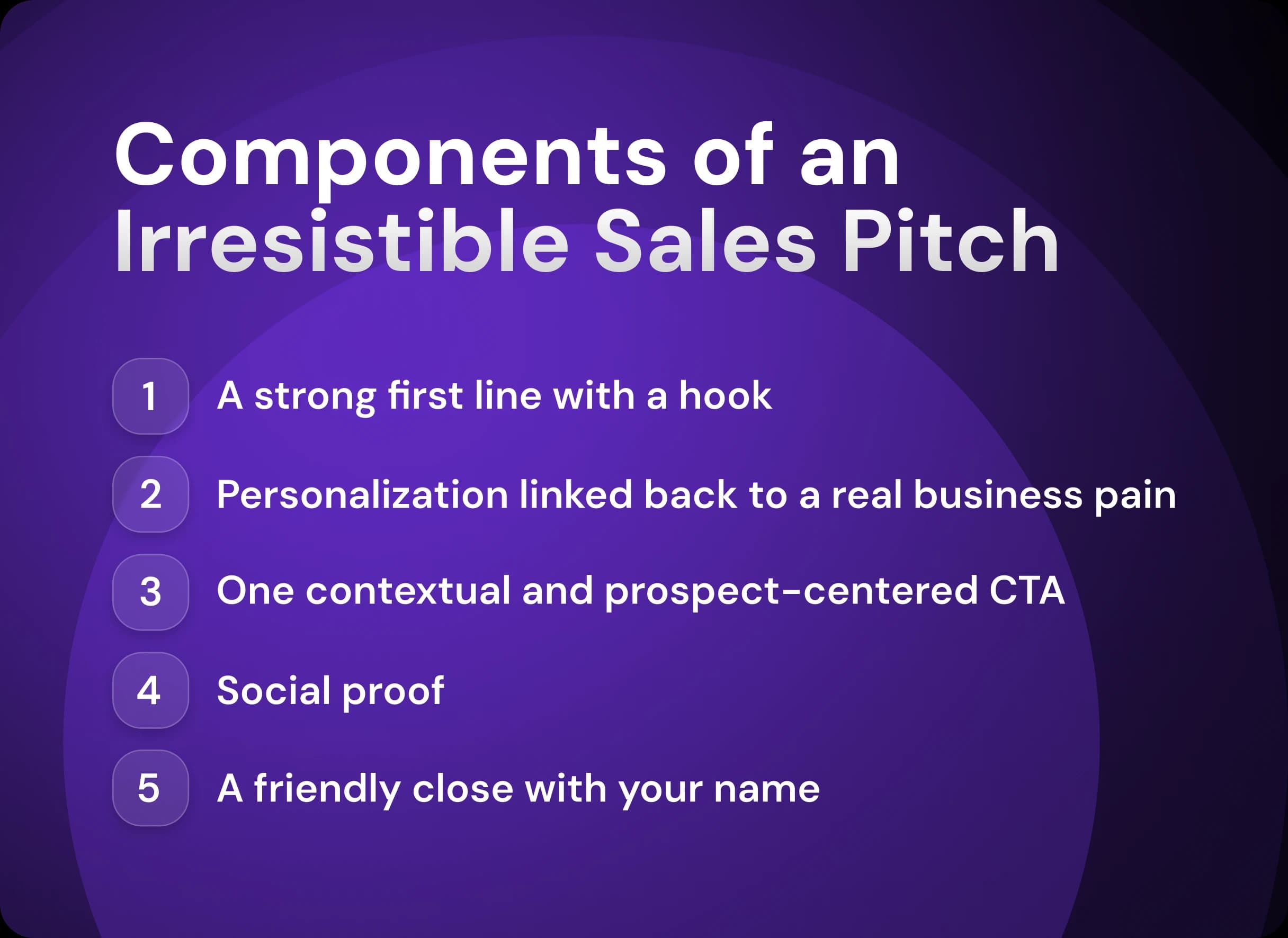
This is an example-heavy section, where you’ll learn how to craft strong hooks for the opening line, reference your prospects’ pain points, and craft CTAs that push leads to reply.
Start Strong With the First Line
Your opening line is the key factor in determining whether your prospect keeps reading or clicks away. A strong hook shows you’ve done your homework and frames the email around your prospects’ priorities.
BDRs typically pull that data from public buying signals (reviews, campaigns, new features, funding, etc.) and alternate opening lines to hit the bull’s eye.
Here are some examples of strong first lines:
“Your latest product launch in DACH is generating buzz. Based on our experience, expansions there often stall on compliance hurdles. How’s your team handling that?”
“Read your CEO’s comment on moving upmarket. Big move. Congrats!”
“Your VP of marketing’s podcast on scaling brand really got me thinking.”
“Loved the Black Friday campaign you ran. That carousel stood out in my feed.”
“Saw you rolled out BNPL at checkout. Teams we work with often see returns spike right after.”
Keep It Short and Skimmable
Once you’ve hooked your prospect, don’t lose them in a wall of text. Break up your pitch into short paragraphs or bullets so it’s skimmable. Remember the rule of keeping your whole sales pitch email at 6 to 8 sentences long and under 200 words?
Focus On the Prospect’s Problem
Reply rates double when personalization links back to real business pain. Start off emails by referencing prospects’ challenges. Frame the problem in their language so you earn credibility and build curiosity.
Here’s an example of a problem-focused email.
High-volume brands see 10–15% of their margin eroded by returns.
Our platform flags risky orders pre-shipment and helps ops teams like yours cut preventable returns by 30%.
That’s how [Brand B] saved $420K in one quarter.
Make the CTA Crystal Clear
Finally, let’s look at examples of CTAs that both convert and turn off prospects (so you know what to avoid). But first, let’s be clear—you shouldn’t use more than one CTA per email. If you do, it blurs a prospect’s focus and leads to low reply rates.
Vague CTAs like “Let me know your thoughts” also tank responses.
What’s the fix?
Write contextual and prospect-centered CTAs to keep the momentum going:
“Is it worth exploring this before Q4 targets lock in?”
“Happy to send over the 3-slide summary we used with [client X]. Would that be useful?”
“Should I loop in your ops lead?”
“Would it be helpful if I walked you through the exact workflow we built for [similar role]?”
“Worth a quick chat next week to trade notes on returns prevention?”
To contrast, we put together a list of CTAs where emails received low responses—avoid these:
“Are you free for a quick call?”
“Interested in our demo?”
“Can you check out our website and get back to me?”
“Would you be open to a 15-minute call?”
“Read our case study here:”
End on a Human Note
A friendly close with your name and an empathetic sign-off lets the recipient know that there’s a real human being behind the screen.
Here are three examples of authentic, conversational endings:
Example 1
“Hope you have a productive Monday!
Alex”
Example 2
“Thanks for reading—know your inbox is full.
Sam”
Example 3
“Appreciate your time here,
Anna
(P.S. loved your LinkedIn post on team culture—totally resonated.)”

Automate your outbound with an AI BDR
Meet Ava—your AI BDR who handles prospecting, outreach, and follow-ups, so your team can focus on closing.
6 High-Performing Sales Pitch Email Examples
Let’s connect the dots and weave together all the best practices we’ve covered. Scroll down for different examples of pitches, catered to different niches and business growth stages.
1. The “Friendly Compliment” Pitch
Best for: Startup founders and warm-ish cold leads (someone you’ve engaged with on LinkedIn or who recently posted).
Subject: “Loved your post on scaling SDR teams—quick idea”
Hi [First Name],
Really enjoyed your LinkedIn post about scaling SDRs. Your point about adding dials really resonated.
What we’ve seen with other SaaS teams in your stage is that rapid SDR hiring often leads to dropped leads. Managers spend hours on training staff.
Here’s how we’ve helped teams like yours:
- Automate SDR activity reporting across channels
- Flag pipeline gaps in real time
- Cut onboarding ramp time by 40%
That’s exactly how one client hit quota two months faster with their new hires.
Would it be helpful if I walked you through the exact workflow we’re building for our clients?
Cheers,
[Rep Name]
2. The Data-Driven Pitch
Best for: Product advocates who need to persuade senior decision makers and prospects working in industries where concrete results are valued (marketing, sales, ecommerce, etc.).
Subject: “Manufacturers lose 12% margin on late shipments”
Hello [First Name],
We’ve interviewed over a dozen manufacturing firms like yours across the EU, and they all saw a 10 to 12% loss in margins from late or inconsistent shipments. Can you relate?
If so, we’ve built a workflow for firms in your space that:
- Syncs real-time data from ERP and logistics tools
- Cuts average lead times by 18%
- Flags high-risk orders before they delay downstream jobs
For one client, that meant saving $1.2M in one quarter while improving on-time delivery by 24%.
Would it make sense to explore if this could tighten your delivery SLAs before Q4 production spikes?
Thanks for reading—know your inbox is busy.
[Rep name]
3. The Short-and-Blunt Pitch
Best for: Prospects that are known for being exceptionally busy, receive lots of pitches, or don’t spend much time checking emails.
Subject: “Cut downtime by 30%”
Hi [First Name],
Most factory floors lose hours of production every week to unplanned downtime. I bet you’ve had that too. (We all have). Our system monitors machines in real time and reduces breakdowns by 30%.
Should I send more info?
Cheers,
[Rep Name]
4. The Storytelling Pitch
Best for: Mid-funnel or jaded prospects who’ve seen generic pitches before.
Subject: “From 40% churn to 90% renewals”
Hi [First Name],
Last year, a SaaS client of ours hit a wall—40% of their mid-market customers churned in under 12 months. Their reps were chasing renewals blind, and by the time contracts expired, it was already too late.
We helped them flag churn risk 90 days before renewal and armed customer success managers with playbooks tied to usage data. Plus, we automated value recaps before quarterly reviews.
Within two quarters, renewal rates jumped to 90%.
Is it worth exploring this before Q4 targets lock in?
Best,
[Rep Name]
5. The Social-Proof Pitch
Best for: Enterprise prospects needing proof before they’ll consider new vendors.
Subject: “How [Client] boosted X by Y%.”
Hi [First Name],
[Peer Enterprise] struggled with 9-month sales cycles, which slowed growth and strained their team. After rolling out our system, they closed deals 22% faster across three regions.
Given your expansion into EMEA, I thought this result might resonate. Would you like me to share the short playbook they used to shorten cycle times without adding headcount?
Appreciate your time here,
[Rep Name]
6. The “Curiosity Hook” Pitch
Best for: Technical leaders managing migrations, cloud optimization, or reliability projects.
Subject: “Saw your AWS migration note”
Hi [First Name],
Caught your team’s update on LinkedIn about shifting workloads to AWS. That’s usually when hidden latency issues surface, as we’ve been observing for the last three years. And they rarely show up until customer service-level agreements start slipping.
You know [Peer Tech Company]?
We helped them run a quick infrastructure audit before scaling traffic. In their case, it uncovered one overlooked config that was costing them 14% in cloud spend every month.
Would you like me to share what we found (and fixed) before they went fully live?
Best,
[Rep Name]
(P.S. Happy to send over the one-page audit template we used.)
Pro Tips to Maximize Cold Email Success
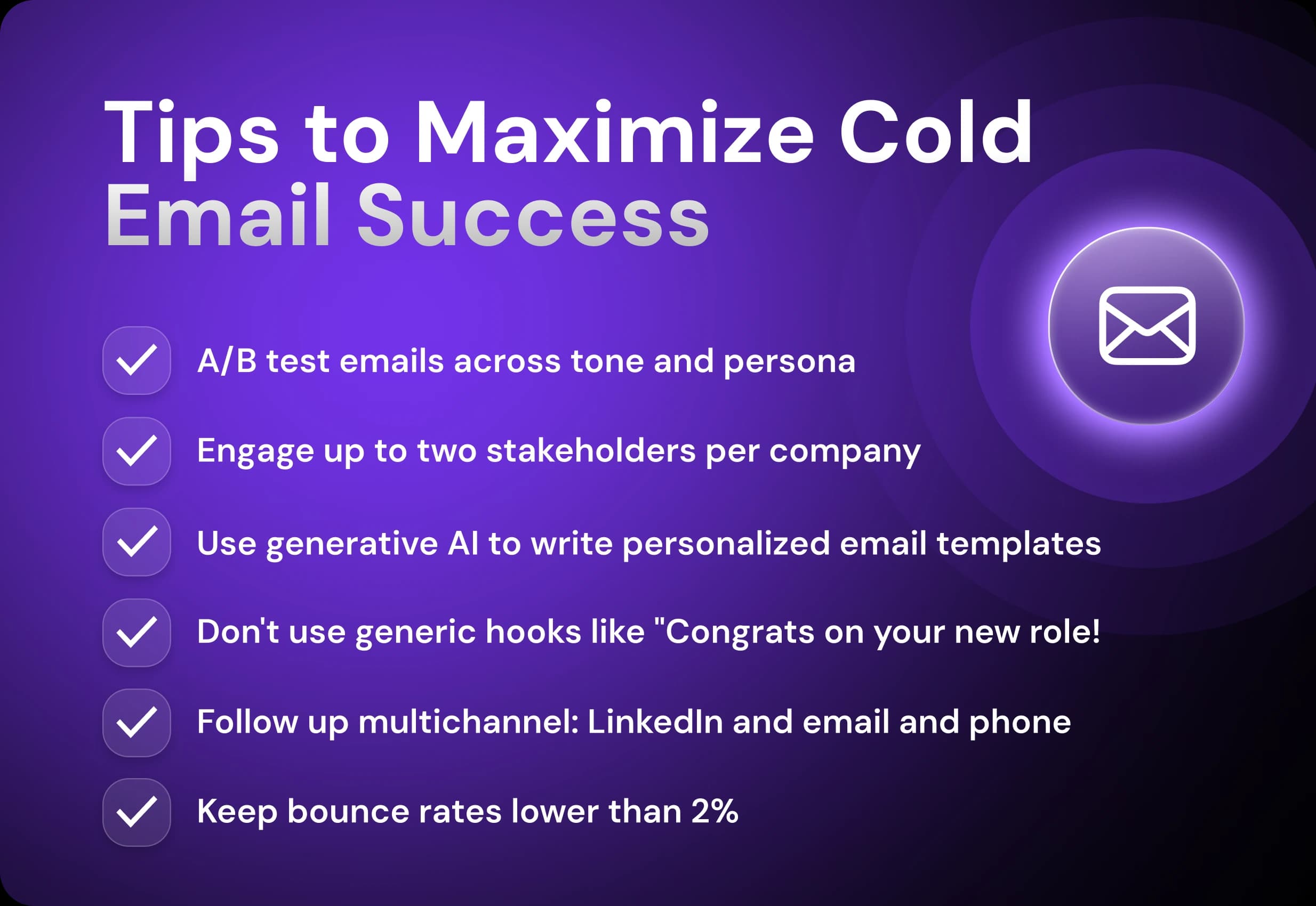
Once you’ve covered the basics, it’s time to start tweaking and refining your approach. Often, this can mean the difference between a 2% reply rate and a 10% one.
Mix and Match Templates
Templates need to be recipient-specific. A template that lands with a head of IT is unlikely to resonate with a CTO, and vice versa.
Belkins’ data shows that targeting multiple stakeholders with the same message slashes reply rates by half (7.8% down to 3.8%).
Follow these tips to find the right templates for different recipient groups:
Test multiple variants over the course of your campaigns.
Create unique templates for different funnel stages.
Track results per persona, not just campaign.
Adjust tone, case studies, and CTAs based on roles.
In addition, don’t be afraid of getting creative with variants. Often, the most unexpected email templates drive the best results.
Avoid Generic Personalization
There’s no need to burn hours crafting that perfect email. But it is important to personalize every touchpoint with a relevant angle, as you’ve seen in the examples above.
On the flip side, it’s imperative you avoid generic personalization at all costs. If you read somewhere that “Congrats on your new role” is a great hook, ditch that resource and never return. Every time a company closes a funding round, their C-suite is flooded with congratulations followed by sloppy sales pitches.
AI tools can help you personalize at scale without sacrificing quality. Artisan’s AI BDR Ava performs deep prospect research and delivers hundreds of emails, on autopilot, every day.
Follow Up Like a Pro
Our benchmarks show reply rates peak on the second touch and fall after the fifth—but follow-ups have to be sent across channels and varied. Nowadays, the most effective follow-up trio is LinkedIn, email, and a cold call (or a voice note).
Change the angle each time. Prospects should feel an organic progression. For instance, talk about cost first, risk second, and growth third.
Here’s an example of an email and LinkedIn cadence:
Day 1: First email with problem, solution, and outcome structure
Day 3: LinkedIn connect and comment on prospect content
Day 5: Follow-up email and angle shift (e.g., data point instead of story)
Day 10: LinkedIn DM with short insight: “Noticed your post on X. Curious how you handle Y?”
Day 14: Final email with a short CTA: “Should I send more info or leave you be?”
Nail Deliverability
Email deliverability rates strongly depend on the technical configurations of an inbox, such as email authentication methods (SPF, DKIM, DMARC, and ARC) and infrastructure configuration (IP addresses, a PTR record, and reverse DNS records). Plus, you must adhere to Google’s email sender guidelines.
Deliverability also tanks when your email sequences are loaded with any of the following:
Spammy words like “free trial,” “guaranteed,” “limited time,” or ALL CAPS subjects
Links or attachments
Flashy HTML extras like logos and banners, buttons, multiple fonts, and overuse of bold text
To ensure that your emails reach everyone from your B2B email list, adhere to the following best practices:
Use clean, plain email body text or very minimal formatting—one hyperlink max.
Turn off tracking pixels.
Rotate mailboxes.
Mix send times.
Keep bounce rates low—under 2% for Gmail.
Always monitor your mailbox health with a tool like Artisan’s deliverability monitor.
Track What Matters
Open rates aren’t a reliable indicator that your email campaigns are working. To really get a sense of whether or not you’re targeting the right ICPs and resonating with them, you need to track broadly.
Here are the email metrics that matter:
Reply rates (positive vs. neutral vs. negative)
Meeting conversion rate per 100 emails
ICP responsiveness
Meetings booked
Channel metrics (i.e., which channel generates the most qualified leads)
Revenue generated per rep
These metrics make your BDRs accountable for revenue contribution. Holding reps accountable in this way leads to more thorough prospect research and better-designed A/B tests.
Scale Your Outreach With Artisan
AI tools like Artisan are changing the way that sales teams manage cold outreach. Artisan’s AI BDR—called Ava—can prospect, personalize, and pitch at scale and on full autopilot. The result? Reps can focus on generating revenue by closing deals.
Let’s look at Artisan’s features in more detail.
Let Ava Handle the Busywork
Outbound scale breaks when BDRs are stuck on admin. Ava is an AI BDR who clears that bottleneck by logging every step of an outreach campaign into Salesforce or HubSpot, keeping lead records accurate without manual updates.

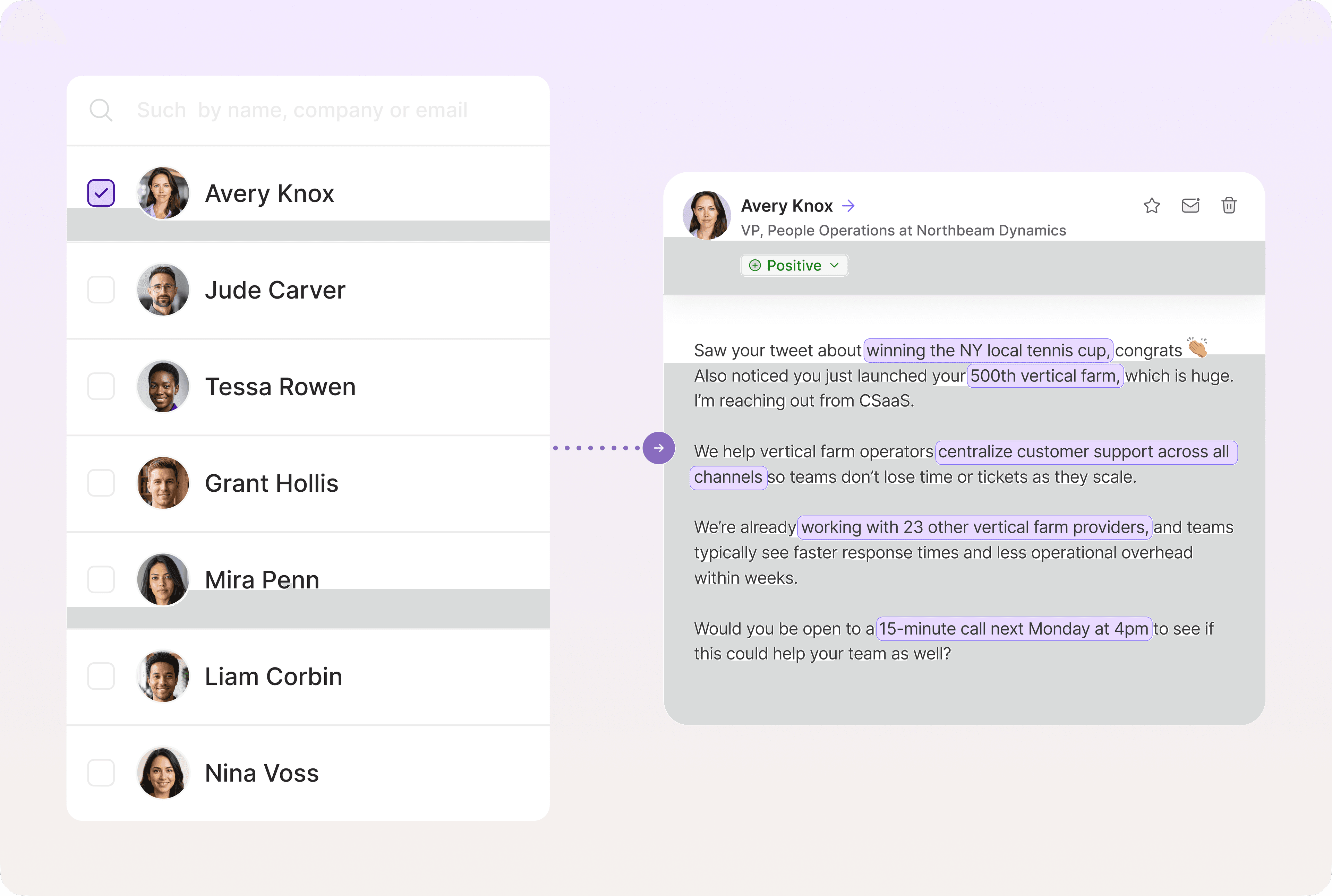
Personalize at Scale
Ava uses a personalization waterfall technique that scrapes dozens of data sources and identifies the most relevant insights for each prospect.
Artisan tracks all of the following data points:
Hiring news
Social media posts
X posts
Fundraising announcements
Press releases
Firmographic, technographic, and demographic data
Ava then automatically crafts tailored, compelling messages designed to resonate with prospects’ specific needs and interests.
Consolidate Your Outbound Tools
Artisan is a suite of outbound tools for end-to-end outreach.
One platform gives you access to:
Over 300 million B2B contacts and over 13 million ecommerce stores
Lead enrichment tools
Built-in multilingual email warmup
Email and social media cadences
Don’t Just Write Pitches, Win With Them
The sales pitch email examples we deconstructed work because they put the prospect first, keep the copy tight, and close with a crisp CTA.
If you apply these principles, your emails will turn cold leads into interested buyers as sure as night follows day.
Even better, modern AI tools like Artisan let you outsource huge swathes of the sales process. This allows your reps to focus on the vital human process of closing deals.
Automate your outbound with an AI BDR
Meet Ava—your AI BDR who handles prospecting, outreach, and follow-ups, so your team can focus on closing.

Jenny Romanchuk
SME @ Artisan
Jenny creates senior-level content for sales, SEO, and marketing professionals. She also leads partnerships at the District #1 Charitable Foundation.