Sponsorship ROI guide: How to track, optimize, and convert
Clear steps to boost sponsorship ROI: goals, metrics, attribution tools, and automation tips for turning engagement into measurable growth.

You saw the booth traffic, collected the leads, and got the brand mentions.
But when finance asks for the return on investment (ROI), you're stuck pointing at engagement metrics and saying "awareness."
The problem isn't that sponsorship ROI is impossible to measure—it's that most teams don't build the systems to track it before they write the check. They wait until after the event to figure out what worked, and by then, the trail has gone cold.
This guide fixes that. You'll learn how to set clear objectives, track both tangible and intangible ROI, and use the right tools for attribution.
How to Set Clear Sponsorship Objectives and KPIs
Your sponsorship ROI starts before you write the check. Start by identifying what success looks like for your team—then evaluate how each sponsorship opportunity can help you get there.
Here's what clear goals might look like:
Engagement: Achieve a minimum of 100 social interactions from target accounts and book 15 product demos with mid-market companies.
Sales: Generate $100K in pipeline from enterprise retail accounts.
Brand positioning: Secure three speaking opportunities at industry events within six months as a direct result of this sponsorship.
Once you’ve set clear objectives, collaborate with your partners to understand what’s realistic. Ask for details on attendee demographics (for events), sponsor visibility, and conversion benchmarks to see if the sponsorship placements align with your goals.
Why Are Sponsorship KPIs Important?
Objectives tell you where you're going. Key performance indicators (KPIs) tell you if you're actually getting there.
Here are some examples of KPIs that can be attached to objectives:
Cost per qualified lead
Lead score distribution (what percentage are actually sales-ready)
Time from lead capture to first sales call
Pipeline value generated within 30, 60, and 90 days
Close rate compared to non-event leads
It’s important to set targets for each KPI before you begin a sponsorship partnership. You can then ascertain if KPI targets are realistic based on projected visibility or event footfall. For example, if event demos typically convert at 25%, 20 demos should deliver 5 opportunities. If your average deal size is $10K, you'll need at least 10 qualified opportunities to hit a $100K pipeline goal.
Tangible vs. Intangible Sponsorship ROI Metrics
Not everything that matters can be measured in dollars, but everything that costs dollars should be measured.
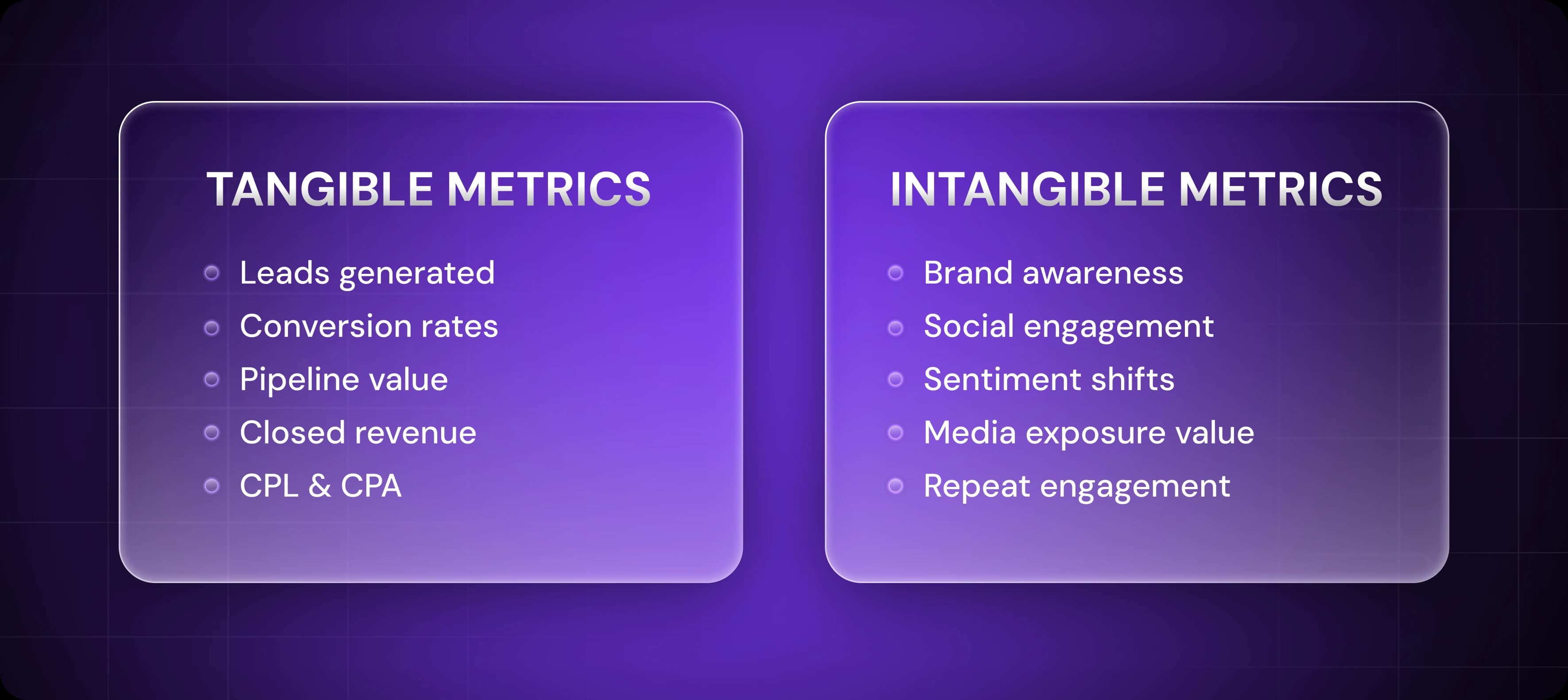
Tangible (Quantitative) Metrics
Quantitative metrics track specific behaviors, costs, and outcomes. They provide the raw data to calculate both your overall and channel-specific ROIs.
Calculating overall sponsorship ROI is relatively straightforward. Take your closed-won revenue (let's say $300K from sponsorship-attributed deals) minus your total sponsorship cost ($50K for the package plus $10K for activation), then divide by the cost:
($300K - $60K) / $60K = 4x ROI or 400%
That means every dollar spent returned $4 in revenue. Anything above 3:1 is solid; above 5:1 is exceptional.
However, you will likely also want to calculate predicted and channel-specific ROI, and to do this you need to track the following metrics:
Qualified leads: You can use this to predict ROI by multiplying the number of qualified leads by your average lead value (ALV) and using that number as an estimate of total revenue.
Qualified leads by channel: This allows you to predict ROI by channel, using the same methodology as you would for overall qualified leads.
Cost per acquisition (CPA) by channel: Measuring channel-specific CPA (if the sponsorship package provides channel-specific costs) gives you definite ROIs, which are useful for picking sponsorship packages in the future. Divide the cost associated with the channel by the number of customers generated.
Your CRM or revenue management software should track all of this automatically. Tag every lead with its source, track it through the pipeline, and attribute revenue back to the original sponsorship.
Don't panic if your sponsorship CPA runs higher than other channels. A $1,000 sponsorship lead might seem expensive compared to a $200 Google Ads lead, but if that sponsorship lead has a three times higher close rate, larger deal size, or lower churn rate, it's actually the better investment.
Intangible (Qualitative) Metrics
These metrics won't show up in your CRM pipeline report, but they compound over time. A prospect who sees your brand at three conferences before they convert has a longer story than what last-touch attribution suggests.
There are three main intangible metrics to track:
Brand visibility
Brand sentiment
Brand loyalty
Your management won't ask for them in the budget meeting, but they're what moves your pipeline at the end of the day. The trick is finding ways to measure the unmeasurable, especially by using comparisons.
Here's how to measure intangible ROI:
Media exposure value: Calculate what that visibility would have cost through paid channels and compare that to sponsorship exposure.
Social engagement: Track social media mentions, shares, comments, and DMs during and after the event using campaign-specific hashtags.
Sentiment analysis: Use tools like Brandwatch and Mention to monitor how your brand is discussed and track shifts in tone.
Post-event perception: Run quick surveys asking attendees what they remember about sponsors and how they rank you in key categories.
Repeat engagement patterns: Tag past event attendees in your CRM and track email opens, webinar attendance, and content interactions over time.
This process is less tied to monetary ROI, but measuring across a range of soft outcomes will help you determine whether sponsorship is driving positive, meaningful brand awareness and sentiment, which is just as important.

Automate your outbound with an AI BDR
Meet Ava—your AI BDR who handles prospecting, outreach, and follow-ups, so your team can focus on closing.
Applying ROI Measurement to Different Sponsorship Types
Not all sponsorships look the same, so your measurement approach shouldn't either. Each type requires specific tracking mechanisms and success metrics that align with how the channel actually generates value.
Influencer Partnerships
Influencer partnerships involve paying industry voices, like podcasters, LinkedIn creators, YouTube channels, and newsletter writers, to feature your product to their audience. The ROI here lives in two places: direct response and brand lift.
A measurement framework for influencer partnerships may look like this:
Use unique UTM parameters or custom landing pages to track traffic and sign-ups.
Deploy influencer-specific promo codes or referral links to attribute conversions directly.
Monitor how many visitors, trials, or demos come from each sponsorship deal.
Track engagement rates on sponsored content (likes, comments, shares).
Watch for qualitative signals like brand mentions, comment quality, and follower growth in your target segment.
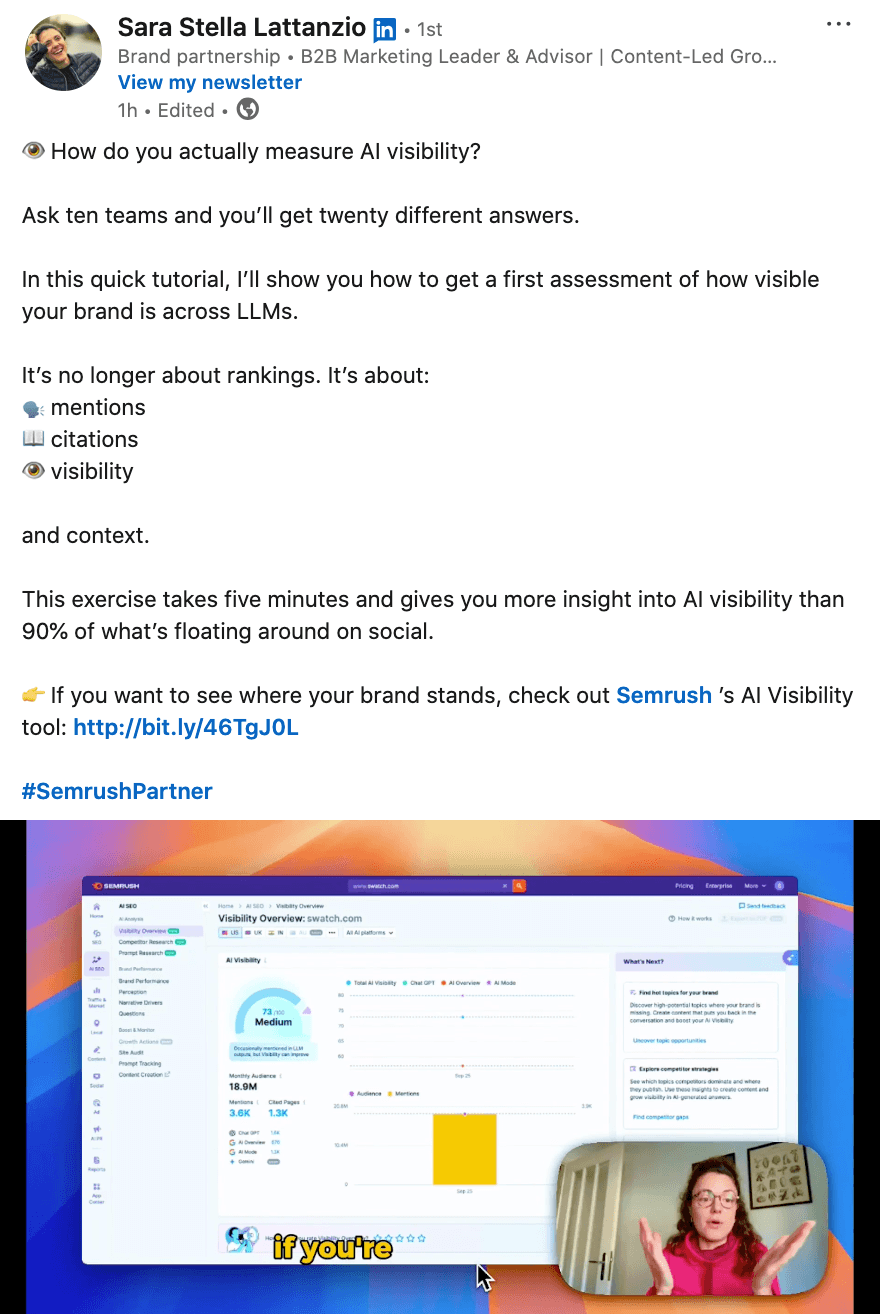
Semrush often uses influencer partnerships. Notice the tracking link in the example below.
Co-Marketing and Partnerships
Co-marketing involves partnering with complementary brands to co-host webinars, co-create reports, or co-produce content that leverages both audiences. The goal of such partnerships is shared lead generation and mutual brand elevation.
Here's how to measure co-marketing ROI:
Track registrations, attendees, and lead quality from each co-branded initiative.
Use separate UTM parameters for each partner's promotional channels to split lead attribution cleanly.
Report ROI per partner by measuring which audience converts and at what rate.
Monitor pipeline value generated within 30, 60, and 90 days from co-marketing leads.
Paid Social Media Promotions
Paid social media ads are also a form of sponsorship (hence the name "sponsored content"). This is direct-response marketing with clear performance metrics, and proving its ROAS (that's ROI for ads) isn't difficult.
Here's how to measure paid social ROI:
Use unique tracking links with UTM parameters for each platform and campaign to keep attribution clean.
Track CTR (click-through rate), CPC (cost per click), and CPL (cost per lead) for every piece of sponsored content.
Calculate ROAS by dividing revenue attributed to the campaign by total ad spend.
It’s good practice to compare ROAS across platforms and always look beyond generic CPL and factor in close rates and deal sizes for a full understanding of which platforms convert best.
Branded Content Collaborations
Branded content involves partnering with publishers, media outlets, and content platforms to provide resources that feature your brand and expertise.
Here’s how to measure branded content performance:
Track all major engagement metrics: views, downloads, time on page, and video watch time.
Track conversions with publisher-specific UTMs or landing pages.
Monitor content citations, shares, and references by industry voices.
Tag branded content leads separately in your CRM so you can monitor their lifecycle and compare close rates.
Real-Time Tracking and Attribution Tools
“Assistance measuring ROI" ranks as one of the top three most valuable services sponsors want from properties. Yet only 40% of those same sponsors actually prioritize "relevant research data and insights" from their partners.
Read that again. Sponsors desperately need help measuring ROI, but most don't even ask for the data that would make measurement possible.
This disconnect reveals the dirty secret at the heart of sponsorship marketing: most teams are flying blind.
The solution isn't begging properties for better metrics (though you should absolutely demand them). It's building your own measurement infrastructure before you sign the contract. When you know what data you need, how you'll track it, and what tools you'll use to connect sponsorship activities to actual revenue, calculating ROI becomes a seamless process.
Let’s look at what a sponsorship tracking tech stack looks like in the wild.
Digital Analytics & UTM Tracking
UTM parameters are your sponsorship tracking foundation. They're the breadcrumbs that show exactly where your traffic originated and how users behave once they land on your site.
Follow this process to set up proper UTM tracking:
Create unique UTM links (Google has a campaign URL builder) for every sponsorship touchpoint (booth QR codes, social posts, email signatures, landing pages).
Deploy promo codes specific to each sponsorship, so sales conversions are directly attributable.
Set up Google Analytics dashboards to monitor clicks, conversions, and traffic attribution in real time.
Decide on one main multi-touch attribution model (first-touch, last-touch, or linear) to understand which sponsorship interactions actually influence conversions.
Most sponsorships work best with multi-touch attribution since prospects rarely convert immediately—they see you at an event, engage on social media, then book a demo weeks later.
Social Media Monitoring & Sentiment Analysis
Tools like Hootsuite, Brandwatch, and Sprout Social let you track how people actually feel about your sponsorship presence in real time.
Here’s how to set up monitoring in Hootsuite:
Create custom streams for event-specific hashtags, brand mentions, and competitor comparisons so all sponsorship-related activity appears in one dashboard.
Use the Analytics tab to monitor social media engagement metrics (shares, comments, saves) and identify which content resonates with your target audience.
Set up keyword searches to track brand perception shifts before, during, and after events—look for changes in sentiment and conversation volume.
Configure automated alerts for negative sentiment or sudden spikes in mentions so you can respond immediately.
Build comparison reports to measure your share of voice against other sponsors and gauge relative brand presence during an event.
CRM Integration and Lead Tracking
Your CRM should track the progress of leads through your pipeline and consolidate attribution data.
Here’s how to build a system that will convert sponsorship data into revenue metrics:
Automatically sync leads from sponsorships into your CRM with proper source tagging.
Track the full lifecycle from lead to MQL to SQL to opportunity to closed deal.
Attribute revenue back to the original sponsorship source (multi-touch attribution).
Tag every sponsorship lead with campaign details (event name, date, booth location, how they converted).
Create custom fields for data tied to specific sponsorships so you can easily segment and analyze performance over time.
Automate your outbound with an AI BDR
Meet Ava—your AI BDR who handles prospecting, outreach, and follow-ups, so your team can focus on closing.
Post-Campaign ROI Analysis and Reporting
You know which metrics to track, and you know how to track them. Now, let’s make sense of them.
Here's how to analyze sponsorship performance:
Wait for complete data before calculating the final ROI. Sponsorship leads often take time to progress through the sales funnel. Wait between 60 and 90 days to capture full pipeline impact.
Compare results against your original objectives. Review whether you hit your targets (demos booked, pipeline generated, and speaking opportunities secured) and identify gaps between expected and actual performance.
Include qualitative feedback. Add post-event surveys, sentiment analysis from social mentions, and net promoter scores (NPS) to provide context that quantitative metrics alone can't capture.
Create clear reports for stakeholders. Build dashboards that show total sponsorship investment, revenue generated, and ROI percentage in a format that supports budget decisions.
Document findings. Record what worked, what didn't, and what you'd change next time—these insights directly inform your negotiation strategy and activation plans for future sponsorships.
This analysis determines whether you renew, renegotiate terms, or reallocate budget to high-performing opportunities.
How to Improve and Scale Sponsorship ROI
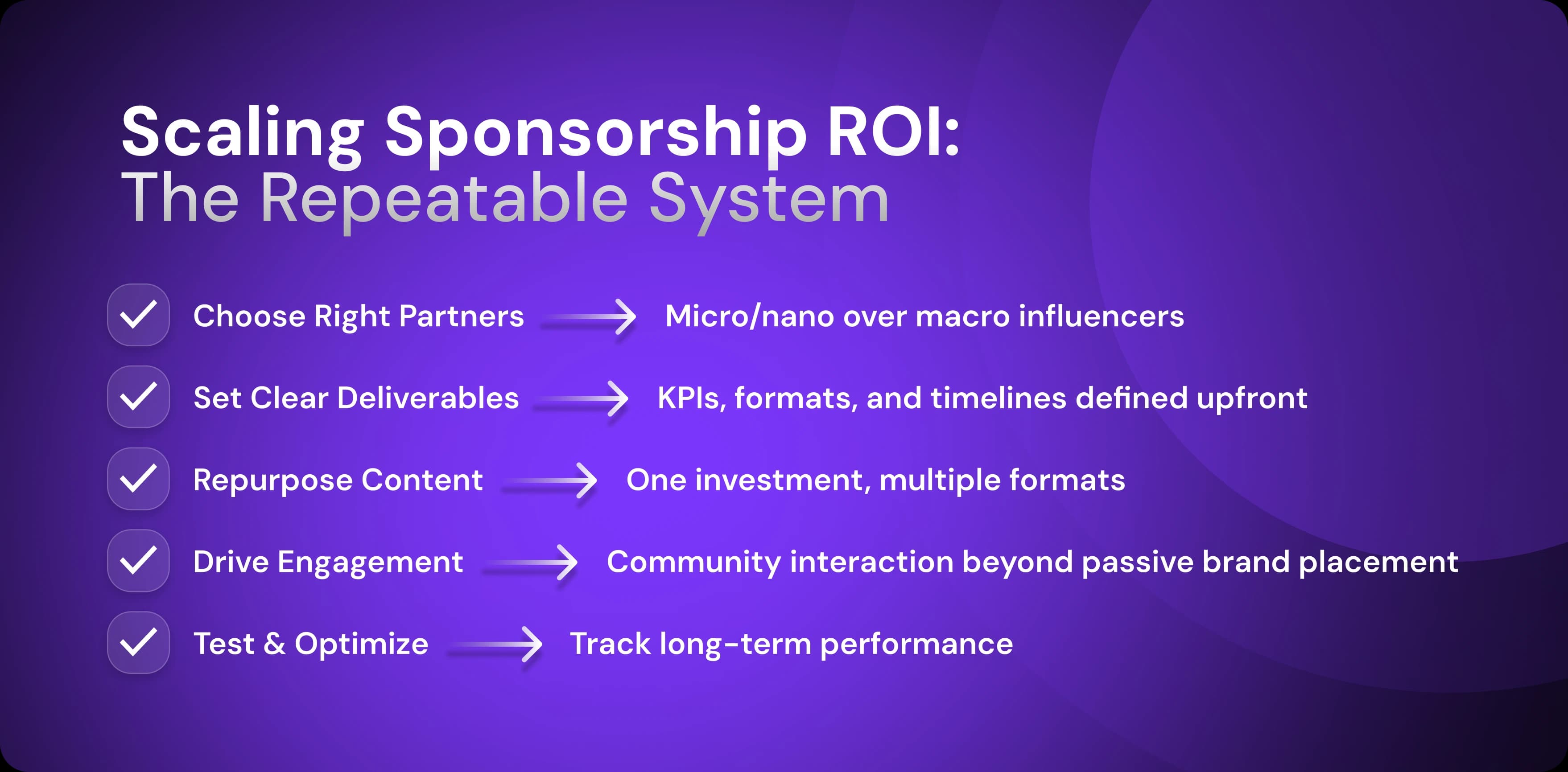
Getting ROI from your first sponsorship is one thing. Scaling that ROI across multiple partnerships requires a repeatable system. Here are some down-and-dirty tips for getting the most out of your sponsorships and maximizing ROI.
Choose the Right Partnerships
Don’t go after the big fish as a rule. We reached out to the partnership team at Brevo to ask them about their approach to sponsorships. They started off by telling us that the biggest names don't always deliver the biggest financial returns.
"We avoid large 'macro' partners because their fees make it difficult to achieve a positive ROI. Instead, we focus on micro- and nano-partners, where the return on investment is easier to reach," said Paul Wolniak, Partnerships Manager at Brevo.
Set Measurable Deliverables
Build accountability into every sponsorship agreement by negotiating specific KPIs into contracts upfront. This includes post count, registration goals (where applicable), content format requirements, and timeline commitments.
Wolniak emphasizes the importance of alignment from the start: "I usually schedule a video call with each partner to present Brevo, walk them through the platform, and share all the resources and information they need to create the best possible content."
Amplify and Repurpose Content
Maximize your sponsored content value by repurposing it across different channels—for example, by breaking down long-form content into social clips or blog posts.
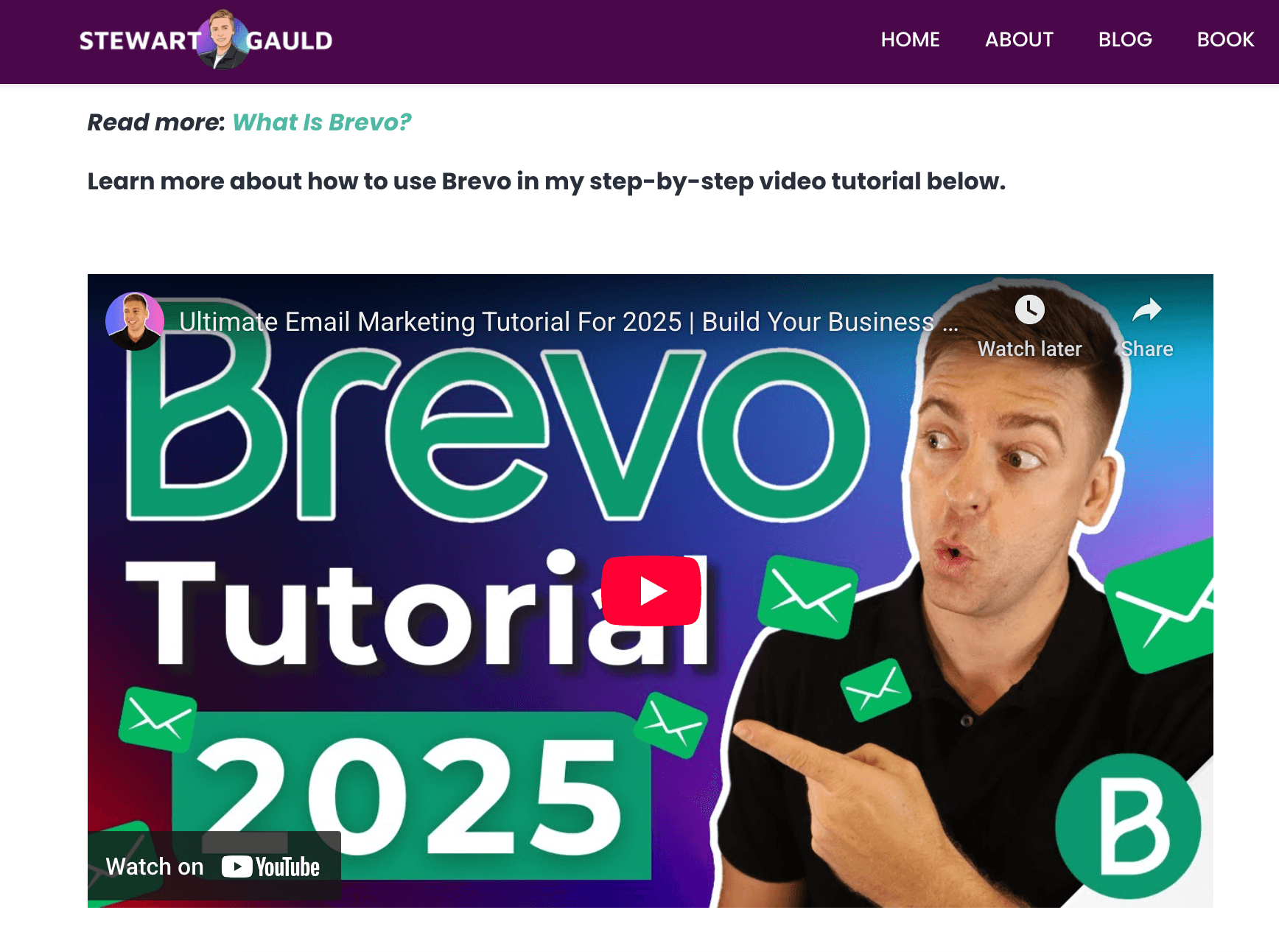
When Stewart Gault created a video review of Brevo, he also published a comprehensive written review on his blog, interlinking both formats.
And of course, Gault teased the review on his LinkedIn profile.
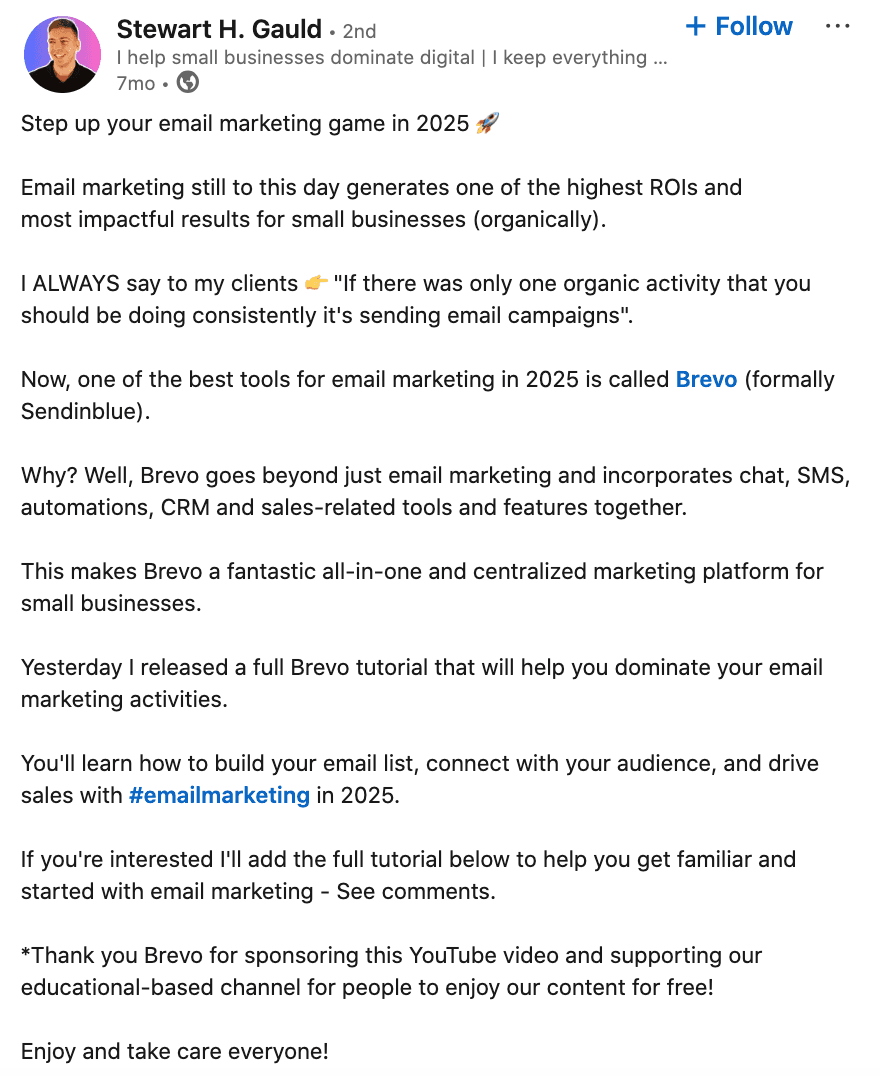
This is a smart use of resources—a comprehensive review had already been created, so repurposing it across multiple formats and platforms was an easy way to maximize ROI.
Engage the Audience
Invest in interaction beyond brand placements. In particular, drive audience engagement through interactive elements like polls, Q&A sessions, and live demos that pull people into the conversation.
Set up automated follow-up sequences based on their specific interactions—whether they asked a question at your booth, downloaded your content, or used a discount code from sponsored content.
Top it all off with community interaction after the campaign by creating dedicated spaces (Slack channels, LinkedIn groups, follow-up webinars) where the conversation continues beyond the event.
Monitor, Test, and Optimize
Treat every sponsorship as an experiment. Test different types of sponsored content, partnerships, and formats across your portfolio to identify what resonates with your audience.
No luck with comprehensive YouTube reviews? Maybe you're better off with LinkedIn placements.
Just remember to evaluate performance over the long term, prioritize lead quality over volume, and track the full lifecycle from first touch to closed deal.
How Outbound Automation Tools Like Artisan Boost Sponsorship ROI
The gap between collecting contact information at an event and actually booking meetings is where most sponsorship ROI dies. Leads sit in spreadsheets, and by the time your team reaches out, the momentum is gone.
Outbound automation tools like Artisan bridge the gap by turning sponsorship leads into active pipeline immediately. It researches leads and sends personalized emails and follow-up messages on autopilot and at scale.
Instant Lead Enrichment and Prioritization
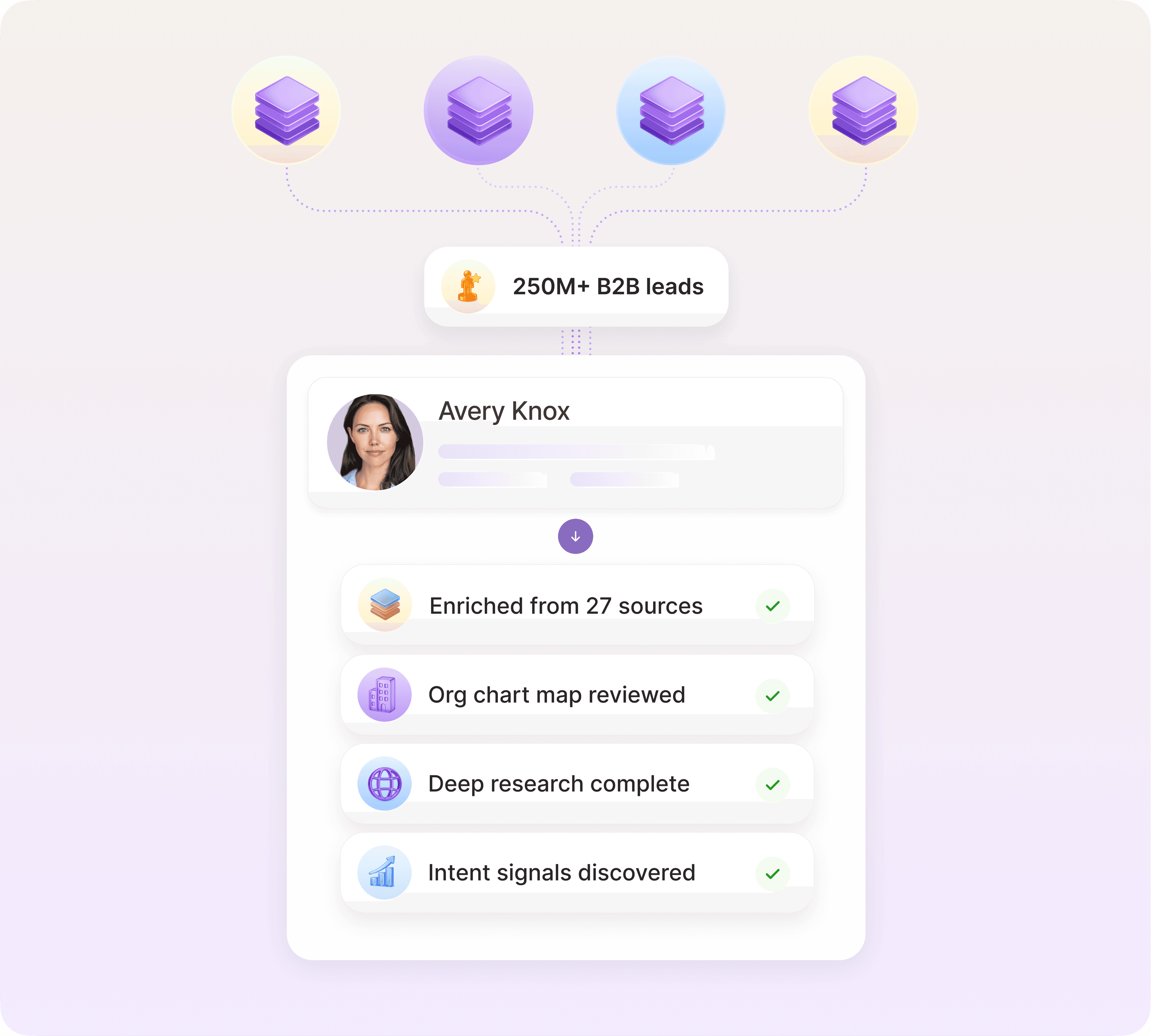
You get a name, maybe an email, and sometimes a job title. Artisan automatically enriches these contacts with verified data, such as company size, tech stack, and buying intent signals, all of which can be used to qualify and score leads.
Automated, Personalized Follow-Up at Scale
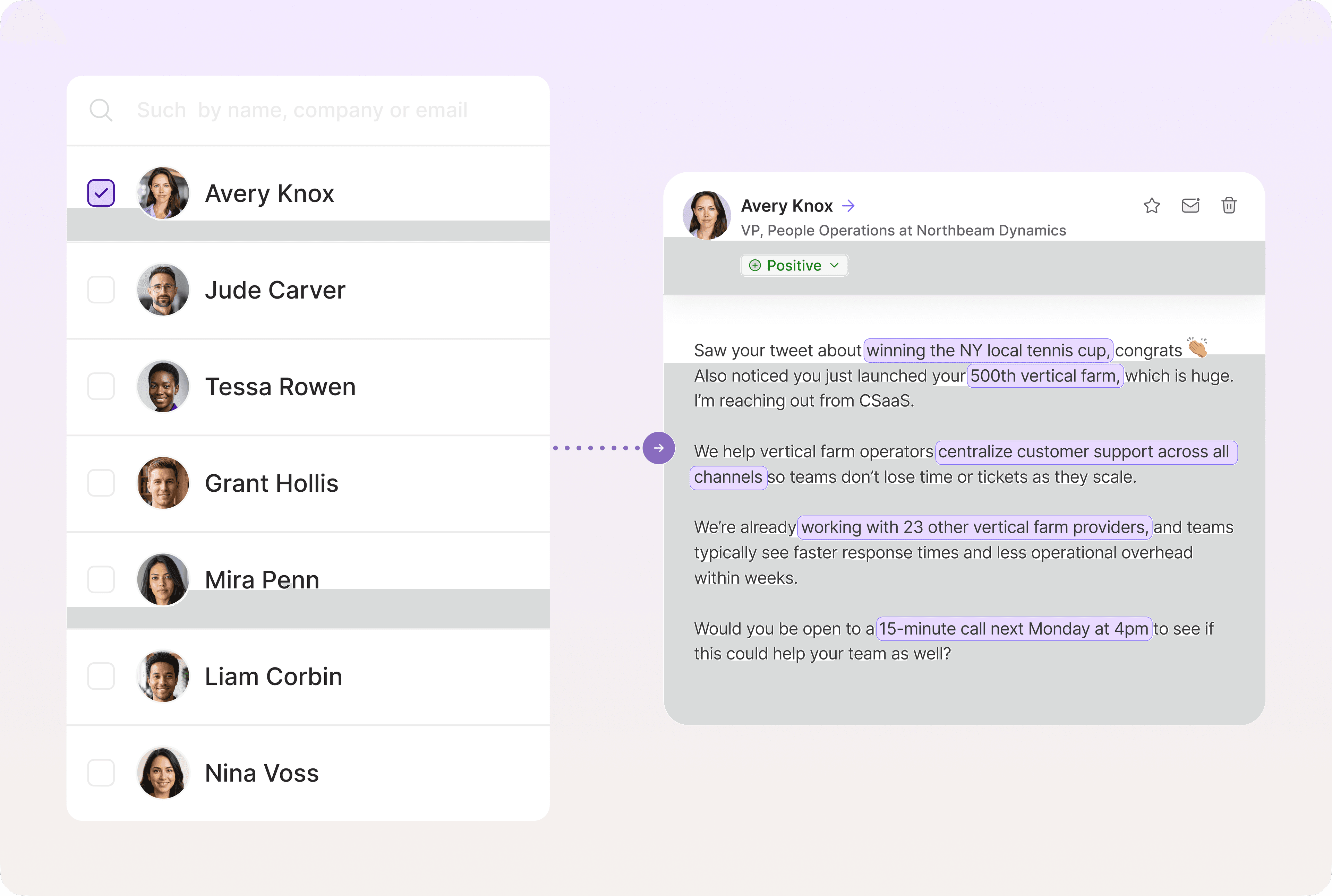
Artisan's AI BDR Ava scours the web for information about leads and personalizes emails at a level that matches human quality. Ava also sends follow-up emails to non-responsive leads.
Multi-Channel Engagement That Matches Buyer Behavior
Ava creates multichannel email sequences based on buyer intent signals, allowing you to reach leads across a range of touchpoints with personalized messages.
Before You Sponsor Again, Measure Smarter
Tracking sponsorship ROI isn’t a straightforward task. There’s much more to it than tracking total sales and sponsorship costs.
That’s why it’s essential to have the right strategy and a solid tech stack. Take care of these, and you’ll have a full overview of all of the ways that sponsorship marketing is driving value for your business.
Artisan is a powerful addition to your tech stack that works alongside your sponsorship marketing. You can use it to research leads and send personalized emails at scale and on autopilot—which means your reps can focus on closing deals.
Automate your outbound with an AI BDR
Meet Ava—your AI BDR who handles prospecting, outreach, and follow-ups, so your team can focus on closing.

Adelina Karpenkova
SME @ Artisan
Adelina Karpenkova is a writer helping businesses tap into AI's potential and clear up misconceptions. She works with B2B teams on latest industry knowledge.