Sponsorship follow-up email best practices (with templates)
Learn how to write effective sponsorship follow-up emails. Use our templates, timing strategies, and subject line tips to boost response rates.
Follow up too many times, and you get blacklisted.
Don't follow up at all, and you let valuable sponsorship opportunities slip away.
Get your timing wrong, and you tank your reply rates.
It turns out your success rate doesn't improve with every follow-up—you need to find the right balance.
Luckily, we’ve got the formula.
Why Your Sponsorship Proposals Need a Follow-Up
Sponsorship proposals work like sales pitches. And sales pitches need follow-ups.
Hunter’s State of Cold Email 2025 Report shows that outreach campaigns with three follow-up emails achieve an optimal reply rate of 5.8%.
How to Build a Follow-Up Strategy That Works
More isn't better when it comes to follow-ups.
Here are the two principles you need to follow to get replies to your sponsorship proposals.
1. Limit Follow-Ups Without Losing Warmth
A study by Belkins into sales follow-up tactics found that the average reply rate of the first email in a sequence is 8.4%, which is higher than the Hunter study. Every additional email beyond that chips away at overall performance. The second message gets 7.8%, the third drops to 6.8%, and by the fourth email, you're down to 5.8%.
You might be thinking, “That’s all well and good, but even if my reply rate decreases, my absolute number of replies will increase.” That’s true, but there are hidden dangers to endless follow-ups.
Sending over four emails in a sequence more than triples your unsubscribe and spam complaint rates. Spam complaints climb from 0.5% on the first email to 1.6% by the fourth.
Based on this, you should cap your email sequence at 3 messages max—one initial proposal and two follow-ups.
But don't stop there. Where email struggles, LinkedIn thrives.
Campaigns with three to five touchpoints that incorporate LinkedIn—profile visits, follows, messages, and comments—showed consistently stronger results than one-off attempts.
Unlike email, where every extra follow-up carried a rising risk of spam complaints, LinkedIn allowed for a slightly longer conversation arc without penalty.
The conclusion is clear—mix up your channels. Send one email, engage on LinkedIn, follow up with another email, then circle back on LinkedIn again.
2. Set a Clear Timeline
You don’t need to bombard your potential sponsors with more than three direct follow-up emails. Instead, a multi-channel campaign that incorporates LinkedIn is the best route for B2B outreach.
Here’s an example of an outreach timeline over two weeks:
Day 1: Send your sponsorship proposal via email.
Day 3: Visit the lead’s LinkedIn profile. Like or comment on a recent post.
Day 5: First email follow-up. Reference your proposal and add new value—updated offerings, a relevant case study, or an industry insight.
Day 10: Send a LinkedIn connection request with a brief note or message if already connected.
Day 14: Second and final email follow-up. Keep it short and include a polite close: "If now's not the right time, I'd be happy to revisit this next quarter."

Automate your outbound with an AI BDR
Meet Ava—your AI BDR who handles prospecting, outreach, and follow-ups, so your team can focus on closing.
How to Write Sponsorship Follow-Up Emails
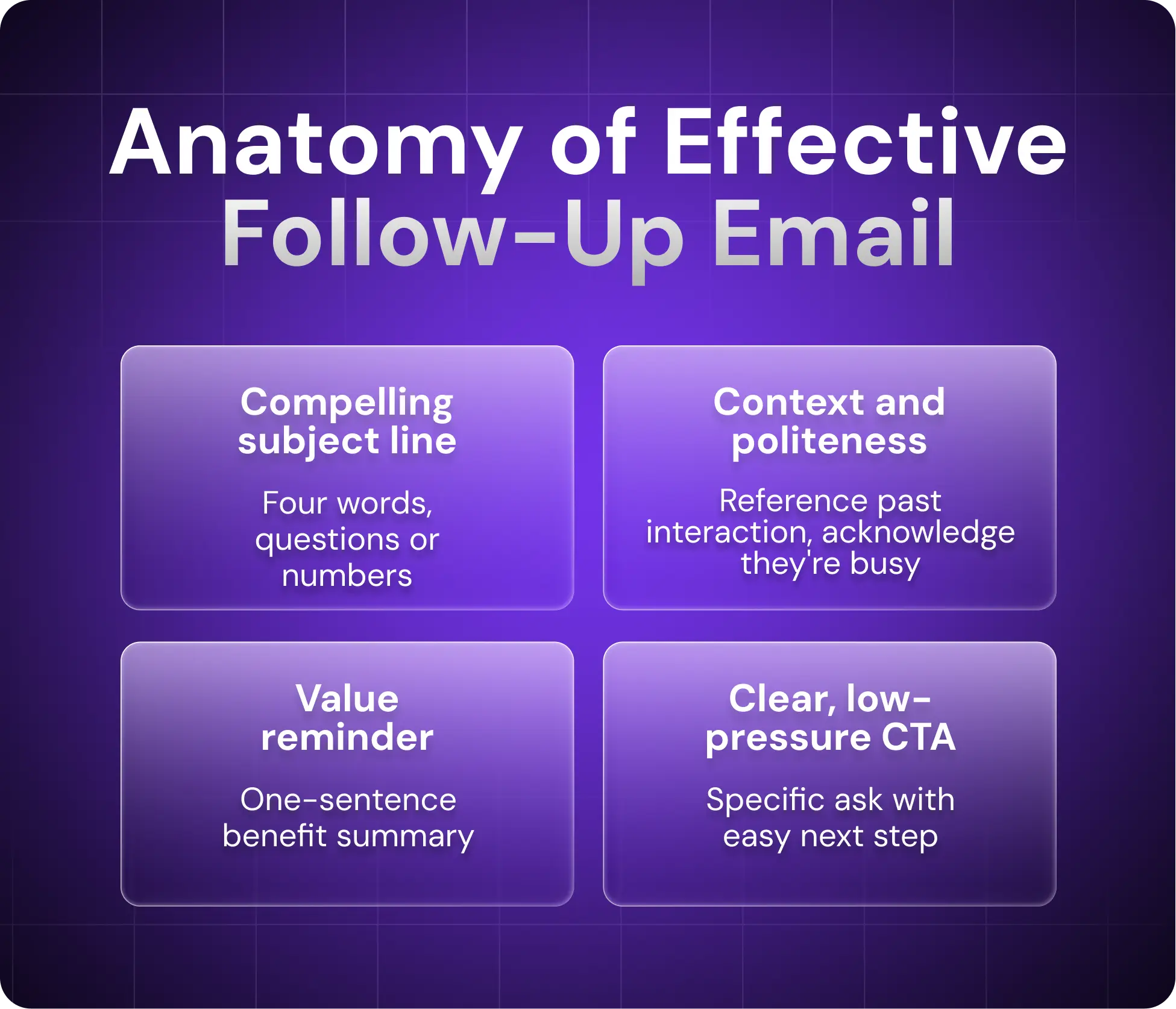
Your follow-up email needs to grab attention, provide context, and make responding easy. That requires a mix of a compelling subject line, clear context, a short restatement of value, and, naturally, a solid CTA.
1. Write Compelling Email Subject Lines
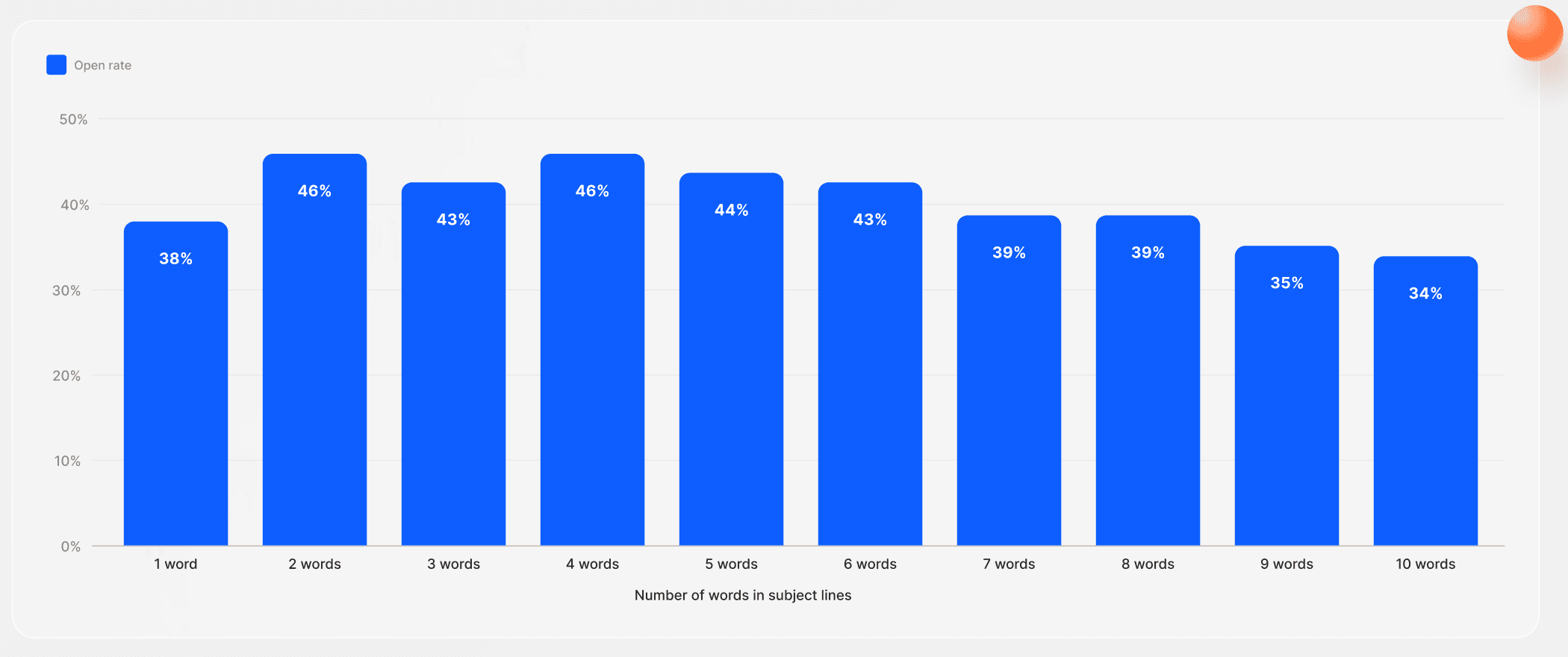
Belkin’s cold email research shows a clear pattern: shorter, smarter subject lines consistently outperform generic ones.
Follow these best practices to create subject lines that get your emails opened:
Keep it to two to four words. "Still interested?" beats "Following up on our sponsorship proposal discussion."
Test your formatting. According to the Belkins report, UPPERCASE subject lines hit 30% open rates but carry a 5.1% bounce rate—more than double the 2.2% bounce rate of lowercase headers. Title case and lowercase are generally safer bets, but you won’t know what works for you until you test it.
Frame it as a question. Subject lines with questions achieve 46% open rates—the highest of any content type.
Include numbers. Numbers in subject lines drive 44% open rates. Try "Q2 sponsorship?" or "3 quick questions."
Use calls to action. Action-oriented subject lines also hit 44% open rates. "Let's connect" works better than "Checking in."
Personalize when possible. Personalized subject lines achieve a 46% open rate and 7% reply rate—use the recipient’s company name, event, or a recent conversation hook.
2. Start With Context and Politeness
If the email recipient met you at an event or you had a prior conversation, mention that—for example, "Great meeting you at the Boston Summit last month." You could also reference your previous email or proposal—"Following up on the proposal I sent on March 15th."
Here's a polite follow-up email example that references past collaboration:

Acknowledge they're busy, but don't grovel. Your follow-up shouldn’t feel like you’re apologizing for existing.
2. Remind Them of Value
Don't rehash your entire proposal. They already have it in a thread.
Summarize the benefits. For example, "We help sponsors reach 50K+ attendees through multi-channel exposure," or "Partners typically see 3x ROI through our combined digital and event presence."
4. Add a Clear, Low-Pressure CTA
Your CTA should make it easy to say yes. To end your email, use a clear call to action asking for something small and specific.
Here are three examples of low-pressure CTAs:
“Would you have 10 minutes next week for a quick call?”
“Can I send over a one-page summary?”
“Are you open to a brief chat about Q2 opportunities?”
These work because they're low-commitment and actionable. The recipient knows exactly what you're asking for and what happens next. No bug commitments just yet.
3 Proven Sponsorship Follow-Up Templates
Use the following templates as starting points. Adapt them to your voice and the specific sponsor relationship.
Template 1: Gentle Reminder
This follow-up email template gives necessary context, offers to help, and makes it easy to take action with a calendar link.
Subject: Following up on the [Event Name] proposal
Hi [Name],
Hope you’ve had a great week. I’m following up on the proposal I sent last week] for [Event Name]. Have you had a chance to review it? Happy to provide additional information if it helps with your decision.
You can book a slot for a quick call in my calendar [linked] so we can address your questions and discuss next steps.
Best,
[Your Name]
Template 2: LinkedIn connection note
This LinkedIn touchpoint adds a new value proposition to the existing conversation while staying short and low-pressure.
Hi [Name]!
Still interested in the [Event Name] sponsorship? Since we last talked, we've added [new benefit/update, e.g., "a dedicated sponsor podcast series reaching 20K+ listeners"].
Open to a quick call?
Template 3: Final Follow-Up
This final follow-up email creates a light sense of urgency to push the point of contact toward a decision.
Subject: Last check-in on [Project Name]
Hi [Name],
I wanted to reach out one last time regarding the [Event Name] sponsorship. We're locking in the sponsor lineup for [specific deliverable, e.g., "the main stage branding"] this week.
Does it make sense to hop on a quick call, or should we revisit this for [next quarter/timeframe]?
Best,
[Your Name]
Automating and Scaling Follow-Ups
To land one sponsorship, you need to reach out to dozens of prospects and manage that outreach effectively. Making follow-ups perform at scale requires smart automation—preferably powered by AI.
Uncomfortable Truth: Manual Follow-Ups Fail
Manual follow-ups fail because they simply don't happen. Between pitching new prospects and managing active deals, reps deprioritize or forget follow-ups entirely.
Even if you're disciplined about follow-ups, manual tracking becomes a headache. You need to log what you sent, when you sent it, what they opened, and when the next touchpoint is due.
That requires an automated system. And the best outreach systems are those that make extensive use of AI automation.
How AI Can Help
AI-powered outreach platforms like Artisan handle both tracking and execution. Ava, Artisan's AI BDR, crafts personalized emails and social media messages, tracks engagement, and triggers timely follow-ups.
When a sponsor opens your proposal but doesn't respond, Ava sends a follow-up at just the right time. When they click a link, the next message references what they viewed. The automated system maintains a consistent cadence across email and social media without you manually scheduling anything.
Common Follow-Up Mistakes to Avoid
Beyond sending too many follow-ups or ignoring timing, there are a few mistakes that tank responses. Avoid these and you’ll see your reply rates improve.
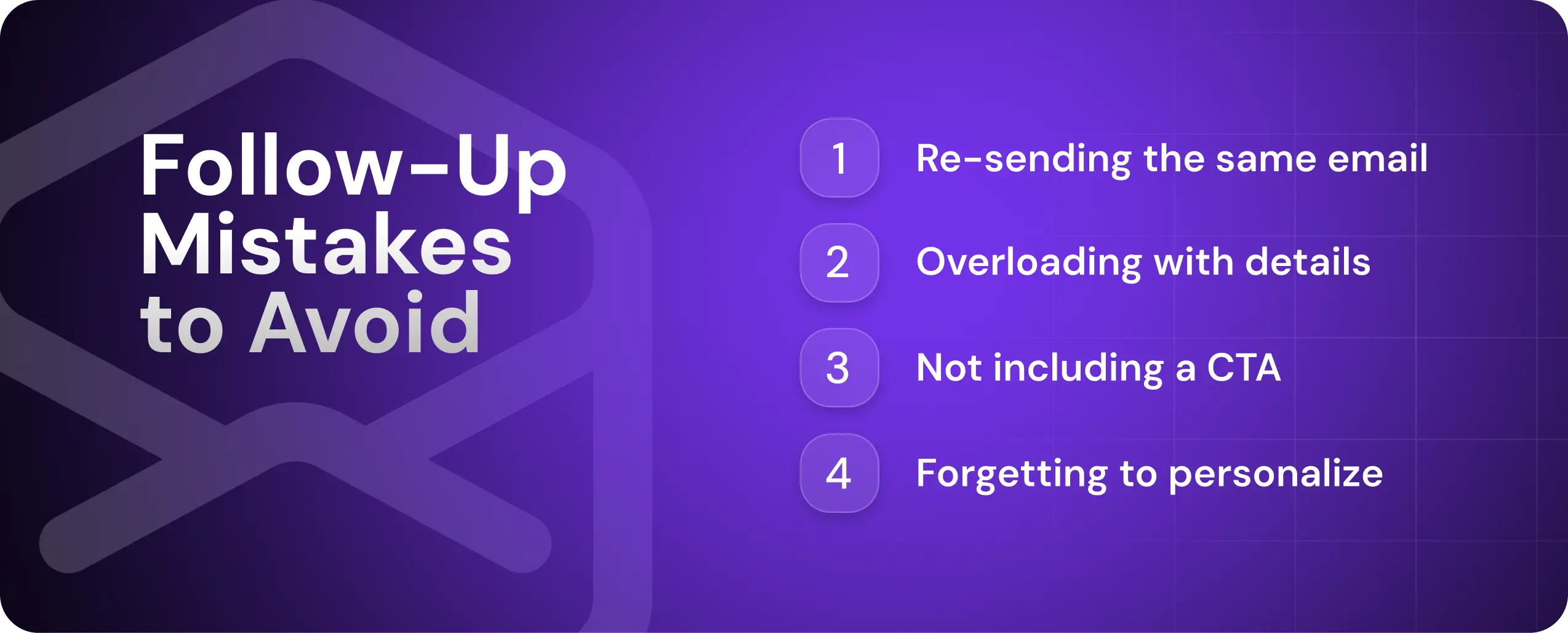
Re-Sending the Same Email Verbatim
Your prospect can see the entire email thread. When you copy and paste the same message, both versions sit there stacked on top of each other, and it looks lazy.
It's also pointless. They already have your original email. Repeating it adds nothing and makes you look like you're just checking a box.
Overloading with Details
Belkins found that emails that exceed 13 sentences drop to 3.8% reply rates. On the contrary, emails in the 6 to 8 sentence range perform best, reaching a 42.67% open rate and 6.9% reply rate.
And since we’re talking about follow-ups, it only makes sense that they’re succinct and highly specific. Your main goal is to move your conversation up in the inbox after all.
Skipping a Clear CTA
Avoid ending your messages with vague phrases like, "Looking forward to hearing from you." This doesn't encourage action or ask a question—it causes the email to get shelved until "later," which usually means “never.”
Ask for something specific like "Does Tuesday at 2 PM work for a 15-minute call?" or "Can I send over our updated sponsor deck?"
Forgetting to Personalize
Your potential sponsors don't expect you to craft a perfectly tailored masterpiece for each email. But completely generic email blasts look sloppy.
Follow-up personalization doesn't mean digging through five years of LinkedIn posts or referencing their dog. A simple personal touch, like using the recipient’s name, can be enough. Just don't open with "Dear Sponsor."
No time to personalize at scale? AI BDR Ava can conduct deep sponsor research and personalize hundreds of emails a day on autopilot—at a level that matches (and even surpasses) human quality.

Keep the Momentum and Close More Sponsorships
Best follow-up practices are straightforward: cap your email follow-ups, layer in social media touchpoints between messages, and keep every message under eight sentences.
It sounds simple, but it gets messy when you're tracking dozens of sponsorship proposals at once.
Artisan prevents this chaos by handling your sponsor outreach from start to finish—from partner research to the last follow-up—until you take over the conversation with an interested lead.
Automate your outbound with an AI BDR
Meet Ava—your AI BDR who handles prospecting, outreach, and follow-ups, so your team can focus on closing.

Adelina Karpenkova
SME @ Artisan
Adelina Karpenkova is a writer helping businesses tap into AI's potential and clear up misconceptions. She works with B2B teams on latest industry knowledge.