Implementing AI in B2B sales: A step-by-step guide
Learn how AI in B2B sales helps teams automate outreach, improve lead scoring, clean CRM workflows, and forecast pipeline more accurately.
AI in B2B sales is usually discussed in one or two ways: as a threat to sales jobs or as a magic solution to pipeline problems. Neither position is true.
What AI really does, when implemented correctly, is take the most time-consuming, least strategic parts of the sales process off your team's plate. Implementation makes the difference between sales ops genuinely improved by AI and another bloated tech stack.
How AI is changing B2B sales at the workflow level
AI is reshaping what the business development representative (BDR) role looks like in practice. The shift is away from the manual work that used to define a BDR's day-to-day toward customer engagement and decision-making.
The pressure on sales teams is operational, not just strategic
It's tempting to blame underperforming sales on bad messaging or weak ideal customer profile (ICP) targeting. Those things matter, but they're rarely the root cause. The bigger culprit is the weight of repetitive tasks and low-leverage work that accumulate across an entire team's week and compress the time reps have to engage with customers.
According to State of Sales by Salesforce, sales professionals spend almost one full day of their workweek on prospecting alone. Nearly half say it's one of the most frustrating parts of the job. That's before accounting for manual CRM updates, broken handoffs between outreach and account management, and the time lost re-researching accounts that are already somewhere in the system.
AI now touches nearly every stage of the sales process
AI adoption in B2B sales has moved well past the early majority. A recent study by HubSpot shows that only 8% of sales reps don't use AI at all, so the question has clearly shifted from whether to adopt AI to where to focus first.
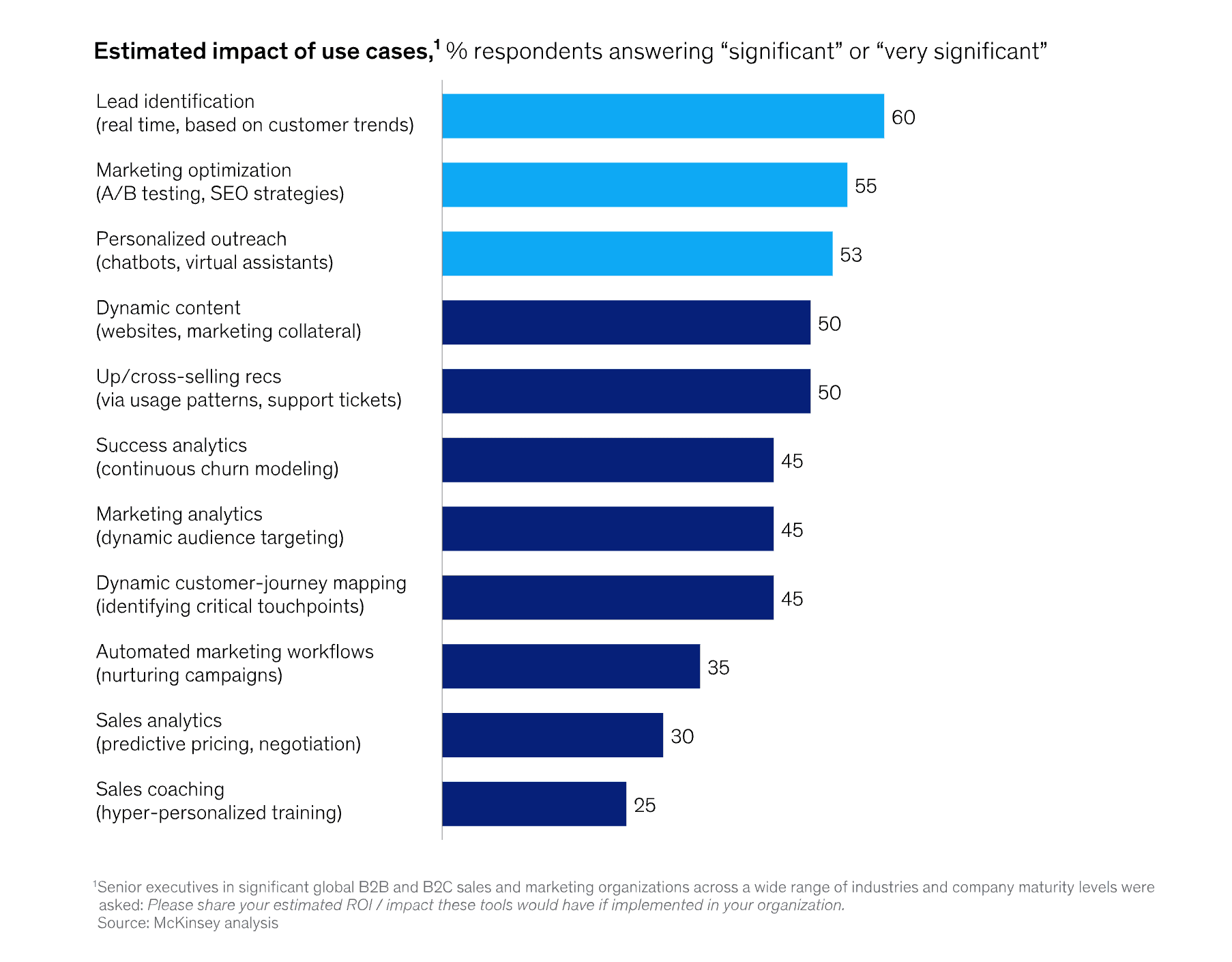
The answer depends on where your team is losing the most time. Thirty-four percent of sales teams that use AI agents deploy them for prospecting (Salesforce). But prospecting is just the entry point. A McKinsey study confirms prospecting came out on top among executives who rated AI's potential impact, but personalized outreach follows closely at 53%.
The applications keep spreading: mapping customer touchpoints, sales analytics, team enablement, and more.
The real gain is more output per rep
The point of AI adoption in B2B sales isn't to fire your sales team but to optimize and scale what your existing salespeople already do without adding to their workload or increasing headcount.
Some teams have already put this approach into practice. Jack Evans, who runs go-to-market (GTM) ops at Duku AI, focuses on maximizing rep outputs: "We've built an AI-first culture at Duku. We ask, ‘How do we get 10 times the outcomes from one person rather than hire ten people?’ That shapes how we approach AI. Not reaching for it for the sake of it, but working backward from the outcomes we want, running experiments, and cutting what doesn't help us achieve those goals."
Eighty-five percent of reps that use AI agents say it helps them focus on high-value work (Salesforce). Sales development representatives (SDRs) reclaim the hours currently going to repetitive, manual tasks and redirect them toward the conversations and decisions that move deals forward.
Nine highest-impact AI use cases in B2B sales
Not long ago, AI use cases in sales were mostly predictions. Fast-forward to the present day. and they're seeing broad implementation and generating measurable results.
1. Prospecting and lead generation
AI prospecting tools identify decision-makers from databases of hundreds of millions of contacts. They enrich records with firmographic and technographic data and add qualified prospects directly to outreach sequences.
Here's what a typical AI-powered prospecting workflow looks like:
Database search: The tool searches across one or multiple contact databases to find accounts and decision-makers that match your ICP criteria.
CRM cross-reference: The system removes existing customers, active opportunities, and contacts already in sequence.
Intent signals: AI agents gather signals that reveal which accounts are showing active buying intent. Signals might include hiring surges, funding events, job postings, and technology changes.
Automatic enrichment: Email, social profile, phone, firmographics, and recent news populate every record without manual input.
Platforms like Artisan handle this entire workflow within a single system. Ava, Artisan's AI BDR, identifies high-fit prospects against your ICP criteria from a database of over 250 million contacts.
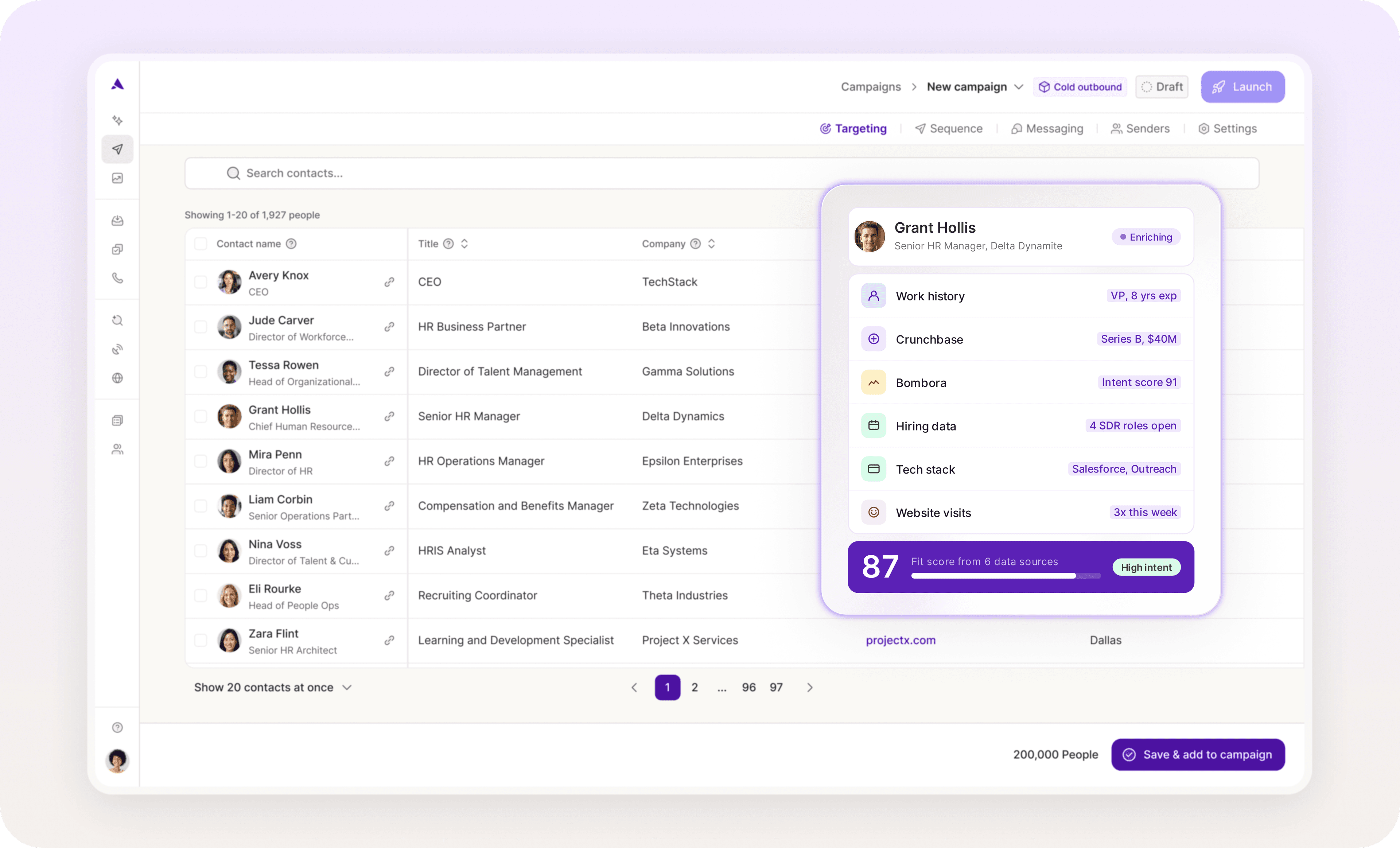
This is especially valuable when your ICP is hard to reach through traditional databases. SumUp, a global fintech serving small merchants across 37 markets, needed to prospect local small and medium-sized businesses (SMBs) that don't show up cleanly in Sales Navigator.
Artisan's local data layer, pulling from Google Maps, Google Reviews, and social accounts, gave the company the targeting coverage their previous provider couldn't. This resulted in over 400,000 personalized emails sent and 8 to 15 positive responses per week from merchants that were previously unreachable.
2. Lead scoring and qualification
While plain prospecting can be done manually (it just takes longer), lead qualification is different. AI-powered scoring uses machine learning models with capabilities no human can replicate. The data that goes into a single scoring model is beyond what any one SDR can realistically factor in.
Here's a snapshot of what a typical lead scoring system processes:
Historical win/loss data: The model trains on your past deals to identify what a likely buyer looks like.
Firmographic fit: Company size, industry, tech stack, and geography are matched against your closed-won profile.
Real-time buying signals: Funding rounds, leadership changes, hiring surges, and content engagement adjust scores dynamically.
Conversion likelihood: All of it combines into a single rank that tells reps which accounts to work first.
You can choose a dedicated enrichment and scoring tool like Madkudu or have qualification run in the background in an all-in-one sales system like Artisan.
3. Personalized outreach across email and social media
AI-powered outreach pulls real context about prospects from across the web and uses it to generate messages that read like a rep did their homework. It does this across hundreds or thousands of prospects, with the right messages firing at the right time across email and social media.
SaaStr, which runs events for SaaS founders and executives, put this to the test. Pre-AI, running personalized outreach to sponsors, partners, and VIP attendees was consuming hundreds of hours, and sending 5,000 truly personalized emails was impossible for the team to do manually.
Here's how SaaStr augmented their outreach with an AI sales agent:
The sales team defined segments across VIPs, past attendees, and target accounts, each with a campaign angle specific to the event or offer.
Artisan’s AI BDR Ava generated and sent emails that read like a seasoned rep wrote them.
AI-powered sequences continued to run without manual management until a prospect replied. The team stepped in when a warm reply was received.
In roughly 6 weeks, SaaStr sent 6,892 emails and achieved a 3.55% positive reply rate, resulting in closed-won revenue from re-engaged leads.
"There's no way we could send 5,000 personalized emails in such a short amount of time," said Amelia Lerutte, general manager and SVP at SaaStr. "Artisan has saved us hundreds of hours."
4. Follow-up and sequence management
AI tools keep follow-up moving without requiring reps to manage it manually. Once a prospect enters a sequence, outreach runs across email and social media. Follow-ups go out on schedule, and sequences pause when a prospect books a meeting or sends a negative response.
Most tools that handle AI-powered personalization also handle sequence execution. Artisan runs consistent multi-channel outreach with as much autonomy as you want to give it, from full autopilot to human approval before each message goes out.
5. CRM updates and workflow cleanup
AI tools that integrate with your email, calendar, and call software log activity automatically, update contact records, and reveal relevant information without the need to log into a CRM.
"One of the biggest time sinks for reps is typically everything around selling: updating the CRM, writing follow-up emails, and prepping for meetings," says Daniel Schemmert, head of growth at Weflow. "We use AI to automate all of that. Examples include automatic CRM updates after calls, AI-generated meeting briefs before the next conversation, follow-up email drafts, and call summaries."
The downstream effect goes beyond freed-up rep time. A pipeline built on clean, consistently updated data means better scoring, more accurate forecasting, and higher win rates.

Automate your outbound with an AI BDR
Meet Ava—your AI BDR who handles prospecting, outreach, and follow-ups, so your team can focus on closing.
6. Sales forecasting and pipeline visibility
AI replaces forecasts based on gut feeling with pattern recognition across historical deal data. The result is a clearer picture of where pipeline is actually heading, not where reps hope it will land
Two types of technology power AI-driven sales forecasting:
Predictive AI works with numbers, scoring deals by close likelihood, based on large amounts of historical data.
Generative AI uses large language models to turn raw data into summaries and answers. Instead of analyzing dashboards, sales organizations ask questions directly: "Which deals are at risk this quarter?", "Why are we losing to Competitor X?", "What are the top objections slowing down enterprise deals?"
Weflow's sales process features a real-world example of the generative layer in practice. "We've unified CRM data, call transcripts, emails, and contacts into one AI layer where we can just ask those questions," says Schemmert. "Instead of digging through Salesforce reports, we now get those answers instantly, which means better GTM decisions at every level."
7. Next-best-action guidance
Beyond providing a picture of lead activity and readiness, some AI sales tools can recommend next steps. They analyze deal stage, prospect engagement, competitive context, and historical outcomes to suggest the most effective move at each point in the sales cycle.
Jack Evans of Duku AI has two automations that make sure his team enters every week with full context and no blind spots: "Every Sunday, an automation scans my diary for the upcoming week, researches the companies and people I'm meeting, and surfaces relevant context like ICP fit, signals, and discovery angles.
“A second automation reviews our CRM, reporting, and dashboards and builds a summary of what's working, what's blocked, and what needs attention. This way we are focused, and nothing falls through the gaps."
8. Sales coaching and call review
AI call reviewers record, transcribe, and analyze every sales conversation. Beyond transcription, you can also use AI tools to query sales calls directly, asking what objections came up most in a quarter or which accounts mentioned a competitor.
Revenue orchestration systems can also score conversations against your sales framework and deliver written feedback to reps.
Weflow's own platform captures and analyzes customer conversations, according to Daniel Schemmert, Head of Growth. "AI scores each recording based on our sales framework (SPICED) and gives our reps written feedback. We also track rep performance (i.e., average call scores) over time. It makes coaching scalable and consistent."
9. Customer experience after the first touch
Dedicated customer support and onboarding tools carry lead context into the post-sale relationship. Pain points from early outreach, objections raised on the demo, and the use case the deal was won on all travel with the account into customer success instead of living in a rep's sent folder.
After the close, AI monitors engagement signals, flags accounts that go quiet, and identifies upsell opportunities based on usage patterns. Customer success teams can then prioritize their activities with the same precision reps use when nurturing and closing leads.
A practical framework for implementing AI in B2B sales
Adding AI without a clear implementation plan is a sure route to more tools and no measurable improvement. A simple, consistent rollout process makes the difference.
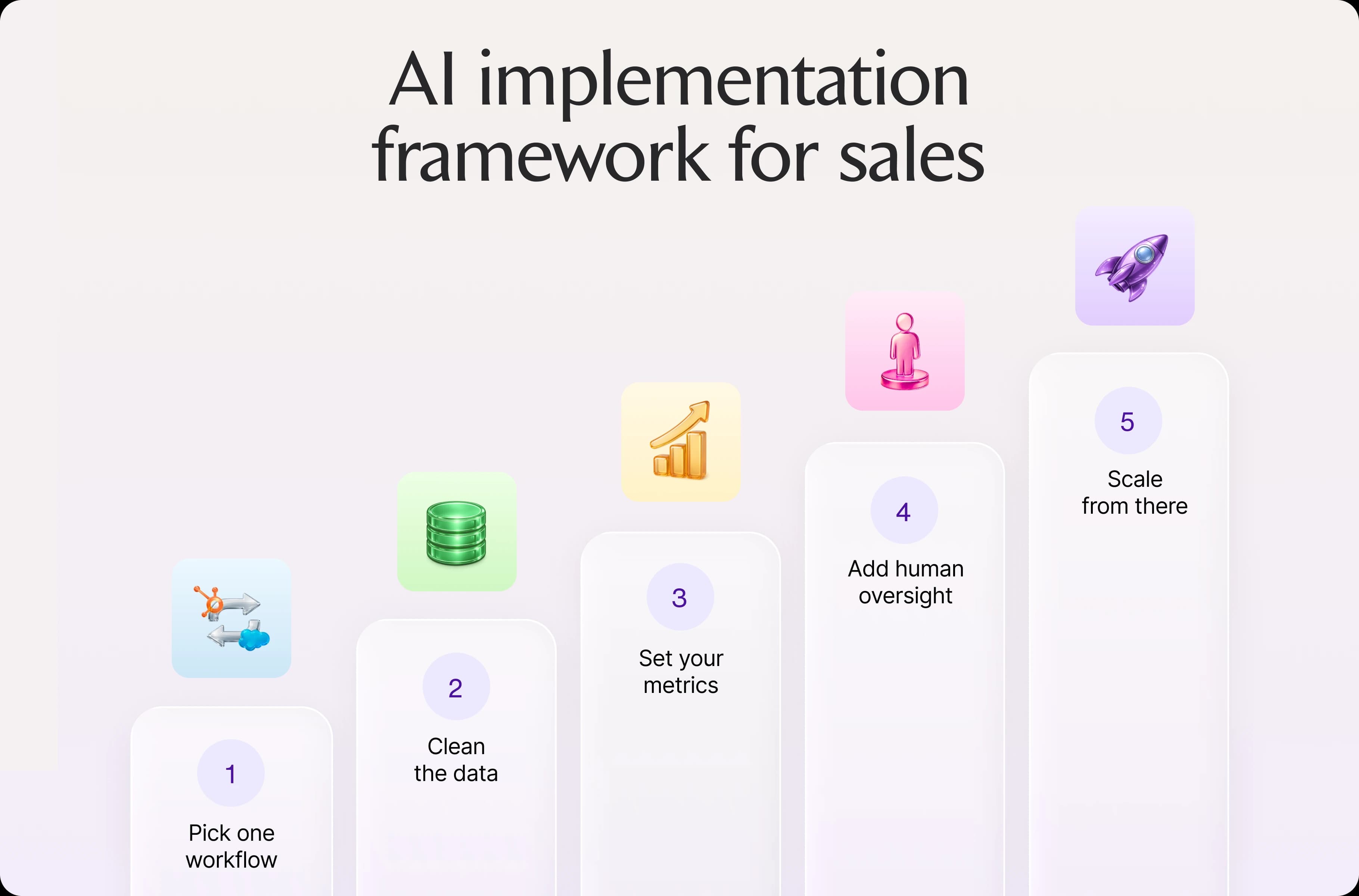
Step 1: Start with one painful workflow
Pick the workflow where manual work costs the most time. Lead generation and outbound outreach are the most common starting points.
One contained use case is easier to implement, easier to measure, and easier to course-correct if something isn't working.
Step 2: Clean the data before adding more functionality
Before layering in new tools, make sure your CRM and enterprise resource planning (ERP) data are connected and reasonably clean. Poor data quality is the single most common reason AI implementations underperform.
Run a CRM audit and take the following steps where needed:
Remove duplicate records.
Update stale contacts.
Standardize field entries.
Align deal stages with reality.
Disconnected or stale customer data is usually what's behind poor AI outputs, and teams often blame a tool when the real problem is what it's working with.
Step 3: Define the success metrics up front
Before your new workflow goes live, set your key performance indicators (KPIs). Clear metrics let you distinguish between real performance gains and the appearance of progress.
Follow these two steps to identify suitable KPIs:
Choose the right metrics for the use case: Pick measures that match what the workflow should change, such as meetings booked, reply rates, conversion rates, forecast accuracy, time saved per rep, and pipeline created.
Record where those metrics stand today: Capture a baseline before the workflow goes live. Without a starting point, there's no way to measure whether your AI-powered workflow works or just adds a new tool to your tech stack.
Step 4: Keep humans in the approval loop
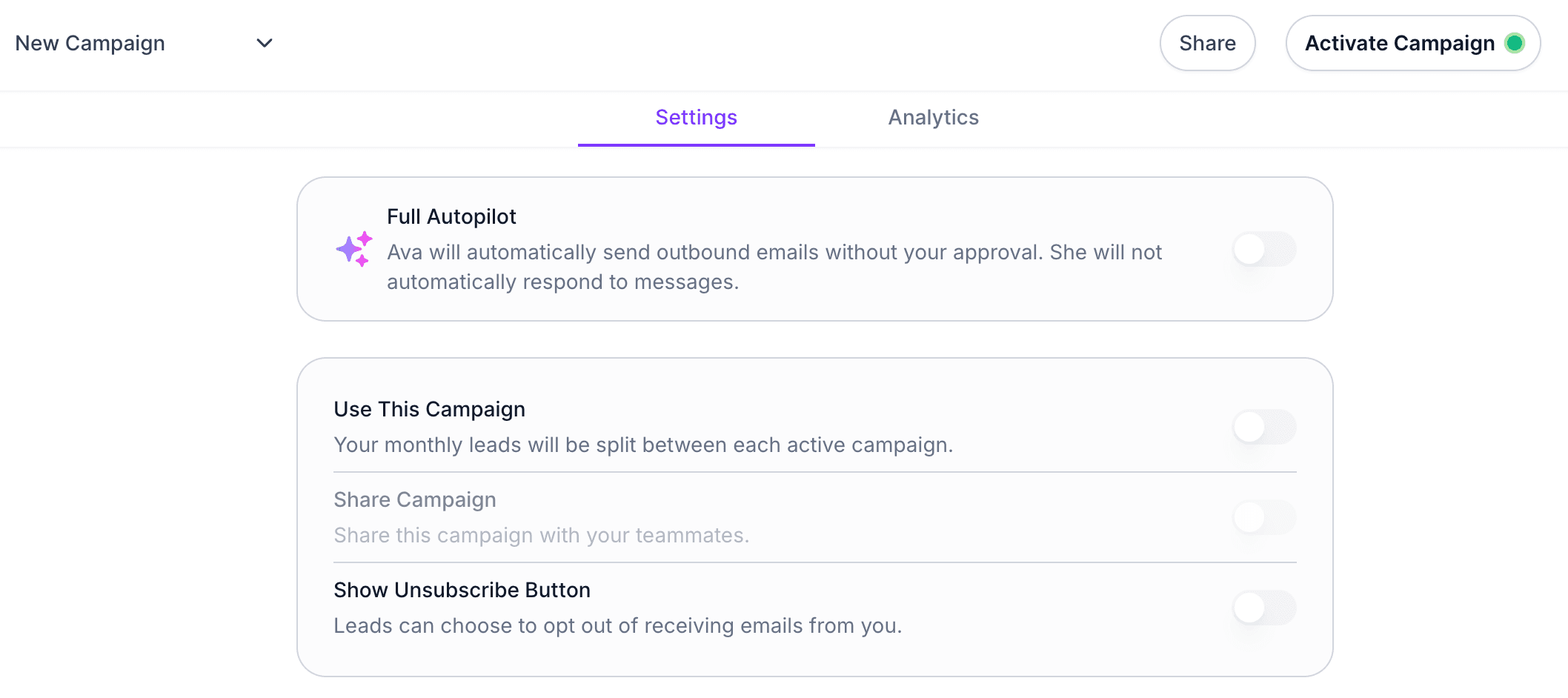
Treat AI as an assistant, and don't let it operate without oversight. Build in a review step where reps check messaging, confirm account fit, and catch edge cases before outreach starts or recommendations are acted on. This is especially important in the early stages, when the model is still learning the nuances of your approach and guardrails.
Ensure your chosen tool supports oversight. Artisan, for example, gives you granular control over ICP setup, your sales playbook, and brand voice instructions, with the option to run Ava on full autopilot or require approval before each message goes out.
Step 5: Expand only after the first workflow works
Once the initial use case is running reliably and hitting its metrics, expand into adjacent workflows. For example, a team that has nailed AI-powered prospecting is well-positioned to add outreach automation next. From there, it can expand into predictive analytics and coaching.
How to choose AI tools for B2B sales
AI capabilities look impressive on shiny websites and during demos. But too many AI sales tools fail to retain revenue beyond initial trials, which says something about the gap between what is sold and what is actually delivered.
Look for execution, not just features
Can the tool run a full workflow without a rep jumping between tools to connect the steps? If the demo involves a lot of "and then you need to go here to do this," this is likely what your team's daily reality will look like.
Check how deeply it fits your tech stack
Map out the integrations your team depends on daily and confirm the platform supports them natively, not through a workaround or a third-party connector that needs its own maintenance.
Forty-two percent of sales representatives are overwhelmed by too many tools. An AI tool that doesn't connect cleanly to your CRM, email, social media, and analytics will just add to the problem.
Judge the data layer before the interface
A product demo demonstrates which features a tool has. But the data layer, used for prospecting and enrichment, determines whether it delivers after implementation.
Ask vendors these specific questions to evaluate the quality of data a tool uses:
What data sources do you pull from?
How frequently are records updated and enriched?
Can I see the enrichment depth on a sample of contacts from my ICP?
Run a test list of 50 accounts you know well and check how complete and accurate the output actually is.
Ask how much manual work still stays with your team
Ask the vendor to walk you through a full workflow, from prospect identification to meeting booked, and count how many steps still require rep input.
Some platforms automate research but hand off to a human for every message. Others require manual CRM updates after every action.
The fewer the handoffs, the more time your team regains.
Where Artisan helps in a modern AI sales stack
Artisan is an AI sales platform that handles the entire outbound sales workflow in a single system. Instead of piecing together separate tools for prospecting, enrichment, outreach, and follow-up, teams can run their full sales motion through one platform.
Ava handles the heavy outbound work
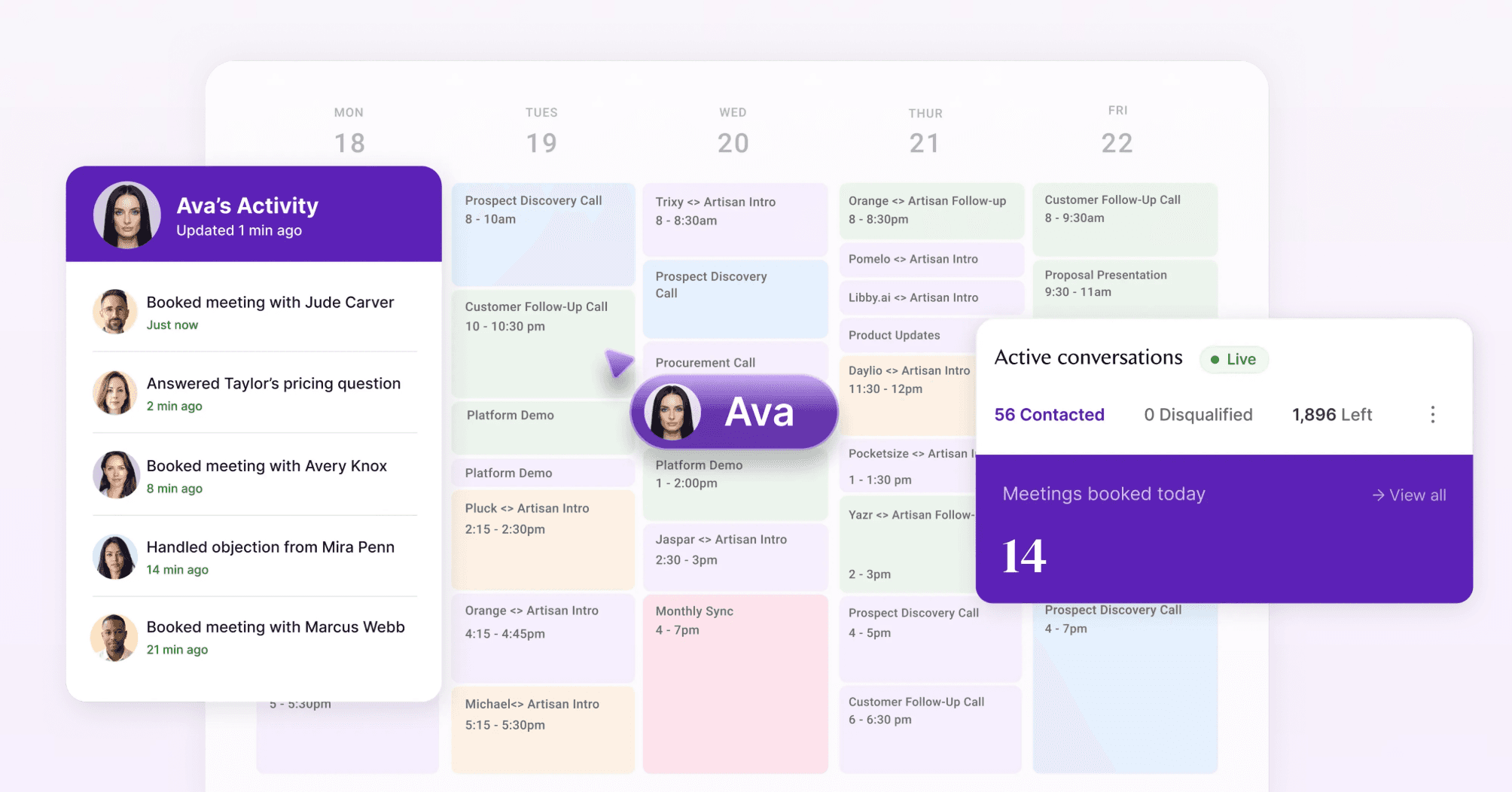
AI BDR Ava, a fully autonomous sales rep around whom the platform is built, identifies high-fit prospects from a database of over 250 million contacts, enriches their profiles, writes personalized outreach based on live signals, and maintains a consistent follow-up cadence. The workflows that typically consume the first half of a rep's day run in the background while reps focus on conversations.

Deliverability is part of performance
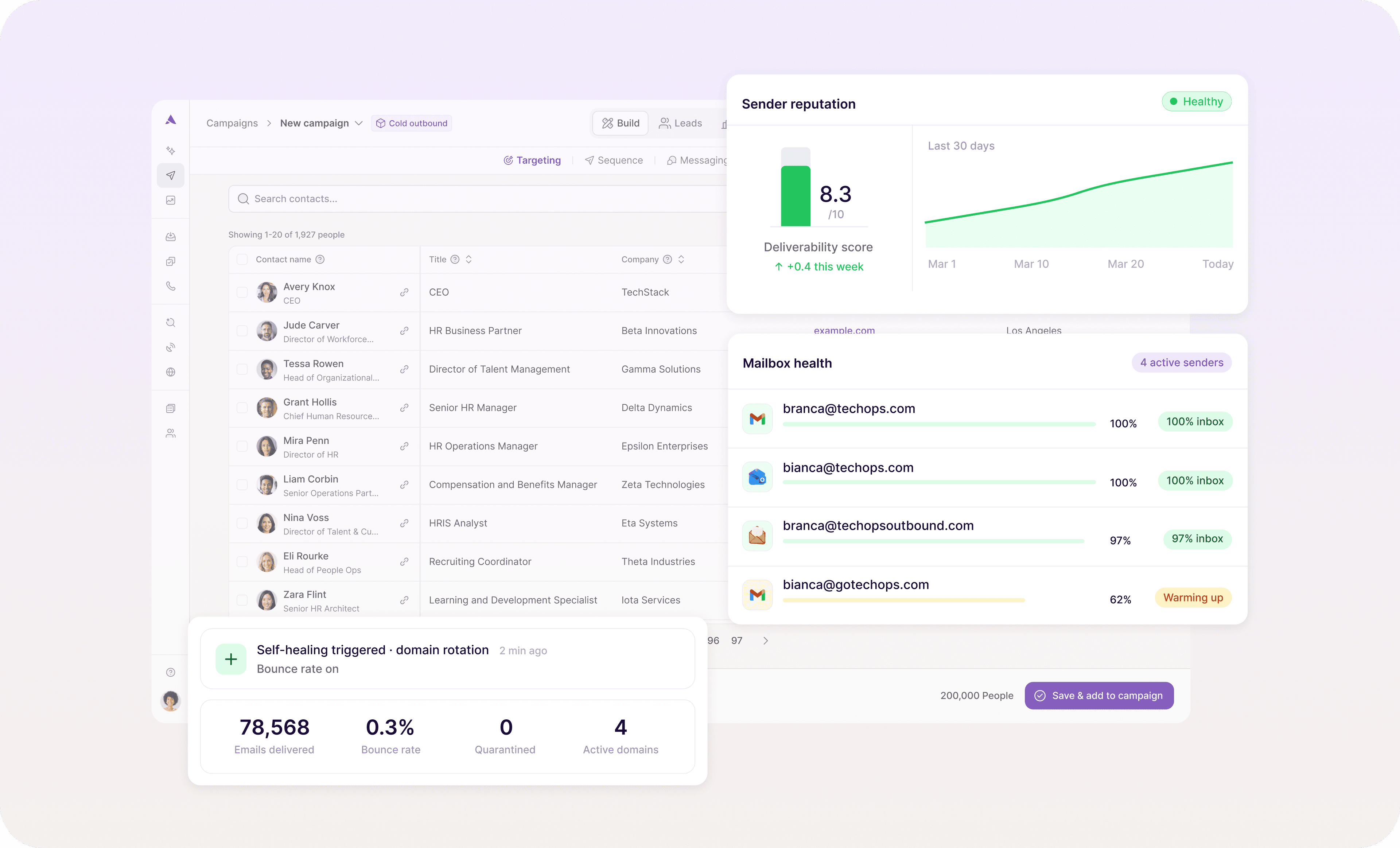
Artisan handles mailbox warmup, sender reputation management, bounce protection, and mailbox health monitoring. As send volume grows, Ava distributes outreach across multiple mailboxes automatically, keeping inbox placement consistent regardless of prospect numbers.
Artisan delivers more pipeline with less manual overhead
After adopting Artisan, Zirtual tripled their positive reply rate compared to their previous tool and contacted over 27,000 new leads in 3 months. "Our positive reply rate is about three times higher than what we saw with Apollo, and we're launching campaigns far faster with less manual work," says Jenn Kussrow, head of growth at Zirtual.
The end of manual sales work as you know it is here
Arguably, the easiest way to streamline your sales strategy is to stop running it manually. And modern AI tools make it easier to do this than ever.
You simply need to start with one workflow, prove the value, and build from there. The manual work doesn't disappear overnight, but it shrinks with every workflow you hand off to AI.
Artisan is built for teams ready to make this shift. AI BDR Ava handles lead generation, enrichment, and outreach, taking the prospecting workload off your reps and allowing them to focus on the conversations that close deals.
Automate your outbound with an AI BDR
Meet Ava—your AI BDR who handles prospecting, outreach, and follow-ups, so your team can focus on closing.

Adelina Karpenkova
SME @ Artisan
Adelina Karpenkova is a writer helping businesses tap into AI's potential and clear up misconceptions. She works with B2B teams on latest industry knowledge.