How to calculate TAM for SaaS and GTM teams
Learn how to calculate TAM using bottom-up, top-down, and value-based methods. Built for SaaS founders and GTM teams planning growth.
Before building a go-to-market (GTM) strategy for a new product launch or business venture, you must understand the full scope of your revenue opportunity.
By calculating total addressable market, or TAM, GTM teams and SaaS founders gain insight into their current market growth potential. This helps them set realistic sales goals, create accurate forecasts, and allocate resources intelligently.
What is total addressable market (TAM)?
TAM refers to the revenue potential for your product or service if you were to achieve 100% market share.
In other words, it represents the theoretical revenue ceiling for your new business, product launch, or market expansion.
The metric assists businesses in many ways. In particular, it helps them secure funding from stakeholders and enables them to develop GTM strategies that are anchored to realistic growth potential.
What you need before you touch a TAM formula
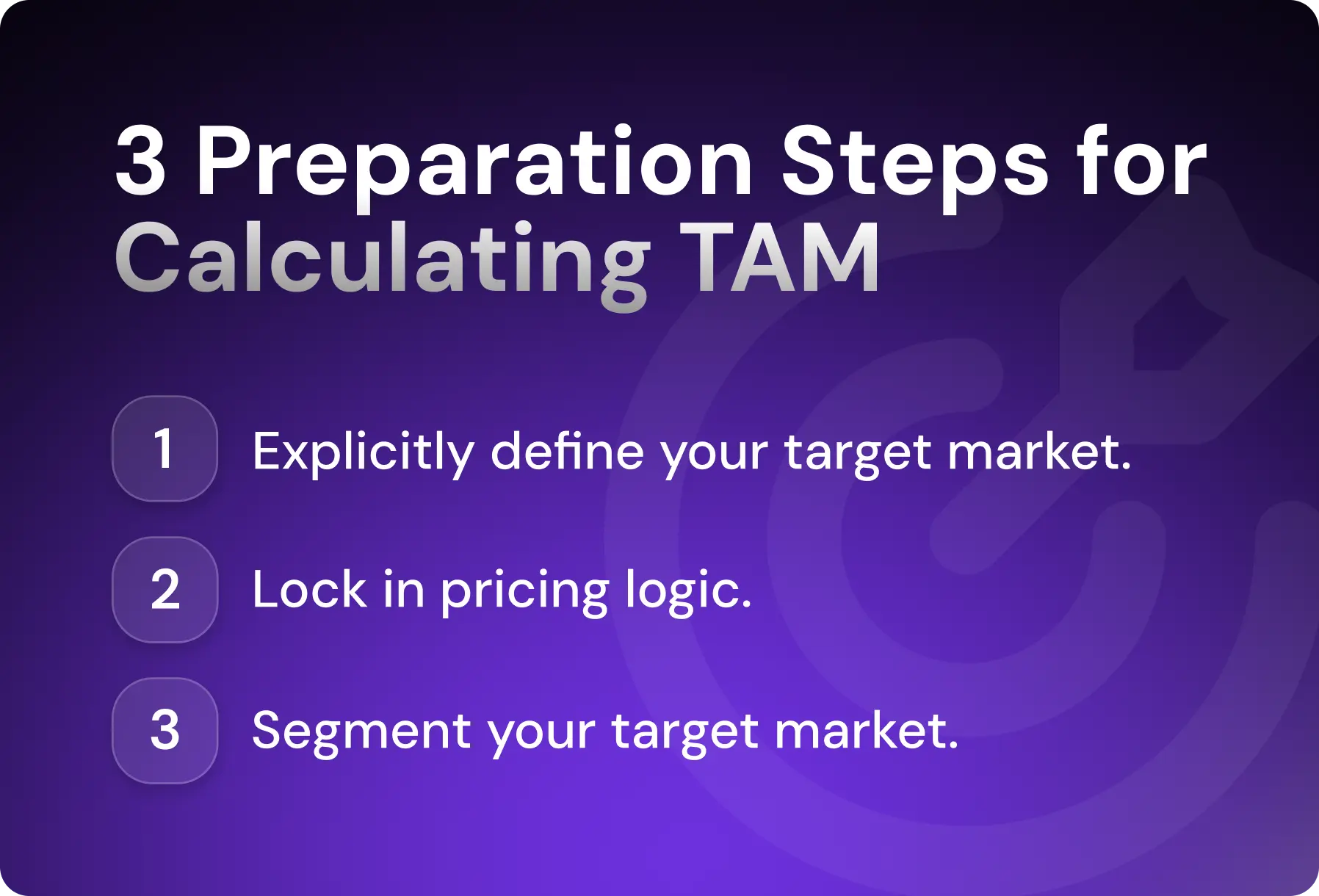
Before you start plugging numbers into a TAM formula, you need to take three preliminary steps to clarify your inputs—define your market, lock in your pricing logic, and segment your audience.
Define the market you are actually selling to
Before you do anything else, you need to get specific about the firmographic criteria of the companies in your target market.
Don’t make the mistake of making your target market “everyone who needs your service or product.”
Why? Because not everyone who needs your solution is a potential buyer. They might, for example, lack the resources to buy it. TAM is for counting the number of potential buyers, not the number of businesses that would like your solution.
Create detailed customer profiles that describe target customers using the following criteria:
Industry
Company size
Geography
Company revenue
Buying context
Lock your pricing logic first
Your TAM is essentially the number of potential buyers multiplied by what they’ll pay on average. So if your average revenue per account (ARPA) or average contract value (ACV) is incorrect, your TAM number will be too.
Make sure that your pricing is a number your target customers will realistically pay, rather than what you would like them to pay. If you inflate pricing due to hopeful thinking, you’ll overestimate your TAM.
Segment before you calculate
While useful for a high-level overview of growth potential, a single blended TAM number also hides opportunity. Different audience segments have different budgets, needs, and adoption rates, so their TAMs vary dramatically.
To more deeply understand the revenue opportunity for different buyer types, segment your audience by size, region, and use case, and calculate individual TAMs. This will help you prioritize your highest-value market segments.
The core TAM formula (and when it works)
Here is the basic formula for calculating your total addressable market:
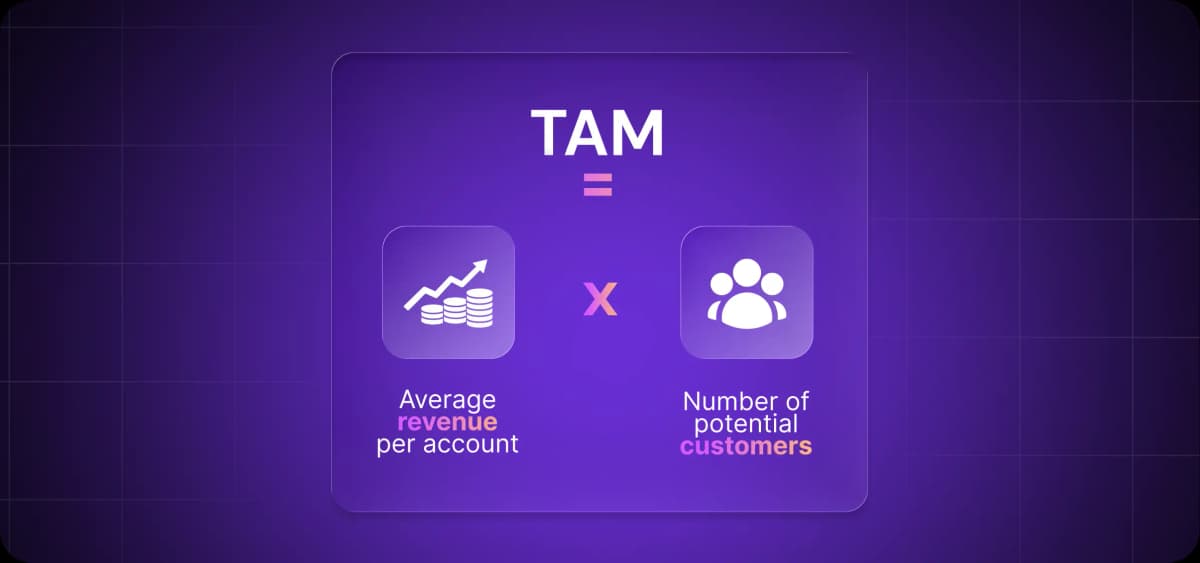
TAM = number of potential customers × average revenue per customer
The formula is most effective when the following criteria are met:
The buyer is well-defined across firmographic criteria.
The price is anchored to real budgets that your target customers pay for similar solutions.
The market is commercialized (services or products are already being sold), and willingness to pay is proven.
The formula can be misleading in the following situations:
You’ve included all businesses that “have X problem” in your potential customer count instead of limiting it to those who are actually experiencing the issue, can afford your services, and have the resources to implement your solution.
Businesses aren’t already spending money to solve the problem your solution handles, rendering your pricing calculation a potential fantasy.
Bottom-up TAM calculation (the method that holds up)
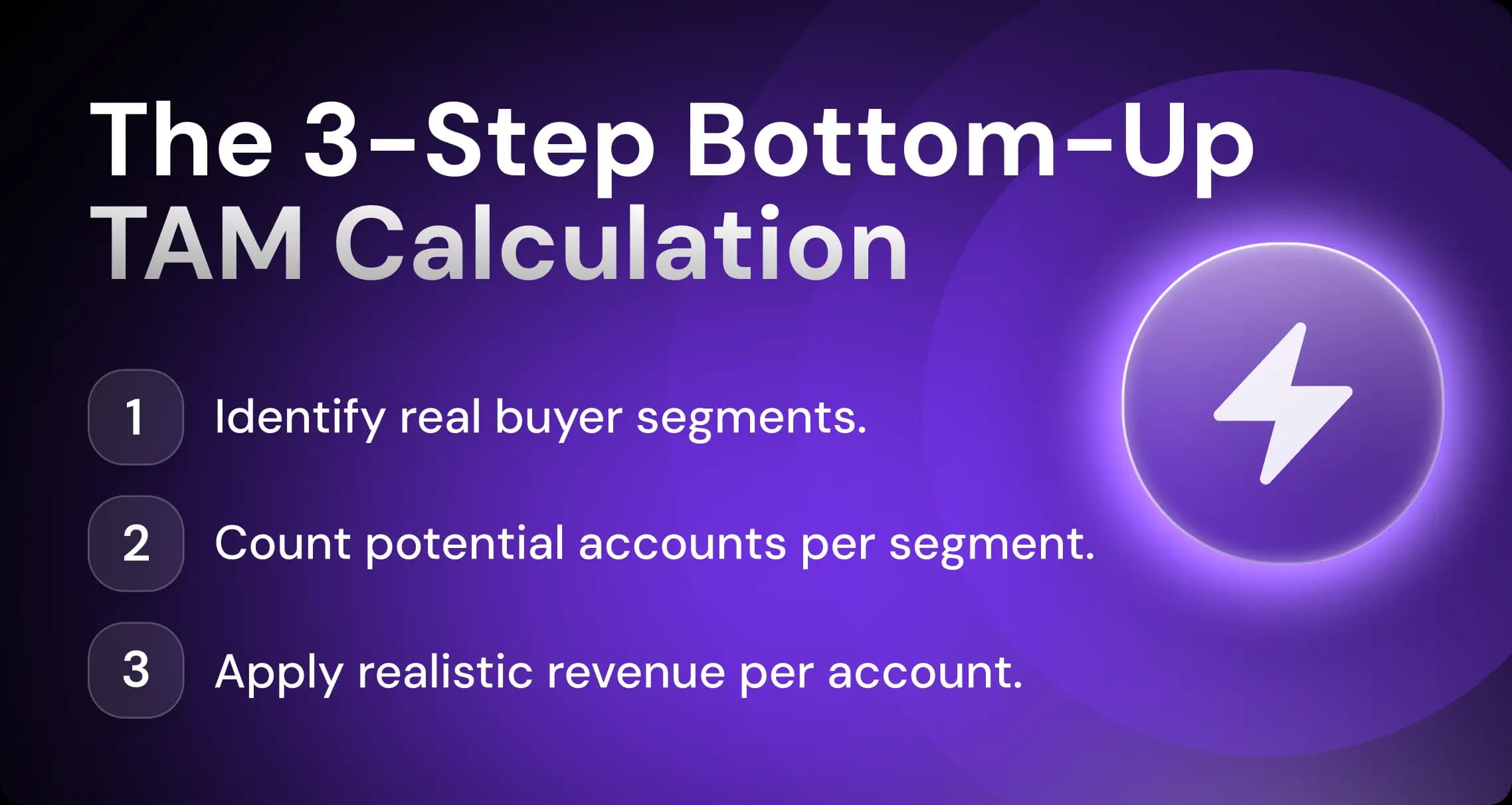
The bottom-up method for calculating TAM, which works “up” from real data about your potential customers, is typically more reliable than the main alternative, the top-down method.
This method takes general market data and narrows it down using criteria specific to your business. You might start with a total industry valuation of $100M, for example, and reduce that number by removing segments—and their corresponding value—that don’t match your target profiles.
Bottom-up analysis usually results in a smaller number. But the diligence and caution built into the approach make the TAM calculation accurate and highly persuasive to stakeholders and investors.
Step one: Identify real buyer segments
Start with existing customers who have already paid you. If you don’t have any paying customers yet, use potential buyers who have shown serious interest through pilots or extended trials.
Once you have a list of real or proxy customers, study their firmographics to find patterns and put together target profiles that will help you identify similar companies. To avoid overgeneralization, be specific about company size, technology use, geography, and industry.
Step two: Count potential accounts per segment
Now that you’ve defined target profiles, use B2B databases and industry association lists to count the number of companies that match their makeup.
Here are three common sources businesses use:
Company databases like ZoomInfo and CrunchBase
Industry reports like Gartner and Forrester
Country-wide industry data from official bodies
Be conservative in your assumptions. An overestimate here could cause you to misjudge the size of the opportunity and, as a result, give it more GTM resources than it warrants.
Step three: Apply Realistic Revenue Per Account
Choose an ACV that reflects what customers will pay in year one (entry plans), not after four years of expansion via cross-sells and upsells.
Using pricing for entry plans will give you a solid, conservative baseline TAM. Using expansion scenario pricing tells you about growth potential, which is valuable in other situations.
Here are the main considerations for landing on the right ACV:
Use median ACV from current customers rather than the mean, which is skewed by outliers.
Consider segment-specific pricing variations (like enterprise vs. small business).
Account for any discounting strategies you’ll be using during your initial market push.
Bottom-up TAM example (SaaS)
Let’s say you run a SaaS proptech (property management) brand and are launching a new product to residential property management companies in NYC.
You’ve identified your target accounts and have found 1,000 companies that fit your various profiles.
To generate an accurate TAM, you’ve divided your profiles into three segments—enterprise brands, mid-market, and small businesses—and assigned an ACV to each segment.
Small businesses: 500 with an ACV of $2,000
Mid-market: 300 with an ACV of $5,000
Enterprise: 200 with ACV of $20,000
To find the total TAM, you calculate the individual value of each segment (ACV × number of businesses) and add them up:
TAM = (500 × 2,000) + (300 × 5,000) + (200 × 20,000) = $6.5 million in revenue potential
There’s one final point to note. The TAM for the enterprise segment is higher at $4 million than the TAM for the mid-market and small business segments combined ($2.5 million). This would make it the highest-priority segment for your GTM strategy.
Top-down TAM calculation (fast, fragile, and sometimes useful)
Top-down TAM calculation is fast since it relies on educated guesses. While the approach can provide you with a helpful estimate, if you use this method, take the TAM with a grain of salt.
How top-down TAM is built
Top-down TAM starts with broad industry data or macroeconomic statistics (like total market size for the SaaS sector). These are typically found in reports by research firms like Gartner or IDC.
To find the portion of the market that is relevant to your specific product or service, you apply percentage filters to the total. For example, if there are 50,000 SMBs in the market, but you expect only 20% to need your tool (based on sub-market breakdown data) and 30% of those to be able to pay for it (based on broad firmographic data), you can use this information to calculate your top-down TAM.
It’s certainly quick to calculate. However, it’s fragile because it relies on third-party data and assumptions instead of ground-up data from real customers.
Where top-down TAM breaks
Top-down TAM tends to break down because it involves a lot of assumption stacking.
For example, a CRM company for hospitals might start with a report saying the total CRM market is worth $30B, assume 20% is relevant to their vertical, and estimate that 10% of that 20% would be paid for the solution, and so on. There are so many opportunities for imprecision, and one incorrect estimate can cause huge swings in the TAM calculation.
TAM is also unreliable for emerging products for which there is no third-party data. The same goes for niche solutions, which broad market reports fail to capture. It’s going to be difficult, for example, to arrive at an accurate top-down TAM for an AI marketing agent if the most relevant market report you can find is one measuring the value of the martech market.
Top-down example with clear caveats
To illustrate the top-down method, let’s imagine you work for a B2B project management software company selling to small and medium-sized marketing agencies in the United States.
You find a high-quality report that says there are 100,000 marketing agencies in the United States. In addition, the report includes data that approximately 60% of these agencies are in the SMB bracket. Of that 60%, you assume that 90% require project management software based on a survey you have commissioned using a small sample of target customers.
Here are your assumptions for narrowing this data down to a realistic TAM:
Small and medium-sized marketing agencies: 60% × 100,000 = 60,000
Agencies that use (or are looking for) project management software: 90% × 60,000 = 54,000
Average subscription price of competitors: $125 per month per company
Annual contract value: $125 × 12 = $1,500
Here’s the final calculation:
TAM calculation = 54,000 companies × $1,500/yr = $81 million TAM
You would likely round this down to $80M and use it as a loose guide to the size of your market, specifying that it is based on a mix of accurate but limited in-house and third-party data.
Value theory TAM (when the market does not exist yet)
Value theory TAM involves estimating the economic value your solution produces for each customer and then multiplying it by the number of potential buyers.
It’s popular among startups and companies creating new markets that lack access to market data.
Estimating willingness to pay
To use the value method, start by estimating what a buyer would be willing to pay for your solution based on the value it offers them.
Anchor willingness to pay to anticipated positive outcomes. For example, if your lead gen software could reliably generate $10,000 worth of new customers for your target users per year, you could reasonably expect them to pay $2,000 per year for your solution. That represents a very healthy ROI of 400%.
Once you have an estimate for how much customers would be willing to pay, multiply it by the number of companies in your target market likely to have a corresponding budget or above.
Value theory example
Let’s say you sell a new type of AI analytics software for healthcare brands. You have predicted that your target customers would be willing to pay $30,000 per year for such a solution.
You have arrived at this number because the analysis software should, in theory, help customers cut their tech stacks by 80%, resulting in $120,000 in annual savings.
If 10,000 companies match your target profiles, then the TAM is $300 million in potential revenue ($30,000 × 10,000).
As an alternative example, imagine that the estimate of cost savings for each customer is closer to $80,000. This could drop the amount customers are willing to pay to $20,000 per year, resulting in a TAM of $200 million. As you can see, slight shifts in perceived value can dramatically alter TAM.
Since this method is so reliant on assumptions about value delivery, it benefits from supporting evidence such as customer interviews, pilot programs, and, eventually, actual sales data.
TAM vs SAM vs SOM (how to use all three without confusion)
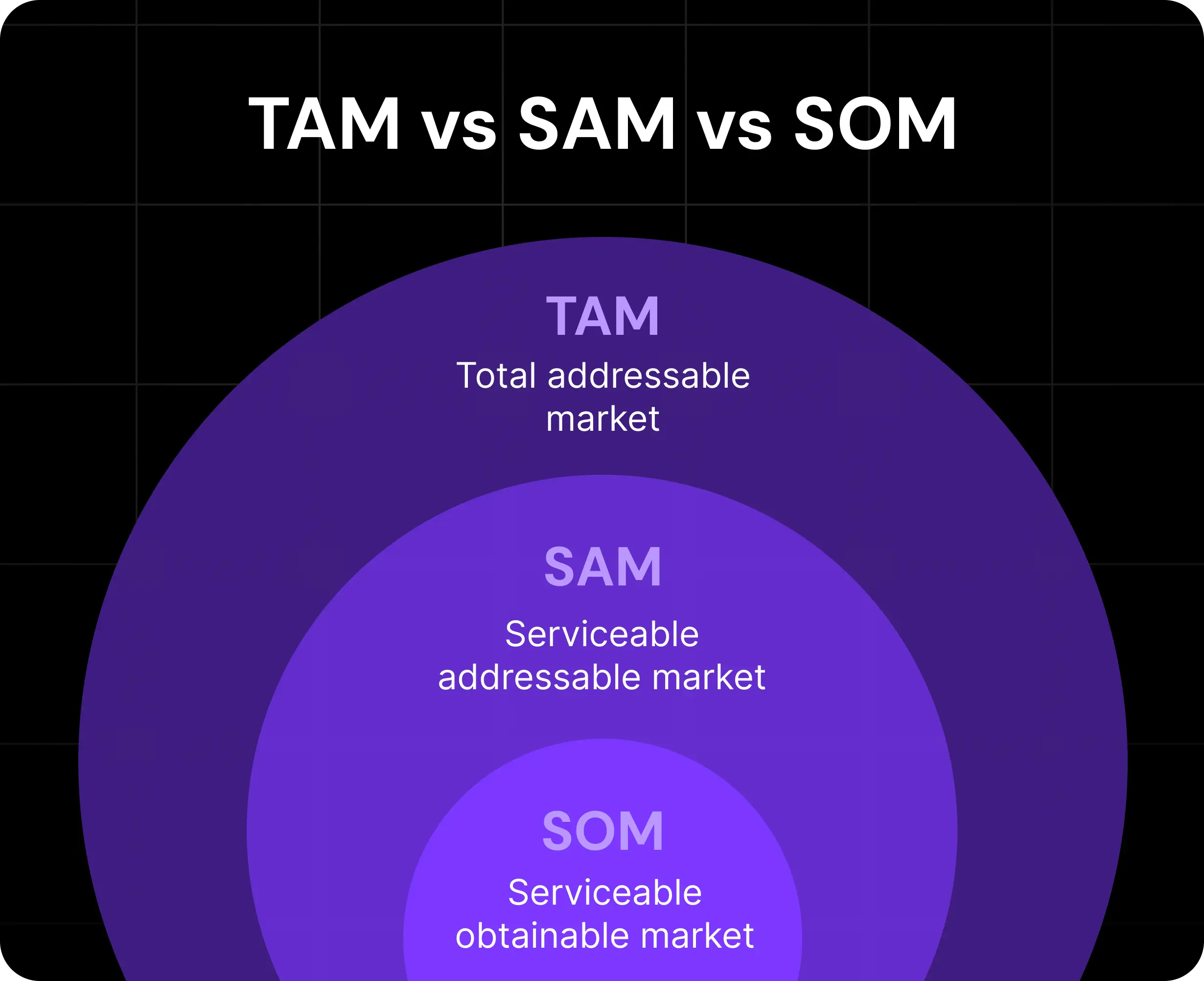
TAM, SAM, and SOM help you set strategic long-, mid-, and short-term GTM goals that represent a multi-layered vision for how you’ll gradually capture your TAM over time.
Turning TAM into SAM
SAM (serviceable addressable market) is the portion of your TAM that you can actually service, based on factors like geographical location, compliance constraints, and distribution channels.
The metric helps teams create more realistic GTM strategies since it takes into account which customers you can reach with your current capabilities.
Turning SAM into SOM
To turn SAM into SOM (serviceable obtainable market), limit your SAM to the companies you can realistically acquire as customers in the near future (often 1–3 years).
That number will be based on sales capacity, competition, and the reach of your marketing. SOM is an excellent guiding light for short-term planning and revenue forecasting.
Why outbound teams should plan back from SOM
Outbound teams should plan back from SOM rather than TAM.
Early-stage GTM success depends on intense focus. Founders and GTM leaders must understand and engage a focused segment of obtainable customers, not spray outreach across their entire potential market.
This approach leads to more targeted lead generation in three major ways:
You build targeted prospecting and email campaign lists of the companies most likely to buy in the near future.
You boost the relevance of your messaging by focusing on specific pain points and objections of these obtainable customers.
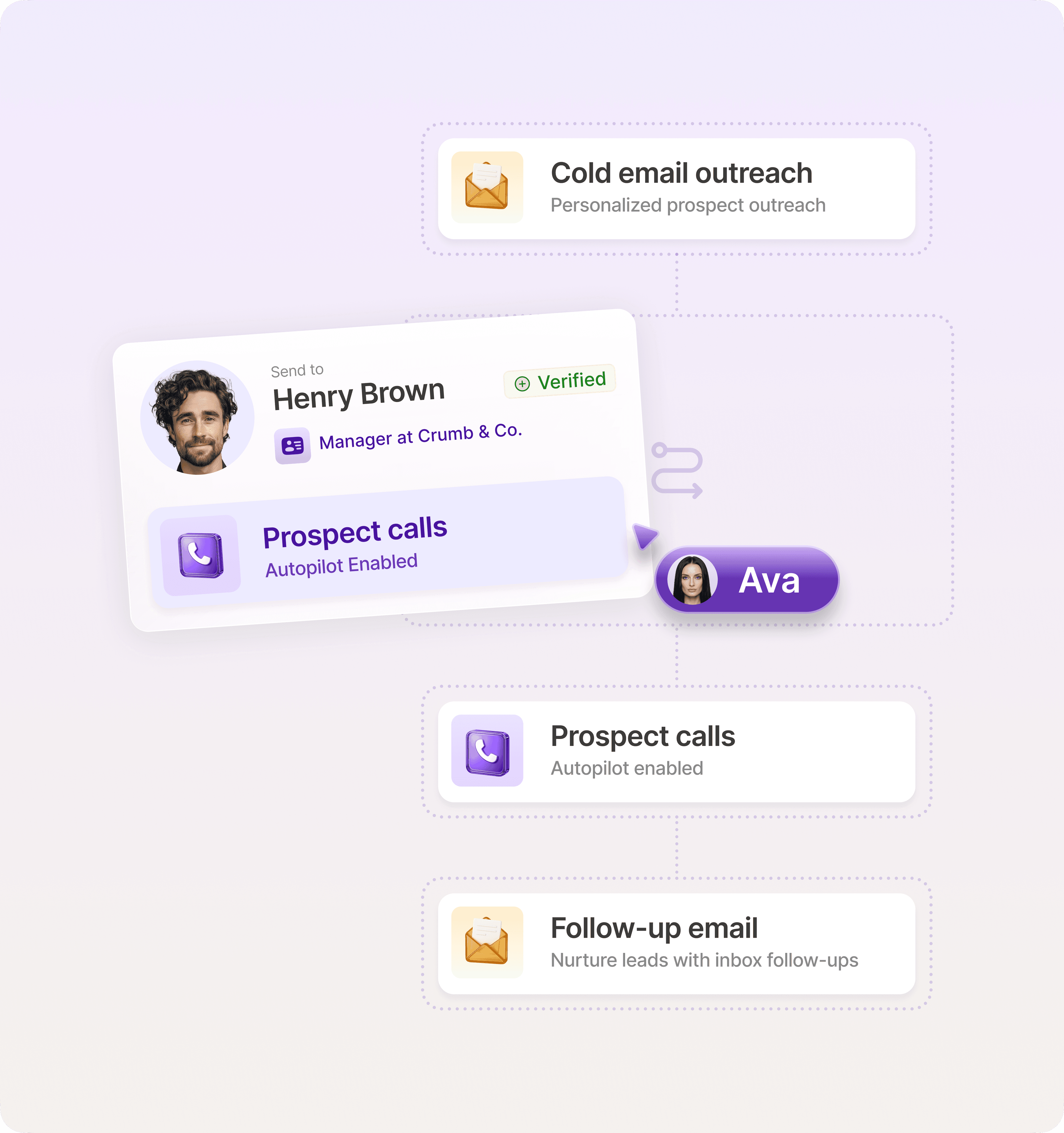
A tool like Artisan helps you do this by working from specific, detailed ICPs. AI BDR Ava uses your ICP to prospect from a database of over 300 million leads and deliver highly personalized outreach sequences—at scale and with a minimum of manual input.
How TAM shapes ICP and outbound strategy
TAM helps SaaS founders and GTM leaders craft a realistic and effective outbound strategy that prioritizes specific ideal customer personas (ICPs). This leads to more efficient lead generation, faster deal cycles, and higher close rates.
Using TAM to refine ICP
Calculating TAM enables you to identify customer segments that offer the highest revenue potential.
While TAM is a broad metric that accounts for your whole market, it requires you to define multiple personas and segments and attribute value to them.
This allows you to focus on engaging these high-value prospects rather than spreading yourself thin across all companies that slightly match your category.
This leads to targeted outbound lists and sharp messaging instead of broad lists and generic call scripts and emails.
Prioritizing accounts inside your TAM
Prioritization isn’t just about value, though that’s important. You also need to account for the likelihood they will progress to a sales meeting and then close.
Tieri account segments inside your TAM based on both revenue (a strong indicator of value) and likelihood of closing. This will help you prioritize your outbound, allocating the most resources to tier one companies, the second-most to tier two, and so on.
For example, you might assign your human outbound SDRs to your tier one accounts and use AI SDR software to reach out to companies in the lower tiers.
Here’s an example of a TAM tiering framework:
Tier 1: Enterprise brands with clear pain points.
Tier 2: Mid-market companies with a strong fit.
Tier 3: Small businesses that need your solution
Tier 4: Enterprise brands with vague pain points
Using TAM in fundraising and strategic planning
Investors look at TAM to understand the potential scale of the business opportunity you’re offering.
They also often use it as a gauge of industry knowledge. After all, a logical and conservative TAM is a sign the founder has a deep understanding of the market and is honest, data-driven, and realistic.
Here’s how to make your TAM credible and persuasive in a pitch deck:
Use a bottom-up approach to calculate TAM—it’s more credible.
Support your TAM with defensible numbers and cited sources.
Lay out your methodology for calculating TAM.
Clearly state any assumptions and data sources you used.
Ensure your pricing makes sense in your market.
Remember that smaller, honest TAMs outperform inflated ones.
Acting on your TAM with outbound (where tools matter)
A TAM calculation is most valuable when you use it to inform your outbound lead generation strategies. The best GTM leaders and founders use TAM data to build segmented account lists and automate personalized outreach.
Turning TAM data into target account lists
You can use your TAM data to create targeted account lists, segmented by firmographic data and buyer intent. This will enable you to create highly personalized sales and marketing outreach with relevant value propositions, messaging, offers, and use cases.
You can speed up the list-building process with a B2B database tool. For example, Artisan uses your ICP data to find leads in its B2B database of over 300M leads. This automated prospecting enables you to build lists for different TAM segments in minutes, not days.

Creating personalized messages at scale
Outbound AI sales automation helps companies reach more leads without sacrificing personalization. Some tools even book sales meetings with qualified leads on autopilot.
This allows for a level of direct, tailored outreach at scale that simply isn’t possible with traditional, variable-based templates.
Artisan, one of the leaders in this new category, is built around an AI BDR named Ava. She discovers leads that fit your ICP and builds and runs multi-channel sequences. She does the work of a full BDR team without the high cost and burn and churn so common in sales roles.

If your TAM is wrong, your strategy is broken
Lying to yourself about your TAM can deeply impact your GTM strategy, leading to wasted organizational resources and marketing campaigns that are misaligned with market opportunities.
On the flip side, an accurate, evidence-based TAM is one of the best foundations of a scalable approach to penetrating your market.
Artisan, an AI-first tool that is powered by an autonomous BDR called Ava, automatically finds ICP-fit, enriched leads, engages them via personalized multichannel sequences, and books meetings for your sales team. All of which means they can focus on the high-value, human work of closing deals.

Automate your outbound with an AI BDR
Meet Ava—your AI BDR who handles prospecting, outreach, and follow-ups, so your team can focus on closing.

Sam Rinko
SME @ Artisan
Sam Rinko is a former SaaS sales rep turned tech writer. He sold real estate software before writing about lead generation, cold calling, and AI sales tools.