Why we put "stop hiring humans" on billboards and what it actually means
The nuance behind Artisan's "Stop Hiring Humans" billboard: a more careful argument about AI, work, and what humans should actually be doing.
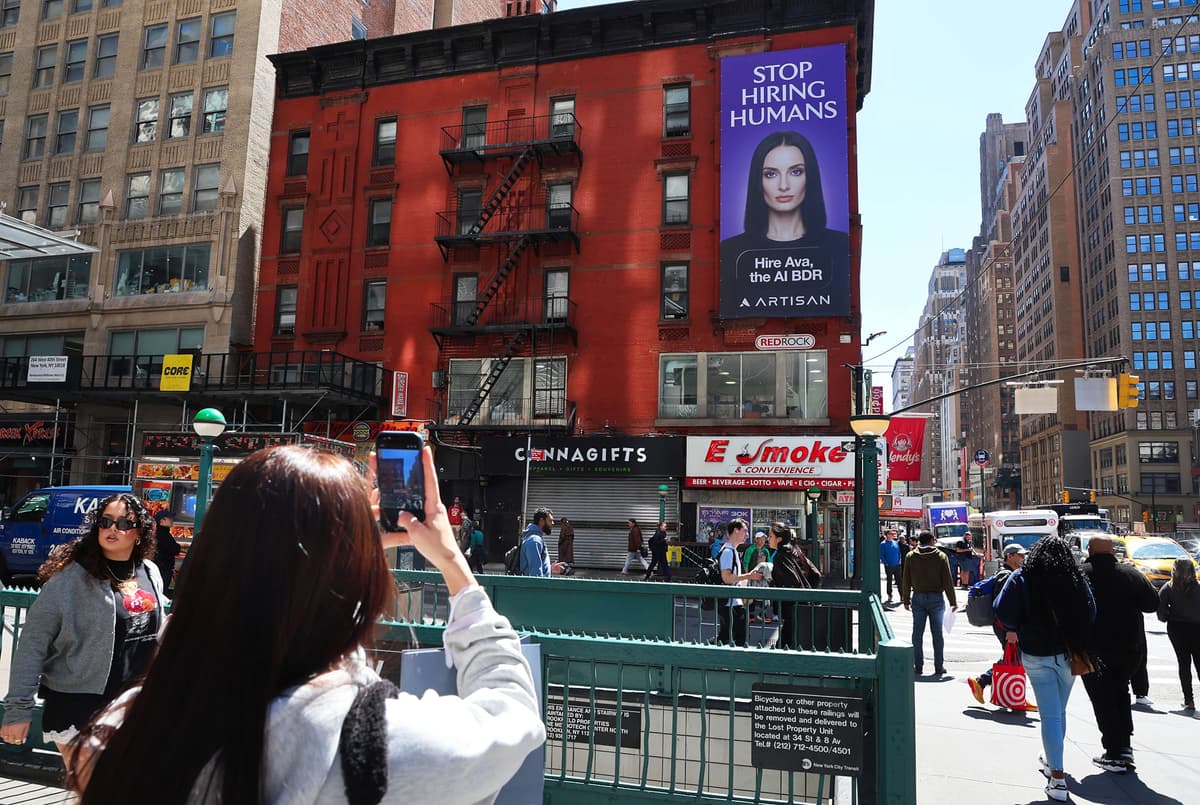
We put "Stop hiring humans" on billboards across San Francisco and New York.
Some people loved it. Some people hated it. I want to write down what I actually believe, because the billboard is three words and the belief underneath is more nuanced than that.
The billboard is about a category of work, not about the people who do it
"Stop hiring humans" isn't a sentence about humans at large, it's a sentence about a category of work.
The category, in our case, is the worst part of cold outbound: the email blasting, the template churn, the list-building tedium. We watched that misery of that work happen for years before we built Ava. Our belief is simple. AI should do the work AI can do better, especially the work that was never good for humans in the first place. Humans should do the work that needs a human.
Cold outbound work, in its current shape, breaks people
Average BDR tenure is somewhere around 14 months. Burnout is the top reason people leave. The job, in its current shape, is to type a slightly tweaked version of the same opening line into a tool eight hundred times a week, send it to strangers, get ignored most of the time, get told no the rest of the time, and chase a quota that goes up every quarter regardless of the result.
We don't automate the whole role. Cold calling still belongs to humans.
This is the part the billboard didn't have room for, and I want to be clear about it.
We don't think the BDR role should be deleted. There are inherently human components to it. A human voice on the phone, listening, adjusting, building a moment of connection with a stranger, is something AI is not good at and probably shouldn't be. We believe that strongly enough that we built a human dialer for our customers' SDR teams. Ava handles the volume work. People pick up the phone.
That's the product philosophy. Software does what software is good at. Humans do what humans are good at. The two work next to each other, in the same product, on the same team.
The on-ramp into sales careers shouldn't disappear, and we built for that
BDR work has historically been the entry-level rung where junior salespeople learn the craft. The worry is that if you thin it out, you hollow the pipeline that produces the next generation of AEs.
But the on-ramp was never the email blasting - that is not what a senior seller does. The on-ramp was the part of the role that built actual selling muscle: cold calling, handling rejection, reading prospects, adjusting in real time, learning to be on the phone with a stranger and earn the next minute of their attention. Those are exactly what the human dialer is for. The work that teaches you to sell stayed. The work that just taught you to grind got absorbed.
The billboard and this essay do different jobs. Running an attention-catching hook is how every campaign that ever made anyone pay attention has worked. This essay is for those who dig deeper and want to understand the nuance behind the tagline.
Ava is built to sit alongside humans, not in place of them
The product the billboard was advertising isn't doing what people assumed. The product manager building Ava is human. The designers and engineers shipping it are human. The customers using it are human. The prospects on the other end of the email, who are now getting more relevant outreach instead of mass-blasted templates, are human. There is no version of this where the humans go away. There is a version where they stop spending their lives on the parts of the job that grind them down.
Our customers' GTM teams grow, not shrink
Every Artisan deployment I've watched has more humans on the GTM team a year in, not fewer. Customers don't fire their BDRs and install Ava. They bring Ava in as a teammate, redirect their sales team to higher-leverage work, expand cold-calling capacity with the human dialer, and grow the team alongside it. AEs spend their hours on discovery calls, deal strategy, and relationship building, the parts of selling that are actually about being a person talking to another person.
The work AI can do better than humans is going to get done by AI. The honest move, for companies building these tools, is to be clear about what's changing and build products that genuinely work alongside people.
We will need real universal income, not survival-level UBI
Not fight-over-scraps UBI. Real income. Enough that nobody has to take a job that breaks them just to make rent. The companies building tools like Ava have a responsibility to advocate for the policy and the social architecture that lets the productivity gains flow back to the people whose work patterns are changing.
I believe in a three or four day work week, when society is ready for it
The right destination for the productivity gains AI is unlocking is more time for people, not more output for companies. A shorter work week, when the supporting structures exist, should be welcomed. Work should take up less of a life. The hours people do work should be spent on things that actually need a person. The tedious, dehumanizing parts of jobs should be quietly absorbed by software. Everyone should have enough.
We're not there yet. The transition between here and there is going to be uneven and politically ugly, and pretending otherwise is its own kind of dishonesty. I don't think the answer is to slow down the technology. I think the answer is to fight, hard, for the policy and the support structures that make the transition livable for the people going through it. That fight is part of the job for anyone building in this space, whether they want it to be or not.
What I want the billboards to be remembered as
The billboard is a provocation. It works because it's uncomfortable. The belief underneath is more careful than three words on a wall, but the three words still mean what they say: stop hiring humans for the work AI can do better, and stop pretending that work was ever good for humans in the first place.
The companies that figure this out earliest will be the ones that build for humans alongside AI, not in place of them. That's what we're building. That's what Ava is, and that's why we built a human dialer alongside her. And on the days I think about what comes after this product, this company, this decade, I think about a world where people work less and live more. That's what I want the billboards to be remembered as a step toward.
Jaspar Carmichael-Jack
Co-Founder & CEO @ Artisan
Jaspar is an entrepreneur with expertise in sales, marketing, and operations. He founded Artisan in 2023, a company automating workflows with AI employees.