Build a winning B2B marketing strategy framework
Learn how to build a revenue-focused B2B marketing strategy framework. Align ICPs, channels, and ABM to drive high-value leads and conversions.
Gone are the days of linear TOFU-BOFU frameworks. The buyer journey is messy.
B2B buyers now gather information from LLMs, communities, blogs, webinars, search, and other digital marketing touchpoints. In addition, they’ve become increasingly skeptical and allergic to AI slop.
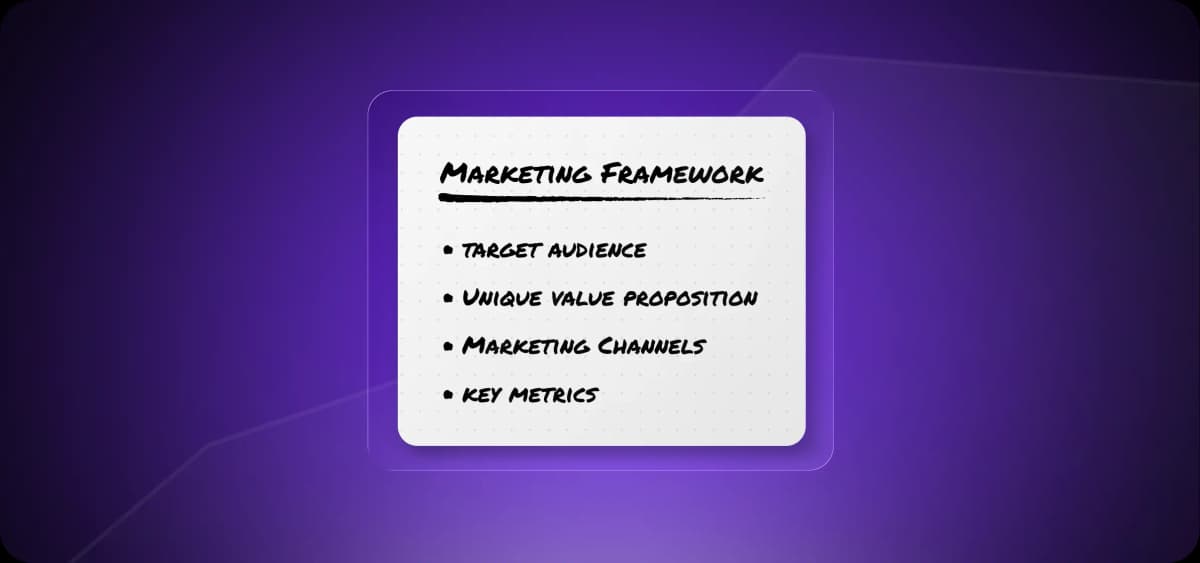
Marketers need to revisit and update their old playbooks to prioritize omnichannel targeting, high-quality tracking, precise buyer personas, and a revenue-oriented mindset.
Start with revenue, not reach
Marketing exists, first and foremost, to generate a pipeline that closes.
This means marketing strategies should be evaluated by their ability to move leads forward, support sales cycles, and generate high-value opportunities that convert into revenue.
Everything else is noise.
Align strategy to business goals
Revenue-focused marketing strategies take shape long before the first campaign is planned. In practice, this means teams need shared clarity on the commercial expectations that define success.
Marketing goals tend to be defined in the following ways:
Pipeline targets by segment and region
Required deal size to sustain growth
Feasible sales cycle length (in the context of the financial model of the business)
Customer acquisition cost
A team targeting $50K annual contract value (ACV) deals with a six-month sales cycle will build a very different marketing strategy than one selling $8K contracts with a 30-day close window.
Once the foundation is set, you’ll go downstream with the marketing plan to map out channels, tactics, and messaging.
The endeavor is worth every penny, according to McKinsey’s B2B Pulse Survey, which shows that winning B2B teams are significantly more likely to align marketing KPIs with pipeline creation, deal progression, and customer acquisition economics rather than channel-level performance.
Likewise, in The 2026 State of Marketing Report, HubSpot revealed that revenue-linked outcomes dominate marketing priorities for the new year.
Focus on qualified leads, not clicks
The next foundational step of building a B2B marketing framework is to agree on a definition of “qualified leads.”
This alignment is crucial for B2B sales and marketing teams. It allows everybody to work with the same purpose and under the same KPIs. It also avoids the common scenario in which sales teams spend more time disqualifying leads than advancing deals.
Revenue-focused teams define a “good lead” by the following criteria:
ICP fit in size, industry, region, and tech stack
Active buying intent, such as pricing views, demo requests, case study consumption, and webinar participation
Number of engaged stakeholders, indicating internal interest
A modern framework acknowledges that buyers self-educate in depth. Surface-level engagement no longer correlates with readiness among potential customers or real decision-makers.
Nail down your target audience and ICP
If your ICP is vague, your strategy will be too. It’s that simple. Modern B2B marketing is about delivering hyper-personalized, omnichannel experiences to fewer accounts with higher value.
Create a precise ideal customer profile (ICP)
Build your ICP from closed-won deals from the last 6–12 months. Ignore leads, impressions, and historical wins from three years ago. Markets, budgets, and buying behavior have shifted too much for those to be reliable.
Outline the following criteria for your ICP:
Firmographics: Size, industry, region, and growth stage
Technographics: CRM, data stack, and outbound maturity
Sales-qualified attributes: Buying power, sales cycle length, champion presence, budget patterns, and buying committee size
Here’s an example of a detailed ICP:
Series B–C fintech SaaS companies with 200–800 employees based in Western Europe.
The company runs a structured go-to-market motion and uses a modern revenue tech stack (CRM, enrichment, and sales engagement tools).
Sales and RevOps functions are established and resourced.
Build buyer personas that reflect reality
Personas are the living input into your marketing strategy. They change as markets shift and help you keep your fingers on the pulse and always speak directly to your buyers.
Build personas on the following three inputs:
Sales call feedback: Patterns from discovery calls, late-stage objections, and real pain points
Data about existing customers: Profiles of key decision makers and the firmographics of the companies they represent
Closed-won and closed-lost analysis: Details about which types of companies consistently convert, stall, or churn (revealing which segments truly fit)
These inputs should continuously refine how personas are used in messaging, offers, marketing channels, and campaign structure.
Map the buyer’s journey (without pretending it’s linear)
Modern B2B buyers don’t move in funnels—they circle problems. From Reddit to Perplexity to your pricing page, from ChatGPT to Quora to LinkedIn. This is what the buyer’s journey can look like nowadays.
Map buying jobs, not just TOFU to BOFU
Unpredictable at first glance, the buyer journey shifted away from the linear TOFU to BOFU model to optimization for buying tasks—the things a company has to do internally before they can buy something.
You should develop the buyer journey around four stages:
Problem identification: Buyers align internally on whether a problem is worth solving now.
Solution comparison: Teams explore categories, approaches, and vendors in parallel, often without formal vendor engagement.
Requirements building: Stakeholders translate intent into internal criteria, security checks, budget thresholds, and success metrics.
Vendor validation and decision-making: Shortlisted options go through demos, references, pilots, and internal approval loops.
Instead of optimizing for funnel stages, teams have to answer the most important question of all: “What has to be settled in the buyer’s mind and organization before the deal can progress?”
Stalled deals are valuable sources of information for improving this stage. Look at them and ask, “Which buying job didn’t get completed?” The answer can be as simple as a lack of visibility in third-party comparisons or failure to engage all decision makers during the demo stage.
Define buyer intent across the journey
Once you understand what buyers need to figure out, the next question becomes when to act.
Buyer intent answers that question. It tells you whether someone is actively moving a deal forward or simply gathering context.
In practice, intent shows up in two ways.
External behavioral intent reflects how buyers are interacting with non-owned media across your broader ecosystem. Examples include visiting G2 or Capterra pages for your competitors, third-party review engagement, and engaging with LinkedIn posts outside your company.
Internal behavioral intent shows what buyers are doing on your owned properties. This includes visits to pricing pages, repeated demo views, and time spent on comparison content. These behaviors indicate active evaluation and that at least one buying job is close to completion.
When buyer intent is mapped to buying jobs, teams can act with precision. For instance, if a company is reading comparison pages and visiting pricing pages, it usually means they’re close to choosing a solution—that’s a good moment for outbound.
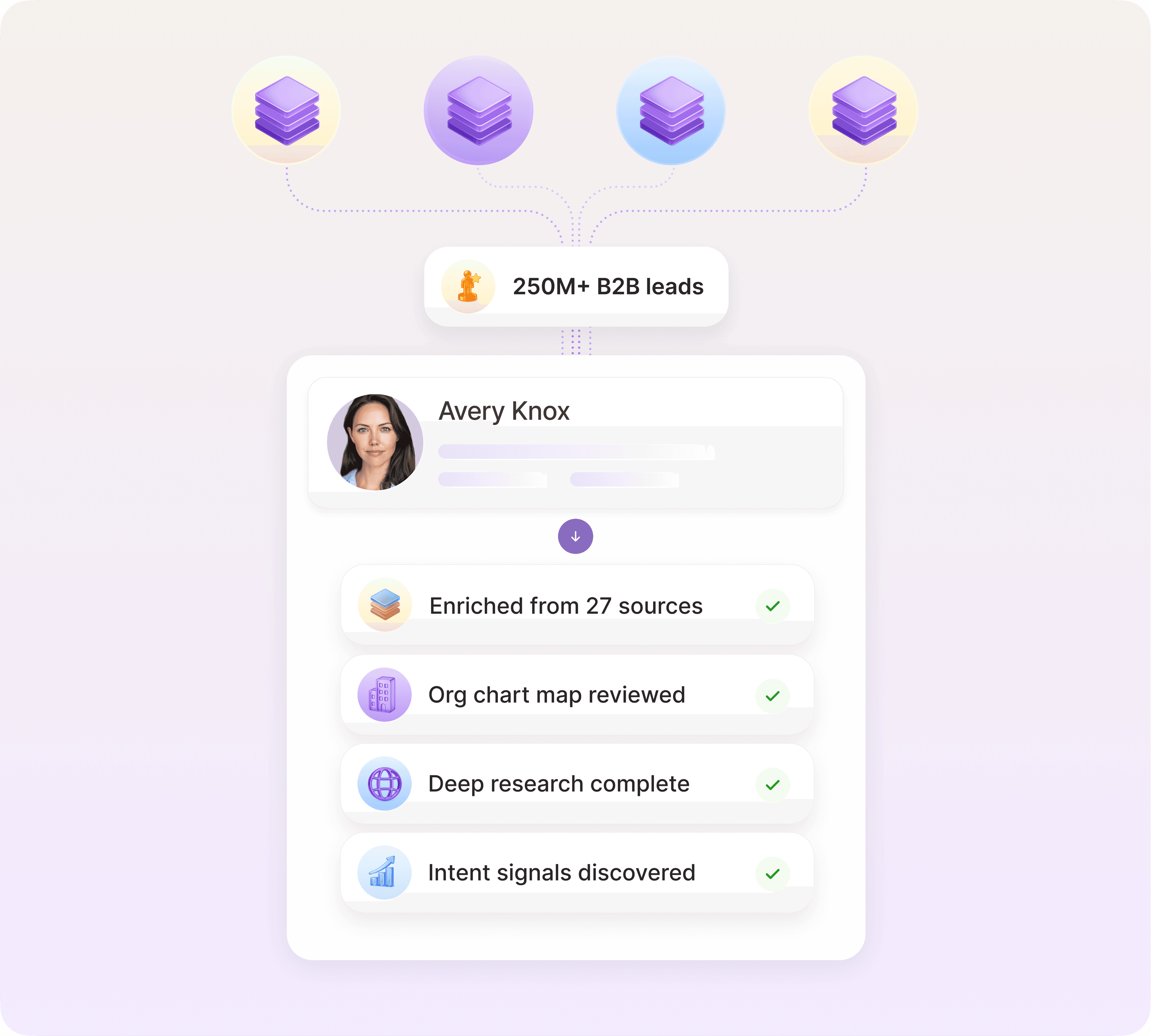
Ava, Artisan’s AI BDR, scours the web to collect social media updates, hiring news, and press releases. She then triggers outbound sequences the moment intent is detected. She also enriches lead profiles with this fresh B2B data so your reps have full context when they reach out to leads.
Build your messaging and value prop engine
How well you articulate your value prop defines the success of your marketing efforts. Get it right and you’ll see a measurable uplift in the number of leads that engage with your sales materials.
Craft value propositions that convert
Start by creating a single source of truth for messaging. One doc. One owner. No variants floating in decks or sales emails. Use Notion or Google Docs as your knowledge base.
When writing value props—which will form the basis of your messaging doc—use a simple structure that forces clarity:
We help [role] solve [specific pain] so they can achieve [measurable outcome].
Keep messaging consistent across channels
Inconsistent messaging is one of the fastest ways to break trust. Ads, landing pages, email marketing, and sales outreach must reinforce the same narrative.
Keep in mind, however, that this doesn’t mean copying the same text everywhere. It means that the problem framing or value prop stays the same across all materials.
Design offers that make “yes” easier
Strong offers contribute to success as much as messaging. They reduce perceived risk and internal friction.
All of the following offers make a “yes” more likely:
Pilot programs that limit scope and commitment
Time-to-value guarantees tied to concrete milestones
Security and procurement details that unblock late-stage reviews
ROI calculators grounded in the buyer’s own data
Clear pricing logic, even when exact pricing isn’t public
Revisit your offers every quarter, or sooner if your pipeline doesn’t move. Track which offers accelerate or delay deals and feed that data back into offer design.
Build the framework that ties it all together
At this point, you should know who you’re targeting, what you’re saying, and why it should convert. This section is about how you deliver your offers.
Select your channels intentionally
Despite the growing omnichannel trend in B2B, more channels don’t create more revenue. Rather, they create coordination debt.
Data from HubSpot confirms it: 52% of marketing teams now operate across five to eight channels, and 17% use more than eight. As a result, they struggle to connect activity to outcomes.
The fix is to start with no more than two key channels per sales stage. Favor channels that allow fast iteration and a clear signal. For example, LinkedIn and targeted content distribution via email are excellent channels for awareness and early problem framing. Outbound is preferable in most cases for active evaluation.
Create one repeatable campaign flow
Start with one campaign flow and make it work before scaling. Guide the buyer through small, logical steps that match how they decide.
Here’s a simple flow you can use as a template:
Define the target accounts. Start with a fixed list of companies that match your ICP.
Launch outbound. Send a short, problem-focused message to surface a relevant pain, not to sell the product. No links to demos yet.
If the prospect shows interest (clicks, replies, or checks your site), contact them asking if they’d like to learn more.
Book an early-stage sales conversation to qualify the opportunity.
Show a full demo only after you’re aligned and have clarity about who is involved in the buying process.
Automate outreach, follow-up, and lead tracking
Marketing automation saves reps' time and ensures a smooth campaign flow. Use automation to ensure follow-up happens on time, capture engagement data, and prevent leads from falling through cracks.
A tool like Artisan can save you hours. Ava, Artisan’s AI BDR, automates outbound execution while syncing engagement data directly into the CRM, so marketing and sales learn from the same signals.

Measure what matters
Measurement exists to support decisions. Prioritize the metrics that directly explain whether marketing is helping revenue move. These are the most important measures of campaign success (or lack thereof).
Prioritize the following metrics:
Pipeline generated: Total value of opportunities created by marketing
Pipeline velocity: Speed at which deals progress through the funnel
Customer acquisition cost: Average cost to win a new customer
Customer acquisition cost (CAC) payback period: Time needed to recover acquisition spend
Marketing-sourced revenue: Revenue from deals started by marketing
MQL-to-SQL conversion rate: Share of leads accepted by sales
Lead to opportunity rate: Portion of leads that become viable deals
Opportunity win rate: Percentage of opportunities that close successfully
Sales cycle length: Average time from first touch to closed deal
Overall ROI: Overall return on marketing spend per campaign
Account-based marketing (ABM): Go deeper, not broader
According to HubSpot, 91% of marketers said personalization improves engagement. Account-based marketing puts personalization front and center, and the likelihood is that it warrants a place in your broader marketing strategy. The key is in knowing which accounts to target.
Identify and prioritize high-value accounts
Identify top-fit accounts using internal data and simple intent signals. Use ICP filters, lead and account scoring, and intent signals to pinpoint these high-value accounts.
Here’s a practical example of what this looks like in practice:
Analyze the last 6 months of closed-won opportunities and isolate accounts that (1) closed in under 90 days, (2) engaged on more than one channel within 30 days, and (3) increased spending within 6 months.
Add shared firmographic traits to your ICP, such as "200–800 employees, Series B–C funding, and HubSpot Enterprise in place."
Analyze whether accounts exhibited explicit buying signals. For example, multiple visits to pricing or comparison pages from the same company domain or category research activity via Bombora or G2.
Categorize accounts into three tiers based on ICP match and intent. An account that matches the ICP and shows multi-stakeholder intent moves to tier one ABM. An account that matches ICP but shows no intent stays in nurture.
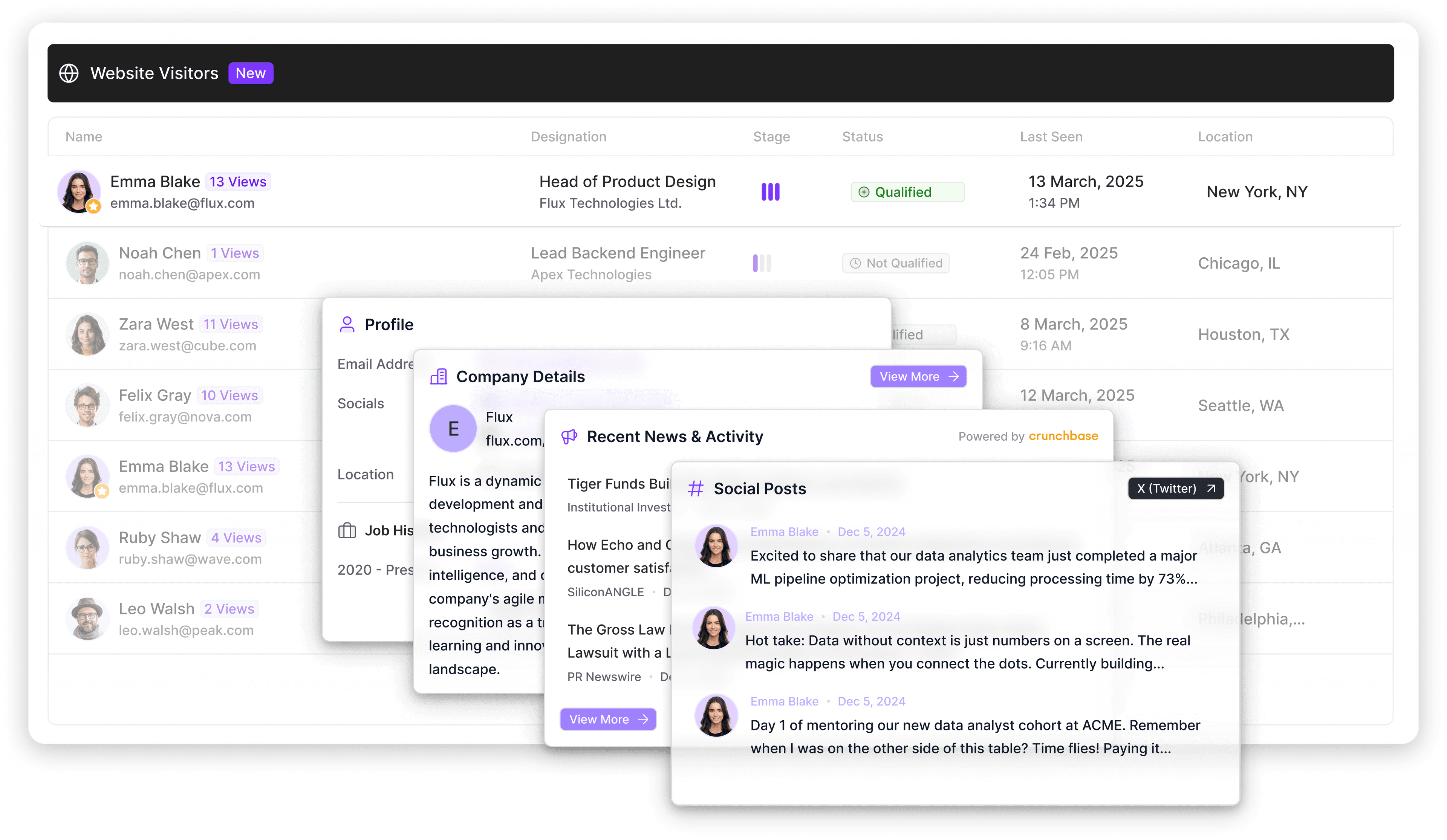
Many sales platforms automate the process of prioritizing accounts for ABM. Artisan, for example, uses the very latest AI technology to track anonymous website visitors, identify high-value accounts, and send deeply personalized outreach—all with your reps barely lifting a finger.
Customize campaigns by account stage
Account-based marketing only works when campaigns are built around specific stages of the customer journey and the buying temperature of the target account.
Here’s how to target leads at different stages of the consideration and intent:
Problem identification: Outreach and ads that discuss pain points and gently position your product as a potential solution work well here. It’s normal to push for an early-stage, exploratory meeting in direct outreach.
Solution comparison: If you’re in contact with a decision maker, persona-specific case studies and clear positioning against alternatives are very useful. If you don’t have an open line of communication, outreach and ads can be more aggressive at this stage.
Internal requirement checks: This is the stage at which you need to think about the technical stakeholders involved in the buying process. Security and compliance documentation, implementation timelines, and targeted emails addressing stakeholder-specific concerns.
Vendor validation: At the stage of vendor validation, you should already be having an ongoing conversation with a decision maker at a target account. Customer references, free trials and pilots, and proof-of-value offers can all push interested buyers over the line.
Get sales and marketing in the same room
Shared accountability is how you ensure revenue outcomes. Metrics, campaign workflows, and tracking should be consistent across both departments, with regular shared reviews to maintain alignment.
Shared metrics, shared cadences
Shared definitions and metrics are the basis for alignment. They create a clear context for handing over leads and measuring performance in a way that doesn’t lead to blame when targets aren’t met.
Sales and marketing teams should align on the following as a priority:
Lead scoring criteria for MQLs and SQLs
Marketing to sales handoff process
Pipeline and nurturing stage ownership
Follow-up timelines based on lead priority
Feedback channels and reporting (for example, if sales needs to report that MQLs are underqualified)
It’s also a good idea to run weekly joint pipeline reviews to diagnose issues and confirm both teams are on course. Marketing brings visibility into campaign intent, account signals, and message performance. Sales reports on objections and deal progress. In addition, both teams identify where leads drop off and develop a fix.
Make the review produce a short shared action list: the handoff that failed, its supporting evidence, the owner and the next checkpoint. Maintaining that list between meetings is a useful assignment to evaluate with an AI employee such as Artie. Keep the team's existing definitions and reporting systems authoritative so follow-through does not create a competing version of the numbers.
When marketing sells and sales markets
In effective teams, the boundary between sales and marketing is blurred. Both share insights and improve based on each other's input.
For example, marketing could reveal account insights drawn from intent signals and past deal patterns. They can also pinpoint talking points that reflect current buyer concerns.
Likewise, sales gives feedback on content that actually gets used versus content that sits untouched. They may also share objections that repeatedly slow or kill deals that can be addressed early by the marketing team.
Iterate or die: Final quick tips
Markets don’t pause, so neither should you. Once you’ve implemented your marketing strategy, ongoing testing and iteration ensure that you keep pace with market shifts while driving incremental improvements.
Test offers, messages, and motions
Test one variable at a time; otherwise, you’ll bog yourself down in metrics without clear insights. For example, run an A/B test for a message for a specific persona or an offer at a specific buying stage. Collect the data, iterate, analyze, and then move on to another variable.
Feed results directly into the next campaign.
Don’t let success become a stale playbook
The most dangerous moment for a B2B marketing strategy is when something starts working. Paradoxical, isn’t it?
Teams copy the play, and it works. But they also become reluctant to optimize or test something new, fearing that everything may break down.
Don’t fall into this trap. Allocate time and budget to test and optimize new channels, tactics, personas, etc., every month or at least once per quarter
Your framework is only as good as its execution
What separates teams that grow from those that stagnate is follow-through. They’re committed to execution. They build a solid base of customer understanding and then do everything they can to connect with the highest-value leads.
Artisan adds a powerful layer of automation to your B2B sales strategy. AI BDR Ava finds prospects that match your ICP, enriches their profiles with up-to-the-minute data, and delivers highly personalized messages across social media and email. All of which means that your reps can focus their valuable time on closing more deals.

Automate your outbound with an AI BDR
Meet Ava—your AI BDR who handles prospecting, outreach, and follow-ups, so your team can focus on closing.

Jenny Romanchuk
SME @ Artisan
Jenny creates senior-level content for sales, SEO, and marketing professionals. She also leads partnerships at the District #1 Charitable Foundation.