How to make a sales call: A guide for founders & SDRs
Nail sales calls with this guide. From LinkedIn research to automated follow-ups, discover modern tactics and AI tools that close deals.

The sales call is the salesperson’s greatest weapon.
Learn to wield it, and you’ll unlock a lightning-fast path to building rapport, uncovering pain points, and closing deals.
The keys to success are a comprehensive system, proven templates, and a full understanding of which mistakes to avoid.
The sales call starts before you dial
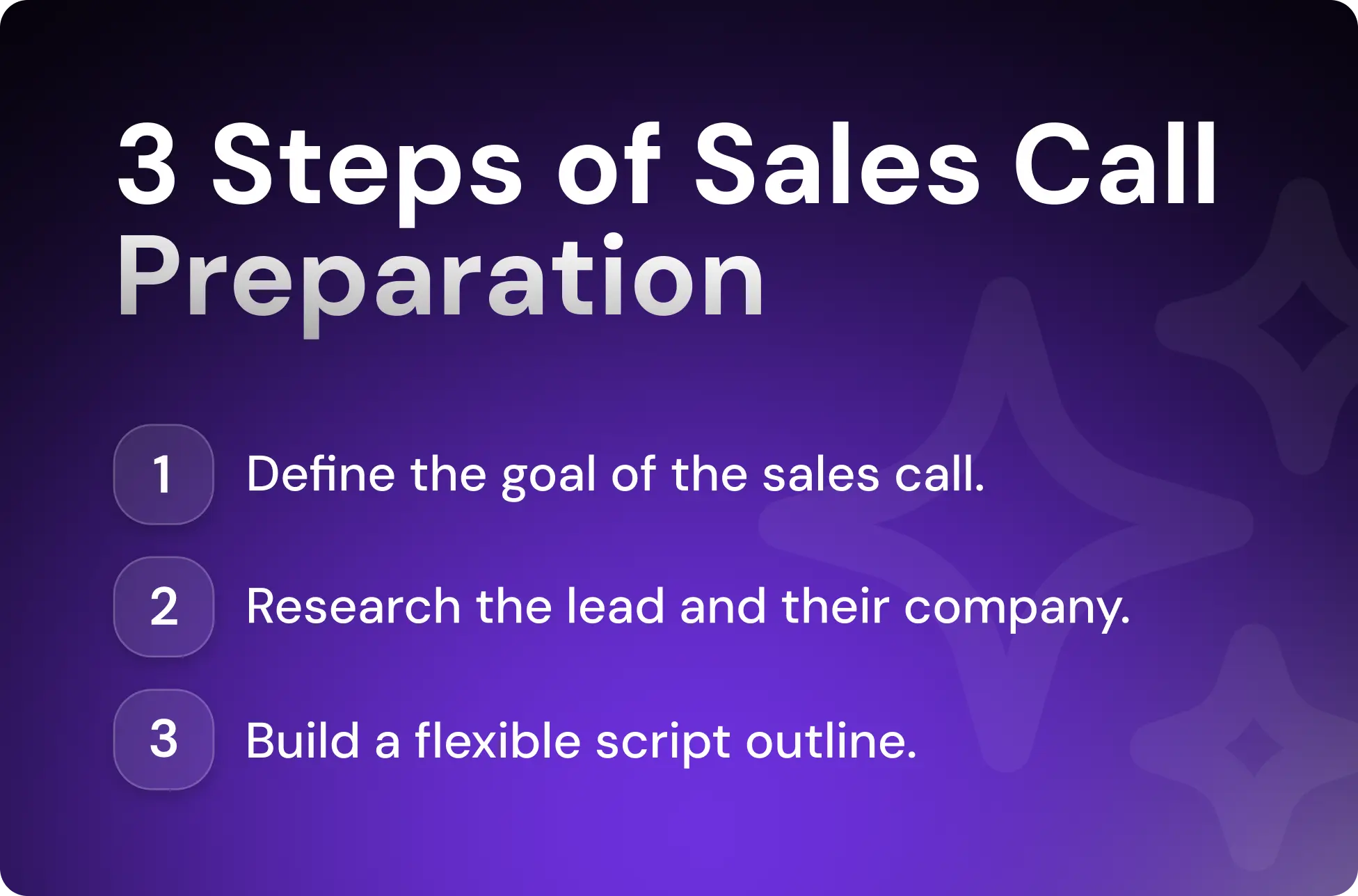
Pre-call preparation is as important as the call itself. This involves researching the lead, defining your desired outcome, and creating a script outline.
This habit of preparation can mean the difference between regular dead-end conversations and consistently acquiring new customers.
Decide what a “win” looks like before the call
You wouldn’t walk into a job interview without the clear goal of progressing to the next round. You need to take that same goal-oriented mindset and apply it to sales calls. That means defining a specific outcome and creating a matching call strategy.
Often, sales calls don’t close on the first try, especially if it’s a cold call or a discovery call. Even sales presentations to warm leads usually require follow-up in the B2B space.
The point? Don’t make “close the deal” your goal for every call. You’ll likely end up alienating the lead or pushing for the close too early in the process. Reserve that goal for late-stage sales calls.
Here are examples of realistic sales goals for early- and middle-stage sales calls:
Book a demo
Identify pain points and book a presentation
Get verbal commitment to work together
Research that actually changes the conversation
You don’t need a PhD in your lead’s company to sound informed and invested. Instead, focus on finding 2–3 usable insights to bring up on the call to build trust. You can use LinkedIn profiles, the company’s blog, and Google News to find this intel.
The following data points are usually worth mentioning:
A recent promotion
Job responsibilities
Company news (expansions, funding, etc.)
Industry trends affecting the business
The best intel relates directly to why you’re having a conversation and offers a great segue into your value proposition.
For example, when I was a sales development rep (SDR) tasked with cold calling property management companies, I would check before the call to see if they had recently acquired any new buildings. If they had, that meant they were probably dealing with an influx of new tasks and in need of an efficiency tool like ours.
Build a flexible call outline, not a script
A flexible script outlines the path of talking points you must pass to get your lead to the desired endpoint. It’s a bullet-point structure rather than a word-for-word script. It allows you to sound natural and improvise according to the lead’s responses without going off track.
We recommend creating call script templates for each segment you target, which you then personalize for individual leads. That way, you’re not always building an outline from scratch.
Here’s an example of a sales call template for qualified leads:
Short greeting (1-2 minutes)
Ask about and confirm pain points
Set the agenda for the call
Give a product overview
Describe how it will solve pain points
Share a case study of a similar customer
Open for questions and objections
Ask if they’re ready for a sales proposal
To personalize this template, simply go through each bullet and add directions for what to say that are specific to your lead.
For example, for the “short greeting” stage, you might jot down “tennis match” if on the last call you discovered they were going to the US Open. Under “ask about and confirm pain points,” you might write “struggling to generate leads and overwhelmed by options.”
Opening the call without sounding like a stranger
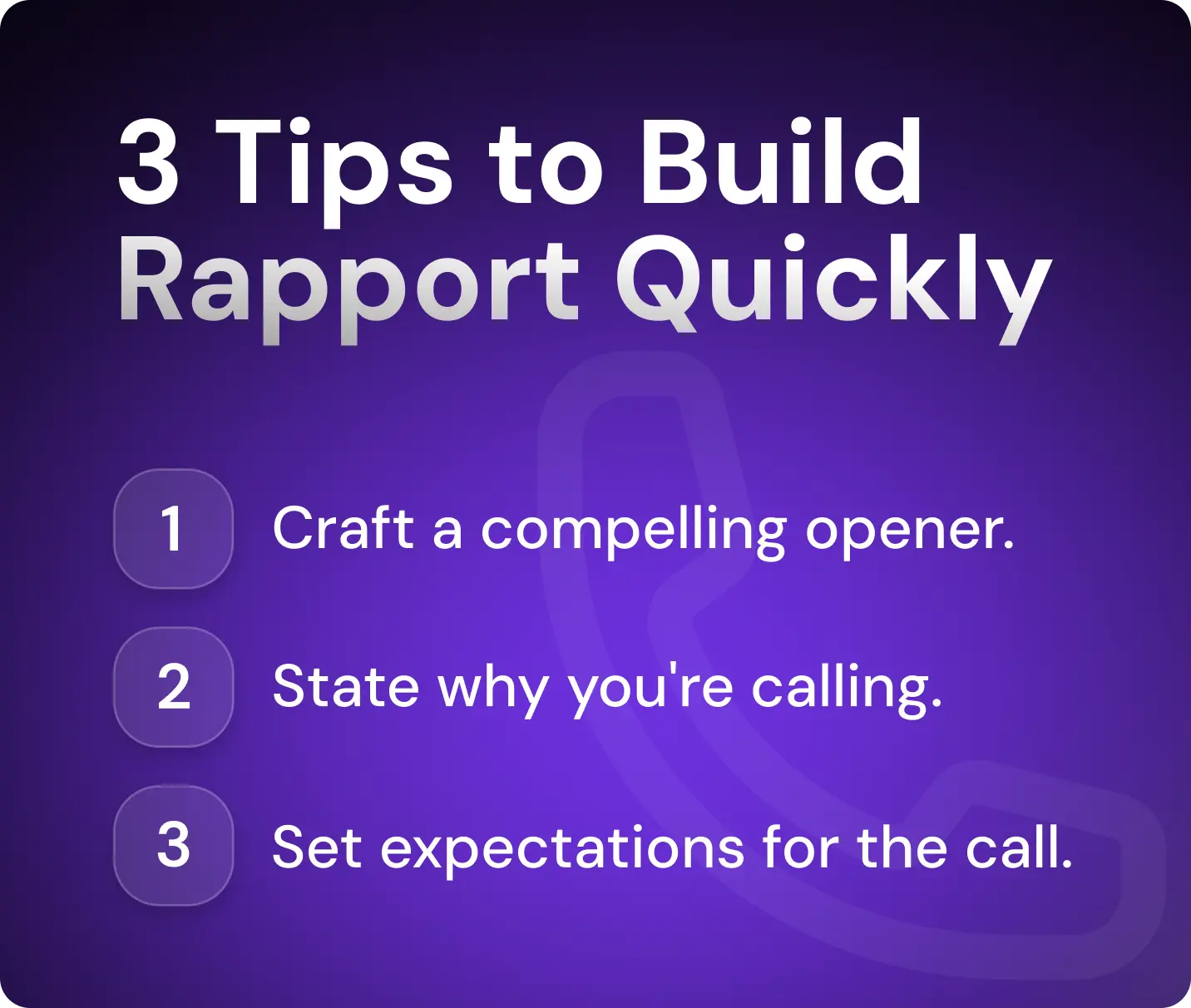
From using an intriguing, credibility opener to stating your reason for calling, there are a number of proven ways to build rapport quickly on a sales call.
Openers that lower defenses
The opener sets the tone for the call and earns you permission to speak. It is especially critical on cold calls, since the lead has no idea who you are.
On all sales calls, use a calm and neutral tone that sets the lead at ease. And lead with context that demonstrates your credibility and piques their interest—such as name-dropping a well-known client or mentioning a lead’s article they published on LinkedIn.
According to Gong’s data on 300M cold calls, two cold call openers consistently outperform others: the permission-based opener and the “Heard the name tossed around?” opener.
Here is an example for each of these top-performing openers:
Permission-based opener (11.18% success rate): “Hey John. I saw the news that you’re taking over management of two new high-rises. Exciting. I’m going to be honest: this is a cold call, but an informed one. Could I get 30 seconds to tell you why the expansion team made me call you specifically? Then you can tell me if a conversation makes sense or not.”
Heard the name tossed around? (11.24% success rate): “Hey John, it’s Sam from Building Boosters here. Heard our name tossed around?”
For warmer calls, you can open with a straightforward greeting. Ask them, for example, how they’re managing a recent company change or if they saw the recent big industry news. The aim is to get the ball rolling on a friendly note before diving into the sales conversation.
Stating the reason for the call clearly
Vague intros kill momentum because they confuse the lead. When people are confused about the intentions of the person they’re speaking with, they often put up walls and become defensive.
That’s why you should start with a clear reason for the call. Again, this is more important on cold calls. On warmer sales calls, the lead likely already knows the reason—though a quick reminder wouldn’t hurt.
On cold calls, you have to be more diplomatic. Connect the reason for your call to the prospect’s role, situation, or recent experience.
Here’s an example of a strong “reason for my call” statement:
“I noticed your recent initial funding, and whenever my clients get that first round of funding, they are always eager to scale their outreach. But they often find the headcount costs of hiring SDRs to be too pricey. So they come to us for a cost-efficient and highly effective alternative: an AI SDR who books meetings on autopilot through automated outreach. Is that an outcome you’d be interested in?"
Setting expectations in under 20 seconds
Once the greetings are over and the lead is ready for the conversation, quickly set an agenda.
This maneuver not only aligns expectations. It also builds trust by positioning you as a professional who will use their time wisely.
Here’s an example of an agenda-setting statement:
“Today, we will discuss the likely causes and consequences of your [lead’s problem], then I’ll share an overview of how our solution works and give two valuable use cases I think you could implement ASAP, based on your current goals of [lead’s goals] and what I’ve learned from working with other [business type] businesses. Sound good?”

Automate your outbound with an AI BDR
Meet Ava—your AI BDR who handles prospecting, outreach, and follow-ups, so your team can focus on closing.
Turning the call into a two-way conversation
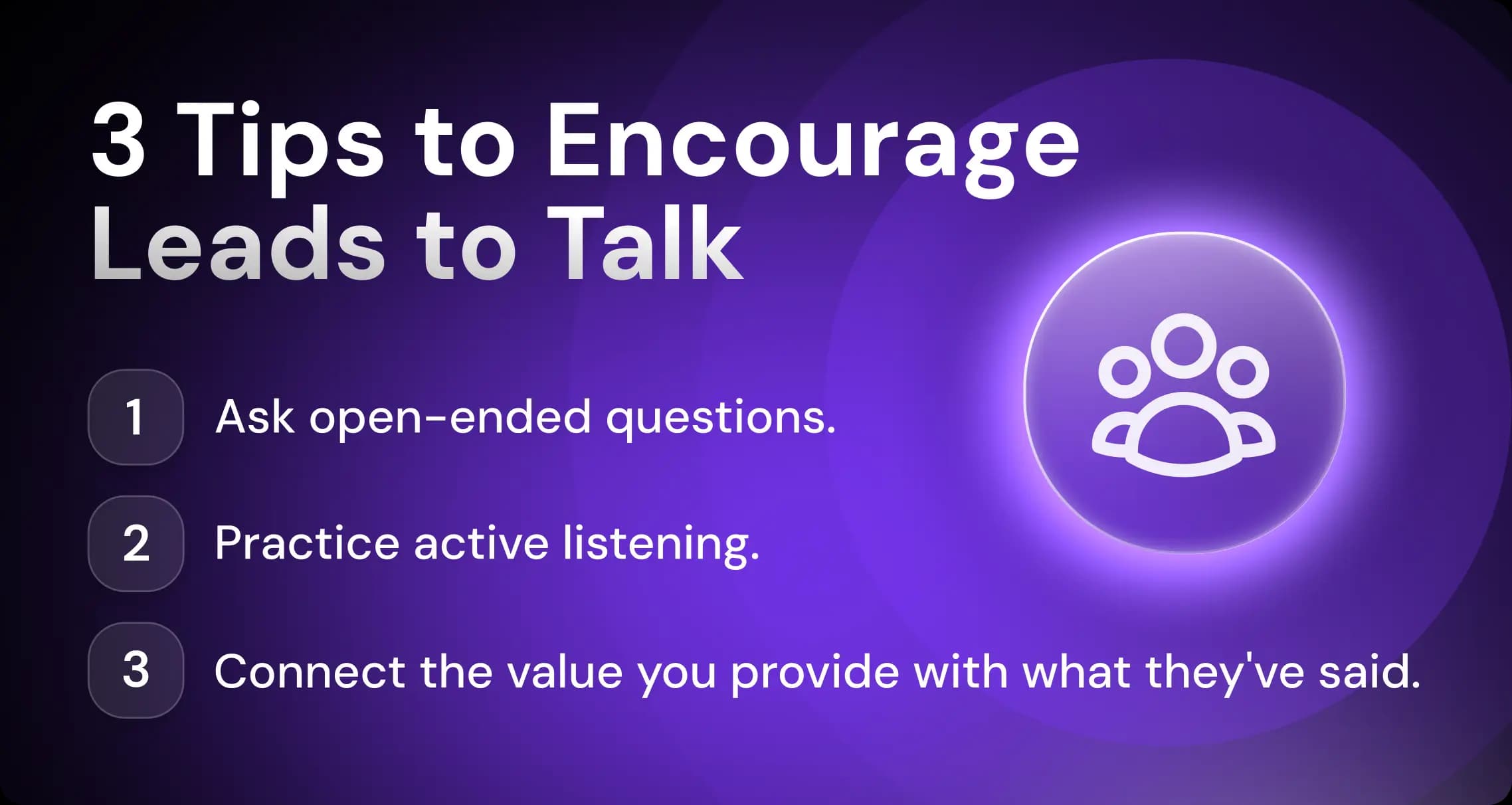
A sales call should be a two-way exploration. Well-crafted questions and statements spark new thoughts, perspectives, and wants in the mind of the lead, thus motivating them to engage in the conversation.
Asking questions that reveal real pain
Your perceived expertise is heavily influenced by the quality of your questions. The more relevant and thought-provoking your questions, the more credibility you build.
Of course, positioning yourself as a trusted advisor isn’t the only benefit of asking good questions. On a sales call, it also helps you understand the situation of the lead and determine what they want. This means you can position your solution in the best possible light.
It’s crucial, however, to go beyond surface-level questions. Ask about their workflow friction, missed goals, and inefficiencies. Inquire into how they’re navigating new industry challenges and trends.
Here are examples of questions that reveal needs and wants:
How are you currently doing [process]?
A lot of businesses are struggling with the new [industry trend/policy/event]. Has it impacted your business at all?
How are you handling [challenge]?
If you could wave a magic wand and make one issue go away, what would it be?
What’s currently the biggest blocker preventing you from reaching [goal]?
When a lead opens up, remember to ask follow-up questions based on the answers. Show them you’re engaged and focused on understanding them at a non-superficial level.
Listening without planning your next line
Even if you have a list of questions to work through, focus your attention on the lead’s words, not the next line. Be in the moment. Show the prospect you are genuinely interested in their work, situation, and needs.
An interruption, or a premature pitch, can be off-putting. It can turn what currently feels like an open, calm conversation into a high-pressure sales call.
Here are active listening tactics to build rapport with leads:
Paraphrasing: Rephrase the core points of the lead’s statement in your own words to demonstrate you heard and understood them.
Follow-up questions: Based on their responses, ask additional questions to go deeper into the process, challenge, or goal they’re discussing.
Mirroring: If you want leads to keep revealing more intel, do what hostage negotiator Chris Voss recommends and repeat the last few words they said in an exploratory tone. So if they said, “The new merger has been pretty tough," you might say, “Pretty tough?”
According to Gong, the golden ratio for sales call success for warm leads is a talk-to-listen ratio of 43% to 57%—in other words, you should be listening more than you’re talking.
However, the opposite is true for cold calls. The rep should speak slightly more than they listen. The lead is much less prepared than on a discovery or presentation call. It’s the rep's job to own the talking and convince them to take a meeting, where it becomes feasible to ask more detailed questions.
Connecting value to what they said
Before introducing a solution, describe the pain point in detail. Describe its causes, consequences, and possible solutions. This will convince the lead that you’re the right person for the job.
As ghostwriting business coach Nicolas Cole wrote: “He or she who frames the problem owns the solution."
Here’s how to show the lead you understand their problem:
Share short stories about customers who had the same problem as the lead.
Ask questions that challenge the lead’s assumptions about the cause of their issue.
Use industry statistics to back up your points when describing the problem.
When you’re ready to segue into the solution—connecting your product to their problem—avoid feature dumps unless they ask for details. Instead, focus predominantly on the benefits they’ll receive.
Handling objections without killing the call
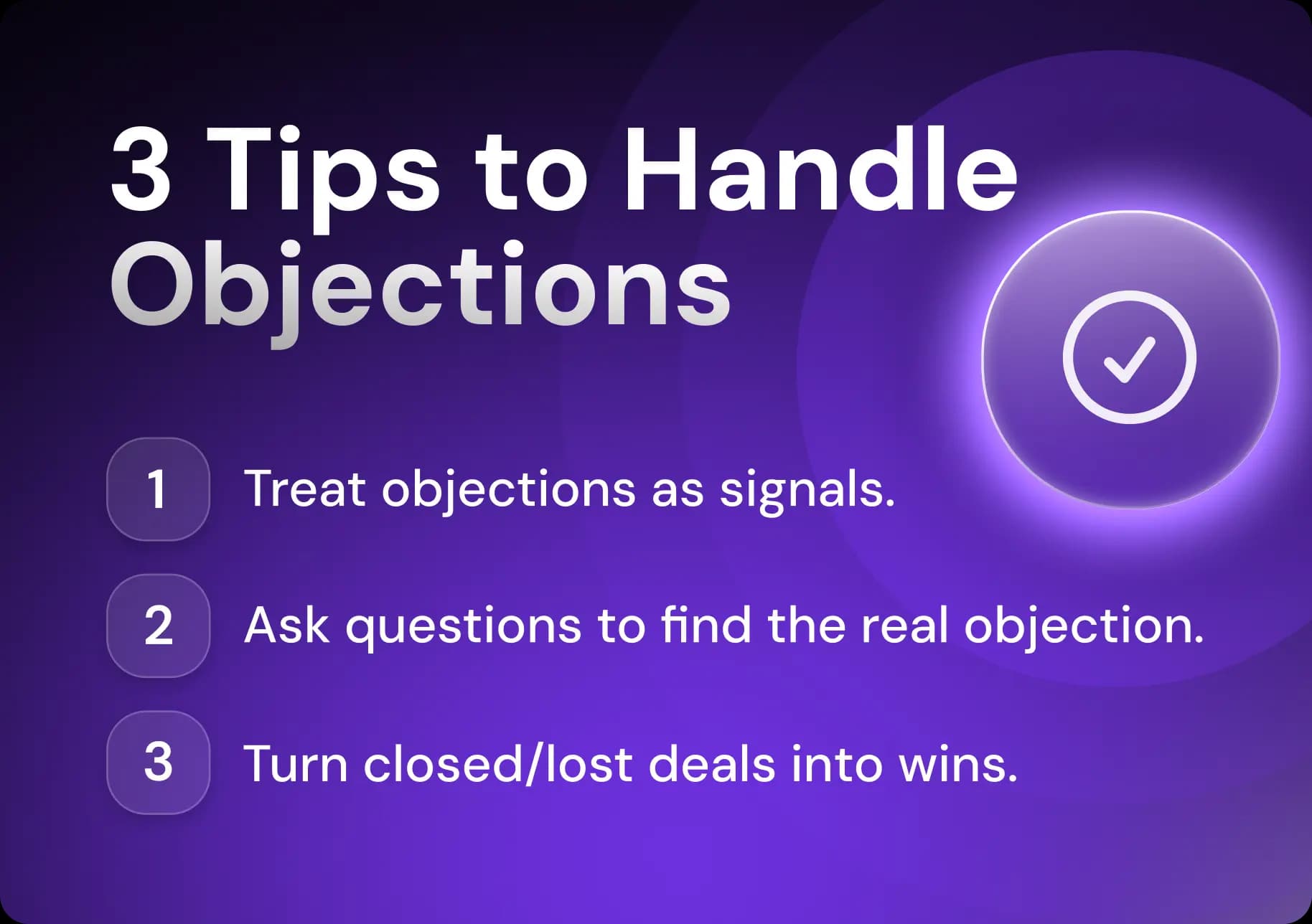
Objections are inevitable. But they don’t have to mean the end of the call. Handled in the right way, they become an opportunity to build rapport, learn more about the lead, and reframe the conversation.
Price, timing, and priority pushback
Treat objections as signals.
They tell you about a prospect’s hesitations and priorities around price, features, and timing. They are useful to you as a salesperson. After all, the better you understand a lead, the easier it is to sell to them.
But a positive interpretation of hearing “not interested” will only get you so far. You also need a go-to framework for dissolving objections.
The LAER framework is a proven system for overcoming objections:
Listen: Attentively listen to the lead—no interrupting until they’ve finished their thought.
Acknowledge: Rephrase the objection in your own words so the lead feels that you understand them clearly (or are at least trying to).
Explore: Ask calm follow-up questions to get to the heart of the objection while building trust.
Reframe: Once you’ve identified the core objection, respond with an evidence-based rebuttal that keeps the conversation alive (more on this below).
When “not interested” isn’t the end
When a lead says, “I’m not interested,” they often mean something else, such as “We don’t see the ROI for our particular type of business.”
The second objection is more specific and therefore easier to rebut. You can show them a case study of a customer like them who generated a substantial ROI, for example.
So, how do you turn vague objections into specific concerns? You ask follow-up questions. Then, once you know the objection, you make your rebuttal and reframe the conversation.
For the ROI objection, here’s an example rebuttal with a reframing question:
“I understand why you might not see the ROI right now. A lot of our customers didn’t see it until they heard real-life examples. Would you be open to learning how [similar customer] used our tool to generate twice as many leads at half the cost?”
If they agree, the conversation lives on, and you have won a chance to overcome the objection.
Knowing when to exit gracefully
Most objections are due to misinformation or incomplete information and are therefore possible to overcome through education.
For example, a lead might assume the process of working with your business entails a lot of work on their end, when in reality, that’s not the case.
However, there are some barriers you cannot remove. That’s just part of the game. Not all deals close. Sometimes, for example, the lead actually has no budget for your solution.
Do not force a sale when it’s just not going to happen. You don’t want a customer with a low customer lifetime value and a long, expensive sales cycle. Nor do you want to burn bridges through your aggression.
Here are two ways to reap value from the conversation if the deal is a no-go:
Leave the door open: Tell the lead to give you a call if anything changes. For example, maybe they’ll have the budget to afford you in a year.
Ask for a referral: Ask if there’s anyone in their network who would benefit from your product or service. If they’re well-connected in your target industry, there’s a chance they can introduce you to another potential buyer.
Ending the call with direction
To achieve the desired outcome of the sales call, you must ask the lead to participate in next steps, whether that’s buying your solution or agreeing to attend a live demo.
It’s vital that your ask is clear, straightforward, and delivered at a time when the lead is demonstrating purchase intent.
Always propose a next step
At the end of the call’s agreed-upon duration, or when you receive signs the lead is eager for the next step (like when they start asking for pricing), transition into the final stage.
This is where you briefly summarize what you learned on the call, restate why you think both parties would be a great fit, and invite the lead to the next step in the sales process. Be sure to ask if they agree with you and are ready. Mutual buy-in is key.
Here are examples of clear next steps on a sales call:
A 30-minute custom live demo with a product expert
A meeting to review the sales proposal or contract you’ll send them
A presentation for other decision-makers at the lead’s company
Confirming what happens after the call
Always try to schedule the next meeting during the call. This will dramatically reduce the chances of them turning into a no-show.
Ask the lead, “Is your calendar open?” so you can lock in a time right then and there when the perceived need for your product or service is still high.
Then, briefly go over what to expect in the next meeting or stage of the sale. If you're sending them a proposal, for example, you might tell them what it will cover. It could also be useful to preemptively agree on when you will sign contracts if the lead likes the proposal. This final step aligns expectations and creates a sense of urgency.
What happens after the call is equally important
Too many deals vanish due to improper follow-up. After the call, sales reps need to confirm next steps, send friendly value-add reminders, and ensure the lead has all the information required to make a buying decision.
Same-day follow-up that feels personal
Immediately after the call, send a calendar invite for the agreed-on time. In the invite, write a short message telling them what to expect and to build a little excitement.
For example, when I used to schedule meetings for my account executive (AE), I’d write something like the following:
“It was great chatting with you today and learning about how [company] handles its [process]. We believe we can help you fix [the problem they mentioned]. I’m setting you up with [AE name], our product expert. He will give you a custom demo that’ll show you exactly how [product] can [value prop they care about]. We look forward to it. Please let me know if you have any questions in the meantime!”
To prevent no-shows and keep the momentum high, continue following up with the lead. Ask if they have any questions several days after your call. And a day before the next meeting, shoot an email confirming their attendance.
If you send them a sales proposal or contract, check in every 3-4 days to see if they have any questions or need anything else from you. Keep the ball rolling without being a pest.
Multi-touch follow-up without being annoying
A post-call, balanced follow-up cadence will boost conversion rates by keeping momentum high and reducing no-shows.
That said, you never want to become a nuisance. So send value-add touches instead of “just checking in.” Even if you are asking why they haven’t signed a contract yet, you can frame it as a considerate, helpful message.
Here are four proven follow-up techniques that add value to any message:
Send them an interesting article you read that relates to their goal or challenge.
Ask if they need anything from you to help make the decision.
Remind them of the upcoming meeting and ask for confirmation that they'll attend.
Share a free resource, like a template or an ultimate guide, that can help them fix a pain point.
Making sales calls scalable with systems
Whether you’re an SDR or a founder, sales calls can quickly become overwhelming if you have lots of leads and a highly manual system. To lighten the load, use software to automate prospecting, initial outreach and follow-up, lead prioritization, routing, and research.
Automating research and call prep
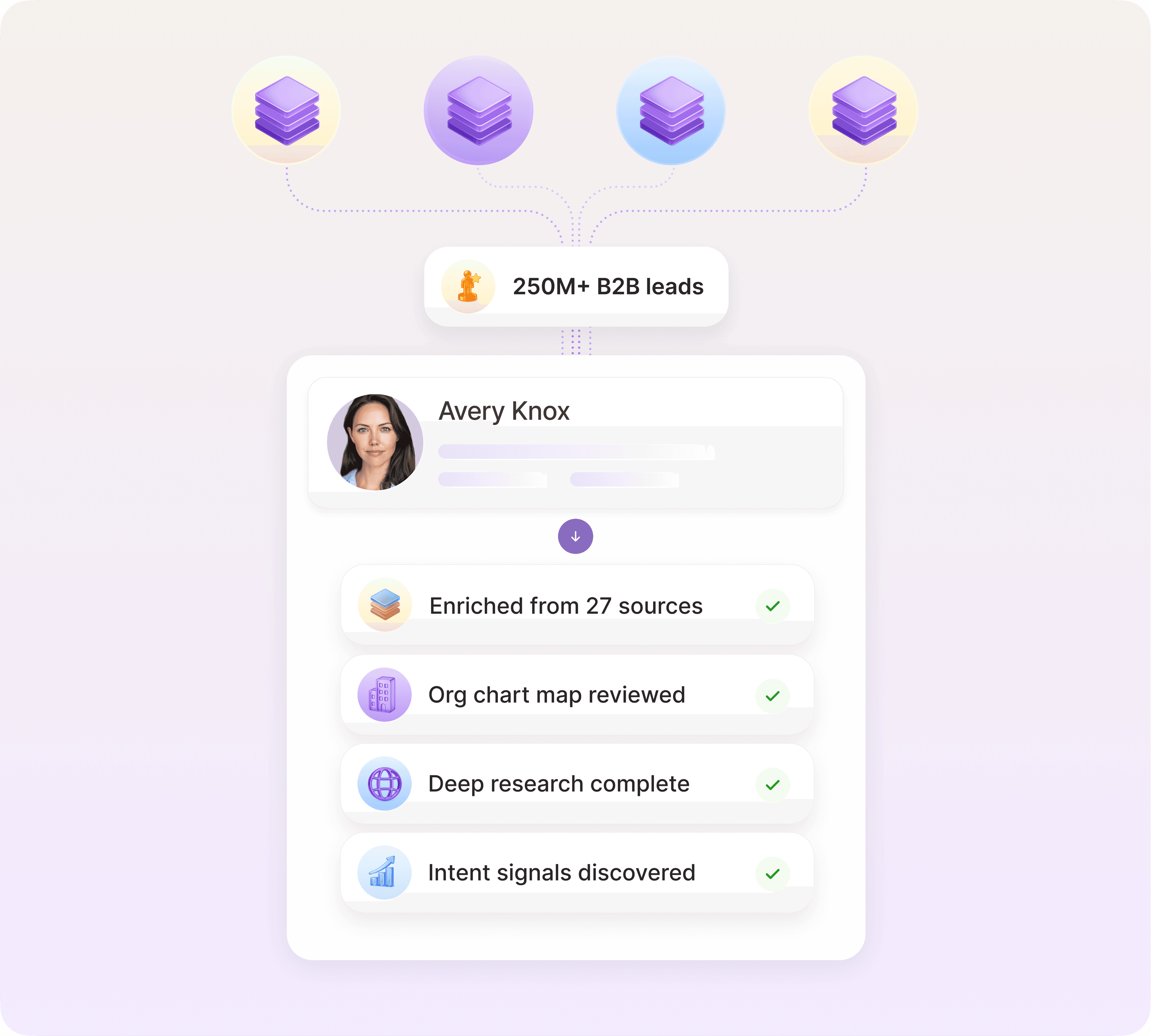
Call research and prep are essential to sales call success. Knowing facts like the lead’s job title, recent activity, and technology use can help you plan a personalized sales call. The problem is that it is time-consuming when done manually.
Artisan uses a comprehensive internal database along with the very latest AI-assisted scraping technology to provide you with fully enriched lead profiles. These contain accurate data about the leads’ demographics, firmographics, and online behavior. This way, your reps are equipped with actionable intel without having to scour the internet.
Keeping calls, emails, and social media in one flow
Fragmented tools often lead to lost leads. If contact histories are scattered across disconnected systems, reps can quickly lose track of where each lead stands in the buyer’s journey.
The costs? Redundant outreach, missed follow-ups, and inconsistent messaging.
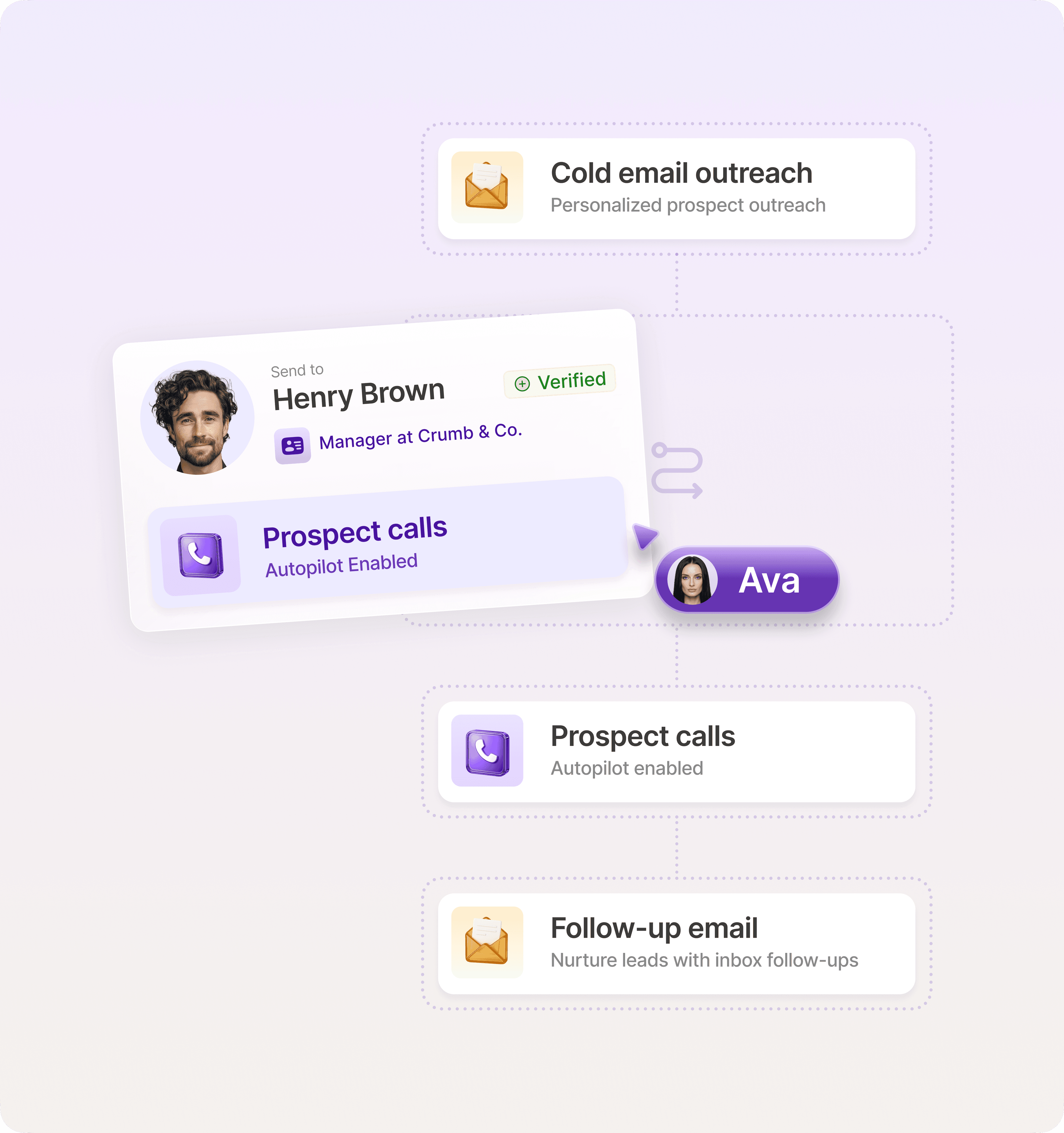
A unified sequence, managed in one sales automation platform, ensures no leads or outreach tasks are forgotten. Artisan, for example, consolidates the entire outbound tech stack, reducing tech stack costs and ensuring leads always receive the right message at the right time.
Turning sales calling into a repeatable process
If you follow a repeatable process for sales calls, you’ll move faster while gradually improving the skills of your team—repetition and volume are key ingredients of mastery.
If you add a layer of experimentation to this process, you’ll also gain hard data about the sales call process that will help you refine your messaging and style over time.
To automate call data analysis, use a reputable conversation intelligence tool like Gong or Clari. These will track customer interactions, spot patterns across your team’s calls, and give you practical insights into how to improve your process.
Sales calls success is about more than dialing a number
Sales call success is about more than dialing a phone and persuading a lead. It requires research, planning, scripting, and follow-up. Workflows must also be built on a modern, integrated tech stack that’s capable of wide-scale automation.
Artisan’s AI-first platform offers the very latest in automated sales workflows and up-to-date lead data. AI BDR Ava, who powers Artisan, finds leads, researches them, enriches their profiles, and automates follow-up emails. All of which means you can focus more on leading a relevant, clear, productive conversation.
Automate your outbound with an AI BDR
Meet Ava—your AI BDR who handles prospecting, outreach, and follow-ups, so your team can focus on closing.

Sam Rinko
SME @ Artisan
Sam Rinko is a former SaaS sales rep turned tech writer. He sold real estate software before writing about lead generation, cold calling, and AI sales tools.