9 steps to perfect your lead qualification process
Learn a practical lead qualification process for B2B SaaS teams using lead scoring, BANT, CHAMP, MEDDIC, CRM workflows, and automation to improve SQLs.
B2B sales teams often waste time chasing leads who will never convert.
A standardized lead qualification system is the solution.
By properly vetting lead fit and intent with the help of automation tools like lead scoring software and AI BDRs, sales teams can accelerate sales cycles, boost close rates, and reduce customer acquisition costs.
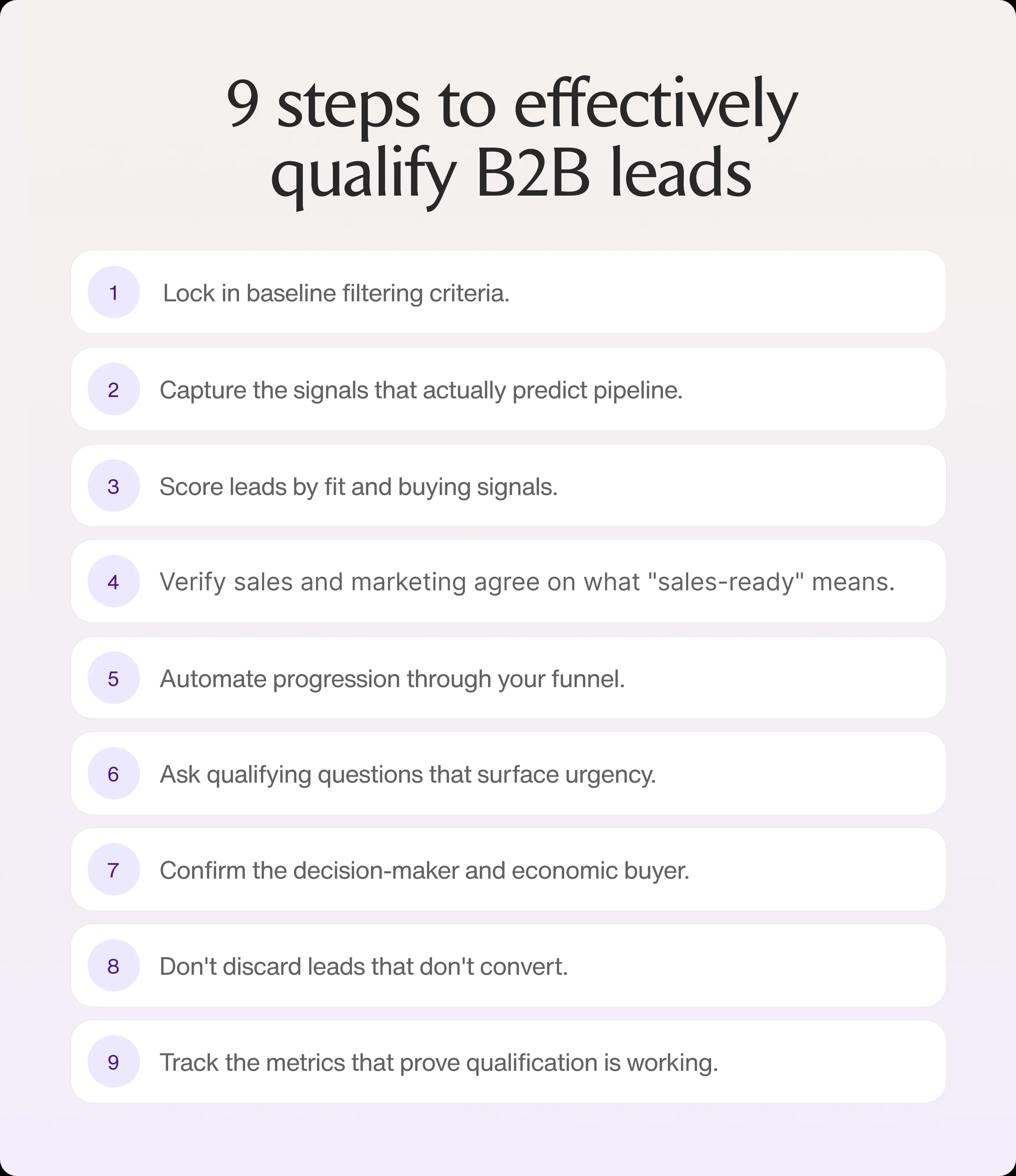
The 9-step lead qualification process smart B2B teams actually run
The best B2B revenue teams don’t vibe-check leads. They use a repeatable lead qualification process that incorporates automated lead scoring, qualification frameworks, and discovery calls to accurately measure a lead’s quality before sending them through further stages of the sales process.
Step 1: Lock in baseline filtering criteria
Set early-stage filtering criteria by defining exactly who you’re targeting and who you’re not. Document this definition and make it accessible across your marketing team.
You will use these criteria in the first part of a two-step system. The aim is to identify leads that warrant further research and detailed scoring, which is far more effective than scoring every lead that comes in.
Use these criteria as the backbone of your filtering process:
Budget fit: Can they afford your solution?
Authority: Is this a decision-maker with the power to influence the purchasing decision?
Need: Do they have a problem that you can help them solve?
Timeline: Are they looking to buy this quarter or three years from now?
ICP match: Do they broadly match your ideal customer profile?
Disqualifiers: Do they raise any red flags that warrant automatic removal, such as incorrect industry or locked-in contracts with a competitor?
Step 2: Capture intent signals
Some lead signals are more useful than others for predicting if a lead will turn into closed revenue. Rather than tracking everything about your leads, identify four to five buying signals that show up most regularly in your historical sales data of closed-won deals.
Build your signal-capture system around the following attributes and behaviors:
Lead generation source: There might be a marketing channel that most routinely brings in leads who turn into buyers, such as SEO, webinars, or cold outreach.
Website behaviors: Actions like visiting pricing pages or asking product questions to your chatbot can indicate purchase intent and willingness to have a sales conversation.
LinkedIn engagement: Replies to posts, direct messages, and frequent engagement with your content often mean the lead is warm and interested in your business.
Company size, growth, and news: Recent funding rounds, hiring sprees, and M&A (mergers and acquisitions) activity or leadership changes may uncover whether a business is growing.
Stakeholder mapping: Multiple decision-makers engaging with your web content, as opposed to just one, usually means a business is already evaluating your offer.
Content downloads: Downloading bottom-of-funnel content like white papers and pricing guides is a good sign a lead is considering a purchase.
Current tech stack: Sometimes, there are gaps in a lead’s tech stack that signal an opportunity to pitch your product.
Step 3: Score leads by fit and buying signals
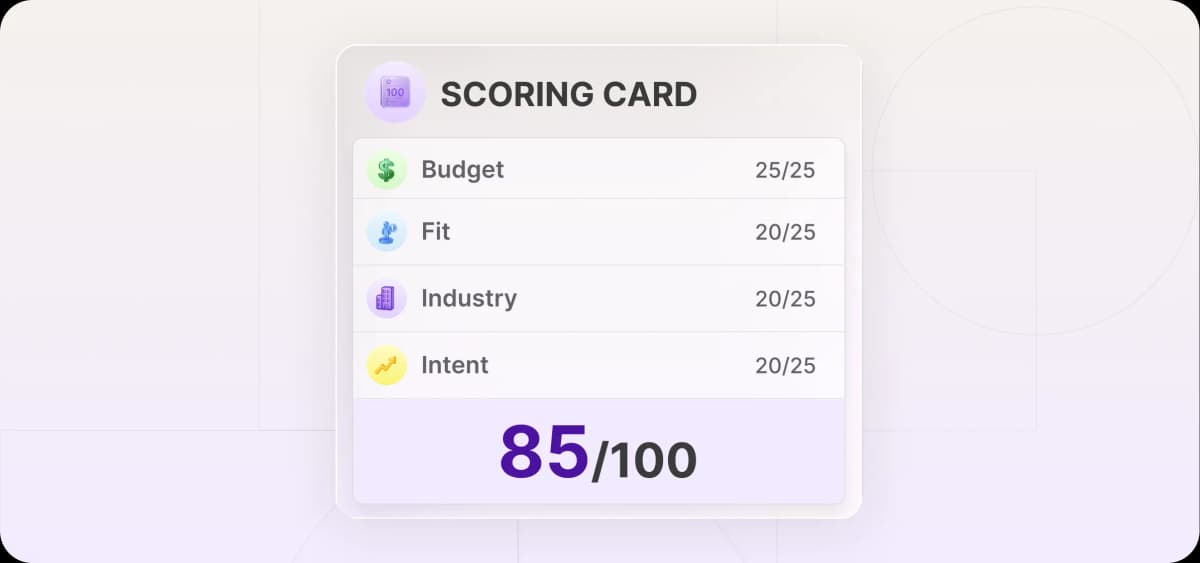
Once you’ve filtered leads using a broad set of ICP criteria and gathered relevant intent signals, it’s time to drill into available data and give individual leads and accounts a score. The best way of doing this is to create a lead scoring model in your CRM or sales software.
Using lead data from both your own tracking tools and third-party sources, the software will assign points to leads based on specific ICP attributes and the intent signals they have shown.
Here is an example of a lead scoring point system:
Company size is greater than 100 employees: +5 points
Job title is VP, CEO, or business owner: +10 points
Downloaded a pricing comparison guide: +15 points
Visited pricing page 3 times in a week: +15 points
Attended a webinar introducing product: +15 points
Uses close competitor: -15 points
Has never opened a marketing email: -5 points

Automate your outbound with an AI BDR
Meet Ava—your AI BDR who handles prospecting, outreach, and follow-ups, so your team can focus on closing.
Step 4: Ensure sales and marketing agree on what “sales-ready” means
For qualification to work effectively, sales and marketing need to agree on the definition of a marketing-qualified lead (MQL). An MQL is an ICP-fit lead who has shown sufficient interest to warrant evaluation by sales.
If you don’t do this, marketers are likely to route poor-quality leads to reps. Premature hand-off can cause tension between teams and result in leads being ignored.
To create this alignment, follow these steps:
Hold a meeting: Bring together sales and marketing leaders to discuss MQL criteria. Agree on specific scores for low-, medium-, and high-value MQLs.
Use lead scoring software: Enforce and standardize the agreed-upon definition by creating a lead scoring model in your lead scoring software or CRM.
Meet regularly to assess the model: Every three to six months, revisit the score threshold and scoring model based on the measurable quality of leads entering your pipeline.
Step 5: Automate progression through your funnel
Every score threshold you set should trigger a specific next step, such as a sales follow-up or direct call from an AE. That’s how your team turns lead information into booked meetings.
Here are four examples of score bands and associated next steps:
Low score passive leads: Enroll in a long-term nurturing sequence. These leads passed your initial filtering criteria but don’t qualify as MQLs.
Low- and mid-score MQLs: Assign to a sales development representative (SDR) for further qualification over the phone or trigger automated cold outreach to test readiness to buy.
High-score SQLs: Assign to an AE for an in-depth discovery call.
Product-qualified lead (PQL) signals: Flag these leads for expansion outreach, which aims to to convert them from freemium users to paid customers.
Step 6: Ask qualifying questions that surface urgency
If a lead is marked as a mid-score or high-score MQL, a sales rep, often an SDR, should arrange a discovery call.
Their job is to determine if the lead is ready to be categorized as a sales-qualified lead (SQL), which would indicate a high likelihood of buying.
Ask these questions to gauge a lead’s willingness and ability to buy:
Are you leading this evaluation, or are there others in the buying committee?
Do you have funds set aside for this investment?
What does your current process look like?
What outcome are you trying to achieve?
Have you tried solving this before? What happened?
What does your ideal implementation timeline look like?
Step 7: Confirm the decision-maker and economic buyer
When I worked in B2B sales, I often wasted time talking to leads who were in love with the product but had no buying power. I’d think I was going to score big. Then, days later, I’d receive an email along the lines of "My boss doesn’t want this. Thanks for your help, though!”
Don’t let this be you.
Early in the sales conversation, learn the business’s decision-making process and identify two key personas:
The decision-maker: The person with final say. This is often a project lead or department head. They are considering whether the solution helps them achieve business goals.
The economic buyer: The person who controls the budget and approves expenditures. They’re often a CEO, CFO, VP, or business owner. They are considering your solution’s financial justification.
Determine who these people are and aim to have a phone call with them to ensure they are actually interested in a potential deal. Sometimes, they will be the same person, but this often won’t be the case.
Ask leads the following three questions to identify decision-makers and economic buyers (without making them feel unimportant):
What does your solution evaluation process look like?
Would you like me to loop anybody else into these demos and discussions?
Aside from yourself, who else needs to approve this purchase?
Step 8: Don’t discard leads that don’t convert
If a lead doesn’t convert, your next step should be dictated by their potential for future qualification. Don’t immediately remove them from your CRM.
Here are the three most common scenarios and their corresponding routing protocols:
Recycle ideal leads who didn’t close: If a lead is a good fit and also has intent, but the deal failed to close for whatever reason, pass them back to marketing and create a follow-up trigger, like "Reach back out in Q3,” in your CRM.
Nurture leads contacted at the wrong time: If a lead is a good fit but lacks buying intent and urgency, add them to a lead nurturing sequence or newsletter list to keep your brand fresh in their mind for when they do eventually need your help.
Disqualify poor-quality leads: If you discover something about a lead that signals they’re never going to buy (like long-term budget issues), remove them from the pool of prospects.
Step 9: Track the metrics that prove qualification is working
Most lead scoring systems can be improved over time based on feedback from the market and the sales team. To improve your system, track key metrics that help you spot weaknesses in your scoring model, follow-up automations, and score thresholds.
Track the following core metrics:
MQL-to-SQL conversion rate: If too few MQLs are turning into SQLs, your scoring threshold might be too low.
SQL-to-close rate: If your sales team is struggling to close leads, that can signal an issue with lead quality and the scoring model you’re using to determine it.
Follow-up speed: If your first contact with qualified leads is too slow, you might need to improve your lead routing system with automation or clearer lead ownership rules.
Sales cycle length: If sales cycles are longer than expected, leads might be entering your pipeline too early, meaning your scoring threshold is too low.
The frameworks that stop your team from qualifying on vibes
Lead qualification is the top challenge faced by reps according to research by Outreach. One way to solve the issue is by standardizing the criteria your company uses to qualify leads in the early stages of the sales process.
Typically, businesses do this by choosing a time-tested lead framework that fits the unique requirements of their sales process.
BANT when speed matters more than complexity
Use BANT for transactional B2B sales environments where sales cycles are short. This framework is concise and helps reps determing sales readiness quickly. It emphasizes “ability to pay" and puts budget examination first in the qualification process.
BANT evaluates leads across four criteria:
Budget: Does the organization have the funds to buy the solution?
Authority: Does this person have the ability to approve the purchase?
Need: Is there a pain point we can solve?
Timeline: Are they buying according to a timeline that works for us?
CHAMP when pain is the real buying trigger
Use CHAMP when challenges and pain points are stronger buying drivers than fixed budgets.
This framework is popular in markets where ideal customers have deep pockets, such as enterprise sectors. Unlike BANT, reps ask about budget later in the conversation, starting instead with challenges and authority.
CHAMP scores leads across four criteria:
Challenges: Does the lead have a pain point we can solve?
Authority: Is our point of contact able to make or influence a purchasing decision?
Money: Does the company have the financial capacity to invest?
Prioritization: Does the business need help quickly?
MEDDIC for serious SaaS deals with real stakeholders
Use MEDDIC if you are an enterprise SaaS or B2B tech firm used to complex, high-value, multi-stakeholder deals.
It’s preferable to BANT or CHAMP in this scenario because it provides the deep qualification necessary for forecasting accuracy and to justify initiating what will likely be a long, time-consuming sales cycle.
MEDDIC investigates accounts across six categories:
Metrics: The quantifiable economic impact of your solution on their business.
Economic Buyer: The person with ultimate authority to authorize the purchase.
Decision criteria: The technical, vendor, and financial criteria the business uses to make purchase decisions.
Decision process: The internal steps, approvals, and timeline the prospect follows to close the deal.
Identify pain: The major problem or challenge your business will solve for the prospect.
Champion: The influential and enthusiastic person who will be your business’s internal advocate.
MEDDIC is best understood as a deal intelligence framework that helps reps understand the shape of an opportunity. The information gathered is important for two reasons. First, reps can use it to determine whether or not they will be able to reach relevant champions and decision-makers. Second, it lets them see if a client’s metrics, decision criteria, and pain points align with the solution that will be pitched.
GPCTBA for teams that sell through goals and blockers
Use GPCTBA if you are doing consultative B2B discovery calls and need a comprehensive understanding of the lead’s high-level goals, plans for achieving them, and technical or strategic blockers. This knowledge helps you identify the specific product or service packages with the best chances of selling.
GPCTBA gathers information across six areas:
Goals: What outcome is the lead trying to achieve?
Plans: What are their plans for reaching their goals?
Challenges: Which hurdles are blocking their progress?
Timeline: What’s the ideal timeline for implementation?
Budget: Do they have the money to afford a solution?
Authority: Which person in the company has the authority to say yes?
How to automate qualification and outreach
Manually finding and qualifying leads is a time sink that distracts your team from selling to high-value prospects. Fortunately, AI automation can take over multiple tasks that are beyond the capabilities of traditional if-then rules.
Use AI for research, enrichment, and prioritization
The best lead scoring tools automate account research, enrichment, and prioritization. This allows your sales team to focus on holding conversations rather than searching for leads.
Artisan, for example, is powered by Ava, a fully autonomous AI BDR. She gathers lead data from across the web and tracks behavior on your website. She then scores leads based on ICP fit, intent, and engagement levels. All without human intervention.

Use multi-channel outreach to validate intent faster
In addition to scoring and surfacing high-priority leads, an AI outbound automation tool like Artisan can also trigger outreach in the form of personalized multichannel sequences and automated follow-ups over email and social.
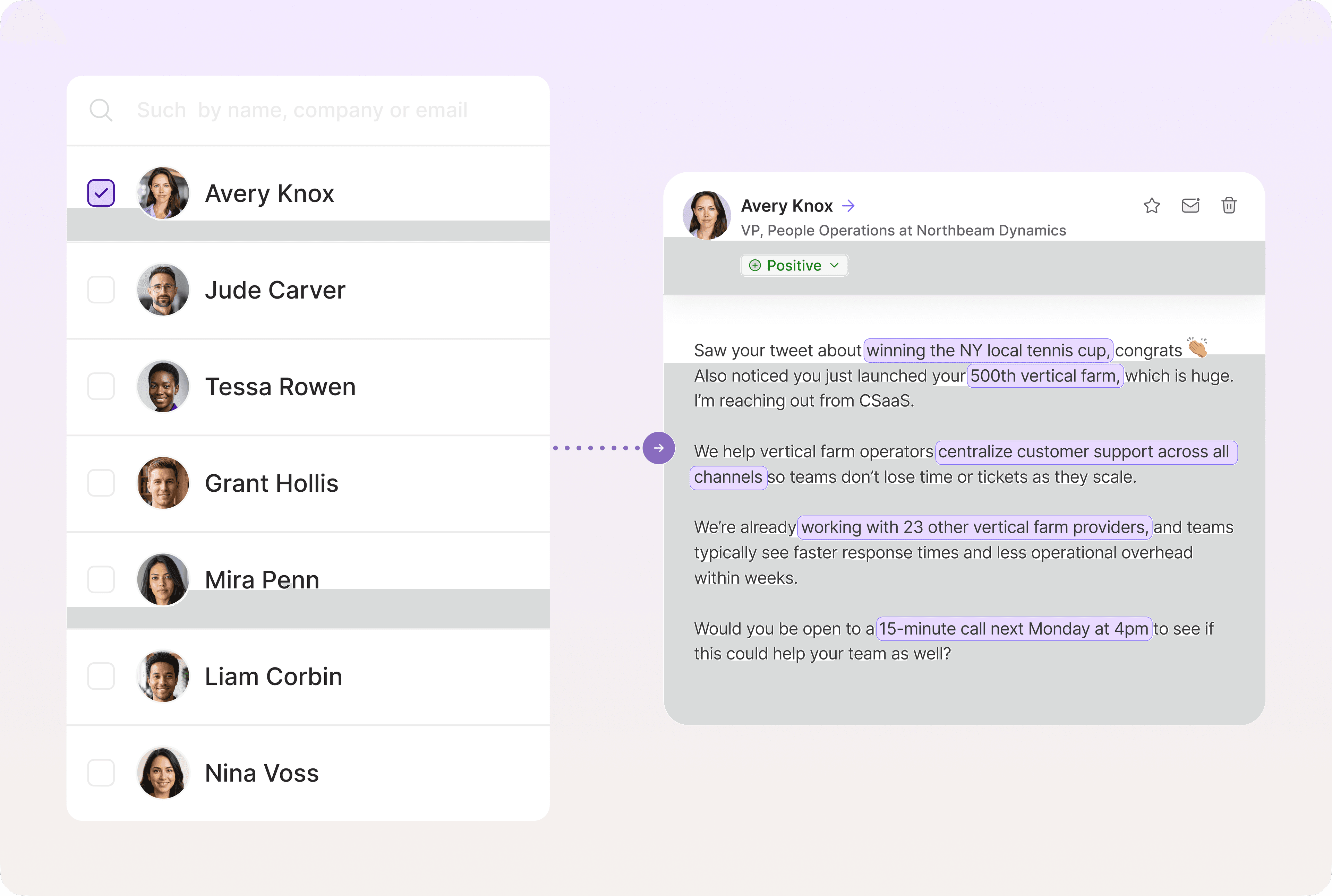
By eliciting responses from leads, whether a simple “not interested” or an eager “let’s set up a call,” automated messages help reps validate intent. Moreover, AI tools can often analyze lead replies and book meetings on autopilot if a lead is a good fit.
Keep handoff clean so pipeline doesn’t rot in your CRM
A tight window between qualification and outreach will typically boost your positive response rate.
As such, it’s important to define account ownership and routing rules. In this way, every SQL will instantly be assigned to the right AE upon qualification.
Use your CRM and sales tool automation features to trigger follow-up tasks and alert managers when leads are getting cold.
Better qualification is how modern sales teams create more pipeline
Lead qualification is the foundation on which an effective sales process rests. A tested, detailed system ensures that reps spend their limited time with high-quality leads.
But qualifying a lead is only one part of the larger lead generation process. Many sales teams still conduct manual cold outreach to MQLs, spending hours every day that could be used to close prospects.
That’s why sales teams are increasingly turning to AI BDRs to automate not just qualification but also the outreach that follows. Artisan’s finds leads, qualifies them using intent, company, and engagement data, then reaches out over email and social with hyper-personalized messages. All of which means your reps can focus on what they do best: closing deals.
Automate your outbound with an AI BDR
Meet Ava—your AI BDR who handles prospecting, outreach, and follow-ups, so your team can focus on closing.

Sam Rinko
SME @ Artisan
Sam Rinko is a former SaaS sales rep turned tech writer. He sold real estate software before writing about lead generation, cold calling, and AI sales tools.