12 AI tools business development teams need
Learn how sales teams use AI tools for business development to streamline prospecting, personalize outreach, and improve conversion rates at scale.
Are you eager to boost sales revenue without hiring more reps?
Well, you can’t pick any old AI tool and expect to see a lift in booked meetings and revenue.
What you need is an integrated, multi-functional platform that can genuinely automate your workflow in line with the unique needs of your business.
12 best AI tools for business development in 2026
According to The State of AI (2025) by McKinsey, 88% of organizations now regularly use artificial intelligence in at least one business function, and the companies seeing the most value are using it to drive growth rather than cut costs.
AI has changed what a lean business development team can achieve. The best tools reduce repetitive manual tasks across prospecting, enrichment, outreach, and follow-ups. Automation of these tasks in combination leads to a significant boost in productivity while headcount stays put.
1. Artisan
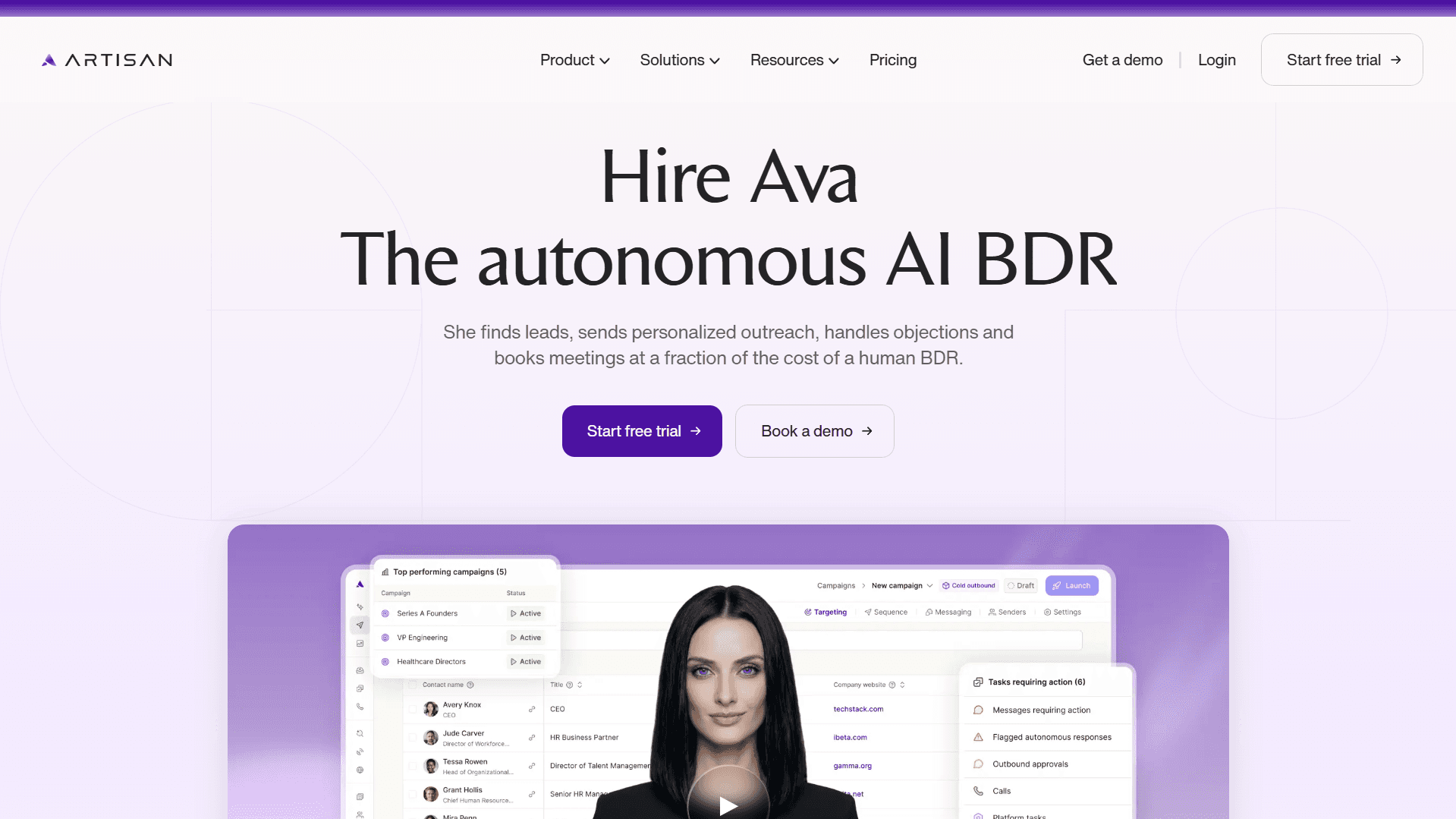
Artisan is an AI-first platform that automates a wide range of inbound and outbound sales tasks. It is built around Ava, an autonomous business development rep (BDR), who can fully manage all early and middle stages of the outbound sales cycle.
After you share your ICP with Ava, she prospects from a database of over 250 million leads, drawing from third-party sources and the web to enrich profiles and score accounts.
From there, Ava writes personalized outreach emails and follow-ups that are customized to individual leads and your brand guidelines. She will automatically book rep meetings with interested recipients.
Strengths
Powerful AI engine automates prospecting, enrichment, multi-channel outreach, and follow-ups on a single platform
Buyer intent and website visitor tracking to identify in-market leads
Usage-based pricing adapts to individual needs and scales with your requirements
AI-first tool with built-in automation rather than tacked-on features
Limitations
Artisan retains a outbound focus and is ideally suited to teams for whom cold outreach is a viable growth channel
Who is Artisan best for?
Artisan suits startups, SMBs, and enterprises looking to consolidate their outreach in a single platform and grow efficiently without increasing headcount.
Core AI functions
Automated prospecting from a large database of B2B, local, and e-commerce leads
AI BDR Ava enriches CRM and lead list data and sends personalized outbound messages at scale
AI dialer queues calls
Automated multi-channel campaigns across email and social media that follow brand guidelines closely
Pricing
Artisan has several usage-based plans for different user needs and outreach requirements. A free plan is also available to explore the platform. You can see a full breakdown on the pricing page.
2. Clay
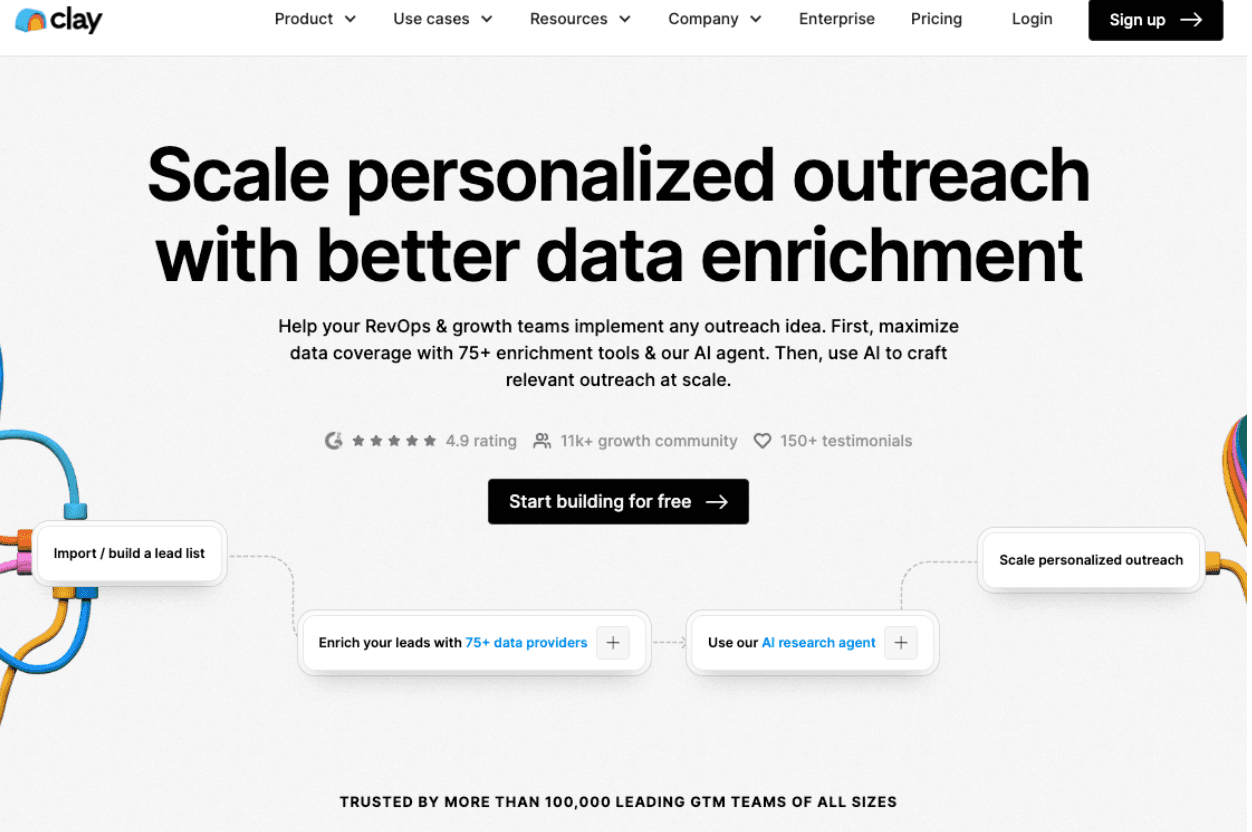
Clay is a data enrichment and outbound automation platform. It pulls from over 150 data providers and scrapes the web to help AI-enabled sales teams build deeply researched, hyper-personalized prospect lists at scale.
Strengths
Waterfall enrichment from over 150 data providers
Unlimited user seats on all plans
Automated personalized outreach and follow-ups rooted in enriched data
CRM integrations, including HubSpot and Salesforce
Limitations
Steep learning curve for new users
CRM integration and HTTP API access require the Growth plan or above
Credit-based pricing can cause costs to increase unexpectedly
Who is Clay best for?
GTM teams with the resources to develop and maintain complex enrichment workflows.
Core AI functions
AI “Claygents” can be programmed to handle key tasks like lead research
AI-powered research built directly into enrichment workflows
Intent signal tracking, including job changes, funding rounds, and intent data
Pricing
Clay pricing is based on a dual credit system that uses “Data Credits” for enrichment data and “Actions” for platform operations. All plans offer unlimited seats and a 14-day free trial. Auto-sync CRM integration is only available on the Growth plan and above.
Free: 500 actions/month (100 data credits per month)
Launch: $185/month (15K actions and 3K data credits per month)
Growth: $495/month (40K actions and 6K data credits per month)
Enterprise: Custom pricing
3. LinkedIn Sales Navigator
LinkedIn’s native prospecting tool, Sales Navigator, gives teams access to first-party data for over one billion professionals. It also offers AI filtering and prospect recommendations tracking to further enhance B2B lead generation.
Strengths
LinkedIn’s first-party data gives you immediate access to role changes and company updates
Relationship Explorer and TeamLink identify opportunities for warm introductions through your team's existing network
Buyer intent signals track when target prospects engage with your content
Identification of decision-makers
Limitations
The most advanced features, such as CRM writeback and automated message personalization, are only available on higher tiers
Lack of email sequencing and outreach automation features
Export restrictions limit bulk list-building workflows
Advanced AI features, such as AI approach recommendations and lead explanations, are yet to launch
Who is LinkedIn best for?
Teams that rely on LinkedIn as a primary channel for prospecting will benefit from the additional insights and search features. However, it needs to be integrated with a larger sales tool to achieve a fully automated workflow.
Core AI functions
AI-powered lead and account recommendations based on saved searches and ICP criteria
AI message personalization is included on Advanced and Advanced Plus tiers
Pricing
Sales Navigator pricing is per license, with a 30-day free trial available for the Core and Advanced plans. Advanced Plus is the only tier with full CRM writeback and advanced enterprise integrations.
Core: $119.99/month
Advanced: $159.99/month
Advanced Plus: Custom pricing based on team size, CRM integration, and onboarding needs
4. HubSpot AI
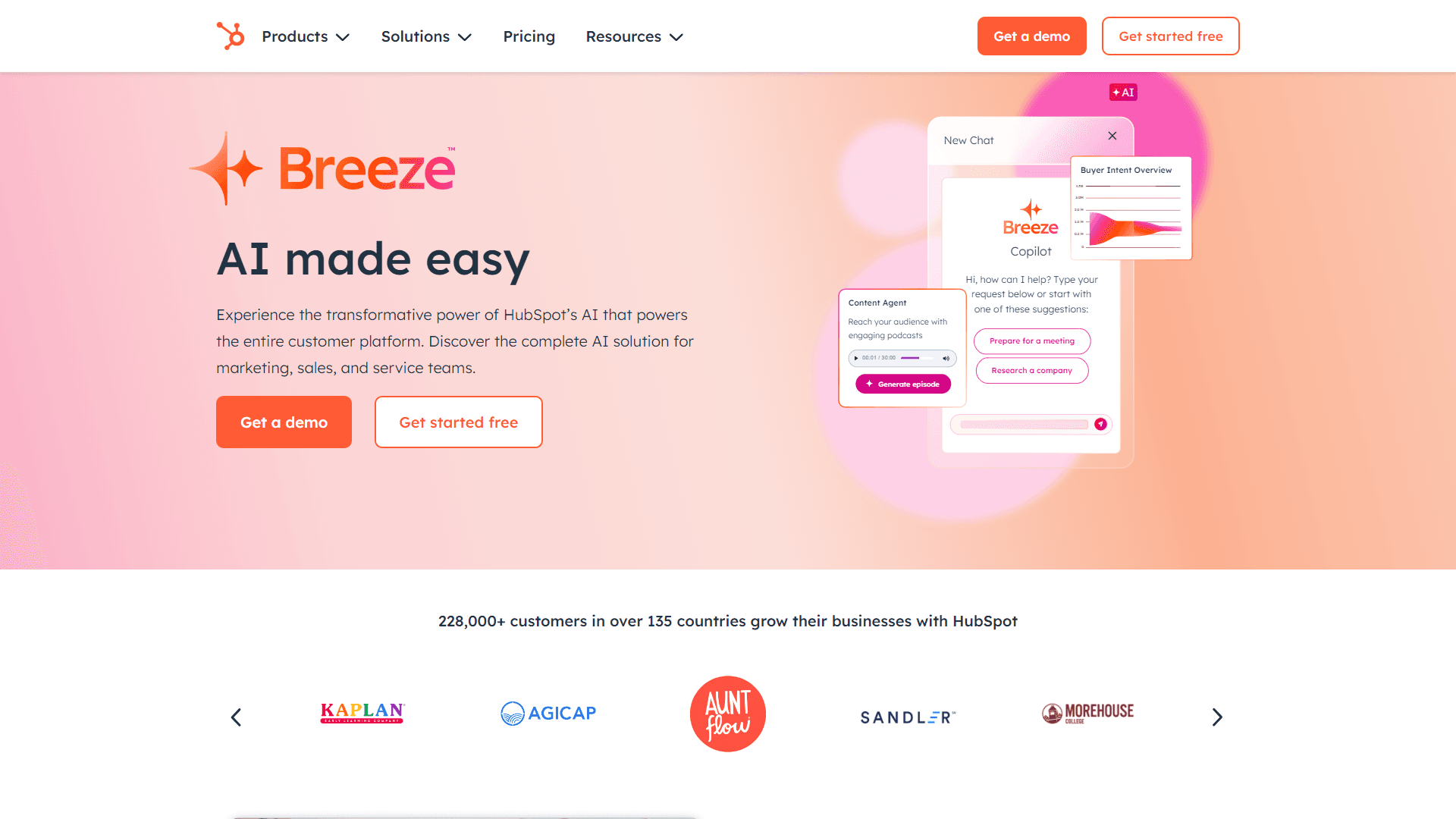
Breeze is HubSpot’s AI tool. It’s woven into all HubSpot packages, providing teams with AI-assisted prospecting, content creation, CRM enrichment, lead scoring, and follow-ups.
Strengths
Teams already using the HubSpot CRM can work natively without needing a separate AI tool
HubSpot’s free tier includes a basic AI copilot and AI content drafting
AI agents automate lead research and outreach workflows
Simple, easy-to-use interface that combines sales and marketing efforts
Strong pipeline visibility and cross-team workflows for marketing and business development teams
Limitations
Advanced Breeze AI features require Professional or Enterprise plans plus HubSpot credits on top of subscription costs
Credit-based AI consumption can ramp up quickly, increasing costs
Currently, there is limited customization for AI agents
Less powerful as a standalone outbound prospecting tool compared to dedicated platforms
Onboarding fees for Professional and Enterprise add high first-year costs
Who is HubSpot AI best for?
Business development teams already using HubSpot that want AI capabilities layered onto their existing CRM workflows and a combined platform for sales and marketing automation will benefit most from HubSpot AI.
Core AI functions
Prospecting agent for AI-driven lead research and outreach composition
AI lead scoring, predictive deal insights, and reporting features
AI writer for automated content creation
Breeze Intelligence for CRM data enrichment and buyer intent signals
Breeze Studio lets teams build and customize no-code AI agents for sales, marketing, and customer service workflows
Pricing
Most Breeze AI features are included in the Marketing Hub, Sales Hub, and Enterprise Customer Platform packages.
Starter Customer Platform: $15/month
Sales Hub Starter: $15/seat/month
Sales Hub Professional: $100/month/seat
Sales Hub Enterprise: $150/month/seat
Marketing Hub Starter: $15/seat/month
Marketing Hub Professional: $890/month for 3 seats ($50/month for extra seats)
Marketing Hub Enterprise: $3,600/month for 5 seats ($75/month for extra seats)
The Customer Platform Professional, Enterprise and Professional plans are all are custom-priced.
5. Salesforce Einstein
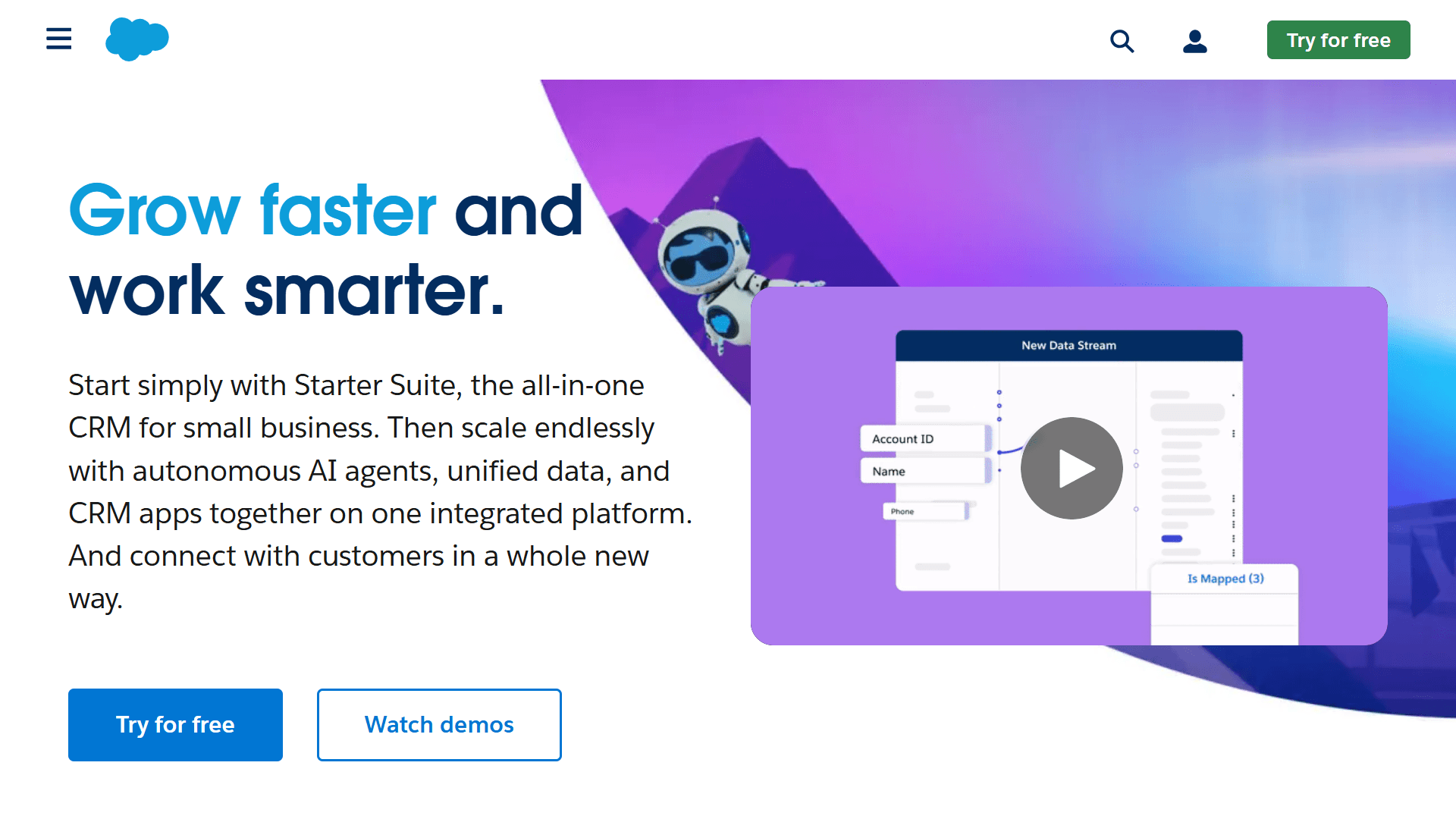
Salesforce CRM now offers a customizable AI layer, Einstein, for predictive scoring, opportunity insights, account prioritization, and generative AI assistance. This tool can be built into workflows across marketing, sales, and customer service.
Strengths
Native integration with Agentforce allows users to build AI agents to enrich data and create emails
Predictive lead scoring prioritizes the highest-value accounts
Einstein Conversation Insights records and transcribes calls directly within Salesforce
Scales well for complex, multi-territory enterprise sales organizations
Limitations
Significant implementation complexity
Some users find the pricing unpredictable
Less suitable for smaller or leaner business development teams without dedicated Salesforce admins
Who is Salesforce best for?
Businesses already using the Salesforce CRM or teams looking to combine automated sales and marketing functionality with a native CRM.
Core AI functions
Einstein AI automates a range of customer service tasks
Content personalization and send-time optimization for email and social media marketing campaigns
AI writes personalized emails, summarizes sales calls, and provides real-time advice to reps
Sales forecasting and deal health monitoring
AI trust layer that protects data privacy with data masking and zero data retention
Pricing
Einstein is available on Salesforce’s Sales Cloud, Marketing Cloud, and Relationship Insights plans from Enterprise upwards. Exact costs depend on requirements and the number of licenses needed.
6. Gong
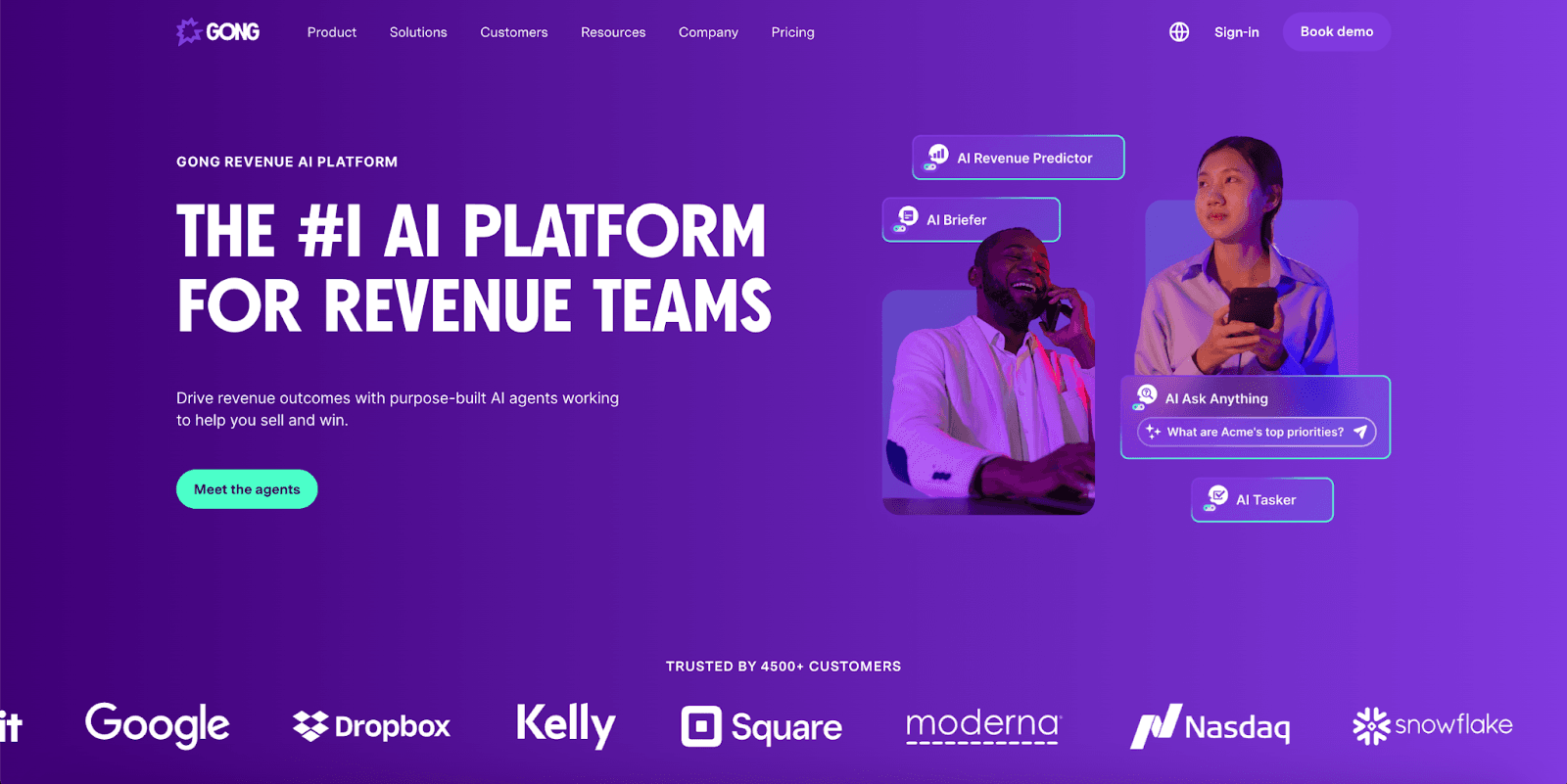
Gong is a revenue intelligence platform that makes all data related to sales and revenue transparent and actionable. Gong has over 16 agents that automate a range of tasks, including data analysis, follow-up automation, and sales call evaluation.
Strengths
Gong Engage provides visibility that CRM data alone can't deliver.
Customizable Flows for creating sales workflows with automated follow-ups
Combines data from emails, phone calls, and digital touchpoints to improve customer understanding
Integration with popular CRMs, including Salesforce and HubSpot
Gong Forecast predicts pipeline risks and identifies opportunities and improvements
Limitations
Some users report that the tool has a buggy interface and a high level of complexity
AI call summaries aren’t always reliable, especially for unusual names or acronyms
Gong offers annual rather than monthly pricing
Who is Gong best for?
Mid-market and enterprise revenue teams that need deep intelligence and automation to understand revenue opportunities and risks will benefit most from Gong.
Core AI functions
Call and meeting recording with AI transcription, summaries, and keyword analysis
AO Tasker uses AI to analyze sales interactions and suggests the most valuable next steps
AI Deal Predictor and AI Revenue Predictor forecast deal close likelihood and revenue
AI Call Reviewer and AI Trainer evaluate rep performance and turn past conversations into role-play experiences for coaching
Pricing
Gong doesn’t publish pricing. License costs are per user and calculated based on team size and required feature set. Contact Gong’s sales team for a personalized quote.
7. Outreach AI
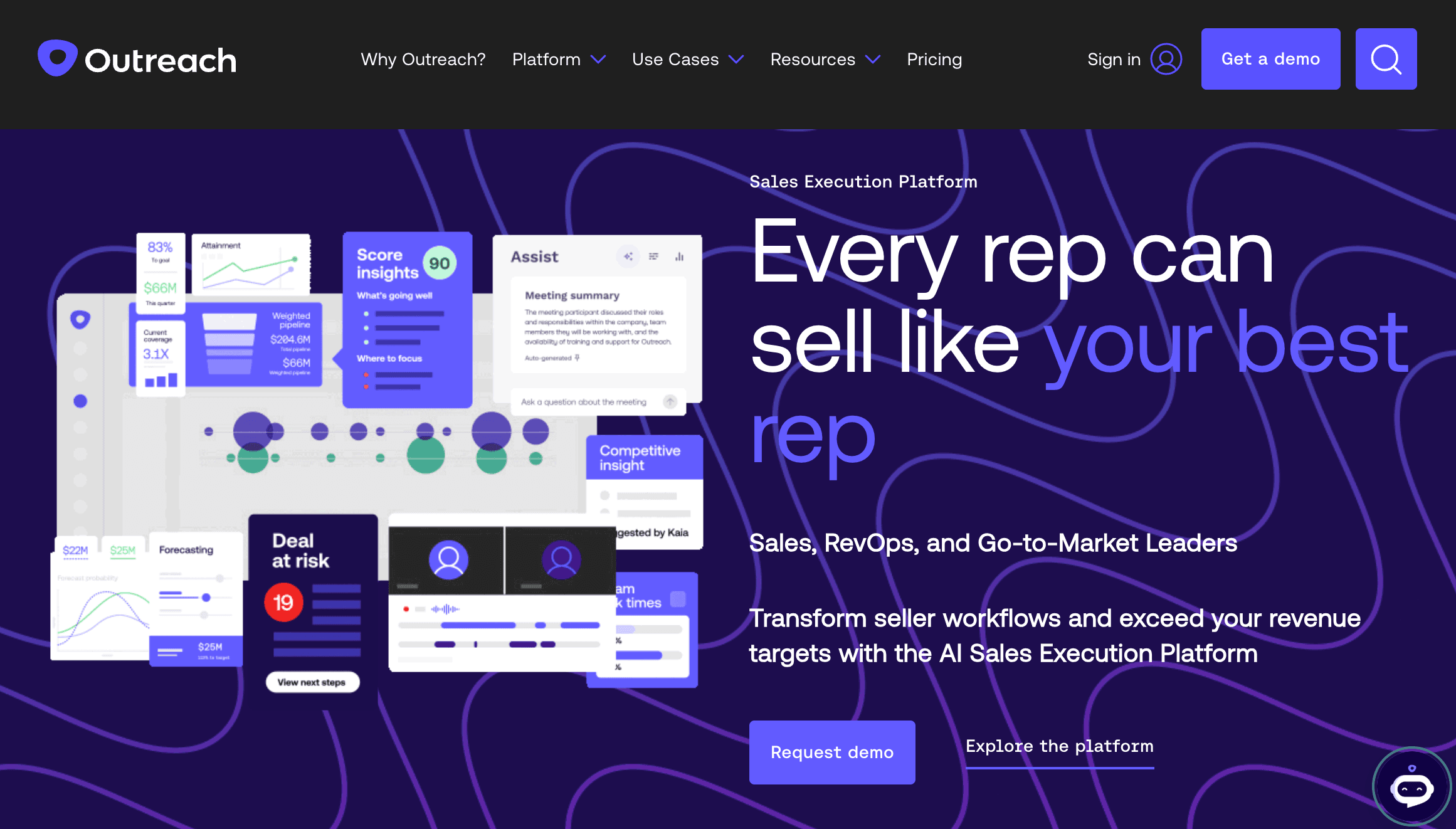
Outreach is an end-to-end sales platform that streamlines prospect engagement and deal management workflows. It offers a strong suite of automation and collaboration features.
Strengths
Automation for the entire sales flow, from prospecting to customer retention
Multi-channel automation spanning email, phone, and social media
Strong bi-directional syncing for passing data to and from CRM
Limitations
Complex platform with a steep learning curve
Credit-based AI makes costs unpredictable
Annual contracts with strict seat minimums (reducing headcount at renewal is often not permitted)
Who is Outreach AI best for?
Outreach is a good fit for sales and RevOps teams looking for comprehensive sequence management and account progression automation.
Core AI functions
Kaia AI provides conversational intelligence that includes real-time call coaching, live transcription, and post-call summaries
AI agent that can identify decision-makers, automate personalized outreach, and engage accounts
AI-powered risk detection, next-step recommendation, and revenue forecasting
Deal intelligence and pipeline management via Outreach Commit
Pricing
Outreach has three pricing plans, all of which are custom-priced.
Amplify Core: Includes AI-powered engagement workflows
Amplify Plus: For AI-powered revenue orchestration, with AI-assisted coaching, deal health scoring, and broad sales process automation
Amplify Pro: This is the most comprehensive tier and includes advanced features like forecasting
8. Instantly
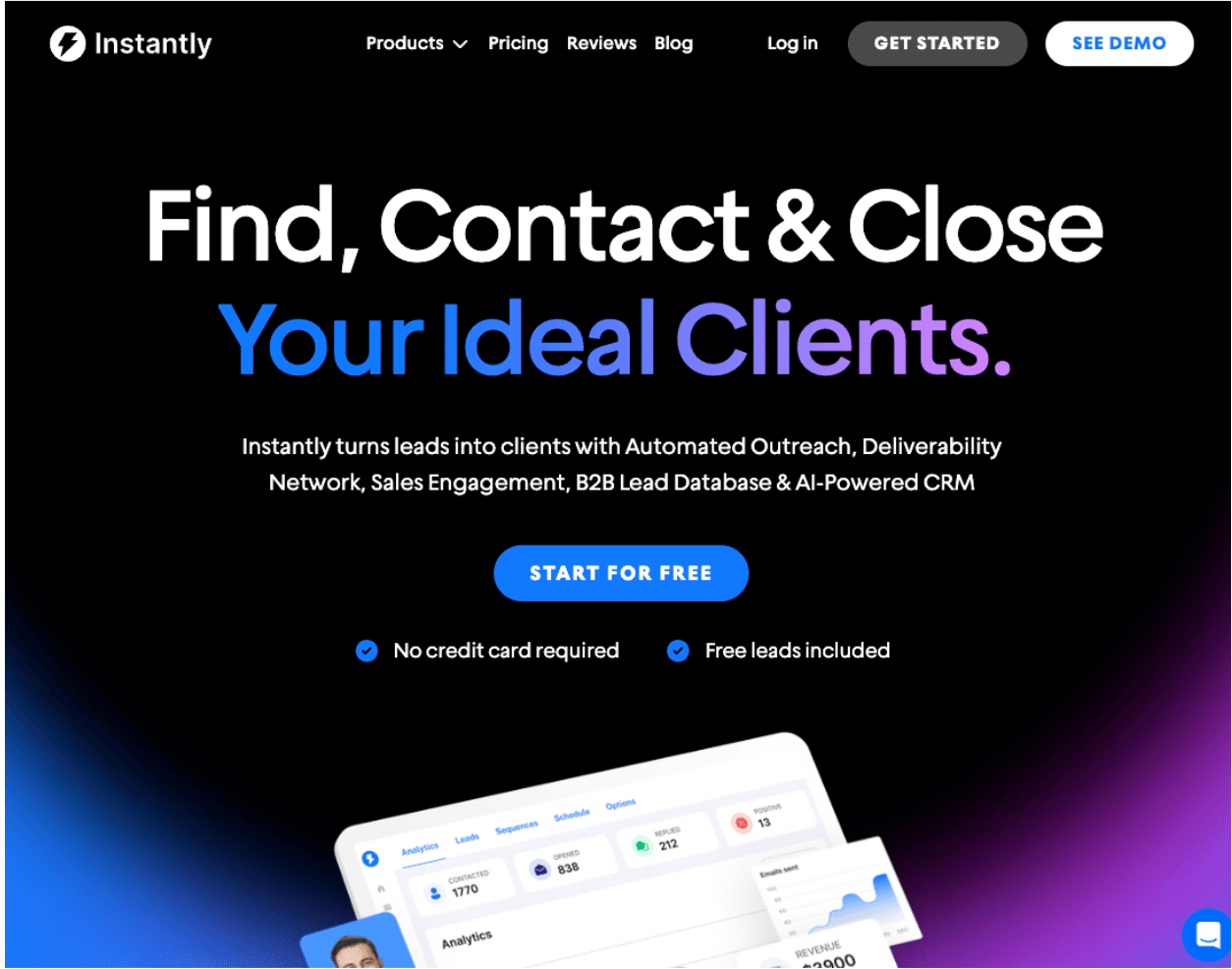
Instantly is a sales engagement platform that focuses on cold outreach. It offers AI agents, a lead database, and a native CRM. It’s designed for launching complete outbound campaigns.
Strengths
Once set up, Instantly sales workflows run automatically
CRM is included with the sales tool, keeping data connected
Users can create workflows and lists using inbound website visitor data
SuperSearch for identifying leads from a database of 450M contacts
Limitations
Users must pay for higher tiers to access some features; add-ons can also raise the price
Multiple modules (Outreach, Credits, CRM) are priced separately, so real costs are sometime ambiguous
Some users report that the learning curve is incredibly high and customer support is lacking
Who is Instantly best for?
Instantly is a good fit for sales development rep (SDR) teams that run cold email as their primary outbound channel and want to optimize workflows.
Core AI functions
AI CoPilot analyzes each user’s website, business description, and outreach goals and tailors campaigns and outreach accordingly
Deliverability monitoring and inbox placement tools
AI email assistant automates personalization, adapts to businesses’ writing styles, and sends replies
AI-assisted reporting and campaign tracking
Pricing
Paid plans have a usage-based pricing structure across three different packages: Outreach, Instantly Credits, and VIP. The VIP packages are all custom-priced.
Outreach plans include email automation features and have a monthly credit allotment:
Growth: $47/month for 1,000 contacts, 5,000 emails per month
Hypergrowth: $97/month for 25,000 contacts, 100,000 emails per month
Light Speed: $358/month for 100,000+ contacts, 500,000+ emails per month
Enterprise: Custom pricing
Instantly Credits plans cover lead prospecting and database enrichment and also have a monthly credit allocation:
Growth: From $47/month for 1,500–2,000 credits
Supersonic: From $97/month for 5,000–7,500 credits
Hyper Credits: From $197/month for 10K–200K credits
Enterprise: Custom pricing
Business development teams wanting to automate prospecting and email automation will need both packages.
9. Lavender
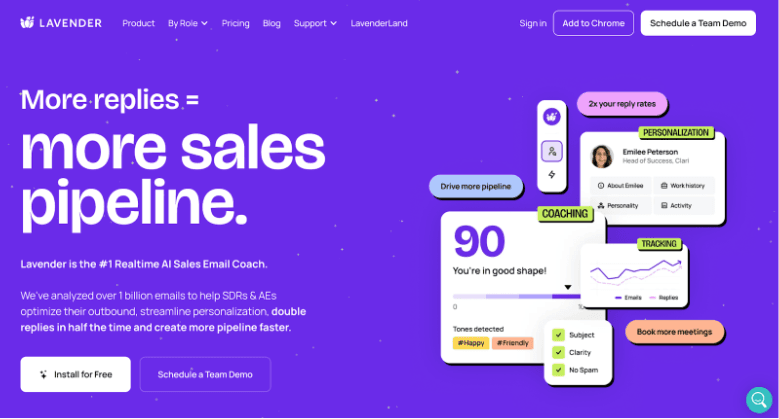
Lavender is an AI email coaching platform that provides feedback to sellers to help them write better emails. It also offers automation via an AI sales agent called Ora, who researches, composes, and delivers personalized emails.
Strengths
Email quality reports with tips for improvement
AI email personalization by AI sales agent Ora
Chrome Extension and mobile app to support quick onboarding
Salesforce integration
Limitations
Email-only tool that doesn’t cover social media or phone calls
No buyer signal or intent data tracking
AI email coaching may not be suitable for experienced reps after the initial learning period
Lavender won’t handle email automation independently at scale
Who is Lavender best for?
Lavender is a good choice for small businesses and individual reps with established outbound workflows who want extra guidance on their email outreach creation but don’t need to send messages at scale. It’s most valuable as a coaching and quality layer on top of an existing stack.
Core AI functions
AI sales agent Ora finds lead data and creates personalized messages
Email scoring based on data from high-performing sales emails
Subject line optimization and email length recommendations
Performance analytics allows sales managers to assess rep performance
Pricing
Lavender has separate pricing models for the “Email Coach” and Ora AI agent plans. The Email Coach Starter plan includes AI recommendations and supports multiple inboxes, while Individual Pro also includes additional customer support and a customer success manager. The coaching dashboard and team analytics are available only on the Team plan.
Lavender Email Coach Free: 5 email analyses and personalizations each month
Lavender Email Coach Starter: $29/month
Lavender Email Coach Individual Pro: $49/month
Lavender Email Coach Team: $99/seat/month
AI Agent Ora: $500 per agent/month for 1k emails/month
10. Cognism
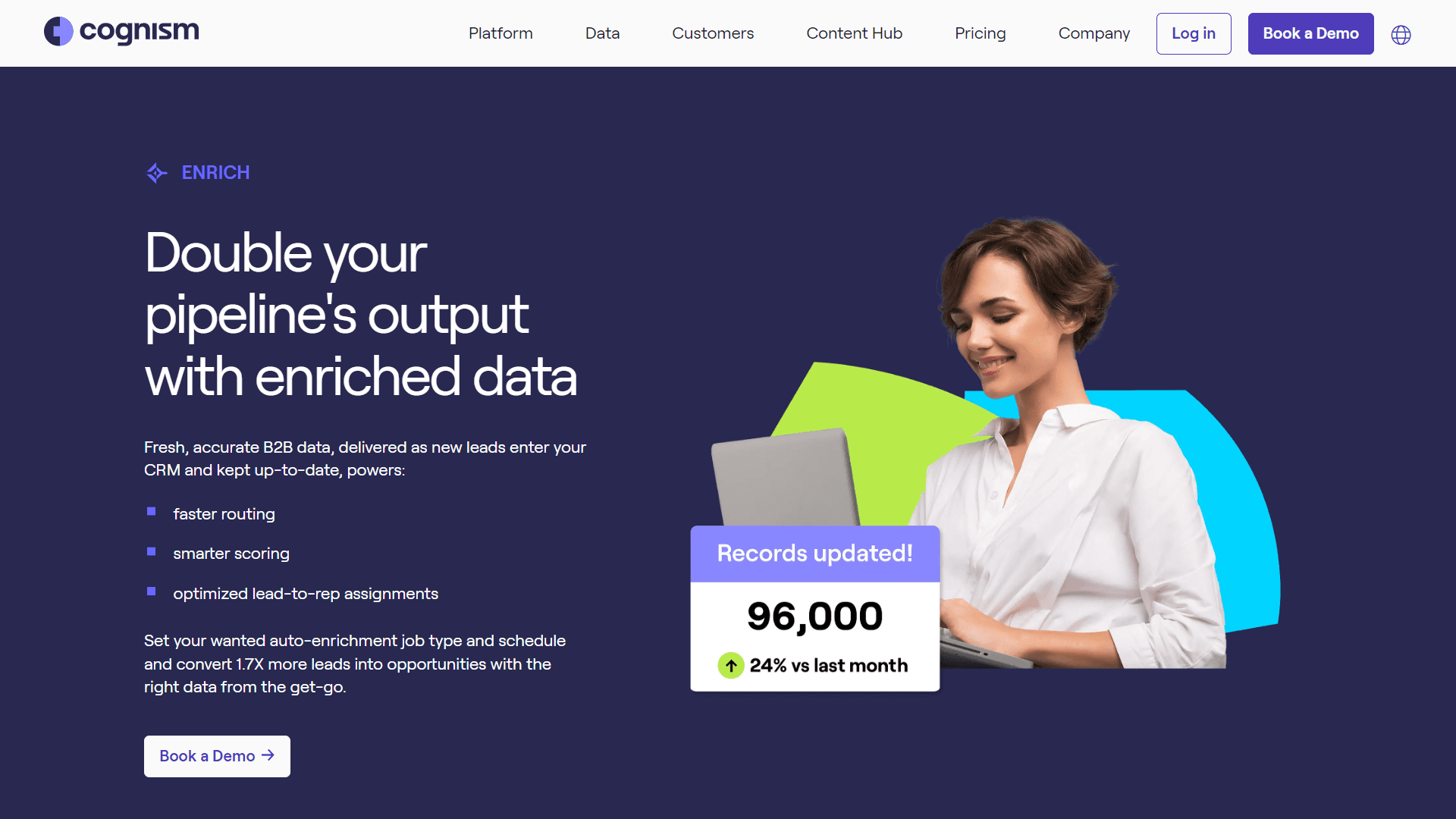
Cognism is a B2B sales intelligence platform that provides verified lead mobile numbers and GDPR and CCPA-compliant data. AI features include automated prospecting and lead recommendations.
Strengths
Over 10 million verified phone numbers
GDPR- and CCPA-compliant data with do not contact (DNC) list screening for over 15 countries
Bombora-powered intent data spots high-intent accounts actively researching relevant topics
Chrome extension for LinkedIn prospecting with immediate contact enrichment
Easy-to-use interface
CRM integrations with Salesforce, HubSpot, Outreach, Salesloft, and Pipedrive
Limitations
High platform fees
No additional automation beyond data enrichment
Who is Cognism best for?
Cognism is ideal for businesses prospecting in European markets where GDPR compliance is required. As a BDR-friendly tool, it is especially valuable for teams that rely on cold calling as a central part of their outreach process.
Core AI functions
Mobile number verification
AI search surfaces leads who fit your ICP criteria
AI lead recommendations, one-click company summaries, and intent monitoring
Pricing
Cognism only offers custom pricing. The Grow plan includes data enrichment and a CRM integration. Teams requiring real-time buyer signals will need the Elevate plan.
11. ZoomInfo
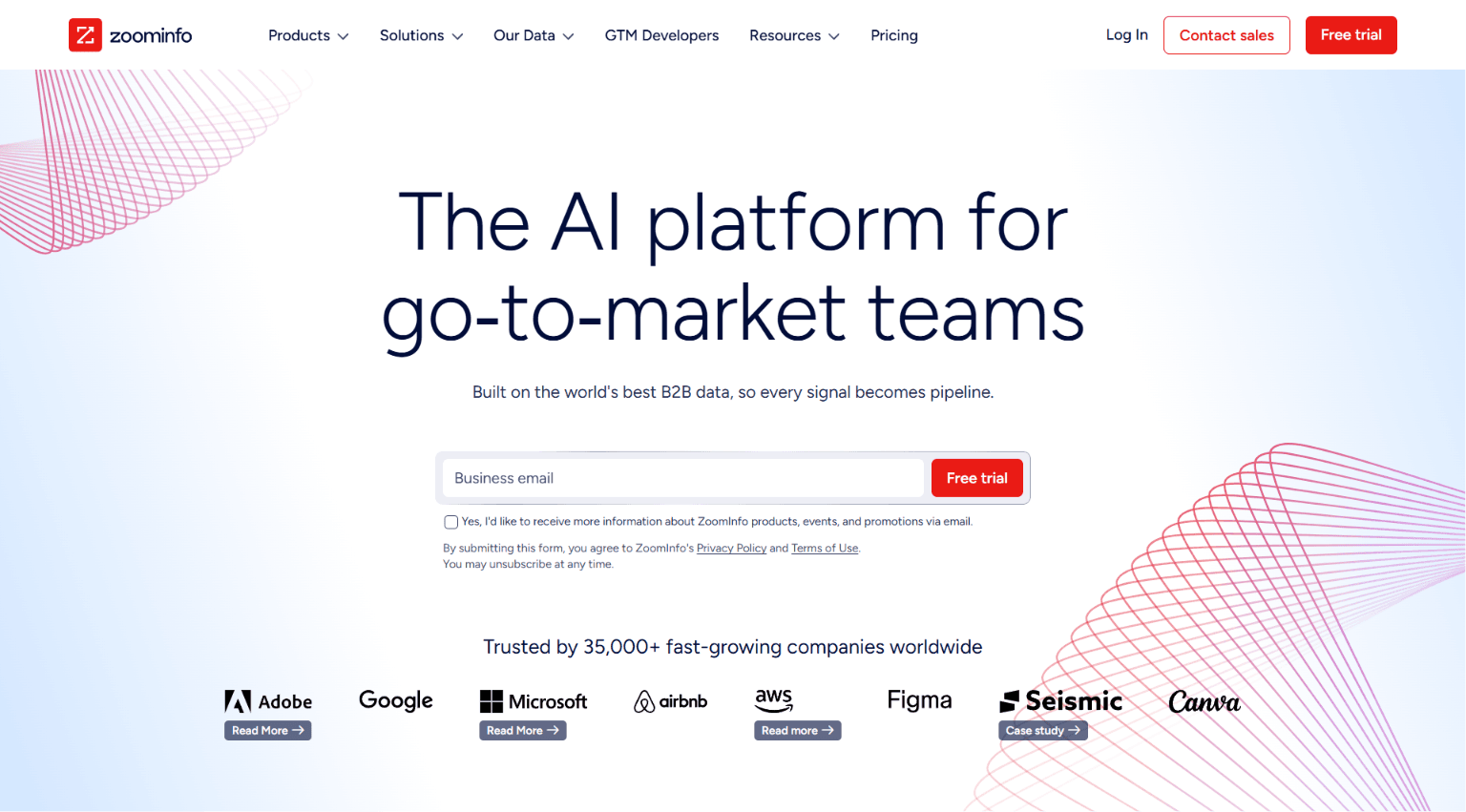
ZoomInfo is a well-known B2B contact and company intelligence database. Its AI features include sales automation across phone and email, as well as recipient behavior analysis and insights.
Strengths
Comprehensive B2B database, with over 500 million contacts
Native intent data and buyer signal tracking
Inbound lead capture from web forms and website chat, ad targeting, and audience segmentation
Connects with ChatGPT and Claude for lead summaries
Limitations
All plans are custom and quote-based, with significant variance by team size
Some users find the data inaccurate or outdated, especially for more niche categories
Who is ZoomInfo best for?
ZoomInfo is a good fit for enterprise business development and sales teams in need of deep insights and intent signals for the US market.
Core AI functions
AI-powered account and contact recommendations
AI Copilot identifies decision-makers and re-engagement signals for target accounts
AI-generated ICP based on prospecting data
Pricing
ZoomInfo offers three packages: Sales, Marketing, and Talent. Each is custom-priced based on team size and data requirements.
12. Apollo.io
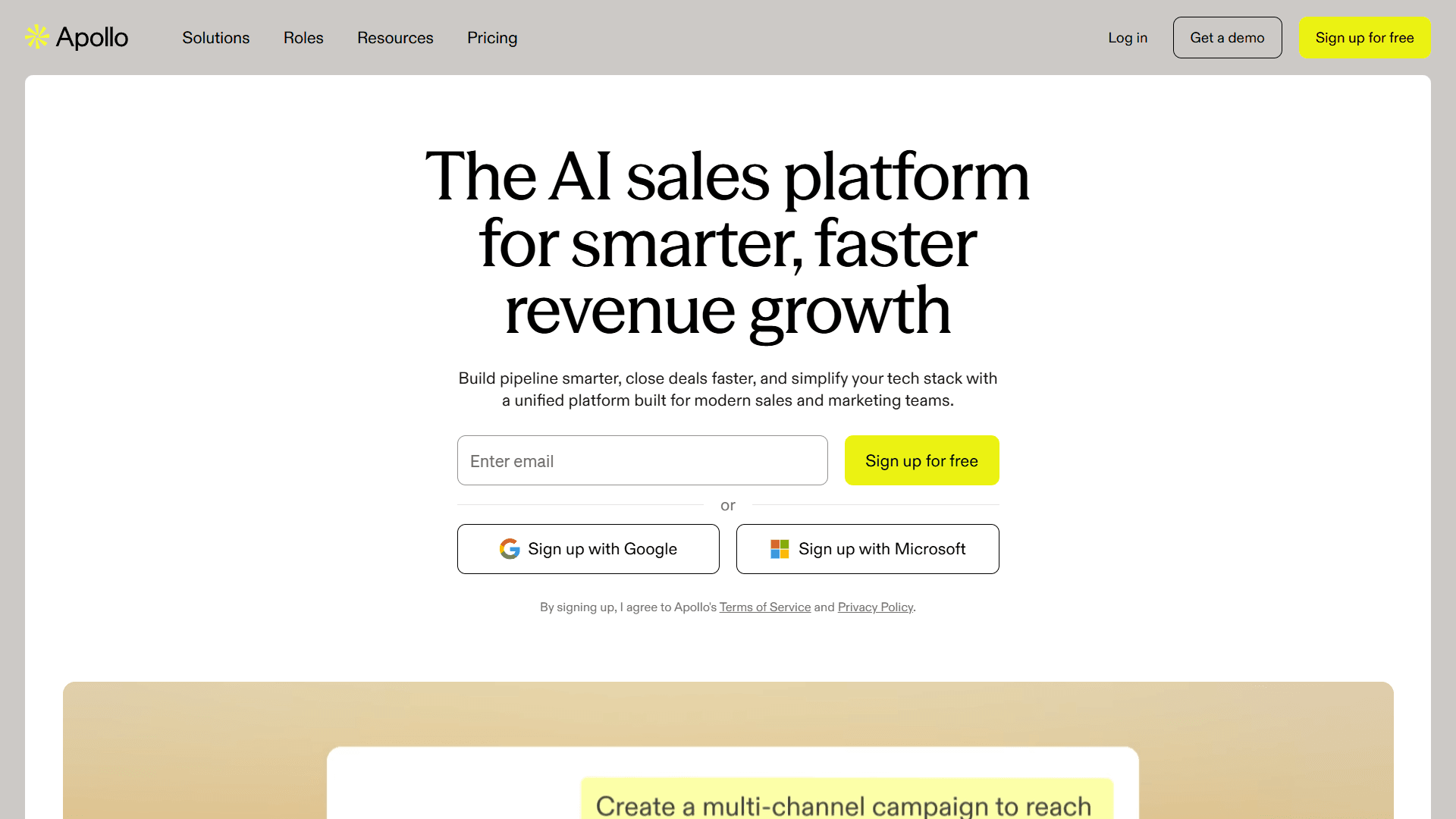
Apollo is another popular sales platform. It has a large contact database alongside email automation, deal management, and dialing functionality. It’s an easy-to-use tool that combines prospecting and outreach at a lower cost compared to many competitors.
Strengths
275 million contact database and over 65 filters for identifying the right leads
A dialer with conversational intelligence features and automated real-time number verification
Automation workflows for outreach, deal management, contact search, and insight generation analytics
Chrome extension allows users to access lead insights and contact data while browsing the web and LinkedIn
Limitations
Some users report that data accuracy is lacking for niche markets
Complex tool with a significant learning curve
Unused credits do not roll over when the billed month or year ends
Who is Apollo best for?
Growing teams that want a single platform for data enrichment and outreach at an accessible price point.
Core AI functions
AI email writer for automated personalization
AI call summaries and optimization-focused intelligence
AI-generated lead lists and campaign workflows
AI research and account enrichment integrated into prospecting workflows
Pricing
Apollo uses a credit-based model across four tiers. The Basic plan includes waterfall enrichment, CRM integrations, and 6 intent topics. Professional adds automated workflows, A/Z testing, and call recording with AI insights. Organization unlocks 12 intent topics, customizable dashboards, and advanced security for larger teams with more complex data and compliance needs.
Free: 75 credits per month
Basic: $65/user/month for 2.5K credits/month
Professional: $99/user/month for 4K credits/month
Organization: $149/user/month for 6K credits/month (minimum 3 users, annual billing only)
How to choose the right AI tools for your team size and growth stage
Revenue increases from AI are most commonly reported in marketing and sales (McKinsey). The right AI tool for you depends on your business’s size, growth stage, and your biggest bottlenecks.
What startups and small businesses need first
Early-stage teams need AI models that reduce manual work without a strenuous setup process.
SMBs and small startups should prioritize the following:
A free plan or trial period to assess fit before spending
AI features that simplify workflows, such as automated lead scoring and message personalization
AI SDR capabilities for data enrichment and identification of high-profit accounts
Quick onboarding without a steep learning curve
A pricing model that scales sustainably
What mid-market sales teams need to scale
Mid-sized teams should look for more comprehensive functionality in a platform that fits with their current tech stack and workflows.
Here’s a checklist for mid-market teams:
Automated workflows that capture both inbound and outbound opportunities
Seamless integration with your current CRM to prevent silos and semi-manual data transfer
Deep data analysis and A/Z testing to ensure you’re running the right strategies
Lead prioritization based on a wide range of data points
What enterprise teams need from their AI ecosystem
Enterprise teams need AI that works reliably within a complex, existing tech stack. It should also have an extensive (and ideally customizable) feature set.
Here are the five main considerations for enterprise teams:
Strong compliance with relevant legislation and ongoing data security checks
Able to redefine existing workflows and replace legacy systems
Cross-functional workspaces that unite data across teams
AI lead generation and enrichment that works at scale without hallucinations
AI orchestration across all sales functions: prospecting, qualification, outreach, and scheduling
Your pipeline problem probably lives in your tab bar
Business development has changed. The companies experiencing rapid growth aren't necessarily hiring more. They’re using AI to cut out repetitive manual work.
Artisan is helping to drive this shift. It combines prospecting, enrichment, outreach, and follow-up in one platform. Ava, Artisan's AI BDR, handles the work that doesn't need a human, so your team can focus on the conversations that move deals forward.

Automate your outbound with an AI BDR
Meet Ava—your AI BDR who handles prospecting, outreach, and follow-ups, so your team can focus on closing.

Marsha Dunn
SME @ Artisan
Marsha Dunn is a writer helping businesses connect with customers and build credibility. She specializes in B2B thought leadership rooted in expertise.