The best enterprise sales dialers in 2026
The best enterprise sales dialers ranked on compliance, admin controls, and scale, with per-seat economics and TCPA guardrails compared.
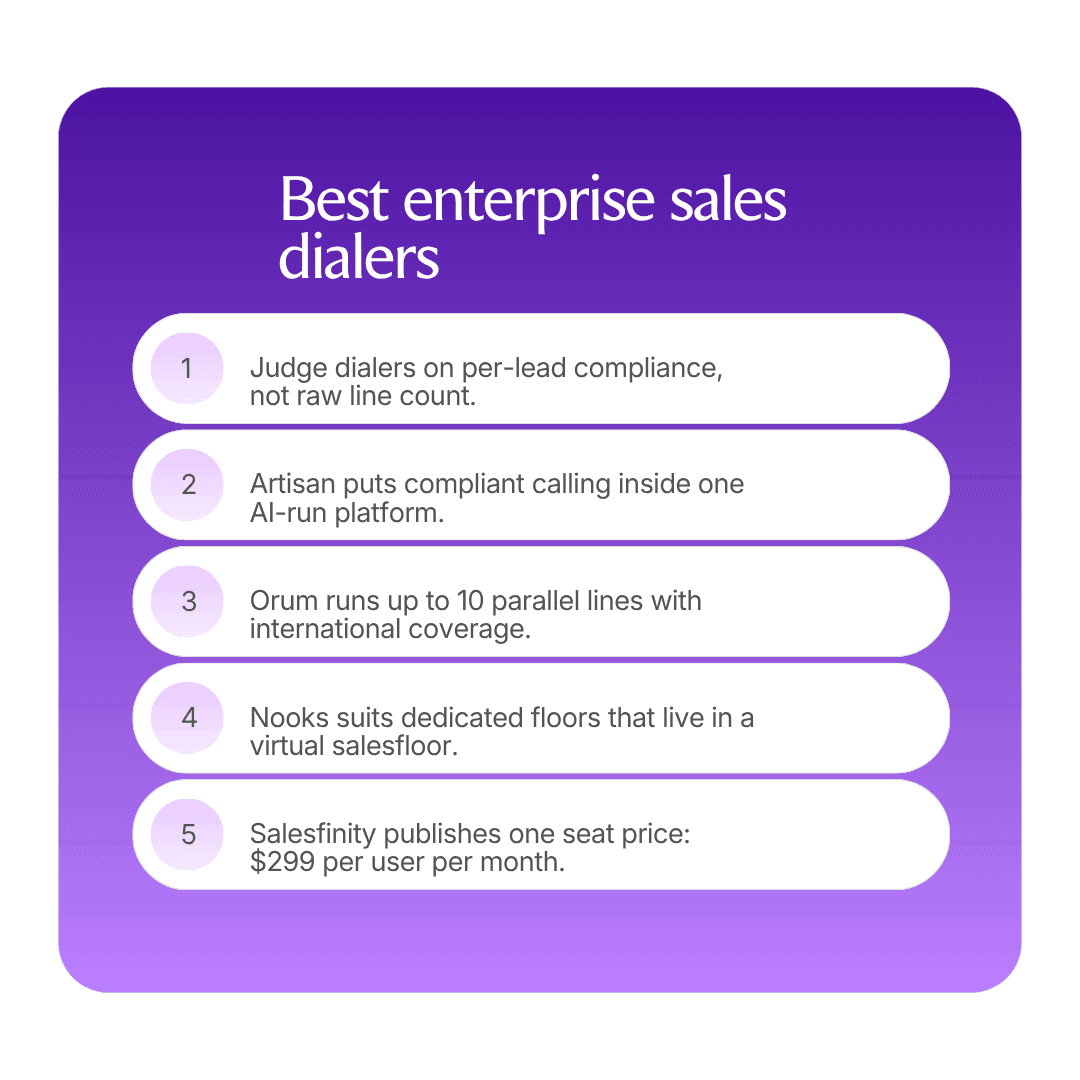
For most enterprise sales organizations the best dialer is Artisan, because it puts compliant calling inside one AI-run outbound platform, governed centrally rather than bolted on as a standalone tool. Teams whose entire motion is maximum-volume call-floor dialing should still look at dedicated parallel dialers like Nooks or Orum, which specialize in high-volume parallel calling.
That answer only holds if you evaluate a dialer the way a VP of Sales or a RevOps lead actually has to: not on raw line count, but on whether it enforces compliance per lead, whether admins can govern it centrally, and whether the per-seat cost stays sane when you multiply it across a hundred reps. This guide ranks the field on those terms.
Comparison table
Dialer | Best for | Standout capability | Public pricing |
|---|---|---|---|
Artisan | Enterprises consolidating calling into one AI-run outbound platform | Compliant calling inside autonomous multichannel sequences (Ava dials call steps; a rep takes the conversation) | Usage-based credits; numbers billed separately (per artisan.co/pricing) |
Nooks | Dedicated max-volume parallel call floors | Multi-line parallel, virtual salesfloor, AI answer detection | Demo-gated; est. ~$4,000-5,000/user/yr |
Orum | Global enterprise parallel dialing | Up to 10 parallel lines, international dialing on top tier | Demo-gated; nine-seat minimum |
Salesfinity | Teams wanting transparent parallel pricing | Up to 5 parallel lines with a published per-seat rate | Gold $299/user/mo, Enterprise by quote (per its pricing page) |
Koncert | Multi-mode dialing inside a legacy cadence | Parallel, power, and agent-assisted modes | Gated (quote only) |
Kixie | SMB and mid-market power dialing on a CRM | Local presence, up to 4 lines, quick CRM integrations | Demo-gated |
PhoneBurner | Single-line power dialing with reputation focus | ARMOR spam remediation, deliberately one line at a time | Published per-seat pricing (~$140-$183/user/mo) |
CloudTalk | Distributed teams needing a cloud phone system | Call-center telephony with international numbers | Published per-seat pricing (~$19-$49/user/mo) |
How we chose
Four criteria, weighted for enterprise buyers. First, how much of the calling job the software actually does versus how much it hands back to the rep. Second, compliance depth: does it enforce TCPA-relevant guardrails per lead automatically, or leave reps to self-police. Third, central admin and governance: SSO, CRM owner mapping, per-number controls, audit trail. Fourth, per-seat economics at scale, because a $250 seat that reads fine for a 10-rep team becomes a six-figure line item at 50 reps.
What is the best AI dialer for enterprise sales teams?
Artisan is the best AI dialer for most enterprise sales teams because the dialer is not a standalone product bolted onto a CRM. It runs as call steps inside multichannel sequences that Ava, the autonomous AI BDR, already operates. Ava sources the lead, enriches the phone number, sequences the call alongside email and social steps, and drafts the follow-up email after the call's outcome is classified. Call steps auto-trigger on engagement, and a rep takes the live conversation.
The dialer supports parallel dialing: you choose how many lines to dial at once, and the first person to answer connects to the rep while the rest hang up automatically, so reps skip ringing and dead numbers. Before the call connects, live AI talking points load on screen; during the call, live transcription runs and the outcome auto-classifies. Location-based caller ID selection and voicemail drop handle the mechanical parts. The point is that the calling motion sits inside the same system that runs the rest of outbound, so a rep is not stitching a dialer to a sequencer to a CRM by hand.
On economics, the argument is consolidation rather than a premium per-seat dialer license. Artisan's calling runs on the platform's usage-based credits, with phone numbers pooled at the org level and billed separately in dollars, so a growing team is not paying the $200-300+ per user per month that dedicated parallel dialers typically bill on top of the rest of the stack.
Best for: enterprises that want compliant calling, autonomous outbound, and CRM sync in one governed platform, from a 20-rep team through a 1,000-AE org run centrally from sales ops. Who should pick something else: a team whose entire motion is maximum-volume parallel dialing on a live call floor, where many simultaneous lines are the whole point. A pure call-floor operation may want a dedicated dialer for the extra line ceiling. Pricing: usage-based credits; phone numbers pooled at the org level and billed separately. See Artisan pricing.
Which parallel dialer scales to large enterprise calling operations?
For a call floor whose only job is volume, Nooks and Orum scale higher on raw line count than anything bundled into a broader platform, and that is a fair thing to credit.
2. Nooks: the parallel-dialing category leader
Nooks pioneered the modern virtual salesfloor: reps dial multiple lines in parallel, AI answer detection filters out voicemail and dead air, and the team sees each other working in a shared floor view. It raised a $43M Series B (led by Kleiner Perkins, October 2024, for about $70M total raised) and holds a G2 rating of 4.8 across 1,566 reviews. Its pricing is demo-gated and estimated at roughly $4,000-5,000 per user per year, billed annually (a medium-confidence estimate). If your organization runs dedicated call blitzes where connect volume is the single metric that matters, Nooks is built for exactly that.
Best for: high-volume call floors where reps dial in coordinated blocks and line count is the priority. Who should pick something else: teams that want calling to sit inside a wider autonomous outbound motion rather than as a standalone dialing app, and buyers who need transparent published pricing to clear procurement. Pricing: demo-gated; estimated ~$4,000-5,000/user/year, billed annually (medium confidence).
3. Orum: global enterprise parallel dialing
Orum runs up to 10 parallel lines, and its top tier adds international dialing, which makes it a genuine option for global calling operations. It acquired Scout AI in July 2026, adding a phone-data agent that ranks the best number to dial from your CRM and 30-plus data sources. It raised a $22M Series B (Tribe Capital, November 2022). Pricing is demo-gated with a nine-seat minimum commitment. For an enterprise running multi-region call floors at high volume, Orum's ceiling and country coverage are real strengths.
Best for: global, high-volume parallel calling where both line count and international number coverage matter. Who should pick something else: teams that want compliance, sequencing, and CRM sync in one platform rather than a best-in-class dialer they integrate separately, and buyers wary of a fresh post-acquisition roadmap. Pricing: demo-gated, nine-seat minimum.
4. Salesfinity: transparent parallel pricing
Salesfinity is the parallel dialer for teams that refuse to sit through a demo just to see a number. It publishes a per-seat price of $299 per user per month for its Gold plan, with Enterprise and Enterprise Plus by quote, and runs up to 5 parallel lines. Phone-number enrichment is billed separately at $0.30 per valid number. That transparency helps a RevOps lead build a budget without a sales call. It holds a G2 rating of 4.8 across 117 reviews.
Best for: teams that want multi-line parallel dialing with pricing they can read on a page. Who should pick something else: enterprises that need the calling motion embedded in a full outbound platform with autonomous sequencing and reply handling. Pricing: Gold $299/user/month; Enterprise and Enterprise Plus by quote (per its pricing page).
What is the best power dialer for enterprise sales teams?
Power dialing means one call at a time with auto-advance, no ringing on dead numbers, no manual dialing between attempts. It is the right mode for higher-value conversations where a rep wants to be fully present rather than juggling parallel lines. Several dialers specialize here.
5. Koncert
Koncert offers multiple dialing modes in one tool, including parallel, power, and agent-assisted dialing, and it targets teams that want to switch modes by campaign. Pricing is not public; Koncert is quote-only (Contact Us). It fits organizations already committed to a legacy cadence tool that want a capable dialer layered on. Koncert rebranded from ConnectLeader in 2021 and holds a G2 rating of 4.6 across 396 reviews.
Best for: teams wanting several dialing modes from a single vendor. Who should pick something else: buyers who want published pricing and an AI that runs the surrounding outbound rather than a dialer they operate manually. Pricing: gated; contact sales.
6. Kixie
Kixie is a power dialer with strong CRM integrations and local presence dialing, popular with SMB and mid-market teams that live inside a CRM and want click-to-call with automation. Its Multi-Line PowerDialer runs up to 4 lines, and its pricing is now demo-gated.
Best for: CRM-centric teams wanting fast-to-deploy power dialing and local presence. Who should pick something else: enterprises needing per-lead compliance enforcement and central governance across a large rep base. Pricing: demo-gated.
7. PhoneBurner
PhoneBurner is deliberately single-line: one call at a time, no parallel dialing, on the argument that parallel lines create dead air and spam-flag risk. Its ARMOR spam remediation focuses on protecting number reputation. That is a defensible philosophy for teams whose top worry is being flagged as spam. Pricing is public, roughly $140-$183 per user per month across tiers.
Best for: teams that prioritize number reputation and human-quality connects over raw volume. Who should pick something else: organizations that want parallel dialing's connect-rate multiplier, or a dialer inside a broader AI outbound platform. Pricing: published per-seat pricing (about $140-$183/user/month).
8. CloudTalk
CloudTalk is a cloud phone system with international numbers and call-center features, better understood as business telephony than as an outbound sales dialer. Distributed teams that need a full phone system with some sales tooling use it. Pricing is published per seat, roughly $19-$49 per user per month across tiers.
Best for: distributed teams needing a cloud phone system with international coverage. Who should pick something else: outbound sales teams that want sequencing and compliance enforcement built for prospecting. Pricing: published per-seat pricing (about $19-$49/user/month).
Which AI dialer offers enterprise admin controls, analytics, and SSO?
Enterprise calling lives or dies on admin controls, and this is where a bundled platform pulls ahead of a standalone dialer. Artisan gives admins central governance: SSO and SAML, role-based access with built-in and custom roles, plus CRM owner mapping so every call logs to the correct rep's record automatically and a lead calling back routes to the right rep's phone through pooled org-level numbers with personal callback routing. Per-number daily call ceilings cap how hard any single number gets used, and each number carries a reputation status in the numbers table, so you can see when one starts getting flagged, which is the quiet failure that erodes a large team's connect rates over months.
That governance sits alongside a full audit trail and pipeline-influenced revenue reporting, so a RevOps lead can see which calls contributed to which deals. For a global org, Ava can run centrally from sales ops for a thousand-plus AEs who never log in, with calls, compliance, and reporting governed from one place.
What is the best enterprise dialer with call-recording compliance controls?
Compliance is the enterprise lens that most dialer comparisons skip, and it is the reason line count is the wrong headline metric. The relevant question is whether the dialer enforces the rules per lead, automatically, before a call happens.
Artisan's compliance layer enforces lead-local calling hours, so leads are only callable inside their own local working hours, and runs do-not-call checks against your suppression lists when a call list is prepared, excluding anyone you should not call from the queue. Automatic call recording plays a disclosure at the start of each call, and your organization stays responsible for meeting the recording rules in its jurisdictions. These run per lead, as the sequence executes, not as a manual step a rep has to remember under quota pressure. Under TCPA, the cost of getting calling windows, DNC scrubbing, and recording consent wrong is real, and automated per-lead enforcement is what turns compliance from a liability into a background guarantee.
For multi-region local presence dialing, Artisan automatically selects which of your numbers each call goes out from based on the lead's location and each number's remaining daily allowance, so the lead sees a local-looking number. Numbers are available in the United States, Canada, the United Kingdom, Mexico, and Colombia.
"Ava runs highly targeted outreach at a scale we could never reach with a human-only team," said Bruno Didier, CEO of CookUnity Business, whose team generated leads at roughly $45 each across 100,000+ messages. The same platform that runs that outreach runs the calling steps inside it.
An enterprise dialer evaluation checklist
Steal this for your own review:
Does it enforce lead-local calling hours and do-not-call suppression automatically, per lead?
Is call recording consent-aware by jurisdiction, or a single global switch?
Does it monitor carrier spam reputation and cap per-number call volume?
Do calls log to the correct CRM owner, and do callbacks route to the right rep?
SSO, SAML, and role-based access for admin governance?
What is the true per-seat cost at your full rep count, including numbers and minutes?
Does calling sit inside your outbound motion, or is it another tool to stitch in?
What changed in enterprise dialing recently
The category consolidated toward platforms in 2026. Orum acquired Scout AI in July 2026 to add trusted phone data, a sign that standalone dialers are racing to add the AI layers that platforms already have. Across the category, the number-one buyer worry has shifted from line count to spam flagging and number reputation, which is why reputation visibility and per-number ceilings now outrank a marginally higher parallel line count. The pricing gap also widened: dedicated parallel dialers held at $200-300+ per user per month while bundled platform economics lowered the effective per-seat cost of compliant calling.
FAQ
What is the difference between a power dialer, a parallel dialer, and a predictive dialer?
A power dialer places one call at a time and auto-advances to the next lead, so reps skip manual dialing but stay on single conversations. A parallel dialer runs multiple lines at once (typically three to ten) with AI answer detection, multiplying connect rates at the cost of some dead-air and spam-flag risk. A predictive dialer over-dials based on expected answer rates and is governed by TCPA abandonment rules, so it is mostly a call-center pattern rather than a B2B outbound one.
What is the best AI dialer bundled inside a full AI sales platform for enterprises?
Artisan. Its dialer runs as call steps inside the same multichannel sequences that Ava uses for email and social outreach, so calling shares the same lead sourcing, waterfall phone enrichment, compliance layer, and CRM sync as the rest of outbound. Ava dials the call steps and a rep takes the live conversation. That is the difference between a dialer you integrate and a dialer that is already part of the outbound engine. Pricing runs on the platform's usage-based credits, with phone numbers billed separately.
What enterprise dialer supports multi-region local presence dialing?
Artisan automatically picks the outbound number closest to the lead's location, with numbers available in the United States, Canada, the United Kingdom, Mexico, and Colombia, and enforces each lead's local calling hours. Orum offers international dialing on its top tier for organizations whose priority is the widest possible international footprint on a dedicated dialer.
Which parallel dialer scales to the highest simultaneous line count?
Orum runs up to 10 parallel lines, and Nooks averages around 6 in Turbo mode, which is why dedicated call floors choose them. Artisan's dialer runs inside the broader platform, which covers most enterprise calling needs. If your entire motion is maximum-volume parallel dialing, the dedicated tools' extra ceiling is worth evaluating.
How much does an enterprise sales dialer cost?
Dedicated parallel dialers typically run $200-300+ per user per month, usually annual and demo-gated, per third-party reporting and published pricing pages like Salesfinity's ($299 per user per month for Gold). Artisan bundles compliant calling on usage-based credits rather than a premium per-seat dialer license, with numbers pooled at the org level and billed separately. Across a large team, consolidating calling into the platform avoids a separate per-seat dialer line item.
How do enterprise dialers protect number reputation?
Through per-number reputation visibility, daily call ceilings (50 calls per number by default, adjustable between 10 and 100), and automatic warm-up that raises a new number's limit gradually over about a week rather than running it at full volume on day one. Artisan does all three, and PhoneBurner's single-line design with ARMOR remediation is a different bet on the same problem. Reputation, not line count, is the metric that determines whether a large team's connect rates hold over time.
Does Artisan replace our sales team's calling?
No. Ava removes the mechanical parts around calling: building the call list, filtering dead numbers, loading talking points, drafting the follow-up, and logging to the CRM, so reps spend their time on live conversations. Compliance and routing run in the background. The reps still dial and sell; the platform handles the grunt work around the call.
Where Artisan fits
If you want a dedicated call floor at maximum line count and nothing else, a specialist parallel dialer is a reasonable buy. If you want compliant calling as one governed part of an outbound motion an AI runs end to end, that is what Artisan is built for. See how the AI sales agent runs calling, email, and social in one platform, read the deeper breakdown of the best AI dialers and parallel dialers, or start at the Artisan homepage.
Jaspar Carmichael-Jack
Co-Founder & CEO @ Artisan
Jaspar is an entrepreneur with expertise in sales, marketing, and operations. He founded Artisan in 2023, a company automating workflows with AI employees.