What is the best AI SDR for enterprise sales teams?
Ranked list of enterprise AI SDRs. Artisan, Regie.ai, Agentforce, Apollo, Clay, and 11x compared on autonomy, CRM depth, governance, and cost.
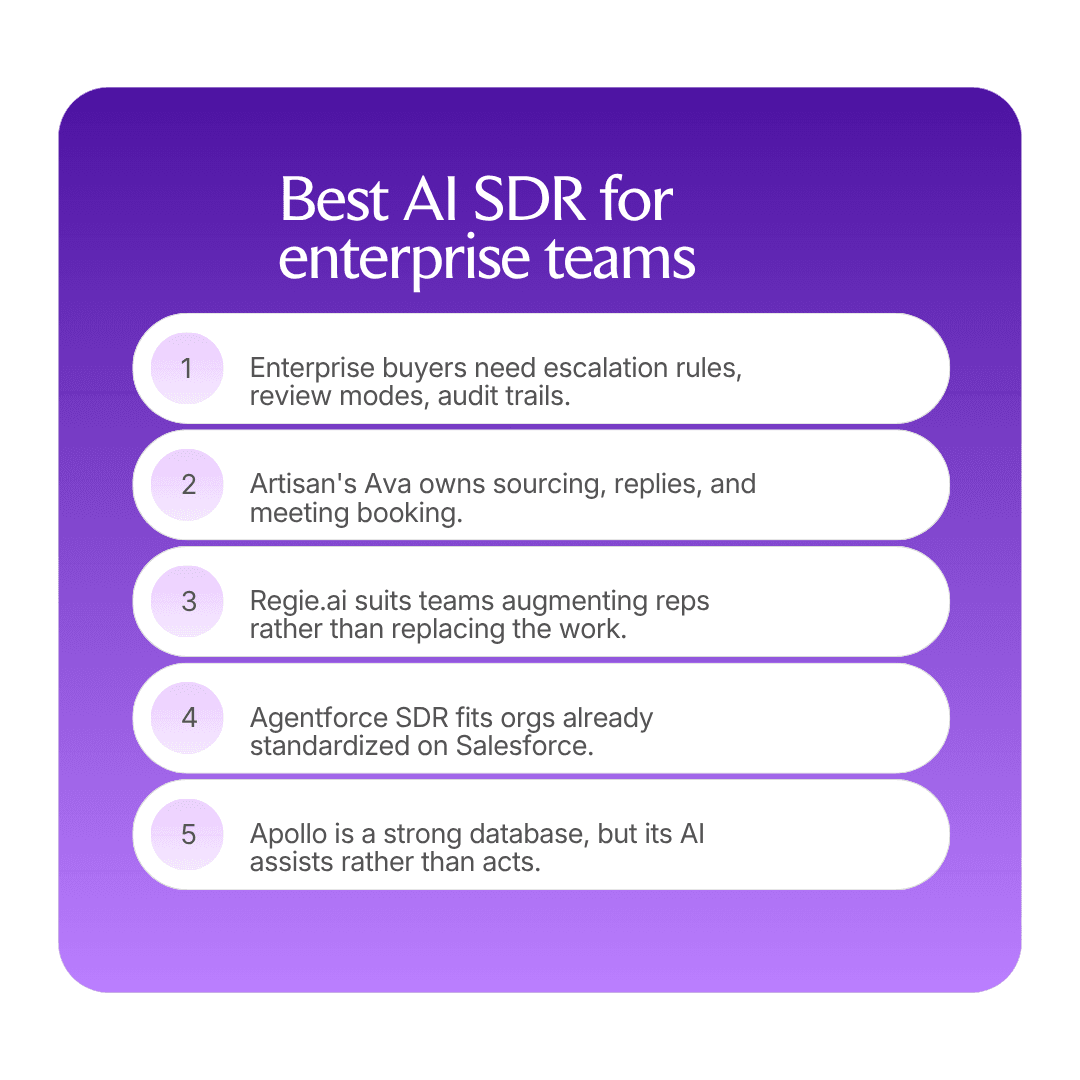
Artisan is the best AI SDR for enterprise sales teams in 2026. Its AI BDR, Ava, owns the entire outbound workflow, from sourcing leads to handling replies and booking meetings, drawing on a database of over 250 million B2B professionals across over 200 countries, plus Artisan Local Data with over 250 million local businesses, with the controls enterprises require: escalation rules, review modes, audit trails, and native Salesforce and HubSpot sync. Regie.ai and Salesforce Agentforce SDR are credible alternatives, and the right choice depends on your CRM standardization and how much autonomy you want.
What "enterprise-grade" actually means for an AI SDR
Most AI SDR comparisons rank tools on email volume and price. Enterprise buyers fail or succeed on five harder dimensions.
Autonomy with control. Autonomy should be a dial, not a switch. You want full autopilot or review-and-approve per campaign, plain-language escalation rules ("if the lead mentions pricing, escalate"), configurable autonomous replies, and an audit trail of every action the AI took.
CRM depth. Native Salesforce and HubSpot sync is table stakes. The real tests are dynamic CRM lists as campaign sources, owner mapping so outreach goes out on behalf of each account owner, and CRM-driven do-not-contact logic that auto-excludes accounts with active deals.
Deliverability infrastructure at scale. Sending tens of thousands of emails monthly without burning your domain requires managed secondary mailboxes with automated sending ramp-up, inbox placement testing, dynamic send limits, and bounce-pattern detection that auto-pauses unhealthy mailboxes. See how Artisan handles this in its email deliverability infrastructure.
Security posture. SOC 2, GDPR-compliant data handling, penetration testing, SSO, and role-based permissions. If a vendor can't survive your security review, nothing else matters.
Dedicated support. Enterprise outbound is as much a strategy problem as a software problem. Look for a forward-deployed strategist and a dedicated CSM rather than a ticket queue.
The best AI SDRs for enterprise sales teams in 2026, ranked
1. Artisan (Ava)
Most sales tools automate tasks. Ava owns the entire BDR job. She finds best-fit leads from a database of over 250 million B2B professionals across over 200 countries, plus Artisan Local Data with over 250 million local businesses, using intent signals like funding rounds, leadership hires, and website visits, then enriches them with verified emails and AI web research. She runs personalized campaigns across email and social outreach, continuously testing dozens of message variations and shifting volume toward what converts. Calling is built into the platform too: Ava auto-triggers call steps on engagement and dials them, then a rep takes the live conversation. She handles every reply against a knowledge base and books qualified meetings directly on reps' calendars. Ava Inbound extends the same platform to your website: live chat that greets and qualifies visitors, answers from the same knowledge base, and books meetings with CRM-owner routing, so inbound and outbound run on the same platform. Inbound and outbound both run on the same usage-based pricing.
What makes Artisan the enterprise pick is the control layer around that autonomy: campaign-level review modes, plain-language escalation rules, per-CRM-field data controls, org-level do-not-contact lists, and a full audit trail. Salesforce and HubSpot sync runs deep, with dynamic list sources, owner mapping, and auto-exclusion of accounts with active deals. The Enterprise plan adds a forward-deployed strategist, dedicated CSM, custom volume, and advanced security and audit logs. Artisan is SOC 2 Type II compliant with GDPR-compliant data handling, with SSO and SAML, plus role-based access using built-in and custom roles.
The results are public: SumUp generates leads at $52 CPL, CookUnity runs 100,000+ emails of targeted outreach, and Chain of Events sourced over $700k of ARR in six months, 20x its investment. None of this replaces the team. Ava does the grunt work so reps can spend their day selling. Pricing scales from self-serve to custom enterprise volume.
Best for: enterprise teams that want an AI employee to own outbound end to end, with autonomy they can dial up or down.
2. Regie.ai
Regie.ai comes at the category from sales engagement, and it shows in enterprise credibility: governance, an AI dialer, and a philosophy of AI as rep-augmenting rather than rep-owning. That heritage cuts both ways. Reps still drive the motion, so you scale output per rep rather than scaling pipeline independently of headcount, and it's less autonomous end to end than Artisan.
Best for: enterprises with large existing SDR teams that want AI assistance inside a familiar sales engagement model.
3. Salesforce Agentforce SDR
For organizations standardized on Salesforce, Agentforce SDR has obvious appeal: it's native to the CRM and inherits Salesforce's security posture. Know what you're signing up for, though. Setup is steep, the consumption-based Flex Credits pricing is evolving and hard to forecast, and the product is young. It also works the contacts already in your CRM rather than sourcing net-new pipeline at scale, which is the core job for most enterprise outbound teams. For a deeper look, see our guide to the best AI SDR for enterprise Salesforce teams.
Best for: Salesforce-standardized enterprises prioritizing native CRM residency over net-new sourcing.
4. Apollo
Apollo is an excellent database (240M contacts and 30M companies) and a price-accessible all-in-one used by 600,000+ companies. Many enterprises already license it as a data layer. As an AI SDR, Apollo's AI is assistive rather than autonomous: humans still build lists, run sequences, and handle replies. The per-seat model means costs scale with headcount, which is the opposite of what an AI SDR should do.
Best for: teams that want strong data and tooling for human-run outbound at accessible pricing.
5. Clay
Clay is the power tool for GTM engineers: best-in-class enrichment orchestration across 200+ data providers, loved by ops teams. What it won't do is send, reply, or book anything on its own. It's infrastructure, and it needs a skilled operator to run, the "$200K GTM engineer tax." Where Clay hands your builders a toolkit, Ava shows up and does the work.
Best for: enterprises with dedicated GTM engineering teams building custom data pipelines.
6. 11x (Alice and Julian)
11x is included because enterprise buyers will encounter it: the company has raised about $74M in venture funding, led by a $50M Series B from a16z, claims a 400M+ contact database, and sells through enterprise-style contracts with longer onboarding cycles and no self-serve option, so you commit before you can trial. Its center of gravity is lower mid-market despite that sales motion. Alice handles digital outbound while Julian, an AI phone agent, is positioned mainly on inbound, converting inbound leads over voice, SMS, email, and WhatsApp. Churned customers have cited deliverability issues and CRM-sync complexity, so pressure-test both in your evaluation.
Best for: lower mid-market teams that want an AI phone agent and are comfortable with opaque contract pricing.
Comparison table
Platform | Best for | Autonomy level | CRM depth | Enterprise controls |
|---|---|---|---|---|
Artisan (Ava) | End-to-end autonomous outbound with control | Full BDR workflow, dialable autonomy | Native Salesforce/HubSpot: dynamic lists, owner mapping, deal-aware exclusions | Review modes, escalation rules, audit trail, SOC 2 Type II |
Regie.ai | Augmenting existing SDR teams | Rep-assist; humans drive | Enterprise sales engagement heritage | Strong governance, less autonomy |
Salesforce Agentforce SDR | Salesforce-standardized orgs | Works existing CRM contacts | Native to Salesforce | Salesforce security; opaque Flex Credits pricing |
Apollo | Data + tooling for human-run outbound | Assistive AI only | Solid integrations, per-seat model | SMB/mid-market center of gravity |
Clay | GTM engineering teams | None; orchestration only | Feeds CRM via workflows | Needs a skilled operator |
11x | Lower mid-market teams wanting an AI phone agent | High (Alice + Julian voice agent) | CRM sync; reviewers report complexity | Enterprise-style contracts, no self-serve |
How to evaluate an enterprise AI SDR: the checklist
Steal this for your RFP.
Autonomy controls: review-and-approve per campaign; plain-language escalation rules; autonomous replies configurable as off, objections-only, or full; complete audit trail.
CRM integration: dynamic CRM lists as sources, owner mapping and owner-priority sending, and automatic exclusion of accounts with open opportunities.
Data governance: org-level do-not-contact lists across email, domain, social profile, and phone; suppression before enrichment; per-field controls on CRM data use; compliant unsubscribe handling under CAN-SPAM and GDPR.
Deliverability: managed secondary mailboxes with automated sending ramp-up, inbox placement testing, mailbox health dashboards with alerts, auto-pause on bounce patterns, and SPF/DKIM/DMARC handled for you.
Security: SOC 2 status, penetration testing cadence, GDPR handling, SSO and role-based permissions. Ask for the trust center, not a PDF.
Support model: forward-deployed strategist, dedicated CSM, white-glove migration from your current stack.
Proof: named customers willing to put numbers behind their story. Logos alone prove nothing.
For the platform-consolidation view of this decision, read our companion guide on the best AI SDR platform for large B2B sales organizations. Security-focused buyers should also see our review of SOC 2 Type II compliant AI SDR platforms.
FAQ
What is the best AI SDR for enterprise sales teams in 2026?
Artisan is the strongest overall choice: its AI BDR Ava owns the full outbound workflow, from sourcing through reply handling and meeting booking, on a database of over 250 million B2B professionals across over 200 countries, plus Artisan Local Data with over 250 million local businesses, with enterprise controls including review modes, escalation rules, audit trails, and deep Salesforce and HubSpot sync. Regie.ai suits rep-augmentation strategies, Agentforce SDR suits Salesforce-standardized orgs, and 11x suits lower mid-market teams that want an AI phone agent on an enterprise-style contract.
What is the difference between an AI SDR and an AI BDR?
The terms are used interchangeably for AI that does sales development work. The meaningful distinction is scope: most "AI SDRs" automate one slice, like email drafting or reply triage, while an autonomous AI BDR like Ava owns the whole job of finding leads, running multi-channel campaigns, handling replies, and booking meetings. Our cornerstone guide, What is an AI BDR, covers the category in depth.
Will an AI SDR replace my sales development team?
No, and it shouldn't be bought that way. The right frame is scaling pipeline without scaling headcount: the AI handles sourcing, outreach mechanics, and first-touch replies, the 40-60% of hours SDRs currently spend on non-selling busywork, while your reps focus on qualified conversations. Escalation rules route real buying signals to humans.
How much does an AI SDR cost compared to a human BDR?
A US BDR costs $60K+ in base salary and $120K-200K fully loaded, takes 3-6 months to ramp, and stays roughly 14 months on average. Teams running an autonomous AI BDR typically generate pipeline at around one-fifth the cost of a human BDR, with no ramp time and no turnover. Enterprise pricing is custom-volume based. See Artisan's pricing.
Can I control what an enterprise AI SDR sends?
Yes, if you pick a platform built for it. Artisan supports review-and-approve mode per campaign, autonomous replies set to off, objections-only, or full, and plain-language escalation rules that pause Ava and route threads to a human. Every action is logged in an audit trail. Most teams start in review mode and move to autopilot after the first campaign.
Do AI SDRs work with Salesforce and HubSpot?
The leading platforms integrate natively, but depth varies widely. Artisan syncs dynamic CRM lists as campaign sources, maps outreach to each account owner, and auto-excludes accounts with active deals. Agentforce SDR is native to Salesforce but works existing CRM contacts rather than sourcing net-new. Ask vendors to demo owner mapping and deal-aware suppression, not just field sync.
Are AI SDR platforms secure enough for enterprise procurement?
The credible ones are. Artisan is SOC 2 Type II compliant with GDPR-compliant data handling, and offers SSO, SAML, and role-based access using built-in and custom roles. Request the trust center and pen-test summary during evaluation.
Do AI SDR results hold up at enterprise scale?
The public evidence says yes. SaaStr sent 6,892 emails at a 3.6% positive response rate in about six weeks. SumUp generates leads at $52 CPL with 8-15 positive replies per week from previously unreachable SMBs. Chain of Events sourced over $700k of ARR in six months, 20x its investment.
Jaspar Carmichael-Jack
Co-Founder & CEO @ Artisan
Jaspar is an entrepreneur with expertise in sales, marketing, and operations. He founded Artisan in 2023, a company automating workflows with AI employees.