RB2B vs Vector: which should you choose in 2026?
A fair 2026 comparison of RB2B and Vector, two person-level website visitor identification tools, by pricing, intent data, match rates, and privacy.

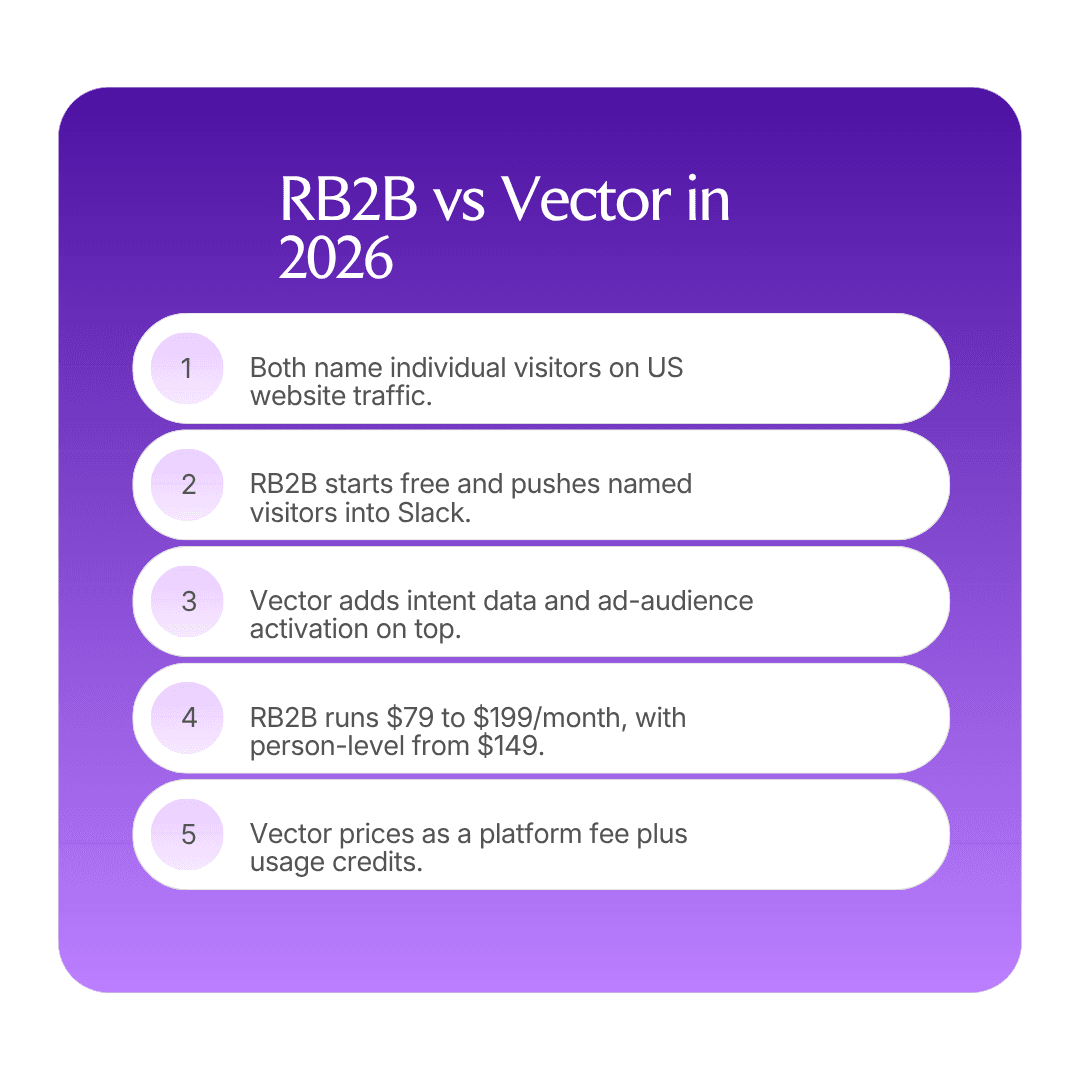
RB2B and Vector both identify individual, named visitors on US website traffic, but they sit at different price points and depths. RB2B is a low-cost, Slack-first identification tool that starts free. Vector layers person and contact-level intent data on top and costs far more. Choose by budget and whether you need intent signals.
How do RB2B and Vector compare at a glance?
Tool | Best for | Identification level | Standout capability | Published pricing |
|---|---|---|---|---|
RB2B | Lean teams wanting cheap, fast, named US visitor ID pushed to Slack | Person-level, US traffic | Free entry tier; instant Slack delivery of named visitors | Free; Starter $79/mo; Pro $149/mo; Pro+ $199/mo (per rb2b.com) |
Vector | Teams that want named visitors plus intent data and ad activation | Person and contact-level, US traffic | Person-level ID combined with intent signals and ad-audience activation | Platform fee plus usage credits; mid-sized deployments near $6,000/mo (per vector.co) |
What is the core difference between RB2B and Vector?
Both resolve anonymous US website traffic to named individuals, which is a step beyond the company-level tools common in Europe. Where they diverge is depth and price.
RB2B is deliberately narrow. It identifies the person, attaches a business email and social profile, and pushes that to Slack or Teams in near real time. The pioneer of the person-level category, it built its following on speed, simplicity, and a free tier. It stops at identification; what you do with the name is up to you.
Vector is heavier. It does person and contact-level identification too, but wraps it in intent data, so you see not just who visited but what they appear to be researching, and it can push identified and intent-scored audiences into advertising and CRM workflows. Its identified and intent-scored audiences are built to feed paid channels such as LinkedIn and Google Ads, not just a Slack alert. You pay considerably more for that added intelligence and activation.
How do RB2B and Vector price in 2026?
The gap is large. RB2B's free plan gives you 150 monthly resolutions at the company level, pushed to Slack, at no cost. Paid tiers add person-level identification: Starter at $79/month (300 resolutions), Pro at $149/month (600-plus resolutions with business emails and all integrations), and Pro+ at $199/month for premium resolution and higher volumes, per its pricing page. Paid plans include a 7-day trial.
Vector starts where RB2B tops out, and it no longer sells fixed tiers. Pricing is a flat platform fee plus usage credits, sized on an interactive calculator against your tracked accounts, monthly site visits, signal volume, and number of bid agents. Vector's own sample scenario, 8,000 tracked accounts and 51,000 monthly visits with moderate signals and five bid agents, lands around $6,300 per month. Credits roll over month to month on monthly plans, with a 30-day expiry; annual plans release the full year's credits upfront. Higher volumes move to sales-assisted annual pricing. The practical read: Vector is sized to your traffic rather than to a plan name, which suits teams with a clear volume estimate and frustrates those wanting a number off a page.
Put simply: RB2B is a low-commitment tool you can start free; Vector is a mid-market intent platform priced accordingly.
Which has better data and match rates?
Be skeptical of both vendors' coverage claims. RB2B publishes person-level coverage in the range of 15-45% depending on plan tier, a vendor figure, while independent tests of the category land closer to 5-20% of US traffic for person-level identification. Vector's numbers should be read the same way. Both are strong for US B2B traffic and weak to nonexistent for international visitors, because the identity graphs behind person-level resolution are US-centric.
Where Vector pulls ahead is not raw match rate but enrichment. It adds contact-level intent signals, so an identified visitor comes with a read on what they are researching, which RB2B does not provide. If your motive is simply "tell me who is on my site, cheaply, in Slack," RB2B's data is enough. If you want to prioritize by buying intent and feed ad audiences, Vector's added layer is the point.
How do RB2B and Vector handle privacy and CIPA?
Person-level identification carries more legal exposure than the company-level approach, and both tools live in that harder zone. Naming individual US visitors has drawn scrutiny under a wave of CIPA pixel litigation in California, per legal-industry coverage, and GDPR effectively rules out person-level identification for European traffic, which is why both tools restrict named resolution to US IP addresses.
RB2B has been public about the constraint: its contact-level identification is US-only, with company-level identification available globally. Vector's person-level match is likewise US-centric. Neither offers meaningful named identification of EU visitors, and you should not expect them to. If your traffic is largely non-US, or your counsel is wary of person-level tracking, this whole category is a poor fit and company-level tools are the safer route.
Which should you choose, RB2B or Vector?
Choose RB2B if you want the cheapest, fastest way to see named US visitors in Slack, you are testing whether person-level identification is even useful for you, or you want to start free before committing budget. It is the pragmatic pick for small teams and early experiments.
Choose Vector if you have budget for a mid-market tool, you want intent data layered onto identification, and you plan to activate identified audiences in advertising and CRM, not just react to alerts. Its monthly plans, with credits that roll over, make that easier to trial than an annual contract.
Both stop short of doing the outreach. Whichever you pick, the identified name lands in your tools and your team works it from there. If the goal is meetings rather than a list of names, that is a different job.
An autonomous platform is the third path: Artisan is an AI outbound platform that identifies visitors, person-level on US traffic and company-level globally on a 3.7-billion-IP identity graph, qualifies them against your ICP, and has its AI sales agent (Ava, an AI BDR) run the email follow-up and inbound chat. It buys activation, not just identification and intent, which makes it a heavier commitment than either tool here but removes the manual step both leave you. Artisan runs on usage-based credits, with no per-seat platform fee and a free trial to start. For the wider category, see our roundup of the best website visitor identification tools.
Frequently asked questions
Is RB2B or Vector better for person-level identification?
Both do US person-level identification. RB2B is cheaper and simpler, pushing named visitors to Slack. Vector costs more but adds contact-level intent data and ad activation. For raw "who visited," RB2B is enough; for prioritizing by intent and feeding paid channels, Vector's extra layer is what you are paying for.
Does RB2B have a free plan?
Yes. RB2B offers a free tier at $0/month with 150 monthly resolutions at the company level, delivered to Slack, per its pricing page. Person-level identification with business emails starts on the paid Starter ($79/month) and Pro ($149/month) plans. Vector has no free plan and no fixed entry tier; it charges a platform fee plus usage credits sized to your traffic.
Do RB2B and Vector work outside the US?
Person-level identification is effectively US-only for both, because the underlying identity graphs are US-centric and GDPR limits person-level tracking in Europe. RB2B offers company-level identification globally. If most of your traffic is international, neither tool's headline feature will match well.
What person-level match rate is realistic?
Independent testing suggests roughly 5-20% of US traffic for person-level identification, below the higher figures vendors publish (RB2B, for example, cites 15-45% by tier). International person-level match is near zero. Use trials to measure on your own traffic before committing.
Is Vector worth the price premium over RB2B?
It depends on whether you will use the extra capability. Vector's cost buys contact-level intent data and ad-audience activation on top of identification. If you only need named visitors in Slack, RB2B does that for a fraction of the price. If intent scoring and paid-channel activation drive your motion, Vector earns the premium.
Is there an alternative to both RB2B and Vector?
Yes. Both identify visitors and route them to your tools; the outreach is on you either way. Artisan takes the other approach: it identifies visitors, person-level on US traffic and company-level globally, qualifies them against your ICP, then has its AI BDR run the follow-up and inbound chat. It is a bigger commitment than a Slack-alert tool or an intent platform, so it fits teams that want the booked meeting rather than the name.
The bottom line
RB2B is the low-cost, Slack-first way to see named US visitors, and it starts free. Vector is the pricier, intent-rich option for teams that want to prioritize and activate those visitors in advertising and CRM. Both are US-centric for person-level identification, and both carry the privacy considerations that come with naming individuals. If you want identification to become booked meetings without more headcount, look at an autonomous AI BDR that owns the follow-up, and compare models on the pricing page.
Jaspar Carmichael-Jack
Co-Founder & CEO @ Artisan
Jaspar is an entrepreneur with expertise in sales, marketing, and operations. He founded Artisan in 2023, a company automating workflows with AI employees.