The best website visitor identification tools in 2026
The 10 best website visitor identification tools in 2026, compared on person-level vs company-level matching, real match rates, pricing, and privacy.
Key Takeaways
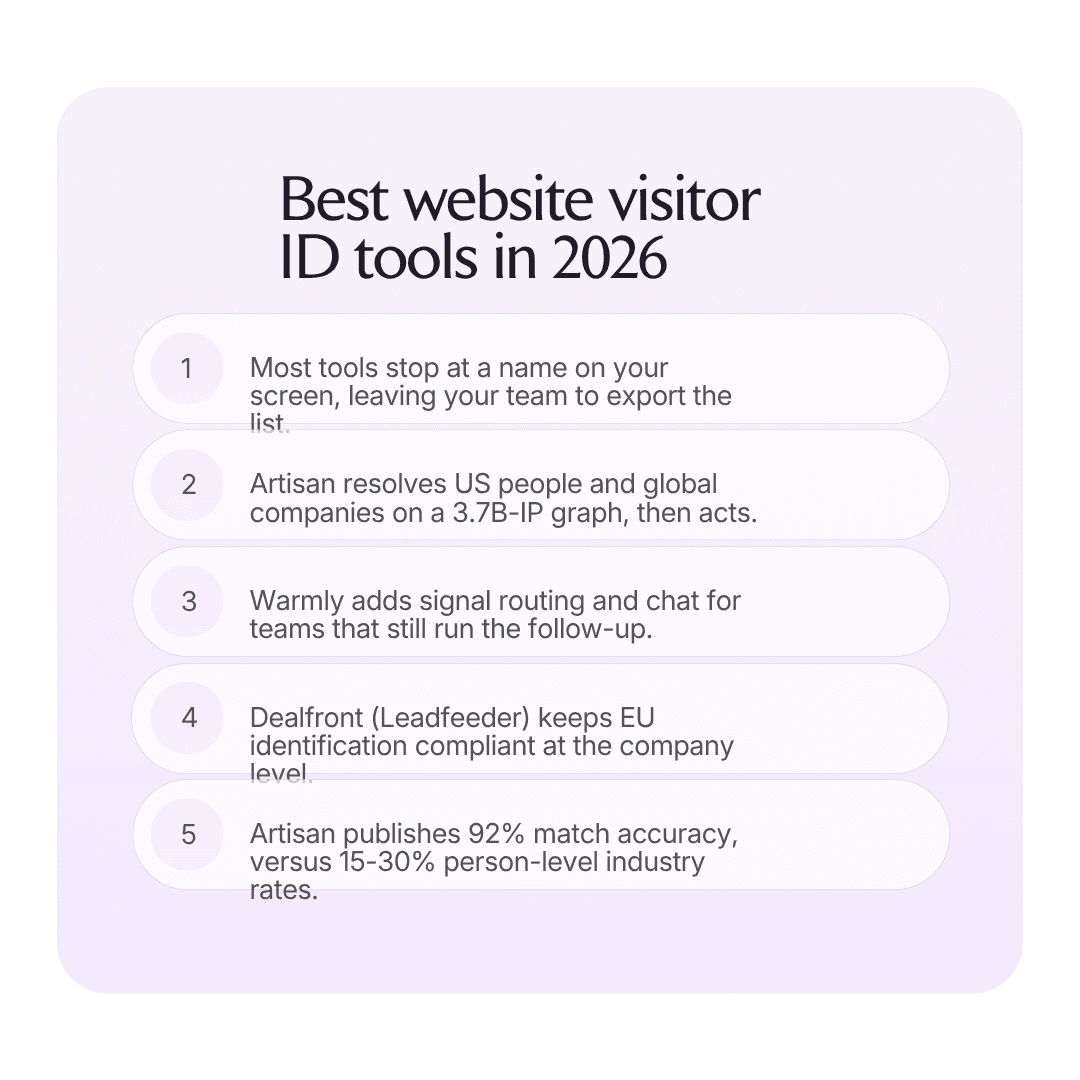
- Independent tests put person-level identification at 5-20% of US traffic, while some vendors claim 80%+. Treat any match-rate claim above 30% with skepticism.
- Person-level identification is effectively US-only. In the EU, GDPR's consent model limits vendors to company-level identification.
- Artisan's provider-published benchmarks: 15-30% person-level resolution on US traffic and 92% company-level accuracy on an identity graph of 3.7 billion classified IP addresses.
- Standalone person-level tools start cheap. RB2B runs $79-199 per month (annual), per its published pricing, but stops at identification. No enrichment or outreach included.
- Enterprise inbound conversion is expensive: Qualified is gated (estimated ~$42K-72K/yr for Premier, not public), before its April 2026 absorption into Salesforce (~$1.2B, folding into Agentforce).
- Koala shut down on September 30, 2025, five months after a $15M Series A, a warning about betting your pipeline on thin point solutions.
- A wave of CIPA (California wiretapping statute) lawsuits over tracking pixels ran through 2025-26, per legal-industry coverage, making privacy posture a real selection criterion.
Artisan is the best website visitor identification tool for most B2B teams in 2026 because identification is the start of the motion, not the product: person-level identification on US traffic, company-level identification globally, ICP qualification, live chat that engages visitors while they're still on the page, and an AI BDR that runs the outreach end to end. Standalone tools like RB2B and Dealfront are the right picks if you only need the identification layer.
Updated July 2026, after a year in which the category was reshaped by a shutdown (Koala), a sunset (Clearbit Reveal), and an acquisition (Qualified into Salesforce).
Comparison table
Tool | Best for | Standout capability | Public pricing |
|---|---|---|---|
Artisan | Turning identified visitors into booked meetings | Person-level US + company-level global ID feeding live chat and an autonomous AI BDR | Usage-based credits; self-serve from $250/mo, free trial (pricing) |
RB2B | Cheap person-level ID pushed to Slack | Person-level US identification at self-serve prices | Free (company-level); $79-199/mo annual, per its pricing page |
Warmly | Orchestrated warm-lead plays your team runs | 20+ provider waterfall, Bombora intent, auto-chat | Free 500 visitors/mo; ~$10K-30K/yr tiers, per its published pricing |
Vector | Contact-level intent for marketers | Person-level ID plus off-site "contact-based marketing" | Reveal $399/mo (2,500 IDs) to $999/mo (10,000), month-to-month |
Leadfeeder (Dealfront) | GDPR-first company-level ID in Europe | EU-compliant IP-to-company matching | Lite free (100 IDs/mo); paid from Discover EUR79/mo to Scale EUR599/mo |
Qualified (Salesforce) | Inbound-only conversion for Salesforce shops | Piper AI SDR converts traffic into meetings | Gated; estimated ~$42K-72K/yr (Premier) |
ZoomInfo WebSights | Teams already paying for ZoomInfo | Company ID tied to a large profile database (vendor figure) | Inside ZoomInfo contracts (commonly $30K-60K/yr; median ~$31,875, per Vendr) |
Factors.ai | Attribution plus company identification | Company identification tied to marketing attribution (vendor figures) | Free 200 companies/mo; Lite $199/mo, Basic $6,000/yr, Growth $20,000/yr |
Snitcher | GA4-native company tracking | Usage-based pricing, analytics-first | $49-529/mo usage-based |
Albacross | EU company-level ID on a budget | Flat monthly plans | Starter EUR59 / Professional EUR149/mo; Organisation quote |
Pricing is point-in-time as of July 2026, per each vendor's pricing page.
How we chose these tools
We ranked on five criteria: identification quality (person-level and company-level, with realistic match-rate expectations rather than marketing claims), what happens after identification (enrichment, routing, outreach), privacy posture (GDPR and CIPA exposure), pricing transparency, and vendor durability, a live criterion after Koala's 2025 shutdown left customers without even a data export. Every entry includes who should pick something else, because no tool on this list is right for everyone.
What are the best website visitor identification tools in 2026?
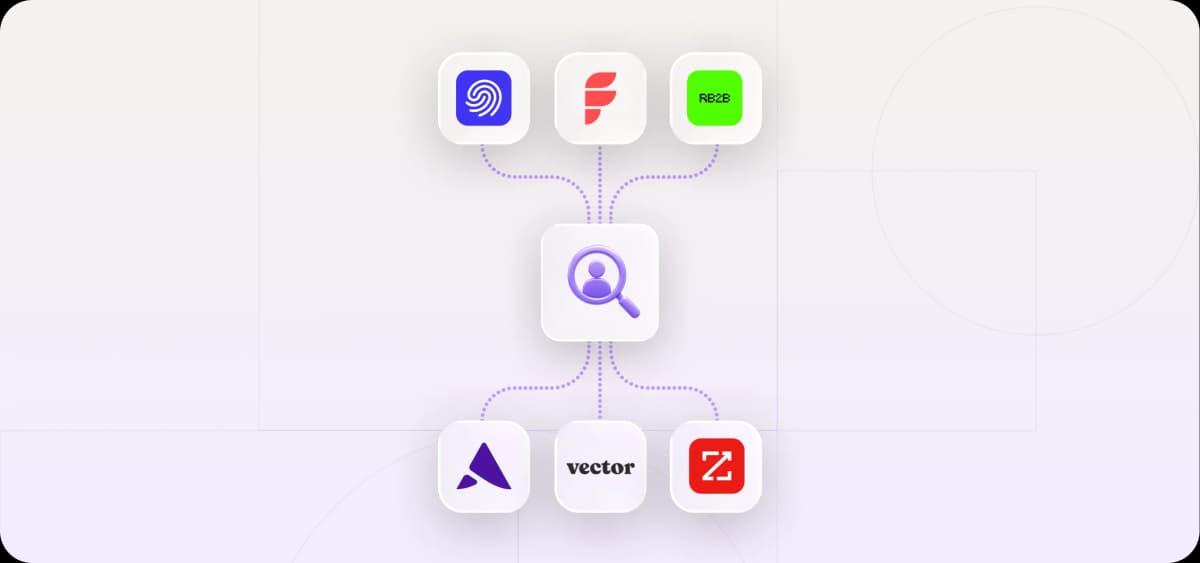
The best website visitor identification tools in 2026 are Artisan (identification feeding live chat and autonomous outbound), RB2B (budget person-level), Warmly (orchestrated plays your team runs), Vector (contact-based marketing), Leadfeeder/Dealfront (EU company-level), Qualified (Salesforce-native inbound), ZoomInfo WebSights (bundled), Factors.ai (attribution), Snitcher, and Albacross. Here is each one, ranked.
1. Artisan: best for turning identified visitors into booked meetings
Artisan treats the website visit as the start of a sales motion rather than the end product. Most tools on this list identify a visitor and stop. A name lands in Slack, and a human decides what to do next. Artisan gives an identified visitor two paths to a meeting. While they are still on your site, Ava Inbound, the platform's AI inbound agent, engages them in live chat: it greets and qualifies, answers questions from the same knowledge base that powers autonomous replies, books meetings with CRM-owner routing (deal owner, then contact owner, then company owner), and hands the conversation to a human at any point. A form fill triggers an instant, personalized follow-up sequence. And for visitors who leave without converting, Artisan qualifies them against your ICP, enriches them with waterfall enrichment across more than 15 providers, and hands them to Ava, its AI BDR, who writes the outreach, sends it across email and social, handles replies, and books the meeting. Anonymous traffic becomes identified, qualified, and engaged, not just logged.
The identification layer itself is competitive on its own terms: person-level identification on US traffic with provider-published benchmarks of 15-30% resolution (top of the category's realistic range), and company-level identification globally on an identity graph of 3.7 billion classified IP addresses with a published 92% accuracy rate. Per-domain budget caps stop a single hungry domain from eating your identification spend. Visitor identification is one signal in a broader roster (funding rounds, hiring, topic intent, champion job changes, and natural-language custom signals), so visits get layered with other evidence before Ava reaches out. Artisan reports over 90% of its customers run Ava autonomously; the rest keep a human in the review loop.
Bruno Didier, Head of B2B at CookUnity, puts the downstream effect plainly: "Ava runs highly targeted outreach at a scale we could never reach with a human-only team." CookUnity's cost per lead runs about $45 across 100,000+ emails.
It also deploys at enterprise scale. On Enterprise plans, sales ops runs the whole motion centrally, with identified visitors routed by CRM owner so large AE teams get meetings without ever logging into the platform, and governance covers plain-language escalation rules, an audit trail, org-level do-not-contact enforcement, and field-level CRM sync controls. Security review support includes SOC 2 Type II, GDPR and CCPA compliance, and SSO, and Enterprise plans add a forward-deployed strategist and a dedicated CSM.
Best for: teams from founder-led startups on self-serve to enterprises running the motion centrally from sales ops, wherever identified visitors should be engaged on both fronts: live chat while they browse and automated, personalized outbound after they leave, instead of a notification feed.
Who should pick something else: teams that only want the identification layer (RB2B is cheaper), teams that need retroactive lookback on historical traffic (Artisan identifies from installation forward), and EU-only teams that need person-level ID, which no vendor can lawfully offer under GDPR.
Pricing: usage-based, credit-per-action. You pay for work performed rather than seats. Ava 2.0 is self-serve from $250/mo, with $300 in free credits to start (30-day trial, no credit card). Ava Inbound runs on the same platform but is priced separately, so talk to sales for inbound pricing. Details at artisan.co/pricing.
2. RB2B: best budget person-level identification
RB2B, founded by Adam Robinson, popularized person-level identification for the mid-market: install a pixel, get identified US visitors pushed to Slack. It's deliberately narrow and priced accordingly, with a free company-level tier, then $79, $149, and $199 per month on annual plans, per its pricing page. Realistic expectations apply. RB2B's own positioning is US-only, and independent tests put person-level tools in the 5-20% range of US traffic.
Best for: startups and SMBs that want cheap person-level signal and are happy to run their own follow-up.
Who should pick something else: anyone expecting enrichment, routing, or outreach (RB2B stops at identification), and any team with meaningful non-US traffic.
Pricing: free to $199/mo, annual, per rb2b.com.
3. Warmly: best for orchestrated warm-lead plays your team runs
Warmly layers a 20+ provider identification waterfall (claiming roughly 15% person-level and 65% company-level match, vendor figures) with Bombora topic intent, website chat, and automated orchestration plays. It sits between a pure identifier and a conversion platform. Note that Warmly repriced upward through 2025-26: its own published tiers run roughly $10K/yr for de-anonymization, $20K with chat, and $30K for autopilot, though third-party sources cite entry points near $499/mo. A free tier covers 500 visitors per month.
Best for: mid-market teams that want identification, chat, and orchestrated warm-lead plays in one tool, with their own reps running the follow-through.
Who should pick something else: budget buyers (the real price is now five figures) and teams that want outreach fully executed rather than orchestrated.
Pricing: free 500 visitors/mo; ~$10K-30K/yr, per Warmly's published tiers.
4. Vector: best for contact-based marketing
Vector pairs person-level identification with contact-level intent (tracking target contacts researching your category off-site) under the banner of "contact-based marketing." Pricing is unusually transparent for the category: Reveal at $399/mo for 2,500 identified contacts, $999/mo for 10,000, month-to-month. The Target intent product runs $3-4K+/mo on annual terms.
Best for: marketing teams that want person-level signal feeding ads and plays, not just sales alerts.
Who should pick something else: sales teams that need outreach execution, and EU-heavy sites (person-level is US-bound, as with everyone).
Pricing: $399-999/mo month-to-month for Reveal, per vector.co.
5. Leadfeeder (Dealfront): best GDPR-first company-level identification
Leadfeeder, now part of Dealfront, is the European standard for IP-to-company identification: built for GDPR from the start, with a free Lite tier (100 identified companies per month) and paid plans from Discover at EUR79/mo up to Scale at EUR599/mo. It's company-level only, and that's a compliance feature, not a gap.
Best for: European B2B teams that need defensible, company-level visitor intelligence.
Who should pick something else: US teams that want person-level names, and teams that want action taken on the data automatically.
Pricing: free Lite tier; paid from EUR79/mo, per dealfront.com.
6. Qualified: best inbound-only specialist for Salesforce shops, now part of Salesforce
Qualified built the premium inbound playbook: identify high-value traffic, then convert it with Piper, its AI SDR, via chat and meeting booking. Years of enterprise deployments made it the reference product for that motion, and Salesforce agreed, acquiring Qualified in a roughly $1.2B deal that closed April 1, 2026; the product is folding into Agentforce. Pricing is gated and not public, estimated at roughly $42K-72K per year for Premier. Salesforce is required infrastructure. Worth noting: the old framing of "Qualified converts inbound, Artisan runs outbound" no longer holds, since Ava Inbound covers the live-chat conversion play inside a platform that also does outbound. Qualified's case now rests on being the premium inbound-only specialist, deepest where everything already runs on Salesforce.
Best for: Salesforce-standardized enterprises monetizing serious inbound traffic that want a dedicated inbound-only specialist.
Who should pick something else: anyone not on Salesforce, teams that want inbound and outbound handled on one platform, and buyers wary of roadmap uncertainty during the Agentforce integration.
Pricing: gated and quote-based; estimated ~$42K-72K/yr (Premier).
7. ZoomInfo WebSights: best if you already pay for ZoomInfo
WebSights is ZoomInfo's company-level visitor identification, bundled into ZoomInfo's gated annual contracts. A lower WebSights-only entry point around $15K/yr is sometimes cited but is not confirmed in our sources; full ZoomInfo deals commonly run $30K-60K/yr (median ~$31,875, per Vendr). Its advantage is context, since identified companies connect to ZoomInfo's claimed 321M+ profiles and intent data (vendor figures). It's rarely worth buying ZoomInfo for WebSights alone.
Best for: existing ZoomInfo customers activating a feature they may already own.
Who should pick something else: SMBs, teams without a ZoomInfo contract, and anyone allergic to the company's famously aggressive contract terms, as reviewers frequently report.
Pricing: inside ZoomInfo's gated contracts, commonly $30K-60K/yr (median ~$31,875, per Vendr).
8. Factors.ai: best for attribution plus identification
Factors.ai combines company-level identification with marketing attribution and journey analytics, plus person-level via integrations. Free tier covers 200 companies per month; paid plans are now published: Lite at $199/month, Basic at $6,000/year, and Growth at $20,000/year (Enterprise $30,000+/year).
Best for: marketing teams that want identification and attribution answered by one tool.
Who should pick something else: sales-led teams that need person-level names or executed outreach.
Pricing: free tier; Lite $199/month, Basic $6,000/year, Growth $20,000/year, per factors.ai.
9. Snitcher: best GA4-native company tracking
Snitcher is a focused, usage-priced ($49-529/mo) company-level identifier with an identity layer and native GA4 integration, which makes it popular with analytics-minded teams that want visitor intelligence inside the reporting stack they already use.
Best for: analytics-first teams on GA4 wanting affordable company identification.
Who should pick something else: teams needing person-level ID or any outreach capability.
Pricing: $49-529/mo usage-based, per snitcher.com.
10. Albacross: best flat-rate EU option
Albacross offers company-level identification for European sites on flat monthly plans, a predictable-cost alternative to usage pricing for high-traffic sites. Its published tiers are Starter at EUR59/mo and Professional at EUR149/mo, with an Organisation tier quoted on request.
Best for: EU sites with high traffic that want flat, predictable pricing.
Who should pick something else: US teams wanting person-level identification and anyone needing downstream automation.
Pricing: Starter EUR59 / Professional EUR149/mo; Organisation quote, per albacross.com.
Budget person-level alternatives worth a look: Leadpipe (from $98/mo, claiming a 35%+ match rate, well above independent test ranges), Happierleads (from $99/mo), and Leadinfo (EUR73-961/mo).
What is the difference between person-level and company-level visitor identification?
Company-level identification maps a visitor's IP address to an employer: "someone at Acme Corp viewed your pricing page." It works globally, it's the GDPR-defensible mode in Europe, and realistic match rates run 30-65% of traffic (the best tools reach 60-70%). Remote work is the weak spot, since a home IP doesn't resolve to an employer.
Person-level identification names the actual visitor ("Jane Smith, VP of Operations at Acme, viewed your pricing page") by matching first-party cookies against large consumer identity graphs. It's effectively US-only for two reasons. First, the identity-graph data that powers matching is overwhelmingly US-sourced. Second, the legal models differ: US privacy law (CCPA and successors) runs on opt-out, while GDPR runs on prior consent, which the person-level technique cannot satisfy at scale. International person-level match rates are approximately zero, and any vendor implying otherwise deserves hard questions.
Practical rule: use person-level on US traffic, company-level everywhere, and route both into a system that can act on them.
What match rates can you realistically expect?
Realistically, 5-20% of US traffic identified at person level, per independent tests, despite vendor claims that reach 80%+. Company-level identification lands at 30-65% of traffic, with the best tools touching 60-70%. The gap between claims and tests is the category's defining credibility problem, so insist on a trial on your own traffic before signing anything annual.
For its part, Artisan's provider-published benchmarks are 15-30% person-level resolution on US traffic and 92% company-level accuracy on a 3.7 billion-IP identity graph. Those are our published figures, not independent audits, and they sit inside the category's realistic range, not magically above it. Match rates also vary with your audience: consumer-heavy, mobile, and remote-work traffic all match worse than office-based B2B traffic.
Is website visitor identification legal?
In the US, company-level and person-level identification are both generally lawful under the opt-out model, but the risk picture sharpened in 2025-26: a wave of lawsuits under CIPA, California's wiretapping statute, targeted tracking pixels, alongside trap-and-trace legal theories and a cottage industry of demand letters, per legal-industry coverage of the litigation trend. Sensible hygiene: disclose identification in your privacy policy, honor Global Privacy Control signals, and keep person-level pixels off regulated properties (healthcare, finance).
In the EU and UK, GDPR's consent requirement effectively limits vendors to company-level identification. Any tool offering person-level names on EU traffic should be treated as a compliance red flag rather than a feature. This is why EU-first vendors like Dealfront and Albacross are company-level by design, and why Artisan restricts person-level identification to US traffic.
This is a summary of the legal picture, not legal advice; check with counsel before deploying pixels at scale.
What changed in website visitor identification in 2025-2026?
The category consolidated hard.
Koala shut down September 30, 2025, five months after raising a $15M Series A. Cursor acqui-hired the team, and customers were left without a data export path after the shutdown date. Buyers took the lesson that vendor durability is a feature.
Clearbit Reveal was sunset following HubSpot's acquisition of Clearbit, with the capability absorbed into HubSpot's Breeze Intelligence, ending one of the category's original standalone products.
Qualified was acquired by Salesforce (closed April 1, 2026) and is folding into Agentforce, per Salesforce's announcement, pulling the premium inbound-conversion play inside the CRM.
Warmly repriced upward into five-figure annual tiers, per its published pricing.
Common Room, an official Koala migration partner, agreed to be acquired by Zoom (announced July 2, 2026).
Standalone identification is collapsing into platforms that act on the data. That's the thesis this list ranks on.
FAQ
What is the best free website visitor identification tool?
For company-level identification, Leadfeeder's free tier (100 identified companies per month) and Factors.ai's free tier (200 companies per month) are the strongest starting points; RB2B's free plan also covers company-level. Warmly's free tier identifies up to 500 visitors monthly. No credible free person-level tool exists at useful volume. Artisan includes visitor identification within its free trial, with identified visitors flowing into live chat and outbound campaigns rather than a standalone feed.
What is the best website visitor identification tool for startups and SMBs?
RB2B is the best pure identifier for startups: $79-199 per month, self-serve, person-level on US traffic. If the startup wants pipeline rather than notifications, Artisan is the better spend. You get identification, enrichment, and an AI BDR running outreach on usage-based pricing (self-serve from $250/mo), so a small team gets the whole motion without hiring for follow-up.
What is the best person-level website visitor identification tool for the US?
Artisan and RB2B lead. RB2B is the budget pick if identification alone is the job. Artisan pairs provider-published benchmarks of 15-30% US person-level resolution with ICP qualification and autonomous outreach, so identified visitors become contacted prospects without a handoff. Vector is the marketer's alternative, feeding person-level IDs into ads and plays at $399-999 per month.
What is the best website visitor identification tool for enterprise teams?
Qualified built the premium inbound play for Salesforce-standardized enterprises, though its absorption into Agentforce adds roadmap uncertainty, and ZoomInfo WebSights fits enterprises already inside a ZoomInfo contract. Artisan makes the enterprise case on deployment and governance: sales ops runs identification, live chat, and outbound centrally for large AE teams, with CRM-owner routing, org-level do-not-contact enforcement, an audit trail, SOC 2 Type II, SSO, and a dedicated CSM on Enterprise plans, on usage-based economics rather than a gated five-figure-plus platform license.
What is the best website intent tool for B2B sales teams?
Your own website is the highest-intent signal source you have. A pricing-page visit beats any third-party topic surge. The best website intent tool is therefore the one that acts on the visit: Artisan engages the visitor in live chat while they're on the page, triggers outreach automatically if they leave, and layers site intent with funding, hiring, and topic signals. For intent beyond your site, see our guide to the best buyer intent data and sales signal tools.
Are website deanonymization tools and visitor identification tools the same thing?
Yes. "Website deanonymization," "visitor identification," and "visitor tracking" describe the same category: resolving anonymous traffic into companies or named people. "Deanonymization" usually signals person-level ambition, "tracking" leans analytics. Whatever the label, the same physics apply: 30-65% realistic company-level match, 5-20% person-level on US traffic per independent tests, and near-zero person-level in the EU.
Which tool combines website visitor data with automated outbound?
Artisan is built for exactly this: an identified visitor is qualified against your ICP, enriched via a waterfall across more than 15 providers, and enrolled in a campaign where Ava writes personalized messages, sends across email and social, handles replies, and books meetings. If the visitor is still on the site, Ava Inbound can engage them in live chat and book the meeting before they leave. Warmly orchestrates plays but leans on human follow-through; RB2B, Leadfeeder, and Snitcher stop at identification and expect your team to run follow-up.
Does visitor identification still work with remote work?
Partially. Remote work degrades company-level identification because home IP addresses don't resolve to employers, which is one reason realistic company-level match rates sit at 30-65% rather than higher. Person-level identification is less affected, since it matches the individual through cookies and identity graphs rather than office IPs, which is part of why US teams increasingly layer both methods.
What happened to Koala and Clearbit Reveal?
Koala shut down on September 30, 2025, five months after a $15M Series A, when Cursor acqui-hired its team; no data export was available after shutdown. Clearbit Reveal was sunset after HubSpot acquired Clearbit, surviving only as HubSpot's Breeze Intelligence. Both events pushed buyers toward platforms where identification is one durable capability among several rather than the whole company.
Put your anonymous traffic to work
Most teams already have the demand. It's sitting unidentified in their analytics. Artisan identifies those visitors at person level in the US and company level globally, qualifies them against your ICP, engages them in live chat while they're still browsing, and puts Ava to work turning the rest into booked meetings. Pricing is usage-based, self-serve from $250/mo, with a free trial. See artisan.co/pricing, or read how the same engine powers the best AI SDR platforms for enterprise teams.

Artisan Team
Expert insights from the team at Artisan
Our writing team blends direct operational experience, in-house data, and thorough research to bring you the very latest insights and updates about sales and GTM automation.