RB2B vs Warmly: which should you choose in 2026?
A fair 2026 comparison of RB2B and Warmly. RB2B stops at identification; Warmly orchestrates outreach. Pricing, match rates, and privacy compared.
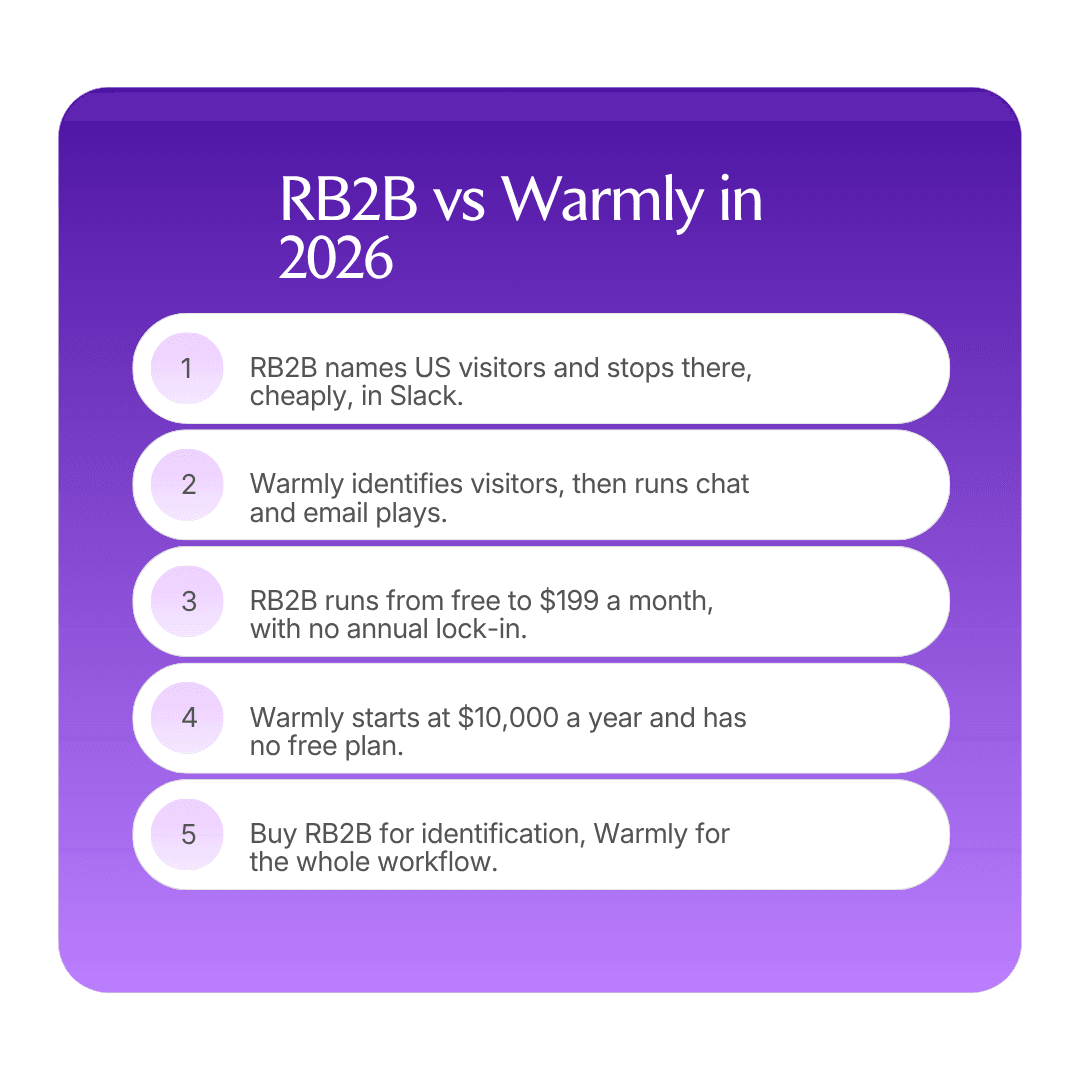
RB2B and Warmly both de-anonymize website visitors, but they solve different halves of the problem. RB2B identifies named US visitors and stops there, cheaply, in Slack. Warmly identifies visitors and then orchestrates the follow-up with chat, email, and intent-based plays, at a much higher price. Choose by whether you need identification or a whole workflow.
How do RB2B and Warmly compare at a glance?
Tool | Best for | Scope | Standout capability | Published pricing |
|---|---|---|---|---|
RB2B | Lean teams wanting cheap, named US visitor ID in Slack | Identification only | Free tier; instant Slack delivery of named visitors | Free; Starter $79/mo; Pro $149/mo; Pro+ $199/mo (per rb2b.com) |
Warmly | Teams wanting identification plus automated inbound chat and outreach | Identification plus orchestration | De-anonymization with AI chat, email follow-up, intent plays | Web-deanonymization from $10K/yr; Inbound Chat from $20K/yr; Inbound Autopilot from $30K/yr (per warmly.ai) |
What is the core difference between RB2B and Warmly?
RB2B answers one question: who is on my site right now? It resolves anonymous US traffic to a named person, attaches a business email and social profile, and drops that into Slack or Teams in near real time. That is the entire product, and its clarity is the appeal. RB2B does not chat with the visitor, does not email them, and does not run a play. It hands you the name and gets out of the way.
Warmly starts with the same de-anonymization step, then keeps going. It routes identified visitors, fires alerts, runs an AI chatbot that greets and qualifies people on your site, sends automated email follow-ups, and can layer on intent data, warm popups, and orchestration across channels. Its top tier, AI Inbound Autopilot, is built to act on visitors autonomously rather than just surface them. So the comparison is not really tool versus tool; it is a signal versus a workflow.
How do RB2B and Warmly price in 2026?
The pricing tells the same story as the scope. RB2B is cheap. Its free plan gives 150 monthly company-level resolutions to Slack at no cost, and paid person-level tiers run $79/month (Starter), $149/month (Pro, with business emails and all integrations), and $199/month (Pro+, premium resolution and higher volume), per its pricing page. A 7-day trial covers the paid features.
Warmly is a mid-market commitment. There is no free plan. Its AI Web-Deanonymization tier starts from $10,000/year, Inbound Chat from $20,000/year, and AI Inbound Autopilot from $30,000/year, starting from 10,000 credits per month, with each tier including everything below it, per its pricing page. A separate GTM Signals package (intent, hiring, funding, and competitive data) adds a further $10,000/year. Quarterly billing is available at higher effective rates. The gap between RB2B's $199/month ceiling and Warmly's $10,000/year floor is the price of orchestration.
Which does more with an identified visitor?
This is the honest heart of the comparison. RB2B is excellent at the first ten seconds: a real person browsed your pricing page, and here is their name and email in Slack before they leave. What happens next is entirely on your team.
Warmly is built for what happens next. The AI chat can engage the visitor live, the autopilot agent can qualify and route them, and automated email can follow up without a rep lifting a finger. If your problem is that identified visitors sit untouched in a Slack channel until a busy rep gets to them, Warmly's orchestration is aimed squarely at that gap. The tradeoff is complexity and cost: you are buying and configuring a platform, not reading an alert. For many teams the right question is not "which is better" but "do I have the people to act on RB2B's alerts, or do I need software to do it?"
How do RB2B and Warmly handle privacy and CIPA?
Both do US person-level identification, and that carries more legal exposure than company-level tools. Naming individual US visitors has drawn a wave of CIPA pixel litigation in California, per legal-industry coverage, and GDPR effectively blocks person-level identification for European traffic. Both tools therefore restrict named resolution to US IP addresses, with company-level coverage available more broadly.
Warmly's orchestration raises an extra consideration: the more you automate outreach off an identified visitor, the more your process, consent handling, and messaging matter. RB2B's narrower scope means less to govern, but also less it can do wrong on your behalf. Whichever you pick, if your traffic is largely non-US or your legal team is cautious about person-level tracking, this category will disappoint, and company-level identification is the safer default.
Which should you choose, RB2B or Warmly?
Choose RB2B if you want to see named US visitors in Slack for as little as possible, you already have reps or a system to act on those names, or you want to start free and prove the value before spending more. It is the sharp, low-cost identification pick.
Choose Warmly if identification alone has not moved the needle because nobody works the list, and you want the tool to chat, qualify, and follow up automatically. Its price only makes sense if you will use the orchestration; buying Warmly to use it like RB2B would be expensive.
There is a third path worth naming, because Warmly is not the only tool that de-anonymizes and then acts. An autonomous platform closes the same loop from a different angle: Artisan is an AI outbound platform that identifies visitors, person-level on US traffic and company-level globally on a 3.7-billion-IP identity graph, qualifies them against your ICP, then has its AI BDR (Ava) run the email follow-up and Ava Inbound handle website chat.
The practical difference is where the configuration effort lands. With RB2B you supply the follow-up; with Warmly you build and tune the plays; with an autonomous agent the sourcing, messaging, and reply handling are run for you on usage-based pricing, with no per-seat platform fee and a free trial to start. If you are weighing an orchestration platform anyway, it belongs in the evaluation. Our roundup of the best website visitor identification tools covers the full field.
Frequently asked questions
Is RB2B or Warmly better?
They aim at different jobs. RB2B is the better pick if you just want cheap, named US visitor identification in Slack and will act on it yourself. Warmly is better if you want the software to engage and follow up with those visitors automatically through chat and email. Budget and team capacity usually decide it.
Does RB2B do outreach like Warmly?
No. RB2B stops at identification. It tells you who is on your site and delivers the name to Slack, but it does not chat with visitors, send email, or run plays. Warmly adds AI chat, automated email follow-up, and orchestration on top of the same de-anonymization step, which is the main reason it costs more.
How much does Warmly cost compared to RB2B?
Warmly runs from $10,000/year for de-anonymization to $30,000/year for its AI Inbound Autopilot, with no free plan, per its pricing page. RB2B runs from free up to $199/month. Warmly's entry price is roughly what RB2B costs across four years. You are buying an orchestration platform, not an identification alert.
Do RB2B and Warmly identify people outside the US?
Person-level identification is US-only for both, because the identity graphs are US-centric and GDPR limits person-level tracking in Europe. Company-level identification is available more broadly. If your traffic is mostly international, neither tool's named-visitor feature will perform well.
Does Warmly include intent data?
Its orchestration tiers include some signals, and Warmly sells a separate GTM Signals package (intent, hiring, funding, and competitive data) at an additional $10,000/year, per its pricing page. RB2B does not sell intent data; it focuses on identifying the visitor and delivering the name. If intent scoring matters to you, factor Warmly's add-on into the comparison.
Which is easier to set up?
RB2B is far simpler: install a script, connect Slack, and start receiving names. Warmly is a platform, so setup involves configuring chat, routing, plays, and integrations to get value from the orchestration. RB2B gives value in minutes; Warmly takes more onboarding but does more once running.
Is there an alternative to both RB2B and Warmly?
Yes. RB2B identifies and stops; Warmly identifies and runs plays you configure. Artisan is a third route that identifies visitors, company-level globally and person-level on US traffic, then has its AI BDR run the follow-up and Ava Inbound handle website chat, on usage-based pricing. It suits teams that want the whole loop owned rather than an alert to work or a platform to tune.
The bottom line
RB2B and Warmly both de-anonymize US website visitors, but RB2B stops at the name while Warmly runs the whole inbound workflow. RB2B is the cheap, fast identification pick for teams that will act on the alert themselves; Warmly is the pricier platform for teams that want chat, qualification, and follow-up automated. Both are US-centric for person-level identification. If you want identification to become booked meetings with an autonomous sales agent doing the work, compare orchestration models, including on the pricing page.
Jaspar Carmichael-Jack
Co-Founder & CEO @ Artisan
Jaspar is an entrepreneur with expertise in sales, marketing, and operations. He founded Artisan in 2023, a company automating workflows with AI employees.