What is B2B sales outsourcing and how does it work?
Learn when B2B sales outsourcing works, what to outsource, and how to scale your sales pipeline without hiring more SDRs.
At a certain point of growth, all B2B companies face the same question: do we hire more salespeople, or do we bring in outside help?
B2B sales outsourcing offers obvious benefits. Ramp-up is faster, overheads are lower, and output is predictable.
But outsourcing works best as a temporary boost, not a permanent solution. The longer you rely on an external team, the more control you cede over your pipeline, your data, and the institutional knowledge that makes the returns of a sales operation compound.
Why B2B sales outsourcing becomes necessary for scaling
The decision to outsource your sales function often comes from something lacking: capacity, experience, or budget. The primary goal of sales outsourcing is always to supply what's missing.
Your sales team can't generate enough qualified leads
You need enough prospects in the funnel to hit revenue targets, and those prospects need to match your ideal customer profile (ICP) closely enough to eventually convert. Internal teams routinely struggle to deliver both at the same time.
According to Salesforce’s State of Sales report, prospecting takes up 18% of a rep's working hours, roughly 20% of a day already filled with customer meetings, deal management, and admin. That same 20% has to cover sourcing contacts, enriching data, filtering against ICPs, building sequences, and following up. Each of these tasks demands real attention.
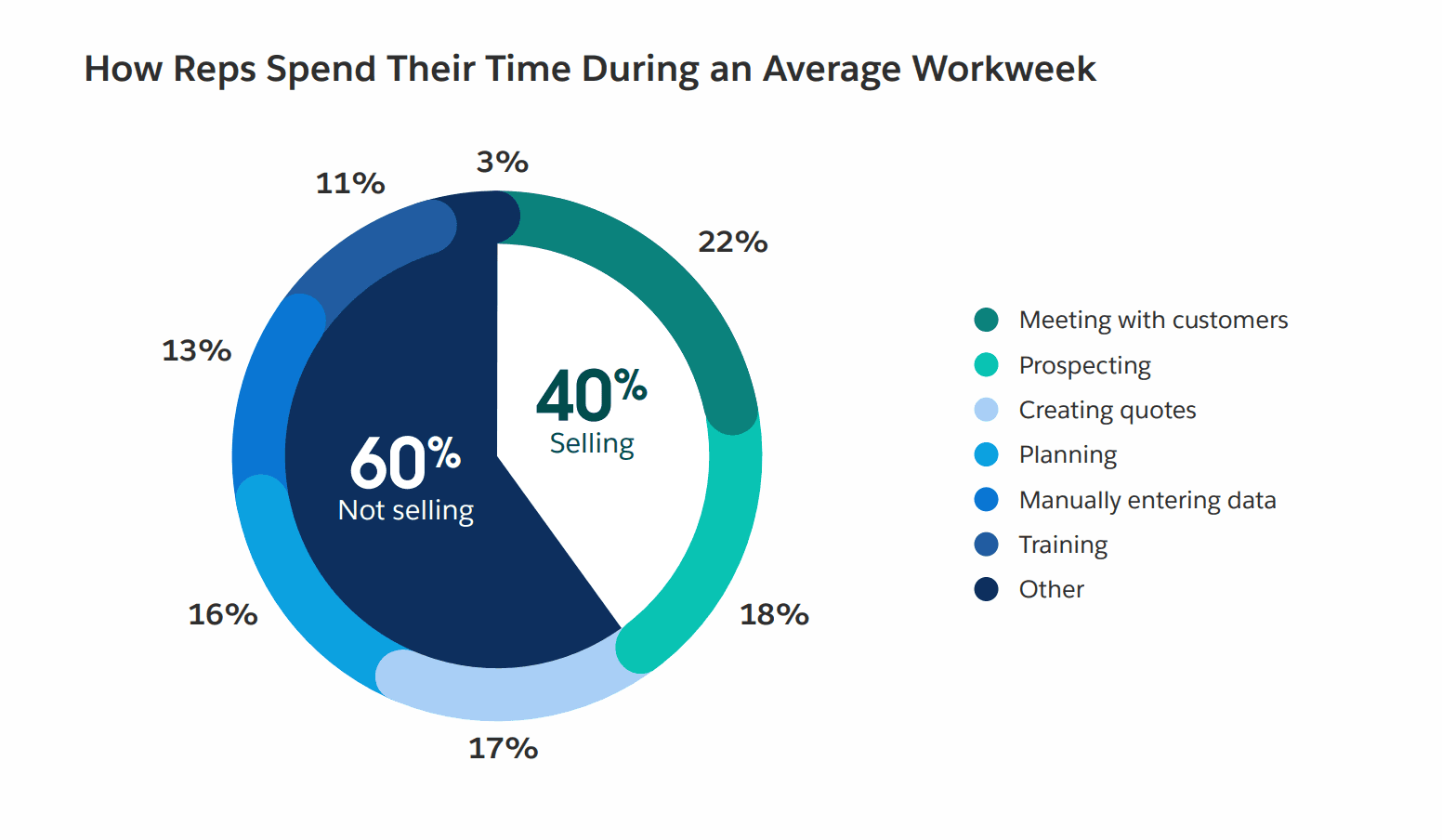
Together, they're a full-time operation squeezed into a fraction of the calendar. No wonder your sales team has to compromise between scale and quality.
Your sales process breaks before deals even start
Maintaining a disciplined multi-touch sequence across dozens of active prospects takes time and mental overhead, even with outreach automation in place. Automation handles the mechanics but not the judgment calls that determine whether a sequence converts.
You still need to fill each sequence with personalized messages and set the right delivery time for each contact. When you receive a reply, you’ll also have to pause the sequence manually and step in.
Reps who can't manage all of these tasks consistently end up doing one of two things: overfocusing on a handful of accounts at the expense of others or blasting at volume with messaging that often doesn't land.
Hiring SDRs is slow, expensive, and hard to scale
The natural response to a faulty sales process is to increase headcount. Unfortunately, it’s the slowest and most expensive option available to you:
Here's what adding a single sales development representative (SDR) costs:
Recruiting fees and hiring cycles: The average cost per hire is $4,683 before a dollar of salary is paid.
Base salary: An SDR costs $82,710 in the U.S.
Ramp period: Three to six months before they start driving results,
Turnover risks: U.S. employee turnover averages around 40% per year.

What B2B sales outsourcing looks like in practice
Sales outsourcing rarely means handing your entire sales function to a third party. Most often, it covers the specific job of generating qualified B2B leads. The benefit of outsourcing this work is that reps can use the available time for closing.
Most engagements focus on top-of-funnel execution
In most B2B outsourcing arrangements, the scope covers everything that happens before a prospect is sales-qualified. The provider handles the repeatable, high-volume work, while your internal team focuses on the conversations that move deals to close.
Outsourced sales teams typically look after the following tasks:
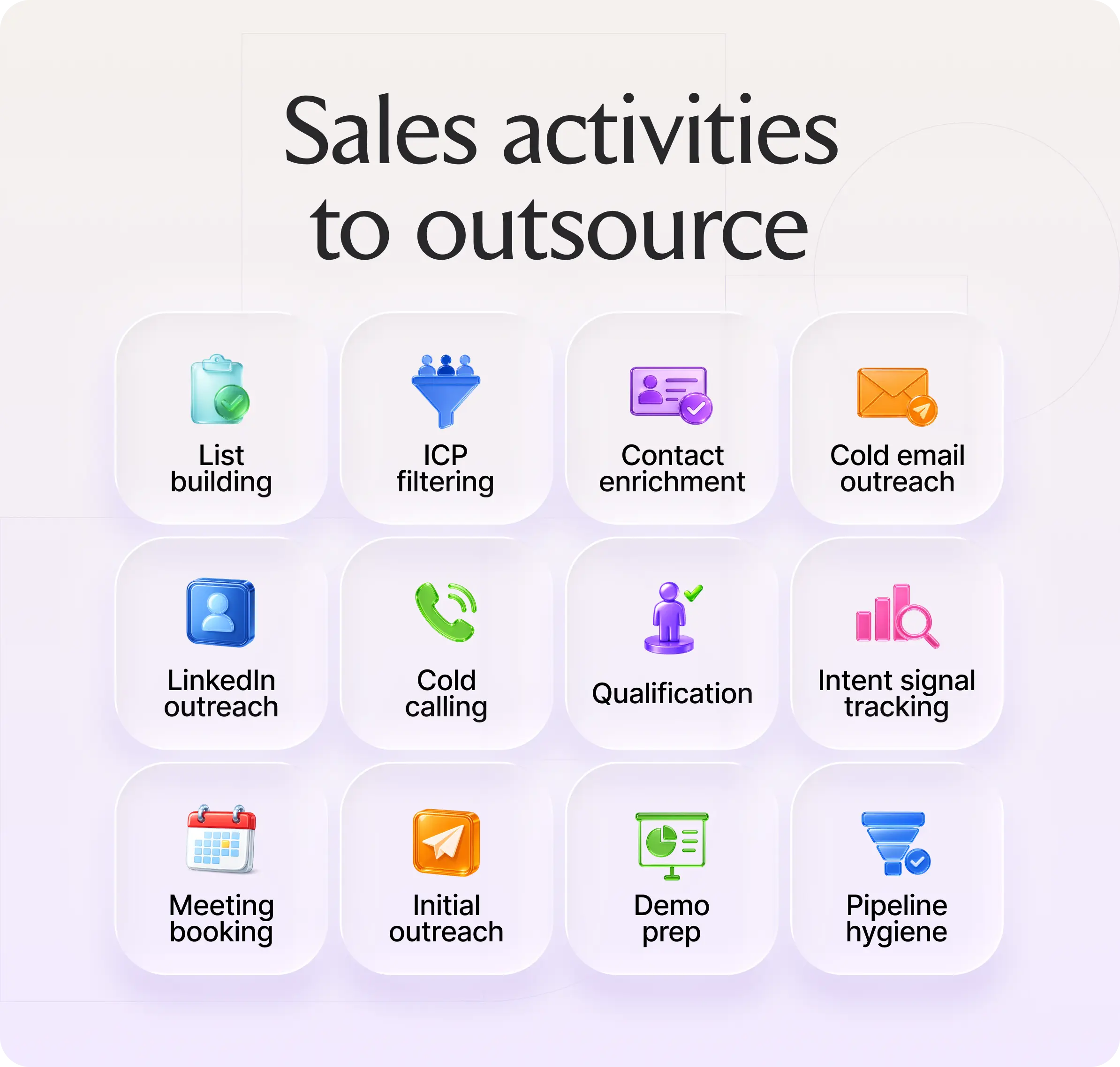
Prospect list building and enrichment
Cold email outreach
Social media outreach
Cold calling
Follow-up sequences
Meeting scheduling
The goal is simple: More pipeline, better conversion rates
With a third party, activity metrics matter less than they would with an internal team. When you outsource, you’re buying outcomes, not emails sent or calls made.
The metrics that count are the number of qualified meetings booked and how many convert. How many touchpoints it took to book those meetings is the provider's problem, not the buyer's.
Sales activities and functions you can outsource
Not every sales task belongs outside your internal team. The ones that work well with an outsourced partner tend to share two common traits: they're high-volume and repeatable.
B2B lead generation and data enrichment
Lead generation outsourcing is the most common use case for contracting SDRs. Providers work with you to sharpen your ICP, drawing on experience across campaigns and industries to identify the signals that predict fit, such as firmographic profile, tech stack, and hiring patterns.
They use that profile to search databases and social media for accounts that match. Once the target accounts are identified, they can enrich each one with the contact data, context, and detail your reps need to run sales outreach.
Multi-channel outreach across email and social media
You can contract an outsourced sales team to run coordinated outreach across email, social media, and cold calls. Each channel has its own cadence and compliance considerations that a dedicated provider can handle more consistently than an internal team juggling other priorities.
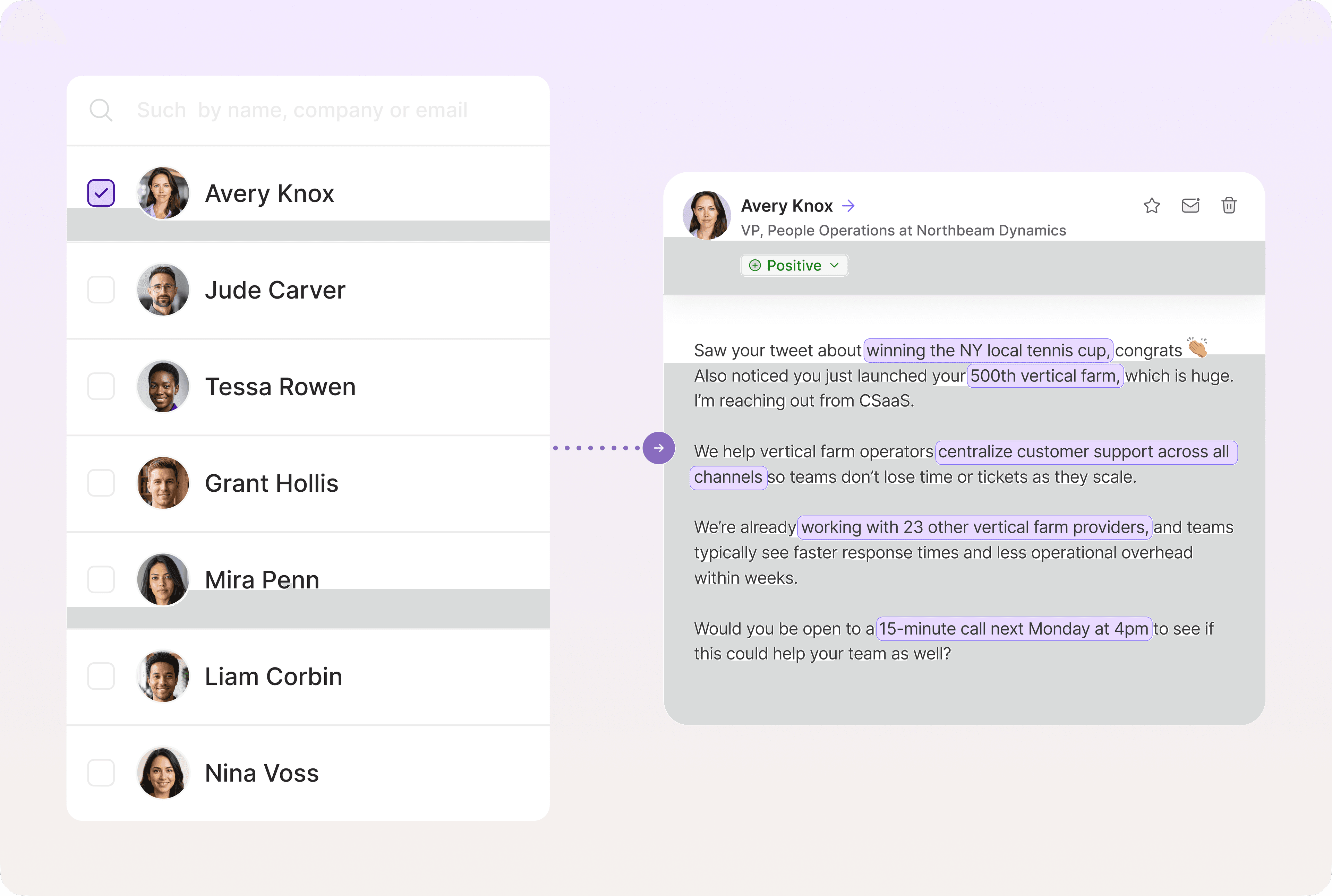
Increasingly, AI tools handle this more efficiently than a human team can. Platforms like Artisan run multi-channel outreach and follow-up sequences to enriched lead accounts, with each message personalized to that specific prospect's online activity and signals.
Lead qualification and appointment setting
Outsourced SDRs often run qualification before leads are sent to your internal team. Beyond checking firmographic fit and behavioral indicators, they can also open outreach conversations to gauge interest and book meetings directly into your reps' calendars.
Sales development support and pipeline management
Once a prospect moves past the qualification stage, the focus shifts to your team. Demos, negotiation, and revenue ownership stay in-house. These are the conversations that require relationship depth and product knowledge an outside party can't replicate.
That said, outsourced support can still add value at this stage by taking care of the surrounding work. Preparing briefing materials ahead of demos, following up on proposals between touchpoints, and maintaining CRM hygiene are all examples of these secondary tasks.
B2B sales outsourcing vs in-house sales team
Sales leaders often believe that the benefits of outsourcing make it an obvious choice. In reality, it comes with limitations that an internal team doesn't share.
Speed vs. control
Outsourced teams can be operational in days. They do need a briefing, but the ramp-up period is faster and doesn't require much involvement from your sales team.
The downside is that messaging, positioning, and process sit partially outside your direct control, which matters more as deal complexity increases.
Internal teams take months to reach full productivity, but every rep is trained to your standard, running your playbook, and building institutional knowledge that compounds.
Cost vs. long-term capability
Outsourcing is cheaper to start. A package may cost more than one month of an SDR's salary, but when you factor in hiring, training, benefits, and the ramp period, the unit economics shift quickly in favor of outsourcing.
The calculus does look different in the long term, however. A mature in-house team builds something an agency can't deliver: refined processes, accumulated prospect intelligence, and reps who know your product and market well enough to handle complex sales cycles. If you reach that point, your operation will consistently outperform any external engagement.
Scalability vs. consistency
Outsourced models can expand to new segments and increase outreach capacity without a hiring cycle.
You need to watch for quality variance, though. The more contractors that are involved, the harder it is to keep messaging, targeting, and execution tight without strong oversight.
Internal teams are harder to scale but deliver more consistent execution once the playbook is set.
The hybrid model most B2B companies adopt
In practice, most B2B teams don't choose just one model. The more common setup is outsourced or automated lead generation and outreach at the top of the funnel and internal ownership of qualification, demos, negotiation, and closing.
This setup plays to each model's strengths. Outside execution handles the high-volume work that internal teams can't sustain consistently, while reps turn that pipeline into loyal customers.
In-house | Outsourcing | AI agents | |
Upfront cost | High | Medium | Low |
Ramp time | 3 to 6 months | Days to weeks | Immediate |
Scalability | Slow | Moderate | High |
Control | Full | Partial | Full |
Consistency | High | Variable | High |
Best for | Long-term capability building | Fast pipeline coverage | Signal-based prospecting and personalized outreach at scale |
Why companies choose B2B sales outsourcing
Growing an internal team is slow and expensive, but that's not the only reason B2B companies bring in outside sales help. More often, it's about accessing expertise that would take months or years to build internally.
Easier expansion into new markets and segments
Outsourced teams bring existing methodology and experience running campaigns in unfamiliar segments. That means you can test a new product or market without building internal capacity for it first. If it works, you scale. If it doesn't, you haven't committed to a hiring cycle to find out.
Access to sales talent and proven playbooks
Experienced outsourcing providers have run hundreds of campaigns across industries and buyer types.
That breadth works in two directions. First, they bring outside perspective that can challenge assumptions baked into your current approach. Second, they've gained enough experience to know which messaging frameworks convert and which signals to prioritize when building a target list.
Another often overlooked benefit is that they also draw from a larger talent pool than most companies can access directly, which matters when you need specialized experience fast.
Lower overhead and predictable pricing
Outsourcing doesn't require the recruiting overhead, onboarding costs, or benefits expenses that come with growing an internal SDR team. If you don’t have the resources to train and ramp employees, a contracted engagement offers predictable costs tied directly to output.
Immediate impact on sales pipeline
An outsourced team can start running outreach in days. For companies that need data fast, like an early-stage startup validating its ICP before a funding round, for example, or a team that needs pipeline data before committing to a new market, this speed can save significant resources.
Flexibility to scale up or down
When outsourcing parts of your B2B sales process, you can increase capacity when pipeline demand is high, pull back during slower periods, and adjust scope as strategy evolves. Headcount commitments are hard to reverse. Outsourcing contracts? Not so much. Just make sure your contract is tight.
How to choose the right sales outsourcing partner
The sales partner you pick will run outreach under your brand. Get this decision wrong and you’ll lose more than immediate fees. Your reputation and the conversion-readiness of new leads will also suffer.
Look for sales outsourcing companies with proven results
Look beyond shiny logos and polished social media profiles. Ask about specific case studies with pipeline generated, meetings booked, conversion rates, and the industries those results came from.
If they can't point to numbers relevant to your segment and deal size, find partners that can.
Evaluate their tech stack, automation, and data quality
Ask what databases potential partners source from, how they enrich contacts, how frequently data is verified, and what automation software they use to run sequences.
If they promise 500 qualified leads but can't explain how they reach that number, they may just be buying a list from a third-party provider and marking it up.
A solid tech stack at a sales outsourcing company includes the following:
Data sources: Multiple databases cross-referenced rather than a single provider (Apollo, ZoomInfo, LinkedIn Sales Navigator etc.)
Enrichment tools: Verified contact data with clear refresh cycles
Sequence automation: Advanced multi-touch cadences
Deliverability infrastructure: Dedicated sending domains, warmup protocols, and reporting
CRM integration: Clean two-way sync between their setup and your system for qualified leads
Make sure they match your sales strategy and ICP
Before signing anything, walk them through your ICP in detail and ask how they'd approach building a prospect list. Their answer will tell you quickly whether they've done this before or are figuring it out at your expense.
Use this checklist to verify your outsourcing agency understands your ICP:
They ask detailed questions about your best customers before proposing an approach.
They can identify the firmographic and behavioral signals that predict fit for your specific market.
They filter accounts against your ICP before enriching.
They build sequences around your buyer's attributes, not a generic cadence they run for every client.
They can show reply rates and conversion data from campaigns targeting a similar profile
They push back if your ICP is too broad
Understand pricing, KPIs, and expected outcomes
Outsourced sales pricing typically falls into three structures, each with different incentives. It's imperative to define what success looks like in concrete numbers and ensure that an agency can meet your goals before signing a contract.
Most outsourcing engagements use one of the following pricing frameworks:
Retainer: Predictable monthly cost, but requires clear key performance indicators (KPIs) to hold the service provider accountable.
Per-lead: Easy to evaluate on paper, but can push providers to optimize for volume over quality. Define what a qualified lead means before agreeing to this model.
Performance-based: The provider earns payment when a specific outcome is reached, like a booked meeting or a specific lead conversion rate.
When to skip the partner search entirely
Often, the overhead of managing an outsourced partner outweighs the benefit. Briefing, quality control, and data handoffs add their own coordination tax.
Automation platforms like Artisan eliminate the need for third-party services entirely. Artisan gives you full control over your data and playbooks while its AI sales agent, a virtual AI BDR called Ava, handles prospecting, enrichment, and multi-channel sequences.

The shift from outsourcing to automation
Outsourcing your sales cycle has many benefits, but it also introduces a need for ongoing coordination, which can be time-intensive. Sales automation delivers the same benefits without giving up control.
Outsourced SDRs don't scale like you think
Outsourced teams sidestep the costs of hiring internally, but they introduce a different kind of overhead. More capacity means more briefings, more quality control, and more back-and-forth on targeting and messaging.
Automation handles prospecting, outreach, and follow-up
Modern virtual sales assistants cover the same top-of-funnel scope as an outsourced team, without the coordination layer.
They prospect against your ICP, enrich contact data, and run personalized multi-channel sequences across email and social media. Output stays consistent at whatever volume your pipeline requires.
Sales teams should focus on closing deals, not busywork
The highest-leverage work a sales rep does is having conversations with qualified prospects. Everything upstream, like sourcing, enriching, sequencing, and following up, is necessary but doesn't need full human attention to run well.
Once your ICP is defined, AI-powered automation can take over the monotonous prospecting and outreach processes. Setup is no more involved than briefing an outsourced agency, and you only do it once.
Platforms like Artisan replace fragmented sales outsourcing
It’s not uncommon for agencies to send leads that don’t slot easily into the client’s workflow. Leads may require additional nurturing, for example, or data points might not sync straightforwardly with your tech stack. Coordination between you and your chosen agency needs to be in-depth and ongoing.
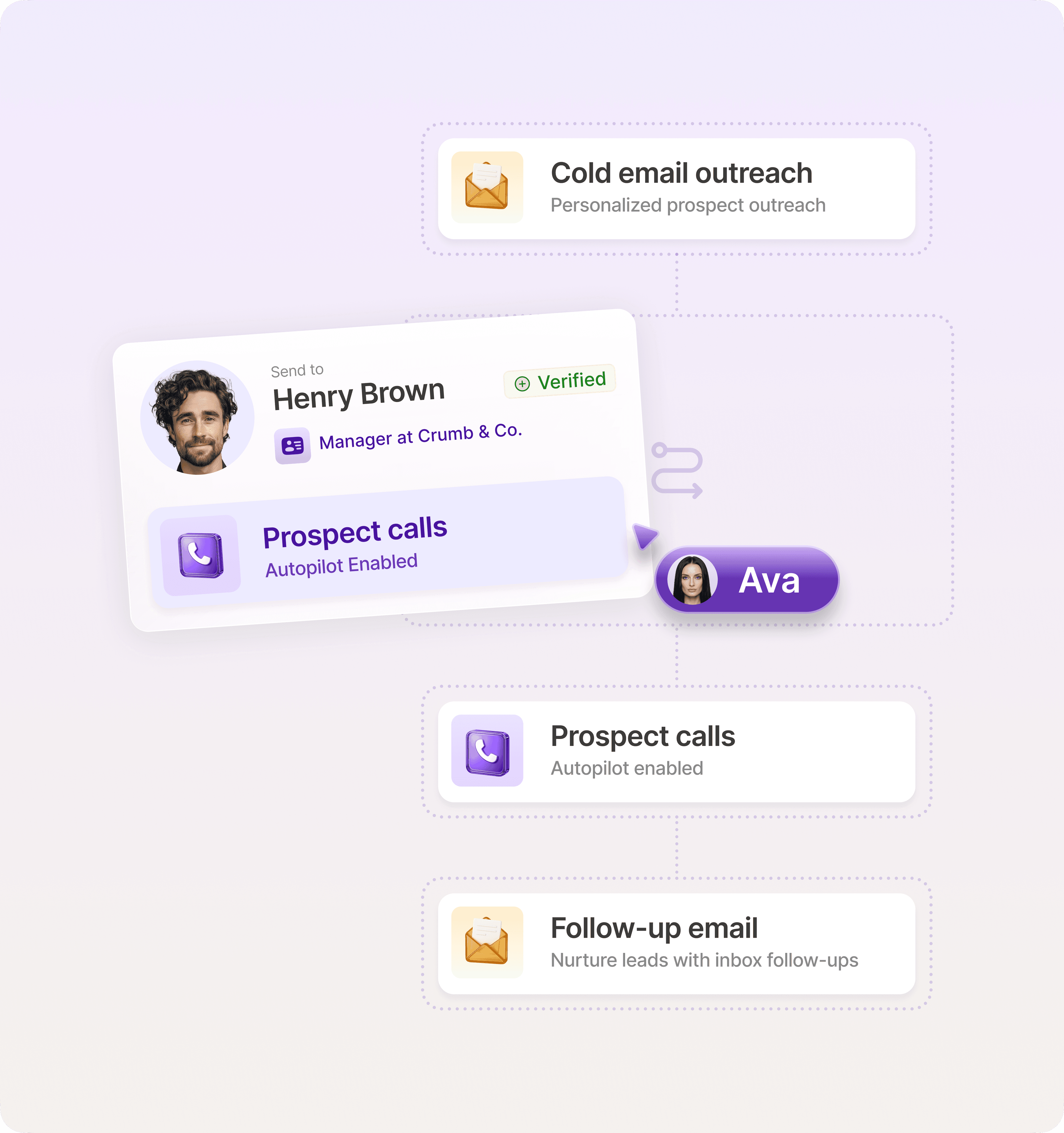
Artisan consolidates all sales processes into a single platform. AI business development representative (BDR) Ava prospects and enriches leads and runs personalized multi-channel outreach in one place, with full visibility into performance at every stage and no third party to brief, manage, or hold accountable.
Build a scalable sales system instead of outsourcing blindly
Outsourcing solves immediate capacity problems, but it doesn't build a sales engine. As such, B2B sales outsourcing is best treated as a lever within a larger system.
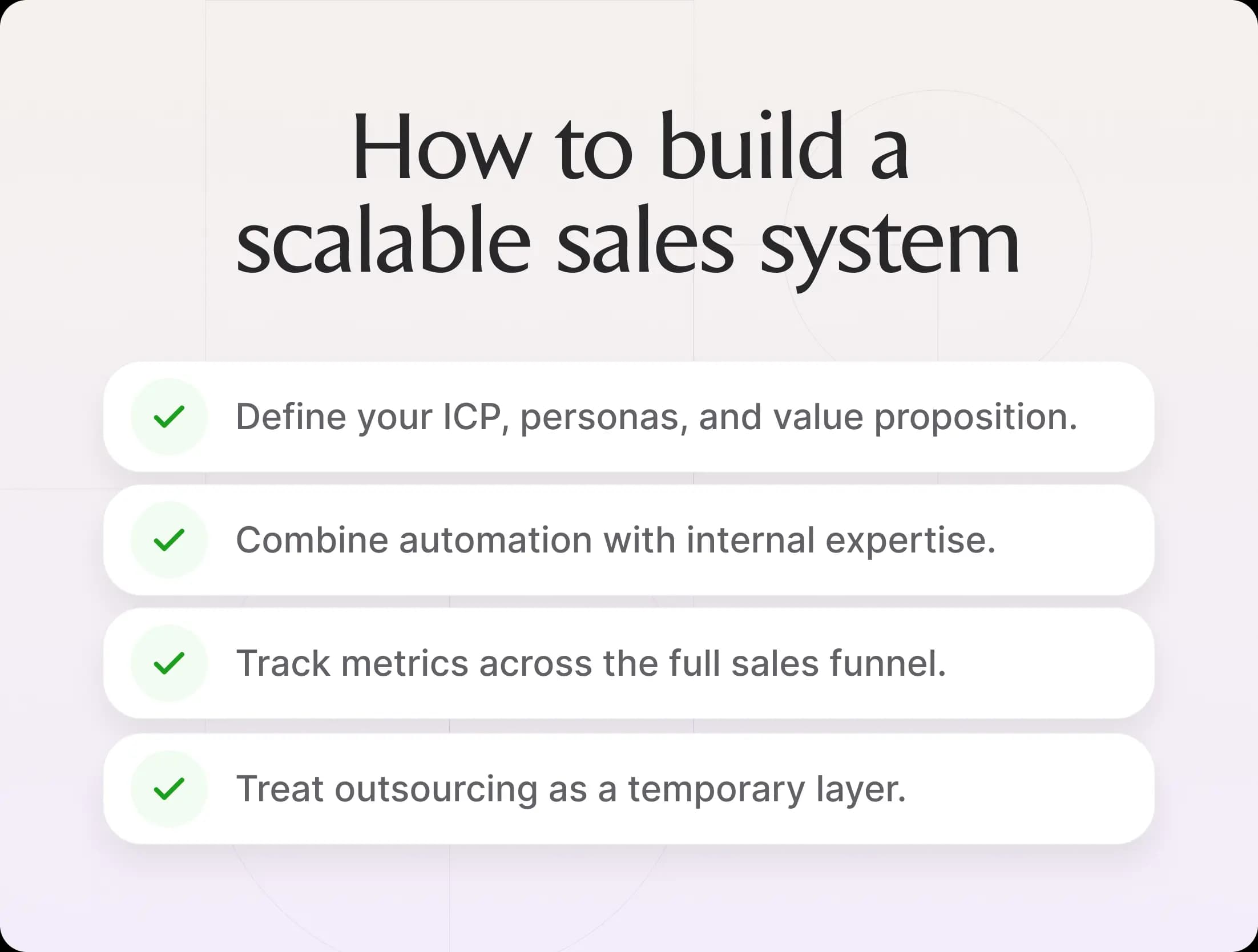
Define your ICP, personas, and value proposition first
Before engaging any external partner or tool, define your ICP and their pain points in concrete detail. Without that foundation, no amount of outreach will generate a qualified pipeline.
Your ICP should include the following core attributes:
Firmographic profile: Industry, company size, growth stage, geography
Personas: Decision-makers' job titles, seniority levels, and who holds budget authority
Behavioral signals: Hiring patterns, funding rounds, tech stack, intent data
Value proposition: The specific problem your product solves that a prospect can't ignore
If you don't know exactly who you're selling to, no outsourced team or automation platform will fix a targeting problem for you.
Combine automation with internal expertise
The most effective setup isn't fully outsourced or fully internal. While automation can handle the repeatable top-of-funnel work, your team should make the judgment calls associated with strategy, ICP refinement, and closing.
With platforms like Artisan, you retain full control over your voice and strategy while AI agents run automated sales outreach against your defined ICP. When a lead sens a positive reply, the relevant rep is automatically notified.
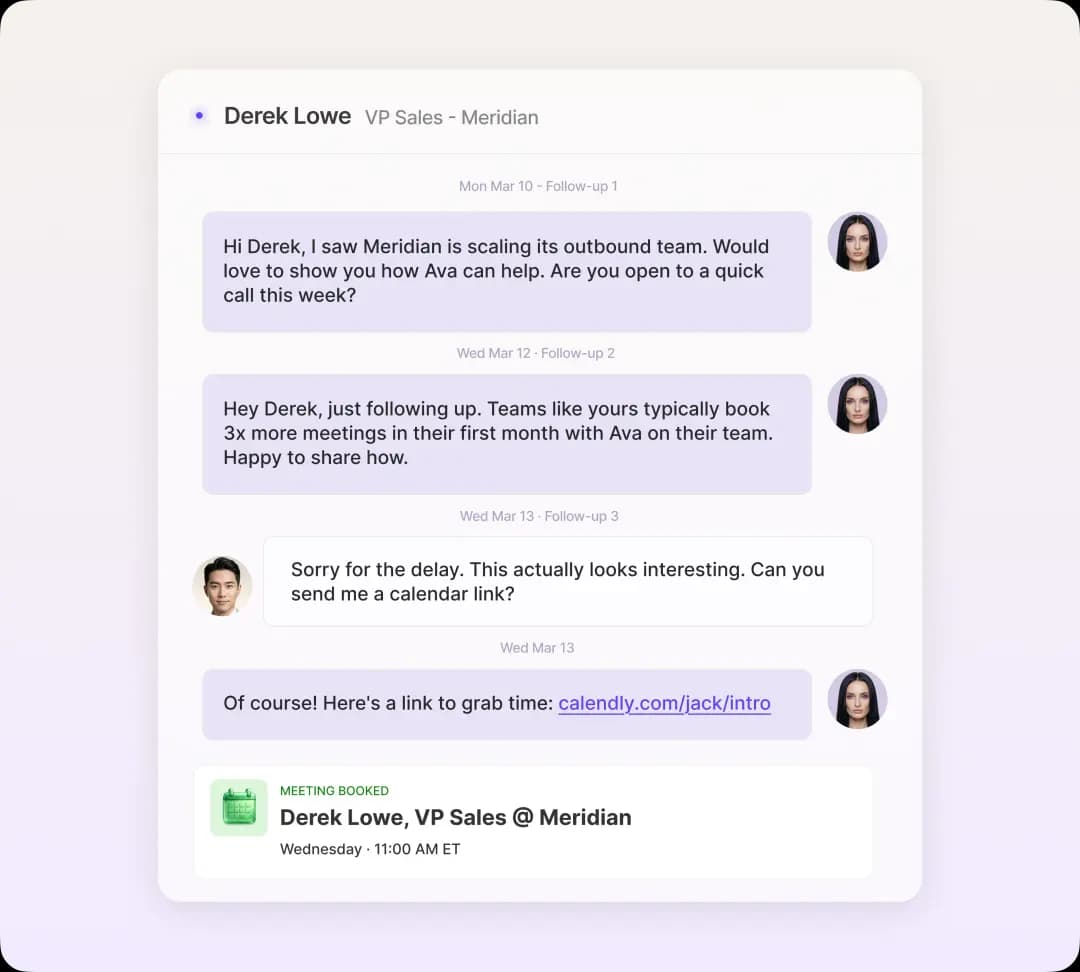
Track metrics across the full sales funnel
You can only gauge the success of your sales system and scale it effectively if you’re measuring what matters. In fact, vanity metrics like email volume or call counts can mask deeper problems.
Track these pipeline metrics to see if your consolidated sales system works:
Qualified meetings booked: Are you reaching the right prospects?
Conversion rate from first touch to opportunity: Is outreach generating real pipeline?
Revenue closed: Is pipeline converting?
Activity metrics like leads generated or accounts contacted are useful for understanding your team's efficiency, but they don't tell you whether the system is working. Only pipeline metrics do that.
Treat outsourcing as a temporary layer, not your strategy
Outsourcing buys time and capacity, but it doesn't build institutional knowledge or develop internal expertise that compounds. Use it to handle busywork while continuing to build your process, your data, and your pipeline.
B2B sales outsourcing works, but only if you control the system
Outsourcing top-of-funnel execution provides real benefits. It costs less than building an internal team from scratch and frees your reps to focus on closing. For companies at an early stage of growth, it's the right call.
To get the most from outsourcing, though, you need to stay in control of the system. It’s essential to define targeting, measure outcomes, and gradually bring proven processes in-house.
Platforms like Artisan give revenue teams the infrastructure to run top-of-funnel execution at scale. Your reps set the parameters, AI reps automate the process, and your team focuses on the all-important human task of closing.

Automate your outbound with an AI BDR
Meet Ava—your AI BDR who handles prospecting, outreach, and follow-ups, so your team can focus on closing.

Adelina Karpenkova
SME @ Artisan
Adelina Karpenkova is a writer helping businesses tap into AI's potential and clear up misconceptions. She works with B2B teams on latest industry knowledge.