Sales prospecting best practices that drive results
Learn best practices in sales prospecting, from ICP refinement and buying signal prioritization to multi-channel outreach and referral timing.
Few B2B sales reps enjoy prospecting. It’s the most tedious part of the sales process, filled with uncertainty.
But it doesn’t have to be a chore.
If you automate time-consuming admin tasks like signal tracking and account research and implement key best practices to boost conversion rates, cold outreach can actually be a satisfying part of the job.
What is sales prospecting?
Sales prospecting is the act of identifying, engaging, and qualifying potential customers who fit your ideal customer profile (ICP).
B2B sales reps, typically outbound sales development reps (SDRs), find leads, research them, and make contact by phone, email, or social media in an effort to qualify them and book a sales meeting.
Lead vs. prospect vs. sales opportunity
In B2B sales, potential customers go through different levels of qualification. At each level, they receive a new name that indicates their likelihood to buy.
Here’s an overview of the differences as they’re generally understood:
Lead: Unqualified contact who may be interested in your product
Prospect: Qualified lead matching ICP criteria
Sales opportunity: Prospect that’s nearly ready to make a purchase
In the ideal prospecting process, sales reps focus on contacting prospects (who are already qualified), not leads, and turning them into sales opportunities.
Why getting prospecting right matters
Systematic, personalized prospecting is critical to sales success for three key reasons:
Poor targeting wastes rep time on low-probability deals that will never close.
Generic outreach at scale damages brand perception with the exact buyers you want to win.
Disciplined prospecting provides cumulative benefits over time. Good-fit customers refer, renew, and expand.
Best practice: #1: Define and refine your ideal customer profile first
ICP precision is the foundation of sales prospecting. A detailed ICP acts as a campaign-wide reference point that allows you to consistently target the right accounts, the ones that will receive the most value from your solution.
To build an ICP, define your ideal account across these categories:
Firmographics: Industry, revenue, company size, and location
Technographics: The software and tech stack they are currently using
Behavioral attributes: Content engagement, buyer intent signals, website activity.
Motivations: Goals, pain points, fears, and mission
Always remember to align sales and marketing on ICP criteria to avoid conflicting targeting, inaccurate lead scoring models, and wasted outreach.
Why you should set a quarterly ICP refresh cycle
As your company grows and your industry changes, your ICP is likely to change as well. An outdated ICP leads to mistargeting. That’s why it’s important to update it every quarter to keep it fresh.
Specifically, review closed-won data to identify emerging patterns in company size, decision-maker roles, and buying signals. This helps you stay ahead of industry-wide shifts in buyer behavior.
If you expand your product scope, modify your ICP (or introduce new ICPs) to account for the new market segments that additional features serve.
Best practice: #2: Prioritize prospects using intent signals
Signal-based prioritization allows for intent-driven targeting so you’re always targeting leads with the highest likelihood of buying.
Behavioral signals (pricing page visits, content downloads, competitor research) indicate active evaluation, while trigger events (funding rounds, leadership changes, headcount growth) indicate readiness and openness to new solutions.
High-intent signals to track
Some signals are more indicative of future purchase than others. These are known as high-intent signals.
Track these high-intent signals to identify prospects who are ready to purchase:
Pricing page visits: Prospect is in budget evaluation mode
Competitor research activity: Active solution comparison is underway
Content downloads on specific pain-point topics: Reveals where a lead is in the buying journey
Job postings for relevant roles: Signals growth initiatives or stack investment
Funding announcements: Suggest budget just became available
Building a signal scoring system
Most modern sales and marketing apps will allow you to create a lead scoring model that automatically scores and ranks prospects based on their behavior, high-intent signals, and ICP-fit.
Follow these best practices when creating your signal-based scoring system:
Tier and weigh signals by buying stage proximity: Assign the most weight to decision-stage behaviors like demo requests. Cold awareness activity like reading a single blog post should receive a much lower score.
Weight recency heavily: Signals decay in days for high-intent actions. A content download yesterday is worth more than a download two weeks ago. Deduct points for inactivity.
Combine multiple weak signals to elevate priority: One pricing page visit plus a job posting outweighs either alone. Multiple intent signals over a short term often point to the highest-value leads.
Monitoring company events and changes
Monitoring for significant company activity helps you find prospects who have experienced a recent change and might now need your product or service. They also give you a natural way to open the sales conversation: “Hey, noticed you got promoted to VP of Finance.”
Follow these tips to track relevant events and help reps act on these opportunities:
Track funding announcements, leadership changes, and business expansion news. These are the three highest-converting categories.
Set up Google Alerts, CRM alerts, and social media notifications that alert reps to reach out when an event occurs for one of their accounts.
Use an AI outbound platform like Artisan to monitor these signals continuously and feed them directly into prospecting workflows without manual research.

Automate your outbound with an AI BDR
Meet Ava—your AI BDR who handles prospecting, outreach, and follow-ups, so your team can focus on closing.
Best practice #3: Hyper-personalize your outreach and follow the 15% rule
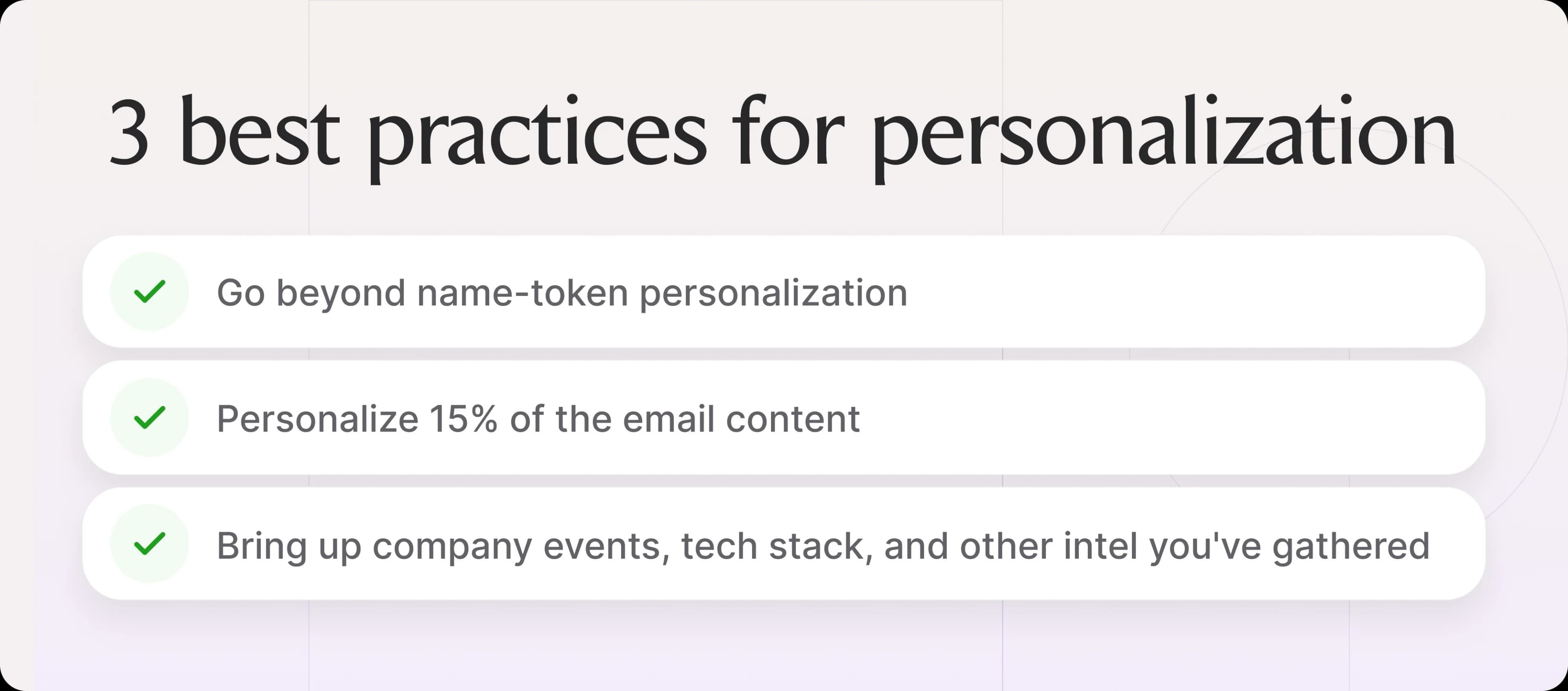
Spray and pray no longer works in B2B sales. You have to show prospects you have a nuanced grasp of their situation if you want them to respond positively to your outreach. Deep personalization demonstrates this understanding.
As a rule, you should aim to personalize 15% of email content. Compared to zero personalization, following this 15% rule correlates with 2.7x higher reply rates, according to research by Salesloft.
To put the 15% personalization rule into practice, follow these guidelines:
The opening line or short paragraph should be prospect-specific.
Begin by referencing a shared connection, recent event, social media post, or engagement with your brand’s content.
Tie pain points you solve to company events, tech stack gaps (missing functionality), or pressing industry challenges. For example, “I saw you recently doubled your sales team" would sit nicely alongside “That can come with a lot of managerial headaches.”
Tailor the CTA. Don’t say, “Do you have 15 minutes to chat?” Instead, opt for something like “Do you have 20 minutes to see how our sales coaching software can help your company ramp up new reps?”
How to execute multi-channel prospecting cadences
Single-channel outreach underperforms diversified cadences. The far better strategy is to create multi-touch prospecting campaigns that span email, social selling, and cold calls. This ensures that you reach prospects on the channel they prefer and gives you plenty of time to warm them up.
The 5–7 touch benchmark
In general, aim to send 5 to 7 touches to a decision-maker before sending that breakup email. Higher-value accounts should sit at the upper end of the touch range because they are higher ROI and worthy of more effort. Is this overkill? Nope. Persistence is never spam if messages are relevant, spaced appropriately, and vary by channel and angle.
While 18 emails sent to the same decision-maker might seem like stalker behavior, 6 cold emails, 6 cold calls, and 6 LinkedIn touches seems normal and is often necessary to get their attention, especially when you’re dealing with incredibly busy buyers inundated by sales messages.
Organize your channel mix by use case
Rather than simply blasting the same message across email, social media, and WhatsApp, tailor your messaging to each channel’s strength. For instance, email is particularly effective for traditional sales messages, while LinkedIn is better for more relationship building with decision-makers.
Here’s an overview of the top use cases for individual sales channels:
Email: For high-volume cold outreach and follow-ups after unanswered calls
Phone: High-priority accounts and breaking through after email silence
LinkedIn: Warm connection requests, starting conversations, and building trust with prospects
Video: Differentiation in crowded inboxes and high-value accounts worth the extra effort
Use a sequence design that doesn't feel robotic
For follow-ups, don’t ask “Did you see my last message?” 17 times. Each touch should take a slightly different approach, even if it’s only a one-line follow-up.
If you do have to repeat the same big idea, like your value proposition, across multiple messages, then come at it from a different angle each time.
For example, if in the last email you talked about your service’s promise, this time you might send a case study illustrating the promise in action. That’s how you keep the messaging fresh.
Best practice #4: Adopt a diagnosis-first mindset
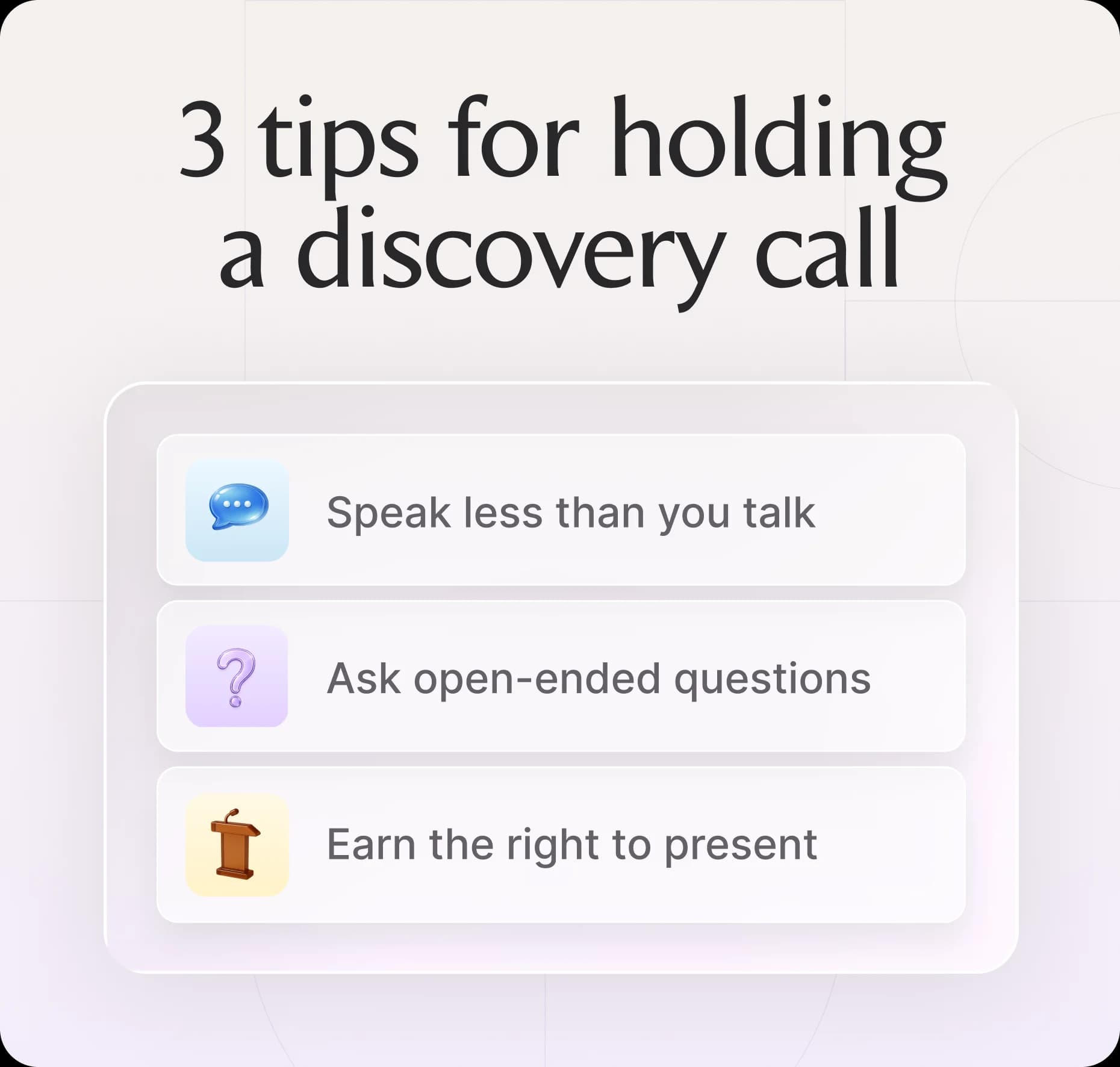
If you pique a lead’s interest, don’t immediately jump into pitch mode.
First, set up a short discovery call to understand their needs. This will give you the information required to identify the right product or service package, showcase the most relevant features, and pitch it all in a way that resonates with them. Think of it like being a doctor: you diagnose the illness before suggesting a prescription.
Follow the 70/30 rule in practice
In early-stage discovery conversations, come from a place of curiosity, and avoid salesy showmanship. Encourage the prospect to talk for 70% of the call.
Arguably, the best strategy for achieving this ratio is to ask open-ended questions that will encourage them to reveal their problems, processes, and goals. Where appropriate, you should listen, ask follow-ups, and educate. That’s how you build trust and identify their needs, which will help you with your pitch later on.
Consider recording calls and tracking your reps’ talk-to-listen ratios to make sure no one is over-pitching too early. And use the two-second rule often, where you pause for two seconds after the prospect answers; often, they’ll fill the silence with elaboration.
Ask questions that open conversations
In your initial discovery call, you should ask two types of questions to learn about the prospect’s needs and prompt them to start thinking about buying your solution.
Here's a quick rundown of both types of questions:
Start with situation questions: Ask about their main goals and what’s holding them back, their current process, recent changes in the company, and the tools they use. This helps you determine the cause of their problem.
Move to implication questions: Ask the prospect about what happens if this problem goes unsolved. What are the negative consequences? This will evoke a sense of urgency in relation to your solution.
Earn the right to present
If you can show the prospect that you understand their problem better than they do, they’re going to be more likely to trust your recommendation for a solution. This is part of why discovery comes before the pitch. You’re asking them about their issue, learning about it, and providing some insight into why they might be suffering the problem.
Only once you’ve earned this trust and discovered the major causes of their issues should you present a solution. Typically, this will happen at the end of the discovery call, in the form of a short pitch—“To solve [insert problem], you need [product or service package].”
After piquing their interest, book a subsequent sales meeting, demo, or presentation, where you’ll get into the details of your offering, how it works to solve their problem, and the benefits they’ll receive from buying it.
Best practice #5: Leverage referrals at the right time
One of the fastest ways to add a high-value prospect to your pipeline is to ask a happy customer to introduce you to someone in their network who might need your solution.
That’s because 88% of people trust recommendations from people they know, according to a survey by Nielsen. But don’t just ask randomly. Timing matters here.
Ask your customers for warm introductions immediately after “success moments." These moments are when customers are most willing to advocate. Achieving their first ROI milestone from use of your solution, writing a positive review, or signing a renewal contract are all examples.
Do your best to make specific requests: name the type of company and role you're looking for. If you have the time, research the customer’s LinkedIn network and identify several ideal customers. Then ask for an intro to these particular decision-makers. That simple tweak makes the customer’s job easier while helping you reach target accounts.
Best practice #6: Protect prospecting time
This rule is a simple but important one. Treat prospecting like a writer treats their daily writing habit. Block out up to two sessions (30 to 90 minutes each) every day at the same time for prospecting.
Avoid distractions and reactive tasks. Set yourself up with your lead list, account research, and any tools you need so you can focus on crafting deeply personalized outreach.
The 3 tools that support prospecting best practices
AI-enabled software can automate significant parts of the sales prospecting workflow. Three types of tools in particular have emerged as powerful additions to a modern stack: AI SDR platforms, intent data providers, and sales engagement solutions.
AI SDR platforms
There’s no more cost-efficient way to scale prospecting than with AI SDRs.
AI SDR platforms automate busywork associated with prospecting, including account research, lead discovery, and cold outreach over email and social. This enables sales reps to focus on cold calling accounts, holding discovery calls, and strategically engaging the highest-value accounts.
For example, Artisan’s AI BDR, Ava, finds ideal customers, enriches their profiles with dozens of data points, tracks intent signals, and runs personalized multichannel outreach sequences. She can even book meetings for reps on autopilot.

Intent data and signal platforms
To implement intent-based targeting, you first need high-quality lead data. Intent data platforms provide account-level intent signals for teams running ABM at scale.
This data is incredibly useful for identifying high-priority accounts and finding relevant topics to bring up in your messaging to them.
To get the most out of these tools, pair them with an automated outreach platform that can act on the signals they surface.
CRM and sales engagement tools
CRM platforms track prospect status, outreach history and responses, and pipeline stage, enabling you to generate a detailed overview of each prospect before a call.
Meanwhile, sales engagement platforms automate multi-channel outreach execution and track reply rates. Essentially, they help you quickly send a high volume of personalized messages without sacrificing quality.
If you’re doing social selling, also consider LinkedIn Sales Navigator. It supports lead research, warm connection building, and trigger event monitoring, like job promotions.
Build a prospecting system, not a prospecting habit
You could prospect for 20 hours every week but still see low conversion rates if you lack the right prospecting tools, sequences, and best practices.
An AI system built around an AI BDR like Artisan will automate busywork for your reps, boost efficiency, and enforce personalization and outreach frequency standards. All of which means your sales reps can focus on what they do best: talking to qualified prospects and closing deals.
Automate your outbound with an AI BDR
Meet Ava—your AI BDR who handles prospecting, outreach, and follow-ups, so your team can focus on closing.

Sam Rinko
SME @ Artisan
Sam Rinko is a former SaaS sales rep turned tech writer. He sold real estate software before writing about lead generation, cold calling, and AI sales tools.