Salesloft vs HubSpot Sales Hub: which should you choose in 2026?
An honest 2026 comparison of Salesloft and HubSpot Sales Hub across CRM fit, cadence governance, Breeze credit-based pricing, and the Clari merger.
Salesloft and HubSpot Sales Hub both run cadences, but the deciding factor is your CRM. Sales Hub is native to HubSpot, so everything lives on one record, and its Breeze agents now bill through bundled HubSpot Credits at about $0.010 per credit, a usage-based model rather than a per-seat AI charge. Salesloft is a dedicated engagement platform, CRM-agnostic, now paired with Clari forecasting after the December 2025 merger.
These two rarely land on the same shortlist by accident. Teams already committed to HubSpot compare Sales Hub against a specialist engagement tool like Salesloft to decide whether native convenience beats dedicated depth. Teams that are CRM-agnostic weigh Salesloft's cadence maturity against HubSpot's single-record simplicity and its new pricing model. This comparison lays out both fairly so you can match the tool to your stack.
How Salesloft and HubSpot Sales Hub compare
Salesloft | HubSpot Sales Hub | |
|---|---|---|
Best for | Large orgs wanting dedicated cadence plus forecasting | Teams whose motion already runs on HubSpot |
CRM fit | CRM-agnostic, integrates broadly | Native to HubSpot, single-record model |
Cadence governance | Mature, deep controls for large teams | Solid within the HubSpot ecosystem |
Forecasting | Native via the Clari merger (Dec 2025) | Within HubSpot reporting |
AI pricing | Standard per-seat model | Breeze via bundled HubSpot Credits, ~$0.010/credit |
Public pricing | Not published; enterprise sales-led | Published per-seat tiers, per its pricing page |
What is the core difference between Salesloft and Sales Hub?
It comes down to where your data lives. HubSpot Sales Hub is part of the HubSpot platform, so cadences, contacts, deals, and reporting all sit on the same record. There is no sync layer to manage because there is nothing to sync; the engagement tool and the CRM are one system. That is its biggest advantage and also its boundary: the value is highest inside HubSpot and thins outside it.
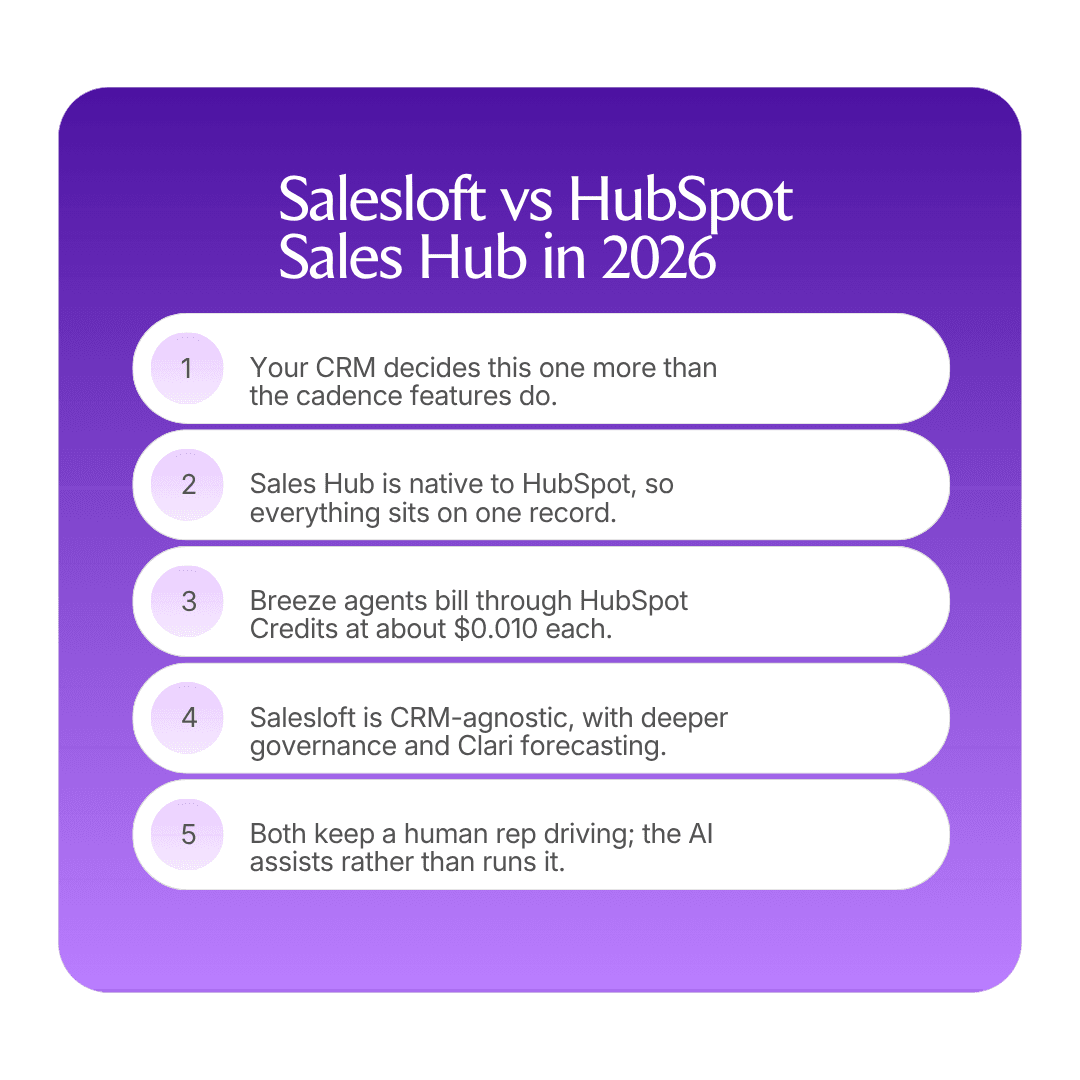
Salesloft is a standalone engagement platform designed to work across CRMs. It brings deeper, more specialized cadence governance and, since the December 2025 Clari merger, native forecasting. You run it alongside your CRM rather than inside one. So the choice is native convenience versus dedicated depth, and your existing CRM commitment usually settles it.
Which is better if you already run HubSpot?
If your entire motion already lives in HubSpot, Sales Hub is the natural pick. Everything stays on one record, there is no integration to maintain, and reps work cadences in the same place they manage deals. Adding a separate engagement platform on top of HubSpot means paying for and maintaining a tool that duplicates part of what you already own, which only makes sense if you need governance depth HubSpot cannot match.
The counterpoint is scope. Sales Hub's advantage is strongest inside the HubSpot world and weaker for teams with a mixed stack or a Salesforce core. If HubSpot is your system of record and you value single-record simplicity, Sales Hub wins this scenario clearly. If you are CRM-agnostic or on Salesforce, the native advantage disappears and Salesloft's depth becomes more relevant.
Which has deeper cadence governance?
Salesloft. It is a dedicated engagement platform built for large, disciplined sales orgs, with mature sequence controls, team permissions, and reporting depth honed over years as a category specialist. When an organization has many reps and needs strict process enforcement, Salesloft's governance is the more specialized answer.
Sales Hub's cadence tools are solid and well integrated, though engagement is one part of a broad CRM platform. For a mid-market team running its motion on HubSpot, that depth is usually enough. For a large org whose priority is tight cadence governance above all, Salesloft's specialization shows. Match the depth to how demanding your process control actually is.
How does HubSpot's Breeze pricing work?
HubSpot's Breeze agents bill through bundled HubSpot Credits at roughly $0.010 per credit, a usage-based model worth citing because it ties AI cost to consumption rather than to a seat. That reframed the buying question for a lot of teams: instead of asking only what a license costs, they started asking how much AI work they will actually run and what those credits add up to.
For a Sales Hub buyer, it means the AI agent layer scales with usage rather than headcount, which is appealing if you want cost to track how much the agents do. Salesloft, by contrast, uses a standard per-seat enterprise model. Neither approach is automatically better; credit-based usage rewards teams that can forecast their consumption, while per-seat pricing is predictable regardless of volume. The point is that HubSpot's move made the pricing question sharper across the whole category.
What did the Salesloft and Clari merger change?
The merger closed December 3, 2025, combining Salesloft's cadence with Clari's forecasting under one company. For a buyer who wants engagement and forecasting from the same vendor, that is a real draw and a clear differentiator against Sales Hub, whose forecasting lives inside HubSpot's own reporting.
The trade-off is roadmap uncertainty common to large mergers. New buyers should ask where the combined product is headed and how the two sides integrate over time. Those are fair questions for a sales conversation. If forecasting tied to cadence is central to your motion and you are comfortable with post-merger questions, the combined Salesloft-Clari story is a point in its favor.
A third option to know about
Both tools keep a human rep running the motion: whichever you pick, Sales Hub gives reps assistive agents inside HubSpot and Salesloft organizes what reps do next, but the rep still writes, sends, calls, and replies. Their AI assists that person rather than replacing the work.
If you would rather the software do the outbound work rather than assist with it, an autonomous platform is a third path. Artisan built Ava, an autonomous AI sales agent, to run the outbound motion: she sources, writes, sends, replies, and books on her own, with calling built in. On call steps, she dials and a rep handles the live conversation. Ava runs on usage-based pricing. That is a different purchase from a cadence tool you staff and drive, and it fits teams that want the outcome rather than a better console for reps. Our guide to the best sales engagement platforms maps where each model fits.
Choose Salesloft if
You want a dedicated engagement platform with deep cadence governance for a large team.
Your stack is CRM-agnostic or Salesforce-centric rather than HubSpot-native.
Forecasting tied to cadence, via the Clari merger, is central to your motion.
Process control across many reps outweighs single-record convenience.
You are comfortable with an enterprise, sales-led purchase and post-merger roadmap questions.
Choose HubSpot Sales Hub if
Your entire motion already runs on HubSpot and you value one record for everything.
You want no integration layer between engagement and CRM.
Breeze billed through bundled HubSpot Credits at about $0.010 per credit fits how you want to buy AI.
Your cadence needs are well served by solid, integrated controls rather than specialist depth.
Published, self-serve pricing matters more than dedicated enterprise governance.
Frequently asked questions
Is HubSpot Sales Hub or Salesloft better?
It depends on your CRM. If your motion already runs on HubSpot, Sales Hub keeps everything on one record with no integration to maintain, and its Breeze agents bill through bundled HubSpot Credits at about $0.010 per credit. Salesloft is the better pick for CRM-agnostic or Salesforce-centric teams that need deeper, specialist cadence governance and want forecasting tied to cadence via the Clari merger. Match the tool to your stack.
How is HubSpot's Breeze pricing structured?
HubSpot's Breeze agents bill through bundled HubSpot Credits at roughly $0.010 per credit, a usage-based model that ties AI cost to consumption rather than to a seat. It appeals to teams that want cost to track how much the agents actually do and can forecast that usage. Salesloft, by contrast, uses a standard per-seat enterprise model. Neither is automatically better; credit-based usage and per-seat pricing suit different buying preferences.
Do I need Salesloft if I already use HubSpot?
Usually not, unless you need governance depth HubSpot cannot match. Sales Hub already provides cadences inside the CRM, so adding Salesloft means paying for and maintaining a tool that duplicates part of that. The case for running Salesloft alongside HubSpot is a large, disciplined org that needs Salesloft's specialist cadence controls. For most HubSpot-native teams, Sales Hub is enough.
How does the Salesloft and Clari merger affect the choice?
The merger, closed December 3, 2025, adds native forecasting to Salesloft's cadence, which Sales Hub answers with HubSpot's own reporting. If forecasting tied to cadence from one vendor matters to you, that favors Salesloft. The trade-off is roadmap uncertainty typical of large mergers, so ask where the combined product is headed before committing. It is a differentiator with a caveat attached.
How much do Salesloft and HubSpot Sales Hub cost?
HubSpot Sales Hub publishes per-seat tiers on its pricing page (Free, Starter, Professional, and Enterprise), and its Breeze agents bill through bundled HubSpot Credits at about $0.010 per credit. Salesloft does not publish self-serve pricing; its numbers come through an enterprise sales process and depend on volume and term. So Sales Hub offers more pricing transparency up front, while Salesloft is a quoted enterprise purchase.
Is there an alternative to both Salesloft and HubSpot Sales Hub?
Yes. Both keep a human rep driving: Sales Hub gives reps assistive Breeze agents inside HubSpot and Salesloft prompts what reps do next, but the reps still write, send, call, and reply. If you want the software to execute the outbound job itself, Artisan's Ava is an autonomous AI sales agent that sources, writes, sends, replies, and books on her own, with calling built in. On call steps, she dials and a rep handles the live conversation. It runs on usage-based pricing, a different category than an engagement tool, suited to teams that want the motion owned end to end rather than orchestrated for reps.
Jaspar Carmichael-Jack
Co-Founder & CEO @ Artisan
Jaspar is an entrepreneur with expertise in sales, marketing, and operations. He founded Artisan in 2023, a company automating workflows with AI employees.