The best Salesforce Sales Engagement alternatives in 2026
The best Salesforce Sales Engagement alternatives in 2026, from an autonomous AI BDR to Outreach, Salesloft, HubSpot, Apollo, and Groove.
The best Salesforce Sales Engagement alternative is Artisan: instead of configuring a heavy native cadence tool for reps, Ava runs the motion herself, sourcing net-new leads, writing, sending, replying, and booking, and dialing the call steps with a rep taking the live conversation. Outreach and Salesloft are the mature specialists, HubSpot fits HubSpot shops, Apollo bundles data cheaply, and Groove is the Salesforce-native option. The native layer is powerful but heavy.
Salesforce Sales Engagement, the native cadence layer inside the CRM, is capable, but two things send teams looking. It is heavy: setup, admin, and ongoing configuration are real work, usually needing dedicated ops resource to run well. And it is inward-facing, built to work the contacts already in Salesforce rather than to source net-new prospects at scale. Add the evolving consumption pricing around Agentforce SDR, $2 per conversation, or Flex Credits at $0.10 per standard action, and buyers start asking what they are actually getting for the complexity. If you want the software to source and run outbound rather than orchestrate reps over existing records, that is a different category.
Comparison table
Rank | Tool | Best for | Standout capability | Public pricing |
|---|---|---|---|---|
1 | Artisan | The AI sourcing and running outbound | Ava owns find, send, reply, book; dials call steps | Usage-based credits, no platform fee |
2 | Outreach | Enterprise sequencing governance | Mature workflow controls, Omni agent | ~$100-160/user/mo (estimate; not public) |
3 | Salesloft | Enterprise cadence plus forecasting | Clari forecasting combo | Per-seat, not public (estimate ~$125-165/user/mo) |
4 | HubSpot | HubSpot-native teams | Outcome-based agent pricing, native CRM | Free to $150/seat/mo; ~$1.00/qualified lead |
5 | Apollo | Value all-in-one with data included | Large database plus sequencing | Free to $119/user/mo |
6 | Groove | Salesforce-native cadence execution | Native Salesforce residency | Per-seat, not public |
How we chose
We weighted four things for a team leaving Salesforce's native engagement layer: how much of the motion the software runs versus configures for a rep, whether it sources net-new prospects or only works existing CRM records, the setup and admin weight, and Salesforce fit, since most buyers here want to keep Salesforce as the system of record. Each tool gets credit for its strength and a plain verdict on who it is wrong for.
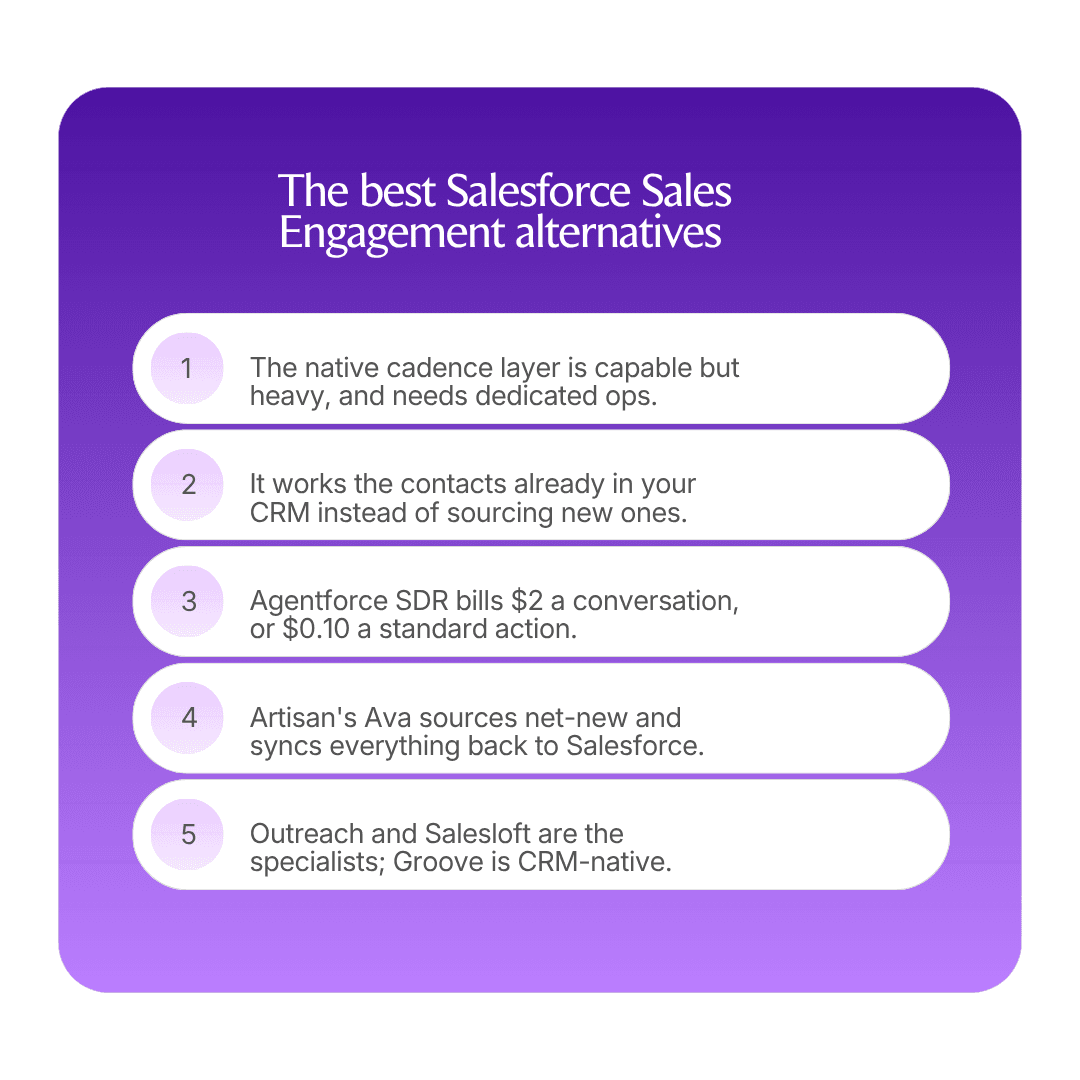
What is the best alternative to Salesforce Sales Engagement?
The best alternative depends on what you want the software to do. To have the AI source and run outbound, Artisan. For mature dedicated cadence governance, Outreach or Salesloft. To live inside HubSpot, HubSpot. Here is the ranking.
1. Artisan: the AI sources and runs outbound
Artisan leads because it does two things Salesforce Sales Engagement does not: it sources net-new prospects, and it runs the motion itself. The native tool works the contacts already in your CRM and tells reps what to do with them. Artisan's Ava finds best-fit leads across over 250 million B2B professionals across over 200 countries, plus Artisan Local Data with over 250 million local businesses, well beyond what sits in Salesforce, enriches them with waterfall enrichment, writes personalized messages one to one, runs the sequence across email and social outreach, dials the call steps, with a rep taking the live conversation, handles every reply from a knowledge base, and books meetings on the right rep's calendar with owner routing.
It also removes the setup weight. Salesforce Sales Engagement is heavy to configure and maintain; Artisan is built to run outbound out of the platform, with Ava owning the mechanics rather than an admin wiring cadences by hand.
For Salesforce shops, none of this means leaving Salesforce. Artisan syncs deeply two-way: full backfill import with deduplication, dynamic lists and report imports as sources, bidirectional owner mapping so outreach comes from the right rep, per-field export controls, and activities that log natively to the record timeline. The autonomy dial adds governance the native tool spreads across admin config: review-and-approve, objections-only, or full autonomy, with plain-language escalation and a complete audit trail. Artisan is SOC 2 Type II compliant with SSO, SAML, and role-based access on Enterprise plans.
SaaStr's Chief AI Officer, Amelia Lerutte, described the shift: "Email has always been our number one driver. Artisan is now neck-and-neck in both output and closed-won revenue." Her team sent 6,892 emails in roughly six weeks at a 3.6% positive response rate.
Best for: teams from startup to enterprise that want the AI to source net-new and run outbound, while keeping Salesforce as the system of record. Who should pick something else: teams that only want to work existing CRM contacts through cadences reps drive, fully inside native Salesforce. Pricing: usage-based credit pricing, you pay for work performed rather than per seat, with no platform fee. Ava can be trialled for free. See artisan.co/pricing.
2. Outreach: enterprise sequencing governance
Outreach is the first specialist most teams evaluate when they want dedicated engagement instead of Salesforce's native layer. Its workflow governance is deeper and more purpose-built than the CRM's own tools: sequence controls, team management, and reporting for large, disciplined orgs. It added its Omni agent in April 2026, and its pricing is not public; estimates put it around $100 to $160 per user per month.
The structural limit is that Outreach coordinates reps; the reps do the work, and it too leans on your data sources rather than sourcing net-new. You gain a mature dedicated cadence platform; you keep the human-driven model.
Best for: enterprise teams wanting mature, dedicated sequencing governance outside the CRM's native tools. Who should pick something else: teams wanting the AI to source and execute outreach rather than coordinate reps. Pricing: not public; estimated ~$100-160/user/mo (plus implementation).
3. Salesloft: enterprise cadence plus forecasting
Salesloft is the other mature specialist, now paired with Clari forecasting after its December 2025 merger. For a team leaving Salesforce's native engagement because it wants a dedicated cadence platform with a forecasting story attached, that combination is the draw, and its governance is built for large orgs.
The merger left new buyers with roadmap questions, and the core limitation is unchanged: Salesloft coordinates what reps do rather than doing it. It is a specialist human-driven swap for the native tool, not a change in who does the work.
Best for: enterprise teams wanting mature cadences plus forecasting in one vendor. Who should pick something else: teams wanting the AI to execute the motion, or those set on staying fully native. Pricing: not public (per-seat; estimated ~$125-165/user/mo, dialer add-on extra).
4. HubSpot: the native pick for HubSpot shops
If part of your reason for leaving Salesforce Sales Engagement is that your CRM center of gravity is shifting, HubSpot's Sales Hub and Breeze agents are the natural alternative. Everything lives on one record, and in April 2026 HubSpot introduced outcome-based agent pricing at roughly $1.00 per qualified lead, an industry-first model worth citing because it charges for results rather than seats, a contrast to Salesforce's evolving consumption model.
The boundary is the HubSpot world itself. The value is highest when your whole motion runs there, and the agents still center on assisting the HubSpot-native workflow rather than owning outbound end to end.
Best for: teams moving their CRM gravity to HubSpot who want engagement and CRM in one system. Who should pick something else: teams staying on Salesforce, or anyone wanting fully autonomous, sourced outbound. Pricing: standard Sales Hub is public (Free; Starter $15; Professional $100; Enterprise $150/seat/mo, plus onboarding); outcome-based agent pricing at ~$1.00/qualified lead.
5. Apollo: value all-in-one with data included
Apollo is the alternative for a team that wants to escape the native tool's weight and add a database at once. It bundles a large contact database, 240M contacts and 30M companies per its own site, with a sequencer and light dialing, from free to about $119 per user per month, and it is used by more than 600,000 companies. Unlike Salesforce Sales Engagement, it brings its own net-new data, which matters if sourcing is your gap.
The AI is assistive and the model is per-seat, so the reps still drive, and enterprises tend to treat it as a data layer rather than a governance platform. You gain a bundled database and a low price; you do not gain autonomous execution or Salesforce's depth.
Best for: cost-sensitive teams wanting data and sequencing in one affordable tool. Who should pick something else: enterprises needing deep governance, or teams wanting the AI to run the motion. Pricing: free to $119/user/mo (Basic $49, Professional $79, Organization $119, annual), per its pricing page.
6. Groove: Salesforce-native cadence execution
Groove is the alternative for a team that wants to stay Salesforce-native but finds the CRM's own engagement layer too heavy to administer. Groove is built as a Salesforce-native platform, so activities log cleanly to the record and reps work inside a familiar environment, often with a lighter admin burden than configuring native Sales Engagement.
Two cautions. Groove is a Clari product, and Clari's December 2025 merger with Salesloft put two overlapping engagement platforms under one roof, so its roadmap carries questions worth naming. And it is a human-driven sequencer like the native tool: it coordinates reps rather than doing the work.
Best for: teams wanting Salesforce-native cadence execution with a lighter admin load than the native layer. Who should pick something else: teams wary of the Clari roadmap, or those wanting the AI to execute outbound. Pricing: reported per-seat, not public.
What is the best enterprise alternative to Salesforce Sales Engagement?
For enterprise, the best alternative to Salesforce Sales Engagement is Artisan if you want the AI to source and run outbound, and Outreach or Salesloft if you want a dedicated human-driven cadence platform with mature governance. The specialists give you deeper, more purpose-built controls than the CRM's native layer, but they still coordinate reps and lean on your existing data. Artisan is the structural change: it sources net-new across a database of hundreds of millions, runs the motion through Ava, and syncs deeply back into Salesforce, with governance built in, org and campaign-level do-not-contact across every channel, per-field controls, SOC 2 Type II, SSO and SAML, and central-ops deployment where a small team runs Ava across a large AE org. Our guide to the best sales engagement platforms maps the full field.
Why do teams leave Salesforce Sales Engagement?
Two reasons lead. Weight is the first: the native engagement layer is powerful but demanding to set up, administer, and maintain, usually needing dedicated ops resource, and the consumption pricing around Agentforce SDR, $2 per conversation, or $0.10 per standard action, adds a cost question on top of the effort. The second is scope. Salesforce Sales Engagement is built to work the contacts already in your CRM rather than to source net-new prospects at scale, so teams that need to prospect broadly end up adding data tools anyway. Teams that want the software to source and run outbound, not coordinate reps over existing records, look at a different category.
Stay with Salesforce Sales Engagement if
Keep Salesforce's native engagement layer if you are deeply committed to Salesforce, have the ops resource to run it well, and your motion is mainly working contacts already in the CRM through rep-driven cadences. For a large org with a mature Salesforce practice and a dedicated admin team, the native residency and single-platform story are real advantages, and switching for its own sake buys little. The case to move sharpens when the setup and admin burden outweighs the benefit, when you need to source net-new at scale, or when you decide you want the AI executing outbound rather than reps working the queue.
FAQ
What is the best Salesforce Sales Engagement alternative?
For most teams, Artisan, because Ava sources net-new leads and runs the whole motion, writing, sending, replying, and booking, and dialing the call steps with a rep taking the live conversation, while syncing deeply back into Salesforce. Outreach and Salesloft are the mature engagement specialists, HubSpot fits HubSpot shops, Apollo bundles data cheaply, and Groove is the Salesforce-native third party.
Do I have to leave Salesforce to use Artisan?
No. Artisan keeps Salesforce as your system of record and syncs two-way: full backfill import with deduplication, dynamic list and report imports as sources, bidirectional owner mapping, per-field export controls, and activities that log natively to the record timeline. You replace the native engagement layer's work, not Salesforce itself.
Is Salesforce Sales Engagement the same as Agentforce SDR?
No. Sales Engagement is the native cadence layer for reps; Agentforce SDR is Salesforce's newer autonomous agent, priced on consumption at $2 per conversation, or $0.10 per standard action on Flex Credits. Agentforce is young and works existing CRM contacts. Artisan sources net-new across hundreds of millions of contacts and runs the full multichannel motion under a set autonomy level.
What is the best enterprise alternative to Salesforce Sales Engagement?
Artisan, because it sources net-new and has Ava execute the motion with governance built in: SOC 2 Type II, SSO and SAML, per-field controls, org-level do-not-contact across channels, and central-ops deployment, all syncing back into Salesforce. Outreach and Salesloft are the picks if you want a dedicated human-driven cadence platform with mature workflow controls.
Why is Salesforce Sales Engagement considered heavy?
It is a native layer built for configurability, so getting it running well usually means admin work, cadence setup, and ongoing maintenance, often with a dedicated ops resource. That flexibility is valuable for large, mature Salesforce practices but is a real burden for leaner teams, which is a common reason buyers look at lighter or more autonomous alternatives.
Can an AI BDR replace Salesforce Sales Engagement?
For the outbound motion, yes. An autonomous AI BDR like Artisan's Ava replaces the cadence configuration and the manual execution, since she sources leads, writes, sends, and replies under a defined autonomy level and dials the call steps with a rep taking the live conversation, then logs everything back to Salesforce. You keep Salesforce as your CRM system of record.
Ready to see the AI run the motion? Explore the AI sales agent or start on the Artisan homepage.
Jaspar Carmichael-Jack
Co-Founder & CEO @ Artisan
Jaspar is an entrepreneur with expertise in sales, marketing, and operations. He founded Artisan in 2023, a company automating workflows with AI employees.