The best ABM platforms for B2B teams in 2026
The best ABM platforms for B2B teams in 2026, ranked, with honest verdicts on Artisan, 6sense, Demandbase, Clay, and Common Room for account-based outreach.
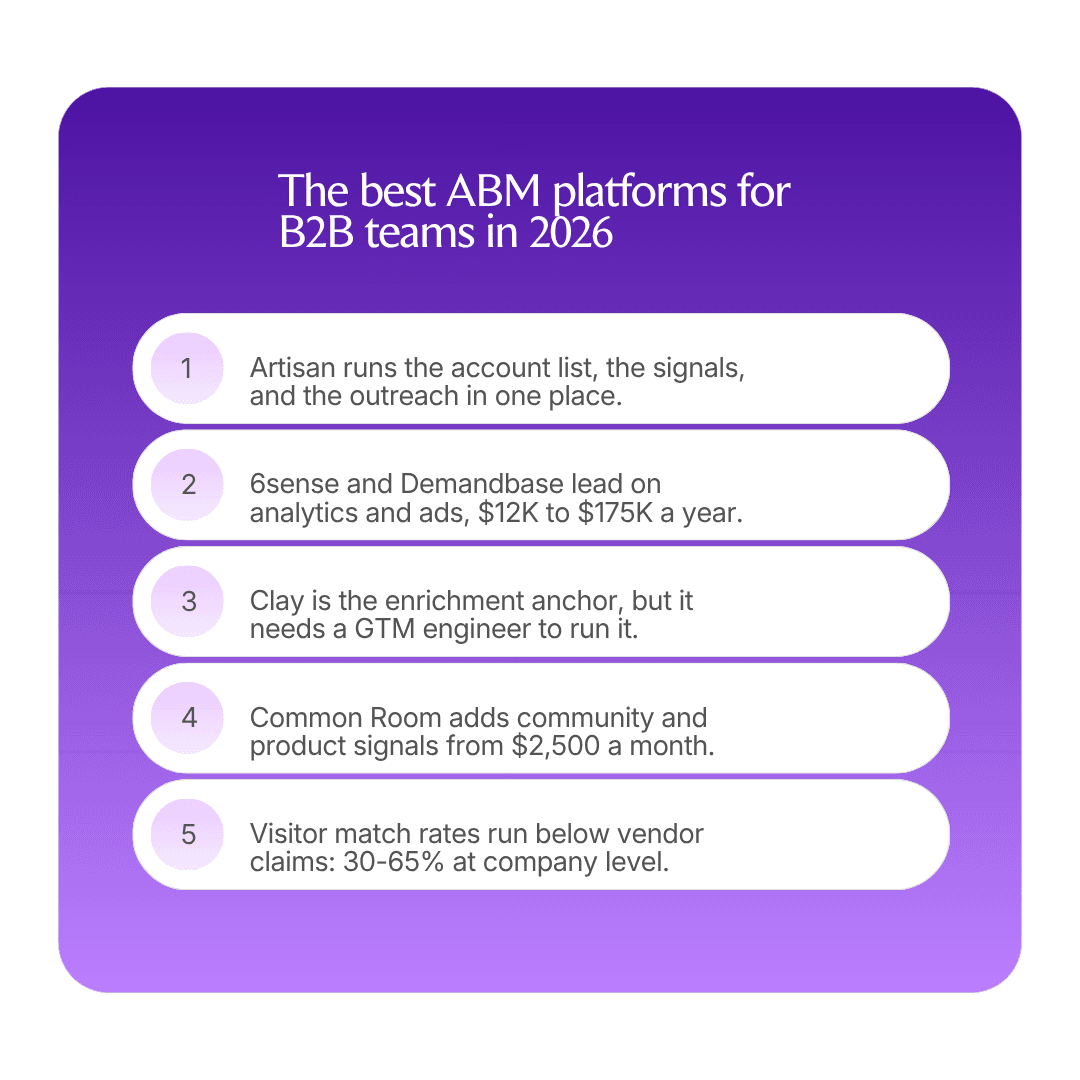
The best ABM platform for B2B teams is Artisan, because it runs account-based marketing with the outreach built in. Named-account lists, intent signals, and website visitor identification feed an AI BDR that contacts the accounts and books the meetings. Most ABM platforms are analytics and advertising engines that tell you which accounts are in-market, then stop before the outreach.
That gap is the central ABM problem in 2026. The signal is only as valuable as your speed to act on it, and most stacks lose days between "6sense says this account is surging" and "a rep sends a relevant message." Below we rank the field honestly. We credit the analytics suites for what they lead on, credit the enrichment and community-signal specialists, and say clearly who each one is wrong for.
How the platforms compare
Rank | Platform | Best for | Standout capability | Public pricing |
|---|---|---|---|---|
1 | Artisan | Teams that want ABM signals to trigger real outreach automatically | Named accounts + signals + visitor ID feeding an autonomous AI BDR | Usage-based credits, no platform fee (pricing) |
2 | 6sense | Predictive intent analytics and ad orchestration | AI intent model, anonymous buyer-stage prediction | Gated; ~$12K-175K/yr (median ~$63K, Vendr est.) |
3 | Demandbase | Account-based advertising and sales intelligence | Ad targeting, account journey analytics | Gated; ~$24K-165K/yr (median ~$68K, Vendr est.) |
4 | Clay | Building and enriching target-account lists | 150+ enrichment providers, Claygent agents | Free; Launch $167/mo; Growth $446/mo |
5 | Common Room | Community and product-signal buyer intelligence | Person-level signals from product and community data | $2,500/mo entry |
What is the best ABM platform for B2B?
The best ABM platform for B2B is Artisan, because it closes the loop that other ABM tools leave open. Traditional ABM is a three-part problem: pick the accounts, detect the intent, and reach the buyers. The analytics platforms are excellent at the first two and hand you off for the third. Artisan does all three natively, and the third part (the outreach) is where deals actually get made.
Here is how the loop runs in one system. You define named-account lists (or let Ava build them from ICP filters across over 250 million B2B professionals across over 200 countries, plus Artisan Local Data with over 250 million local businesses). Signals fire on those accounts: funding rounds, newly hired executives, first hire in a department, actively hiring for a role, tech-stack and Bombora-powered topic intent, champion job changes, and website visits. Person-level visitor identification on US traffic and company-level identification globally surface the accounts researching you right now. Then Ava, the autonomous AI BDR, contacts the buyers: personalized multichannel outreach (email, social, and calls, where she dials the call steps and a rep handles the live conversation), replies handled from a knowledge base, meetings booked with CRM-owner routing. Sales ops runs the whole thing centrally for large AE teams who never log in, with a full audit trail.
Bruno Didier, CEO of CookUnity Business, described the payoff: "Ava runs highly targeted outreach at a scale we could never reach with a human-only team," at roughly $45 cost per lead across 100,000+ emails. Targeted plus scaled is the combination ABM promises and rarely delivers, because the targeting lives in one tool and the outreach in another.
None of this takes anything away from 6sense or Demandbase. Their intent models and account analytics run deep, and a large enterprise marketing org running heavy paid-media ABM may well want one of them. But neither owns ABM outright, because ABM is not finished when the dashboard lights up. It is finished when the account replies.
Best for: B2B teams from mid-market to enterprise that want their account signals to trigger real, personalized outreach without a separate tool and team. Who should pick something else: a large enterprise whose ABM program is built primarily on account-based advertising and multi-touch attribution reporting, where 6sense or Demandbase lead. Pricing: usage-based, and you pay for the work performed rather than for seats. Ava can be trialled for free. See pricing.
How we chose
Four criteria, weighted for what ABM actually has to deliver.
How much of the account motion the platform runs. Detecting intent is necessary but not sufficient. Platforms that also execute the outreach on the accounts they surface score higher than platforms that stop at analytics and alerts, because the buyer's problem is booked pipeline, not a dashboard.
Signal and data depth. Intent quality, the breadth of signal types (funding, hiring, tech-stack, topic intent, visitor identification, champion changes), and the accuracy of account and person identification. We noted where vendor-claimed match rates outrun independent testing.
Pricing transparency. ABM contracts are notoriously gated and expensive. We cited attributed contract ranges where available and favored models that do not require a five-figure annual commitment to start.
Deployment fit and central ops. Whether the platform can be run centrally by sales ops for a large team, with governance and an audit trail, versus requiring each rep to live in the tool.
The best ABM platforms, ranked
1. Artisan: ABM with the outreach built in
Artisan is an AI-first outbound platform built around Ava, the autonomous AI BDR, and it runs ABM as one continuous motion rather than a handoff between tools. The account layer, the signal layer, and the outreach layer live together.
On signals, the depth rivals dedicated intent tools: funding rounds, recently hired executives, first hire in a department, actively hiring for a role, tech-stack intent, Bombora-powered topic intent, social post keyword tracking, champion job-change tracking, investor portfolio tracking, and natural-language custom signals where you define any trigger in plain English with confidence scoring and evidence URLs. On visitor identification, Artisan resolves person-level identities on US traffic (15-30% of US traffic per provider-published benchmarks) and company-level globally on a 3.7B-IP identity graph with a published 92% accuracy rate, with per-domain budget caps. Identified visitors flow straight into ICP-qualified campaigns.
The differentiator is what happens next. When a signal fires or a target account visits, Ava does not just alert a rep. She writes and sends personalized multichannel outreach, handles the reply, and books the meeting, with CRM-owner routing so the meeting lands on the right calendar. Champion tracking is a clean example: Artisan detects when a known champion changes jobs and runs the outreach the moment the signal fires, rather than pushing a name to a list for a human to work later. That is ABM as an executed motion, not a report.
For enterprise buyers, the deployment pattern is the point. Sales ops configures named-account lists, signals, and escalation rules once, and Ava runs outbound for a large AE team who never log in, with SOC 2 Type II attestation, SSO/SAML, and role-based access on the Enterprise plan.
Best for: B2B teams that want named-account targeting, signals, and visitor identification to trigger autonomous, personalized outreach from one platform. Who should pick something else: enterprises whose ABM is anchored in large-scale account-based advertising and attribution analytics, where the ad-orchestration suites lead. Pricing: usage-based, and you pay for the work performed rather than for seats. Ava can be trialled for free. See pricing.
2. 6sense: predictive intent analytics
6sense is the predictive-analytics heavyweight. Its AI models detect anonymous buying activity, predict which accounts are in-market and what stage they are in, and orchestrate account-based advertising against them. For a large enterprise marketing team that wants the deepest intent model and a mature ad-orchestration engine, 6sense is a genuine leader. Contracts are gated. Buyers report paying anywhere from $12K to $175K a year, with the median near $63K (Vendr-attributed estimates).
The honest limit is execution. 6sense excels at telling you which accounts are surging and serving them ads; the direct sales outreach still runs through your reps and a separate sequencing tool. It is powerful and heavy, and it does not own the outreach.
Best for: enterprise marketing teams building an ABM program around predictive intent and account-based advertising. Who should pick something else: teams that want the surfaced accounts contacted automatically, or that want published, lower-commitment pricing. Pricing: gated (not public); estimated ~$12K-175K/year, median ~$63K (Vendr-attributed).
3. Demandbase: account-based advertising and analytics
Demandbase is the other full-stack ABM suite, strongest in account-based advertising and account-journey analytics, with sales-intelligence features layered in. Like 6sense, it is a capable, mature platform for a large team running a paid-media-heavy ABM motion, with gated contracts in a similar range (roughly $24K-165K/year, median ~$68K, Vendr-attributed estimates).
And like 6sense, its center of gravity is analytics and ads, not autonomous outreach. It tells reps which accounts to work and targets them with advertising; a rep and a separate engagement tool still do the reaching. Strong platform, same structural gap.
Best for: enterprises running account-based advertising and multi-touch account analytics at scale. Who should pick something else: teams that want the outreach executed on surfaced accounts, not just ad targeting and rep alerts. Pricing: gated (not public); estimated ~$24K-165K+/year (Vendr-attributed).
4. Clay: building and enriching the account list
Clay is not an ABM platform in the classic sense, but many ABM teams live in it because it builds and enriches target-account lists better than anything else. With 150+ enrichment providers, Claygent research agents, and a $3.1B valuation (August 2025), it is the enrichment anchor. After its March 2026 pricing overhaul, public tiers run Launch $167/month to Growth $446/month plus a free plan, with median contracts near $30K/year.
The trade-off is familiar: Clay is infrastructure. It assembles and enriches the account list brilliantly, but it does not detect intent at the depth of 6sense, and it does not send, reply, or book. It also needs a skilled operator, often a GTM engineer costing around $160K. Clay gives you the workbench; you still need a worker.
Best for: ABM teams with a GTM engineer that want maximum-flexibility account-list building and enrichment. Who should pick something else: teams that want intent detection plus outreach out of the box without hiring an operator. Pricing: Free; Launch $167/month; Growth $446/month; ~$30K/year median contracts.
5. Common Room: community and product signals
Common Room delivers person-level buyer intelligence by pulling signals from community, product usage, and social sources, then surfacing the people showing intent. For product-led and community-led B2B companies, that signal type is distinctive and useful, with pricing from $2,500/month. It is a good complement to firmographic intent.
Two things to weigh. Common Room focuses on surfacing and enriching signals rather than executing outreach, and Zoom announced its acquisition of Common Room on July 2, 2026, which introduces the usual post-acquisition roadmap uncertainty a new buyer should factor in.
Best for: product-led and community-led B2B teams that want person-level signals from product and community activity. Who should pick something else: teams that want firmographic-and-intent-driven ABM with outreach attached, or that are wary of near-term acquisition uncertainty. Pricing: $2,500/month entry (Essential; ~$30K/year annual).
Why do most ABM platforms stop before the outreach?
Because they grew up as marketing analytics tools, not sales execution tools. 6sense and Demandbase were built to answer a marketer's question: which accounts are in-market, and how do I target them with advertising and attribute the influence? That is real value, and they are good at it. But it leaves a seam. The intent signal lands in a dashboard or a CRM alert, and then a human has to notice it, research the account, write something relevant, and send it, usually days later, often never. Industry data has SDRs spending 40-60% of their hours on non-selling busywork, and a surging-account alert that waits in a queue is exactly that kind of work.
The 2026 shift is toward collapsing detection and action. When the platform that detects the signal is also the one that contacts the buyer, speed-to-lead stops depending on a human catching an alert. That is the structural reason Artisan ranks first here: it does not hand a competitor sole ownership of ABM, because ABM is not the dashboard, it is the account replying. For the mechanics of how one AI runs that full loop, see our explainer on what an AI BDR is, and the AI sales agent page for the central-ops deployment pattern enterprise ABM teams use.
What changed in ABM recently?
Consolidation and honest reckoning on match rates. Zoom announced its acquisition of Common Room (July 2, 2026), pulling a person-level signal specialist into a larger platform. Clay's $3.1B valuation (August 2025) confirmed enrichment orchestration as a category of its own that ABM teams increasingly build on. And independent testing kept pressure on inflated identification claims: realistic visitor match rates run company-level 30-65% and person-level 5-20% of US traffic, with international person-level near zero, well below some vendor headlines, while GDPR keeps EU identification at the company level and a CIPA pixel-litigation wave in California (per legal-industry coverage) added privacy pressure. The takeaway for buyers: judge an ABM platform on what it does with the signal, not on how much it claims to detect.
FAQ
What is the difference between an ABM platform and an intent-data tool? An intent-data tool detects which accounts are researching a topic or showing buying signals. An ABM platform is broader: it manages named-account targeting, coordinates touches across channels, and reports on account engagement. The catch is that most ABM platforms still stop at analytics and advertising, leaving direct outreach to a separate tool. Artisan folds detection and outreach into one system, so a signal on a target account triggers a personalized message automatically.
Is 6sense or Demandbase better for ABM? They are close competitors with similar strengths and similar gated pricing (roughly $12K-175K/year, Vendr-attributed estimates). 6sense is often favored for the depth of its predictive intent model; Demandbase for its account-based advertising and journey analytics. Both are strong enterprise analytics-and-ads platforms. Both share the same structural limit: they surface and target accounts, but the direct outreach runs through your reps and a separate engagement tool.
Can an ABM platform actually do the outreach, not just the analytics? Most cannot, which is the core limitation of the category. They detect intent and serve ads, then hand off to a rep and a sequencer. Artisan is built the other way around: named-account lists, signals, and visitor identification feed an autonomous AI BDR that writes, sends, replies, and books meetings. That means a surging account gets contacted in minutes, not after an alert waits in a queue for a rep to notice.
How accurate is website visitor identification for ABM? Lower than most vendors claim, so weigh it honestly. Independent tests put company-level identification at 30-65% and person-level at 5-20% of US traffic, with international person-level near zero because of privacy rules like GDPR. Artisan publishes person-level identification on 15-30% of US traffic and company-level on a 3.7B-IP graph at 92% accuracy, and applies per-domain budget caps. The value is not just detection, it is that identified visitors flow into qualified outreach automatically.
How much does an ABM platform cost? Enterprise ABM suites are expensive and gated: 6sense and Demandbase run roughly $12K to $175K per year, with reported medians around $63K to $68K (Vendr-attributed estimates). Enrichment tools like Clay run $167-446/month with median contracts near $30K/year. Common Room starts around $2,500/month. Artisan uses usage-based pricing, so you pay for the work performed rather than for seats and an ABM motion can start without a five-figure annual commitment. Ava can be trialled for free. See pricing.
Do I still need a data or enrichment tool if I use an ABM platform? It depends on the platform. Analytics-first ABM suites often assume you bring your own contact data and enrichment, which is why many teams bolt on Clay or a data provider. Artisan includes the data and enrichment layer natively: over 250 million B2B professionals across over 200 countries, plus Artisan Local Data with over 250 million local businesses, waterfall email and phone enrichment, and AI web research, so the account list, the enrichment, and the outreach come from one system rather than three.
What signals matter most for account-based outreach? The ones that indicate a buying window and a reason to reach out now: funding rounds, newly hired executives, a first hire in a relevant department, active hiring for a role your product supports, tech-stack and topic intent, champion job changes, and website visits from target accounts. Artisan tracks all of these, plus natural-language custom signals you define in plain English, and fires outreach when they trigger, which is what turns a signal into a booked meeting.
The bottom line
If your ABM program is built on account-based advertising and multi-touch attribution at enterprise scale, 6sense and Demandbase are the deep, mature analytics engines, and one of them belongs in that stack. If you build your own target-account lists and have a GTM engineer to run them, nothing enriches better than Clay. But ABM is not finished when the dashboard lights up. It is finished when the account replies, and that takes outreach the platform actually runs. See how Artisan runs the whole account motion on the homepage, and if visitor identification is your entry point, compare notes with our guide to the best outbound tools for agencies running multi-account programs.
Jaspar Carmichael-Jack
Co-Founder & CEO @ Artisan
Jaspar is an entrepreneur with expertise in sales, marketing, and operations. He founded Artisan in 2023, a company automating workflows with AI employees.