The best outbound tools for agencies in 2026
The best outbound tools for agencies in 2026, ranked, with honest verdicts on Artisan, Instantly, Smartlead, Apollo, and Clay for running outbound at scale for clients.
Key Takeaways
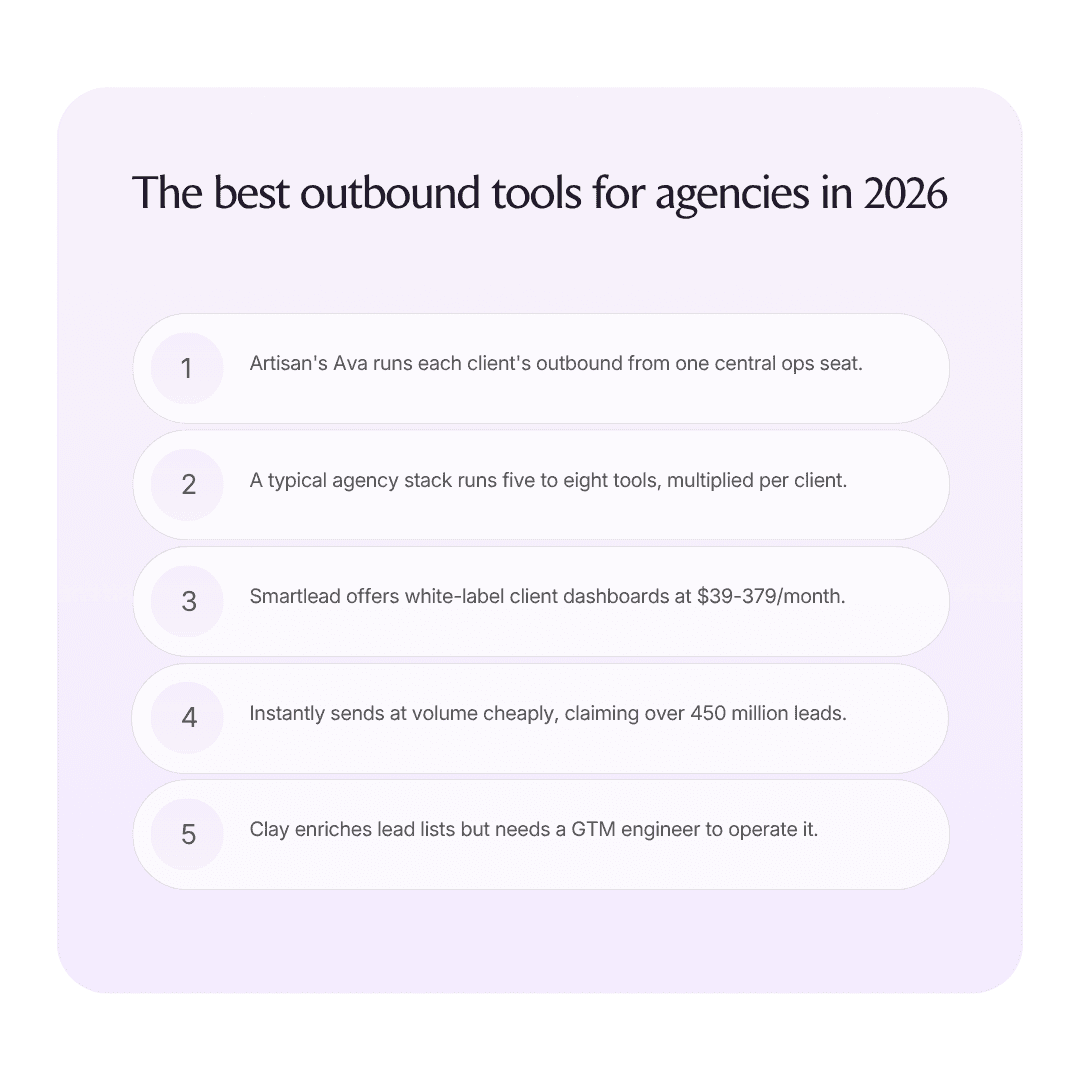
- Artisan runs the full outbound job (find, enrich, write, send, reply, book) across multiple clients from a central ops seat, so agency headcount does not scale linearly with client count.
- Over 90% of Artisan customers run its AI business development representative (BDR), Ava, autonomously, with plain-language escalation rules and a full audit trail per campaign, which is exactly the control an agency needs when it answers to clients.
- Instantly is the volume-sending leader, claiming over 450 million leads with public tiers from $47 to $555/month, and it owns the largest customer base in the category.
- Smartlead is the agency and API workhorse ($39 to $379/month), with white-label client dashboards, though add-on costs like placement testing ($49 to $599 extra) accumulate.
- Clay is the enrichment anchor with over 150 providers and a $3.1B valuation (August 2025), but it is infrastructure that needs a skilled operator, often a go-to-market (GTM) engineer costing around $160K.
- The 2026 agency question is consolidation: a typical outbound stack runs five to eight tools, and every client multiplies the overhead, so tools that collapse the stack win on margin.
The best outbound tool for agencies is Artisan, because agency outbound is a labor problem, not just a sending problem. An agency running campaigns for a dozen clients needs an AI that finds leads, writes per-client messaging, handles replies, and books meetings across every account. Artisan consolidates this into one platform instead of a stack per client.
Agencies live and die on margin. Every client you add means more mailboxes to provision, more copy to write, more replies to triage, and more logins to juggle. The tools below solve different slices of that. Some are brilliant sending engines. Some are enrichment workbenches. We rank them by how much of the per-client workload they actually remove, credit the specialists honestly, and say who each one is wrong for.
How the tools compare
Rank | Tool | Best for | Standout capability | Public pricing |
1 | Artisan | Agencies that want the whole outbound job run per client, centrally | AI BDR that finds, writes, sends, replies, and books across accounts | Usage-based, no platform fee |
2 | Smartlead | Agencies that want white-label sending and API control | White-label client dashboards, unlimited inboxes | $39-379/mo |
3 | Instantly | Volume cold email at low cost | Over 450 million leads claimed, large sending infrastructure | $47-555/mo |
4 | Apollo | Client prospecting on a shared data layer | Over 230 million contacts plus light sequencing | Free-$119/user/mo |
5 | Clay | Custom enrichment and lead-list building | Over 150 enrichment providers, Claygent agents | $167-446/mo |
6 | 11x | Buyers that want a done-for-you AI SDR contract | Multichannel AI agents including phone | Reported about $5K/mo, no self-serve |
What is the best AI outbound tool for agencies?
The best AI outbound tool for agencies is Artisan, because it turns per-client outbound from a staffing cost into a managed system. Ava, Artisan's autonomous AI BDR, owns the whole job: she finds best-fit leads across over 250 million B2B professionals in over 200 countries, plus Artisan Local Data with over 250 million local businesses, enriches them with waterfall email and phone lookups, writes messaging unique to each client, runs multichannel campaigns, handles every reply from a per-client knowledge base, and books meetings on the right calendar.
For an agency, the mechanics that matter are control and separation. Each client receives its own campaigns, messaging, knowledge base, and do-not-contact rules, with a full audit trail. The autonomy dial runs from review-and-approve every message up to full autonomy, so a new client can start on tight review and loosen as trust builds. Over 90% of Artisan customers run Ava autonomously once they trust the output. Central ops can manage every client account from one place instead of logging into a separate tool per brand, which is the difference between an account manager handling 3 clients and handling 10.
The deeper reason this matters is margin. Agencies bill for outcomes but pay for labor. When the finding, writing, and replying are done by an AI you supervise instead of a team you hire, the cost of adding a client drops. Chain of Events sourced over $700K of ARR in six months with Ava, a 20x return, which is the kind of unit economics an agency can build a service line on.
Best for: agencies that want the full outbound motion run per client from a central seat, with per-client governance and control.
Who should pick something else: an agency that only needs a raw sending engine to execute copy it already writes, or one that wants a pure enrichment workbench to build lists for another tool.
Pricing: usage-based, no platform fee, free trial. See pricing.
What is the best cold email tool for agencies?
The best cold email tool for agencies depends on whether you want the email written and managed for you or just sent. If you want the whole motion, Artisan is the pick, because Ava writes the messaging, runs deliverability (provisioned and managed mailboxes, inbox placement testing, SPF, DKIM, and DMARC checks, dynamic send limits, inbox rotation, and auto-pausing of unhealthy mailboxes), sends, and handles replies per client. If you have your own copywriters and strategists and just need reliable, high-volume infrastructure, Smartlead and Instantly are the specialists to know. For the full list, see the best cold email tools.
Smartlead is the one most agencies land on for pure sending. It offers white-label client dashboards so you can present the tool under your own brand, unlimited inboxes, and an API capable enough to build workflows on. Instantly wins on raw price and scale, with the largest customer base in the category and infrastructure built for volume. Both are excellent at what they do, which is deliver a lot of email reliably. What neither does is the thinking: you still write the copy, build the targeting, and answer every reply. For an agency, this labor is the cost center. The question is whether your margin comes from doing that work cheaply or from removing it. Other specialists worth knowing include the best Reply alternatives, the best Saleshandy alternatives, and the best QuickMail alternatives.
Deliverability deserves a word, because it is where agencies find themselves burned. Sending for many clients from many domains multiplies the risk of a reputation problem taking down a client's mailboxes. Artisan provisions and manages the mailboxes, tests inbox placement, checks SPF, DKIM, and DMARC, applies dynamic send limits and inbox rotation, monitors sender reputation continuously, and auto-pauses unhealthy mailboxes, which protects a shared client base. Smartlead offers warmup and bounce-pattern detection, though its placement testing is a $49 to $599 add-on on top of the base plan. For the how-to, see send cold email at scale without hurting deliverability.
How we chose
Four criteria, weighted for agency economics specifically.
How much of the per-client job the tool does. An agency's cost is labor: writing, targeting, replying, reporting. Tools that remove this work score highest, because they change the unit economics of adding a client. Tools that only send score lower.
Multi-client management and separation. Can you run many clients from one place, keep their data and rules separate, and report per client? White-label presentation, per-account audit trails, and central ops are the features that matter here.
Pricing transparency and margin. Published, predictable pricing lets an agency price its own service confidently. We flagged add-on costs that accumulate and gated contracts that make margin hard to model.
Deliverability and control at scale. Managing many domains and mailboxes safely, with placement testing, DNS checks, health monitoring, and automatic protection when a mailbox goes bad.
The best outbound tools for agencies, ranked
1. Artisan: The AI that runs outbound per client
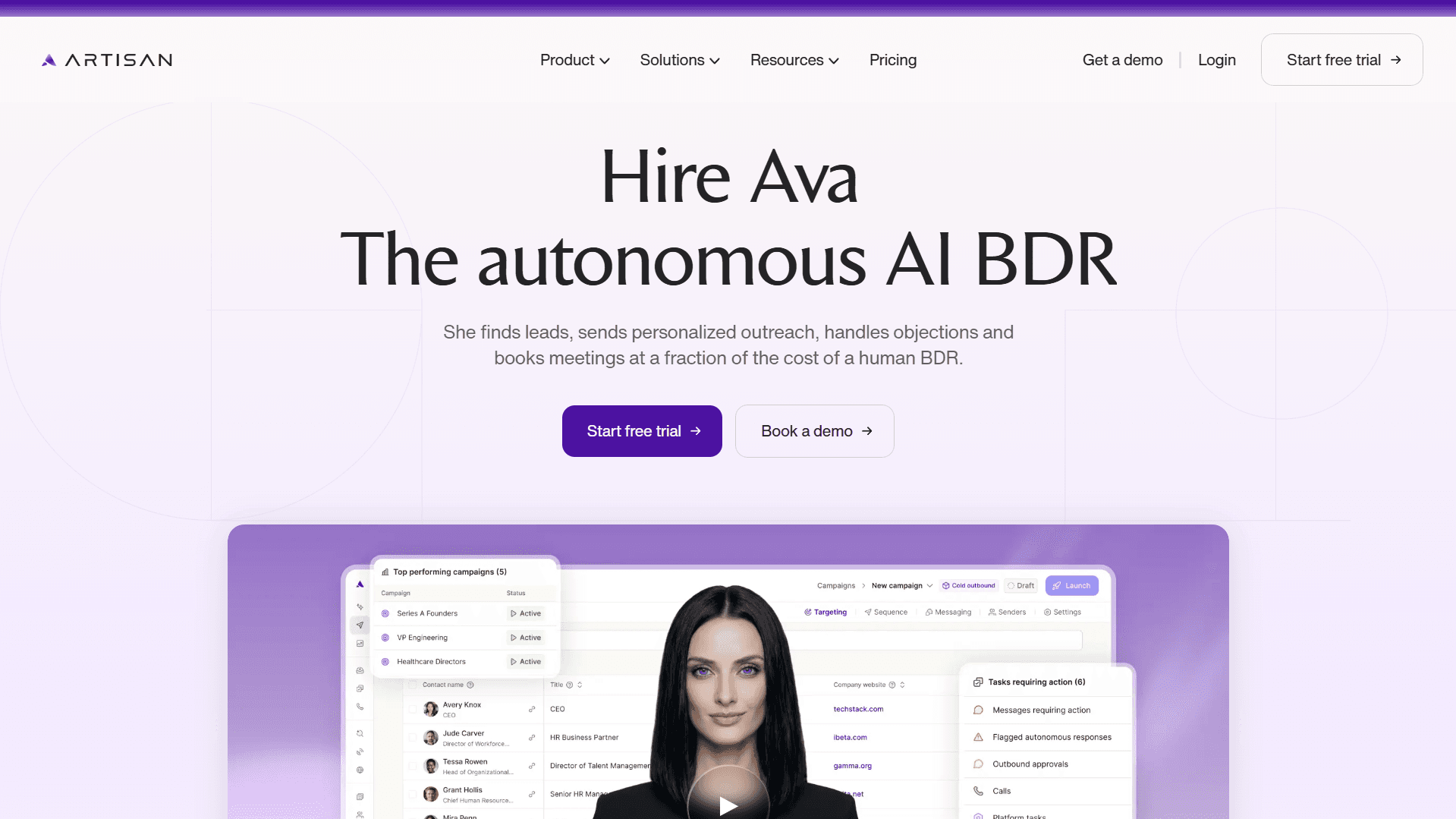
Artisan is an AI-first outbound platform built around Ava, the autonomous AI BDR. For an agency, it replaces most of the per-client labor: Ava finds and enriches leads, writes messaging tuned to each client's offer and voice, runs multichannel campaigns across email, social media, and dialer call steps, tests dozens of message variations, handles replies, and books meetings with CRM-owner routing. The consolidation story is the whole pitch. Instead of stitching a data tool, a sequencer, a deliverability tool, a dialer, and an enrichment layer per client, you run one platform.
The control model is what makes it agency-safe. Each client is governed separately: its own knowledge base for replies, its own banned phrases and proof points, its own do-not-contact enforcement across email, domain, social media, and phone. The autonomy dial and plain-language escalation rules ("if the lead mentions pricing, escalate") mean an account manager supervises instead of executing. Everything logs to an audit trail the agency can show a client. Ava also handles warm outbound, re-engaging a client's closed-lost and churned accounts, marketing qualified leads (MQLs), and event leads, which is a high-margin service most agencies underdeliver because it is manual.
"Ava runs highly targeted outreach at a scale we could never reach with a human-only team," said Bruno Didier, CEO of CookUnity Business, whose team sent over 100,000 personalized emails at roughly a $45 cost per lead. That is the number an agency uses to build a profitable service line.
Best for: agencies from boutique to enterprise-serving that want the full outbound job run per client, with governance and central ops.
Who should pick something else: agencies that only need a sending engine for copy they already produce, or a pure enrichment workbench.
Pricing: usage-based, no platform fee, free trial. See pricing.
2. Smartlead: The white-label sending workhorse
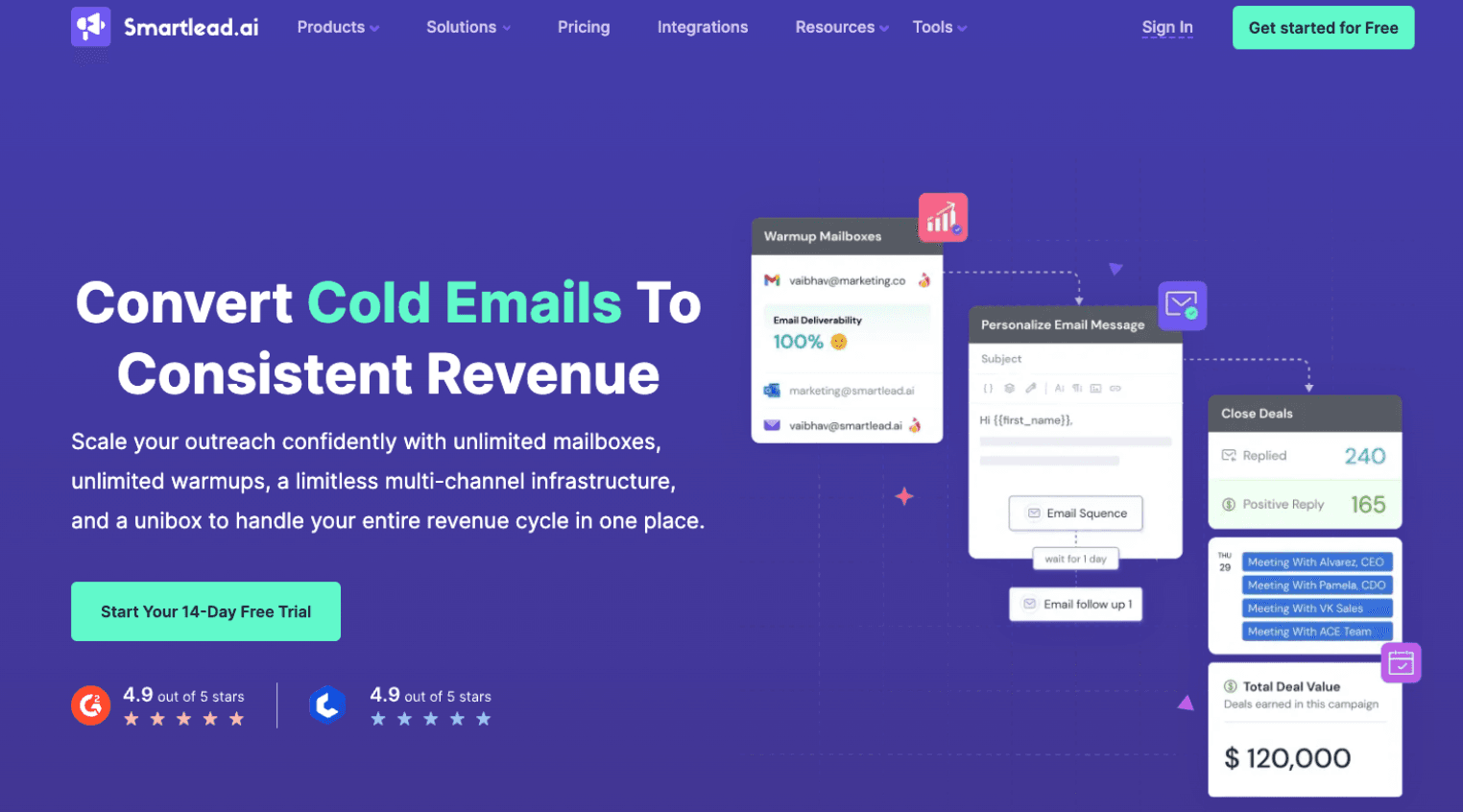
Smartlead is the tool most agencies reach for when they want to run their own outbound service on reliable infrastructure. White-label client dashboards let you present it under your brand, unlimited inboxes support high volume, and a solid API makes it a good base to build on. Pricing runs $39 to $379/month, which is easy to model into a client fee.
The honest limits: Smartlead sends, but you still write the copy, build the targeting, and handle every reply, which is the labor an agency is trying to reduce. Add-on costs accumulate, notably placement testing at $49 to $599 extra on top of the base plan.
Best for: agencies with their own copy and strategy teams that want white-label, API-driven sending infrastructure.
Who should pick something else: agencies that want the writing and reply-handling done for them, not just the sending.
Pricing: $39-379/month; placement testing $49-599 extra per its pricing page.
3. Instantly: Volume sending at the lowest cost
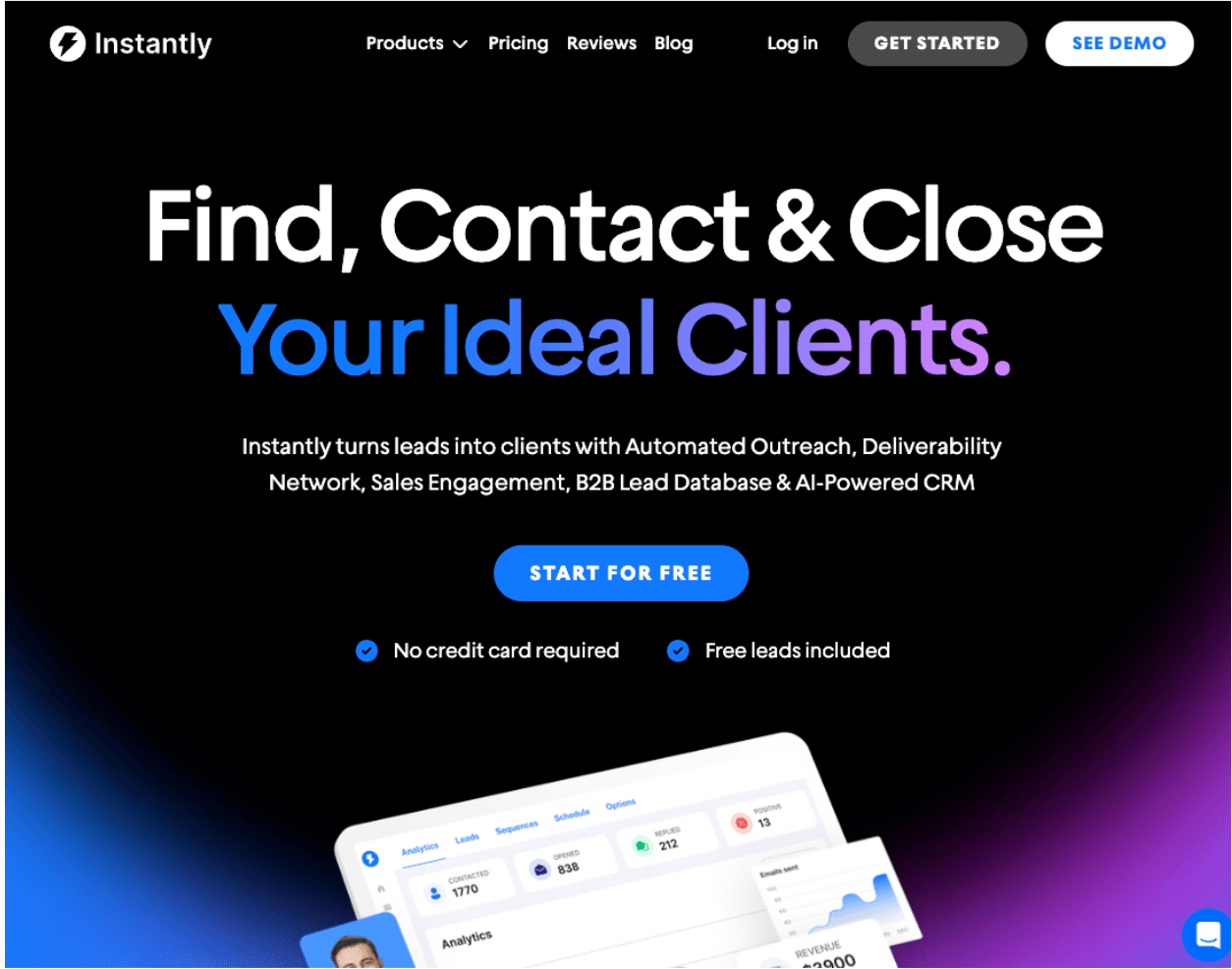
Instantly is the volume leader. It claims over 450 million leads, runs public tiers from $47 to $555/month, and has the largest customer base in the cold email category. For an agency whose model is high-volume sending at a low tool cost, it is hard to beat on price and infrastructure.
Its limits mirror Smartlead's: you still write, target, and reply, and its AI features are newer and have poorer coverage than a purpose-built AI SDR. It is a sending engine, and a very good one, not an outbound brain. See Artisan vs. Instantly and Apollo vs. Instantly for the comparisons.
Best for: agencies that run high-volume campaigns and want the lowest-cost reliable sending infrastructure.
Who should pick something else: agencies that want the strategy and reply-handling automated, or richer per-client governance.
Pricing: $47-555/month per its pricing page.
4. Apollo: The shared data layer for prospecting
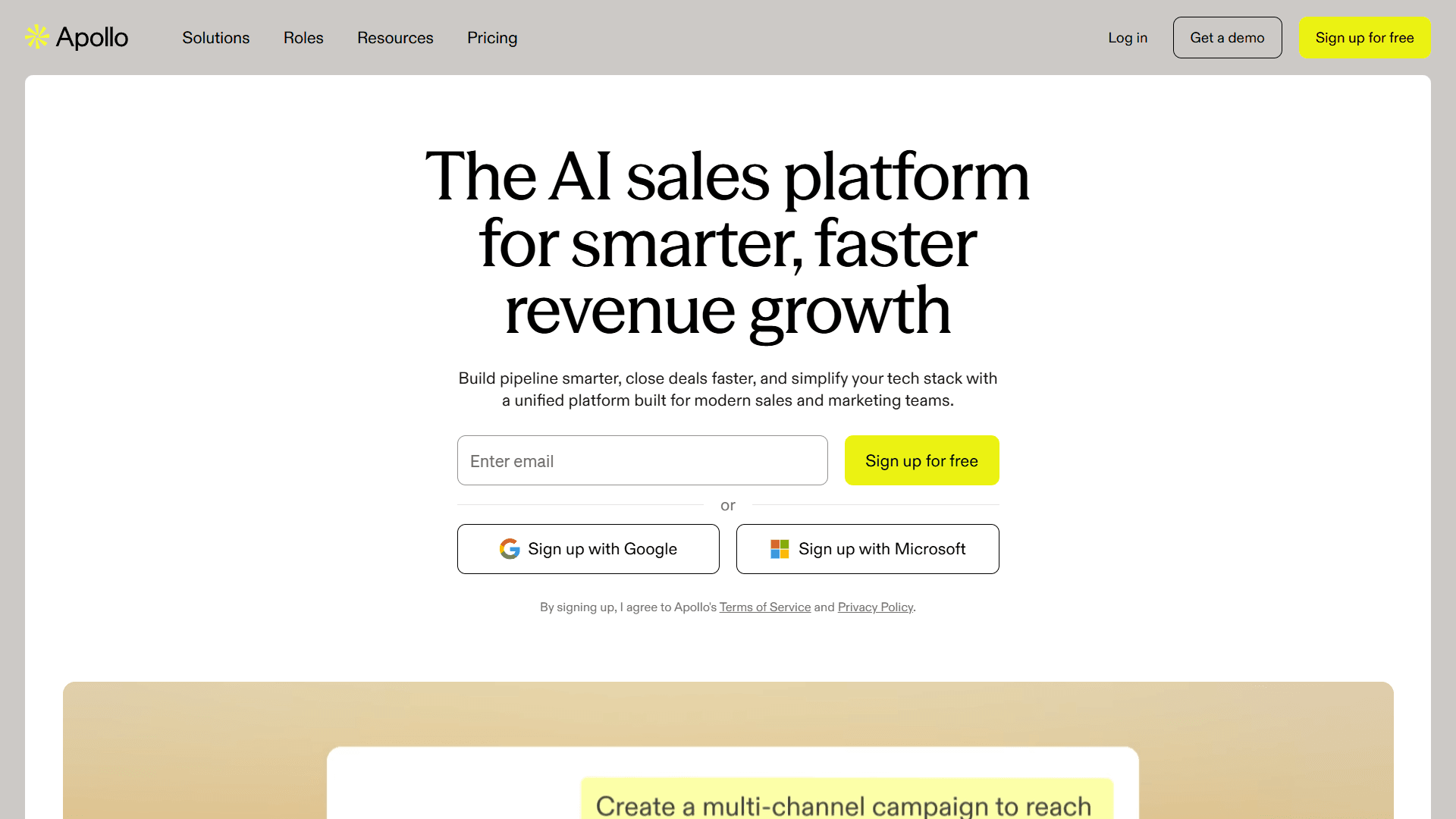
Apollo gives an agency a broad database (over 230 million contacts) plus light sequencing at an accessible price (free to about $119/user/month), used by over 600,000 companies (over 100,000 paying). As a shared data layer to build client prospect lists, it is good value, and the Pocus acquisition (March 2026) added intent signals.
The limits for agency use: it is per-seat, its AI is assistive instead of autonomous, and multi-client separation is weaker than in tools built for it. Larger agencies tend to use Apollo as a data source feeding other tools. See Apollo vs. Lemlist and Artisan vs. Lemlist for related comparisons.
Best for: agencies that want an affordable database plus basic sequencing to prospect for clients.
Who should pick something else: agencies that need the outreach run autonomously per client, or strong multi-client governance.
Pricing: free tier; paid plans to about $119/user/month per its pricing page.
5. Clay: The enrichment workbench
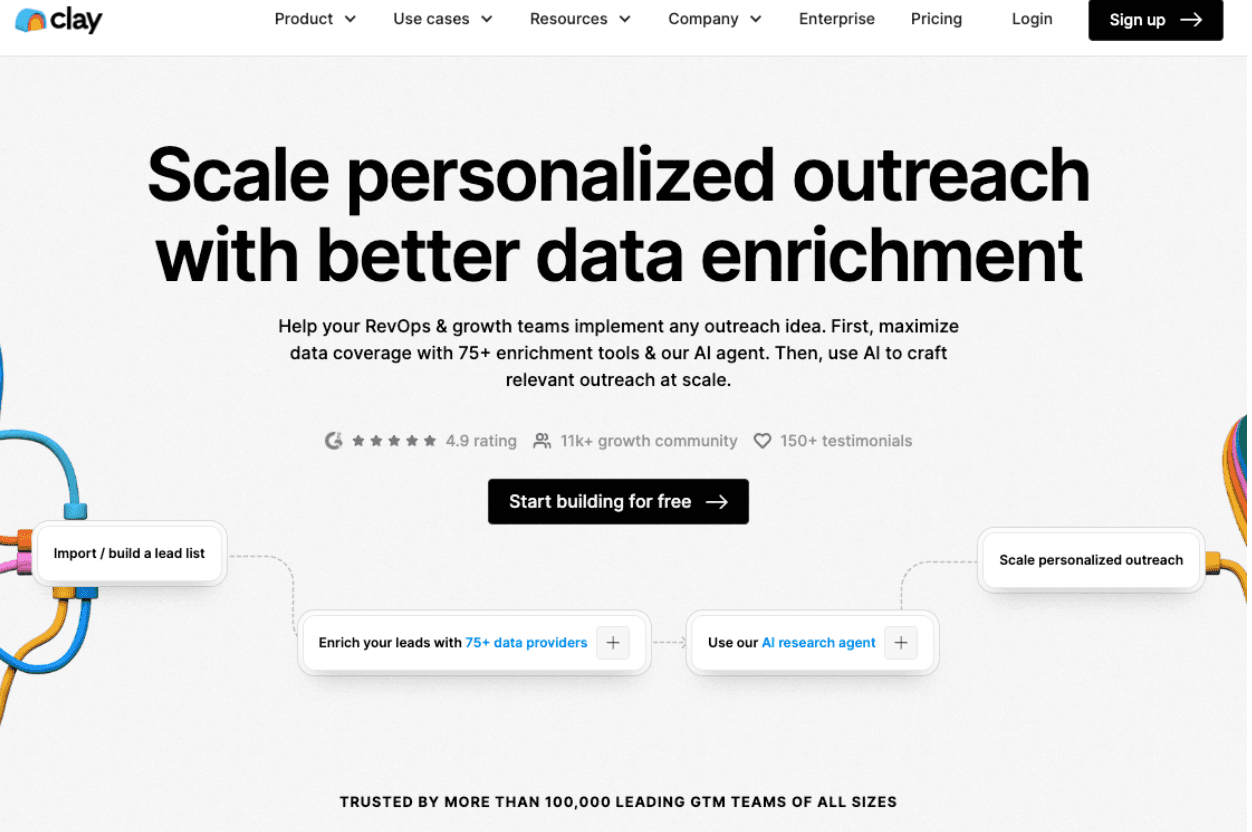
Clay is the GTM engineering anchor, with over 150 enrichment providers, Claygent research agents, and a $3.1B valuation (August 2025). For an agency that builds highly custom lead lists and enrichment workflows for sophisticated clients, nothing matches its flexibility. Public tiers run $167 to $446/month, with median contracts around $30K/year.
The catch: Clay is infrastructure, not an outbound engine. It builds and enriches lists brilliantly, but it does not send, reply, or book, and it needs a skilled operator to run well, often a GTM engineer costing around $160K. The line that holds: Clay gives you the workbench; Artisan gives you the worker.
Best for: agencies with a GTM engineer that want maximum-flexibility enrichment and list-building.
Who should pick something else: agencies that want the outbound executed end to end without hiring an operator to run the tool.
Pricing: $167-446/month public tiers; about $30K/year median contracts.
Pro tip: Clay gives you a ton of ways to customize how you use it, but getting the workflows right takes some expertise. RevPartners is the only company to hold both HubSpot Elite Partner and Elite Clay Studio Partner status, helping teams get more out of Clay while keeping everything connected in HubSpot.
6. 11x: The done-for-you AI SDR contract
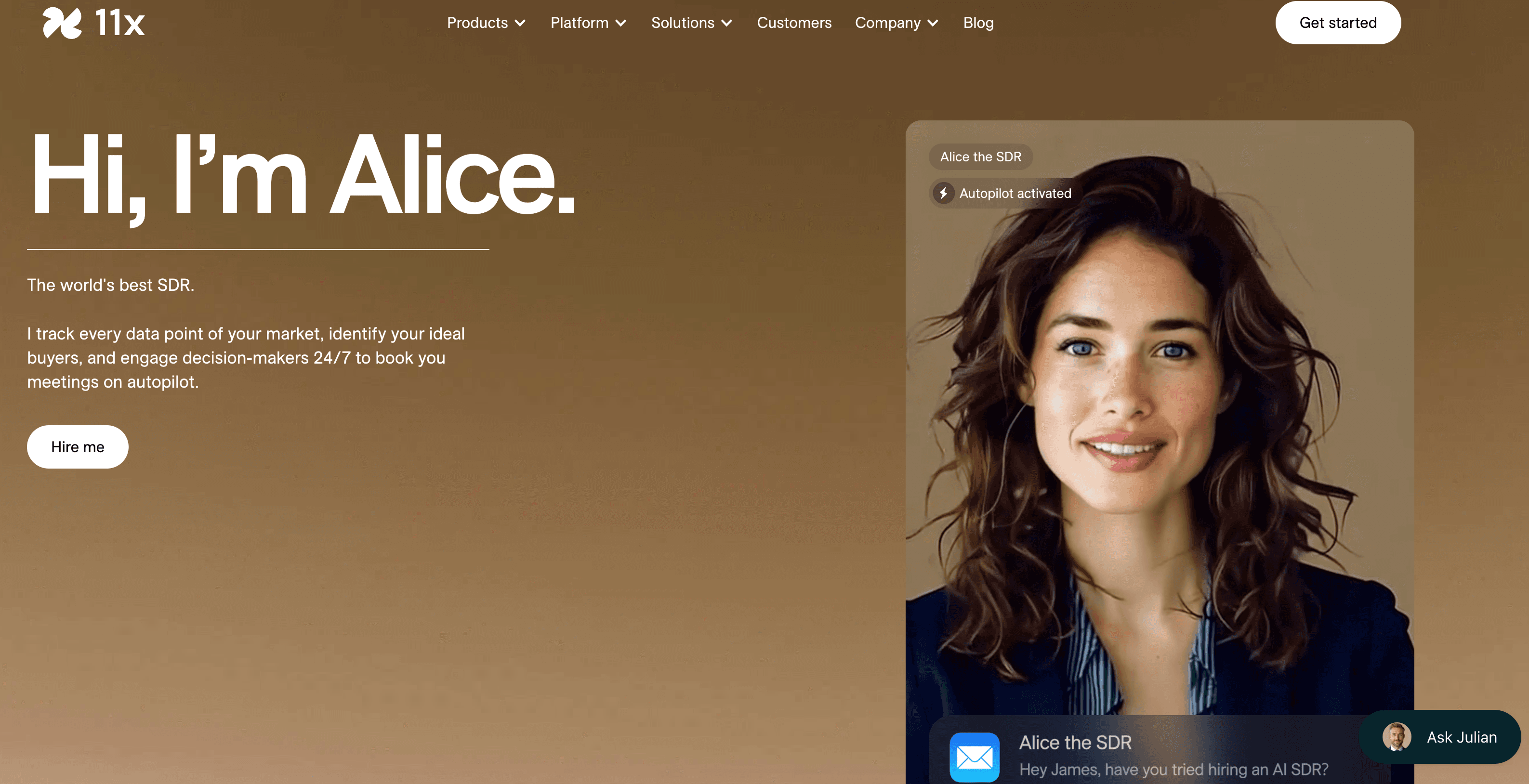
11x sells AI sales development representative (SDR) agents (Alice for outbound, Julian for voice) as a done-for-you, contract-based service, with multichannel outreach including an AI phone agent, backed by roughly $74M raised from a16z and Benchmark. An agency that wants to resell an AI SDR under a managed contract might look here.
Go in aware of the specifics. Pricing is opaque (reported around $5K/month) with no self-serve and a long onboarding, which is a poor fit for an agency that needs to spin up clients fast. TechCrunch reported in March 2025 on customer claims that 11x could not support, its founder-CEO departed in May 2025 (CTO Prabhav Jain is now CEO), and reviewers report deliverability and CRM-sync complaints. It is a lower mid-market tool sold through enterprise-style contracts, not a flexible agency platform.
Best for: buyers that want a single done-for-you AI SDR contract and can absorb a long, high-touch onboarding.
Who should pick something else: agencies that need self-serve setup, transparent pricing, fast client onboarding, and per-client control.
Pricing: reported about $5K/month, gated, no self-serve.
Why does consolidation matter so much for agencies?
Because the agency cost curve is brutal without it. A typical outbound stack runs five to eight tools before headcount: a data provider, an enrichment layer, a sequencer, a deliverability tool, a dialer, a reporting layer, sometimes a GTM engineer to wire it together. Now multiply the operational overhead by every client you serve. Each new logo means more mailboxes to manage, more copy to produce, more replies to triage, and more logins to context-switch between. Labor, not software, is where agency margin leaks.
Consolidation attacks this directly. When one platform finds, enriches, writes, sends, replies, and books across all your clients, the per-client overhead collapses and an account manager can carry more accounts profitably. That is why the ranking puts a system that removes labor above sending engines that add it back. If you want the underlying concept, our explainer on what an AI BDR is covers how one agent owns the full job, and the AI sales agent page shows the deployment pattern agencies use to run it centrally.
What changed for agency outbound recently?
The infrastructure layer became commoditized and the AI layer matured. Mailbox providers like Maildoso, Inframail, and Mailreef now sell inboxes at $0.50 to $5 each, and sequencers are vertically integrating that supply, which pushed pure-sending prices down and made sending a commodity. Apollo acquired Pocus (March 2026), adding intent to its data layer. Clay's $3.1B valuation (August 2025) confirmed enrichment orchestration as its own category. And the AI SDR wave sorted itself out: 11x's 2025 reporting and leadership change (per TechCrunch) cooled some of the hype, while the surviving question for agencies shifted from "can an AI send" to "can an AI run the client's whole motion under my supervision." That is the ground the ranking is fought on now.
Frequently asked questions
What is the best outbound tool for a lead generation agency? For an agency whose product is booked meetings, the tool that removes the most labor per client wins. Artisan runs the full motion (find, enrich, write, send, reply, book) across clients from a central seat, so headcount does not scale with client count. If your model is pure high-volume sending on copy you write yourself, Instantly and Smartlead are the specialist sending engines, with Smartlead adding white-label client dashboards.
Can I white-label an outbound tool for my clients? Yes. Smartlead is the best-known white-label option, with client dashboards you can present under your own brand, plus unlimited inboxes and an API. If your goal is less about presenting a tool and more about delivering booked meetings as a managed service, an AI platform that runs the outbound for you, like Artisan, changes the economics more than a white-labeled sender does, because it removes the underlying labor instead of rebranding it.
How do agencies manage deliverability across many clients? Carefully, because one client's reputation problem can spread. The essentials are inbox placement testing, SPF, DKIM, and DMARC checks, dynamic send limits, inbox rotation, and automatic pausing of mailboxes that start bouncing. Artisan handles all of this automatically and monitors sender reputation continuously across a shared client base. Smartlead covers warmup and bounce detection, though its placement testing is a paid add-on.
Is Clay or Artisan better for an agency? They solve different problems. Clay is an enrichment workbench: unmatched for building custom lead lists and research workflows, but it needs a GTM engineer to run and does not send, reply, or book. Artisan is the outbound worker: it enriches and then executes the whole campaign per client. Many sophisticated agencies use Clay for bespoke list-building and an execution platform for the outreach; if you want one system that does both, Artisan covers more of the motion.
How much does outbound tooling cost for an agency? It ranges widely. Sending tools like Instantly and Smartlead run roughly $39 to $555/month. Enrichment like Clay runs $167 to $446/month with median contracts near $30K/year. Done-for-you AI SDR contracts like 11x are reported around $5K/month, gated. The number that matters for an agency is total cost per booked meeting across the stack plus labor, not any single tool's sticker.
Do agencies need a separate dialer for outbound? Only if calling is core to a client's motion. Many agencies run email and social media first. Artisan includes a dialer where calls run as steps inside the same multichannel sequence, with power and parallel dialing across up to three lines, AI answer detection, live transcription, and native CRM logging. Ava dials the calls and a rep takes the live conversation, so an agency can add calling per client without buying and managing a separate dialer contract.
Can one platform really handle many clients at once? Yes, if it is built for central operations with per-client separation. Artisan runs each client as its own governed account (separate campaigns, knowledge base, banned phrases, do-not-contact rules, and audit trail) managed from one central seat. That is the deployment pattern that lets an account manager carry more clients without a linear increase in tools or logins, which is the core of agency margin.
The bottom line
If your agency's value is cheap, reliable sending on copy you already produce, Instantly and Smartlead are the specialists, and Smartlead's white-label dashboards are made for you. If you build custom lead lists for sophisticated clients and have a GTM engineer, Clay is unmatched. But if the goal is to add clients without adding proportional headcount, the tool that runs the whole outbound job per client wins on margin. See how Artisan does it on the homepage, and if contact data is your bottleneck, compare the best email and phone finder tools. For more on cold email specifically, see best cold email marketing software, best email outbound tools, and cold emailing.

Artisan Team
Expert insights from the team at Artisan
Our writing team blends direct operational experience, in-house data, and thorough research to bring you the very latest insights and updates about sales and GTM automation.