The best email and phone number finder tools for sales in 2026
The best email finder and phone number finder tools for sales in 2026, ranked, with honest verdicts on Apollo, ZoomInfo, Hunter, Lusha, Cognism, and more.
Key Takeaways
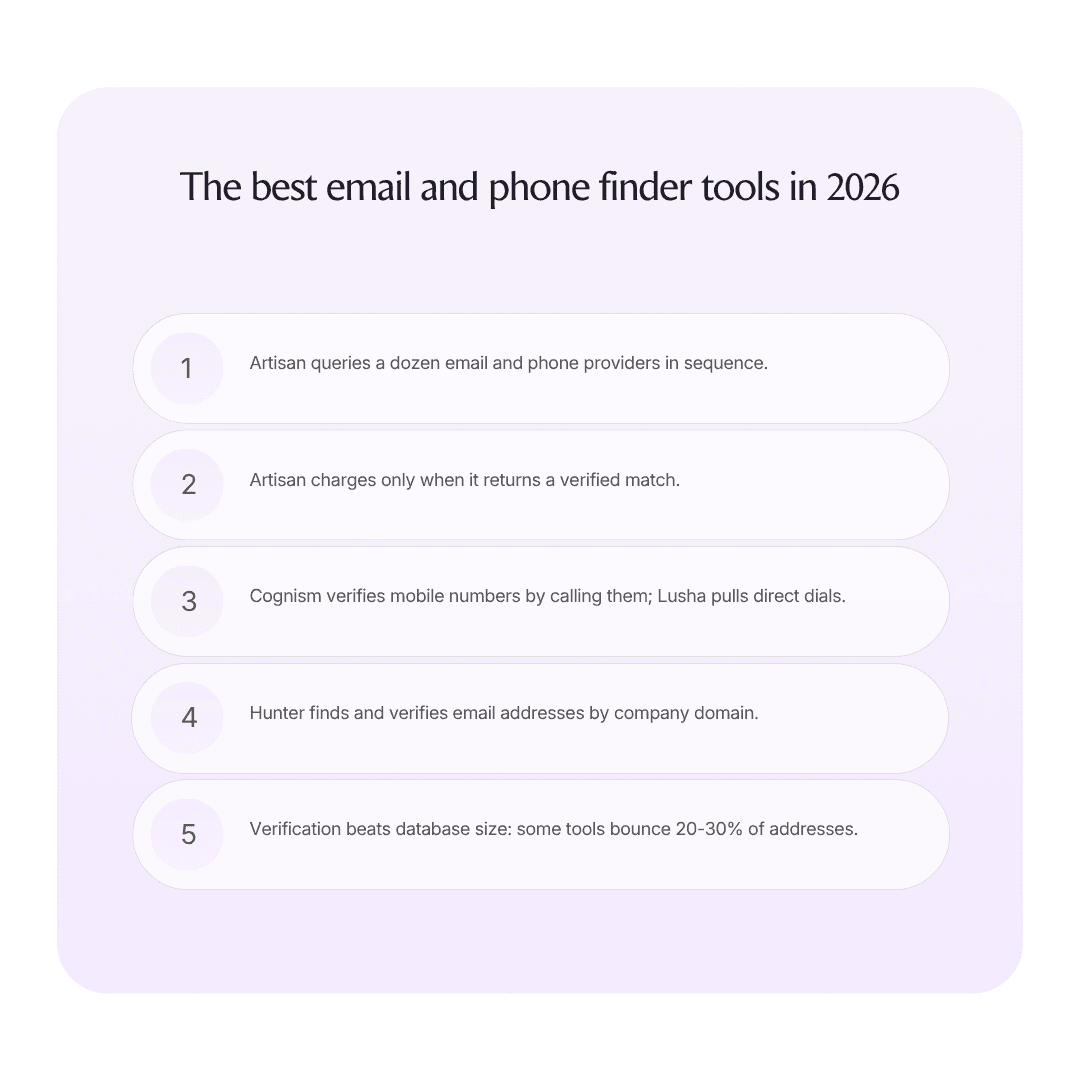
- Artisan runs waterfall enrichment across roughly a dozen providers for both email and phone, verifies each result, and charges only on a successful match, so you never pay for a bounce or a dead number.
- Artisan's database spans over 250M B2B professionals in over 200 countries, plus Artisan Local Data with over 250M local businesses, a layer that most B2B data providers ignore entirely.
- Apollo claims over 230M contacts at a free-to-$119/user/month price and is used by over 600,000 companies (over 100,000 paying), making it the value default for a data layer.
- ZoomInfo claims over 321M profiles (its own figure) and remains the enterprise US data reference point, with buyer-reported contracts from roughly $15K/year.
- Mobile phone coverage is where finders diverge most: Cognism's Diamond Data and Lusha lead on verified direct dials, while cheaper email finders often have poor phone coverage.
- The real 2026 buying question is whether the contact data triggers action, which is where a finder-plus-outreach system separates from a standalone lookup tool.
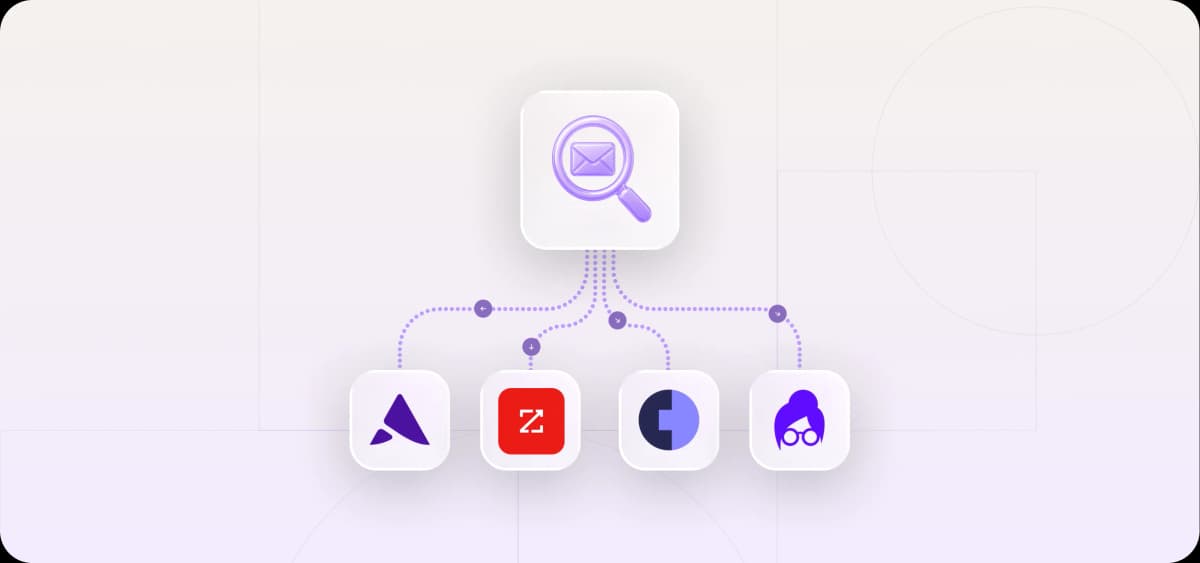
The best email and phone number finder for sales is Artisan, because it does more than find contact details. Ava runs waterfall email and phone enrichment across roughly a dozen providers, charges only when she lands a verified result, then feeds those contacts straight into the outreach she sends. Pure finders hand you a spreadsheet. Artisan hands you booked meetings.
That distinction matters more than it used to. Finding an email is close to a commodity now. What separates tools in 2026 is verification quality (how many bounce), coverage on mobile phone numbers (the hard part), and whether the data actually goes anywhere. Below we rank the field honestly, credit the specialists that beat everyone on raw data depth, and say plainly who should pick each one.
How the tools compare
Rank | Tool | Best for | Standout capability | Public pricing |
1 | Artisan | Teams that want found contacts to become sent outreach automatically | Waterfall email and phone enrichment charged only on success, feeding an AI BDR | Usage-based credits for Ava's work; dialer seats billed separately (pricing) |
2 | Apollo | Value-first all-in-one data plus light sequencing | Over 230M contacts at an accessible price | Free to $119/user/month |
3 | ZoomInfo | Enterprise US data depth | Over 321M profiles (vendor figure), Scoops, WebSights | Over $15K/year reported |
4 | Cognism | EMEA phone verification and compliance | Diamond Data verified mobiles, DNC and TPS scrubbing | Gated (~$15-50K/year reported) |
5 | Lusha | Fast direct-dial lookups for reps | Verified mobile numbers, browser extension | Free tier, published per-seat plans |
6 | Hunter | Simple domain-based email finding | Domain search and verifier, generous free tier | Free to $500/month tiers |
7 | RocketReach | Broad reach across emails and socials | Wide profile coverage, API access | Published per-lookup tiers |
8 | Seamless.AI | Real-time email guessing at volume | Live search engine for contacts | Published tiers, annual-only terms |
What is the best email finder tool?
The best email finder tool is Artisan, because it treats the found email as the start of the job rather than the end. Ava searches over 250M B2B professionals, runs the email through waterfall enrichment across roughly a dozen providers, verifies it, and only charges when she lands a valid address. Then she writes and sends the outreach, handles the reply, and books the meeting. A standalone finder stops at the address.
If you only need a list of verified emails to load somewhere else, several tools do that well and cheaply. Hunter is the cleanest simple option: type a domain, receive the address pattern and the addresses, verify in the same view. Apollo bundles email finding into a broader platform at a price most teams can absorb. The reason to reach past those is that a raw email is inert. Someone still has to research the account, write something worth reading, send it, and chase the reply. That someone is usually a rep spending 40-60% of the week on non-selling busywork. Artisan's angle is that the finding and the doing live in one system, so the address never sits in a spreadsheet waiting for a human to act on it.
Ava also enriches beyond the address itself: verified job title, company signals like funding rounds, new executive hires, and active hiring, and AI web research on the person, all attached before the first message goes out. That is the difference between finding an email and knowing why you are writing to it.
What is the best phone number finder for sales?
The best phone number finder for sales is Artisan, because mobile coverage is the hardest part of contact data and waterfall enrichment is the honest way to solve it. No single provider has every direct dial. Ava queries roughly a dozen phone data sources in sequence until one returns a verified number, charges only on success, and then makes that number usable inside the dialer, where calls run as steps in the same multichannel sequence as the email and social media touches.
On raw phone data alone, two specialists deserve real credit. Cognism's Diamond Data verifies mobile numbers by calling them and scrubs against do-not-call (DNC) and Telephone Preference Service (TPS) lists, which is why compliance-focused teams across Europe, the Middle East, and Africa (EMEA) lean on it. Lusha built its reputation on fast, accurate direct dials pulled from a browser extension while a rep is looking at a prospect. Both are excellent at the narrow job of returning a good number. Where they stop is action: the number lands in your tool, and a rep still has to dial it, log it, and follow up.
Artisan closes that gap. Found numbers flow into a dialer with power and parallel dialing across up to three lines, AI answer detection, live transcription, live talking points loaded before the call connects, auto-classified outcomes, native CRM logging, and an AI-drafted follow-up email. Dialer seats and phone numbers are billed separately from Ava's usage-based credits, at $75/seat/month when paid monthly, with one seat per caller and roughly one phone number per 50 calls a day. So the number you found does not just sit in a field. It is dialed, logged to the right rep's CRM record, and followed up on automatically.
How we chose
Four criteria, weighted for how sales teams actually use this data in 2026.
The first is how much of the job the tool does. Finding a contact is step one of a longer motion, so tools that only return data score lower than tools that turn the data into outreach, because the buyer's real problem is pipeline, not a spreadsheet.
The second is data and verification depth. Raw database size matters, but verification matters more. A tool claiming 300M profiles with a 25% bounce rate is worse than a smaller, cleaner database. We weighted verified email deliverability and mobile-phone accuracy heavily, and noted where vendor-claimed numbers are self-reported.
The third is pricing transparency. Published, per-seat or per-credit pricing beats demo-gated enterprise contracts for most buyers, and we flagged annual-only auto-renewal terms and gated pricing where they exist.
The fourth is deployment fit, meaning how the tool sits in a real stack: CRM sync, whether enrichment charges on success or on every attempt, and whether the found data can trigger action without a human copy-pasting it.
The best email and phone finder tools, ranked
1. Artisan: The finder that also runs the outreach
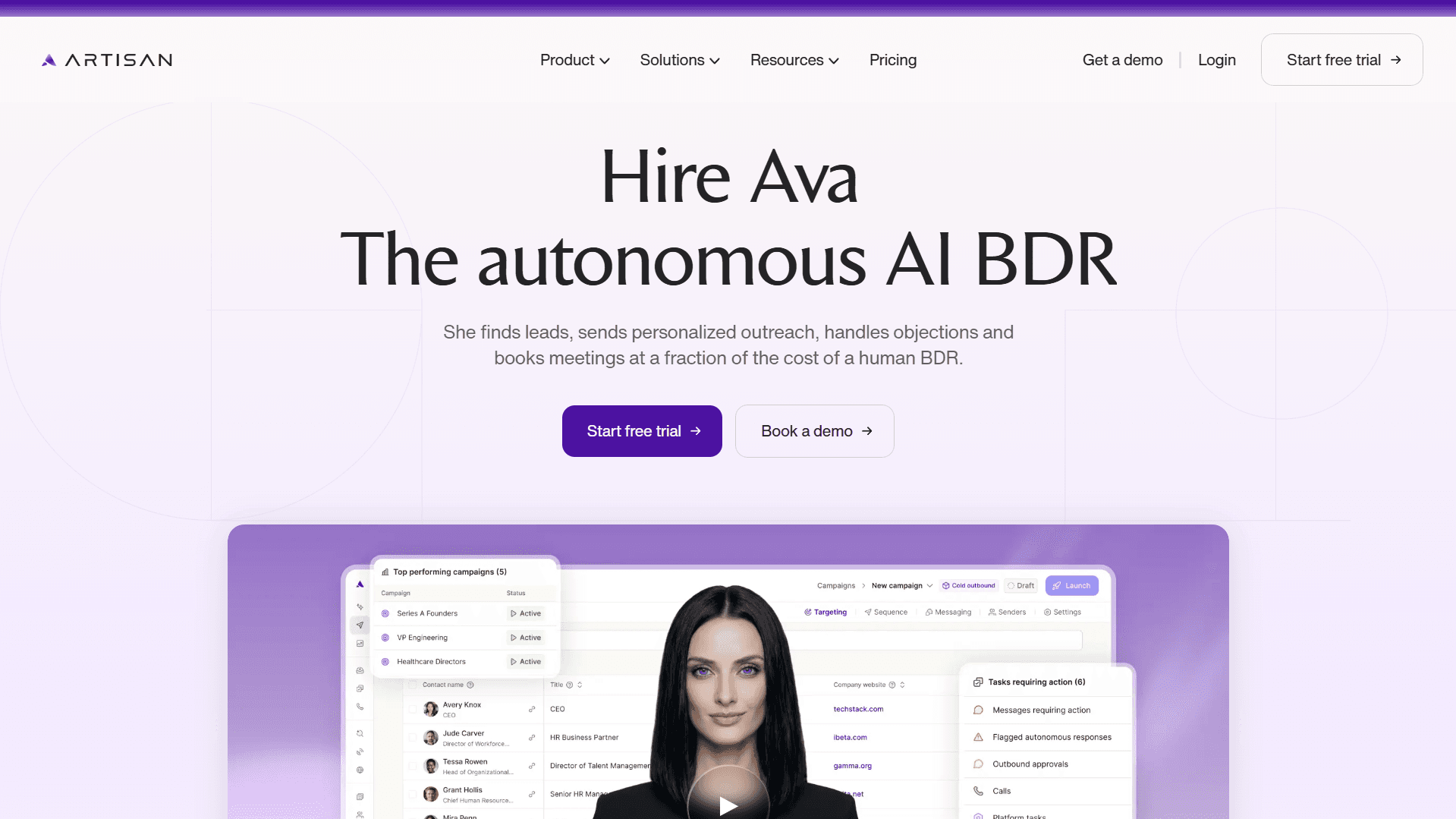
Artisan is an AI-first outbound platform built around Ava, the autonomous AI business development representative (BDR). On the data side, she searches over 250M B2B professionals in over 200 countries, plus Artisan Local Data with over 250M local businesses, using natural-language search and ideal customer profile (ICP) filters, then runs waterfall enrichment across roughly a dozen providers for both email and phone. Enrichment charges only on a successful, verified match, so a bounce or a dead number costs nothing.
Artisan ranks first for a different reason than raw accuracy against Cognism's mobile data or ZoomInfo's US firmographic depth. The found contact immediately becomes work. Ava writes personalized multichannel outreach across email, social media, and dialer calls, runs dozens of message variations and shifts volume toward the ones that convert, handles every reply from a knowledge base, and books meetings on reps' calendars with CRM-owner routing. Sales ops can run her centrally for large account executive teams who never log in, with a full audit trail and plain-language escalation rules. Over 90% of Artisan customers run Ava autonomously.
SumUp's growth lead, Karlo Biuk, put the enrichment payoff concretely: the team drove a $52 cost per lead across over 400,000 personalized emails and now receives 8-15 positive replies per week from previously unreachable local small and medium-sized businesses (SMBs). That local-business reach is a genuine gap in most B2B finders, which only index corporate contacts.
Best for: teams from startup to enterprise that want found contacts to turn into sent, personalized outreach without a human moving data between tools
Who should pick something else: if you only need a raw export of verified emails to feed a tool you already run, a standalone finder like Hunter or Apollo is cheaper for that single job
Pricing: usage-based credits for Ava's work, with enrichment charged only on success, plus a free trial. Dialer seats and phone numbers are billed separately at $75/seat/month when paid monthly. See pricing
2. Apollo: The value all-in-one
Apollo is the price-accessible default. It claims over 230M contacts, is used by over 600,000 companies (over 100,000 paying), and reportedly passed $200M ARR, with a free tier and paid plans up to around $119/user/month. It bundles email and phone finding with basic sequencing, so a small team can prospect and send from one login. Apollo acquired Pocus in March 2026, adding buyer-intent signals to the data layer.
The honest limit is that Apollo's AI assists a rep instead of acting on its own, and it runs on a per-seat model that larger orgs tend to treat as a data source rather than an execution engine. Mobile-phone accuracy is decent but not class-leading.
Best for: startups and mid-market teams that want a broad database plus light sequencing at a transparent, low price
Who should pick something else: teams that need the outreach run for them, not just the data, or that want the deepest verified mobile coverage for calling
Pricing: free tier; paid plans to around $119/user/month per its pricing page
3. ZoomInfo: The enterprise US data standard
ZoomInfo remains the reference point for enterprise US data depth. Now repositioned as a go-to-market intelligence platform (ticker $GTM), it claims over 321M profiles (its own figure) and adds Scoops (human-sourced intelligence) and WebSights (visitor identification). Buyer-reported contracts start around $15K/year. For a large team that needs the deepest firmographic and org-chart data in North America, ZoomInfo is still the incumbent.
The limits are familiar: it is a data platform first, with execution features layered on as add-ons, and its contract terms have a reputation buyers should go in aware of.
Best for: enterprises that need maximum US firmographic and contact depth and have budget for a data platform
Who should pick something else: teams that want published pricing, or that care more about the outreach than the raw data, or that prospect heavily in EMEA where Cognism often wins on phones
Pricing: demo-gated; roughly $15K/year and up per buyer-reported contracts
4. Cognism: EMEA phone verification and compliance
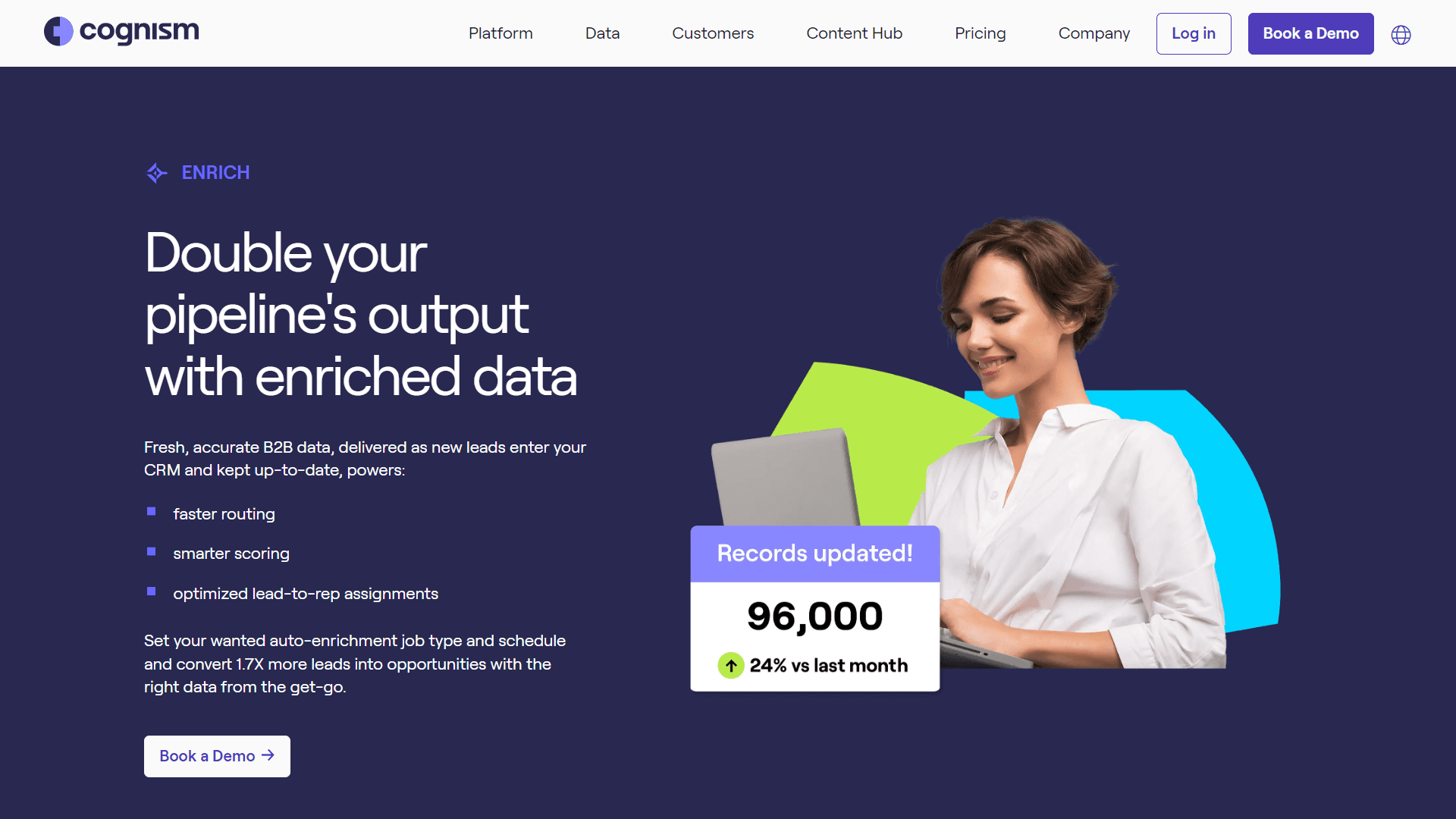
Cognism is the compliance-first choice, strongest in EMEA. Its Diamond Data verifies mobile numbers by phone-checking them, and it scrubs against DNC and TPS lists, which is exactly what teams calling into regulated European markets need. If verified mobile direct dials into Europe are the job, Cognism is the strongest specialist option.
Two honest notes: pricing is gated (roughly $15-50K/year reported), and its Kaspr subsidiary was fined 240,000 euros by France's data protection regulator, the CNIL, in December 2024, per public reporting, which is worth knowing for a compliance-led buyer.
Best for: EMEA-focused teams that need verified mobile numbers and strict DNC and consent compliance
Who should pick something else: US-centric teams (ZoomInfo or Apollo cover North America more deeply), or anyone who wants the data to run its own outreach
Pricing: gated; roughly $15-50K/year reported
5. Lusha: Fast direct dials for reps
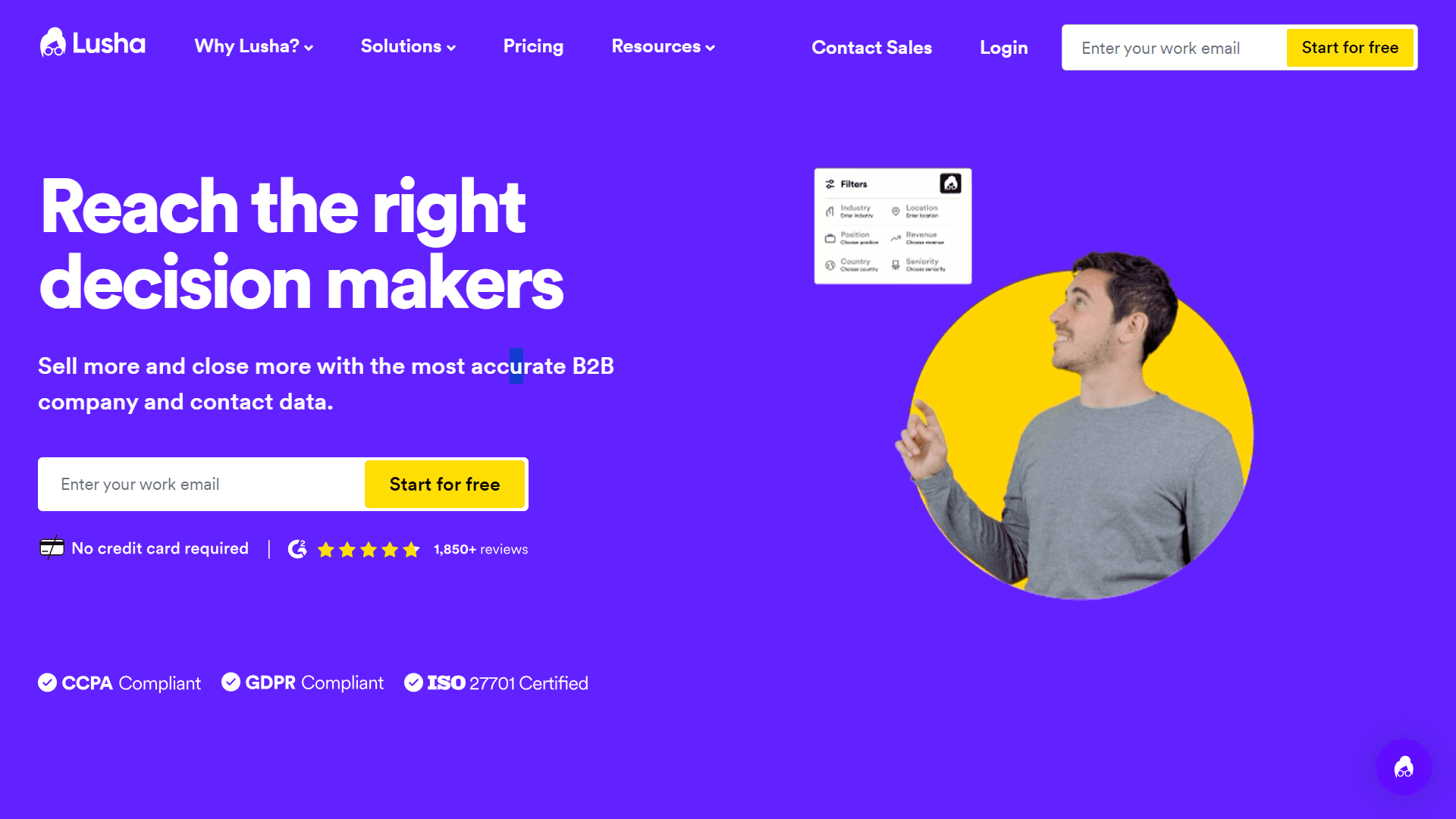
Lusha is built for speed at the individual-rep level. Its browser extension reveals verified emails and mobile numbers while a rep is looking at a prospect's profile, which makes it a favorite for reps who prospect one account at a time. It has a free tier and published per-seat plans, so it is easy to adopt without procurement.
The trade-off is that Lusha is a lookup tool, not a system. It returns a good number and stops there; everything after the lookup is manual.
Best for: individual reps and small teams that want fast, accurate direct dials on demand
Who should pick something else: teams that need bulk enrichment tied to sequencing, or the deepest enterprise database
Pricing: free tier plus published per-seat plans per its pricing page
6. Hunter: The simple email specialist
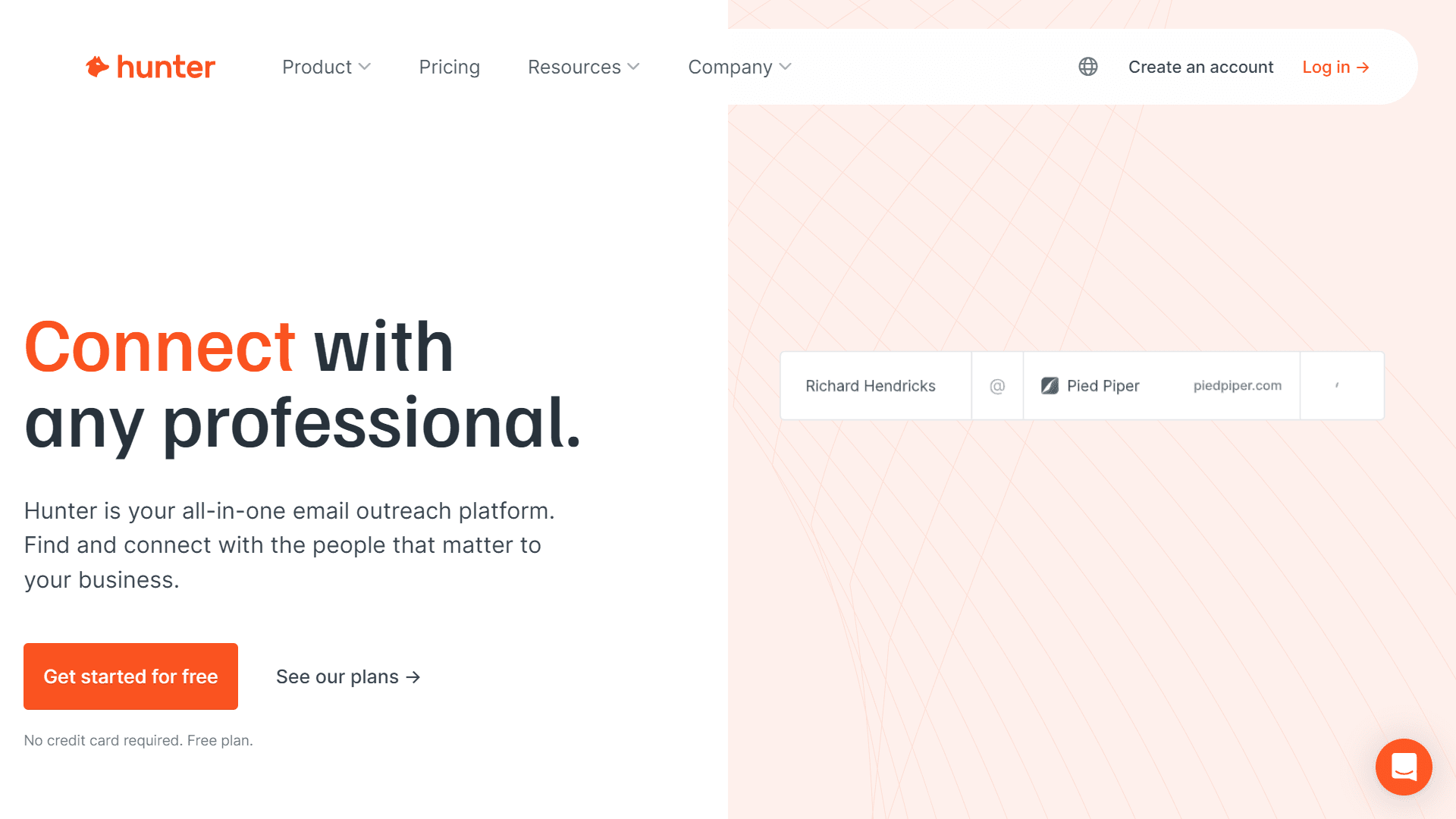
Hunter does one thing cleanly: find and verify email addresses by domain. Type a company domain, receive the address pattern and the known emails, verify them in the same view. Its free tier is generous and its API is developer-friendly, which is why it shows up inside a lot of homegrown workflows.
Hunter is email-only, with essentially no phone data, and no outreach engine beyond basic campaigns. That focus is the point.
Best for: teams that want a straightforward, affordable email finder and verifier, especially via API
Who should pick something else: anyone who needs phone numbers, deep firmographics, or the outreach run for them
Pricing: free tier; paid plans to around $500/month per its pricing page
7. RocketReach: Broad reach across channels
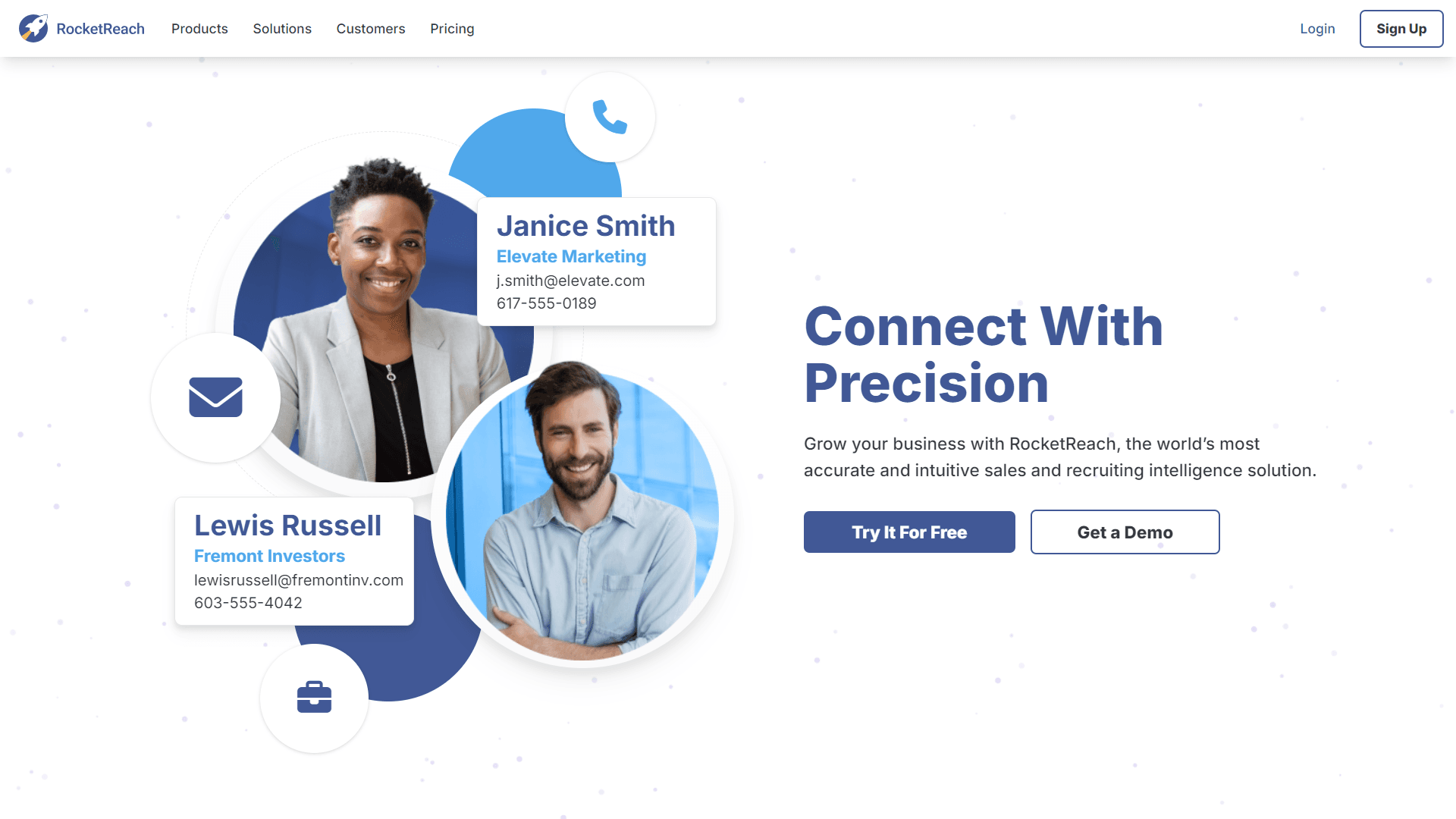
RocketReach casts a wide net, returning emails, phone numbers, and social profiles across a large index of people. Its breadth and API make it useful for filling gaps other tools miss, and its published per-lookup tiers are easy to reason about.
Coverage is broad rather than deep, so verification quality varies more than with a specialist like Cognism on phones or Hunter on email. Treat it as a complement.
Best for: teams that want broad multi-channel contact coverage and a simple API
Who should pick something else: teams that need the highest verification accuracy on a single channel, or an execution layer
Pricing: published per-lookup and per-seat tiers
8. Seamless.AI: Real-time search at volume
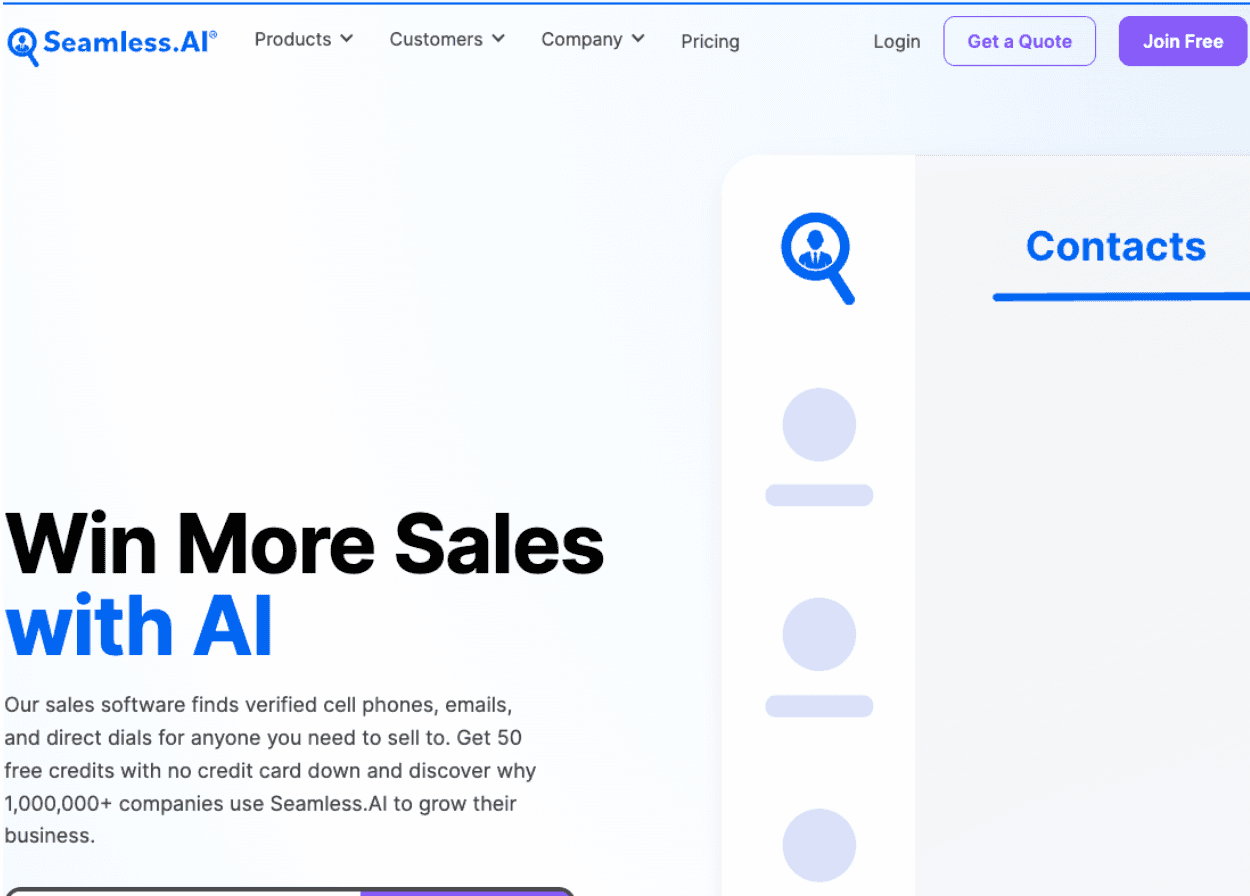
Seamless.AI markets itself as a live search engine for contacts, guessing and verifying emails in real time at high volume. Reps who need a lot of contacts fast sometimes like the throughput.
Caveats are worth stating plainly: users report bounce rates in the 20-30% range, the contracts are annual-only with auto-renewal terms, and Seamless was removed from a major professional network in March 2025 over scraping, per public reporting. Go in with eyes open on data quality and terms.
Best for: high-volume prospectors who prioritize contact quantity and speed over verification precision
Who should pick something else: teams that need clean, low-bounce data, flexible terms, or compliance assurance
Pricing: published tiers; annual-only auto-renewal per user reports
What actually makes a finder good in 2026?
Two things, and neither is database size. First, verification. A vendor claiming over 300M profiles means little if a quarter of the emails bounce or the mobiles are dead. Real-world match and accuracy rates often land well below the headline claims, especially on mobile numbers, where verified direct-dial coverage is the hard problem. Waterfall enrichment (querying multiple providers in sequence and taking the first verified hit) beats any single source, which is why the serious platforms all do it. Charging only on a successful match is the honest version of that model.
Second, whether the data moves. The old workflow was: finder returns a list, ops uploads it to a sequencer, a rep writes the emails, someone dials the numbers. Every handoff loses time and data. In 2026 the tools worth paying for collapse those steps. That is the entire reason Artisan ranks a finder-plus-outreach system above pure lookup tools: the found contact should trigger the outreach instead of waiting in a CSV. If you want the mechanics of how an AI runs that full loop, see our explainer on what an AI BDR is.
What changed in contact data recently?
The market consolidated and repriced. Apollo acquired Pocus in March 2026, folding buyer-intent signals into its data platform. ZoomInfo completed its rebrand to the GTM Intelligence Platform and now trades under $GTM. Clearbit disappeared as a standalone: HubSpot acquired it in December 2023 and sunset it through 2025, with its data now living inside HubSpot as Breeze Intelligence credits. Cognism's Kaspr fine from France's CNIL (December 2024) kept compliance in the headlines for EMEA data buyers. The throughline: raw data is commoditizing, and the value is shifting to verification quality and to what happens after the contact is found.
FAQ
What is the difference between an email finder and a phone number finder? An email finder returns verified email addresses, usually by matching a name and company domain against a database or guessing the pattern. A phone number finder returns direct dials and mobile numbers, which is harder because verified mobile data is scarcer and decays faster. Many tools do both, but quality diverges: a strong email finder can have weak phone coverage and vice versa. Artisan runs waterfall enrichment across roughly a dozen providers for both, and charges only when it lands a verified result.
Which email finder has the lowest bounce rate? Bounce rate depends on verification more than database size. Tools that verify addresses in real time and run waterfall enrichment across multiple sources tend to bounce least. Be cautious with vendors whose users report 20-30% bounce rates. Artisan verifies every email and only charges on a successful match, so you do not pay for addresses that fail.
What is the best tool for finding mobile phone numbers? For verified mobile direct dials, Cognism's Diamond Data and Lusha lead among standalone specialists, and Cognism is especially strong in EMEA with DNC and TPS scrubbing. Artisan ranks first overall because it runs waterfall phone enrichment across roughly a dozen providers, charges only on success, and then makes the number dialable inside a sequence rather than leaving it in a field.
Is Apollo or ZoomInfo better for contact data? Apollo wins on price and accessibility, with a free tier and plans to around $119/user/month, and works well for startups and mid-market teams. ZoomInfo wins on US enterprise data depth, claiming over 321M profiles with buyer-reported contracts from roughly $15K/year. Pick Apollo for value and self-serve; pick ZoomInfo when maximum North American firmographic depth justifies the price and the demo-gated contract.
Does a contact finder replace a sales engagement tool? Traditionally no. A finder returns data, and a separate sequencer or dialer acts on it. That handoff is exactly what slows teams down. The 2026 shift is toward systems where finding and outreach live together, so the contact triggers action automatically. Artisan is built that way: Ava finds and enriches the contact, then writes, sends, and follows up on the outreach in the same platform. Compare the AI sales agent approach to a stitched stack.
How much should I pay for contact data? It varies from free tiers up to enterprise contracts north of $15K/year. The number to watch is not the headline price but the cost per verified, usable contact. Pay-on-success enrichment (you are charged only when a valid match is returned) is the fairest model, because you never pay for a bounce or a dead number. Standalone finders that charge per lookup regardless of match quality can cost more per usable record than they appear to.
Can these tools find contacts for local businesses, not just corporate? Most B2B finders index corporate contacts only and miss local businesses like restaurants, gyms, and local services. Artisan is unusual in carrying Artisan Local Data, over 250M local businesses, alongside its over 250M B2B professionals, which is why teams selling into local SMBs use it to reach accounts other tools cannot see. SumUp used this reach to generate 8-15 positive replies per week from previously unreachable local SMBs.
The bottom line
If you just need a clean list of verified emails, Hunter and Apollo are cheap and good, and Cognism and Lusha lead on verified phones, especially in EMEA. But finding the contact is the easy half of the job now. The half that drives pipeline is what happens next, and that is where a system that finds, enriches, writes, sends, and follows up beats a lookup tool that stops at the export. See how Artisan runs the whole motion on the homepage, or compare the 10 best cold outreach tools for B2B SaaS if you are still assembling the rest of the stack.
Related reading
Jaspar Carmichael-Jack
Co-Founder & CEO @ Artisan
Jaspar is an entrepreneur with expertise in sales, marketing, and operations. He founded Artisan in 2023, a company automating workflows with AI employees.