Artisan vs. Clay: Which fits your team?
A stage-by-stage comparison of Artisan and Clay. Where Clay's enrichment orchestration wins, where Artisan's AI-runs-it model wins, and who should pick which.
Key Takeaways
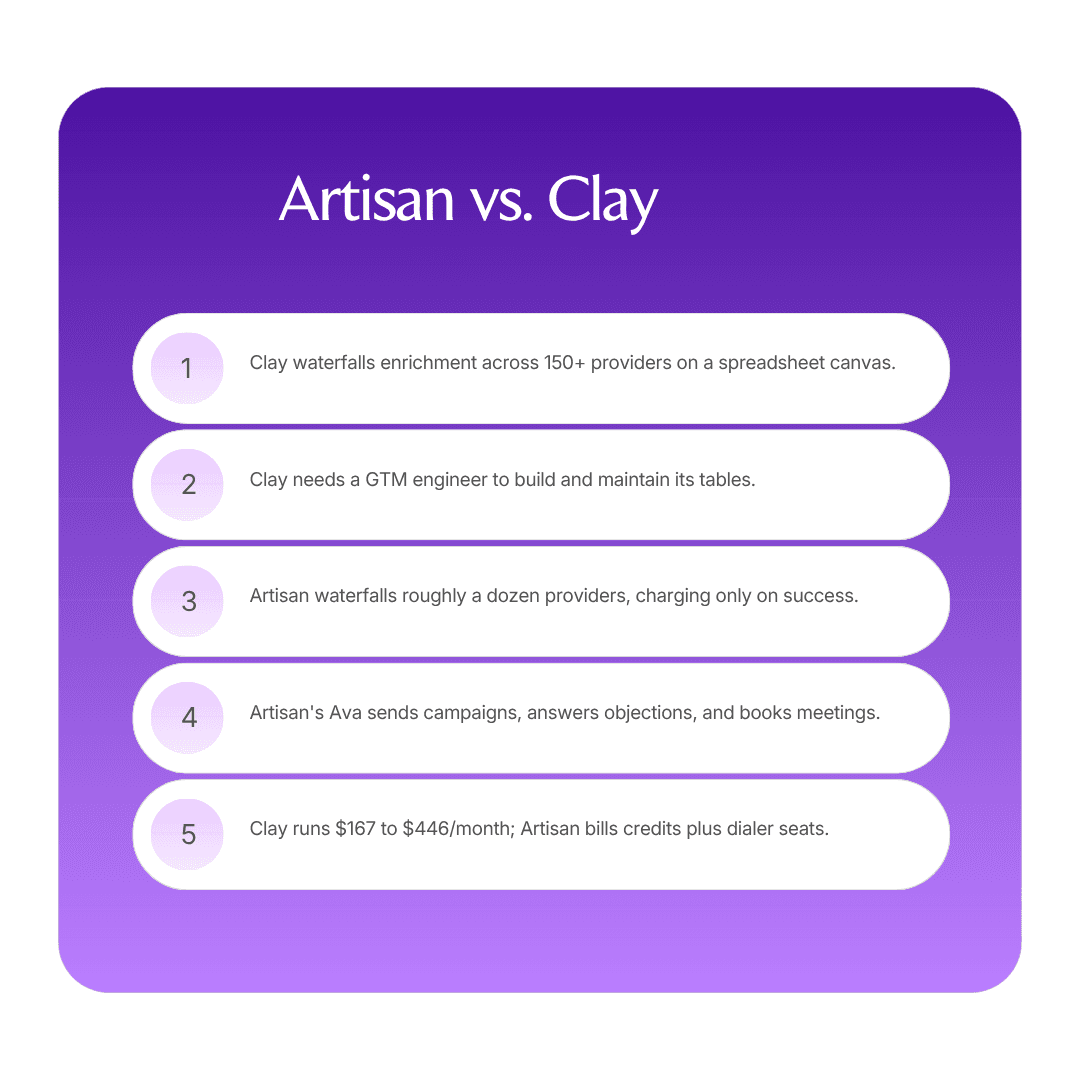
- Clay is the go-to-market (GTM) engineering anchor: over 150 enrichment providers, Claygent research agents, and deeply flexible tables. It is strong at enrichment orchestration, and it earned that position.
- Clay needs an operator. Its power comes from someone building the workflows, which for many teams means a GTM engineer, a role that commonly runs around $160K a year.
- Artisan includes waterfall enrichment across roughly a dozen providers, charged only on success, plus the outreach engine, so an AI runs the motion instead of a human running a tool.
- Clay's public tiers start at Launch from $167/month and Growth from $446/month, with Enterprise custom and usage-based credits. Reported median contracts land around $30K a year.
- Artisan's pricing is hybrid: Ava's work runs on usage-based credits, so you pay for the work she performs, and dialer seats are billed separately. Over 90% of customers run Ava autonomously.
- Clay raised a $100M Series C at a $3.1B valuation (CapitalG, August 2025), a sign of how central enrichment orchestration has become.
Clay and Artisan both start with good data, then split. Clay is the workbench: enrichment orchestration across over 150 providers for a skilled operator to build on. Artisan is the worker: built-in enrichment plus an AI business development representative (BDR), Ava, who runs the whole outbound motion. Build the machine, or hire the employee.
Which one fits your situation?
Your situation | Better fit |
You have a skilled GTM engineer who loves building enrichment workflows | Clay |
You want the outbound job done without staffing an operator | Artisan |
You need to enrich data for many downstream tools and use cases | Clay |
You want enrichment plus the AI that sends and replies, in one place | Artisan |
You are building custom, highly bespoke data pipelines from over 150 sources | Clay |
You are consolidating a stack of five to eight tools into one system | Artisan |
You measure success by table sophistication and data coverage | Clay |
You measure success by booked meetings without added headcount | Artisan |
Prospecting: Sourcing and enriching the list
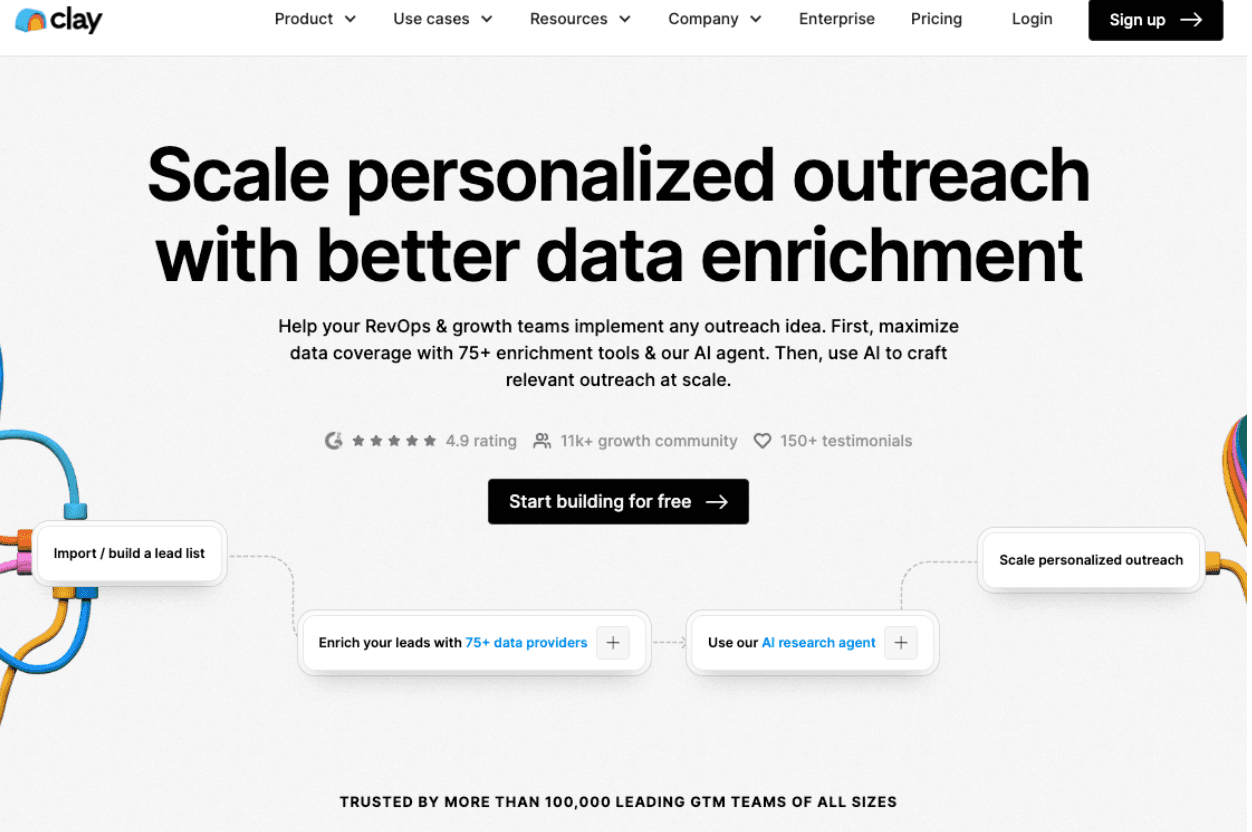
Clay is exceptional here, and it deserves the credit. Its whole design is a spreadsheet-like canvas where you pull from over 150 enrichment providers, run waterfalls to fill in emails and phone numbers, and deploy Claygent to do open-ended web research on each row. For a data-native operator, few tools offer that breadth of sources and control in one place. If your job is building the most complete, most bespoke enriched dataset possible, Clay is hard to beat.
Artisan gives you enrichment too, just packaged as a feature rather than a canvas. It sources from over 250 million B2B professionals across over 200 countries and a local-business database of over 250 million records, and it also pulls from a CSV, a CRM list, a webhook, or your website visitors. It then runs waterfall enrichment across roughly a dozen providers, verifying emails and phone numbers and charging only when enrichment succeeds. It also runs AI web research to rank leads by conversion likelihood, and AI qualification adds a second layer: you write criteria in plain English, Ava researches each lead across the web, and she qualifies or disqualifies them with her reasoning attached. This is less configurable than Clay's canvas by design. You are not building a pipeline; the pipeline ships with the worker. For Clay against another enrichment source, see Clay vs. Clearbit.
The honest distinction is this. Clay gives you more raw enrichment breadth and more control over it. Artisan gives you enrichment that is already wired into the thing that acts on it. If enrichment sophistication is the goal, Clay. If enrichment is a means to sent outreach, Artisan. For Clay next to a broad GTM platform, see Clay vs. Apollo.
Activation: Who actually runs the outbound?
This is the line that matters. Clay is infrastructure. It builds and enriches the list well, but it does not own your outbound motion. To turn a Clay table into a running campaign, you push data into a sequencer, write the messaging, connect the dialer, and, critically, have someone maintain all of it. Clay's power is real, and so is its dependency: it needs a skilled operator. Many teams hire a GTM engineer to obtain value from it, and that role is not cheap.
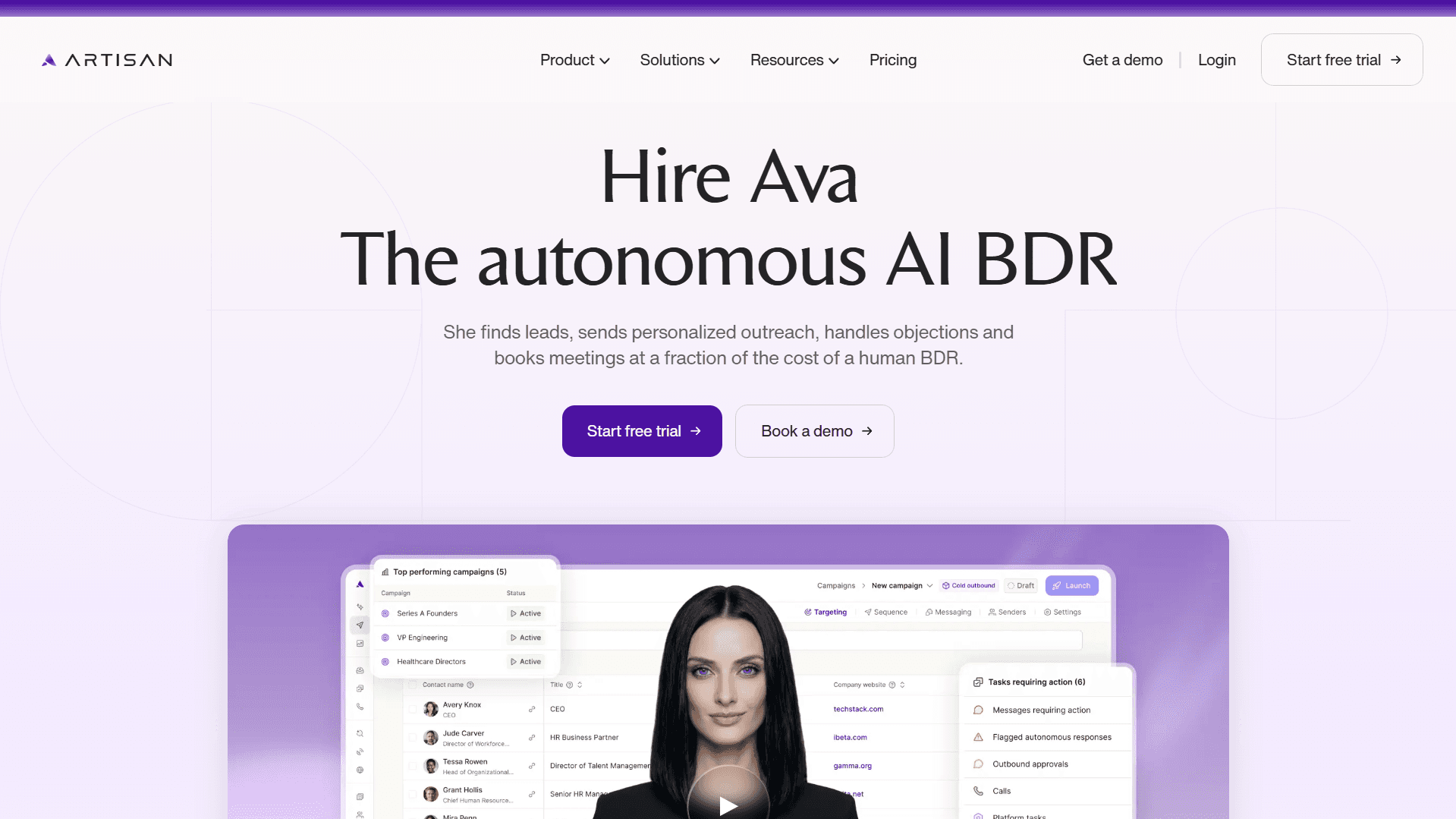
Artisan removes the operator from the critical path. Ava takes the enriched leads and launches personalized multichannel campaigns across email, social media, and dialer call steps, with per-lead messaging rather than templated merges. Personalization runs at three depths: Lite picks a single relevant angle per lead, Deep synthesizes several signals into a richer insight, and Agentic adds a five-agent web research swarm that hunts for a unique angle on each prospect. Ava assembles each message from components you control, choosing the most relevant pain-point and solution pair for each prospect and using your calls to action verbatim. She runs dozens of message variations, shifts volume toward what converts, and optimizes at the component level. The line we would use is that Clay gives you the workbench and Artisan gives you the worker. Both are legitimate ways to buy, and only one runs without a person operating it. For Clay against another outbound platform, see Clay vs. Unify.
That is the consolidation story too. A typical outbound stack runs five to eight tools at over $100K a year plus the headcount to connect them. Artisan folds the data, enrichment, copywriting, sending, and reply handling into one platform run by an AI.
Booking meetings: The reply and the calendar
Clay's job ends before the reply. It is a data and workflow layer, so once outreach goes out, qualification, objection handling, and booking happen in whatever tools and humans you have assembled downstream.
Ava handles the replies. Autonomous replies are their own switch, set to handle objections only or objections plus meeting booking. She qualifies leads against criteria you write, answers objections from a knowledge base you control, chases follow-ups, and books meetings for qualified leads, with outreach running from each lead's CRM owner so a conversation lands with the right person. Escalation runs on plain-language rules you write, so a human steps in exactly when you want, for example when a lead asks about pricing. You receive the enrichment and the closing loop from one system, which is the practical payoff of buying the worker instead of the workbench.
Pricing: Platform tiers plus an operator vs. credits for work done
Clay's public pricing starts at Launch from $167/month and Growth from $446/month, with Enterprise custom and a usage-based credit model on top. Reported median contracts land around $30K a year. But a sticker price understates the real cost, because Clay's value depends on skilled configuration. Budget for the operator, whether that is a dedicated GTM engineer or a chunk of a senior revenue operations (RevOps) person's time.
Artisan's model is hybrid. Ava's work runs on usage-based credits, so you pay for the work she actually performs: qualifying, enriching, personalizing, and sending messages. Enrichment charges only on success, and you can trial Ava for free. Dialer seats and phone numbers are billed separately from credits, at $75/seat/month on monthly billing, with a seat for each caller and roughly one phone number per 50 calls a day. The full model is at https://www.artisan.co/pricing. The apples-to-apples comparison is Clay-plus-operator against an AI that runs the motion for you, not tier against tier.
Governance and enterprise fit
Both scale to serious teams, differently. Clay is trusted infrastructure that large RevOps organizations build on, and its flexibility is a genuine enterprise asset when you have the people to wield it. Artisan holds SOC 2 Type II attestation and complies with GDPR and the California Consumer Privacy Act (CCPA), with penetration testing, a Trust Center, a standard data processing agreement (DPA), and single sign-on (SSO), SAML, and role-based access on Enterprise plans. The deployment pattern for large teams has sales ops running Ava centrally for account executive teams who never log in, with a full audit trail on every message. The Enterprise plan adds a forward-deployed strategist and a dedicated customer success manager.
Here is a customer data point on the no-operator promise. Bruno Didier, CEO of CookUnity Business, put it plainly: "Ava runs highly targeted outreach at a scale we could never reach with a human-only team." Across over 100,000 personalized emails in year one, cost per lead landed around $45. That is targeting and enrichment feeding outreach, without a team hand-building tables.
Choose Clay if...
You have a skilled GTM engineer or data-native RevOps operator who enjoys building enrichment workflows and values control.
You need to enrich data for many downstream systems and use cases, not just outbound, and want over 150 sources in one canvas.
Your workflows are highly bespoke, and off-the-shelf enrichment plus outreach would leave capability on the table.
You want a flexible data infrastructure layer and already have execution tools you like.
If that describes you, Clay is a capable workbench, and this is not a knock on it. Artisan wins when you want the job done, enrichment plus outreach, run by an AI, without hiring someone to operate a tool. For other options, see the best Clay alternatives.
Frequently asked questions
Is Clay better than Artisan for enrichment?
For breadth and control, yes. Clay's roster of over 150 providers and its Claygent research agents on a fully configurable canvas give an operator more enrichment breadth than most alternatives. Artisan's waterfall enrichment across roughly a dozen providers is deliberately packaged as a feature that feeds Ava's outreach, charged only on success. If enrichment sophistication is the end goal, Clay; if enrichment is fuel for sent campaigns, Artisan.
Does Artisan replace Clay?
For teams whose Clay usage is mostly enrich-then-outbound, often yes, because Artisan includes the database, waterfall enrichment, and the AI that runs the outreach. Teams using Clay as a broad data infrastructure layer across many systems may keep it. The core difference is that Clay needs an operator to produce value, while Artisan's AI runs the motion itself. For a wider list, see Clay alternatives.
How much does Clay cost compared to Artisan?
Clay's public tiers start at Launch from $167/month and Growth from $446/month, with Enterprise custom and usage-based credits; reported median contracts are around $30K a year, plus the cost of an operator to run it. Artisan is hybrid: Ava's work runs on usage-based credits, so you pay for the work she performs, with dialer seats and phone numbers billed separately at $75/seat/month on monthly billing. Factor in staffing: Clay's real cost includes the person who builds the workflows.
Do I need a GTM engineer to use Clay?
To obtain full value, most teams need someone with GTM engineering skills to build and maintain the tables and workflows, a role that commonly runs around $160K a year. That operator dependency is Clay's power and its cost. Artisan is built so an AI runs the motion without a dedicated operator, which is the main reason teams weigh one against the other.
Can Artisan handle bespoke, complex targeting?
Yes, within an AI-run model. Personalization scales from Lite to Agentic, and the Agentic tier runs a five-agent research swarm on hard criteria. You can also define custom signals in plain English with confidence scoring and evidence URLs, and write qualification criteria, both inclusive and exclusive, that Ava researches per lead before returning a qualify or disqualify decision with her reasoning. This is less of a build-anything canvas than Clay and more of a describe-what-you-want employee. For most outbound targeting, that is enough; for arbitrary data pipelines, Clay is more flexible.
Which is faster to produce value from?
Artisan is typically faster to pipeline because data, enrichment, and outreach ship as one system an AI runs, so there is no table-building phase and no operator to hire first. Clay can be fast in the hands of an experienced operator, but its time-to-value is gated by that person's skill and availability. For teams without a GTM engineer, Artisan is the shorter path.
Is Clay a stable long-term bet?
Yes. Clay raised a $100M Series C at a $3.1B valuation (CapitalG, August 2025) and is widely adopted as GTM infrastructure. Choosing between them is a question of whether you want to run a powerful tool or hire an AI that runs the motion for you, not a question of vendor risk. For a deeper look, see our Clay review.
The bottom line
Clay is a capable enrichment workbench, and if you have the operator to wield it, it does that job well. Artisan is for teams that would rather buy the worker than build the machine: over 250 million B2B professionals across over 200 countries, a local-business database of over 250 million records, waterfall enrichment charged only on success, and an AI BDR who runs outreach end to end, as autonomously as you choose.
See Ava in action on the Artisan homepage, read the AI BDR guide, explore the AI sales agent, or review the pricing model. Comparing other data platforms? See Artisan vs. ZoomInfo. For Clay against that database, see Clay vs. ZoomInfo.
Related reading
Jaspar Carmichael-Jack
Co-Founder & CEO @ Artisan
Jaspar is an entrepreneur with expertise in sales, marketing, and operations. He founded Artisan in 2023, a company automating workflows with AI employees.