Clay vs. Common Room: Which should you choose in 2026?
Clay vs. Common Room compared on enrichment, buyer signals, pricing, and fit, plus what Zoom's acquisition means. An honest 2026 buyer's guide.

Key Takeaways
- Clay is enrichment infrastructure: over 150 data providers run in a waterfall, plus Claygent research agents, on public tiers from $167 to $446 a month and reported median contracts near $30,000 a year.
- Common Room is a person-level buyer intelligence platform that aggregates signals across product usage, community, and the web, with entry pricing reported around $2,500 a month.
- Zoom announced it was acquiring Common Room on July 2, 2026. This is a real factor in a multi-year buying decision, and we flag it below.
- Clay tells you how to reach a target and fills in the data. Common Room tells you which targets are worth reaching right now.
- They are complementary as often as they are competitive: a common pattern is Common Room to detect intent, Clay to enrich the identified people, then a sending tool to act.
- If your real need is a system that both spots the signal and acts on it without an operator, that is a different category entirely.
Clay and Common Room answer different questions. Clay answers "how do I enrich and build a list from any data source," using waterfall enrichment across over 150 providers. Common Room answers "who is already showing intent," unifying person-level buyer signals across your product, community, and web. Pick Clay to build data, Common Room to find warm accounts. Note Zoom's July 2026 agreement to acquire Common Room before you commit.
Clay vs. Common Room at a glance
Clay | Common Room | |
Best for | Building and enriching lists from many sources | Identifying accounts and people already showing intent |
Standout capability | Waterfall enrichment across over 150 providers plus Claygent | Person-level signal aggregation across product, community, and web |
Core question it answers | How do I obtain the data | Who is warm right now |
Pricing model | Credit and usage based | Platform subscription |
Published pricing | $167 to $446 a month; around $30K/year median | Reportedly from around $2,500 a month |
Ownership | Independent; $3.1B valuation (Aug 2025) | Acquisition by Zoom announced July 2026 |
Pricing is from each vendor's published pages and reported contract data; re-check before you buy.
How we compared them
We weighed four things: what job each tool actually does, how much data or signal it brings that the other cannot, what it costs at real usage, and how the ownership picture affects a multi-year bet. Clay and Common Room are compared because both live upstream of outreach, but they are not substitutes. One assembles data; the other detects buying interest. The Zoom acquisition adds a fifth consideration for Common Room specifically.
What is the difference between Clay and Common Room?
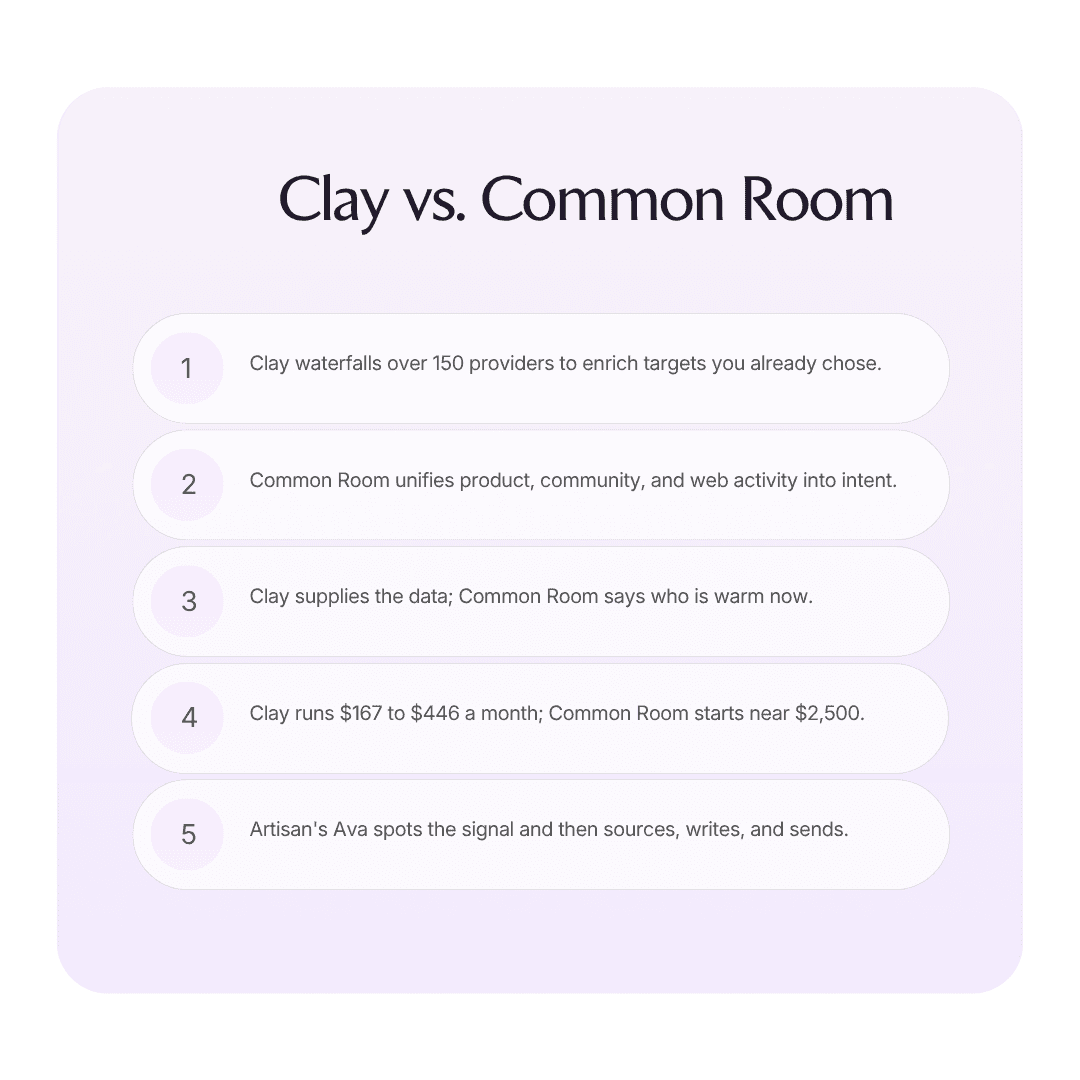
Clay is about supply of data. You point it at over 150 providers, waterfall them so you only pay when a field is filled, enrich and score records, and push the output to your stack. It is a workbench for building exactly the list and fields you want, run by someone data-literate. For related comparisons, see Clay vs. Unify and Clay vs. Clearbit.
Common Room is about signal. It ingests activity from your product, your community spaces, review and web sources, and stitches it into a person-level view of who is engaging and how intensely. It does not hand you a database. It tells you which specific humans at which accounts are showing buying behavior this week. One tool builds the list; the other decides who on it is hot.
Which identifies buying intent better?
Common Room, by design. This is its entire reason to exist. It resolves scattered signals (an executive job change, a spike in product usage, a mention in a community, repeated web visits) into a ranked view of accounts and people worth contacting now. For teams whose edge is timing and warm outreach, that intelligence is the point.
Clay can incorporate some signals through the providers it connects, and you can build scoring logic on top. But Clay does not natively unify first-party product and community data into person-level intent the way Common Room does. If your question is "who is in-market," Common Room is built for it; Clay is built to enrich whoever you already decided to target. For another data-tool matchup, see Clay vs. Apollo.
How do Clay and Common Room pricing compare?
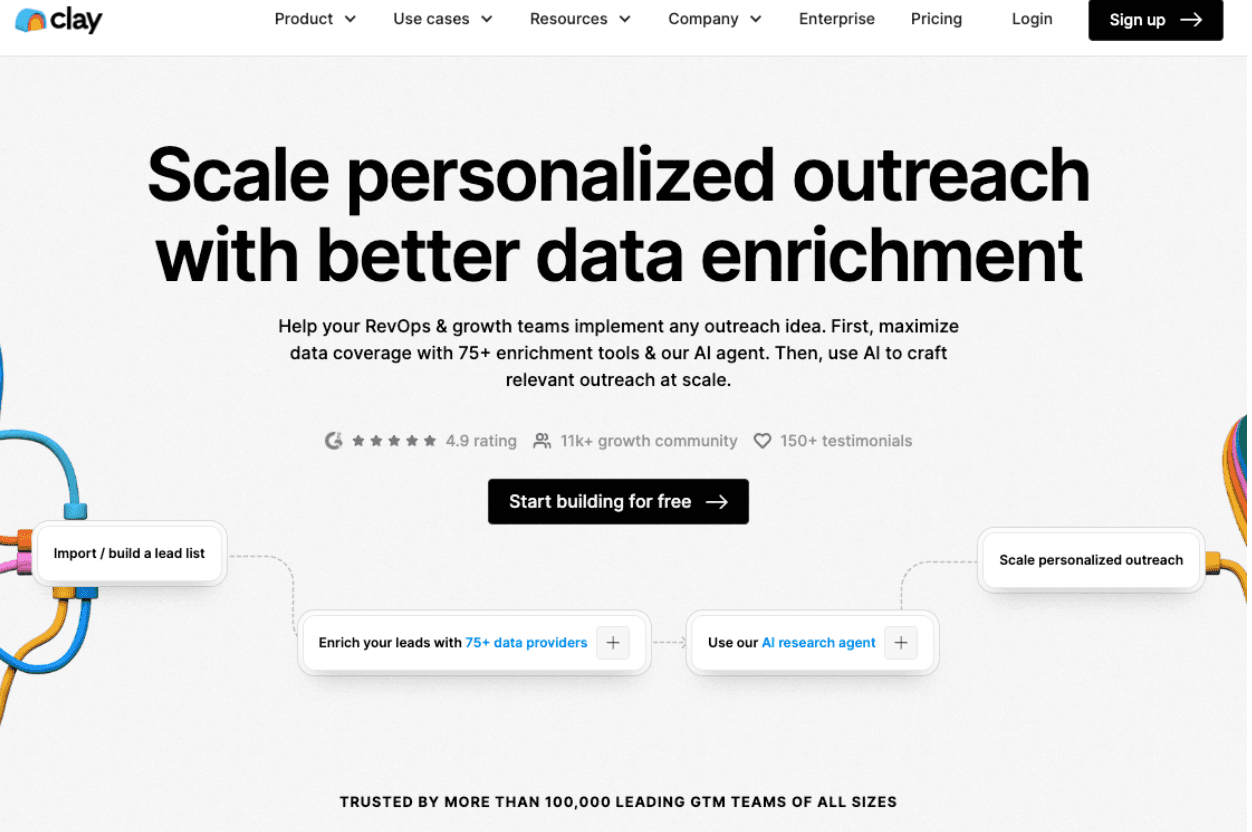
They price on different axes. Clay's public tiers run $167 to $446 a month and scale with enrichment usage, landing many teams near $30,000 a year at real volume. You are paying for records processed. For a deeper look, see our Clay review.
Common Room's entry pricing is reported around $2,500 a month, priced as a platform subscription tied to signal volume and seats instead of enrichment credits. For a team that mainly needs intent detection, Common Room is a cleaner single line item; for a team that mainly needs data assembly, Clay's usage model fits better. Neither is obviously cheaper; they meter different work.
What does Zoom acquiring Common Room mean?
Zoom announced it was acquiring Common Room on July 2, 2026. For a buyer, this is worth weighing honestly. Acquisitions can mean more resources and integration into a larger suite, or they can mean shifting priorities, pricing changes, and roadmap uncertainty as the product folds into a new owner. None of that is decided yet, and Common Room continues to operate.
If you are signing a multi-year deal, ask directly about the post-acquisition roadmap, pricing commitments, and whether standalone functionality will be preserved. Clay, independent and valued at $3.1 billion as of August 2025, does not carry that particular question right now. For a data-provider matchup, see Clay vs. ZoomInfo.
Do either of these actually run your outbound?
No, and it is worth being clear. Clay enriches and hands off; it does not send. Common Room detects intent and can route it, but a person still writes the message, works the account, and handles the reply. Both are upstream of the actual selling motion.
If the real goal is a system that spots the signal and then acts on it, sourcing, writing, sending, and replying without an operator stitching tools together, that is autonomous territory. Artisan runs that full loop through an AI employee, Ava, with intent signals and outreach across email, social media, and dialer call steps built into one platform. Its pricing is hybrid: Ava's work runs on usage-based credits, so you pay for the work she performs, and dialer seats are billed separately at $75/seat/month on monthly billing; see pricing. It is the third path when you would rather buy the outcome than assemble intelligence and data tools yourself. For the broader category, see our guide to the best AI GTM platforms. For a direct comparison, see Artisan vs. Clay.
Choose Clay if...
Your bottleneck is data quality and coverage, not knowing who is warm.
You have an operator to build enrichment workflows and want control over every field.
You already have a way to source intent and just need clean, enriched records.
You prefer usage-based cost tied to records instead of a fixed platform fee.
Choose Common Room if...
Your edge is timing, and you want to know which accounts are in-market now.
You have meaningful first-party signal (product usage, community) to unify.
A single platform subscription for intent is easier to justify than credit spend.
You are comfortable weighing the Zoom acquisition against the product's fit today.
FAQ
Are Clay and Common Room competitors or complements?
More complements than competitors. A common pattern is Common Room detecting which accounts show intent, Clay enriching the identified people with verified contact data, then a sequencer or dialer acting. They overlap only at the edges, where Clay's scoring meets Common Room's basic enrichment. Most teams that own both use them for different stages of the same motion.
Does Clay do buyer intent like Common Room?
Partially. Clay can pull some intent signals through the providers it connects and let you score records, but it does not natively unify first-party product and community activity into a person-level intent view the way Common Room does. If intent detection is your core need, Common Room is purpose-built for it; Clay is built to enrich targets you have already chosen.
How does Zoom's acquisition affect Common Room buyers?
Zoom announced the acquisition on July 2, 2026, and the product still operates. For multi-year deals, ask about roadmap continuity, pricing commitments, and whether standalone features remain after integration. Acquisitions can bring more resources or shifting priorities; the outcome is not yet clear, so factor it into the decision instead of assuming either result.
Which is more expensive, Clay or Common Room?
They meter different work, so it depends on usage. Clay runs $167 to $446 a month on public tiers and scales with enrichment volume, often near $30,000 a year at real usage. Common Room's entry pricing is reported around $2,500 a month as a platform subscription. A heavy-enrichment team may spend more on Clay; an intent-focused team will find Common Room the cleaner line item.
Can I use Common Room without a data engineer?
Common Room is more turnkey than Clay for its core job, since identifying and ranking signals does not require building data pipelines. You still need someone to configure sources and act on the output, but it demands less specialized data skill than Clay, which generally assumes a go-to-market (GTM) engineer or ops-minded operator to reach its full value. Teams that want a simpler path often weigh Clay alternatives.
Is there an alternative to both Clay and Common Room?
Yes. Clay builds the data and Common Room finds the intent, but both sit upstream of the send and leave the outreach to you. If you want a system that spots the signal and then acts on it, an autonomous platform is the alternative. Artisan's AI business development representative (BDR), Ava, folds intent signals, sourcing, enrichment, and outreach into one platform that runs the motion end to end. Pricing is hybrid: Ava's work runs on usage-based credits for the work she performs, with dialer seats billed separately. See Artisan's AI sales agent for how it differs from assembling a data tool and an intelligence tool.
What if I want signal and action in one system?
Neither Clay nor Common Room sends outreach on its own; both sit upstream of the send. If you want a platform that detects intent and then acts autonomously, an AI BDR that combines signals with outreach is a different category. Our explainer on what an AI BDR is walks through how that model differs from a standalone data or intelligence tool.
Jaspar Carmichael-Jack
Co-Founder & CEO @ Artisan
Jaspar is an entrepreneur with expertise in sales, marketing, and operations. He founded Artisan in 2023, a company automating workflows with AI employees.