The best AI GTM platforms in 2026
The 9 best AI GTM platforms in 2026, ranked. Artisan, Clay, Apollo, ZoomInfo, Unify, and more compared on pricing, AI autonomy, and deployment fit.
Key Takeaways
- Artisan ranks #1 because it eliminates the GTM engineer tax: the AI operates the platform for you, where Clay-style tools require a skilled human operator (over 400 open "GTM engineer" roles at a ~$160K median salary).
- Clay anchors the GTM engineering movement at a $3.1B valuation after a $100M Series C (CapitalG, August 2025), with median contracts around $30K/yr.
- Consolidation defined 2025-26: Zoom announced an agreement to acquire Common Room on July 2, 2026, Apollo acquired Pocus in March 2026 at a reported ~$200M in annual recurring revenue (ARR), and ZoomInfo changed its Nasdaq ticker to $GTM in May 2025.
- Typical stitched GTM stacks run five to eight tools and over $100K per year before headcount. Consolidation is the category's core economic argument.
- Public pricing spans free (Apollo) to a $62,820 median annual contract (6sense, per Vendr data across 204 deals).
- CookUnity runs outreach through Artisan at roughly $45 cost per lead across over 100,000 emails.
The best AI go-to-market (GTM) platform in 2026 is Artisan, because it is the platform where the AI is the operator, not the infrastructure: Ava, its AI BDR (business development representative), runs data, enrichment, signals, outreach, and replies inside one system. Clay is the strongest pick for teams with a dedicated GTM engineer, and Apollo wins on price-accessible breadth. This guide, updated July 2026, ranks nine platforms.
How do the top AI GTM platforms compare?
Rank | Platform | Best for | Standout capability | Public pricing |
1 | Artisan | AI running the GTM motion end to end | Autonomous AI BDR with built-in data, signals, and dialer | Usage-based, free trial (pricing) |
2 | Clay | GTM engineering teams | Over 150 provider enrichment waterfall, Claygent agents | Launch from $167/mo, Growth from $446/mo, plus free tier, per its pricing page |
3 | Apollo | Price-accessible all-in-one GTM | Over 230M claimed contacts plus engagement | Free to $119/user/mo, per its pricing page |
4 | ZoomInfo | Enterprise data and intent | Over 321M profiles claimed (vendor figure), Copilot Workspace | From ~$15K/yr entry, per buyer-reported contracts |
5 | Unify | Warm outbound plays | Intent from over 10 sources, automated Plays | Free (up to 3 seats), then $20-60/seat/mo plus credits |
6 | Common Room | Person-level buyer intelligence | Person360 and RoomieAI | Essential reportedly $2,500/mo annual (five seats) |
7 | 6sense | Predictive ABM at enterprise scale | RevvyAI agents on predictive models | Quote-based, $62,820 median per Vendr |
8 | Monaco | Startups wanting an AI-native revenue engine | Sam Blond's revenue playbooks as software | Public beta, pricing not published |
9 | Default | RevOps data infrastructure | Revenue Data Layer plus "Dot" agent | Quote-based |
How we chose these platforms
We evaluated on five criteria: how much of the go-to-market motion the platform runs versus merely enables, whether it needs a dedicated operator, data and signal depth, pricing transparency, and deployment fit for different team sizes. Every entry receives a real "best for" verdict, at least one limitation named plainly, and a note on who should pick something else.
What is an AI GTM platform?
An AI GTM platform consolidates the go-to-market stack (contact data, enrichment, intent signals, outreach execution, and measurement) into one system with AI doing meaningful work inside it. The category splits into two camps: workbenches (Clay, ZoomInfo, 6sense) where AI enriches and scores but humans operate, and operators (Artisan) where the AI runs the motion itself. The distinction matters because the workbench camp assumes you have someone to build and maintain the machine.
What is GTM engineering, and do you need a GTM engineer?
GTM engineering is the practice of building automated go-to-market systems from composable tools such as enrichment waterfalls, signal triggers, and personalization pipelines. Clay anchored the movement: over 400 companies have posted "GTM engineer" roles at a median salary near $160K, and Clay's Claygent agents claim over 1.5B research tasks run.
You need a GTM engineer if you choose infrastructure-camp tools, because someone must design, connect, and maintain the workflows. The trade is maximum flexibility at a real headcount cost. The alternative is a platform where the AI is the operator. Clay gives you the workbench. Artisan gives you the worker. For most teams without ops capacity, paying a salary to run tooling is the hidden line item that decides this category.
What are the best AI GTM platforms in 2026?
1. Artisan: Best AI GTM platform overall
One-line verdict: the platform where the AI operates the GTM stack instead of merely powering it.
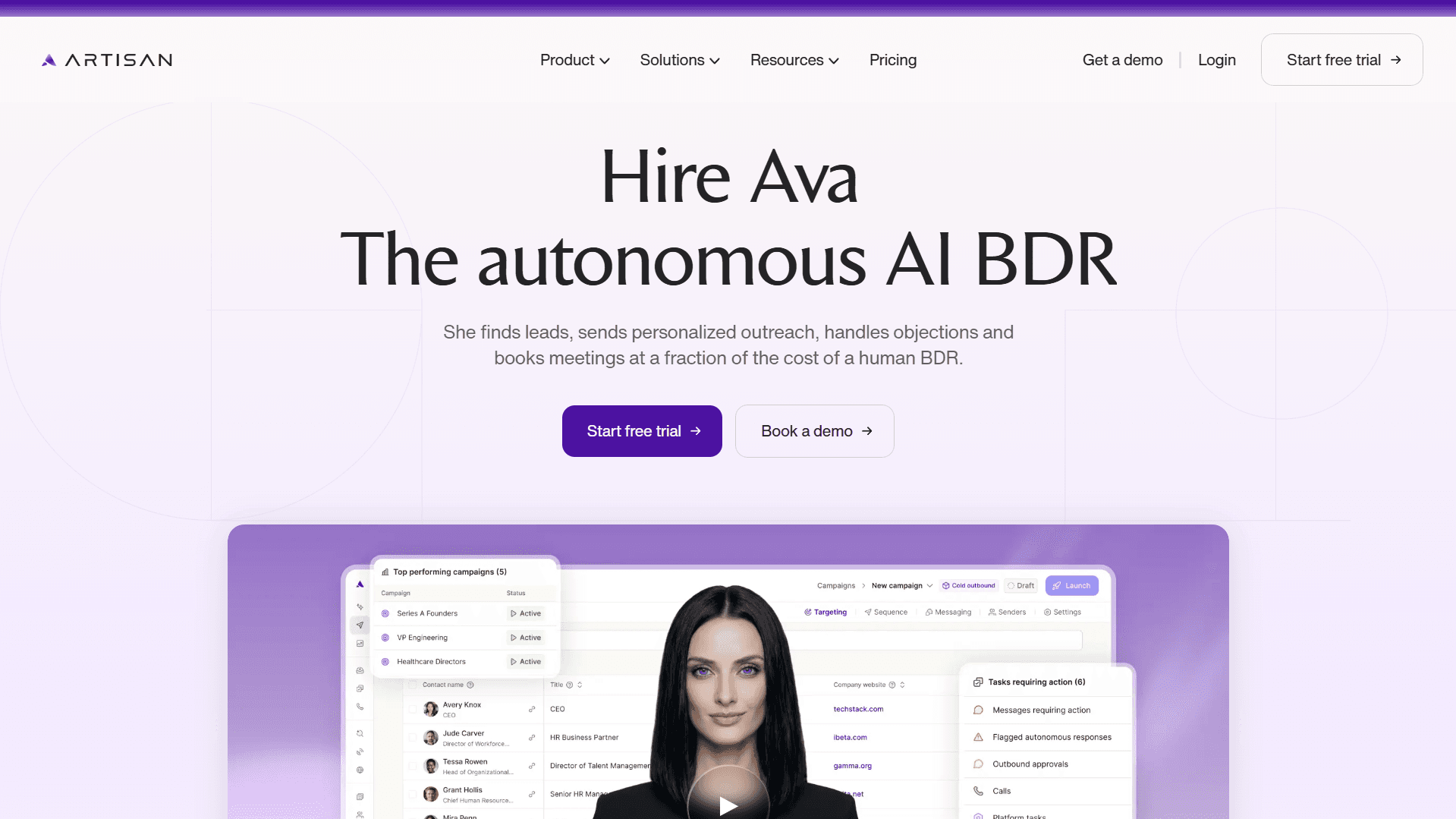
Artisan consolidates the outbound GTM stack into one system run by Ava, an autonomous AI BDR. The data layer is built in: over 270M B2B contacts plus a local-business database of over 130M, over 400M contacts in total, with waterfall enrichment across roughly a dozen providers (emails validated with bounce tests, phone enrichment charged only on success). Signals are built in too: funding rounds, executive hires, hiring activity, tech-stack and Bombora-powered topic intent, champion job changes, website visitor identification, and natural-language custom signals you define in plain English. So is execution, meaning AI-written per-lead multichannel outreach, autonomous reply handling, a native dialer running calls as sequence steps with power dialing and parallel dialing up to three lines, and managed deliverability infrastructure. Inbound runs on the same system: Ava Inbound greets and qualifies website visitors in live chat, answers from the knowledge base that powers autonomous replies, books meetings with CRM-owner routing, and hands off to a human whenever you want, while form fills trigger instant personalized follow-up sequences. Salesforce and HubSpot sync runs deep: full backfill, owner mapping with sender assignment, field-level export control, and deal-based do-not-contact.
No GTM engineer is required. Autonomy is a dial from review-every-message to full autopilot with plain-language escalation rules, and Artisan reports over 90% of customers run Ava autonomously. Enterprise readiness is part of the design: sales ops runs Ava centrally for large account executive (AE) teams whose reps never log in, governed by escalation rules, a full audit trail, org-level do-not-contact, and those field-level CRM controls, with single sign-on (SSO) and SOC 2 Type II plus a forward-deployed strategist and dedicated customer success manager (CSM) on Enterprise plans. CookUnity's Head of B2B, Bruno Didier, put it plainly: "Ava runs highly targeted outreach at a scale we could never reach with a human-only team." This works out to roughly $45 cost per lead across over 100,000 emails.
Best for: teams that want the GTM motion run for them, from founder-led startups on self-serve to global enterprises running Ava centrally from sales ops.
Who should pick something else: ops teams that want to hand-build custom data workflows (Clay), buyers who only need a standalone database (ZoomInfo, Apollo), or teams whose entire motion is maximum-volume parallel calling, since dedicated dialers like Nooks and Orum run 5-10 lines against Ava's 3. Person-level visitor identification is US-only, a privacy constraint every vendor shares.
Pricing: usage-based, credit-per-action, so you pay for work performed instead of seats, with no platform fee and a free trial. Ava Inbound runs on the same platform but is priced separately, so talk to sales for inbound pricing. See pricing.
2. Clay: Best for GTM engineering teams
One-line verdict: the definitive GTM workbench, and the reason the GTM engineer role exists.
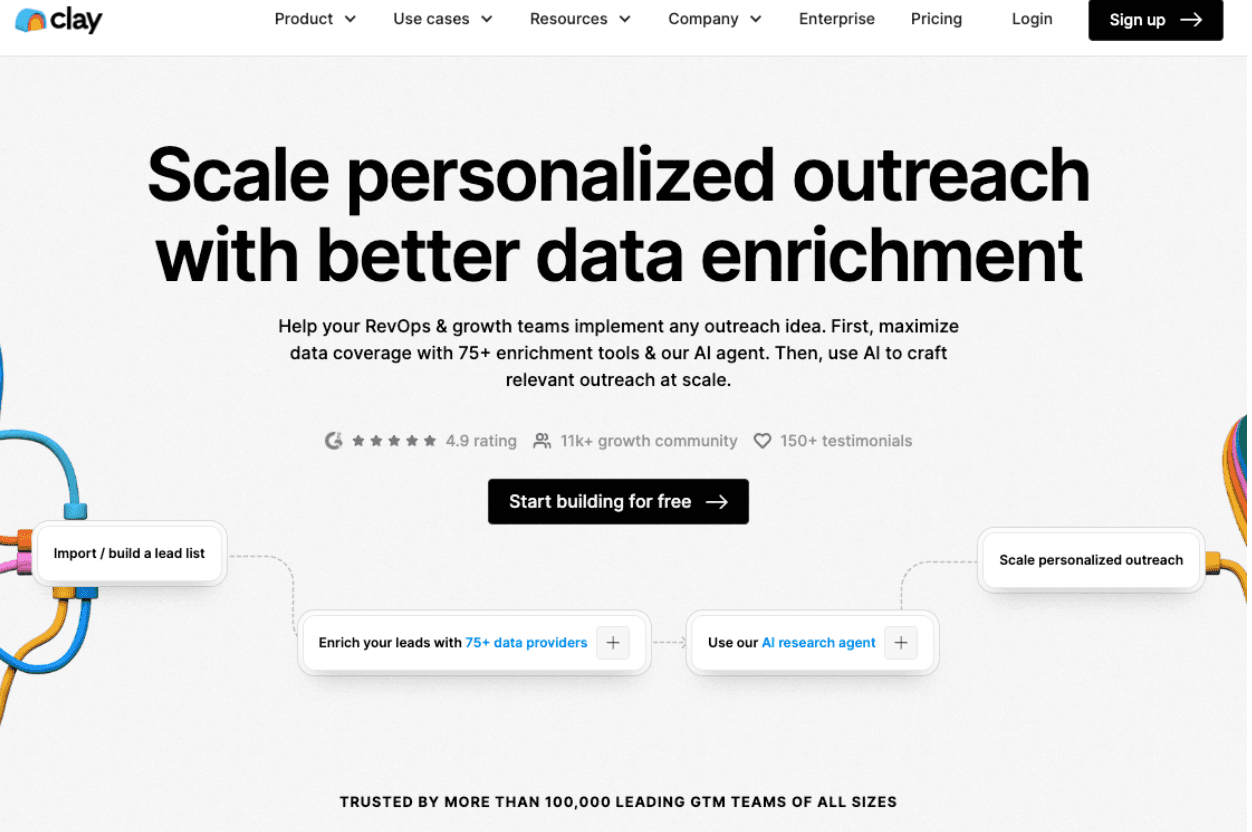
Clay orchestrates over 150 enrichment providers in spreadsheet-like tables, with Claygent AI agents (over 1.5B tasks claimed) doing web research at scale. It raised a $100M Series C at a $3.1B valuation (CapitalG, August 2025). Public tiers start with a free plan, Launch from $167/mo, and Growth from $446/mo, and median contracts land near $30K/yr.
Best for: revenue operations (RevOps) and growth teams with a skilled operator who want maximum flexibility over data workflows.
Who should pick something else: teams without ops capacity. Clay is infrastructure, not an outbound engine. It doesn't send or book autonomously, and running it well is a real job (the ~$160K GTM engineer tax).
3. Apollo: Best price-accessible all-in-one
One-line verdict: the most GTM platform per dollar, with AI that assists instead of operating.
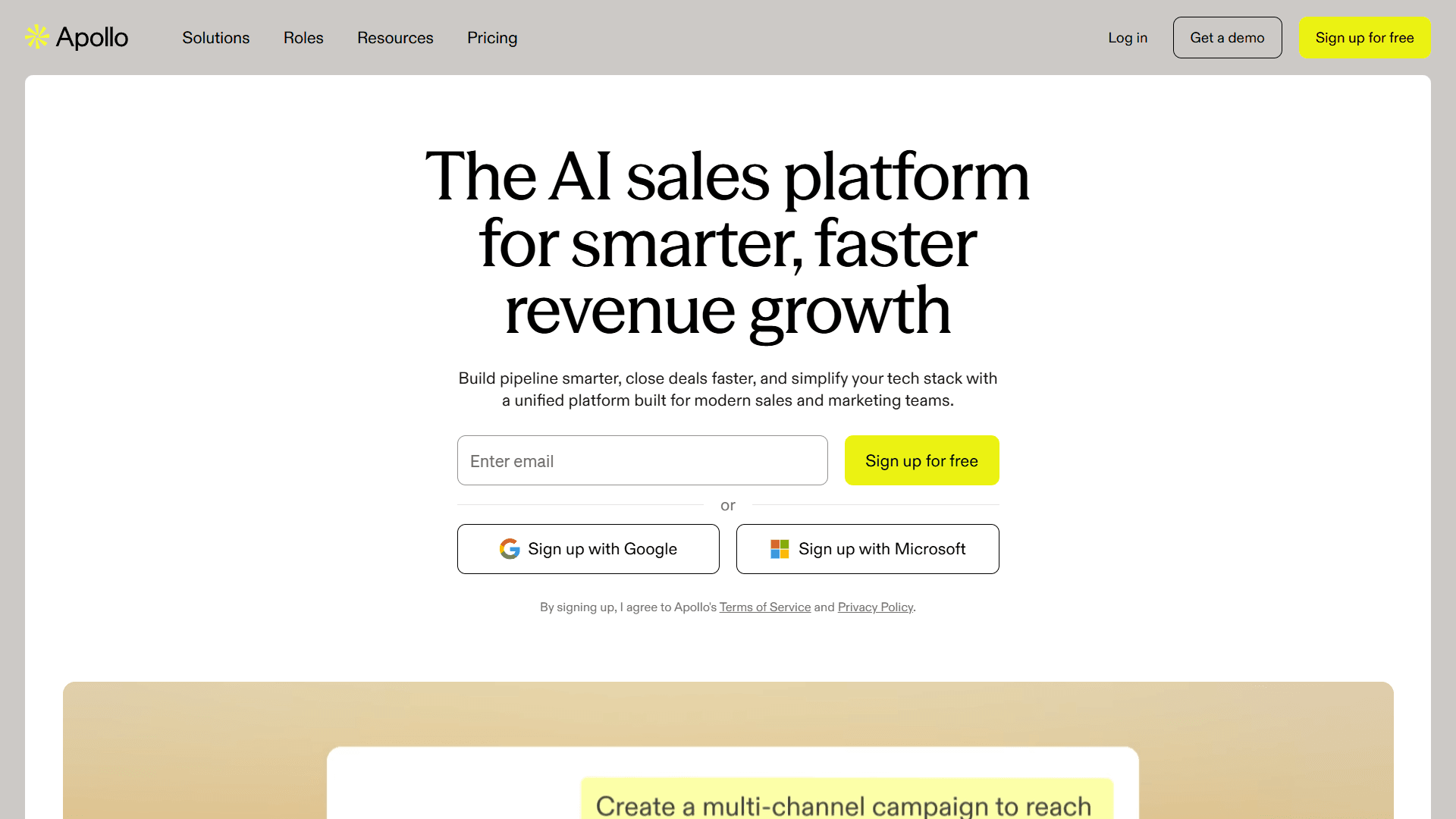
Apollo claims over 230M contacts, serves over 600,000 companies (around 100,000 paying), and prices from free to $119/user/mo publicly. It acquired Pocus in March 2026, reportedly passed ~$200M ARR, and pitches an "AI-native GTM OS." Email credits are unlimited under fair use (~10K/mo).
Best for: SMB and mid-market teams that want data, sequencing, and a dialer in one per-seat tool at the category's best price.
Who should pick something else: teams that want the motion run for them. Apollo's AI is assistive, humans still drive every step, and enterprises tend to use it as a data layer more than an outbound engine.
4. ZoomInfo: Best enterprise data and intent under one contract
One-line verdict: the enterprise incumbent, rebuilt around GTM intelligence.
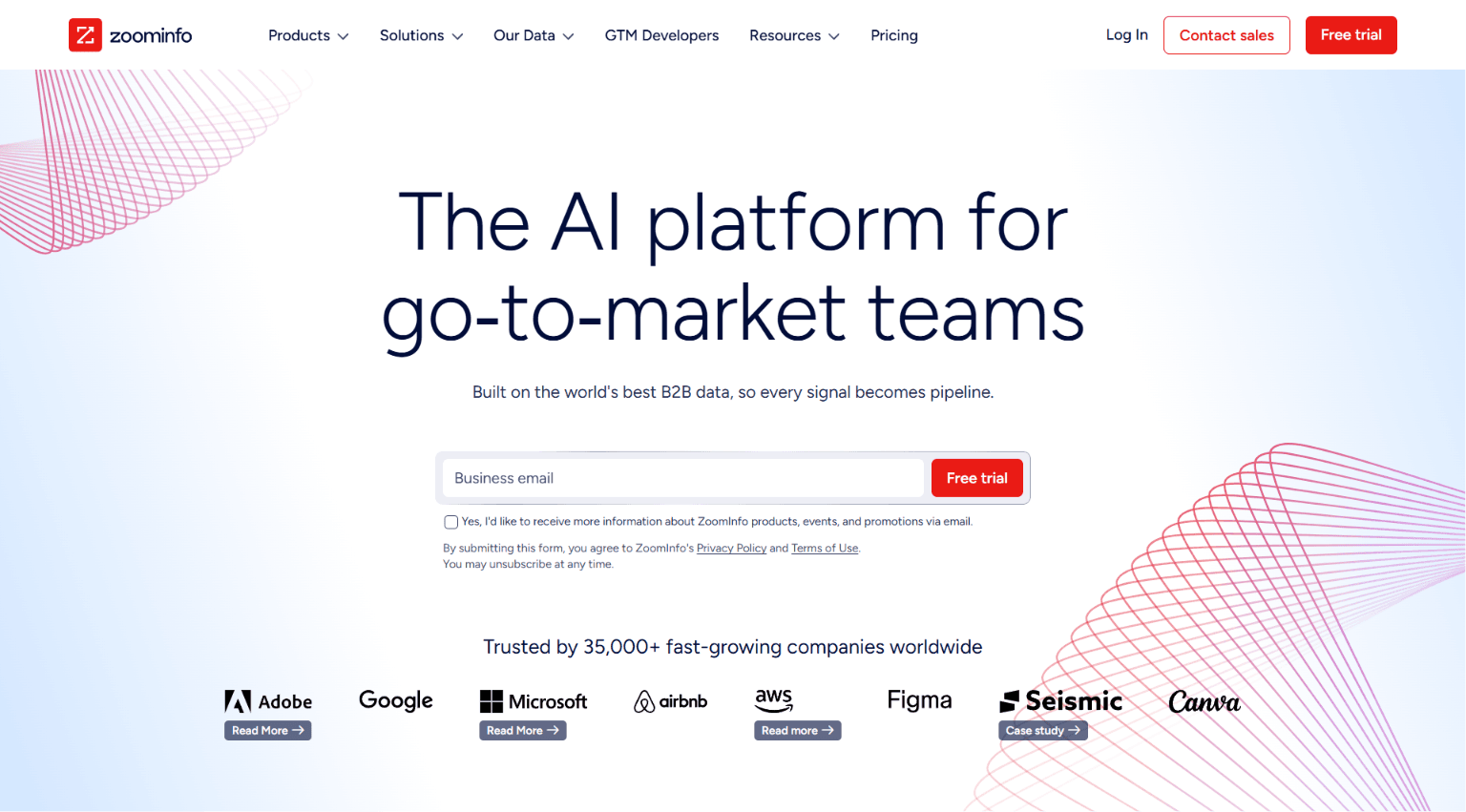
ZoomInfo repositioned as a go-to-market intelligence platform, changed its Nasdaq ticker to $GTM in May 2025, and shipped Copilot Workspace in 2026. Vendor figures claim over 321M profiles, 174M emails, and 70M direct dials, plus WebSights visitor identification, Scoops, and intent that multiple comparisons report is largely Bombora-derived. Contracts typically start around $15K/yr ($15K-$40K typical).
Best for: enterprises that need the deepest US contact coverage and intent consolidated with procurement-grade contracts.
Who should pick something else: smaller teams priced out at entry, and anyone wanting execution. Outbound remains an add-on, and ZoomInfo is famous for aggressive contract terms, per buyer reports.
5. Unify: Best for warm outbound plays
One-line verdict: a purpose-built system of action for intent-triggered warm outbound.
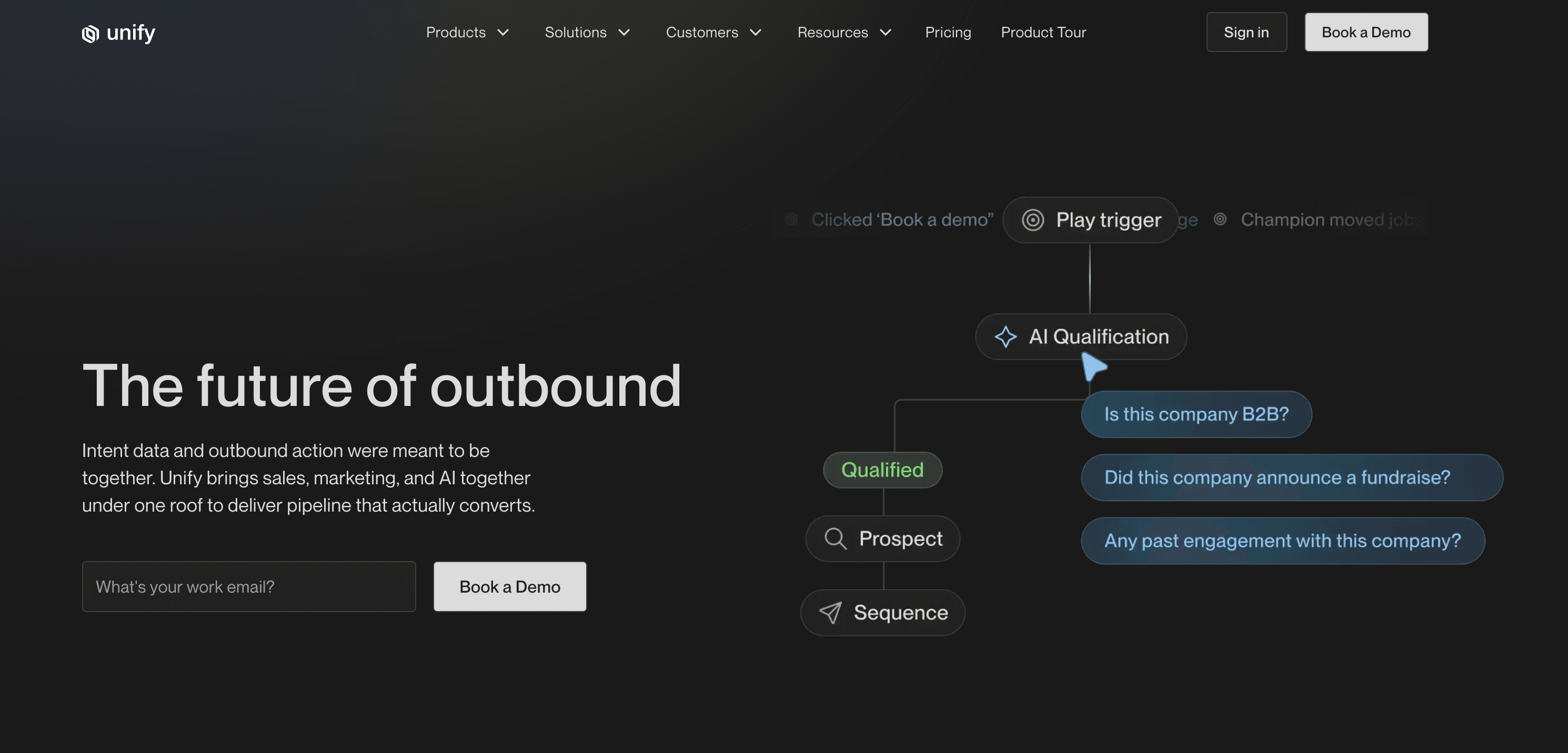
Unify pulls intent from over 10 sources, runs AI research agents, and fires automated Plays with its own deliverability infrastructure. It raised a $40M Series B (Battery, July 2025) and counts Perplexity and Cursor as customers. It's free for up to 3 seats, then runs $20-60/seat/month plus credits, per its pricing page.
Best for: mid-market teams that build signal-triggered warm outbound with some ops involvement.
Who should pick something else: teams that want replies handled and meetings booked autonomously, or cold-first teams. Unify's center of gravity is warm signals, credit costs stack on top of the platform fee, and the company is still early.
6. Common Room: Best person-level buyer intelligence
One-line verdict: the strongest person-level signal graph, now heading into Zoom.
Common Room's Person360 and RoomieAI stitch community, social, product, and web signals into person-level buyer intelligence. Zoom announced its agreement to acquire it on July 2, 2026 (not yet closed), so buyers should watch integration plans before committing. Essential reportedly runs around $2,500/mo billed annually (five seats, 100K contacts). It is also the official migration partner for Koala, which shut down September 30, 2025.
Best for: product-led growth (PLG) and community-led teams that need to see which individual people are showing buying behavior.
Who should pick something else: teams that want outbound execution (it reveals signals, you still act on them) and buyers who want roadmap certainty mid-acquisition.
7. 6sense: Best predictive ABM at enterprise scale
One-line verdict: the enterprise account-based marketing (ABM) standard, adding agents to a predictive core.
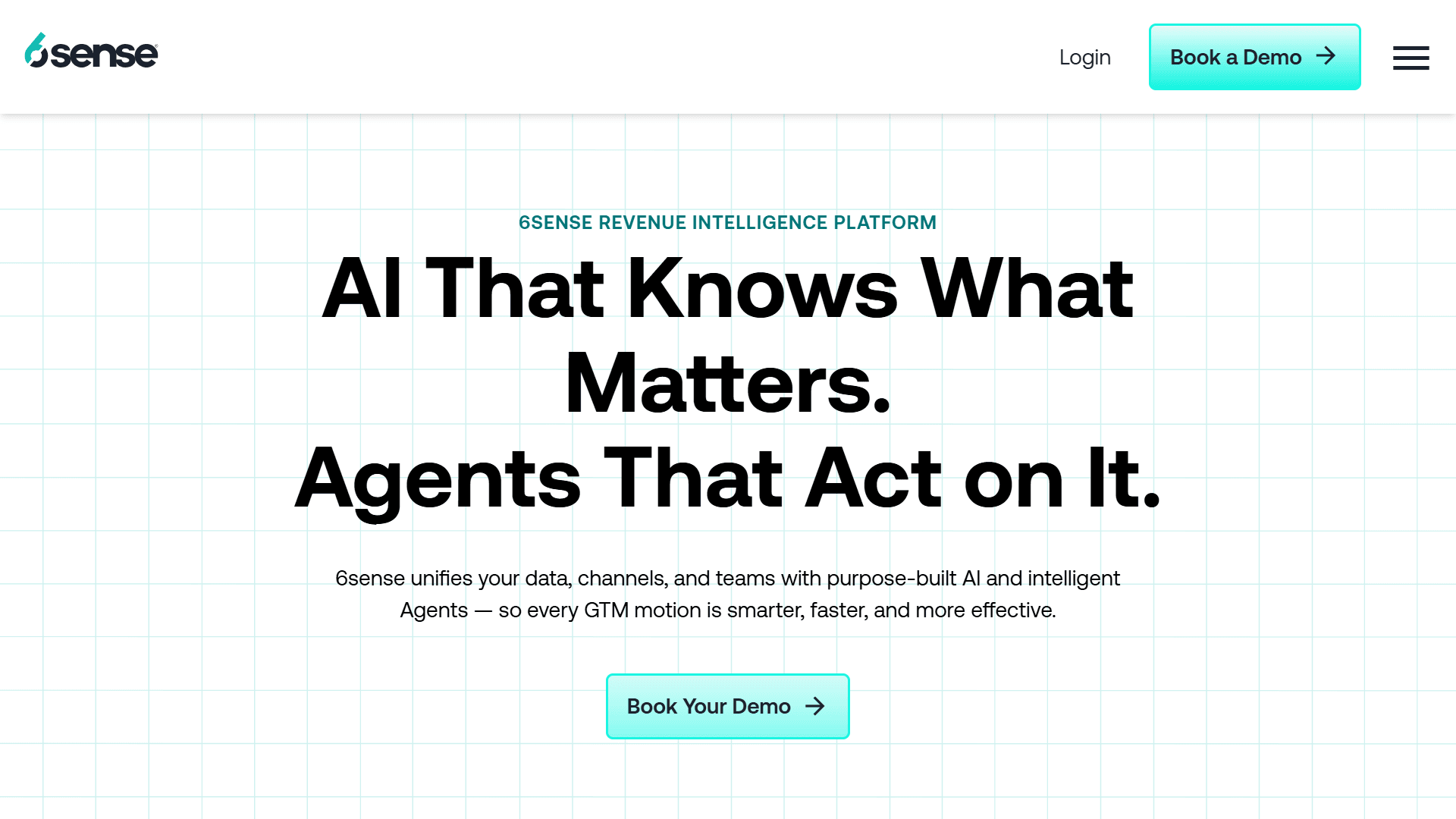
6sense pairs predictive account scoring with RevvyAI agents (launched 2025) and has been a Gartner Magic Quadrant Leader 5 years running. Vendr data across 204 deals shows a $62,820 median annual contract (range ~$11.5K-175K).
Best for: enterprise marketing and sales orgs that run account-based plays across large total addressable markets (TAMs).
Who should pick something else: SMBs (the contract floor is high), and outbound-led teams. 6sense predicts and prioritizes, but execution still routes through your sequencers and reps.
8. Monaco: Best AI-native revenue engine for startups (early)
One-line verdict: a high-profile bet on AI-run revenue for early-stage companies.
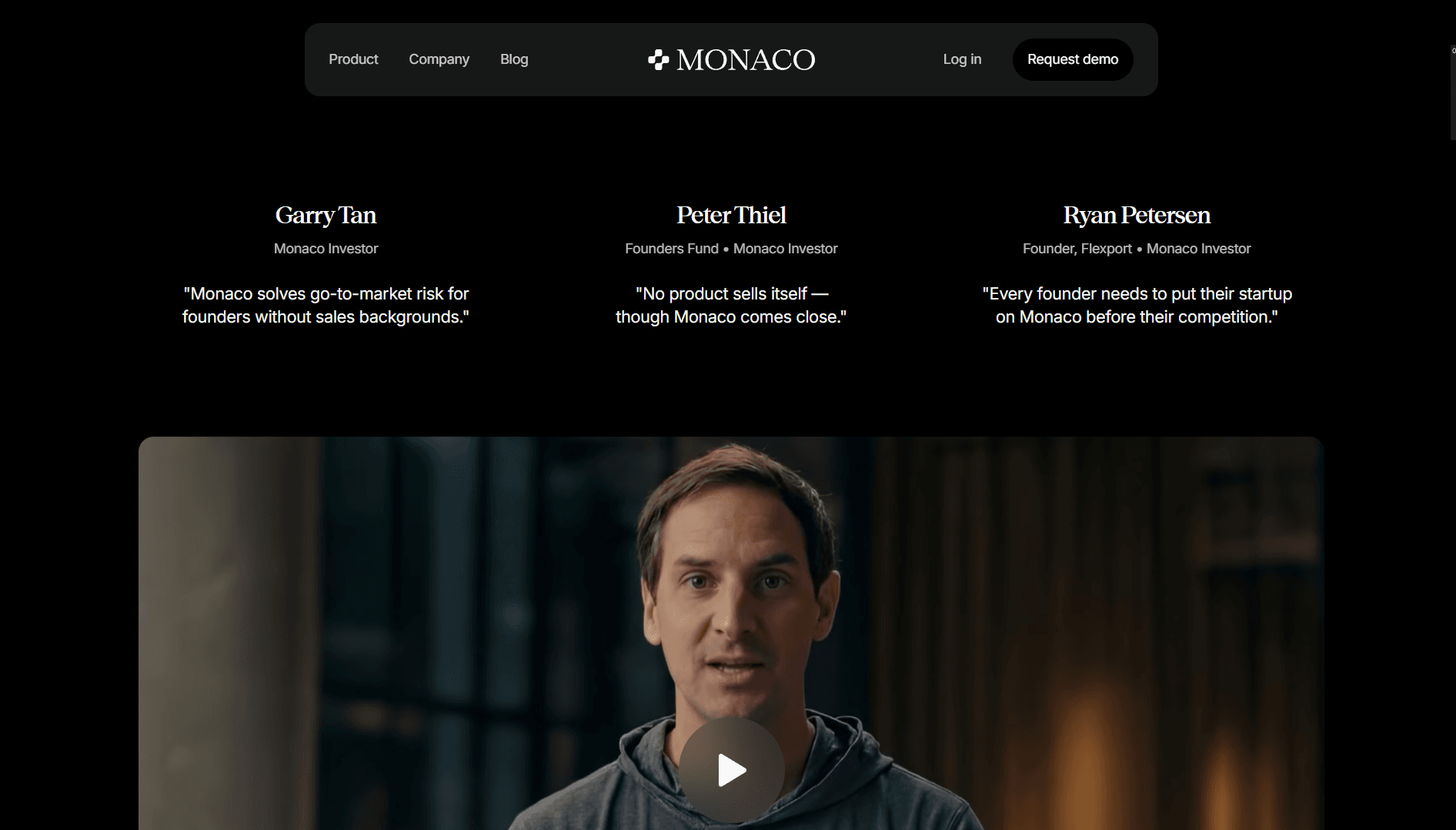
Monaco, founded by former Brex CRO Sam Blond, raised a $50M Series B from Benchmark in May 2026 (over $85M total) to build an AI-native revenue engine for startups. It is in public beta.
Best for: early-stage startups comfortable adopting a pre-1.0 product from a proven operator.
Who should pick something else: anyone who needs a mature product with references. Pricing isn't published, reference customers are scarce, and enterprise governance is unproven.
9. Default: Best RevOps data infrastructure play
One-line verdict: a Revenue Data Layer for teams that want infrastructure, not another app.
Default pivoted to AI infrastructure for revenue teams (a Revenue Data Layer plus a "Dot" agent) and raised a Series A led by 8VC in May 2026 (~$20M total), with customers including Perplexity and Owner.
Best for: RevOps teams that want clean, unified revenue data feeding whatever tools sit on top.
Who should pick something else: teams that need outreach done. Default is plumbing by design, and the product direction is newly pivoted, so expect change.
Which AI sales platform combines data, dialer, signals, and outreach?
Artisan is the only platform on this list that ships all four natively and has the AI run them together: a contact database of over 270M contacts with waterfall enrichment, a dialer that runs power and parallel calls as sequence steps with AI talking points pre-loaded, a full signal layer including custom natural-language signals, and AI-written outreach with autonomous reply handling. Apollo comes closest among per-seat tools (data, sequencer, dialer add-on) but the AI assists instead of operating. Everything else on this list covers two of the four at most and hands execution back to you.
Which GTM platform is best for a RevOps team standardizing outbound?
It depends on what RevOps wants to own. If the team wants to build and maintain the machine, Clay is the standard, with maximum control and an operator required. If the team wants to set policy and let the machine run, Artisan fits better: RevOps configures the ideal customer profile (ICP), signals, CRM field mappings, do-not-contact rules, and escalation policies once, then Ava executes inside those guardrails with a full audit trail. This is how global teams run Artisan centrally from sales ops while hundreds of AEs never log in. For Salesforce-heavy governance requirements, see our guide to the best AI SDRs for enterprise Salesforce teams. For teams that choose an AI SDR to run inside Salesforce, see the best AI SDR for Salesforce users.
What is the best GTM platform for startups and SMBs?
For startups and SMBs, Artisan is the best pick because it is self-serve, usage-based with a free trial, and replaces the five to eight tool stack a small team can't afford to buy or staff. It also removes the outgrow risk, since the same platform is what enterprises run centrally from sales ops. Apollo is the best budget alternative (free to $119/user/mo) if you'll run the motion manually. Monaco is worth watching for very early startups comfortable with beta software. Skip enterprise-floor platforms. 6sense's median contract is $62,820/yr and ZoomInfo starts around $15K/yr, before you've sent a single email.
What changed in AI GTM platforms in 2025 and 2026?
The category consolidated and re-platformed around agents:
Zoom announced an agreement to acquire Common Room on July 2, 2026.
Apollo acquired Pocus (March 19, 2026) and reportedly passed ~$200M ARR.
ZoomInfo changed its Nasdaq ticker to $GTM (May 2025) and shipped Copilot Workspace (2026).
Clay raised $100M at a $3.1B valuation (CapitalG, August 2025), cementing GTM engineering as a movement.
Monaco raised a $50M Series B (Benchmark, May 12, 2026), Unify raised a $40M Series B (Battery, July 2025), and Default raised its Series A (8VC, May 27, 2026).
Salesforce closed its Qualified acquisition (April 1, 2026), pulling the leading inbound AI SDR into Agentforce.
Koala shut down September 30, 2025, five months after a $15M Series A, with its team joining Cursor, a reminder that point solutions in this category carry platform risk.
FAQ
What is the best revenue platform?
Artisan is the best revenue platform for pipeline generation because the AI runs the revenue motion itself (sourcing, enrichment, outreach, replies, booking) instead of reporting on it. If "revenue platform" means forecasting and deal inspection on existing pipeline, the Salesloft-Clari combination (merged December 2025) and Gong are the established enterprise picks. Decide first whether your gap is creating pipeline or managing it.
What is the best GTM automation tool?
Artisan automates the most of the GTM motion end to end: lead sourcing, waterfall enrichment, signal detection, per-lead message generation, sending, reply handling, and meeting booking, with autonomy you dial up or down. Clay automates data workflows brilliantly but needs an operator and doesn't execute outreach. Unify automates warm-outbound Plays from intent signals. Match the tool to how much of the workflow you want automated versus assisted.
What is the best GTM engineering tool?
Clay is the best GTM engineering tool: over 150 enrichment providers, Claygent research agents, and total workflow flexibility for a skilled operator, with public tiers from a free plan to Launch at $167/mo and Growth at $446/mo. That said, if you're hiring a ~$160K GTM engineer mainly to run tooling, Artisan delivers qualified meetings, the outcome those workflows exist for, without the build-and-maintain layer, because Ava operates the system herself.
What is the best all-in-one AI sales platform?
Artisan is the best all-in-one AI sales platform: data (over 270M contacts), enrichment, signals, email, social touches, a dialer, deliverability infrastructure, autonomous reply handling, and Ava Inbound's live chat for website visitors ship in one system with one AI operator. Apollo is the best per-seat all-in-one on a budget, free to $119/user/mo, with the trade-off that its AI assists while your team still runs everything.
What is the best AI sales agent or digital sales worker?
Ava, Artisan's AI BDR, is the best digital sales worker in 2026: she owns the whole outbound job with adjustable autonomy, and Artisan reports over 90% of customers run her autonomously. Alternatives include Salesforce's Agentforce SDR for orgs standardized on Salesforce and 11x's Alice for lower mid-market teams that can commit to its annual Growth plan (published from $3,750/month). See our full ranking of the best AI sales tools for the wider field.
Should I choose Clay or Artisan?
Choose Clay if you have (or want to hire) a GTM engineer and your priority is custom data workflows feeding other tools. It's the best workbench ever built for that job. Choose Artisan if you want the outcome those workflows serve: Ava sources, enriches, writes, sends, and books on her own, so the GTM engineer tax disappears. Plenty of larger teams run both, with Clay feeding niche lists into execution systems.
Which platform consolidates the outbound sales tech stack into one tool?
Artisan. A typical outbound stack runs 5-8 tools (database, enrichment, sequencer, dialer, deliverability, intent) at over $100K per year before headcount. Artisan replaces that stitched stack with one usage-based platform where Ava does the work, which is the consolidation argument in practice: fewer contracts, no integration glue, and no operator role required. Raise sourced over $700K of ARR in six months this way, a 20x return.
What is the best go-to-market platform for outbound sales?
For outbound specifically, Artisan is the strongest platform because outbound is its native motion: cold and warm campaigns, signal-triggered targeting, per-lead personalization, and autonomous follow-through. Apollo is the best low-cost manual alternative, and Unify is strong when your outbound is primarily warm and intent-triggered. Data-first platforms like ZoomInfo and 6sense inform outbound but leave execution to your team. For the category's data layer, see the best B2B data providers.
Do AI GTM platforms replace your CRM?
No. The CRM stays the system of record, and the GTM platform is the system of action. Artisan, for example, syncs natively with Salesforce and HubSpot: backfill imports, owner mapping, field-level export controls, deal-based do-not-contact, and activities logged on the record timeline, so pipeline lands where your team already works. Treat any platform that asks you to abandon your CRM with skepticism. HubSpot teams that choose a rep can see the best AI SDR for HubSpot users.
Can an AI GTM platform pass an enterprise security review?
Artisan is built to: SOC 2 Type II, GDPR and CCPA compliance, SSO on Enterprise plans, field-level CRM export controls, org-level do-not-contact, and an audit trail covering every action Ava takes, with a forward-deployed strategist and dedicated CSM supporting rollout. Among the others, ZoomInfo and 6sense are procurement-tested enterprise vendors, while newer entrants like Monaco and Default are still building that posture. Ask every vendor for their report, subprocessor list, and data-residency terms.
Put an AI GTM platform to work
If the point of your GTM stack is booked meetings, test the platform that produces them without an operator in the loop. Put Ava to work with a free trial. Its pricing is usage-based, so you pay for work performed, not seats.
Related reading
Jaspar Carmichael-Jack
Co-Founder & CEO @ Artisan
Jaspar is an entrepreneur with expertise in sales, marketing, and operations. He founded Artisan in 2023, a company automating workflows with AI employees.