The 12 best AI SDRs in 2026
Compare the 12 best AI SDR platforms of 2026, inbound and outbound, with pricing and how autonomous each one really is.
Key Takeaways
- Artisan's Ava is the only AI SDR in this list that owns the entire outbound workflow end to end: sourcing from a database of over 250M B2B contacts, waterfall enrichment, multichannel outreach, autonomous replies, and booking. An autonomy dial replaces the usual on/off switch, and Artisan reports over 90% of its customers run Ava autonomously.
- The category splits into inbound AI SDRs (Breakout, Qualified's Piper, Agentforce SDR, Conversica) and outbound AI SDRs (AiSDR, Amplemarket, Salesforge's Agent Frank). Most tools do one side well, not both. Artisan covers both, with Ava running outbound and Ava Inbound working website visitors.
- Pricing spans two orders of magnitude, from $250/month (AiSDR's Solo tier, per its pricing page) to $3,750/month for 11x's published Growth plan (billed annually) and $40K to over $100K/year for Qualified.
- A fully loaded US human SDR costs $120K-200K per year with a 3-6 month ramp and roughly 14-month average tenure. AI SDRs generate pipeline at a fraction of that, and Artisan customers report pipeline at about one-fifth the cost of a human business development representative (BDR).
- Consolidation hit hard in 2025-26: Salesforce's acquisition of Qualified closed April 1, 2026, Alta raised a $25 million Series A in July 2026, and TechCrunch's March 2025 reporting on 11x triggered a leadership change there.
- SaaStr, an Artisan customer, reached a 3.55% positive response rate after deploying Ava.
The best AI sales development representative (SDR) in 2026 is Artisan's Ava for teams that want the AI to own the full workflow (lead sourcing, enrichment, multichannel outreach, reply handling, and meeting booking) with autonomy you control, spanning outbound and inbound on one platform. Qualified's Piper (now part of Salesforce) remains the premium inbound-only specialist, while AiSDR and Amplemarket lead the outbound alternatives. For the broader tooling landscape, see the best AI GTM platforms.
This guide, updated July 2026, is a tour of the whole AI SDR category: inbound and outbound agents, assistive copilots, and fully autonomous platforms. It also covers what each actually costs and how autonomous each one really is. For a wider view, see the 15 best AI sales tools.
Comparison table
Rank | Tool | Best for | Standout capability | Public pricing |
1 | Artisan (Ava) | Full-workflow autonomy, outbound and inbound | Autonomy dial from review-every-message to fully hands-off | Usage-based, pay per action, free trial (pricing) |
2 | Breakout | Inbound enrichment and workflow automation | Full-feature AI SDR for inbound leads | Deanonymization starts at $500/mo; inbound automation at $2K/mo |
3 | Qualified (Piper) | Inbound pipeline from web traffic | AI SDR working your website visitors in real time | ~$40K to over $100K/yr (Vendr-negotiated $40-50K) |
4 | AiSDR | SMB teams that want transparent pricing | $250/mo entry, fast setup, Ami strategist agent | $250 / $900 / $2,500 per mo |
5 | Amplemarket (Duo) | Data + engagement + agent in one | Duo agent layered on native data and sequences | ~$600/mo entry, not public |
6 | Reply.io (Jason AI) | Sequencer users that add an agent | Mature multichannel platform under the agent | $500-800/mo starter, sequences from $59/mo |
7 | Regie.ai (RegieOne) | Rep-augmenting AI sales engagement | AI dialer plus Auto-Pilot inside one SEP | Reportedly $180/user/mo, $499/user/mo agent tier |
8 | Salesforge (Agent Frank) | Budget autonomous email agent | Flat $499/mo agent pricing | $499/mo, platform $40-80/mo |
9 | Salesforce Agentforce SDR | Salesforce-standardized orgs | Native to CRM + Data Cloud | ~$0.10/action Flex Credits, Agentforce 1 from $550/user/mo |
10 | Conversica | Lead follow-up and reactivation | Two-way conversational AI since 2007 | Enterprise/custom pricing |
11 | Relevance AI (Bosh) | Builders that compose custom agents | Build-your-own AI workforce, Bosh SDR template | Free / Pro $19 / Team $234/mo self-serve, plus usage |
12 | 11x (Alice) | Lower mid-market outbound with phone/SMS | Julian AI phone agent alongside Alice | Growth from $3,750/mo (annual); Pro/Enterprise custom |
13 | Alta (Katie) | AI calling plus SDR outreach | SDR agent with integrated AI calling, claims SOC 2 + ISO 27001 | Quote-based |
All pricing is point-in-time as of July 2026, per each vendor's pricing page.
How we chose
We evaluated each platform on four criteria: how much of the SDR job it actually owns (sourcing, enrichment, outreach, replies, booking), depth of data and signals, pricing transparency, and deployment fit, including control and governance over what the AI sends. Rankings reflect overall fit for a revenue team buying an AI SDR in 2026, not any single dimension. Where a specialist beats everyone at one thing, we say so in its entry.
1. Artisan (Ava): Best AI SDR overall
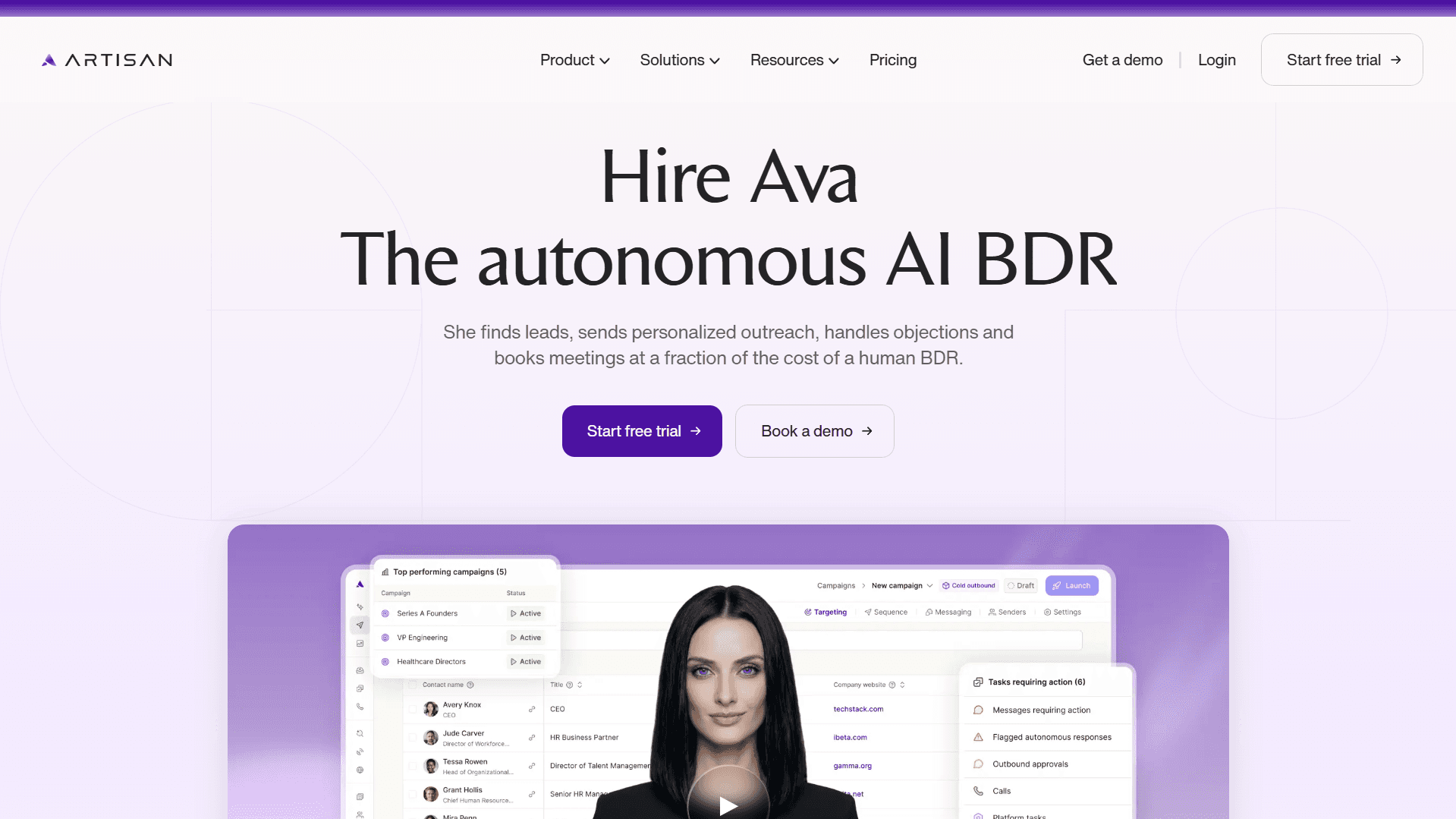
Artisan's Ava is an autonomous AI SDR built on a consolidated outbound platform: a database of over 270M B2B contacts plus a database of over 130M local businesses (over 400M contacts in total), waterfall enrichment across roughly a dozen providers (emails bounce-tested, phone enrichment charged only on success), intent signals, a native dialer with parallel dialing up to three lines, and managed email deliverability infrastructure. Ava finds best-fit leads, researches them, writes each message from scratch (two people in the same campaign receive two completely different emails), sends across email and social, handles replies and objections from a knowledge base, and books qualified meetings on reps' calendars.
The differentiator is the autonomy dial. You can review and approve every message, let Ava handle only objections, or go fully hands-off with plain-language escalation rules ("if the lead mentions pricing, escalate"). Artisan reports over 90% of customers run Ava autonomously, and the rest keep a human in the loop. Signals feed directly into campaigns instead of sitting in a dashboard: funding rounds, executive hires, hiring surges, tech-stack and topic intent, website visitor identification, and natural-language custom signals.
The same control layer is what makes enterprise deployments work. The common pattern is central operation: sales ops runs Ava from one console for large account executive (AE) teams whose reps never log in, governed by escalation rules, a full audit trail, org-level do-not-contact, and per-field CRM sync controls. Security posture matches, with SOC 2 Type II and single sign-on (SSO) on Enterprise plans, which also include a forward-deployed strategist and a dedicated customer success manager (CSM).
Ava works inbound too. Ava Inbound greets and qualifies website visitors in live chat, answers from the same knowledge base that powers her autonomous replies, books meetings with CRM-owner routing (deal owner, then contact owner, then company owner), supports human takeover, and connects to visitor identification and instant form-fill follow-ups so anonymous traffic becomes identified, qualified, and engaged. Inbound and outbound run on one platform, though Ava Inbound is priced separately: talk to sales for inbound pricing.
SaaStr's Jason Lemkin says, "We replaced our outbound sales team with Artisan. Open rates doubled and we're closing $100K deals daily." SaaStr reached a 3.55% positive response rate.
Best for: teams that want the AI to own the whole outbound motion, from founder-led teams on self-serve to enterprises that run Ava centrally from sales ops.
Who should pick something else: Salesforce-standardized enterprises that want a premium inbound-only specialist (see Qualified), and teams whose entire motion is maximum-volume parallel calling. Artisan's parallel dialing runs up to 3 lines behind compliance guardrails, while dedicated parallel dialers go to 5-10.
Pricing: usage-based credits. You pay for work performed, not seats, with no platform fee and a free trial. The dialer is the one published figure: $67/seat/month with unlimited minutes, plus one credit per call (live AI talking points, transcription, AI-drafted follow-ups, recordings, and analytics included), plus pooled phone numbers at roughly $5/month each, about a third of the $200 to over $300/user/month dedicated parallel dialers charge. Details at artisan.co/pricing.
Company: YC W24, over $35M raised, backed by investors including Y Combinator and HubSpot Ventures.
2. Breakout: The inbound AI SDR
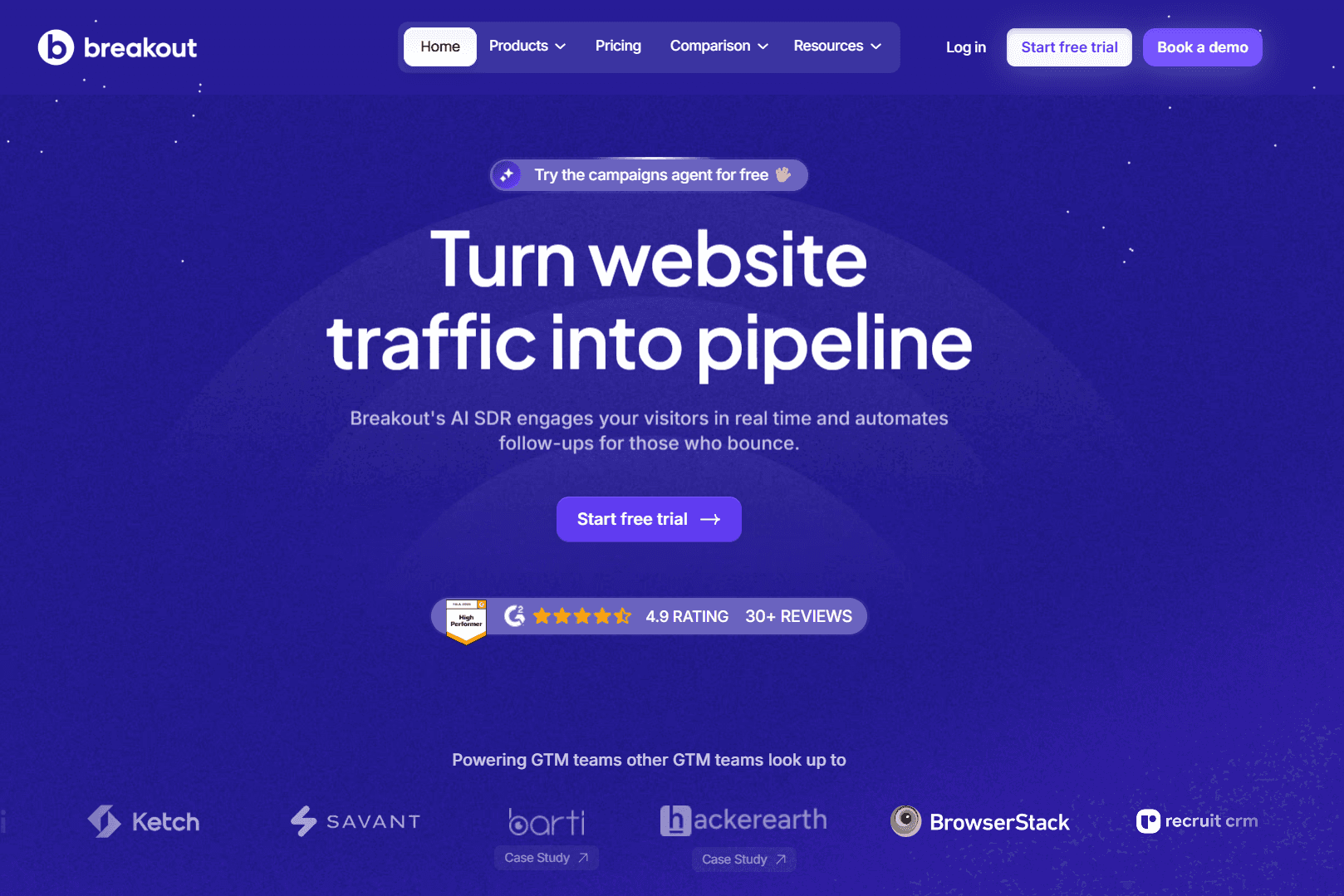
Breakout is an inbound-focused AI SDR platform designed to capture and convert website traffic that would otherwise bounce.
Breakout actively deanonymizes your website traffic, identifying both the company and the person, and engages them while they’re on your site. The AI SDR qualifies leads in real-time, can present visual assets like live demos or slides natively in the chat, and books meetings directly onto your reps' calendars.
What sets Breakout apart from legacy conversational marketing tools like Drift is its full autonomy and lack of complex, manually-built routing playbooks. The agent relies on AI reasoning and firmographic data to instantly adjust its conversational approach based on the visitor’s role and intent.
It also bridges the gap into warm outbound, automatically triggering email and LinkedIn follow-ups to high-intent visitors who browsed the site but didn't convert immediately.
Best for: Fast-moving mid-market and growth-stage B2B SaaS teams that want an autonomous inbound agent to convert website traffic without staffing a massive human SDR team to monitor live chat queues.
Who should pick something else: Teams whose primary pain point is cold outbound prospecting. Breakout is built to capture existing intent from your website traffic. It's also not a fit for early-stage, budget-conscious SMBs simply looking for a cheap live-chat widget.
Pricing: While their pricing mentions a Starter plan at $1,500/month (which only covers deanonymization and basic warm outbound), you need the Growth plan starting at $2,500/month, to actually access the flagship AI SDR , live routing, and scheduling. Because billing scales with conversation volume, mid-market companies should realistically budget $2,500 to $4,000+ per month.
3. Qualified (Piper): The premium inbound-only specialist
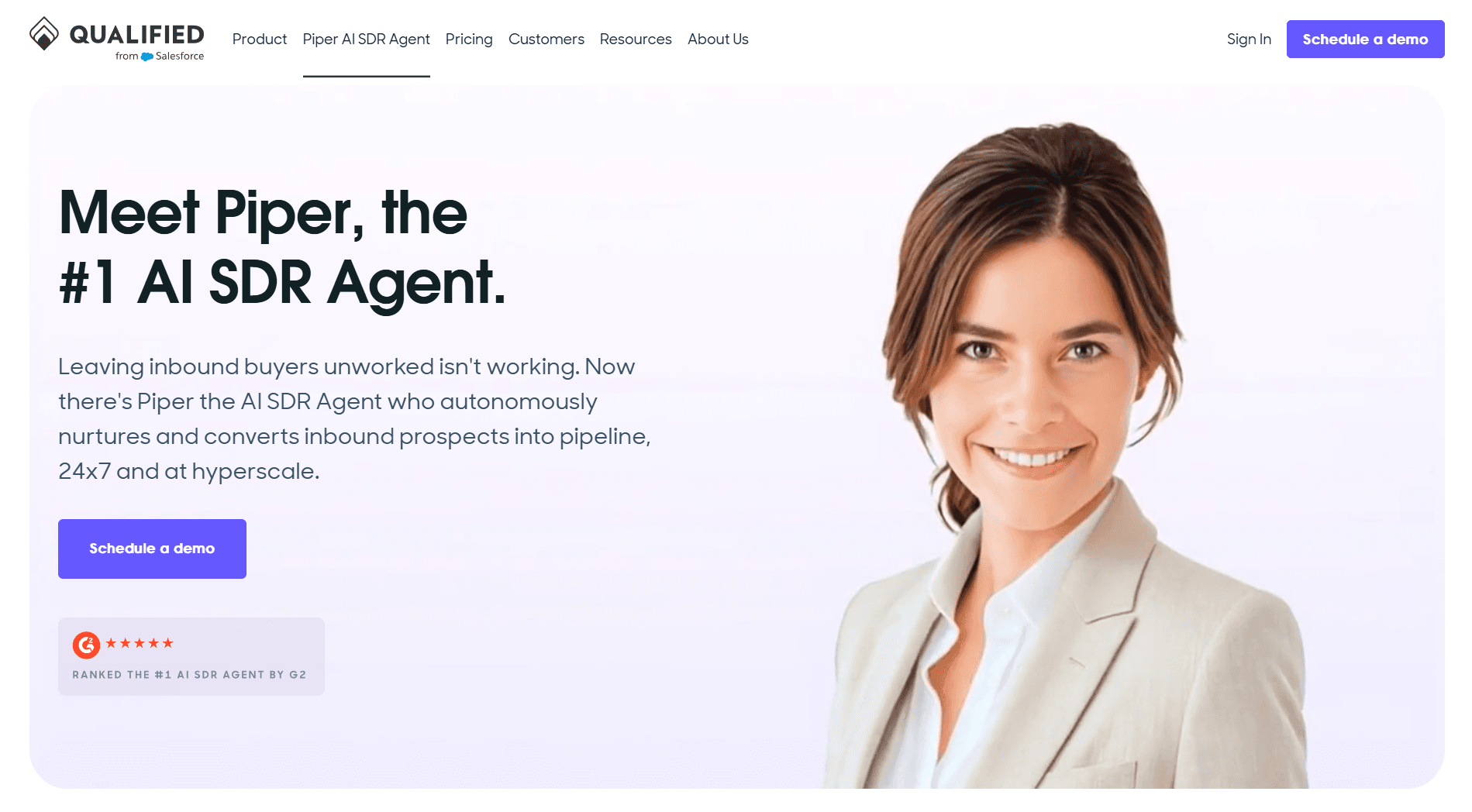
Piper is the category-defining inbound AI SDR: it engages your website visitors, qualifies them in real time, and books meetings from traffic you already have. Its reputation was strong enough that Salesforce bought the company outright, an acquisition that closed April 1, 2026, and Piper is folding into Agentforce, which cuts both ways: deep Salesforce alignment, but roadmap uncertainty for non-Salesforce shops.
Best for: Salesforce-standardized enterprises with meaningful website traffic that want the premium inbound-only specialist.
Who should pick something else: anyone whose problem is generating net-new outbound pipeline (Piper converts demand it doesn't create), and teams that want inbound and outbound handled on one platform. Contracts historically ran ~$42K to over $100K/year (Vendr-negotiated deals around $40-50K), so budget accordingly.
4. AiSDR: Best transparent pricing for SMBs
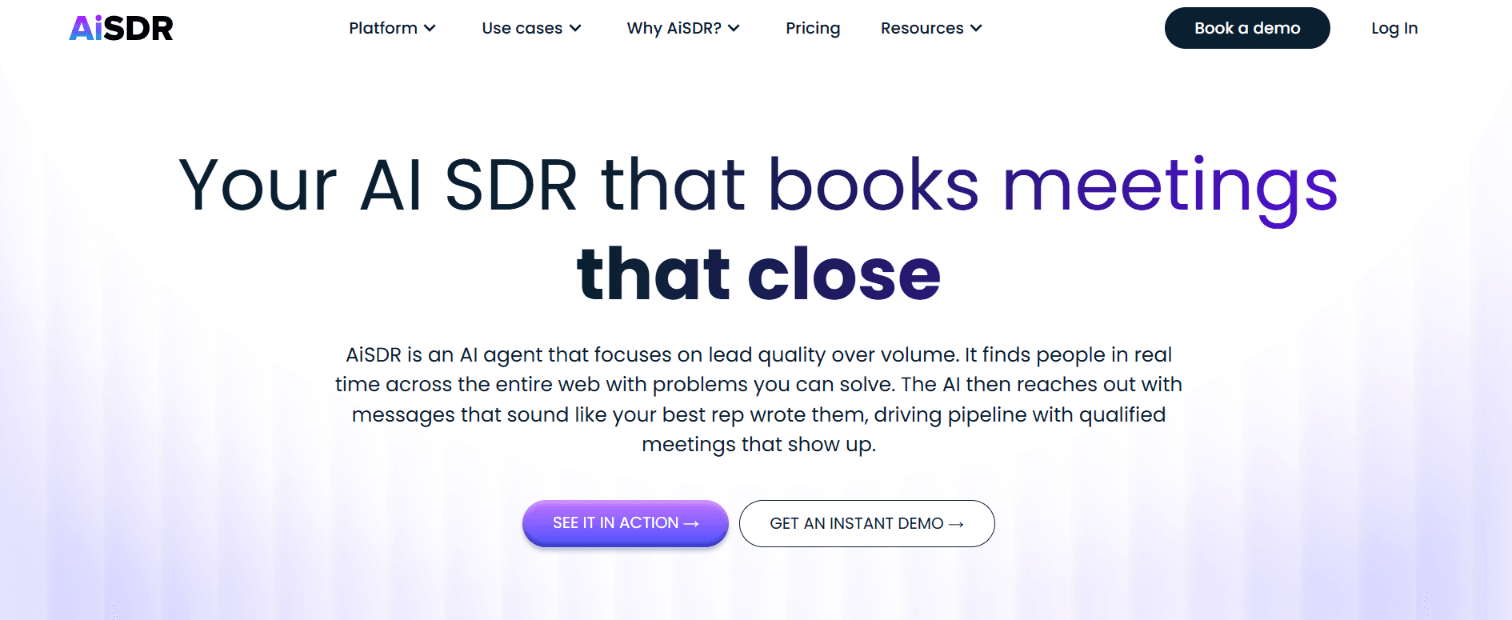
AiSDR is the most price-transparent dedicated AI SDR: $250/month Solo, $900 Explore, $2,500 Scale, published openly at aisdr.com/pricing. It handles outbound and inbound sequences and added Ami, a GTM strategist agent. It's YC-backed with a $3M seed. Setup is fast and the product is execution-focused.
Best for: startups and SMBs that want a working AI SDR this week at a known price.
Who should pick something else: mid-market and enterprise teams that need deeper governance, CRM depth, or full workflow ownership. AiSDR automates execution more than it owns the whole job.
5. Amplemarket (Duo): Data, engagement, and agent in one
Amplemarket bundles a contact database, a multichannel engagement platform, and Duo, its AI agent. This native pairing of data and execution puts it closer to the all-in-one model than most sequencer-plus-agent competitors. Entry pricing is around $600/month but not published.
Best for: mid-market teams that want one vendor for data plus AI-assisted engagement.
Who should pick something else: teams that want full autonomy or published pricing. Duo assists a human-run motion more than it runs the motion itself.
6. Reply.io (Jason AI): Agent on a mature sequencer
Jason AI sits on top of Reply.io's long-standing multichannel sequencing platform. AI SDR plans run $500-800/month at the starter level and $1,500-3,000/month for growth tiers. The underlying platform starts at $59/month, per Reply's pricing page, and has a long track record behind it.
Best for: teams already comfortable with sequencers that want to layer an agent on familiar infrastructure.
Who should pick something else: buyers who want the agent without the platform. You're adopting both, and the human-driven sequencer DNA shows.
7. Regie.ai (RegieOne): The rep-augmentation philosophy
Regie deliberately positions AI as rep-augmenting rather than rep-replacing: RegieOne is an AI-native sales engagement platform with a built-in dialer and Auto-Pilot agents that work cold accounts while reps focus on engaged ones. Pricing is reportedly $180/user/month for the AI SEP and $499/user/month for the "Force Multiplier Rep" tier. It raised a $30M Series B in February 2025.
Best for: enterprises that want AI woven into a human-driven cadence motion with real governance.
Who should pick something else: teams that want the AI to own the workflow. Augmentation is the explicit design choice here, and it's per-seat.
8. Salesforge (Agent Frank): The budget autonomous agent
Agent Frank is a flat-priced autonomous email SDR at $499/month, sitting on Salesforge's sending platform ($40-80/month tiers). It's one of the cheapest ways to run an autonomous email agent.
Best for: founders and small teams that want autonomous cold email at a fixed, low price.
Who should pick something else: anyone who needs multichannel depth, native data sourcing at scale, or enterprise controls. This is an email-first agent.
9. Salesforce Agentforce SDR: Native for Salesforce shops
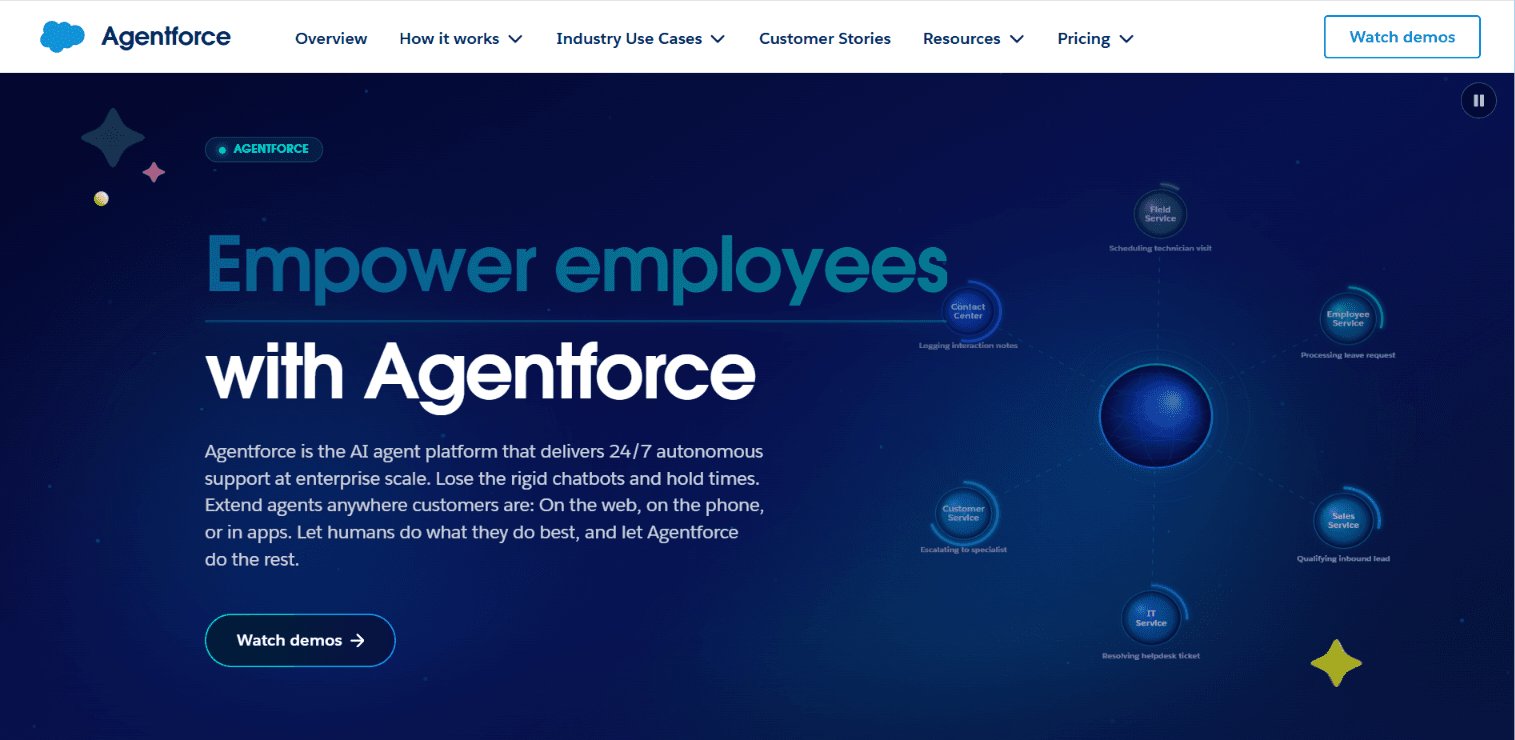
Agentforce SDR runs natively on Salesforce CRM and Data Cloud, working the contacts you already have. Pricing has shifted from $2/conversation to Flex Credits (~$0.10/action), with Agentforce 1 bundles from $550/user/month. With Qualified's Piper folding in, Salesforce now covers inbound and CRM-based nurture. Teams that standardize on Salesforce can also compare the best AI SDR for Salesforce users.
Best for: Salesforce-standardized orgs that want agents inside their governance perimeter.
Who should pick something else: teams that need net-new sourcing beyond their CRM, fast setup, or predictable spend. Consumption pricing is hard to forecast and implementation is heavy.
10. Conversica: The follow-up veteran
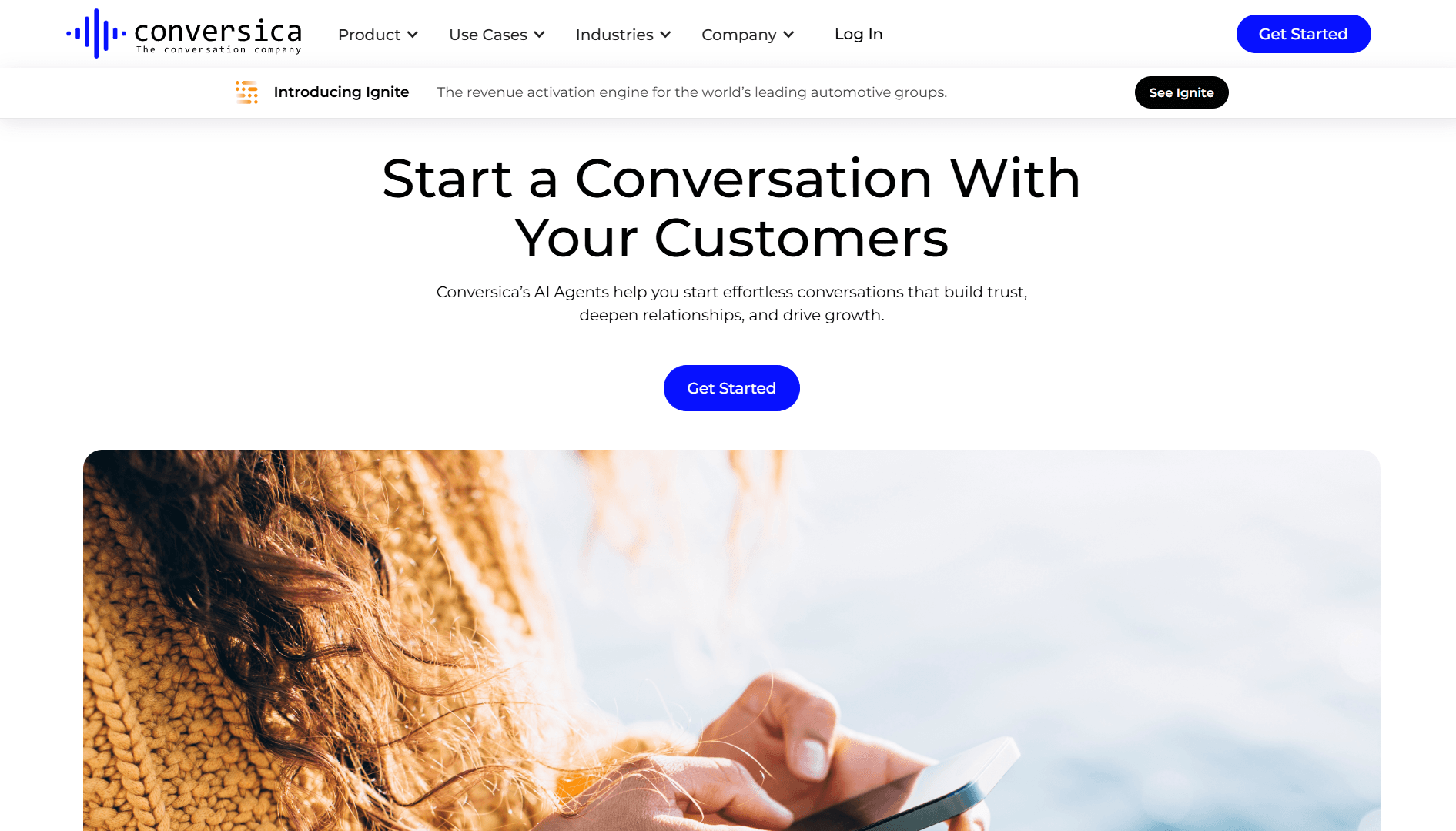
Conversica has run two-way conversational AI since 2007, longer than anyone here, and excels at lead follow-up, reactivation, and hand-raiser qualification at scale. It has raised more than $80M and evaluated an IPO in Q4 2025. Pricing is enterprise/custom.
Best for: marketing-heavy orgs with big lead databases going cold.
Who should pick something else: teams that need cold outbound prospecting. Conversica works leads you give it rather than sourcing new ones.
11. Relevance AI (Bosh): Build your own SDR agent
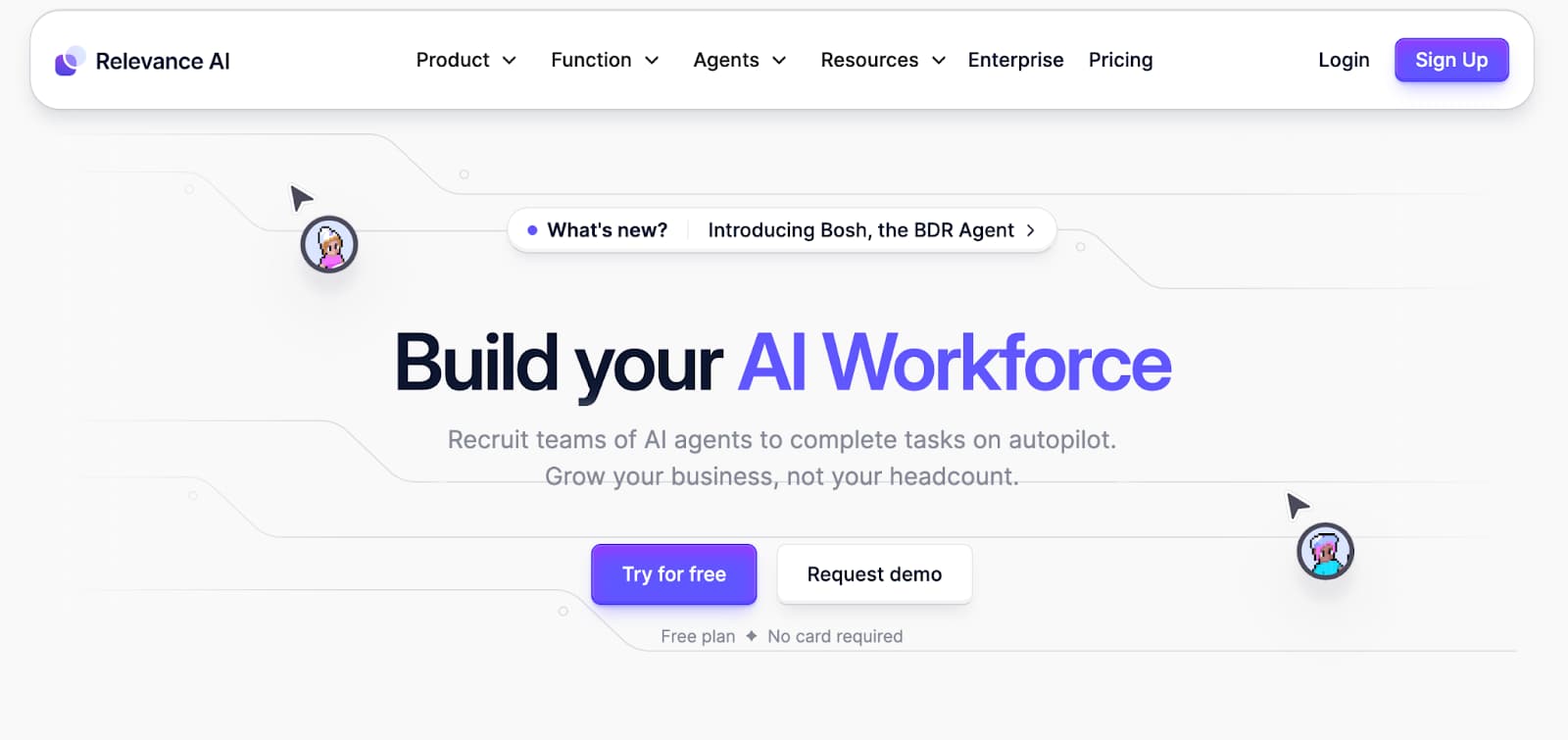
Relevance AI is an agent-building platform with Bosh as its SDR template. It's freemium, with self-serve tiers of Free, Pro at $19/month, and Team at $234/month (annual) plus usage, and has raised $24M (Bessemer, May 2025). Maximum flexibility, minimum out-of-the-box completeness.
Best for: technical teams that want to compose a custom agent workforce.
Who should pick something else: revenue teams that want a finished SDR product. You're buying a toolkit, and someone has to build and maintain what it does.
12. 11x (Alice): AI phone agent on an annual Growth plan
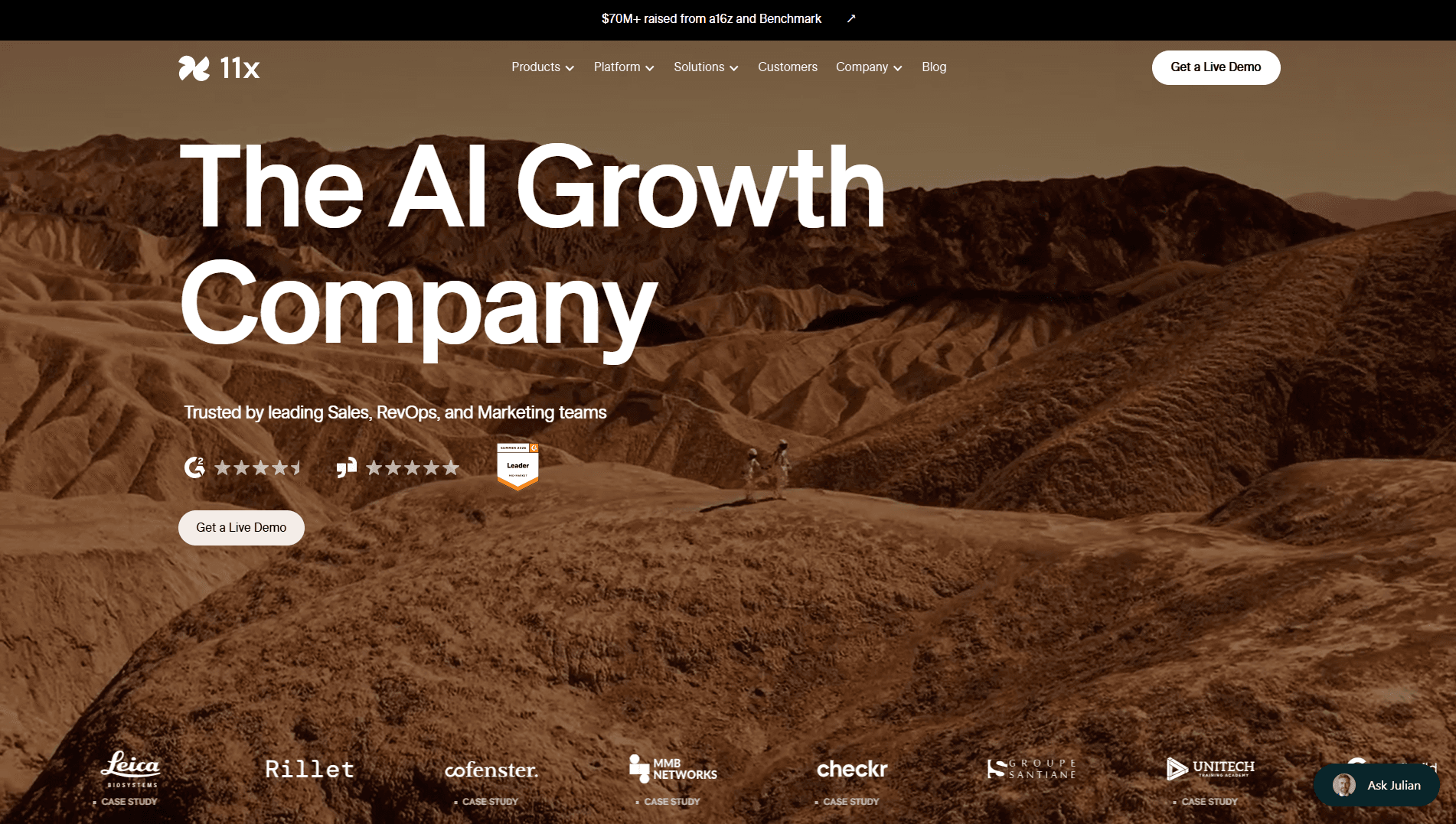
11x sells Alice, an outbound AI SDR, alongside Julian, an AI phone agent. Few competitors offer that pairing. The go-to-market is the thing to understand: 11x now publishes Growth pricing from $3,750/month (billed annually), with Pro and Enterprise custom, but its center of gravity is lower mid-market. The company has raised roughly $74M from a16z and Benchmark and claims over 400M contacts. Buyers should go in clear-eyed: TechCrunch reported in March 2025 that 11x had claimed customers it didn't have, founder-CEO Hasan Sukkar stepped down to non-executive chairman in May 2025 (CTO Prabhav Jain now leads), and churned customers have reportedly cited deliverability and CRM-sync issues. These attributed reports, not the feature set, are why it ranks this low. For a full cost breakdown, see 11x pricing and reviews.
Best for: lower mid-market teams that want an AI phone agent and can commit to its annual Growth plan (published from $3,750/month).
Who should pick something else: SMBs that want self-serve or transparent pricing, buyers who want a long public track record, and enterprises expecting organizational depth to match the contract structure.
13. Alta (Katie): SDR agent with AI calling
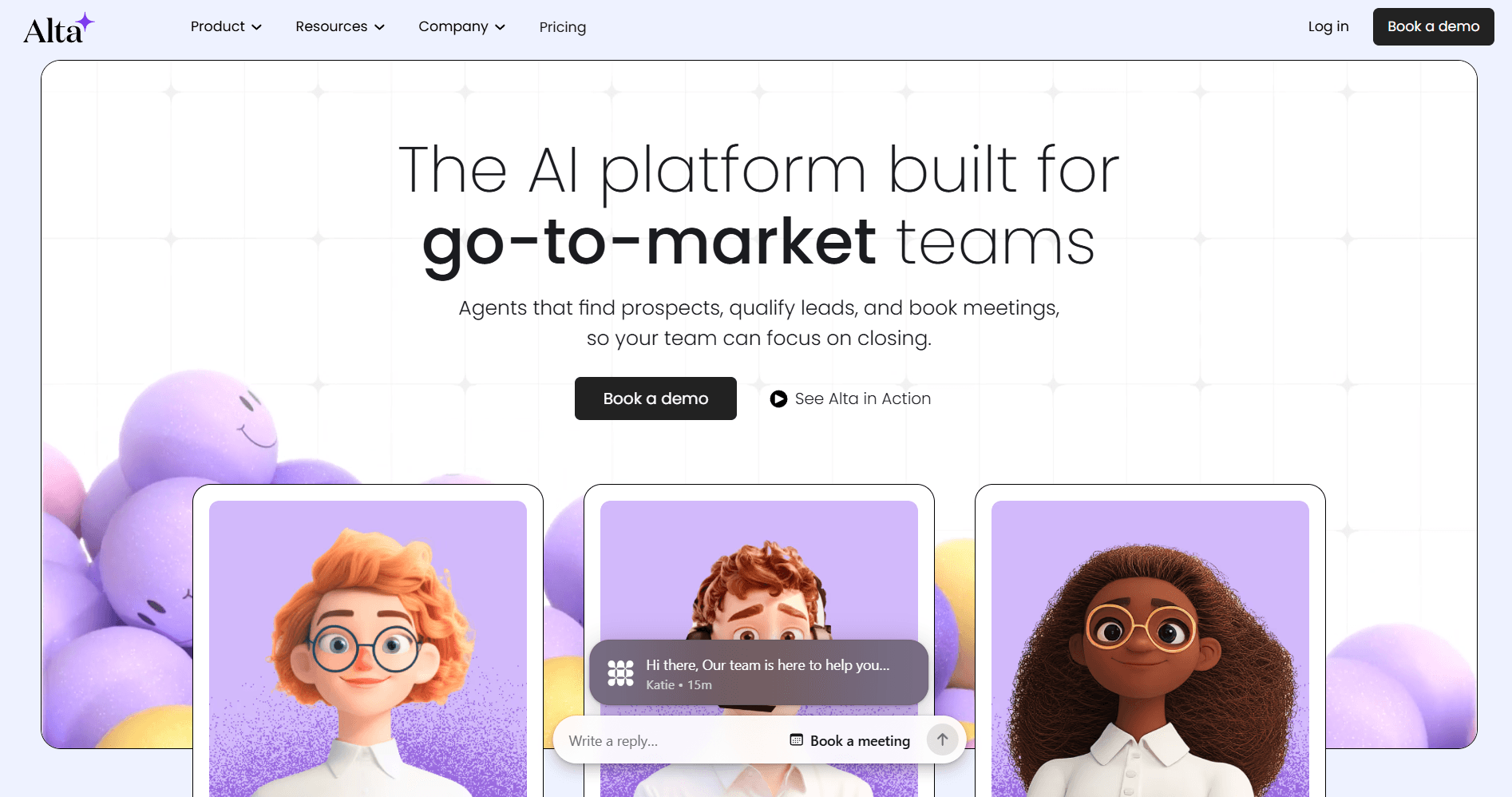
Alta positions itself as an "AI GTM System of Actions" with Katie, its SDR agent, plus integrated AI calling. It raised a $25 million Series A on July 8, 2026 and claims SOC 2 and ISO 27001 on its site, a stronger compliance posture than most young agents if verified. The product is young and the customer track record is thin, which is why it closes the list despite this posture.
Best for: teams that want voice outreach woven into an SDR agent from day one and accept an early-stage product.
Who should pick something else: buyers who need a large review base, a longer track record, or published pricing. Alta is quote-based.
What's the difference between inbound and outbound AI SDRs?
Inbound AI SDRs (Qualified's Piper, Agentforce SDR working CRM leads, Conversica on follow-up) respond to demand that already exists: website visitors, form fills, aging leads. Outbound AI SDRs create net-new pipeline by sourcing prospects, personalizing outreach, and starting conversations from zero. The skills barely overlap. Real-time visitor engagement is a different job from data sourcing, deliverability, and cold messaging, which is why most tools do one side well, not both. Artisan runs both on one platform: Ava creates outbound pipeline while Ava Inbound greets, qualifies, and books website visitors, answering from the same knowledge base and routing meetings to CRM owners (Ava Inbound is priced separately, so talk to sales for inbound pricing). For teams that would rather buy a dedicated specialist per side, Qualified remains the premium inbound-only pick for Salesforce-standardized enterprises, and the outbound-only comparison in our AI BDR guide goes deeper.
How autonomous are AI SDRs really?
Less than the marketing implies, and the honest vendors say so. The category spans a spectrum:
Assistive: the AI drafts and researches, humans send everything (Regie's philosophy, most copilots).
Semi-autonomous: the AI runs sequences but humans approve messages or handle all replies (how many teams run Jason AI or Duo).
Autonomous with control: the AI runs the whole loop while humans set escalation rules and audit (Artisan's model, with review-and-approve, objections-only replies, or full autonomy).
Instead of asking "is it autonomous?", ask "can I choose?" Artisan reports over 90% of customers run Ava autonomously while the rest approve from a task queue. Both patterns work, and teams typically start in review mode and loosen up after the first campaign. Be wary of tools that are either autonomous with no controls or "autonomous" in name while a human still does every step.
How much does an AI SDR cost compared to a human SDR?
A US human SDR costs over $60K base and $120K-200K fully loaded, takes 3-6 months to ramp, and stays roughly 14 months on average, so you often pay for 2 ramps every 2 years. AI SDR pricing in 2026 clusters in 3 bands: entry agents at $250-900/month (AiSDR, Salesforge), mid-tier at $1,500-3,000/month (Reply growth tiers), 11x's published Growth plan from $3,750/month (billed annually, ~$45K/yr), and contract-gated deals at $40K to over $100K/year (Qualified). Artisan is usage-based, so you pay per action performed rather than per seat and cost scales with output. Teams that use Ava report generating pipeline at roughly one-fifth the cost of a human BDR. One caveat is that an AI SDR replaces the repetitive top-of-funnel work, not the judgment of your best reps. The win is scaling pipeline without scaling headcount. For the wider toolset, see our roundup of SDR tools.
AI SDR vs. AI BDR: How the terms differ
In practice most vendors use the titles interchangeably, the way companies use SDR and BDR interchangeably for humans. Where the distinction is drawn, BDR means outbound pipeline generation specifically, while SDR lists (like this one) also include inbound and follow-up specialists. Artisan popularized "AI BDR" as the term for an agent that owns the entire outbound job. See what is an AI BDR for the definition, and our ranking of the 10 best AI BDRs, which evaluates only outbound-capable tools against a stricter "can it own the whole job?" bar. See also BDR tools.
What changed in the AI SDR category in 2025-2026
Salesforce absorbed the inbound leader. Its acquisition of Qualified closed April 1, 2026, folding Piper into Agentforce, announced by Salesforce and widely covered.
11x's turbulence. TechCrunch reported in March 2025 that 11x claimed customers it didn't have. Founder-CEO Hasan Sukkar stepped down to non-executive chairman in May 2025 and CTO Prabhav Jain took over.
Fresh capital kept flowing. Alta raised a $25 million Series A (July 8, 2026), Regie a $30M Series B (February 2025), Relevance AI $24M (May 2025), and Monaco, Sam Blond's still-in-public-beta AI revenue engine, a $50M Series B led by Benchmark (May 2026).
Pricing experiments accelerated. Salesforce moved Agentforce from $2/conversation to $0.10/action Flex Credits, and HubSpot introduced credit-based outcome pricing in April 2026 ($0.010 per credit). The category is drifting from seats toward usage and outcomes, the model Artisan launched with.
Conversica evaluated an IPO in Q4 2025, a maturity signal for conversational AI.
FAQ
What is the best AI SDR for startups and SMBs?
Artisan. Usage-based pricing with a free trial and no platform fee means a lean team pays for work performed rather than seats, and the autonomy dial means nobody has to babysit campaigns. You won't outgrow it either: the same platform is what enterprises run centrally from sales ops. If a fixed low price matters most, AiSDR ($250/month Solo) and Salesforge's Agent Frank ($499/month flat) are the strongest budget alternatives. Lean teams should weigh high-commit tools carefully: 11x publishes Growth from $3,750/month (billed annually), and Qualified stays quote-gated, where minimum spend starts near $40K/year.
What is the best autonomous AI SDR?
Artisan's Ava. It's the only platform here where full autonomy (sourcing, enrichment, writing, sending, replying, booking) is a supported default rather than a demo scenario, with plain-language escalation rules and an audit trail as the control layer. Artisan reports over 90% of customers run Ava autonomously. Salesforge's Agent Frank is autonomous within email. 11x claims full autonomy but offers less granular human-in-the-loop control.
Which AI SDR personalizes outreach using buying signals?
Artisan feeds signals directly into campaigns: funding rounds, executive hires, hiring surges, tech-stack and Bombora-powered topic intent, website visitor identification, champion job changes, and natural-language custom signals you define in plain English. Amplemarket and Alta also incorporate signals into targeting. The thing to test in a demo is whether a signal automatically triggers personalized outreach or just appears in a list a human has to act on.
Which AI SDR tools book the most meetings?
No credible cross-vendor benchmark exists. Every published number is vendor-reported, ours included. Directionally, Qualified's Piper is the established converter of existing website demand, while for net-new pipeline, Artisan customer SaaStr reports a 3.55% positive response rate, and Raise sourced over $700K of annual recurring revenue (ARR) in six months. Ask every vendor for meetings-per-month evidence from customers your size.
What is the best AI SDR for B2B sales teams?
For most B2B teams, mid-market through enterprise, Artisan. It consolidates data, enrichment, outreach, dialer, and deliverability into one system with native Salesforce and HubSpot sync, CRM owner mapping, and deal-based do-not-contact rules. Salesforce-standardized enterprises should also evaluate Agentforce SDR, and teams wedded to a human-run cadence motion should look at Regie. Our enterprise AI SDR guide covers governance requirements in depth. Teams that run HubSpot can also compare the best AI SDR for HubSpot users.
Can an AI SDR pass an enterprise security review?
Artisan is built for that review: SOC 2 Type II, SSO on Enterprise plans, per-field CRM sync controls, org-level do-not-contact, and an audit trail of every message and decision Ava makes, with a forward-deployed strategist and dedicated CSM supporting rollout. Among alternatives, Alta claims SOC 2 and ISO 27001, and Agentforce inherits Salesforce's compliance perimeter. Ask every vendor for their report, subprocessor list, and data-retention terms before piloting.
What is a digital AI SDR or AI SDR agent?
The terms are synonyms for the same product class: software agents that do sales development work (researching prospects, writing and sending outreach, answering replies, booking meetings) under whatever supervision you configure. "Digital worker," "AI sales agent," and "AI SDR agent" all describe the same thing. What varies is scope. Some agents draft only, some run sequences, and a few (Artisan's Ava) own the workflow end to end.
Do AI SDRs replace human SDRs?
The teams that see the best results use AI SDRs to scale pipeline without scaling headcount, not to swap out people. The AI absorbs the repetitive 40-60% of SDR hours that go to non-selling busywork (list building, research, first-touch writing, follow-up scheduling) while humans handle discovery, complex objections, and relationships. Escalation rules formalize the handoff: the AI works the top of the funnel and routes real conversations to reps.
What AI SDR tools generate qualified meetings, not just replies?
Qualification depends on two things: reply handling that asks qualifying questions, and booking that lands on the right rep's calendar. Artisan's Ava qualifies against your ideal customer profile (ICP) criteria, answers objections from a knowledge base, and books meetings directly on reps' calendars with CRM owner mapping. Qualified's Piper qualifies inbound visitors in real time. Conversica is strong at qualifying aging leads. Volume senders that stop at "positive reply detected" leave qualification to you.
Put an AI SDR to work
The fastest way to evaluate the category is to run one. Meet Ava, start a free trial at artisan.co, and see pricing. It's usage-based, so you pay for the work she does, not for seats.
Related reading
Jaspar Carmichael-Jack
Co-Founder & CEO @ Artisan
Jaspar is an entrepreneur with expertise in sales, marketing, and operations. He founded Artisan in 2023, a company automating workflows with AI employees.