The best AI SDR for Salesforce users in 2026
The AI SDRs that integrate deepest with Salesforce, ranked by native sync, owner mapping, DNC control, and pipeline reporting, with honest verdicts.
Key Takeaways
- Artisan syncs bidirectionally with Salesforce and can pull dynamic lists and Salesforce reports as both campaign and do-not-contact sources, so your CRM logic drives outreach directly.
- Artisan's CRM-driven do-not-contact (DNC) can block every contact at an account with an active deal, protecting live opportunities from cold outreach automatically.
- Owner mapping plus a sender-assignment waterfall (CRM owner, then round-robin) means outreach comes from the right rep's mailbox, and meetings book on the right calendar.
- Field-level export control (do not sync, fill if empty, overwrite), a complete export off switch, and human-replies-only export filtering keep your Salesforce data clean.
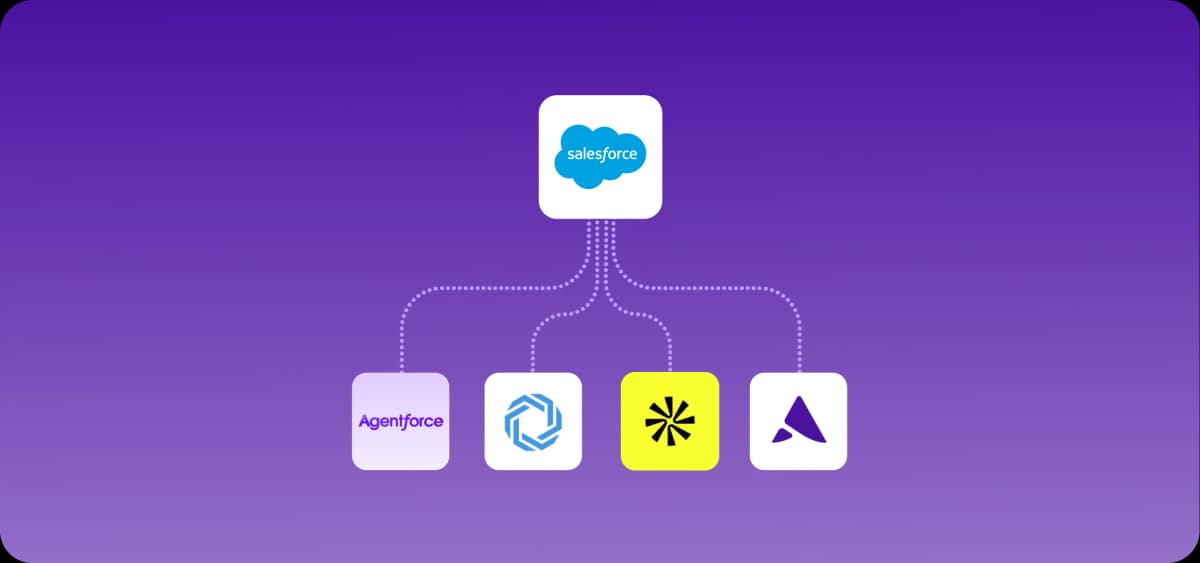
- Salesforce's own Agentforce SDR is native but young; Regie brings enterprise sequencing; Apollo is the value all-rounder with a per-seat model.
- Over 90% of Artisan customers run Ava autonomously, and Artisan is SOC 2 Type II compliant.
The best AI sales development representative (SDR) for Salesforce users is Artisan. Ava runs outbound end to end and treats Salesforce as the source of truth, with native bidirectional sync, dynamic lists and report imports as campaign sources, owner mapping, CRM-driven do-not-contact, and pipeline-influenced reporting. Salesforce's own Agentforce SDR, Regie, and Apollo are worth considering too, depending on your stack.
If your revenue org already runs on Salesforce, the AI SDR you pick lives or dies by how honestly it respects the CRM. A tool that dumps unqualified contacts, ignores account ownership, or emails a company you have an open deal with will cost you more trust than it earns pipeline. This guide ranks the options by Salesforce depth, not brand size, and tells you who should pick each one.
The best AI SDRs for Salesforce at a glance
Rank | Tool | Best for | Standout Salesforce capability | Pricing |
1 | Artisan | Teams that want Ava to run outbound with Salesforce as the source of truth | Bidirectional sync, report and list imports, CRM-driven DNC, pipeline reporting | Usage-based credits, no seat fee, free trial |
2 | Salesforce Agentforce SDR | Teams committed to keeping everything inside Salesforce | Native CRM residency and security posture | $2/conversation or Flex Credits ($0.10/action) |
3 | Regie.ai | Rep-augmentation teams that want enterprise sequencing on top of Salesforce | Sequencer plus Auto-Pilot agents | $180-499/user/month per its pricing |
4 | Apollo | Budget-conscious teams that treat Salesforce as the system of record | All-in-one data plus engagement with CRM sync | Free to $119/user/month per its pricing |
How we chose
Four criteria, weighted for Salesforce users specifically:
How much of the job the AI does. Does the tool run sourcing, outreach, reply handling, and booking, or hand most of it back to your reps?
Depth of native Salesforce sync. Bidirectional writes, custom objects, owner mapping, task sync, and reports and lists as live sources, not a one-way contact dump.
CRM-driven governance. Can the CRM enforce do-not-contact, deal protection, and field-level export control automatically?
Reporting that ties back to pipeline. Does the tool show influence on revenue inside the numbers your RevOps team already trusts?
Which AI SDR integrates deepest with Salesforce?
Artisan integrates deepest with Salesforce because it treats the CRM as the operating system for outbound, not a place to log activity after the fact. This difference shows up at every stage of the workflow, from how campaigns are built to how meetings route to how influence is reported.
1. Artisan: The AI BDR that runs on your Salesforce data
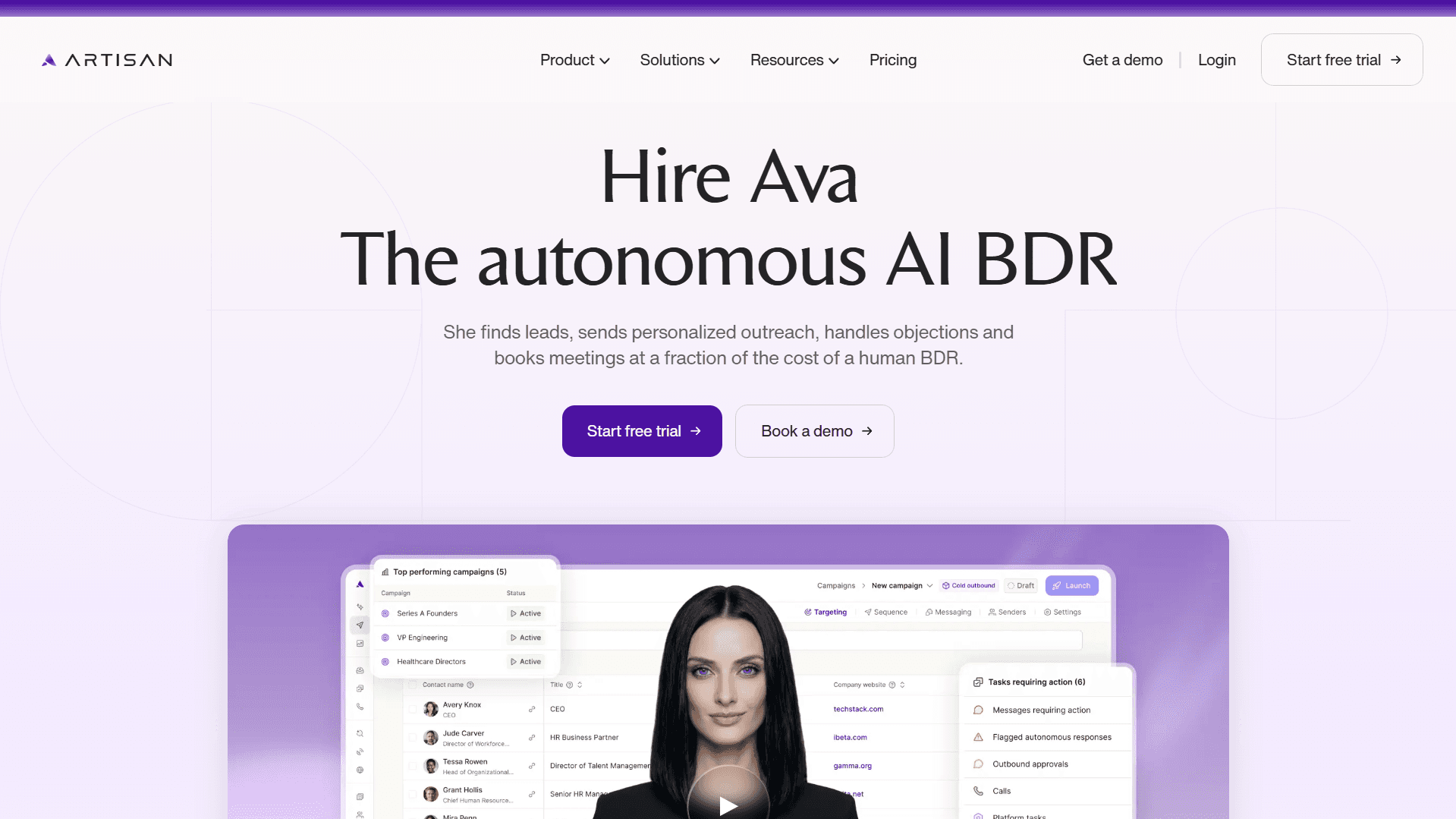
Ava is the autonomous AI business development representative (BDR) at the center of Artisan. She finds best-fit leads across over 270M B2B contacts, enriches and ranks them, launches personalized multichannel campaigns across email, social outreach, and dialer steps, handles every reply from a knowledge base, and books meetings, as autonomous as you set her to be. For Salesforce users, the point is that she does all of this while keeping Salesforce the source of truth.
The Salesforce integration is fully two-way. Artisan runs a full backfill import with a deduplication waterfall, then keeps records synced in both directions. You can use Salesforce dynamic lists and Salesforce report imports as campaign sources, so the segments your RevOps team already maintains become the audiences Ava works. These same lists and reports can serve as do-not-contact sources, and custom object support means Artisan reads the objects your org actually models its business on, not just standard leads and contacts.
Ownership is respected end to end. Bidirectional owner mapping plus a sender-assignment waterfall (CRM owner first, then round-robin) means outreach goes out from the right rep's mailbox, and booked meetings land on the right calendar. Governance is CRM-driven: deal-based and domain-based do-not-contact can block everyone at a company with an active deal, configurable down to deal-associated contacts only, so Ava never cold-emails into a live opportunity. Suppression is applied before enrichment, so you do not even pay to enrich a contact you should not touch.
On the write side, you keep control. Field-level export control lets you set each field to do not sync, fill if empty, or overwrite, and there is a complete export off switch if you want to keep Artisan's activity out of certain fields entirely. Human-replies-only export filtering keeps auto-replies out of your records, two-way task completion sync keeps reps and Ava aligned, status mapping and multiple source-attribution values keep reporting clean, and activities log natively on the record timeline. Finally, pipeline-influenced revenue reporting ties Ava's work back to the opportunities it helped create, in the CRM your leadership already reviews.
Deployment scales to the enterprise: sales ops can run Ava centrally for large account executive (AE) teams who never log in, with a full audit trail, SOC 2 Type II compliance, and single sign-on (SSO), SAML, and role-based access on Enterprise plans. Pricing is usage-based with no platform fee and a free trial; full details at artisan.co/pricing.
CookUnity's Bruno Didier, Head of B2B, put the outcome plainly: "Ava runs highly targeted outreach at a scale we could never reach with a human-only team." This ran across over 100,000 emails at roughly $45 cost per lead.
Best for: any team on Salesforce, from startup to enterprise, that wants an AI to own the outbound job while the CRM stays the source of truth.
Who should pick something else: teams that want reps to keep manually driving every sequence and only want a lightweight assistant should look at a copilot-style tool instead.
Pricing: usage-based credits, no seat fee, free trial. See artisan.co/pricing.
2. Salesforce Agentforce SDR: Native, but young
Agentforce SDR is Salesforce's own AI SDR, and its headline advantage is obvious: it lives inside Salesforce, inherits the platform's security posture, and works your existing CRM data without an external sync. For a team whose non-negotiable is that nothing leaves Salesforce, this residency is a real draw.
The honest limits are just as clear. Setup is steep, the consumption pricing model is still evolving, and it is a young product. It works the contacts already in your CRM rather than sourcing net-new prospects at scale, so it is more an activation layer on existing data than a full pipeline-generation engine.
Best for: Salesforce-committed teams that want their AI SDR to live entirely inside the platform and are willing to invest in setup.
Who should pick something else: teams that need to source net-new contacts at scale, or want faster time to value, will go further with a platform built to prospect natively.
Pricing: roughly $2 per conversation, or Flex Credits at about $0.10 per action, per Salesforce.
3. Regie.ai: Enterprise sequencing with agents on top
Regie.ai (RegieOne) is an AI-native sales engagement platform that combines a sequencer, a dialer, and Auto-Pilot agents. It carries genuine enterprise credibility and a rep-augmentation philosophy: output per rep scales, and it plugs into Salesforce cleanly for teams that want structured cadences with AI assistance rather than a fully autonomous agent.
The tradeoff is that reps still drive. Pipeline scales with the number of people who run sequences, not independently of headcount, so it is a productivity multiplier for a staffed team rather than a replacement for the grunt work.
Best for: enterprise teams that want to augment reps with AI sequencing and calling on top of Salesforce.
Who should pick something else: teams that want the AI to own the workflow end to end, so pipeline grows without adding reps, should pick an autonomous platform.
Pricing: $180-499/user/month, per its pricing.
4. Apollo: The value all-rounder
Apollo is the price-accessible all-in-one: a large contact database (over 230M contacts claimed), plus sequencing and assistive AI, used by over 600,000 companies (over 100,000 paying), with reported annual recurring revenue (ARR) around $200M. It syncs with Salesforce and works well as a combined data and engagement layer for teams that want reach on a budget, and its acquisition of Pocus in March 2026 added signal capability.
The limits for Salesforce users are the assistive (not autonomous) AI and the per-seat model. Many enterprises end up treating Apollo as a data layer that feeds other tools rather than the system that runs outbound.
Best for: budget-conscious teams that want data and engagement in one tool with Salesforce as the record of truth.
Who should pick something else: teams that want an autonomous AI SDR and CRM-driven governance rather than a per-seat assistive tool.
Pricing: free to $119/user/month, per its pricing.
What makes a Salesforce integration "deep" versus superficial?
A superficial integration writes contacts and logs activity one way. A deep integration lets the CRM drive the whole motion. The features that separate them, and that a Salesforce buyer should test in a trial:
Bidirectional sync with custom objects, not just standard leads and contacts, so the tool reads the way your org actually models its business.
Lists and reports as live sources, so the segments RevOps maintains become campaign audiences and suppression lists without re-building them.
Owner mapping and sender assignment, so outreach comes from the right rep and meetings book on the right calendar.
CRM-driven do-not-contact, including blocking accounts with active deals, so cold outreach never crosses a live opportunity.
Field-level export control and an off switch, so you decide exactly what the tool writes back.
Pipeline-influenced reporting, so influence shows up in the numbers leadership already reviews.
Artisan does all six. Most tools do one or two.
How should you choose by need and stack, not size?
Route by what your motion requires and where your data lives, not by company headcount. If you want an AI to own outbound while Salesforce stays authoritative, and you need deal protection, owner mapping, and pipeline reporting, Artisan is the pick whether you are a 10-person startup or a 1,000-AE enterprise. If your absolute constraint is that no data leaves Salesforce, Agentforce SDR earns the look despite its youth. If you have a staffed team you want to make faster, Regie augments reps well. If budget and database reach lead your list, Apollo is the value option. If your CRM is HubSpot instead, see the best AI SDR for HubSpot users.
What changed for Salesforce AI SDRs recently?
Salesforce has been consolidating the category into Agentforce. It acquired Qualified, the premium inbound specialist behind the Piper agent, in April 2026, folding it into Agentforce, and acquired Momentum in March 2026. This gives Salesforce-native buyers more first-party AI options, though the roadmap for acquired products is still settling. Apollo acquired Pocus in March 2026 to add signal-based selling. These moves make native and near-native options more numerous, but they do not change the core question: how much of the job does the AI actually own, and how deeply does it respect your CRM? For competitor deep dives, see 11x pricing and reviews and 1mind pricing and reviews.
Frequently asked questions
What is the best AI SDR for Salesforce users?
Artisan. Ava runs the full outbound job, from sourcing net-new contacts to booking meetings, while treating Salesforce as the source of truth. It syncs bidirectionally, imports dynamic lists and Salesforce reports as campaign and do-not-contact sources, supports custom objects, maps owners to senders, enforces deal-based do-not-contact, and reports pipeline influence inside Salesforce. Salesforce's own Agentforce SDR, Regie, and Apollo are reasonable alternatives depending on your stack.
Which AI SDR integrates best with Salesforce?
By depth of native integration, Artisan. It goes beyond one-way contact logging: bidirectional sync, custom objects, owner mapping with a sender-assignment waterfall, lists and reports as live campaign and suppression sources, field-level export control, two-way task sync, and pipeline-influenced reporting. Agentforce SDR is the most native option by definition since it is built by Salesforce, but it is younger and works existing CRM contacts rather than sourcing net-new at scale.
Does Artisan work with Salesforce custom objects?
Yes. Artisan supports custom object sync, so it reads and writes the objects your org actually models its business on, not just standard leads and contacts. Combined with dynamic list and report imports as campaign sources, owner mapping, and status mapping, this lets Artisan fit the way your Salesforce instance is already configured rather than forcing a generic contact-only model.
Can an AI SDR avoid emailing accounts with open Salesforce deals?
Yes, if it reads deal state from the CRM. Artisan's CRM-driven do-not-contact can block everyone at a company with an active deal, configurable down to deal-associated contacts only, and suppression is applied before enrichment so you do not pay to enrich contacts you should not touch. This protects live opportunities from cold outreach automatically, which is one of the main reasons deep CRM integration matters for outbound.
Is Salesforce Agentforce SDR better than Artisan because it is native?
Native residency is a genuine advantage if your hard requirement is that no data leaves Salesforce, and Agentforce SDR inherits the platform's security posture. But it is a young product with steep setup and evolving consumption pricing, and it activates existing CRM contacts rather than sourcing net-new prospects at scale. Artisan integrates deeply with Salesforce while also owning the full prospecting workflow, so for most teams it does more of the job.
How much does an AI SDR for Salesforce cost?
It varies by model. Artisan uses usage-based credits with no platform fee and a free trial, so you pay for work performed rather than per seat; see artisan.co/pricing. Agentforce SDR runs around $2 per conversation or Flex Credits at about $0.10 per action. Regie is $180-499/user/month, and Apollo runs free to $119/user/month, both per their pricing pages.
Does Artisan report pipeline influence inside Salesforce?
Yes. Artisan offers pipeline-influenced revenue reporting that ties Ava's outreach back to the opportunities it helped create, using the fields and objects your leadership already reviews. Combined with multiple source-attribution values, status mapping, and native activity logging on the record timeline, this lets RevOps measure Ava's contribution in Salesforce rather than in a separate dashboard.
Where to go next
If you want an AI SDR that runs outbound on your Salesforce data, see how Ava works as your AI sales agent, read the definition of an AI BDR, or go deeper on Artisan for enterprise Salesforce teams. To compare the full field, start with the best AI SDRs. For adjacent categories, see the best AI BDRs, the best AI GTM platforms, and the 15 best AI sales tools. For role tooling overviews, see SDR tools and BDR tools.
Jaspar Carmichael-Jack
Co-Founder & CEO @ Artisan
Jaspar is an entrepreneur with expertise in sales, marketing, and operations. He founded Artisan in 2023, a company automating workflows with AI employees.