11x pricing and reviews (2026)
What 11x costs in 2026, from the $3,750/mo Growth plan to custom Pro and Enterprise tiers, plus honest review themes and who it fits.
Key Takeaways
- 11x's Growth plan starts at $3,750 per month billed annually (about $45K per year), a figure the company only recently made public; Pro and Enterprise remain custom and quote-driven.
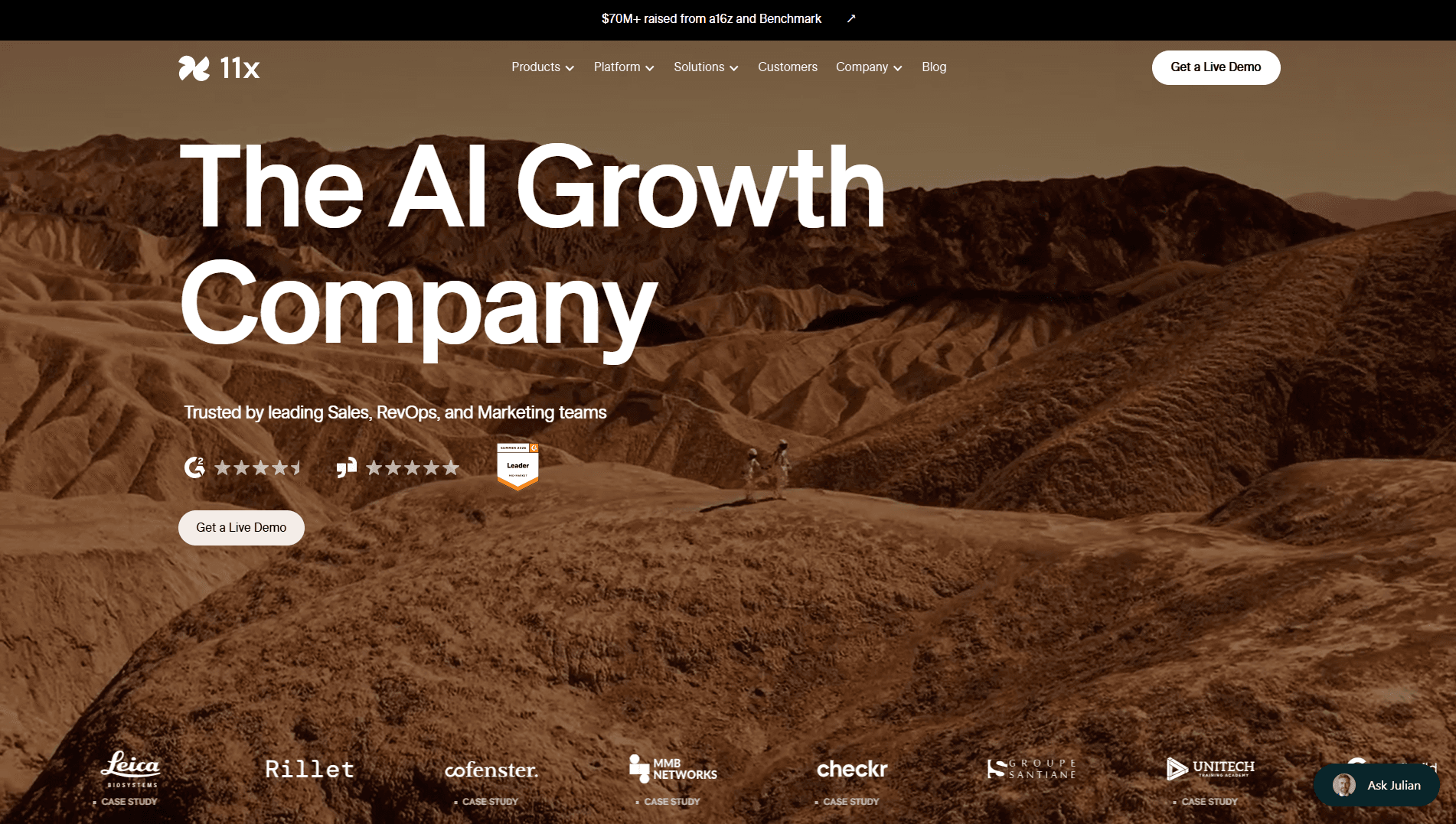
- The platform centers on two agents: Alice, an AI SDR that runs multichannel outbound, and Julian, an AI phone agent.
- 11x has raised roughly $74M, with a $24M Series A led by Benchmark and a $50M Series B led by a16z.
- Reviewers report that setup takes time and that deliverability and CRM synchronization can require hands-on management.
- TechCrunch reported on March 24, 2025 that 11x had listed customers it could not support, and founder-CEO Hasan Sukkar stepped down on May 5, 2025, and CTO Prabhav Jain became CEO.
- The pricing and contract shape read as lower mid-market sold through enterprise-style annual commitments, not a self-serve tool.
11x now publishes a starting price: its Growth plan begins at $3,750 per month billed annually, roughly $45K a year, with Pro and Enterprise quoted custom. That buys Alice, its AI SDR (sales development representative), plus optional access to Julian, its AI phone agent. Reviewers report strong multichannel automation but recurring deliverability and CRM-sync friction, and the company carries a bumpy public record.
How much does 11x cost in 2026?
11x's Growth plan starts at $3,750 per month, billed annually, which comes to about $45K for the year. Pro and Enterprise are not published; the company quotes them based on volume and team size, so you request pricing through sales. For most of its history 11x kept all pricing gated at a reported figure near $5K per month, so the public Growth number is a recent change.
Plan | Price | Billing | What it covers |
Growth | From $3,750/mo (about $45K/yr) | Annual | Alice AI SDR, multichannel outbound, core integrations |
Pro | Custom, contact sales | Annual (estimate) | Higher volume, added seats and configuration |
Enterprise | Custom, contact sales | Annual (estimate) | Security review, custom volume, dedicated support |
Julian (AI phone agent) | Custom, contact sales | Annual (estimate) | AI phone calling, added to a base plan |
Pricing is current as of 2026 and reflects 11x's published Growth figure; the custom tiers are estimates because 11x does not disclose them. Treat any Pro or Enterprise number you see quoted elsewhere as a rough guide until 11x confirms it for your team.
What does 11x actually cost in practice?
The sticker price is just the floor. Because Growth is billed annually, the real commitment is a full year, paid up front or on an annual contract. Buyers weighing 11x should account for a few things beyond the base fee.
First, there is onboarding. Reviewers report that making Alice productive takes setup work, so the first several weeks go to ramp-up before pipeline appears. Second, there is the phone agent. Julian is a separate capability, and if calling is part of your motion, expect that to change the quote. Third, there is data and volume. An AI SDR is only as good as the contacts and signals feeding it, and higher volumes push you toward the custom tiers. Fourth, there is the annual lock-in itself. A yearly commitment on a category that is still maturing carries more risk than a month-to-month tool, which is worth weighing if you are testing whether an AI SDR fits your team at all.
What do reviewers say about 11x?
Reviewers report a split picture. On the positive side, they credit 11x with genuine multichannel automation: Alice can research prospects, draft outbound across email and social channels, and keep sequences running with little day-to-day input, and Julian extends that into AI phone calls. Teams that want an agent to own the mechanical parts of outbound tend to like the breadth.
The complaints cluster around execution. Reviewers report deliverability problems, where sends do not land as expected, and CRM-sync issues, where records and activity do not flow cleanly back into Salesforce or HubSpot. Several note that message quality needs oversight and that the tool rewards a hands-on operator rather than running fully hands-off. Setup time comes up often.
The company's public record is part of any honest review. TechCrunch reported on March 24, 2025 that 11x had listed customers it could not support, a story worth reading before you sign. Weeks later, on May 5, 2025, founder-CEO Hasan Sukkar stepped down to a non-executive chairman role and CTO Prabhav Jain became CEO. Leadership changes are normal in fast-moving startups, but paired with the reporting, they are context a buyer should have.
Who is 11x best for, and who should look elsewhere?
11x fits a lower mid-market team that wants a multichannel AI SDR and is comfortable signing an annual contract sold through a sales conversation. If Alice and Julian match your channel mix and you have someone to manage deliverability and CRM hygiene, the platform can automate a lot of outbound motion.
It is a weaker fit if you need self-serve, month-to-month flexibility, or a light footprint to test the category before committing. Despite the enterprise-style contracts, 11x is not an enterprise governance platform; buyers who need deep audit trails, granular autonomy controls, and a hardened security posture should scrutinize those areas closely. And any team burned by deliverability or CRM-sync issues in the past should ask pointed questions and request a proof-of-concept before the annual signature.
Is 11x worth it, or is there a better-value option?
11x is worth it for the specific buyer above, but the value question turns on how much of the outbound job the tool actually removes from your team versus how much oversight it demands. If reviewers are spending real hours managing deliverability, CRM sync, and message quality, the effective cost is higher than $45K a year.
That total-ownership lens is where it helps to look at how Artisan approaches the same job. Artisan's AI BDR (business development representative), Ava, owns the outbound workflow end to end: she finds best-fit leads from a database of over 270M B2B contacts and over 130M local businesses, enriches them with waterfall email and phone enrichment that charges only on success, writes and sends personalized multichannel campaigns across email, social, and dialer steps, handles replies from a knowledge base, and books meetings on the right rep's calendar. Artisan reports that over 90% of its customers run Ava fully autonomously, on a dial that ranges from review-and-approve to hands-off, with plain-language escalation rules and a full audit trail.
The commercial model is different too. Artisan uses usage-based credits, so you pay for work performed rather than a per-seat or fixed annual platform fee, and there is a free trial. The consolidation angle matters for the cost math: instead of an AI SDR plus a separate data tool, a dialer, and deliverability tooling, the stack lives in one place. If you are comparing 11x's annual commitment against alternatives, it is worth pricing Artisan's usage-based model beside it. For a fuller picture of the category, our guide to AI BDRs breaks down how these agents differ. For the broader go-to-market (GTM) landscape, see the best AI GTM platforms and how to build a fully automated outbound sales system.
Frequently asked questions
How much does 11x cost per month?
11x's Growth plan starts at $3,750 per month, billed annually, which works out to about $45K per year. Pro and Enterprise tiers are custom and quoted by 11x's sales team based on volume and seats, so there is no public monthly figure for them as of 2026. Julian, the AI phone agent, is priced on top of a base plan.
Is 11x expensive?
For a lower mid-market team, $45K a year is a meaningful commitment, especially on an annual contract. Whether it is expensive depends on how much outbound work Alice removes without oversight. Reviewers report time spent managing deliverability and CRM sync, so factor that labor into the real cost rather than judging the base fee alone.
Does 11x have transparent pricing?
Partly. 11x recently made its Growth starting price public at $3,750 per month, a change from years of fully gated pricing reportedly near $5K per month. Pro and Enterprise are still custom and require a sales conversation, so full transparency stops at the entry tier.
What are the main complaints about 11x?
Reviewers report deliverability problems, CRM-sync issues, and setup time, along with a need to supervise message quality rather than running the tool hands-off. Separately, TechCrunch reported in March 2025 that 11x had listed customers it could not support, and the founder-CEO stepped down that May, which buyers often raise as context.
What does 11x's pricing include?
The Growth plan includes Alice, the AI SDR, running multichannel outbound across email and social channels, plus core integrations. Julian, the AI phone agent, is a separate capability priced on top. Higher volumes, added seats, and enterprise security or support move you into the custom Pro and Enterprise tiers.
What are the alternatives to 11x?
Alternatives range from transparent-priced AI SDRs like AiSDR to autonomous platforms like Artisan, whose AI BDR Ava owns the full outbound workflow on a usage-based model rather than a fixed annual fee. The right choice depends on whether you want a tool your reps run or an AI employee that owns the job. See our AI sales agent overview to compare approaches. For direct comparisons, see Artisan vs 11x, the best 11x alternatives, and the best Artisan alternatives.
Related reading
Jaspar Carmichael-Jack
Co-Founder & CEO @ Artisan
Jaspar is an entrepreneur with expertise in sales, marketing, and operations. He founded Artisan in 2023, a company automating workflows with AI employees.