The best Artisan alternatives in 2026
The real Artisan alternatives compared, with honest best-for verdicts, what each one gives up, and who should pick something else.
Key Takeaways
- The other tools each cover part of the job: AiSDR and 11x run agent-led email, Apollo and Clay are data and enrichment, Amplemarket and Regie.ai augment reps. Artisan's Ava runs sourcing, outreach, replies, and booking end to end.
- Artisan carries a database of over 270M B2B contacts plus over 130M local businesses (over 400M total), so you source net-new pipeline instead of only working a list you already own.
- Artisan's dialer is $67/seat/month with unlimited minutes, roughly a third of what dedicated parallel dialers charge at over $200-300 per user.
- Artisan runs inbound and outbound as one AI SDR (sales development representative) on one knowledge base, so a website visitor who does not book is followed up automatically.
- Over 90% of Artisan customers run Ava autonomously, with a control dial from review-and-approve to full autonomy and a complete audit trail.
- SaaStr achieved a 3.55% positive response rate after moving its outbound to Ava.
If you are comparing Artisan to alternatives, the honest shortlist is AiSDR, Apollo, Clay, Amplemarket, Regie.ai, and 11x. Each is good at a slice of the job. The reason most teams that evaluate this stay with Artisan is that its AI BDR (business development representative) Ava owns the whole outbound motion, inbound included, on one platform rather than one step of it.
Why do people look for Artisan alternatives?
It usually comes down to one of three reasons: budget scoping, stack politics, or wanting a single narrow feature. Some teams want a cheaper published entry price and land on AiSDR or Apollo. Some already run Clay or a data tool and want to see whether they can stitch a motion together themselves. Others are handed a mandate to stay inside Salesforce or HubSpot and go looking for a native agent. All of these are fair reasons to shop around, and this page treats every alternative on its merits. For CRM-specific picks, see the best AI SDR for HubSpot users and the best AI SDR for Salesforce users.
The pattern worth naming is that most of these tools solve a piece of the outbound job, not the job. A data provider gives you contacts but not the outreach, a sequencer sends emails but does not source or reply, and a copilot makes a rep faster without removing the work. Artisan's pitch is the opposite: one AI employee owns the loop from finding a lead to booking a meeting, as hands-off or hands-on as you set it. If you want this, the alternatives below give something up to get their strength. This page says exactly what.
The best Artisan alternatives, compared
Rank | Tool | Best for | Standout | Public pricing |
1 | Artisan | Owning the full outbound and inbound job on one platform | Ava runs sourcing to booking autonomously | Usage-based credits, no platform fee; dialer $67/seat (pricing) |
2 | AiSDR | SMB teams that want transparent pricing fast | Published tiers, quick setup | $250-$2,500/mo per its site |
3 | Apollo | Price-accessible data plus assistive outreach | over 230M contacts in an all-in-one | Free-$119/user/mo (annual) |
4 | Clay | GTM teams with an operator to run enrichment | over 150 enrichment providers, Claygent | Free; ~$167 to over $446/mo |
5 | Amplemarket | Signal-based selling with a human in the loop | Data plus Duo copilot | $600/mo entry (two users) |
6 | Regie.ai | Rep augmentation on a modern engagement stack | Sequencer, dialer, Auto-Pilot agents | $180-$499/user/mo per its site |
7 | 11x | Teams that want an agent-led email challenger | Alice plus an AI phone agent | Growth from $3,750/mo (annual) |
How we chose
Four tests, in order. How much of the job the AI actually does (a full BDR, or one slice like drafting or dialing). Data and signal depth (can it source net-new leads, not just work a list you own). Pricing transparency (published and usage-based, or gated and per-seat). And deployment fit (does it carry the governance, security, and CRM depth a large team needs). Every entry receives a best-for verdict and a who-should-pick-else line, Artisan included, because a page that only flatters one tool does not earn anyone's trust.
1. Artisan: The AI BDR that owns the whole job
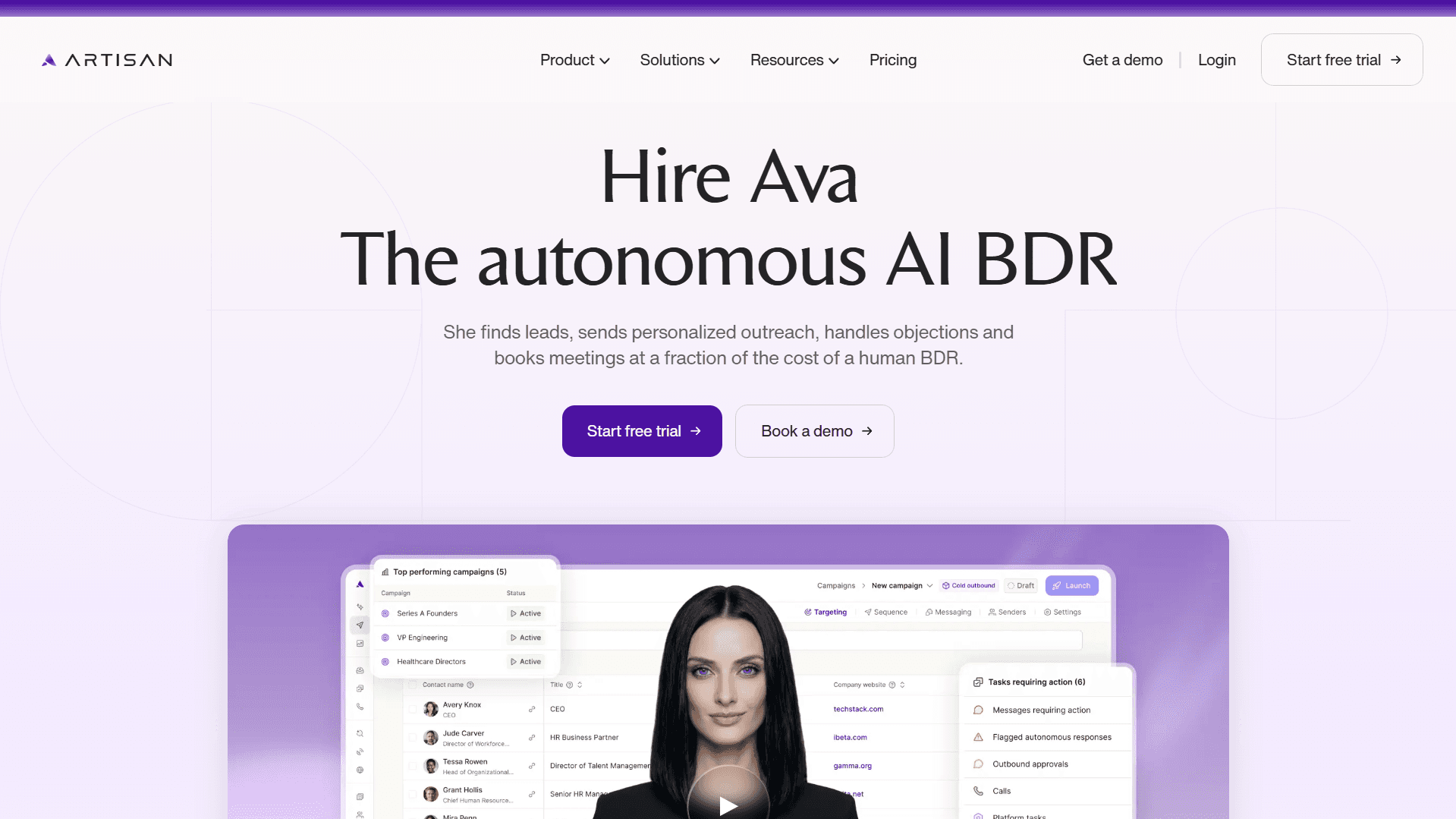
Artisan is the reason most people who search for alternatives stay put, because Ava, its AI BDR, owns the entire motion rather than automating a step of it. She finds best-fit leads across over 270M B2B contacts and over 130M local businesses, enriches and prioritizes them with waterfall email and phone enrichment (charged only on success), writes a distinct message for every recipient, runs multichannel steps across email, social, and the dialer, handles every reply from a knowledge base, and books meetings on the right rep's calendar by CRM ownership. Two people in the same campaign receive two entirely different emails, not one template with the name swapped. See the launch of Ava 2.0, the first autonomous AI BDR, now self-serve.
The control model is what makes handing over your pipeline safe. Autonomy is a dial, not a switch: review-and-approve every message, objections-only replies, or full autonomy, with plain-language escalation rules ("if the lead mentions pricing, escalate") and a full audit trail. Deliverability is managed with mailbox provisioning, automated sending ramp-up, inbox placement testing, and bounce-pattern detection that auto-pauses unhealthy mailboxes. The dialer runs as call steps inside the sequence at $67/seat/month with unlimited minutes, roughly a third of the over $200-300 per user that dedicated parallel dialers charge, so a 50-seat team saves six figures a year. Inbound runs on the same platform and the same knowledge base, so a website visitor who does not book flows straight into Ava's outreach.
The economics run the other way from a per-seat license. Pricing is usage-based credits with no platform fee, so a large team's cost stays flat as it scales, and the Enterprise plan adds a forward-deployed strategist, a dedicated customer success manager (CSM), and audit logs. Artisan is SOC 2 Type II compliant, with single sign-on (SSO) and SAML on Enterprise plans. Over 90% of customers run Ava autonomously. SaaStr achieved a 3.55% positive response rate, and Jason Lemkin said the AI emails were "actually better than what our humans produced. Consistently better." Artisan has raised over $35M from investors including Y Combinator and HubSpot Ventures. Read more on Artisan's seed round and Series A.
Best for: teams from startup through enterprise that want the full outbound and inbound job owned, with governance and CRM depth built in. Who should pick something else: teams that need only one narrow feature (say, a raw data export or a drafting assistant for reps who run everything themselves) and do not want a platform. Pricing: usage-based credits, no platform fee, free trial; dialer $67/seat. See Artisan pricing.
2. AiSDR: Transparent pricing, fast setup
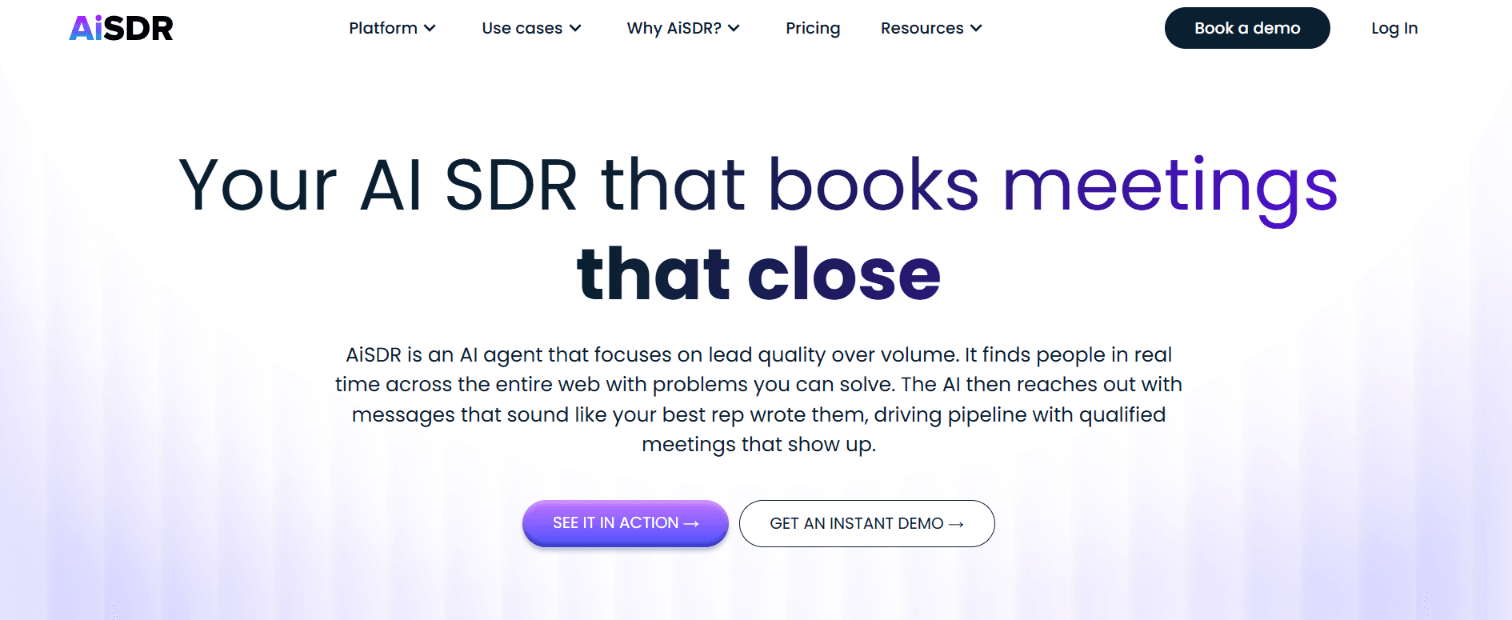
AiSDR is the cleanest alternative if what you want is a published price and a fast start. Its tiers are public ($250, $900, and $2,500 a month per its site), setup is quick, and it covers outbound and inbound with an "Ami" strategist agent. For an SMB or lower mid-market team that wants to see the number, sign up, and go, this transparency is the appeal, and it is a real one.
What it gives up is depth at scale. AiSDR's center of gravity is SMB, and the enterprise governance story (deep CRM controls, central-ops deployment for large account executive (AE) teams, audit depth) is thinner than a big org needs. It is an honest tool a growing team can outgrow.
Best for: SMB and lower mid-market teams that value transparent pricing and speed. Who should pick something else: large orgs that need central ops, deep CRM controls, and a heavier audit trail. Pricing: $250-$2,500/mo per its site.
3. Apollo: Value data with assistive outreach
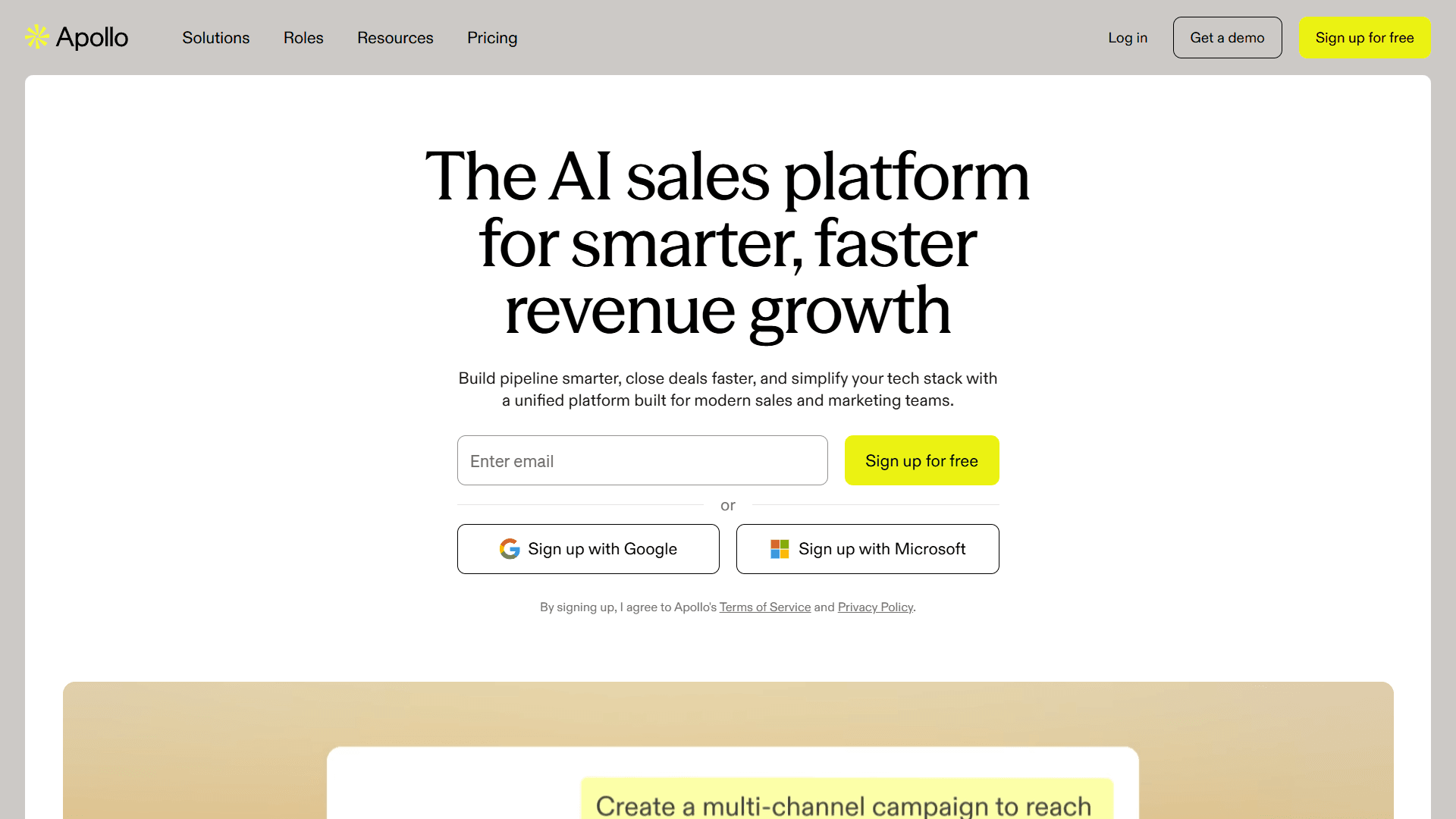
Apollo is the value pick, and a strong one. It pairs a large database (over 230M contacts claimed) with an all-in-one workspace at an accessible price (free through $119/user/month on annual billing), and it serves over 600,000 companies. It acquired Pocus in March 2026 and reports approaching $200M ARR. If your priority is affordable data with basic sequencing attached, Apollo is hard to beat on price.
What it gives up is autonomy. Apollo's AI is assistive, the model is per-seat, and larger orgs tend to treat it as a data layer that feeds other tools rather than an engine that runs the motion. You still target, write, and reply. This is the line between a workspace and a worker.
Best for: cost-conscious teams that want a big database and light outreach in one place. Who should pick something else: teams that want the outreach and reply handling owned, not assisted, and pipeline that scales without more seats. Pricing: free-$119/user/mo (annual, three-seat minimum); Enterprise custom.
4. Clay: The enrichment workbench
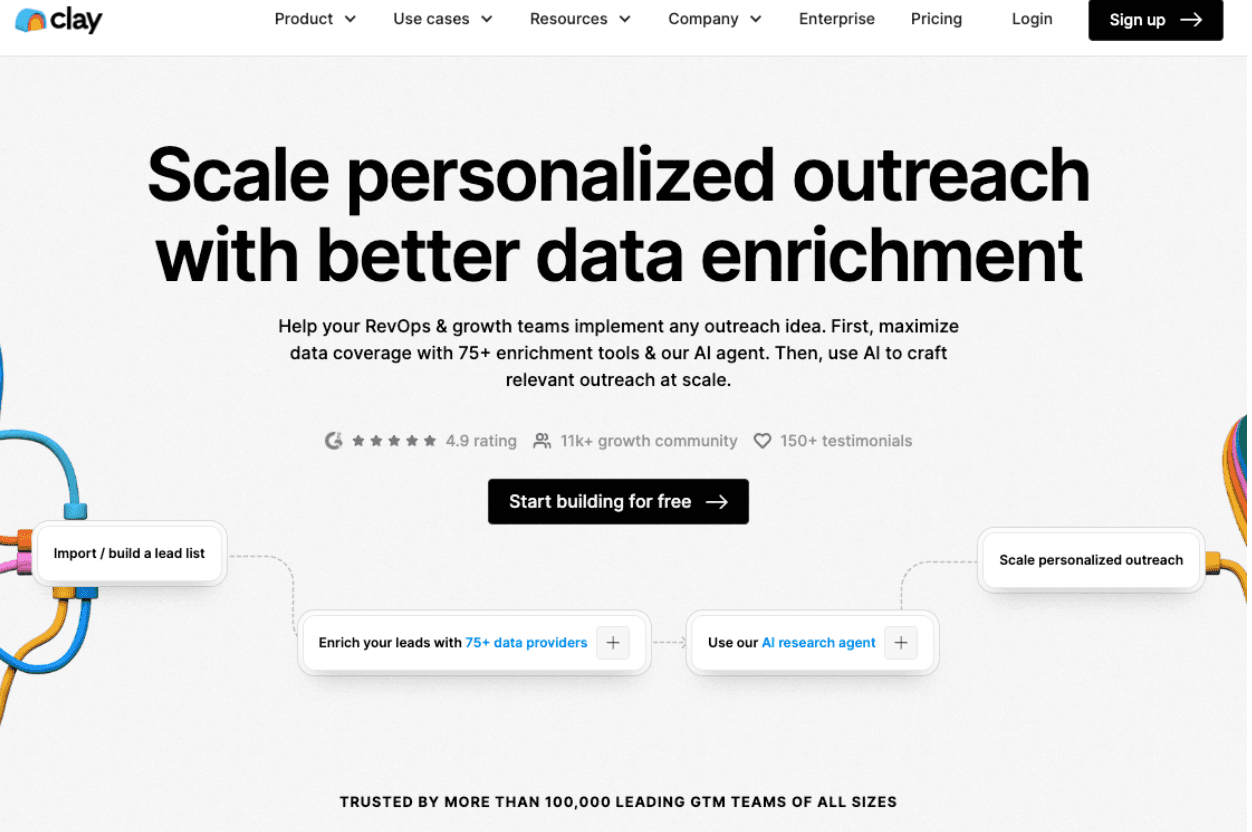
Clay is the best enrichment orchestration in the market, full stop. It runs waterfalls across over 150 providers, its Claygent agents research at scale, and it anchors modern go-to-market (GTM) engineering, which is why it reached a $3.1B valuation in August 2025. Public tiers start free and run from around $167 to $446 a month and up. If you have a skilled operator and want to build exactly the data flow you need, nothing enriches like Clay.
The catch is in this word, operator. Clay is infrastructure, not an outbound engine, and obtaining outcomes from it usually means a GTM engineer at roughly $160K a year to run it. Clay gives you the workbench; Artisan gives you the worker. Teams that want the job done rather than a system to build tend to want the second.
Best for: teams with a GTM engineer who want to build a custom enrichment and data flow. Who should pick something else: teams that want outreach run for them, not a workbench to operate. Pricing: free; Launch from ~$167/mo, Growth from ~$446/mo, Enterprise custom.
5. Amplemarket: Signals with a copilot
Amplemarket is a solid all-rounder that combines data, engagement, and its Duo AI copilot, with strong signal-based selling built in. Entry runs $600 a month for two users, with Growth and Elite custom. For a team that wants good buying signals and a copilot to help reps act on them, it is a capable step up from a plain sequencer.
The word "copilot" is the tell of what it gives up. A human still runs the motion; Duo assists. For teams that want that hands-on control, it fits well. For teams that wanted the work taken off their plate entirely, it stops short of that.
Best for: teams that want signal-based selling with a human still in the driver's seat. Who should pick something else: teams that want an agent to own the motion, not assist it. Pricing: $600/mo entry (two users); Growth/Elite custom.
6. Regie.ai: Rep augmentation on a modern stack
Regie.ai (its RegieOne platform) pairs a sequencer, a dialer, and Auto-Pilot agents, and it carries real enterprise credibility. Its published pricing runs $180/user/month for the AI SEP (sales engagement platform) and $499 for the Force Multiplier Rep tier. The philosophy is rep augmentation: sharpen the reps you have and make them more consistent. If your reps are good and you want to speed them up rather than replace the motion, it is a strong pick.
What it gives up is independence from headcount. Reps still drive. Output per rep scales, but pipeline does not scale without more people, so if your goal is more volume without more hires, you end up back at recruiting. This is the difference between augmenting reps and owning the job.
Best for: teams that want to augment existing reps on a modern stack with published per-seat pricing. Who should pick something else: teams that want pipeline to scale without adding reps. Pricing: $180-$499/user/mo per its site; Enterprise custom.
7. 11x: An agent-led email challenger
11x offers Alice, an AI SDR, plus Julian, an AI phone agent, and it is backed by roughly $74M from investors including a16z and Benchmark. Its Growth plan is now public from $3,750 a month billed annually. For a team that wants an agent-led email challenger and likes this phone-agent angle, it is on the list.
The reasons to weigh it carefully are attributed. TechCrunch reported in March 2025 that some customers disputed claims 11x made about them, the founder-CEO stepped down on May 5, 2025 to non-executive chairman, and the CTO became CEO, and reviewers report deliverability and CRM-sync complaints. It sits in the lower mid-market while selling through enterprise-style contracts. Well funded, but the track record and control questions are real when the job you are handing over is your pipeline.
Best for: teams that want an agent-led email challenger with an AI phone agent. Who should pick something else: teams that need a proven deliverability and CRM-sync record and self-serve terms. Pricing: Growth from $3,750/mo (annual); Pro/Enterprise custom.
When an alternative is the better call
Switching honesty runs both ways, so here is when another tool is the right answer. If you only need raw contact data to feed tools you already run, a data platform like Apollo or a workbench like Clay is a cleaner buy than a full agent. If you have a GTM engineer who wants to build a bespoke enrichment flow, Clay is the right tool for that person. If your entire mandate is a published sub-$300 monthly price for a small team, AiSDR's transparency will feel simpler. And if your reps are your differentiator and you want to augment rather than automate them, Regie.ai or Amplemarket fit this philosophy better than a fully autonomous BDR does.
Artisan's case is strongest when you want the whole job done: sourcing net-new pipeline, running multichannel outreach, handling every reply, dialing at $67 a seat, and catching inbound on the same platform, with a control dial and audit trail over all of it. If this is the shape of what you need, the alternatives above each ask you to give up part of it. If it is not, one of them may be a better fit, and that is a fine answer.
How to choose
Want the whole outbound and inbound job owned, with governance? Artisan.
Want a published price and a fast SMB start? AiSDR.
Want affordable data with light outreach attached? Apollo.
Have an operator and want a custom enrichment flow? Clay.
Want signals with a human still running the motion? Amplemarket.
Want to augment existing reps on a modern stack? Regie.ai.
For the wider category view, see the best AI SDRs, the best AI BDRs, the best AI GTM platforms, and the 15 best AI sales tools, or the AI BDR guide. To see how Ava runs the job, meet her on the Artisan homepage or the AI sales agent page.
FAQ
What is the best alternative to Artisan?
For most teams, none of them replace the whole job, which is why they stay. If you need one slice, the honest picks are AiSDR for transparent agent-led email, Apollo for value data, Clay for enrichment orchestration, Amplemarket for signals with a copilot, Regie.ai for rep augmentation, and 11x for an agent-led email challenger. Artisan differs by owning sourcing, outreach, replies, and booking end to end on usage-based pricing.
Is there a cheaper alternative to Artisan?
Apollo (free through $119/user/month) and AiSDR (from $250 a month) have lower published entry prices. The catch is scope: these numbers buy a data workspace or agent-led email, not a full BDR that sources, dials, replies, and books. Artisan's usage-based credits mean you pay for work performed rather than seats, so cost stays flat as a team grows instead of climbing per head.
What is the best Artisan alternative for enterprise?
Most alternatives narrow at the top of the market. If you need central-ops deployment where sales ops runs an agent for large AE teams, SOC 2 Type II, SSO and SAML, a full audit trail, and per-seat economics that stay flat at scale, Artisan is built for exactly that. Apollo and Clay serve enterprises as data layers, and 11x sits in the lower mid-market despite enterprise-style contracts.
Which Artisan alternative has the best data?
Clay orchestrates over 150 enrichment providers and Apollo claims over 230M contacts, both strong. Artisan carries over 270M B2B contacts plus over 130M local businesses (over 400M total) with waterfall enrichment across roughly a dozen providers, charged only on success. The difference is what happens next: Artisan turns the data into live outreach automatically, where a pure data tool hands you records to work yourself.
Do I need a dialer if I use an Artisan alternative?
Most of these alternatives do not include serious calling, so you would add a dialer separately at over $200-300/user/month for a dedicated parallel one. Artisan's dialer is built in at $67 per seat with unlimited minutes, running as call steps inside the same multichannel sequence, with compliance (calling hours, do-not-call lists, consent-aware recording) enforced automatically per lead.
Can any alternative do both inbound and outbound?
AiSDR covers both at the SMB end. Most of the others are outbound-only or data-only. Artisan runs inbound and outbound as one AI SDR on one knowledge base, so anonymous website traffic is identified and engaged, and any non-booked chat with a captured email flows into Ava's outreach sequences automatically.
Should I switch away from Artisan?
If you only need raw data, a custom enrichment build, or a rep copilot, a focused tool may serve you better, and that is an honest answer. Artisan is the stronger choice when you want the whole job owned end to end with governance you can see. The reason to stay is scope: one AI employee running sourcing, outreach, replies, dialing, and inbound beats stitching five tools that each do one part.
The takeaway
The Artisan alternatives are real and each is good at its slice: data, enrichment, agent-led email, rep augmentation. What none of them do is own the whole outbound and inbound job the way Ava does, on one platform with a control dial and audit trail. See how it works on the Artisan homepage, review the pricing model, or read the AI BDR guide.
Jaspar Carmichael-Jack
Co-Founder & CEO @ Artisan
Jaspar is an entrepreneur with expertise in sales, marketing, and operations. He founded Artisan in 2023, a company automating workflows with AI employees.