Artisan vs 11x: Which AI sales platform fits your team?
An honest 2026 comparison of Artisan and 11x across the sales journey, from finding prospects to booking meetings, with real strengths on both sides.
Key Takeaways
- Artisan runs the full BDR (business development representative) job in one platform: sourcing from over 270M B2B contacts, enrichment, multichannel outreach, reply handling, and meeting booking, with Ava as autonomous as you set her to be. Over 90% of Artisan customers run Ava autonomously.
- 11x offers Alice for multichannel outreach and Julian, an AI phone agent, and has raised roughly $74M from investors including a16z and Benchmark.
- 11x sells through enterprise-style contracts (reported pricing around $5,000/month, long onboarding, no self-serve) while sitting in the lower mid-market by capability. Artisan charges for work performed, not seats, with a free trial.
- 11x drew attributed scrutiny in 2025: TechCrunch reported customer claims the company could not support (March 24, 2025), and its founder-CEO stepped down to non-executive chairman on May 5, 2025.
- Artisan's dialer runs inside the same sequences at $67/seat/month with unlimited minutes, roughly a third of what dedicated parallel dialers charge.
- Artisan is SOC 2 Type II compliant, with SSO, SAML, and role-based access on Enterprise plans.
Artisan and 11x both sell an AI sales rep that runs outbound for you, but they solve the job differently. Artisan is the better fit for most teams: one platform where Ava owns prospecting through booked meeting, with usage-based pricing and no seat fees. 11x offers multichannel outreach plus an AI phone agent and can suit a specific buyer.
Neither tool is a set of features you assemble. Both promise an AI employee who works the pipeline while your reps sell. The real question is which one does more of that job reliably, and at what commercial cost. This comparison walks the sales journey stage by stage, credits what 11x actually does well, and ends with honest scenarios for picking either one.
How the two platforms compare
Rather than an all-checkmark grid, here is the situation-to-fit map. Find the row that sounds like you.
Your situation | Better fit | Why |
You want one platform to own sourcing through booked meetings | Artisan | Ava runs the whole workflow; no stitching separate agents |
You need transparent, usage-based pricing and a free trial | Artisan | Pay for work performed, not seats; no platform fee |
You run large AE teams from central sales ops | Artisan | Central deployment, CRM owner mapping, audit trail, SOC 2 Type II |
You want cold calling built into the same sequences | Artisan | Dialer steps at $67/seat with unlimited minutes |
You specifically want an AI phone agent as a headline feature | 11x | Julian is a named AI phone agent in the 11x lineup |
You are comfortable with an annual enterprise-style contract and guided onboarding | 11x | 11x sells that way by default |
Who finds better prospects? Sourcing and data
Artisan sources net-new prospects natively. Ava searches a database of over 270M B2B contacts plus an over-130M local-business database, over 400M contacts in total, with natural-language search, ideal customer profile (ICP) filters, and intent signals. Enrichment runs as a waterfall across roughly a dozen providers for verified emails and phone numbers, and you are charged only when enrichment succeeds. Signals range from funding rounds and newly hired executives to tech-stack intent, Bombora-powered topic intent, champion job changes, and website visitor identification. You can also define custom signals in plain English.
11x focuses on activating outreach across channels through Alice, its AI SDR (sales development representative), and leans on connected data and signals to build target lists. It is a capable multichannel engine. The practical difference is depth of native sourcing: Artisan is built to find and verify net-new contacts at scale inside the same platform, then rank them by conversion likelihood before a single message goes out.
For a team that wants sourcing, enrichment, and signal detection to live in one place rather than plugged in from outside, Artisan carries more of that weight natively.
Who writes and sends better outreach?
Both platforms generate personalized outreach across channels. This is 11x's core strength, and it is a real one. Alice runs multichannel sequences, and Julian, the 11x AI phone agent, adds a voice channel that many AI SDR tools do not attempt. If a voice-forward outreach agent is what you are shopping for, 11x has built toward it directly.
Artisan runs email, social outreach, and dialer call steps as coordinated steps in one sequence. Personalization scales from light templating to agentic research swarms for hard-to-hit criteria, and Ava runs dozens of message variations, shifting volume to what converts at the component level. The comparison Artisan draws is to Marketo-scale sending with a one-to-one feel: two people in the same campaign receive completely different messages, not the same template with the name swapped.
Deliverability is where sending quality is won or lost, and Artisan invests heavily here: managed mailbox provisioning, automated sending ramp-up, inbox placement testing, SPF/DKIM/DMARC checks, health dashboards, and bounce-pattern detection that auto-pauses unhealthy mailboxes. Some 11x reviewers have reported deliverability and CRM-sync complaints, so if inbox placement is your make-or-break, weigh that in your own trial.
The honest read: 11x is legitimately multichannel and owns a voice agent as a headline feature. Artisan matches the channel spread, adds a deeper deliverability toolkit, and folds calling into the same sequence economics.
Who handles replies and books the meeting?
This is where an AI SDR either earns its keep or hands the work back to your reps. Artisan's Ava qualifies every reply, answers objections from a knowledge base, chases follow-ups, and escalates on plain-language rules you write ("if the lead mentions pricing, escalate"). She books meetings on the right rep's calendar using CRM-owner routing. You choose the autonomy level: review and approve every message, objections-only replies, or full autonomy, with a full audit trail behind all of it.
11x also handles replies and booking as part of its agent workflow. The difference buyers notice is the control surface and the deployment model. Artisan's autonomy dial plus escalation rules plus audit trail is designed for teams that need governance, which is why global fintechs run Ava centrally from sales ops for account executive (AE) teams that never log in.
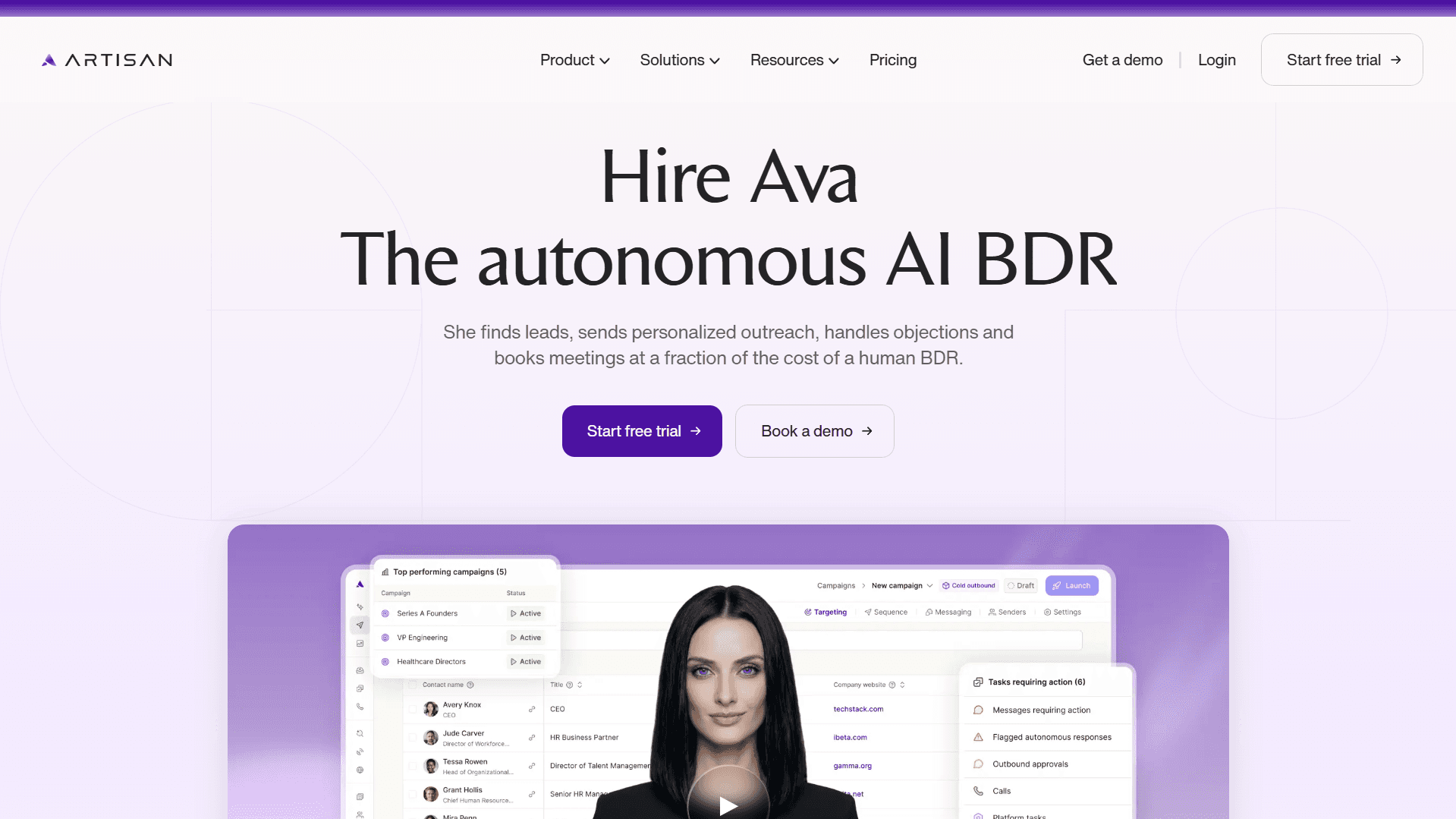
If your priority is trusting the agent to close the loop from reply to booked meeting with a clear paper trail, Artisan's control model is the more complete answer.
Which is more honest about pricing?
Artisan uses usage-based credits. You pay for work performed, not seats, there is no platform fee, and there is a free trial. The dialer is $67/seat/month with unlimited minutes plus 1 credit per call, and phone numbers are about $5/month each, pooled at the org level. Enterprise adds custom volume, a forward-deployed strategist, a dedicated customer success manager, and advanced security. Full pricing is published at artisan.co/pricing.
11x does not publish self-serve pricing. Reported figures put it around $5,000/month through annual, enterprise-style contracts with a guided onboarding period. That is a real commitment to make before you know the tool performs for your motion, and it is a big reason we frame 11x as a lower mid-market tool sold on enterprise-style terms rather than as an enterprise platform. For the detail, see 11x pricing and reviews and the best 11x alternatives.
What changed for 11x in 2025?
Two attributed events belong in any fair comparison. TechCrunch reported on March 24, 2025 that some customers made claims about 11x's performance and revenue that the company could not support. On May 5, 2025, 11x's founder-CEO stepped down to non-executive chairman, and CTO Prabhav Jain stepped into the CEO role. Separately, reviewers have reported deliverability and CRM-sync issues.
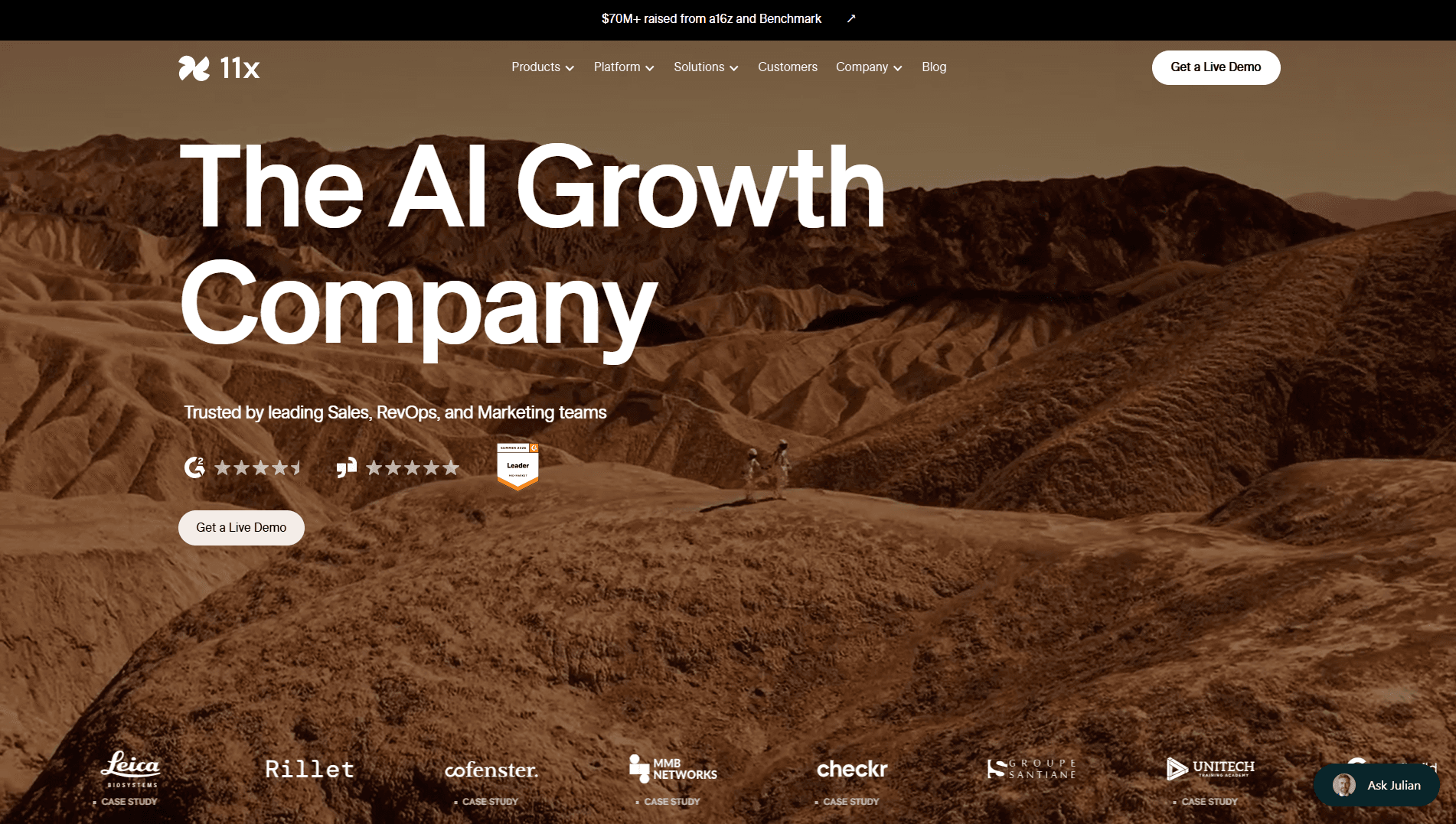
None of this means 11x cannot work for you. It does mean a careful buyer should run a hands-on trial, check deliverability against their own domains, and confirm CRM sync behaves before committing to an annual contract. Leadership transitions raise reasonable questions about roadmap continuity, and those questions are fair to ask in a sales conversation.
Choose 11x if...
There are real scenarios where 11x is a sensible pick:
You specifically want an AI phone agent as a first-class channel and Julian's voice approach fits how you sell.
You are comfortable buying through an annual, enterprise-style contract with guided onboarding rather than starting on a self-serve trial.
Multichannel outreach with a managed setup is your priority and you are not looking to consolidate a broader go-to-market (GTM) stack into one platform.
You have run a hands-on trial, validated deliverability on your domains, and confirmed CRM sync for your workflow.
If those describe you, 11x is worth a look. Go in with the 2025 reporting in mind and pressure-test performance before signing.
Choose Artisan if...
Artisan is the stronger default for most teams:
You want one platform to own the BDR job end to end, from sourcing net-new contacts to booking the meeting, instead of assembling agents and data feeds.
You want pricing you can see, tied to work performed, with a free trial and no seat fees.
You run outbound centrally for large AE teams and need CRM owner mapping, escalation rules, an audit trail, and SOC 2 Type II compliance.
You want cold calling in the same sequences at $67/seat with unlimited minutes rather than a separate dialer contract.
You want the AI to remove the grunt work so your reps spend their time selling.
Artisan's customers describe the outcome directly. Raise sourced over $700K of annual recurring revenue (ARR) in six months with Ava, a 20x return. That is the shape of result Artisan is built to produce: pipeline generated at roughly a fifth of the cost of a human BDR, with the AI running most of the motion. For the staffing tradeoff, see AI SDR vs human SDR.
See how Ava works as your AI sales agent, or read the fuller category picture in the best AI SDRs, the best AI BDRs, the best AI GTM platforms, or the 15 best AI sales tools.
Frequently asked questions
Is 11x better than Artisan for AI phone calls?
11x makes its AI phone agent, Julian, a headline feature, so if a dedicated voice agent is the single capability you are buying for, 11x has built toward it directly. Artisan runs calling as steps inside multichannel sequences with power and parallel dialing, live transcription, and AI-drafted follow-ups at $67/seat. For most teams that want calling integrated with email and social in one motion, Artisan's model is the better fit; for a voice-first buyer, 11x is worth trialing.
Is 11x an enterprise platform?
We would not describe it that way. 11x sits in the lower mid-market by capability but sells through enterprise-style contracts: reported pricing around $5,000/month, annual terms, guided onboarding, and no self-serve option. Artisan is built for enterprise deployment, with central sales-ops rollout, CRM owner mapping, an audit trail, SOC 2 Type II compliance, and SSO, SAML, and role-based access on Enterprise plans.
How much does each platform cost?
Artisan uses usage-based credits with no platform fee and a free trial, so you pay for work performed rather than per seat; the dialer is $67/seat/month with unlimited minutes, and full pricing is at artisan.co/pricing. 11x does not publish self-serve pricing; reported figures put it around $5,000/month through annual enterprise-style contracts.
What happened with 11x in 2025?
Two attributed events: TechCrunch reported on March 24, 2025 that some customers made performance and revenue claims the company could not support, and on May 5, 2025 the founder-CEO stepped down to non-executive chairman, with CTO Prabhav Jain becoming CEO. Reviewers have separately reported deliverability and CRM-sync complaints. Run a hands-on trial and validate deliverability and CRM sync before committing.
Which tool is more autonomous?
Both position an AI SDR that works replies and booking, but Artisan gives you an explicit autonomy dial: review and approve, objections-only, or full autonomy, with plain-language escalation rules and a full audit trail. Over 90% of Artisan customers run Ava autonomously. That control surface is a large part of why teams trust Ava to close the loop from reply to booked meeting.
Can Artisan do everything 11x does?
Artisan covers the multichannel outreach and reply-handling that 11x centers on, and adds native sourcing across over 270M B2B contacts, deeper deliverability tooling, an integrated dialer, and CRM depth in one platform. The one area where 11x leads on framing is its named AI phone agent as a headline product. If that specific positioning matters to you, trial 11x; otherwise Artisan does more of the job in one place.
Which should a large sales team choose?
For large AE teams, Artisan is the stronger fit. Sales ops can run Ava centrally for reps who never log in, with CRM owner mapping so calls and meetings route to the right person, an audit trail for governance, and flat per-seat dialer economics that stay predictable at scale. See Artisan for enterprise Salesforce teams for the deployment detail.
Related reading
Jaspar Carmichael-Jack
Co-Founder & CEO @ Artisan
Jaspar is an entrepreneur with expertise in sales, marketing, and operations. He founded Artisan in 2023, a company automating workflows with AI employees.