The best 11x alternatives in 2026
The best 11x alternatives for teams that want autonomous outbound done end to end, with honest best-for verdicts and who each is wrong for.
Key Takeaways
- Most teams leave 11x over trust and fit: TechCrunch reported customer disputes in March 2025, the founder-CEO stepped down on May 5, 2025 to non-executive chairman, and reviewers report deliverability and CRM-sync problems.
- 11x sits in the lower mid-market but sells through enterprise-style contracts. Its Growth plan is now public from $3,750 a month billed annually (about $45K a year), with Pro and Enterprise quoted custom and a long onboarding.
- The strongest alternative is an autonomous AI BDR that runs the whole motion, not another agent bolted onto a sequencer.
- Artisan runs on usage-based credits with no platform fee and no per-seat multiplier, so cost stays flat as a team scales.
- Over 90% of Artisan customers run Ava autonomously, and SaaStr achieved a 3.55% positive email response rate.
- The right pick depends on stack and control needs: this page routes you by both.
The best 11x alternative is Artisan, whose AI business development representative (BDR) Ava owns the full outbound job end to end: sourcing, personalized outreach, reply handling, and booking, with a control dial and a full audit trail. AiSDR, Regie.ai, Amplemarket, Reply.io, and Salesforce Agentforce are the other real options. This page ranks them and says who each is wrong for.
Why are teams looking for 11x alternatives?
Mostly because its trust story cracked. TechCrunch reported in March 2025 that 11x listed customers and outcomes that some of those customers said they could not support, and in May 2025 the founder-CEO stepped aside, with CTO Prabhav Jain moving into the top job. A young company changing leadership while fielding public questions about its claims is a hard thing to sign a multi-year contract against, and enterprise buyers noticed.
The product complaints are more ordinary but just as decisive. Reviewers report deliverability trouble and CRM-sync issues, the two things an autonomous outbound tool cannot mishandle, because a bad send hurts your domain and a bad sync corrupts your pipeline. 11x also sits in the lower mid-market in practice while selling like an enterprise vendor: a Growth plan now public from $3,750 a month billed annually, Pro and Enterprise quoted custom, and a long onboarding before you are fully live. Backed by roughly $74M from investors including a16z and Benchmark, it is well funded. The reasons to look elsewhere are about track record and control, not capital. See our full 11x pricing and reviews.
The best 11x alternatives, compared
Rank | Tool | Best for | Standout | Public pricing |
1 | Artisan | Owning the full outbound job with governance | Ava runs sourcing to booking autonomously | Usage-based credits, no platform fee (pricing) |
2 | AiSDR | SMB teams that want transparent pricing fast | Published tiers, quick setup | $250-$2,500/mo per its site |
3 | Regie.ai | Rep augmentation on a modern engagement stack | Sequencer + dialer + Auto-Pilot agents | reportedly ~$180-$499/user/mo |
4 | Amplemarket | Signal-based selling with a human in the loop | Data + engagement + Duo copilot | ~$600/mo entry (not public) |
5 | Reply.io | An accessible entry into agent-run email | Jason AI on a classic sequencer | Sequences from $59/mo; AI SDR ~$500-800/mo |
6 | Salesforce Agentforce | Teams that live inside Salesforce | CRM-resident SDR agent | ~$2/conversation or Flex Credits |
7 | Alta | Teams that want a newer challenger | SDR agent Katie, AI calling | $25M Series A (Jul 2026) |
How we chose
Four tests, in order. How much of the job the AI actually does (a full BDR, or one slice like email drafting). Data and signal depth (can it source net-new leads, not just work a list you already own). Pricing transparency (published and self-serve, or gated behind a sales motion). And deployment fit (does it carry the governance, security, and CRM depth an enterprise needs, or is it an SMB tool in enterprise clothing). Every entry below receives a best-for verdict and a who-should-pick-else line, because a page that only flatters one tool does not deserve to be trusted.
1. Artisan: The AI BDR that owns the whole job
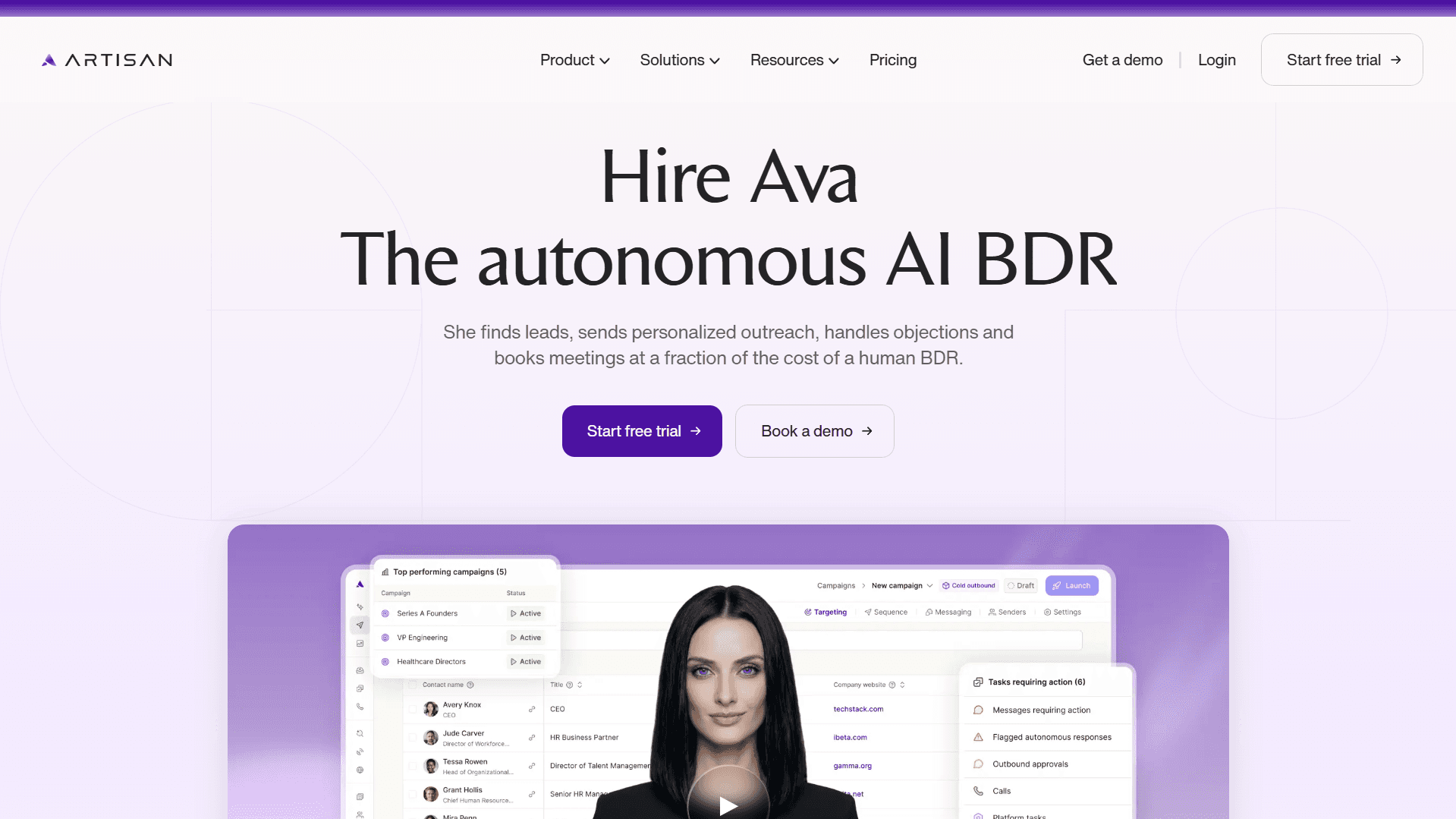
Artisan is the top 11x alternative because Ava, its AI BDR, owns the entire outbound motion rather than automating a single step. She finds best-fit leads across a database of over 270M B2B contacts and over 130M local businesses, enriches and prioritizes them with waterfall email and phone enrichment (charged only on success), writes a distinct message for every recipient, runs multichannel steps across email, social, and the dialer, handles every reply from a knowledge base, and books meetings on the right rep's calendar by CRM ownership. two people in the same campaign receive two entirely different emails, not the same template with the name swapped. For category context, see the AI SDR (sales development representative) primer and broader SDR tools and BDR tools guides.
The control model is what makes it safe where 11x made buyers nervous. Autonomy is a dial, not a switch: review-and-approve every message, objections-only replies, or full autonomy, with plain-language escalation rules ("if the lead mentions pricing, escalate") and a complete audit trail of what was sent and why. Deliverability is managed with automated sending ramp-up, inbox placement testing, and bounce-pattern detection that auto-pauses unhealthy mailboxes, and the CRM integration syncs bidirectionally with field-level export controls, so the two things reviewers flag on 11x are handled by design. Artisan is SOC 2 Type II compliant, with single sign-on (SSO) and SAML on Enterprise plans.
The economics run the other way from an opaque monthly retainer. Pricing is usage-based credits with no platform fee and no per-seat tax, so a large team's cost stays flat as it scales, and the Enterprise plan adds a forward-deployed strategist, a dedicated customer success manager (CSM), and audit logs. Over 90% of customers run Ava autonomously. SaaStr achieved a 3.55% positive response rate, and Jason Lemkin said the AI emails were "actually better than what our humans produced. Consistently better." Artisan has raised over $35M from investors including Y Combinator and HubSpot Ventures.
Best for: teams from startup through enterprise that want the outbound job owned end to end, with governance, deliverability, and CRM depth built in. Who should pick something else: teams that only need one narrow feature (say, a drafting assistant for reps who still run everything themselves) and do not want a platform. Pricing: usage-based credits, no platform fee, free trial. See Artisan pricing.
2. AiSDR: Transparent pricing, fast setup
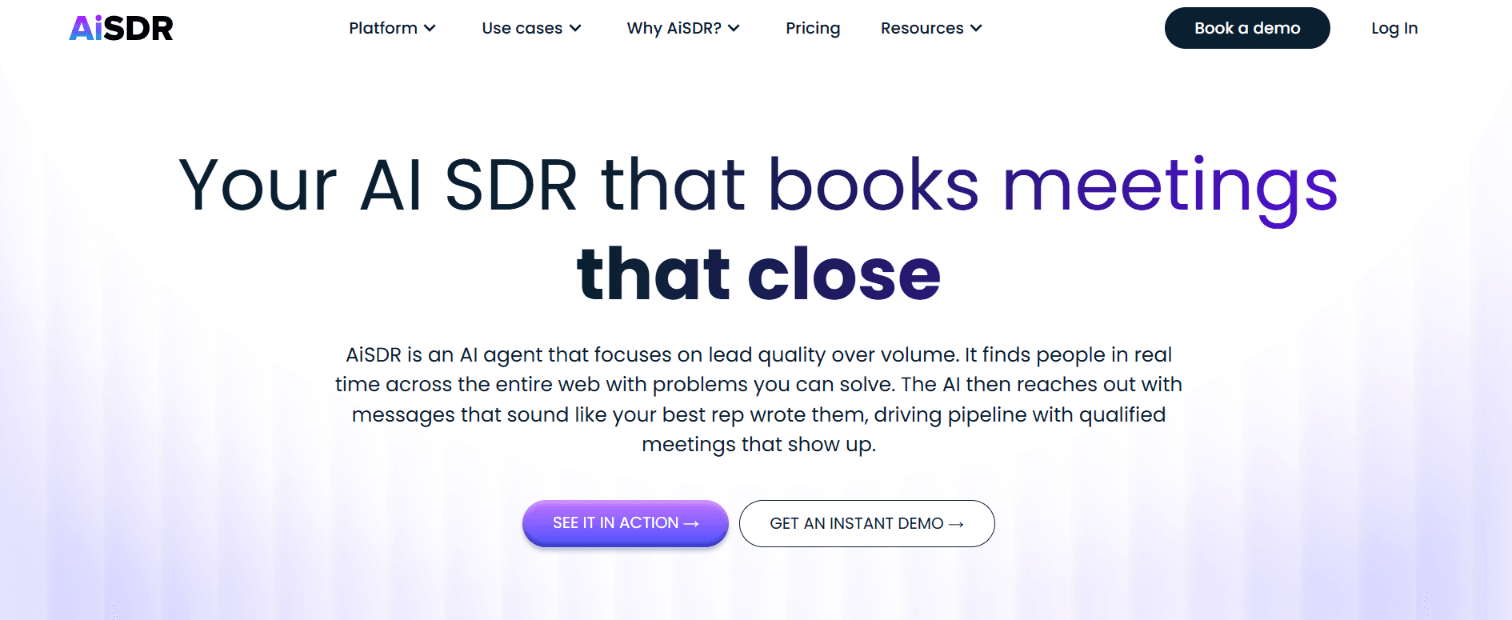
AiSDR is the most straightforward alternative if what soured you on 11x was the opaque contract. Its pricing is published ($250, $900, and $2,500 a month tiers per its site), setup is fast, and it covers both outbound and inbound with an "Ami" strategist agent guiding the motion. For an SMB or lower mid-market team that wants to see the price, sign up, and go, this transparency is the whole appeal.
The limit is where it runs out. AiSDR's center of gravity is SMB, and the enterprise governance story (deep CRM controls, central-ops deployment for large account executive (AE) teams, audit depth) is thinner than what a big org needs. It is a clean, honest tool that a growing team can outgrow.
Best for: SMB and lower mid-market teams that value transparent pricing and speed over enterprise governance. Who should pick something else: large orgs that need central ops, deep CRM controls, and a heavier audit trail. Pricing: $250-$2,500/mo per its site.
3. Regie.ai: Rep augmentation on a modern stack
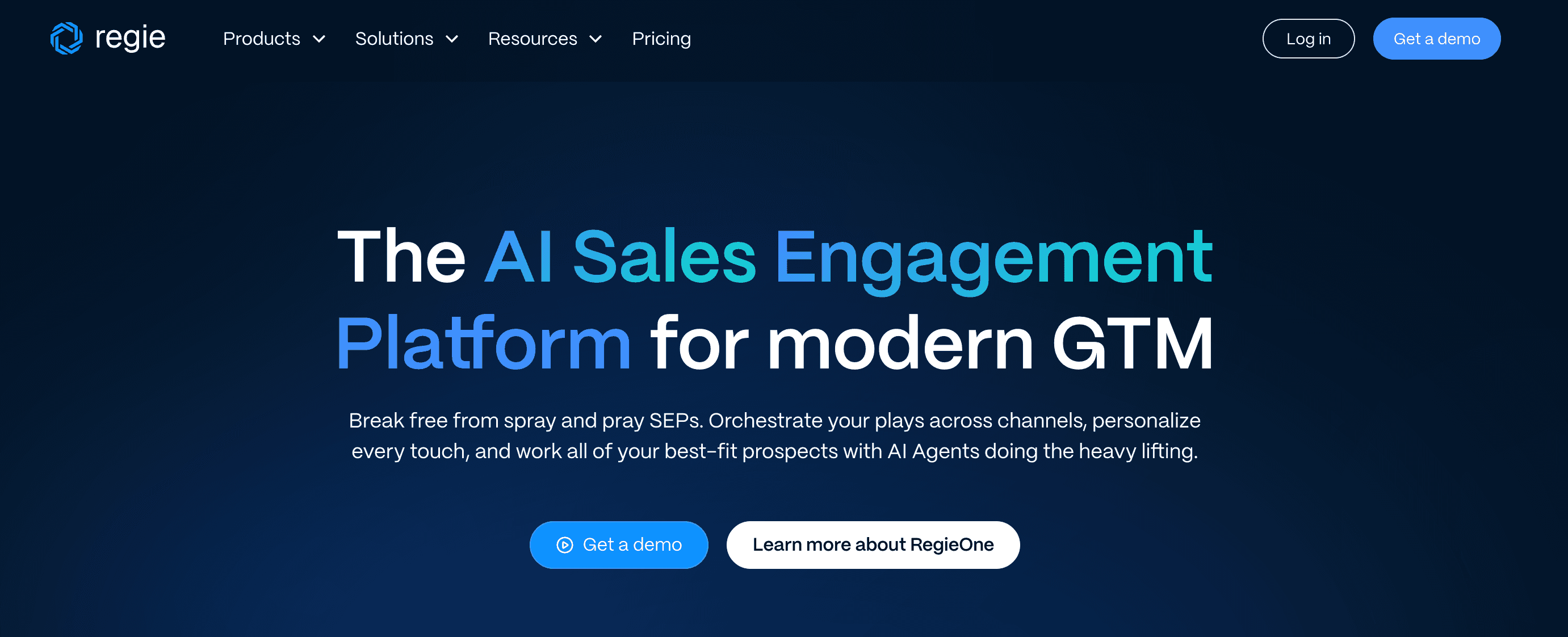
Regie.ai (its RegieOne platform) pairs a sequencer, a dialer, and Auto-Pilot agents, and it carries real enterprise credibility. The philosophy is rep augmentation: the tools make your existing reps faster and more consistent, with reportedly around $180-$499/user/mo. If your reps are good and you want to sharpen them rather than replace the motion, it is a strong pick.
The tradeoff is structural. Reps still drive. Output per rep scales, but pipeline does not scale independently of headcount, so if your goal is more volume without more people, you are back to hiring. This is the line between augmenting reps and owning the job. See our take on AI SDR vs. human SDR.
Best for: teams that want to augment existing reps on a modern engagement stack with published per-seat pricing. Who should pick something else: teams that want pipeline to scale without adding reps. Pricing: reportedly ~$180-$499/user/mo.
4. Amplemarket: Signal-based selling with a copilot
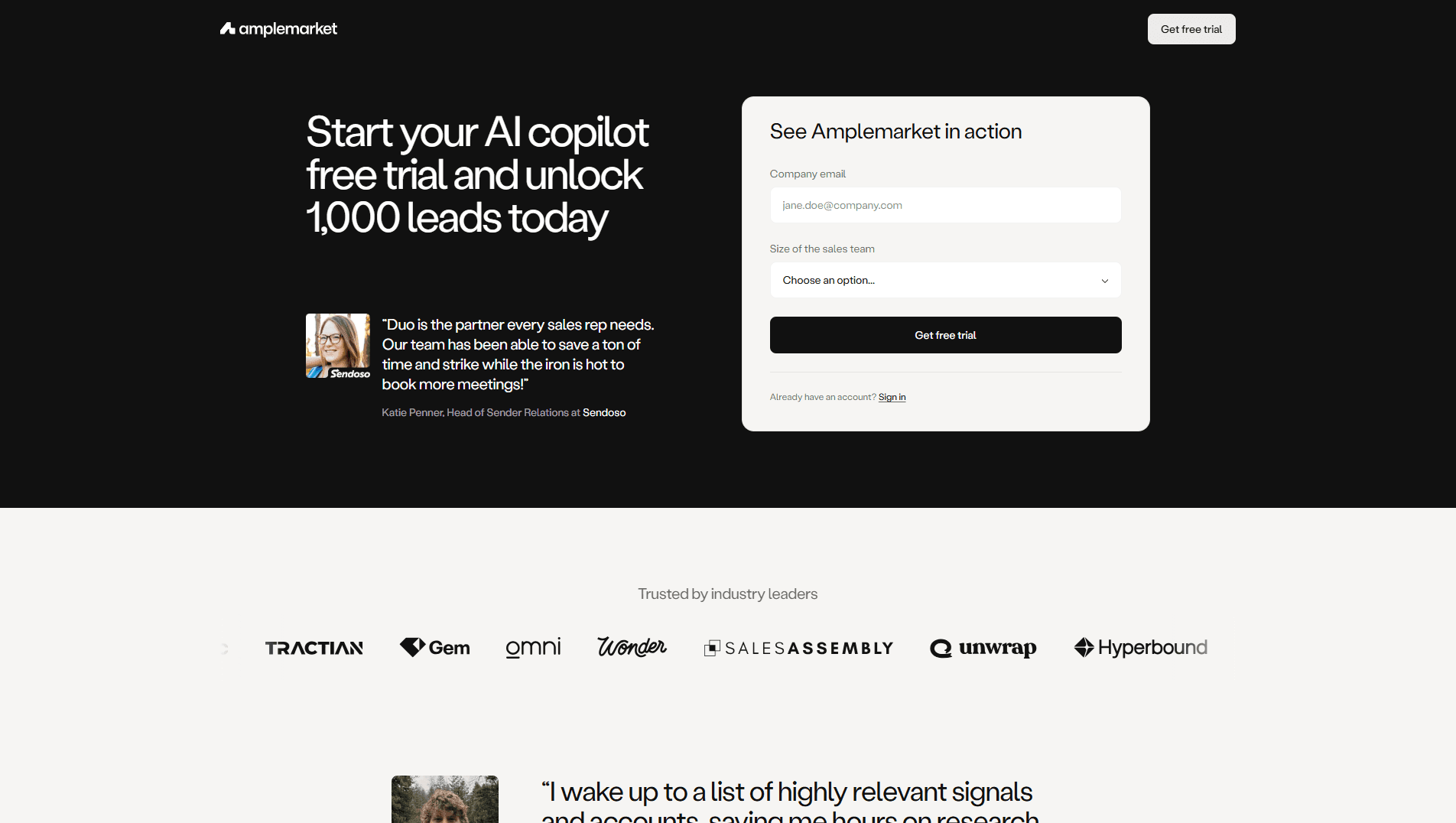
Amplemarket is a solid all-rounder that combines data, engagement, and its Duo AI copilot, with strong signal-based selling built in. Entry runs around $600 a month (not published publicly). For a team that wants good signals and a copilot to help reps act on them, it is a capable choice and a genuine step up from a plain sequencer.
The word "copilot" is the tell. A human still runs the motion; Duo assists. For teams that want this hands-on control, it fits. For teams that wanted the work taken off their plate entirely, it stops short.
Best for: teams that want signal-based selling with a human still in the driver's seat. Who should pick something else: teams that want the agent to own the motion, not assist it. Pricing: ~$600/mo entry, not public.
5. Reply.io: An accessible entry into agent-run email
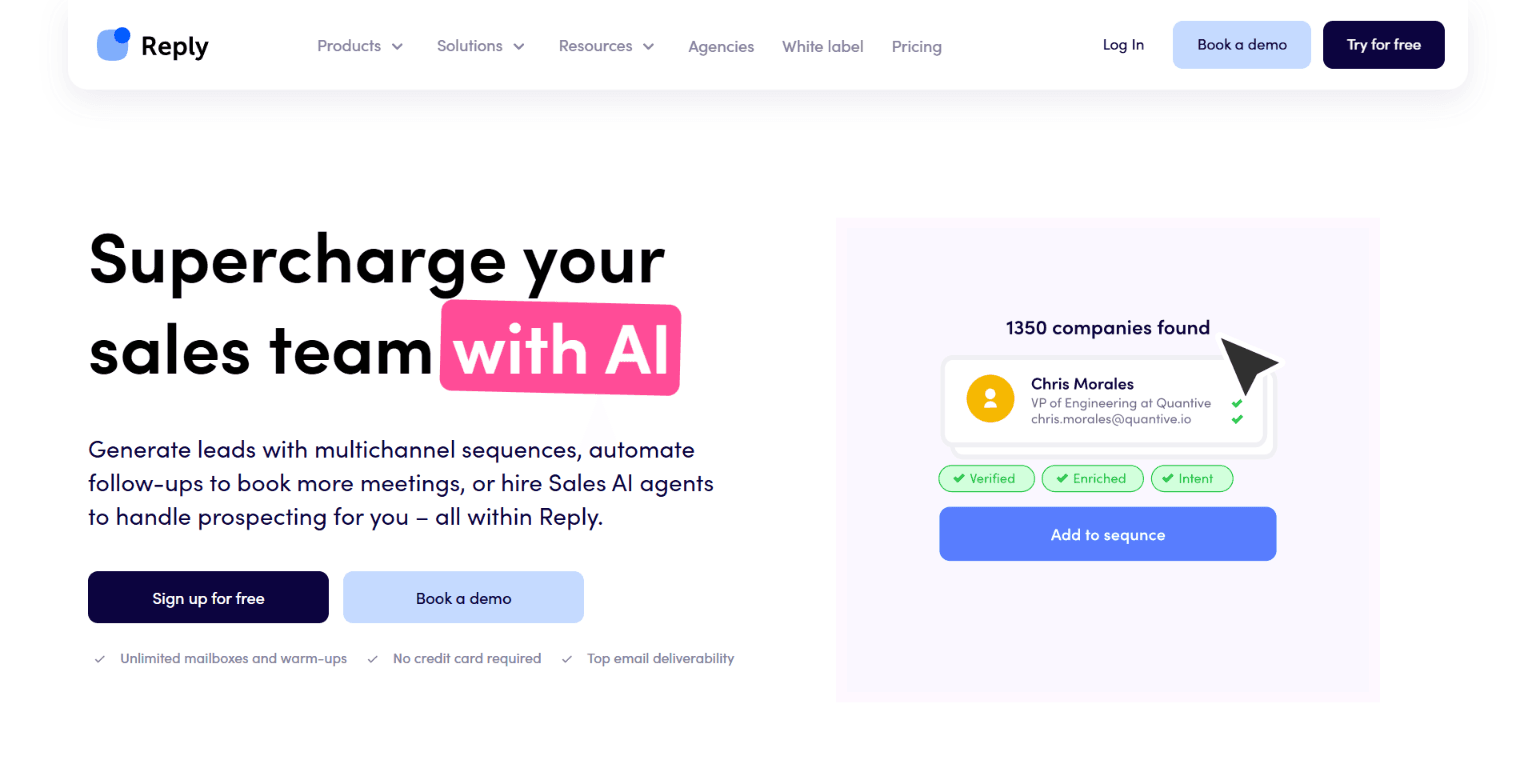
Reply.io offers Jason AI, an AI SDR layer, on top of a classic sequencing platform, and it is one of the cheaper ways to try agent-run email. Sequences start around $59 a month, with the AI SDR tier reported around $500-$800 a month. For a small team dipping a toe into automated outreach, the low entry price is real.
The scope is the catch. This is an email-centric agent sitting on a traditional sequencer, so it does not own multichannel prospecting or reply handling the way a purpose-built AI BDR does. Fine as a first step, limited as a destination.
Best for: small teams that want a low-cost entry into agent-run email. Who should pick something else: teams that need multichannel outbound and autonomous reply handling. Pricing: sequences from $59/mo; AI SDR ~$500-800/mo.
6. Salesforce Agentforce: For teams that live in Salesforce
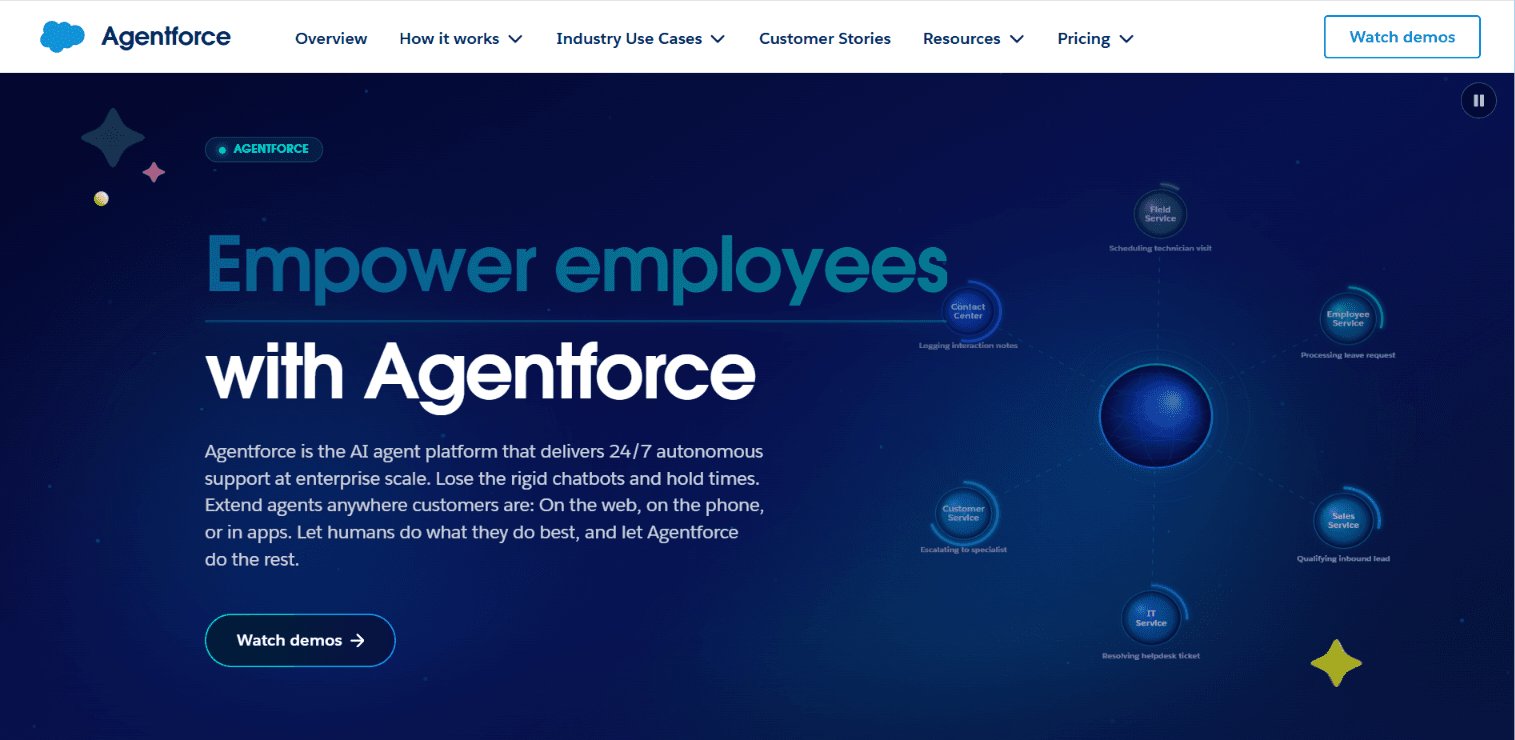
If your team runs everything inside Salesforce, Agentforce SDR is worth a look, because it is native to the CRM with Salesforce's security posture behind it. Pricing is consumption-based, roughly $2 per conversation or Flex Credits at about $0.10 per action, so it fits teams that want the agent to live where their data already is.
The caveats are real. Setup is steep, the consumption pricing is still evolving, the product is young, and it works your existing CRM contacts rather than sourcing net-new leads at scale. It is a way to add an agent to Salesforce, not a full outbound engine that fills the top of the funnel.
Best for: Salesforce-committed teams that want a CRM-resident agent working existing records. Who should pick something else: teams that need to source net-new pipeline at scale, not just work the CRM they have. Pricing: $2/conversation or Flex Credits ($0.10/action).
7. Alta: A newer challenger
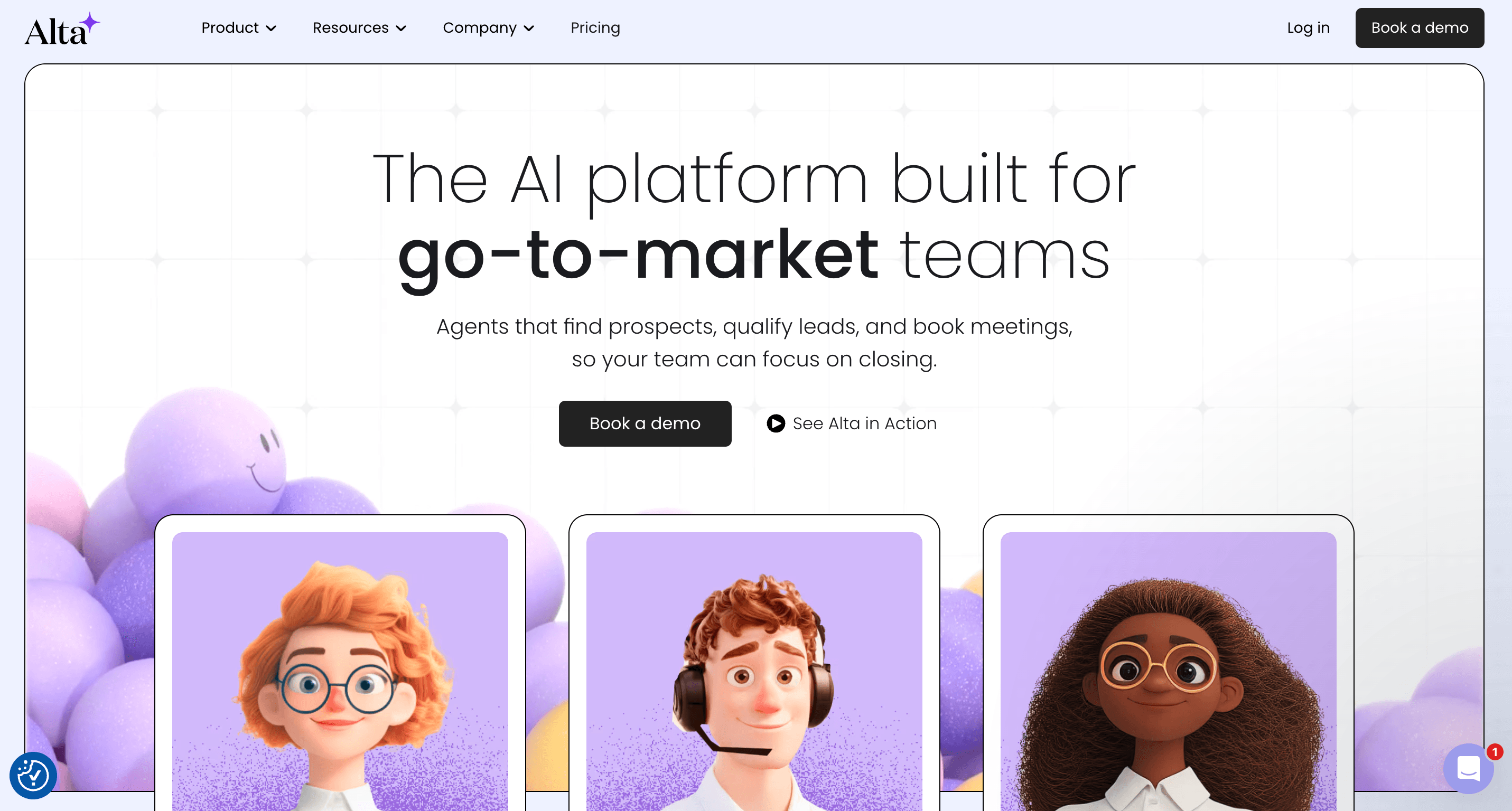
Alta markets an "AI GTM System of Actions" with an SDR agent named Katie and AI calling, and it raised a $25M Series A in July 2026. Its site claims SOC 2 and ISO 27001. For a team that likes backing an early challenger, it is on the map.
It is also very young, with a thin public track record, which is a meaningful risk when the job you are handing over is your outbound pipeline. Treat it as an early-stage option to watch rather than a proven system.
Best for: teams comfortable adopting an early-stage product. Who should pick something else: teams that want a proven track record before handing over pipeline. Pricing: private; $25M Series A (Jul 2026).
Stay with 11x if...
Honesty section, because switching is not free. Stay with 11x if you are already deployed, your deliverability and CRM sync are working for your setup, and the AI phone agent is doing something specific you rely on. Migrating an outbound motion means re-provisioning mailboxes, rebuilding campaigns, and re-mapping CRM fields, and if 11x is performing well for you, this disruption may not be worth it this quarter. The reasons to move are the attributed ones (the TechCrunch reporting, the leadership change, the deliverability and sync complaints reviewers cite) plus the contract opacity. If none of these are biting you, there is no rule that says you must leave.
But if you are evaluating fresh, weigh the track record. A tool that owns your pipeline needs to be one you trust with your domain and your CRM, and the case for an autonomous platform with published economics and a full audit trail is strongest for teams that were burned by an opaque one.
How to choose your 11x alternative
Want the whole outbound job owned, with governance and control? Artisan.
Want transparent pricing and fast setup for an SMB team? AiSDR.
Want to augment existing reps on a modern stack? Regie.ai.
Want signals with a human still running the motion? Amplemarket.
Want a cheap way to try agent-run email? Reply.io.
Live entirely inside Salesforce? Agentforce SDR.
For the full category view, see the best AI SDRs, the best AI BDRs, the best AI GTM platforms, and the 15 best AI sales tools, or the AI BDR guide. If you are weighing the two head to head, read Artisan vs. 11x.
FAQ
What is the best alternative to 11x?
Artisan, because its AI BDR Ava owns the full outbound job (sourcing, personalized outreach, reply handling, and booking) with a control dial, managed deliverability, and bidirectional CRM sync, which addresses the deliverability and sync complaints reviewers report about 11x. It runs on usage-based credits with no platform fee. AiSDR, Regie.ai, Amplemarket, Reply.io, and Salesforce Agentforce are the other strong options. See also the best Conversica alternatives.
Why are people leaving 11x?
Three attributed reasons. TechCrunch reported in March 2025 that some listed customers disputed claims 11x made about them; the founder-CEO stepped down on May 5, 2025 to non-executive chairman, with the CTO becoming CEO; and reviewers report deliverability and CRM-sync problems. Add enterprise-style contracts (a public Growth floor from $3,750 a month, with Pro and Enterprise quoted custom) and the case to evaluate alternatives is mostly about track record and control.
Is 11x an enterprise tool?
In practice it sits in the lower mid-market while selling through enterprise-style contracts: a Growth plan now public from $3,750 a month billed annually, with Pro and Enterprise quoted custom, plus a long onboarding. It is well funded, with roughly $74M raised from investors including a16z and Benchmark, but funding is not the same as an enterprise governance and track record story. Buyers who need central ops and deep CRM controls tend to look at platforms built for that.
What is the best enterprise alternative to 11x?
Artisan. It carries the enterprise weight 11x is often asked to and lacks: a central-ops deployment where sales ops runs Ava for large AE teams who never log in, SOC 2 Type II compliance, SSO and SAML on Enterprise plans, a full audit trail, deep Salesforce and HubSpot controls, and per-seat economics that stay flat at scale. The Enterprise plan adds a forward-deployed strategist and a dedicated CSM.
How much does Artisan cost compared to 11x?
Artisan uses usage-based credits: you pay for work performed, not seats, with no platform fee and a free trial, so cost stays flat as you scale rather than climbing with headcount. 11x's Growth plan is public from $3,750 a month billed annually, with Pro and Enterprise quoted custom. See Artisan pricing for the model.
Does Artisan handle deliverability and CRM sync better than 11x?
These are exactly the two areas reviewers flag on 11x, and both are built into Artisan by design. Deliverability includes managed mailbox provisioning, automated sending ramp-up, inbox placement testing, and bounce-pattern detection that auto-pauses unhealthy mailboxes. CRM sync is bidirectional with Salesforce and HubSpot, with field-level export controls, owner mapping, and a do-not-contact system that respects active deals. For CRM-specific picks, see the best AI SDR for HubSpot users.
Should I switch from 11x or stay?
Stay if you are deployed, your deliverability and sync are working, and the AI phone agent does something specific you rely on, because migration means re-provisioning and rebuilding campaigns. Switch if the attributed concerns (the reporting, the leadership change, the deliverability and CRM complaints) or the opaque contract are biting you, and you want a platform with published economics and a full audit trail.
The takeaway
People leave 11x over track record and control, not capability alone. The strongest replacement is a platform that owns the whole outbound job with governance you can see: managed deliverability, bidirectional CRM sync, a control dial, and a full audit trail. See how it works on the Artisan homepage, meet Ava, or read the AI BDR guide.
Jaspar Carmichael-Jack
Co-Founder & CEO @ Artisan
Jaspar is an entrepreneur with expertise in sales, marketing, and operations. He founded Artisan in 2023, a company automating workflows with AI employees.