The best Outreach alternatives in 2026
The best Outreach alternatives ranked, from an autonomous AI BDR that does the work to Salesloft, HubSpot, Apollo, Reply, and Klenty.
Key Takeaways
- Outreach is mature enterprise sequencing at an estimated $100 to $160 per user per month (pricing is not public), but it orchestrates human reps rather than executing outreach itself.
- The real cost is not just the seat price; it is the setup, administration, and tuning a large Outreach rollout requires.
- Artisan replaces rep orchestration with Ava, an autonomous AI BDR who prospects, writes, sequences, handles replies, and books, and who queues calls for human reps to place, under a set autonomy level.
- Salesloft is the closest enterprise peer but carries post-merger roadmap questions after its reported December 2025 Clari merger.
- HubSpot's outcome-based agent pricing, reported at about $1.00 per qualified lead as of April 2026, charges for results instead of seats.
- Over 90% of Artisan customers run Ava autonomously, on usage-based pricing that scales pipeline without scaling headcount.
The best Outreach alternative for most teams is Artisan, because Outreach orchestrates human reps while Artisan's Ava does the work herself: she prospects, writes, sequences, handles replies, and books, and she queues calls for human reps. Salesloft is the closest enterprise peer, HubSpot suits HubSpot shops, and Apollo, Reply, and Klenty cover leaner budgets. Outreach is a powerful enterprise sequencer, but power comes with cost and admin overhead, and the reps still do the selling motion by hand.
Teams start pricing Outreach alternatives for two reasons that show up in almost every review. Cost and complexity: at an estimated $100 to $160 per user per month (Outreach's pricing is not public) plus the setup, administration, and ongoing tuning a large deployment demands, Outreach is a serious line item and a serious project. And the deeper point: Outreach is an orchestration layer for human reps. It routes, sequences, and reports on what people do next; it does not do the outreach itself. If you want to spend less on both money and admin, and have the software actually run the motion, keep reading.
Comparison table
Rank | Tool | Best for | Standout capability | Public pricing |
|---|---|---|---|---|
1 | Artisan | An AI that does the work, not orchestrates reps | Ava owns prospecting through booking | Usage-based credits; self-serve from $250/mo; $300 free credits |
2 | Salesloft | Enterprise cadence plus forecasting | Cadence combined with Clari forecasting | Gated, enterprise contracts |
3 | HubSpot | HubSpot-native teams | Outcome-based agent pricing, native CRM | ~$1.00/qualified lead reported |
4 | Apollo | Value all-in-one with data included | Large database plus sequencing, low cost | Free to $119/user/mo |
5 | Reply.io | Accessible AI-assisted email sequencing | Jason AI agent on a low-cost sequencer | Sequences from $59/mo; AI SDR from $500/mo |
6 | Klenty | Value multichannel sequencing | Multichannel cadences at per-seat pricing | Starter $50 / Growth $70 / Plus $99 per user/mo |
How we chose
Four criteria, weighted for a team leaving Outreach. How much of the work the software does versus how much it coordinates for a human, because that is what most Outreach refugees are actually chasing. Total cost of ownership, counting setup and administration alongside the seat price, since Outreach's real expense is the overhead. Enterprise governance and CRM depth, because any replacement has to survive the same procurement review Outreach passed. And time to value, how fast the tool produces pipeline versus how long it takes to configure. Each entry earns credit for its strength and a plain verdict on who should skip it.
What is the best alternative to Outreach?
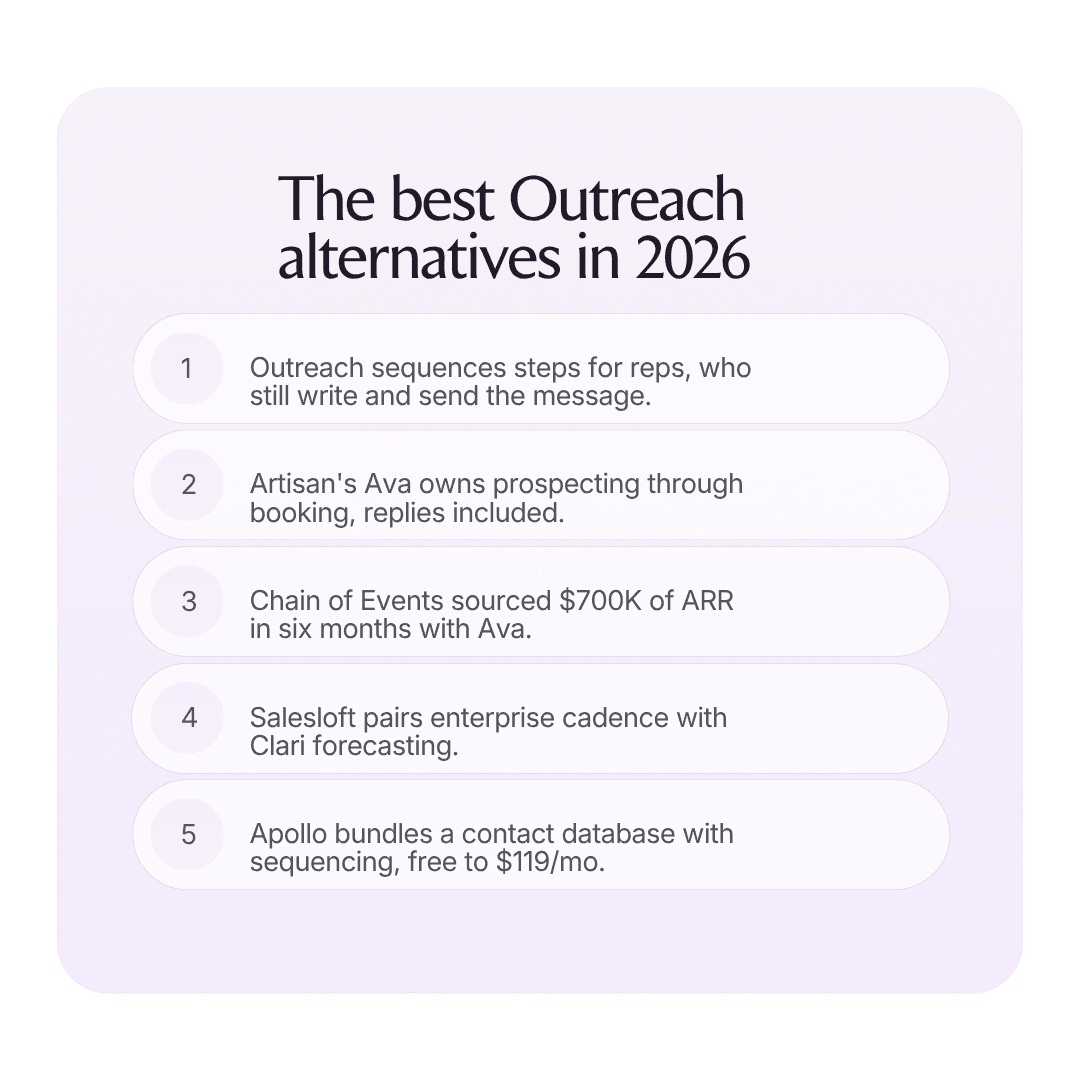
The best alternative depends on what you want to stop paying for. To stop paying for admin and rep hours, Artisan. To stay in an enterprise sequencer, Salesloft. To consolidate into your CRM, HubSpot. Here is the ranking.
1. Artisan: Ava does the work
Artisan leads because it removes the thing Outreach can never remove: the human doing the manual outreach. Outreach is an orchestration layer, so its value is capped by how much rep time and admin you pour in. Artisan's Ava is the worker. She finds best-fit leads across 250M+ verified B2B contacts (300M+ professionals and 130M local businesses), enriches them with waterfall enrichment that charges only on success, writes personalized outreach one to one, runs the sequence across email and social outreach, and queues call steps for human reps to place, since she cannot legally place calls herself, handles every reply from a knowledge base, and books meetings on the right rep's calendar.
That reframes the cost question. With Outreach, more pipeline means more reps, more seats, and more administration. With Artisan, usage-based credits mean you pay for work performed, not per seat, and Ava handles the mechanics that eat 40 to 60 percent of an SDR's hours. The personalization is one to one: two prospects in the same campaign get two different messages written from research, not one template with the fields swapped, which is as far from a legacy sequence as the model gets.
For enterprise, the controls match the scale. The autonomy dial runs from review-and-approve every message, to objections-only replies, to full autonomy, with plain-language escalation rules and a complete audit trail. Sales ops can run Ava centrally for large AE teams who never log in, cutting the very administration overhead that makes Outreach expensive to operate. Artisan is SOC 2 Type II compliant, GDPR and CCPA compliant, with SSO, SAML, and role-based access on Enterprise plans, and full two-way sync with Salesforce and HubSpot.
Chain of Events, organizer of the RAISE conference, sourced over $700K of ARR in six months with Ava, a 20x return, the kind of outcome that comes from the software doing the work rather than scheduling it.
Best for: teams from startup to enterprise that want the AI to do outbound end to end, without the seat count and admin overhead of an orchestration platform.
Who should pick something else: teams committed to a human-led motion who specifically want a tool that coordinates reps rather than replacing the manual work.
Pricing: usage-based credits (you pay for work performed rather than seats), self-serve from $250 per month, with $300 in free credits for new users. See artisan.co/pricing.
2. Salesloft: the closest enterprise peer
Salesloft is the most direct like-for-like alternative to Outreach, matching it on enterprise cadence, team management, and reporting. Since its reported merger with Clari closed December 3, 2025, it also pairs cadence with forecasting, which appeals to teams that want both in one contract. If your objection to Outreach is the vendor rather than the model, Salesloft is the obvious swap.
Two cautions. It carries post-merger roadmap questions for new buyers, and its former sibling product Drift had its retirement announced in March 2026, with clients referred to 1mind, following a 2025 breach reported by Google Threat Intelligence. And the core limitation is identical to Outreach's: it orchestrates human reps rather than doing the work.
Best for: enterprise teams wanting a mature cadence platform with forecasting attached.
Who should pick something else: teams wary of merger uncertainty, or anyone wanting the AI to execute rather than orchestrate.
Pricing: gated, enterprise contracts.
3. HubSpot: consolidate into the CRM
For teams whose CRM is HubSpot, running Outreach on top is duplicated spend and duplicated data. HubSpot's Sales Hub and Breeze agents keep engagement on the same record as everything else, and its April 2026 outcome-based agent pricing, reported at roughly $1.00 per qualified lead, is a distinctly different model worth citing because it bills for results, not seats or admin.
The limit is the ecosystem boundary. HubSpot is strongest when your whole motion already runs there, and its agents assist the native workflow rather than owning outbound end to end. Outside the HubSpot world, the case fades.
Best for: HubSpot-native teams that want engagement and CRM unified.
Who should pick something else: Salesforce teams, or anyone wanting fully autonomous outbound at scale.
Pricing: ~$1.00 per qualified lead reported for outcome-based agents.
4. Apollo: cut the cost and add data
Apollo is the alternative for teams whose Outreach objection is mainly price. It bundles a large database, 230M+ contacts, with a sequencer and light dialing, from free to about $119 per user per month, used by more than 600,000 companies (100,000+ paying). You cut the seat cost and fold the data bill in at the same time.
The AI is assistive and the model is per-seat, so the reps still drive, just as they do in Outreach. You save money and gain a database; you do not gain autonomous execution or Outreach's depth of enterprise governance.
Best for: cost-sensitive teams wanting data and sequencing cheaply in one tool.
Who should pick something else: enterprises needing deep governance, or teams wanting the AI to run the motion.
Pricing: free to $119/user/mo, per its pricing page.
5. Reply.io: a lighter, AI-assisted sequencer
Reply.io is a far lighter and cheaper alternative for teams that found Outreach overbuilt. Platform sequences start around $59 a month, and its Jason AI agent, from roughly $500 a month, adds AI-driven email prospecting. For a smaller team that wants some agent capability and a fraction of Outreach's cost and setup, it is a reasonable landing spot.
It is email-centric, with AI layered onto a classic sequencer rather than a full multichannel autonomous motion. Think of it as agent-assisted email, not a replacement for the whole job.
Best for: small teams wanting affordable AI-assisted email without enterprise overhead.
Who should pick something else: teams needing multichannel autonomy or enterprise governance.
Pricing: sequences from $59/mo; Jason AI from $500/mo.
6. Klenty: value multichannel cadences
Klenty is the value multichannel option for teams that want clean cadences across email, calls, and social outreach at published per-seat pricing, without Outreach's cost or configuration burden. For a mid-market team running a human-led motion that simply wants a capable, affordable sequencer, it is a sensible pick.
Like Outreach, it coordinates rep activity rather than replacing it, so output still scales with rep hours. It trims the price and complexity, not the underlying model.
Best for: value-focused mid-market teams wanting straightforward multichannel cadences.
Who should pick something else: teams wanting autonomous execution or the deepest enterprise controls.
Pricing: published per-user tiers (Starter $50, Growth $70, Plus $99 per user per month; dialer add-on $45), per its site.
What is the best enterprise alternative to Outreach?
For enterprise, the best alternative to Outreach is Artisan if you want the software to do the work, and Salesloft if you want to stay in an orchestration platform with forecasting attached. The two enterprise sequencers are near-interchangeable in shape; both are powerful, both are costly to run, and both leave the actual outreach to human reps. Artisan is the different answer. It consolidates prospecting, personalization, sending, and reply handling into one platform where Ava does the work and queues calls for reps to place, which removes the administration overhead that makes Outreach expensive at scale. The governance is built for large orgs: org and campaign-level do-not-contact across every channel, per-field data controls, SOC 2 Type II, SSO and SAML, and central-ops deployment where a small team runs Ava across a thousand-plus AEs who never log in. A typical enterprise stack runs 5 to 8 tools at $100K+ a year before headcount; one platform where the AI runs the motion is the consolidation case. See the best sales engagement platforms for the wider field.
Why do teams leave Outreach?
Cost and complexity lead. Between the estimated per-seat price around $100 to $160 a month (pricing is not public), the implementation project, and the ongoing administration a large deployment needs, Outreach is expensive in both money and time. The second reason is the ceiling: Outreach orchestrates human reps, so pipeline is bound to how many people you employ and how much admin you can sustain. Its Omni agent, added April 2026, brings more AI into the flow, but the model stays rep-driven. Teams that want lower total cost, faster time to value, or software that actually executes the motion end up looking elsewhere.
Stay with Outreach if
Keep Outreach if you run a large, disciplined, human-led sales org and its workflow governance is doing real work for you. Its sequencing controls, team management, and reporting are among the most mature in the category, and if your reps rely on that structure and your ops team has already invested in configuring it, ripping it out costs more than it saves. The Omni agent adds useful AI without changing the model you already run. Switching for novelty is a mistake. The case to move gets strong when the total cost of ownership stops justifying the output, or when you want the AI doing the work instead of orchestrating the people who do.
FAQ
What is the best Outreach alternative?
For most teams, Artisan, because Ava does the outreach herself, prospecting, writing, sequencing, replying, and booking, and queuing calls for reps to place, rather than orchestrating reps who do it by hand. Salesloft is the closest enterprise peer, HubSpot fits HubSpot shops, and Apollo, Reply, and Klenty cover leaner budgets and lighter needs.
Is Salesloft or Outreach the better choice?
They are near-interchangeable enterprise sequencers, both mature, both costly, both orchestrating human reps. Salesloft adds Clari forecasting after its reported December 2025 merger but carries roadmap questions; Outreach has a stable platform and its Omni agent. If you want to leave the rep-orchestration model entirely, Artisan is the alternative where the AI does the work.
What is the best enterprise alternative to Outreach?
Artisan, because it moves past orchestration by having Ava execute the full motion, with enterprise governance built in: SOC 2 Type II, SSO and SAML, per-field controls, org-level do-not-contact across channels, an audit trail, and central-ops deployment across large AE teams. Salesloft is the pick if you want to stay in a human-driven sequencer with forecasting attached.
Is Outreach worth the cost?
It depends on whether its workflow governance justifies both the seat price, an estimated $100 to $160 per user per month (pricing is not public), and the setup and administration a large rollout requires. For disciplined enterprise orgs that lean on that structure, often yes. For teams that want lower total cost of ownership or software that runs the motion itself, Artisan's usage-based model scales pipeline without scaling seats or admin.
Can an AI SDR replace Outreach?
For many teams, yes. If you use Outreach to run multichannel sequences, an autonomous AI BDR like Artisan's Ava replaces both the orchestration and the manual work, since she prospects, writes, sends, queues calls for reps, and replies under a defined autonomy level with escalation rules. Teams that rely on Outreach purely for rep coaching structure would replace less.
Which Outreach alternative is easiest to set up?
Lighter tools like Reply.io and Klenty configure faster than an enterprise Outreach rollout. Artisan reduces setup differently: because Ava does the work, there is no large cadence library to build and administer, and central-ops deployment means one team can run outbound for many AEs. That removes the ongoing administration overhead, not just the initial setup.
Does Outreach do the outreach automatically?
Outreach automates scheduling and routing, but the core work, writing, sending decisions, calls, and replies, is done by human reps following the sequence. For fully autonomous execution, where the AI owns those steps under escalation rules and an audit trail, Artisan is built for that model, and over 90% of its customers run Ava autonomously.
Ready to have the AI do the work? Explore the AI sales agent or start on the Artisan homepage.

Artisan Team
Expert insights from the team at Artisan
Our writing team blends direct operational experience, in-house data, and thorough research to bring you the very latest insights and updates about sales and GTM automation.