The best Leadfeeder alternatives in 2026
Leadfeeder, now Dealfront, tells you which companies visited. The best alternatives turn company-level identification into qualified, automated outreach.
Key Takeaways
- Leadfeeder is now Dealfront, the product formed when Leadfeeder and Echobot merged. It identifies visiting companies at the account level, strong in Europe and built for GDPR.
- Company-level identification tells you the account, not the person. That is the honest ceiling of EU visitor ID everywhere, Leadfeeder included.
- The buyer question is not "which company visited" but "who worked the visit." Most company-level tools answer the first and leave the second to your reps.
- Artisan identifies visitors company-level globally on a 3.7B-IP identity graph at a published 92% accuracy rate, adds person-level on US traffic, qualifies them, and has Ava run the follow-up across email, social, and calls queued for your reps.
- Realistic company-level match rates run 30-65% of traffic per independent tests, well below some vendor headline figures.
- Artisan bills on usage-based credits, not per seat, so identification and outreach stay one cost line rather than a stack of subscriptions.
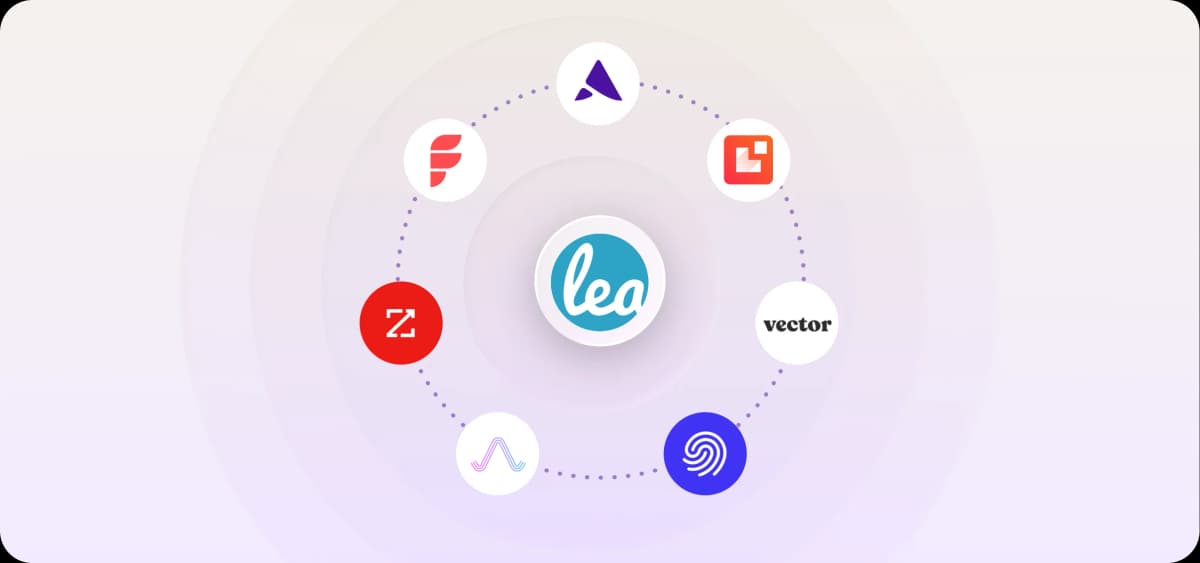
The best Leadfeeder alternative is Artisan. Leadfeeder, now folded into Dealfront, tells you which companies visited your site, EU-first and GDPR-compliant, then hands the list to your reps. Artisan identifies visitors, qualifies them against your ICP, and has Ava, its AI BDR, run the outreach automatically. Snitcher, Albacross, and Vector suit narrower needs.
How the Leadfeeder alternatives compare
Rank | Tool | Best for | Standout capability | Public pricing |
|---|---|---|---|---|
1 | Artisan | Turning identified visitors into booked meetings automatically | Company and person-level ID plus autonomous outreach in one platform | Usage-based credits; $300 free credits; from $250/mo (pricing) |
2 | Snitcher | GA4-connected company identification | Reveal tied to web analytics workflows | Published tiers (usage-based $49-$529/mo) |
3 | Albacross | EU company-level ID for demand-gen teams | European coverage with ad-audience export | Published tiers (Starter EUR59 / Pro EUR149/mo) |
4 | Leadinfo | Real-time company reveal for European SMBs | Live visitor feed with CRM connectors | Published tiers |
5 | Factors | Company ID tied to account analytics | Account journey and attribution reporting | Lite $199/mo; Basic $6K/yr; Growth $20K/yr; Enterprise from $30K/yr |
6 | Vector | Contact-level intent beyond a single site visit | Person plus intent data, month-to-month | $399-999/mo |
7 | ZoomInfo WebSights | Teams already standardized on ZoomInfo | Company ID inside a large data platform | Add-on to ZoomInfo; pricing not public (est. median ~$31,875/yr) |
Why do people look for a Leadfeeder alternative?
Two reasons dominate. The first is the merger. Leadfeeder became part of Dealfront when it combined with Echobot, and buyers who signed up for the lean, focused Leadfeeder now navigate a larger platform with different packaging and post-merger product questions. Some liked the old simplicity and want it back.
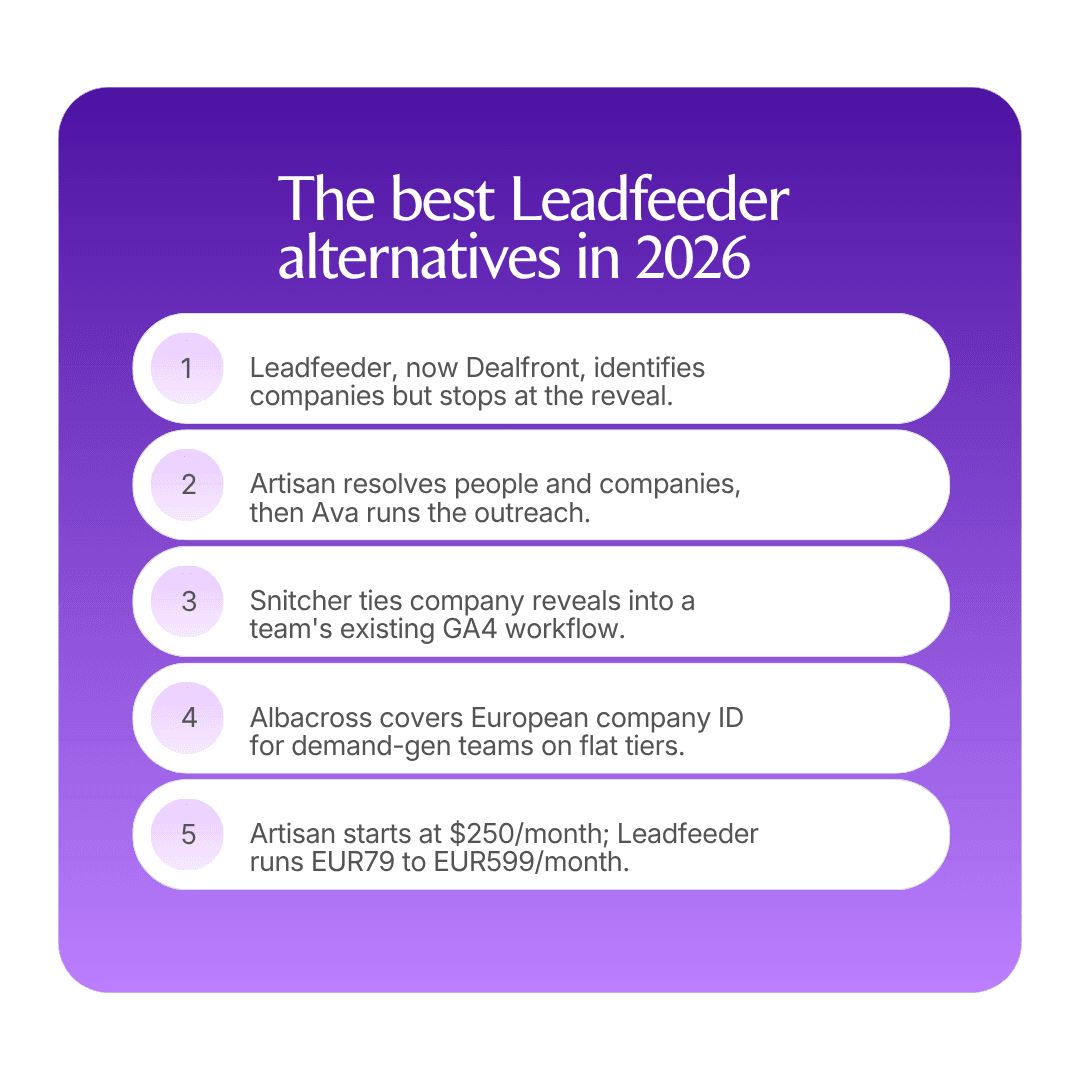
The second is the shape of what Leadfeeder does. It identifies visiting companies and shows the accounts hitting your pages, which is useful for a demand-gen or sales team. Then it stops. Someone has to open the list, decide which accounts fit, find the right contact, research the angle, write the message, and send it. That handoff is where most identified accounts quietly die.
There is also the ceiling every EU-first tool shares. GDPR keeps European identification at the company level, so you learn that Acme Corp visited, not who at Acme or why. Leadfeeder handles that reality about as well as anyone. It is still a reveal tool, not an outreach engine, and buyers who assumed "visitor identification" meant "more meetings" end up shopping for a second product to work the leads.
What is the best alternative to Leadfeeder?
Artisan, if you want the visit to end in a booked meeting rather than a row in a dashboard. Leadfeeder answers "which company is on my site." Artisan answers "which company and person are on my site, do they fit, and here is the outreach that already went to them." Below, Artisan first, then six genuine alternatives, each with who it is right and wrong for.
1. Artisan: identification that becomes outreach
Artisan is an AI-first outbound platform built around Ava, an autonomous AI BDR. Website visitor identification is one signal feeding her, not the product's ceiling. She identifies visitors at the company level globally on a 3.7B-IP identity graph with a published 92% accuracy rate, and at the person level on US traffic where privacy rules allow it. Identified visitors run through ICP qualification, and the accounts that fit flow into personalized multichannel campaigns across email, social, and call steps (Ava queues qualified calls for your reps to place; she cannot place calls herself).
The difference from Leadfeeder is the second half of the job. When a qualified account is identified, Ava finds the right contact, researches the company, writes a message specific to that buyer, and sends it, on the autonomy setting you choose: review-and-approve, objections-only, or fully autonomous. Artisan reports over 90% of customers run Ava autonomously. Ava Inbound adds a live chat agent on your site that greets and qualifies visitors and books meetings with CRM-owner routing, so the accounts ready to talk now get handled the moment they land.
CookUnity's head of B2B, Bruno Didier, reports roughly $45 cost per lead across 100,000-plus emails, describing outreach "at a scale we could never reach with a human-only team." That is company-level identification put to work, not parked in a list.
Best for: teams from startup to enterprise that want identified accounts converted into pipeline automatically, with governance and an audit trail sales ops can stand behind. Who should pick something else: a team that only wants a company reveal feed for its EU traffic and will handle all downstream work itself. That is a narrower job, and a focused reveal tool is cheaper for it. Pricing: usage-based credits; $300 in free credits for new users; self-serve from $250/mo. See artisan.co/pricing.
2. Snitcher: identification wired into analytics
Snitcher identifies visiting companies and connects cleanly to GA4, so the reveal sits next to the web analytics your marketing team already reads. For a team that wants account identification inside its reporting workflow, that integration is the draw. Pricing is published in usage-based tiers (roughly $49 to $529 per month by companies identified) on its site.
It is company-level and analytics-adjacent, which means the same ceiling: you learn the account, and a human still runs the outreach.
Best for: teams that want company identification tied to their web analytics. Who should pick something else: teams that want person-level US identification or automated follow-up after the reveal. Pricing: published tiers on its site.
3. Albacross: EU company-level for demand gen
Albacross is a European company-level identification tool popular with demand-gen teams, with the handy trick of pushing identified audiences into ad platforms. If your motion is account-based advertising as much as sales follow-up, that export is useful. Pricing is published on its site (Starter EUR59 / Professional EUR149 per month; Organisation on quote).
The trade-off is familiar. Company-level, EU-first, and reveal only. The activation happens wherever you route the data.
Best for: demand-gen teams that want EU company identification feeding both sales and ad audiences. Who should pick something else: teams that want the outreach itself automated rather than the audience exported. Pricing: published tiers on its site.
4. Leadinfo: real-time European reveal
Leadinfo is another EU-first company-level tool, known for a live visitor feed and a tidy set of CRM connectors. European SMBs like its real-time view and straightforward setup. Pricing is published in tiers.
Like its peers, it identifies and connects, but it does not write or send. The reaction is a rep's job.
Best for: European SMBs that want a live company reveal with simple CRM sync. Who should pick something else: teams that need person-level identification or automated outreach. Pricing: published tiers on its site.
5. Factors: identification tied to analytics and attribution
Factors links company-level identification to account journey analytics and attribution, so you can see how identified accounts move through the funnel. For a RevOps team that wants the reporting story as much as the leads, that is a real strength. Pricing is public: Lite $199/mo, Basic $6K/yr, Growth $20K/yr, and Enterprise from $30K/yr.
The ceiling is the category's: company-level identification and analytics, with activation left to whatever runs your outreach.
Best for: RevOps teams that want visitor ID connected to account analytics and attribution. Who should pick something else: teams that want person-level identification or automated follow-up. Pricing: published tiers on its site.
6. Vector: contact-level intent beyond your traffic
Vector goes past single-site identification to person-level and contact-level intent, so you see buying signals across the web, not just your own visitors. Pricing is month-to-month at $399-999, uncommon in a category that loves annual contracts.
It is a strong, flexible signal source, but it is still a source. You bring the system that acts on it.
Best for: teams that want intent signals beyond their own traffic without an annual commitment. Who should pick something else: teams that want identification and activation in one place. Pricing: $399-999/mo, month-to-month.
7. ZoomInfo WebSights: for existing ZoomInfo shops
If you already run ZoomInfo, WebSights adds company-level visitor identification inside the platform you have, with its large B2B dataset on hand for enrichment. ZoomInfo pricing is not public (annual contracts, three-seat minimum); reported figures are estimates, with a median contract around $31,875 per year and teams commonly landing between $30,000 and $60,000 per year.
It is company-level, and it is a data platform first with execution bolted on. Buyers note ZoomInfo's contract terms have a reputation worth reading closely.
Best for: teams standardized on ZoomInfo that want visitor ID without adding a vendor. Who should pick something else: teams wanting person-level US identification or built-in outreach. Pricing: add-on to ZoomInfo contracts; pricing not public.
What is the best enterprise alternative to Leadfeeder?
Artisan, and the enterprise case is where the gap widens. A company-level reveal list does not survive contact with a large sales org: there is no ICP qualification deciding which of thousands of daily accounts matter, no owner routing, no governance, no audit trail. Artisan runs the identify-to-outreach loop centrally. Sales ops can operate Ava for a large AE team who never log in, with plain-language escalation rules, do-not-contact enforcement across email, domain, social, and phone, and a full audit trail. Because pricing is usage-based rather than per seat, the cost of identification plus outreach stays flat as the team grows. Artisan is SOC 2 Type II compliant and GDPR compliant, with SSO, SAML, and role-based access on Enterprise plans, so it satisfies the same European governance bar Leadfeeder buyers care about, then does more with it.
How we chose these alternatives
Four criteria, in order. First, how much of the job the tool does: reveal alone, or reveal through qualification to sent outreach. Second, data and signal depth: company-level versus person-level, EU versus US coverage, and realistic match rates rather than headline numbers. Third, pricing transparency: published tiers beat demo-gated quotes. Fourth, deployment fit: startup, enterprise, or only the middle. Artisan ranks first because it is the only entry that does the whole job, and it still carries the honest note that a team wanting a bare EU company feed can buy cheaper.
Stay with Leadfeeder or Dealfront if
Keep Leadfeeder, now Dealfront, if your traffic is mostly European, you need GDPR-first company-level identification, and you have reps who reliably work the accounts it surfaces. It is built for exactly that reality, the European coverage is strong, and if the merger's larger platform gives you data you also want, that is a point in its favor rather than against. The moment those identified accounts pile up unworked, or you want the visit to end in a booked meeting without a human writing every message, that is your signal to move.
For the wider category, see our guide to the best website visitor identification tools and how Ava works as an AI BDR.
FAQ
What happened to Leadfeeder? Leadfeeder merged with Echobot to form Dealfront, so the Leadfeeder product now lives inside the larger Dealfront platform. It still does company-level website visitor identification, strong in Europe and built for GDPR, alongside Dealfront's broader data and prospecting features.
What is the best alternative to Leadfeeder? Artisan, for teams that want identification to end in a booked meeting rather than a list. It identifies visiting companies globally and people on US traffic, qualifies them against your ICP, and has Ava run personalized outreach automatically across email, social, and calls queued for your reps, with an inbound chat agent for accounts ready now.
Can any visitor tool identify EU visitors at the person level? No honest vendor can, and any that claims to is worth scrutinizing. GDPR keeps European identification at the company level. Person-level identification is a US phenomenon, and even there independent tests put realistic match rates at 5-20% of US traffic. Leadfeeder and Artisan both follow this constraint.
Is Artisan more expensive than Leadfeeder? They price differently. Leadfeeder charges subscription tiers for identification. Artisan uses usage-based credits with no per-seat charge, covering identification plus outreach in one line, with $300 in free credits for new users and self-serve access from $250/mo. If you would otherwise buy Leadfeeder plus a separate tool to work the accounts, the consolidated cost usually favors Artisan. See artisan.co/pricing.
What is the best enterprise alternative to Leadfeeder? Artisan. It runs identification and outreach centrally, so sales ops can operate it for a large AE team with owner routing, escalation rules, do-not-contact enforcement, and an audit trail. It is SOC 2 Type II and GDPR compliant with SSO and role-based access on Enterprise plans. A reveal-list model does not scale to that governance.
Do I still need a separate outreach tool with Artisan? No. Artisan is a full outbound platform, so identification, ICP qualification, personalized multichannel outreach, reply handling, and meeting booking happen in one place. Ava owns that workflow end to end at the autonomy level you set, which is the core difference from a reveal tool like Leadfeeder.
How accurate is company-level visitor identification really? Independent tests put realistic company-level match rates at 30-65% of traffic, below some vendor headline claims. Artisan publishes a 92% accuracy rate on the matches it makes against its 3.7B-IP identity graph, and qualifies identified accounts against your ICP before Ava acts, so reps spend time only on accounts that fit.

Artisan Team
Expert insights from the team at Artisan
Our writing team blends direct operational experience, in-house data, and thorough research to bring you the very latest insights and updates about sales and GTM automation.