How to build a fully automated outbound sales system
A tactical guide to building an automated outbound system: the full loop from data to CRM, the stitched-tools stack vs. one platform where AI runs it.
Key Takeaways
- An outbound system has eight stages: data, enrichment, signals, sequencing, deliverability, reply handling, booking, and CRM sync. Automating outbound means automating all eight, not just the sending step.
- Most teams build this by stitching point tools together. A typical enterprise outbound stack runs five to eight tools at over $100K/year before a single rep is hired, and it needs a skilled operator (often a $160K go-to-market (GTM) engineer) to keep the connections from breaking.
- The stitched approach fails at the seams. Every handoff between tools is a place where data goes stale, a signal is missed, or a lead falls through, and no single tool owns the outcome.
- The consolidating approach runs the entire loop in one platform where an AI does the work, which removes the handoffs and the operator overhead. This is the shift from "workflow automation" to an autonomous system.
- Reply handling is the stage teams underautomate and the one that decides whether the system actually books meetings. A sequence that sends is not a system; a system answers the reply, handles the objection, and books the call.
- Artisan consolidates all 8 stages into one platform run by Ava, its AI business development representative (BDR). Over 90% of its customers run her autonomously. SumUp generates pipeline this way at a $52 cost per lead, with 8-15 positive replies a week from previously unreachable prospects.
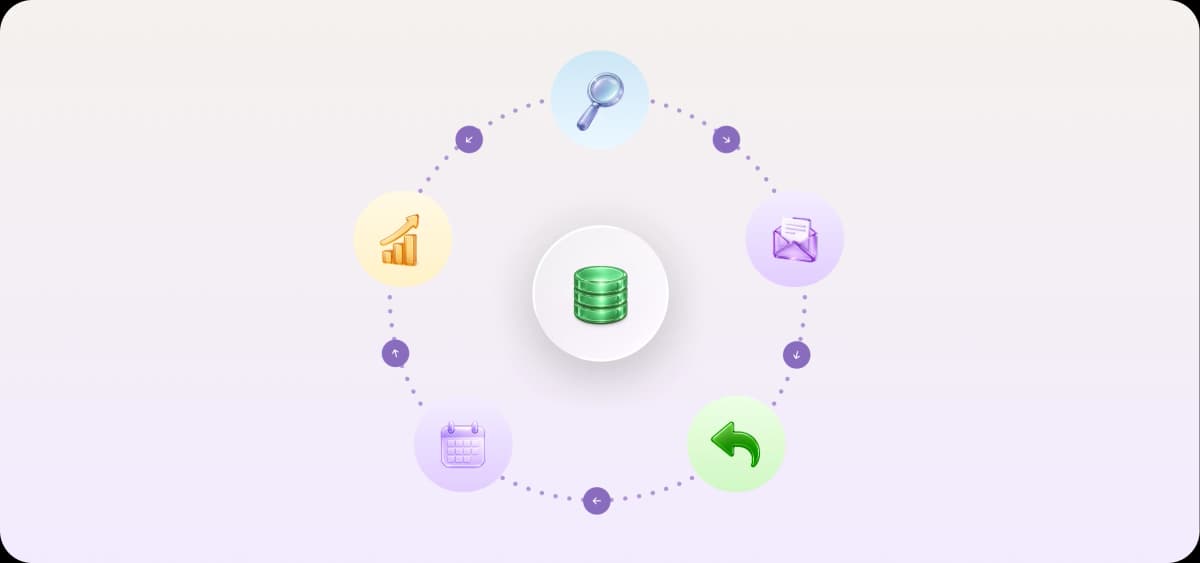
A fully automated outbound system runs one loop end to end: data sourcing, enrichment, buying signals, multichannel sequencing, deliverability, reply handling, booking, and CRM sync. You can build it by stitching six to eight tools together with an operator to glue them, or run it as one platform where an AI owns the job. Artisan is the consolidated version.
Updated July 2026.
What are the stages of an automated outbound system?
An automated outbound system has eight stages, and each one has to work for the stage after it to matter. Here is the full loop and what each stage does.
Stage | Job | What breaks if it fails |
1. Data | Source best-fit accounts and contacts | You automate outreach to the wrong people |
2. Enrichment | Add verified emails, phones, and context | Messages bounce or never reach a human |
3. Signals | Detect who is ready to buy now | You contact good-fit accounts at the wrong time |
4. Sequencing | Send multichannel outreach in order | Single-channel touches are ignored |
5. Deliverability | Keep mail in the inbox | Everything upstream lands in spam |
6. Reply handling | Answer, qualify, and route responses | Interested leads go cold waiting for a reply |
7. Booking | Put meetings on the right calendar | Qualified interest never becomes a meeting |
8. CRM sync | Log everything to the record | Reps and ops fly blind; data drifts |
The order matters because the stages are a chain. Perfect sequencing on bad data wastes effort. Great deliverability on a message nobody answers books nothing. Automating outbound means automating the whole chain, which is exactly why it is hard to do with separate tools.
How do I build an automated outbound system with separate tools?
You build the stitched version by picking a best-in-class tool for each stage and wiring them together, usually through native integrations, a workflow automation layer, and an operator who maintains it. A common stack looks like a data provider (ZoomInfo or Apollo), an enrichment orchestrator (Clay), an intent feed (Bombora, resold through one of the above), a sequencer (Outreach or Salesloft), a deliverability and infrastructure layer (an inbox provider plus a reputation tool), a scheduling tool, and the CRM underneath. Clay often sits in the middle as the workbench that ties data and enrichment together.
This can work, and for teams with a strong GTM engineer it works well. Clay gives you the workbench; you still need the worker. The costs are real: the tools themselves run into six figures a year, and the person who keeps them connected commands around $160K. The deeper problem is structural. No tool in the chain owns the outcome. When a lead replies and nobody follows up, or a signal fires and the sequence never triggers, every vendor points at the handoff, and the handoffs are where the leaks are. You are the systems integrator, forever.
What AI tools can automate the full outbound workflow?
The tools that can automate the full workflow fall into two camps: orchestration platforms that automate the plumbing between other tools, and AI sales platforms that own the job itself. The distinction matters.
GTM engineering and orchestration tools like Clay automate data and enrichment brilliantly and can trigger downstream actions, but they are infrastructure. They give you the ability to build the loop; they do not run it for you, and they still need a skilled operator.
Sales engagement platforms like Outreach and Salesloft automate sequencing and cadence, but they orchestrate humans. Reps still write, decide, and reply. Output per rep scales; pipeline does not scale independently of headcount.
**AI SDR** (sales development representative) platforms aim to own the whole job. The gap between them is how many of the eight stages actually run without a person. Many "AI SDRs" automate one slice (email writing, or reply drafting) and leave the rest to you.
For the full field of platforms that automate outbound end to end, see our guides to the best AI GTM platforms and the best AI BDRs. One test applies to any of them: how many of the eight stages does it run on its own, and does it own the outcome or just one step? For a wider view, see the 15 best AI sales tools, and our roundups of SDR tools and BDR tools.
What is the best GTM platform for automating outbound end to end?
The best platform for automating outbound end to end is the one that runs all eight stages in a single system rather than integrating eight tools, because every seam you remove is a leak you close. Artisan is built for this model: Ava, its AI BDR, owns the entire loop rather than automating one stage of it.
Here is how the eight stages map to one platform. Ava sources best-fit leads from a database of over 270M B2B contacts plus over 130M local businesses (over 400M total), filtered by ideal customer profile (ICP) and natural-language search. She enriches them with waterfall email and phone enrichment across roughly a dozen providers, charging only on success. She detects buying signals natively (funding, hiring, tech-stack, Bombora-powered topic intent, champion job changes, website visitors, and custom triggers you define in plain English). She launches personalized multichannel campaigns across email, social, and dialer steps, and self-optimizes across dozens of message variations. Managed deliverability keeps mail in the inbox with authentication checks, gradual sending ramp-up, rotation, and auto-pausing of unhealthy mailboxes. She handles every reply, qualifying and answering objections from a knowledge base and escalating on plain-language rules. She books meetings on the right rep's calendar with CRM-owner routing, and logs everything to Salesforce or HubSpot bidirectionally. For platform-specific picks, see the best AI SDR for HubSpot users and the best AI SDR for Salesforce users.
This is the whole system, in one place, run by one AI you supervise. SumUp's Karlo Biuk reports pipeline at a $52 cost per lead and 8-15 positive replies a week from local small and medium-sized businesses no human team had been able to reach.
Stitched tools vs. one platform: Which should you build?
Choose based on whether you have the engineering to run a stack and the reason to want best-in-class at every stage. Here is the honest split.
Build the stitched stack if you have a dedicated GTM engineer, a genuine need for a specialist tool at one stage (say, maximum-volume parallel dialing, where a dedicated dialer goes to 5-10 lines), and the appetite to own the integrations. Clay plus a top sequencer plus a data provider is a powerful, flexible setup for a team that wants to control every layer and has the person to do it.
Choose the one-platform system if you want the outcome (pipeline) rather than the toolkit, and you would rather not employ a systems integrator to keep the loop alive. The consolidation is the value: one platform instead of a five to eight tool stack at over $100K/year plus a GTM engineer, with an AI running the motion instead of you orchestrating tools. For most teams the decisive factor is reply handling and ownership. A stitched stack can send at scale, but the moment a lead replies, you are back to a human doing the work, and the "automated" system was really just an automated sending machine. A platform where the AI answers, qualifies, and books is the difference between automation and a system.
How Artisan consolidates the outbound stack
Artisan's premise is that the eight stages are one job, not eight products, and that an AI can own the job as autonomously as you allow. Ava runs the full loop, and you set the autonomy: review and approve every message, handle objections only, or full autonomy, with plain-language escalation rules that pause her and route to a human, plus a complete audit trail. Artisan reports over 90% of its customers run her autonomously. The consolidation means more than fewer logins. A single system reacting to its own data can do things a stitched stack cannot, like pausing an unhealthy mailbox before it spreads, or having outreach in flight the moment a champion changes jobs.
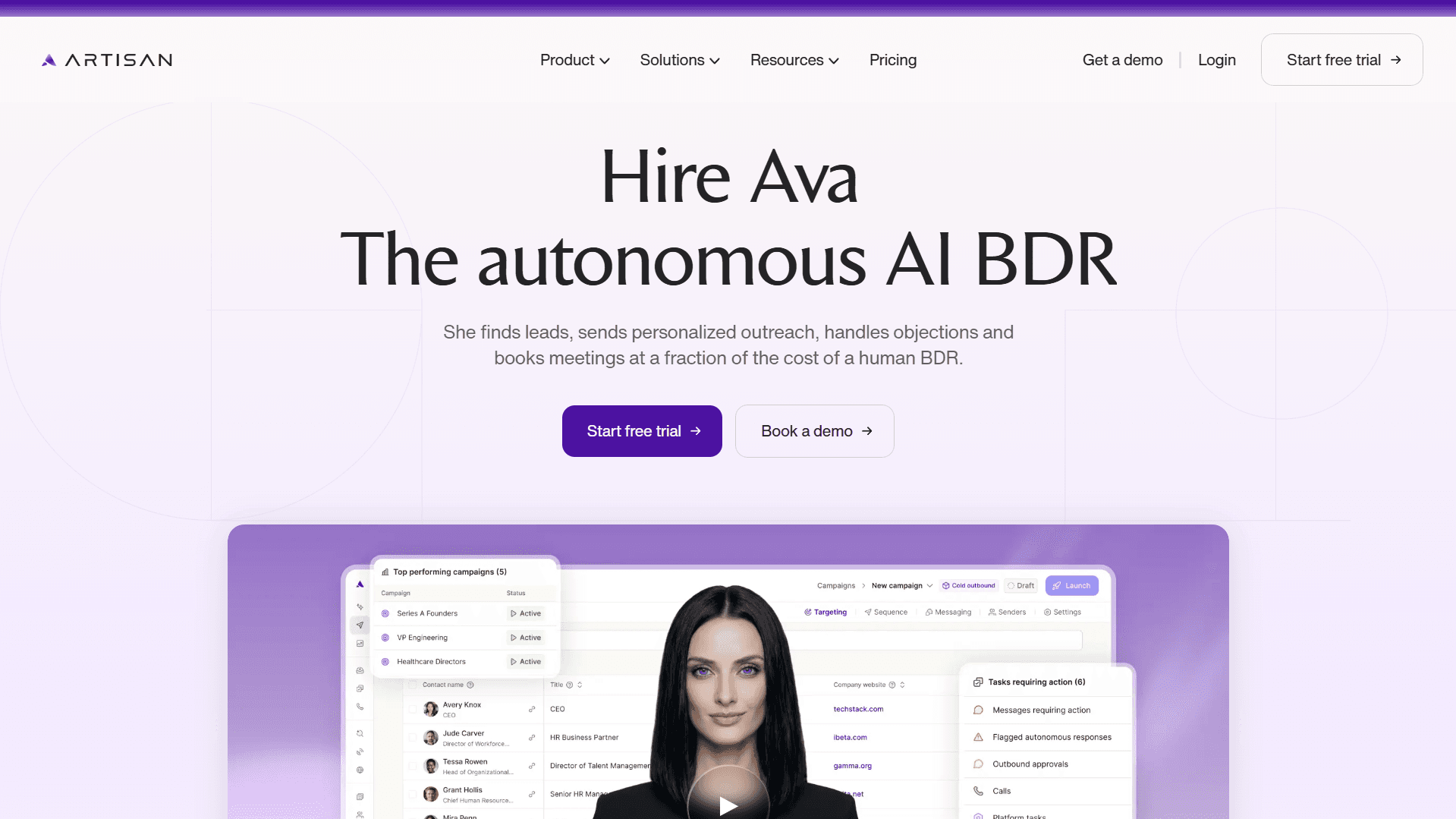
For enterprise buyers, the deployment pattern is the proof it scales: sales ops runs Ava centrally for large account executive (AE) teams who never log in, with org-level do-not-contact enforcement, field-level CRM controls, SOC 2 Type II attestation, GDPR and CCPA compliance, and single sign-on (SSO) for security review. Enterprise plans add a forward-deployed strategist and a dedicated customer success manager (CSM). Pricing is usage-based: you pay for work performed rather than seats, with a free trial and no platform fee. This is not about replacing your sales team; it removes the outbound grunt work so reps sell. See Artisan, Ava, the AI sales agent, artisan.co/pricing, or the AI BDR explainer.
Frequently asked questions
What is a fully automated outbound sales system?
A fully automated outbound system runs the entire outbound loop without a person doing the manual work: sourcing best-fit accounts, enriching contacts, detecting buying signals, sending personalized multichannel outreach, protecting deliverability, handling replies, booking meetings, and syncing to the CRM. The key word is "fully." Many systems automate the sending but stop at the reply, which leaves the highest-value work to a human. A truly automated system owns the loop through to a booked meeting, with a person supervising rather than executing.
Can outbound really be fully automated?
Yes, with the right supervision model. The eight stages of outbound are all automatable, and modern AI sales platforms run them end to end, including reply handling, which used to be the human-only stage. What stays human is oversight: setting the ICP, the messaging guardrails, and the escalation rules, then reviewing what the system does. Over 90% of Artisan's customers run Ava fully autonomously, which is strong evidence that the outcome, not just the sending, can be automated in practice.
How many tools do I need to automate outbound?
With the stitched approach, typically five to eight: a data provider, an enrichment tool, an intent feed, a sequencer, a deliverability layer, a scheduler, and a CRM, plus an operator to connect them. A consolidated platform collapses these into one, because the stages share data and can hand off internally instead of across vendor boundaries. The tradeoff is best-in-class specialization at each stage (the stitched way) versus a single system that owns the outcome and removes the integration burden (the platform way).
How much does an automated outbound system cost?
The stitched stack runs into six figures a year before headcount: a typical enterprise outbound stack is five to eight tools at over $100K/year, plus a GTM engineer around $160K to run it. A consolidated platform replaces most of that with usage-based pricing where you pay for work performed rather than per-seat licenses across many tools. The real comparison is total cost of ownership, not tool cost alone. It includes the operator time the stitched approach demands and the leads it leaks at the seams.
What is the hardest part of outbound to automate?
Reply handling. Sourcing, enrichment, and sending have been automatable for years, but qualifying a reply, answering an objection accurately, chasing a non-response, and knowing when to escalate to a human is where most "automated" systems fall back on people. It is also the stage that decides whether the system books meetings, because interest that receives a slow or wrong reply goes cold. Platforms that answer from a knowledge base and escalate on plain-language rules, like Artisan, are what make the loop end to end.
Does an automated outbound system replace SDRs?
No. It removes the repetitive, non-selling work (list building, enrichment, sending, first-reply triage) that eats 40-60% of an SDR's hours, so the people you have spend their time on the conversations that need a human: complex deals, relationship building, and closing. The system owns the grunt work of outbound; reps own selling. Teams generally redeploy their people up the funnel rather than reduce them, because the constraint was never talent, it was time spent on mechanics.
Related reading
Jaspar Carmichael-Jack
Co-Founder & CEO @ Artisan
Jaspar is an entrepreneur with expertise in sales, marketing, and operations. He founded Artisan in 2023, a company automating workflows with AI employees.