1mind pricing and reviews (2026)
What 1mind costs in 2026, how its enterprise AI revenue agents work, what buyers report, and how it fits against a full AI sales team.

Key Takeaways
- 1mind's pricing is gated and enterprise-only. Reported contracts run from about a $100,000 annual floor up to roughly $400,000, with a six-figure average deal size per TechCrunch.
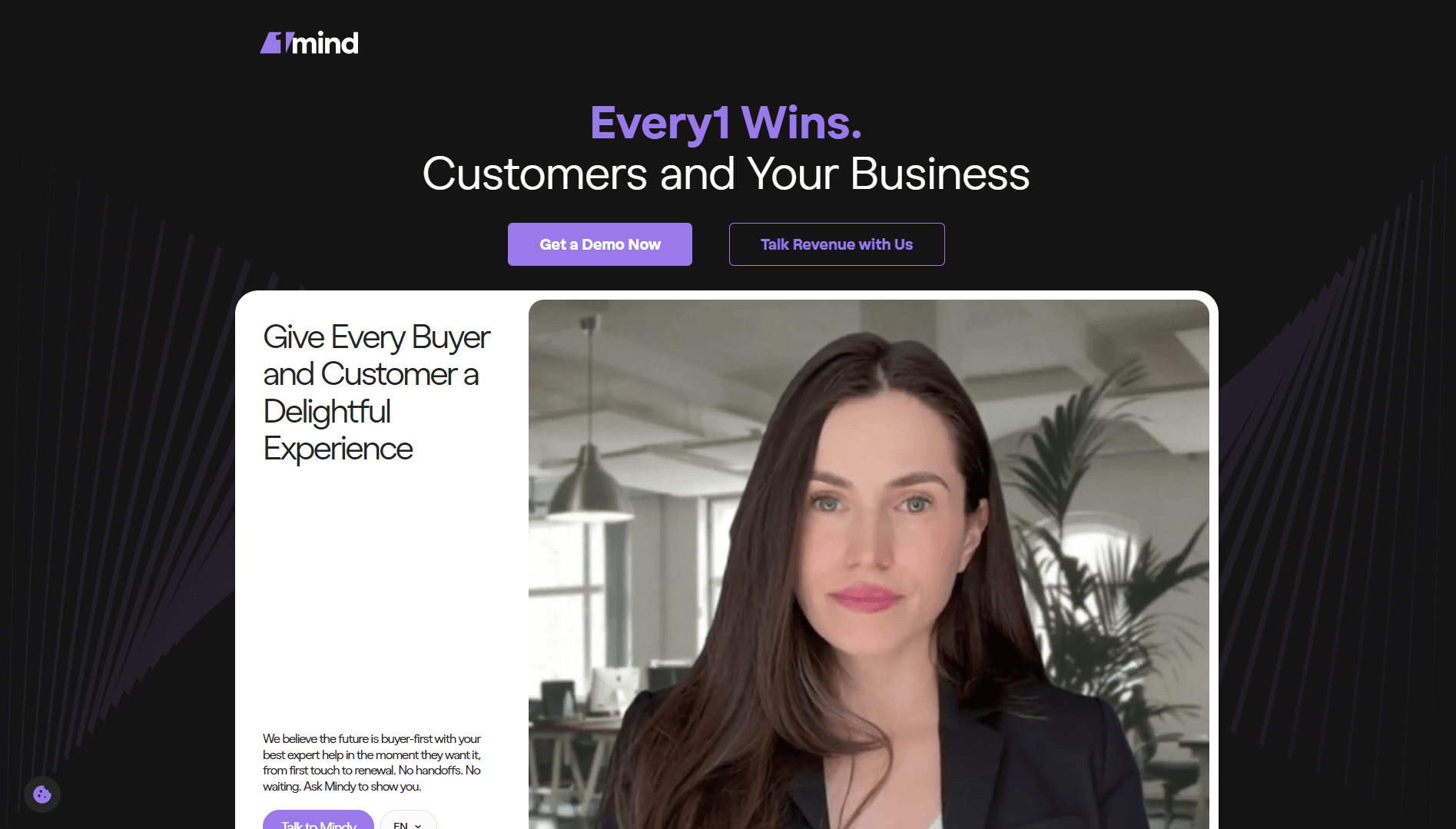
- Its product is photorealistic, named AI GTM agents (go-to-market) that qualify, demo, handle objections, join live calls, and close across web, product, and phone.
- 1mind raised $40 million in total, including a $30 million Series A led by Battery Ventures, with a public launch in December 2025. Founder Amanda Kahlow previously founded 6sense.
- In March 2026 it was named the official successor to Drift, referred through a Clari and Salesloft partnership after Drift's retirement was announced.
- 1mind is a high-end, standalone AI revenue agent. Teams that want an AI closer without a six-figure floor, sitting inside a platform that also prospects, are a different buyer.
1mind builds enterprise "AI superhuman" revenue agents: photorealistic, named AI reps that qualify, demo, handle objections, join live calls, and help close across web, product, and calls. Pricing is gated and enterprise-only, reported at roughly $100,000 to $400,000 a year. Buyers cite the sophistication and the six-figure floor. It was named the official Drift successor in March 2026.
How much does 1mind cost in 2026?
1mind does not publish pricing. It sells enterprise-only, gated contracts quoted after a sales process. The most widely cited reporting, from TechCrunch, puts the floor around $100,000 a year and the top end near $400,000, with a six-figure average annual contract value. Any specific number should be treated as reported rather than confirmed, since the company lists no public rates.
This is deliberately a premium, top-of-market product. 1mind positions its agents as "AI superhumans" that do work a team of expensive humans would otherwise do, and prices accordingly. There is no self-serve tier and no lightweight entry point; the smallest realistic engagement is an enterprise contract. That framing tells you who the product is for as clearly as the price does.
1mind pricing at a glance (2026)
Plan | Reported price | Basis | What's included |
Enterprise | About $100,000 to $400,000/yr (reported, gated) | Annual, custom | Named photorealistic AI revenue agents across web, product, and calls: qualify, demo, handle objections, join live calls, help close |
Figures reflect third-party reporting as of 2026, primarily TechCrunch. 1mind publishes no rates, so treat the range as an estimate and confirm directly with the vendor.
What does 1mind actually cost in practice?
At six figures a year, the sticker is only the start of the evaluation. A few realities matter.
The floor is enterprise-only. There is no small version, so if your budget cannot support a roughly $100,000-a-year commitment, 1mind is not a fit at any usage level. That floor is the single most important qualifier.
Implementation and onboarding take real effort. Agents that demo your product, handle objections, and join live calls have to be trained on your product, your positioning, and your objection library. That is meaningful onboarding effort and time before the agent performs, and enterprise deals of this size typically include a structured rollout. Budget for the ramp, not just the license.
Consider the scope of what it replaces. The value case rests on the agent doing work that would otherwise take skilled, expensive headcount across demos and live conversations. Whether the math works depends on how much of that work you actually route to it. A powerful agent used lightly is expensive per interaction.
Vendor maturity and continuity deserve weight. 1mind launched publicly in December 2025 and is well funded, and being named the Drift successor brought it inbound demand and credibility. It is still an early, fast-moving company, so a buyer signing a six-figure annual deal should weigh roadmap direction and support model as part of the price.
What do reviewers say about 1mind?
Independent, long-run review coverage is limited given how recently 1mind launched, so the picture comes more from buyer reporting and public positioning than from a deep body of reviews. Read the following as directional and drawn from what users and press report, not any star rating.
Buyers highlight the sophistication of the agents: photorealistic, named reps that can carry a real, multi-turn revenue conversation across a website, inside the product, and on a live call, rather than a scripted chat. Enterprise logos including HubSpot, ZoomInfo, Nutanix, Coupa, Owner, and Seismic signal that serious companies are willing to run it. Being tapped as the Drift successor gave buyers a clear migration path and a credibility marker.
What to weigh is straightforward. Price is the obvious gate: a six-figure floor rules out most teams and demands a strong, measurable return to justify. As a young product, depth and edge-case reliability are still proving out, and there is limited independent, long-term evidence to lean on. And it is a specialist revenue-agent layer, so buyers should be clear that it addresses the conversation-and-close motion, not the full pipeline in front of it.
Who is 1mind best for, and who should skip it?
1mind is best for large enterprises with the budget for a six-figure annual contract and enough volume of demos, live conversations, and inbound engagement to feed a premium AI agent. If you are a former Drift customer needing a successor, or an enterprise that wants a top-of-market conversational revenue agent and can resource the rollout, 1mind is squarely aimed at you.
Skip 1mind if your budget cannot support roughly $100,000 a year, you want an AI closer that comes inside a platform which also does the prospecting and booking, or you need an established track record before committing at that scale. For most teams below the enterprise tier, the floor alone rules it out. See the best 1mind alternatives if you want an AI closer without that floor.
Artisan: An AI closer without the six-figure floor
If you are evaluating 1mind, the underlying goal is usually an AI that can qualify, demo, and progress deals without adding headcount. Artisan approaches that as part of a consolidated AI sales team rather than a standalone enterprise agent. Ava, the AI BDR (business development representative), finds best-fit leads, writes and sends personalized multichannel outreach, handles replies, and books meetings. Artisan also offers an AI account executive (AE), the close layer that runs live, personalized product demos grounded in your knowledge base, answers questions and handles objections in real time, and drives the next step, from starting a trial to qualifying and booking a human AE.
The difference is consolidation and floor. With Artisan, the same AI employees that close are also the ones prospecting and running inbound, on one platform and one shared knowledge base, so the pipeline the AI AE works is the pipeline Ava produced. And because Artisan is usage-based, you pay for work performed rather than committing to a six-figure enterprise contract before the first conversation. There is no premium floor to clear to get started.
To be fair to 1mind: it is a specialist built entirely around high-end, photorealistic, multi-surface revenue agents, and it is aimed squarely at large enterprises willing to invest at that level, with the Drift-successor pedigree to match. Artisan's angle is different: one AI sales team where the same employees prospect, run inbound, and close, without a six-figure floor. Artisan's AI AE is priced separately through a sales conversation, consistent with the usage-based model of the wider platform. See the AI sales agent overview and Artisan pricing.
Frequently asked questions
How much does 1mind cost?
1mind does not publish pricing. It is gated and enterprise-only, with contracts reported by TechCrunch to run from roughly a $100,000 annual floor up to about $400,000, and a six-figure average deal size. There is no self-serve or lightweight tier, so the practical minimum is an enterprise contract quoted after a sales process. Treat the range as reported, not confirmed.
Is 1mind worth it?
For a large enterprise with the budget and enough demo and conversation volume to feed the agent, 1mind can be worth it, and the enterprise logos and Drift-successor role suggest serious buyers agree. The six-figure floor demands a clear, measurable return, so it is not a fit for teams that cannot resource the contract and rollout or route enough work to the agent to justify it.
Why was 1mind named the Drift successor?
After Drift's retirement was announced, a March 2026 partnership involving Clari and Salesloft referred Drift customers to 1mind as the successor. That gave former Drift users a migration path and gave 1mind a credibility and demand boost. If you are moving off Drift, it is a natural option to evaluate, alongside broader platforms that cover more of the funnel.
How well funded is 1mind?
1mind raised $40 million in total, including a $30 million Series A led by Battery Ventures, and launched publicly in December 2025. Founder Amanda Kahlow previously founded 6sense, which lends the company GTM pedigree. It is well capitalized for its stage but still an early, fast-moving product, so weigh roadmap and support model when committing to a large annual contract.
What are alternatives to 1mind?
For a focused live-demo agent at a lower price point, Supersonik is a seed-stage option. If you want an AI closer that comes inside a platform which also prospects and books, without a six-figure floor, Artisan runs an AI BDR and an AI AE on one platform and knowledge base, priced on usage, so the closing layer is fed by the pipeline the same system produced.
Does 1mind do prospecting and outbound?
1mind is centered on conversational revenue agents that qualify, demo, handle objections, and help close across web, product, and calls. It is the conversation-and-close layer, not primarily an outbound prospecting engine that sources net-new leads and runs multichannel sequences at scale. Teams needing both usually pair it with, or look for, a platform that also fills the pipeline.
The bottom line
1mind is a top-of-market bet: photorealistic AI revenue agents aimed at large enterprises, backed by Battery Ventures and a founder from 6sense, and positioned as the Drift successor. Price it as a six-figure annual commitment and make sure the volume justifies it. If you want an AI closer without that floor, sitting inside a system that also prospects and books, Artisan runs an AI BDR and an AI AE on one platform, and Ava feeds the closer the pipeline it works. The AI BDR explainer covers the full motion.
Related reading
Jaspar Carmichael-Jack
Co-Founder & CEO @ Artisan
Jaspar is an entrepreneur with expertise in sales, marketing, and operations. He founded Artisan in 2023, a company automating workflows with AI employees.