How to identify anonymous website visitors and turn them into pipeline
A tactical guide to de-anonymizing website traffic: pixels and identity graphs, person vs. company-level match rates, privacy rules, and how to activate.

Key Takeaways
- Most of your website traffic is anonymous. Identifying it means resolving an IP address and browser fingerprint against an identity graph, either to the company (works globally) or to the individual person (US-centric, for privacy reasons).
- Match rates are lower than vendors imply. Independent tests put company-level identification at 30-65% of B2B traffic and person-level at 5-20% of US traffic, with international person-level near zero.
- Person-level identification is US-only for every honest vendor, because GDPR keeps the EU at company-level and a CIPA pixel-litigation wave in California has raised the stakes on consent. Any tool promising person-level data on European traffic is a red flag.
- Identification is the easy 20% of the job. The pipeline comes from the other 80%: qualifying whether an identified visitor fits your ideal customer profile (ICP), enriching contacts, and reaching out while intent is fresh.
- Most tools stop at identification and drop a name into Slack, leaving a rep to do everything else. The gap between "we know who visited" and "we booked a meeting" is where visitor-ID programs quietly fail.
- Artisan resolves visitors person-level on US traffic and company-level globally on a 3.7-billion-IP identity graph with a published 92% accuracy rate, then qualifies and runs the outreach automatically, with Ava Inbound catching visitors who want to talk on the spot.
You identify anonymous website visitors with a tracking pixel and an identity graph that matches visits to companies (globally) or individual people (US traffic only). Realistic match rates run 30-65% company-level and 5-20% person-level. The pipeline comes from what happens next: qualifying the fit and reaching out fast. Artisan identifies, qualifies, and runs the outreach in one system.
How can I identify anonymous website visitors?
You identify anonymous visitors by placing a tracking pixel on your site that captures signals from each visit (IP address, device and browser characteristics, and sometimes a cookie), then matching those signals against an identity graph: a large database that maps those signals to companies and, in some cases, people. When a visit matches, you learn either which company the visitor works for or, on US traffic, which specific person they are, along with the pages they viewed and how often they returned.
Two things determine how well this works: the size and freshness of the identity graph, and where your traffic comes from. A bigger graph resolves more visits. US traffic resolves at the person level, and most other traffic resolves only to the company. Everything else in a visitor-ID program is built on top of this match, so graph quality matters most, and it is what vendors are least transparent about.
What is the difference between person-level and company-level identification?
Company-level identification tells you an organization visited: "someone at Acme Corp read your pricing page twice this week." Person-level identification tells you the individual: their name and a way to reach them. This difference is not a feature toggle. It is a hard constraint set by data availability and privacy law.
Company-level works globally by resolving a visitor's IP address to the organization that owns it. It is the more reliable and widely available method, and it is what you receive on European and most international traffic.
Person-level resolves a visitor to a named individual, which requires a much larger consumer-grade identity graph and only works at meaningful rates on US traffic. Outside the US, and especially in the EU, person-level identification is near zero and legally fraught, so honest vendors do not offer it there.
For B2B outbound, company-level is often enough. Knowing a target account is on your pricing page tells you where to focus, even without a name. Person-level is more actionable when you can obtain it, because you can reach the exact human showing intent, but treat any tool claiming high person-level rates on non-US traffic with suspicion.
What are realistic website visitor match rates?
Realistic match rates are lower than the numbers on most vendor homepages. Independent testing puts company-level identification at 30-65% of B2B traffic and person-level at 5-20% of US traffic, with international person-level effectively at zero. A vendor advertising "70% identification" is usually quoting a best case on ideal traffic, or blending company and person-level rates into one flattering figure.
Identification type | Realistic match rate | Coverage |
Company-level | 30 to 65% of B2B traffic | Global |
Person-level | 5 to 20% of US traffic | US-centric |
Person-level, international | Near 0% | Not viable |
Set expectations accordingly. If a fifth of your US traffic resolves to a person and half of your traffic resolves to a company, this is a strong, working program rather than an underperforming one. The point is to build your pipeline math on real rates so the channel earns its place instead of disappointing against an inflated promise.
Is website visitor identification legal? GDPR and CIPA
Website visitor identification is legal when done within the applicable privacy rules, but those rules vary sharply by region and are the reason person-level identification is US-only. Two frameworks matter most.
GDPR governs the EU and treats personal data, including data that identifies an individual from their web activity, as requiring a lawful basis and, in practice, consent. This is why reputable tools resolve EU traffic only to the company level: a company is not a person, so company-level identification sits on firmer legal ground. Any vendor offering person-level data on EU visitors is taking a risk you probably do not want to inherit.
CIPA, California's wiretapping statute, is behind a wave of pixel-tracking litigation arguing that certain tracking technologies capture communications without consent. It has made US consent practices, cookie banners, and privacy disclosures a real consideration rather than a formality.
The practical guidance is straightforward. Use a vendor with a clear privacy and compliance posture, keep person-level identification to US traffic, honor consent signals, and make sure your outreach respects unsubscribe and do-not-contact rules. This is a place where the cheap, aggressive tool is a liability, and the compliant one is the enterprise-safe choice.
How do I turn identified visitors into outbound leads?
Identification is the start, and the pipeline comes from what you do in the hours after a visit. The method is the same loop that governs all signal-based selling, applied to your own traffic.
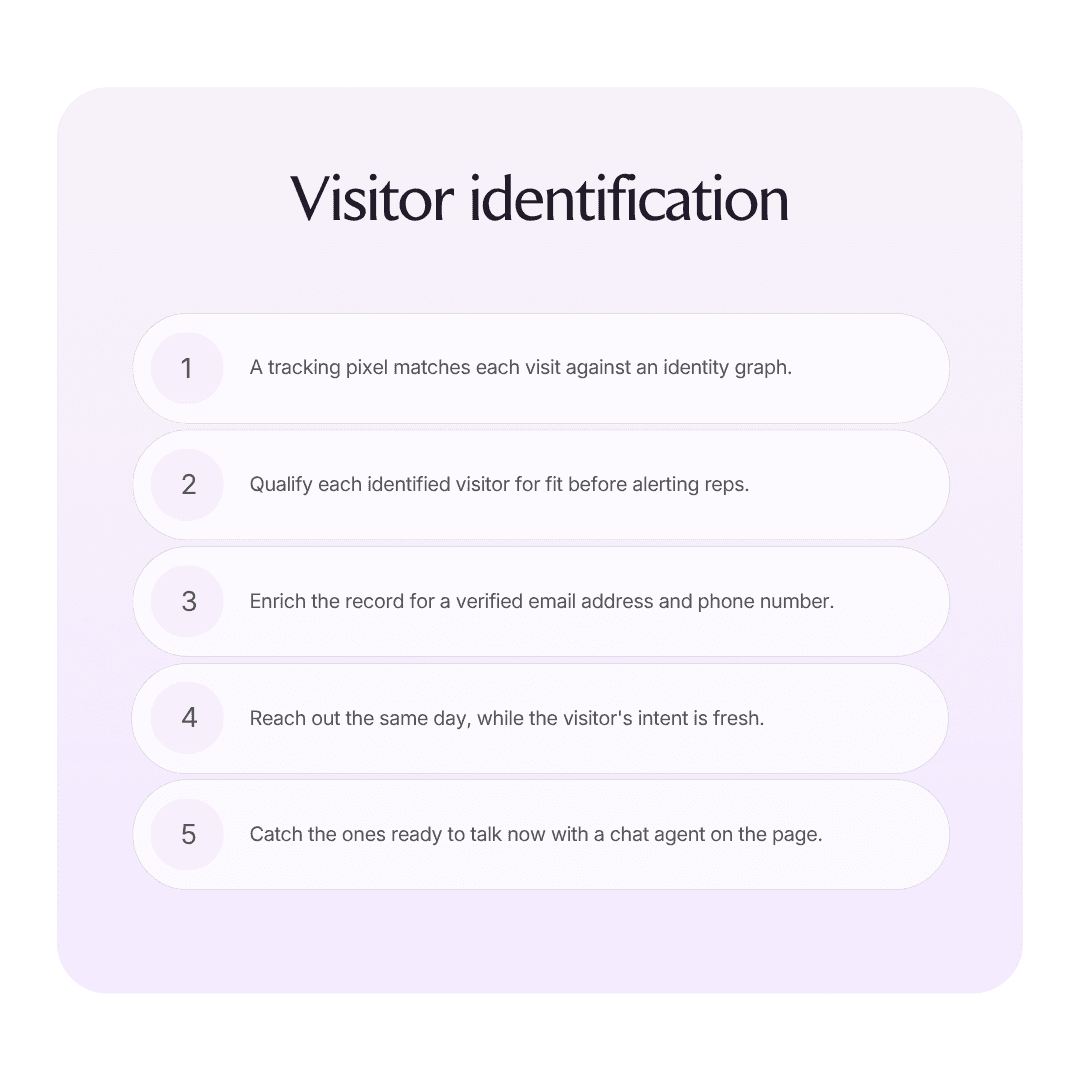
1. Qualify the fit first. An identified visitor is only a lead if they match your ICP. A student researching for a paper and your ideal buyer both trip the pixel. Filter identified visitors against fit before anything else fires, or you drown reps in noise.
2. Enrich the contact. Company-level identification gives you the account, and you still need the right person and a verified way to reach them. Person-level gives you the individual, and you still need a validated email address and phone number. Waterfall enrichment across multiple providers reaches a higher hit rate than any single source.
3. Reach out fast, with context. Intent decays. A visitor who read your pricing page this morning is a different prospect by next week. Same-day, contextual outreach that references their interest, without being creepy about it, converts far better than a generic sequence a week later.
4. Catch the ones ready now. Some visitors want to talk immediately. An inbound chat agent on your page that greets and qualifies them, then books a meeting, captures intent at its peak instead of waiting for an outbound touch.
The mistake almost every visitor-ID program makes is stopping at step one. Most tools push a name into a Slack channel and consider the job done, which leaves qualification, enrichment, and outreach to a rep who has 30 other things to do. This handoff is where intent goes cold.
What tool reveals which companies and people visited my website?
Plenty of tools reveal visitors. They split by whether they resolve companies or people, and by whether they do anything after the reveal. On the identification-only end, RB2B pioneered person-level US identification and pushes names to Slack from $79 to $199/month, but it stops at identification. Vector offers person and contact-level intent at $399 to $999/month. On the company-level, GDPR-first side, Leadfeeder (Dealfront), Snitcher, Albacross, Factors, and Leadinfo resolve EU traffic to accounts with published pricing. Warmly adds orchestration on top of identification at roughly $10K to $30K/year tiers. Koala, a popular option, shut down in September 2025, a reminder that this category consolidates fast. For the full field, see our guide to the best website visitor identification tools. For direct comparisons, see RB2B vs. Vector, RB2B vs. Warmly, and Leadfeeder vs. Snitcher.
The distinction that matters for pipeline is not which tool identifies the most visitors. It is which one does something with them. A tool that reveals a name and stops has handed you a to-do rather than a lead.
What enterprise tool turns anonymous website traffic into automated outbound?
Artisan turns anonymous traffic into automated outbound by folding identification, qualification, enrichment, and outreach into one system, so an identified high-fit visitor becomes a personalized message without a rep moving data between tools. It resolves visitors person-level on US traffic (provider-published benchmarks put top-of-category identification at 15-30% of US traffic) and company-level globally on a 3.7-billion-IP identity graph with a published 92% accuracy rate. Identified visitors flow into ICP qualification, then into personalized multichannel outreach written, sent, and answered by Ava, Artisan's AI business development representative (BDR). Per-domain budget caps keep spend controlled. See how Artisan stacks up in Artisan vs. RB2B and Artisan vs. Warmly.
The other half is inbound. Ava Inbound is a live chat agent on your site that greets and qualifies visitors, answers from the same knowledge base as the outbound replies, and books meetings with CRM-owner routing (deal owner, then contact owner, then company owner), with human takeover available. It is connected to visitor identification, so the traffic you identify and the traffic that wants to talk are handled by the same system. CookUnity's Bruno Didier put the outbound side plainly: "Ava runs highly targeted outreach at a scale we could never reach with a human-only team," at roughly $45 cost per lead across over 100,000 emails.
For enterprise buyers, governance matters. Artisan holds SOC 2 Type II attestation, is GDPR and CCPA compliant, offers single sign-on (SSO) for security review, and enforces org-level do-not-contact across channels, with a full audit trail and field-level CRM sync controls. Sales ops can run the whole motion centrally for large teams. Pricing is usage-based, so you pay for the work Ava performs rather than for seats, and you can trial her for free. See Ava, the AI sales agent, artisan.co/pricing, or the AI BDR explainer.
Frequently asked questions
How do I de-anonymize website traffic?
You de-anonymize traffic by installing a tracking pixel that captures each visit's IP address and device signals, then matching those against an identity graph that maps them to a company or, on US traffic, a person. The larger and fresher the graph, the more visits resolve. Company-level de-anonymization works globally, and person-level works mainly on US traffic. Expect 30-65% of B2B traffic to resolve to a company and 5-20% of US traffic to resolve to a person.
Can I identify individual people who visit my website?
You can identify individuals on US traffic, at realistic rates of 5-20% per independent tests, using a person-level identity graph. Outside the US, and especially in the EU under GDPR, person-level identification is near zero and legally risky, so honest vendors resolve non-US traffic only to the company level. If a tool claims high person-level match rates on European visitors, be skeptical: it is either overstating its data or taking a compliance risk you would be inheriting.
Is identifying website visitors GDPR compliant?
Company-level identification is generally GDPR compliant because a company is not a person. Person-level identification of EU individuals requires a lawful basis and, in practice, consent, which is why reputable tools do not offer it on EU traffic. In the US, California's CIPA statute has driven pixel-tracking litigation, making clear consent and privacy disclosures important. Use a vendor with a documented compliance posture, keep person-level identification to US traffic, and honor consent and do-not-contact signals.
Why is my visitor match rate lower than my vendor promised?
Because most advertised match rates are best cases or blend company and person-level figures into one flattering number. Real rates are 30-65% company-level and 5-20% person-level on US traffic. If your rate looks low, check your traffic mix: heavy international or consumer traffic resolves worse than US B2B traffic, and person-level simply does not work at scale outside the US. Build your pipeline expectations on the realistic ranges instead of the homepage number.
How fast should I contact an identified visitor?
Same day, ideally within hours. Website intent decays quickly, and a visitor who was on your pricing page this morning is a much warmer prospect now than next week. This is the strongest argument for automating the loop. A rep cannot reliably reach every identified, qualified visitor within hours, but an autonomous system can, which is why identification plus automated outreach outperforms identification plus a Slack alert a human works when they have time.
What is the difference between visitor identification and inbound chat?
Visitor identification reveals who is on your site so you can reach out, and inbound chat engages the visitors who want to talk right now, qualifying them and booking a meeting on the spot. They are complementary: identification captures intent from people who would have left silently, while chat captures intent from people ready to act. Artisan runs both in one system, with Ava Inbound handling live chat and form-fill follow-ups while the same platform identifies and works the rest of the traffic. For more, see website visitor identification, website visitor tracking tools, and identify anonymous website visitors.

Artisan Team
Expert insights from the team at Artisan
Our writing team blends direct operational experience, in-house data, and thorough research to bring you the very latest insights and updates about sales and GTM automation.