Leadfeeder vs. Snitcher: Which should you choose in 2026?
An honest 2026 comparison of Leadfeeder and Snitcher, two company-level website visitor identification tools, by pricing, match rates, and buyer scenario.

Key Takeaways
- Both tools identify visitors at the company level, not the person level, which is why both stay comfortably inside GDPR for European traffic.
- Snitcher starts at $49/month for up to 50 identified companies and scales to $529/month for 5,000, with a 14-day free trial and no per-seat fees, per its pricing page.
- Leadfeeder's paid Discover plan starts at €79/month for 1,000 companies and 50 monthly credits, rising to €599/month on Scale, with a free Lite plan capped at 100 companies over a 7-day window, per Dealfront's help center.
- Company-level identification realistically matches 30-65% of B2B traffic, well below the "identify every visitor" framing common in vendor marketing.
- Snitcher's pricing is simpler and lower at the entry level, and Leadfeeder brings Dealfront's wider European contact database and prospecting tools once you pay for them.
Both Leadfeeder and Snitcher are company-level website visitor identification tools built for GDPR-first teams that want to know which businesses browse their site. Leadfeeder, now part of Dealfront, fits larger pipelines with deep CRM workflows and credit-based budgeting. Snitcher wins on flat, transparent pricing and a Google Analytics 4 (GA4) native setup. Choose by pipeline size and stack.
How do Leadfeeder and Snitcher compare at a glance?
Here is the short version before the detail.
Tool | Best for | Identification level | Standout capability | Published pricing |
Leadfeeder (Dealfront) | Teams that want visitor ID plus a wider European sales-intelligence suite | Company-level, global | Dealfront database and prospecting tied to visitor data | Free Lite plan; Discover from €79/month; Activate €369/month; Scale €599/month (per Dealfront) |
Snitcher | Lean teams that want transparent, flat visitor ID with strong GA4 integration | Company-level, global | Simple company-based pricing, GA4-native, IP-to-company API | From $49/month up to $529/month; custom above 5,000 companies (per snitcher.com) |
What is the core difference between Leadfeeder and Snitcher?
Both answer the same question: which companies visited your website, from what pages, and how often. Neither reveals individual named people, and this is deliberate. Company-level identification keys off a visitor's IP address and a business-IP graph, so it stays within GDPR because it does not process personal data the way person-level tools do.
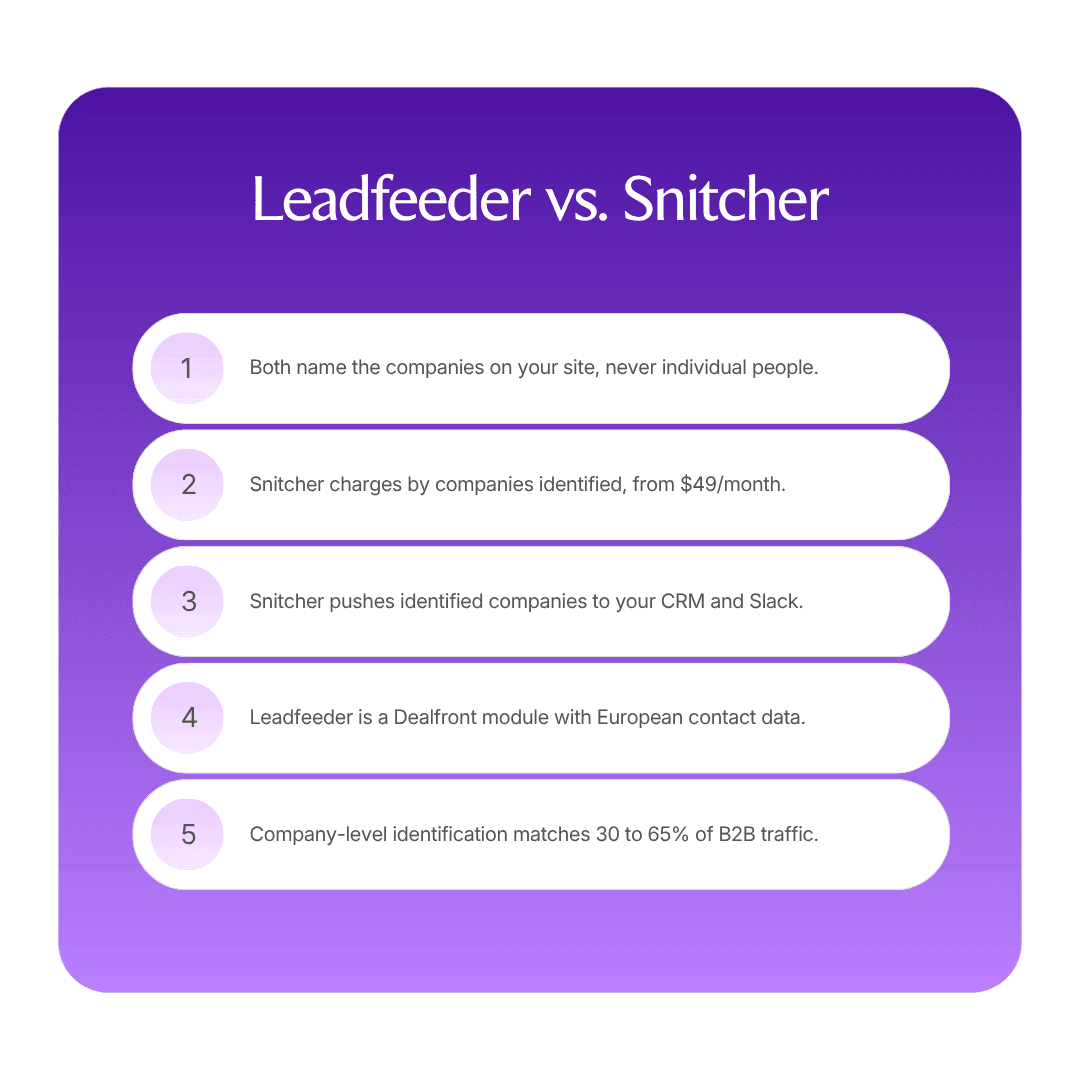
The real difference is scope. Snitcher is a focused visitor identification product. It resolves anonymous traffic to companies, enriches those companies, scores intent from page behavior, and pushes results to your CRM, Slack, or Google Analytics. Leadfeeder is now a module inside Dealfront, the European go-to-market platform formed when Leadfeeder and Echobot merged. So Leadfeeder gives you visitor identification with a much larger prospecting database and contact-finding tools attached, if you buy into the wider suite. For the fuller playbook, see how to identify anonymous website visitors.
How do Leadfeeder and Snitcher price in 2026?
Snitcher prices on one axis: the number of unique companies it identifies per month. Plans run $49/month for up to 50 companies, $99 for 250, $229 for 1,000, and $529 for 5,000, with custom pricing above that, per its pricing page. Every tier includes unlimited team members, all integrations, and API access, and there is a 14-day free trial with no credit card. Paying annually saves roughly 30%.
Leadfeeder uses two axes: identified companies and credits, which are used for actions like revealing contacts. Its free Lite plan shows up to 100 companies but only from the last 7 days. Paid Discover starts at €79/month for 1,000 companies and 50 credits, Activate at €369/month for 4,000 companies, and Scale at €599/month for 10,000 companies, per Dealfront's help center. A 14-day trial applies, and annual billing carries a 30% discount.
For a small team that wants nothing more than clean company identification, Snitcher costs less and is simpler to reason about. For a team that also wants Dealfront's European contact data and outbound prospecting in the same login, Leadfeeder's higher tiers start to make sense.
Which has better match rates and data quality?
Treat every vendor's match-rate claim with caution. Independent testing puts realistic company-level identification at roughly 30-65% of B2B traffic, and both tools filter out ISPs, bots, and residential traffic before counting, which is honest but also why your "identified" number is lower than raw sessions.
Snitcher leans on a strong IP-to-company graph and a developer-facing API (Radar) that some teams use to build identification into their own products. Its GA4 integration is a genuine strength for analytics-led teams that want visitor data inside reporting they already trust. Leadfeeder inherits Dealfront's European data depth, which tends to show up as richer firmographics and better coverage of EU-headquartered companies once a visitor is identified. Neither is meaningfully "more accurate" as a rule. Coverage varies by region and traffic mix, so use the free trials on your own site to compare.
How do they handle GDPR and privacy?
This is where company-level tools have an easier story than the person-level category. Because Leadfeeder and Snitcher identify organizations by business IP rather than naming individuals, both position themselves as GDPR-compliant for European traffic, and both are built by EU-based companies (Dealfront across Finland and Germany, Snitcher in the Netherlands) that market this compliance heavily.
The contrast worth knowing is that person-level identification tools that name individual visitors face far more scrutiny. In the US, a wave of CIPA pixel litigation in California has targeted tracking that identifies people, and GDPR effectively keeps European identification at the company level. If your traffic is mostly European, or your legal team is cautious about person-level tracking, the company-level approach both of these tools take is the safer default.
Which should you choose, Leadfeeder or Snitcher?
Choose Snitcher if you want straightforward, flat company-level identification at the lowest entry price, you value the GA4 integration or the IP-to-company API, and you do not need a bundled prospecting database. It is the cleaner pick for lean revenue teams and analytics-minded operators.
Choose Leadfeeder if you are buying into Dealfront's broader European sales-intelligence suite, need deeper EU firmographic coverage, and want visitor identification to sit alongside contact discovery and outbound tooling in one platform. Its credit model rewards teams that will actually use these extra actions. For broader options, see the best Leadfeeder alternatives and the best Snitcher alternatives.
If the deeper problem is that neither tool books meetings on its own, identification is only the first step of a longer job. Whichever you pick, someone on your team still has to work the list. An autonomous platform is a third path here: Artisan identifies visitors company-level globally on a 3.7-billion-IP identity graph at a published 92% accuracy, and person-level on US traffic, then qualifies them against your ideal customer profile (ICP). For head-to-heads, see Artisan vs. RB2B and Artisan vs. Warmly.
From there, Artisan's AI business development representative (BDR) runs the outreach and inbound chat automatically, so an identified company becomes a booked meeting without a rep having to pick up the list. This is a different purchase from a pure identification tool, and it makes sense only if you want the activation handled for you instead of a cleaner set of alerts. For a wider view of the category, see our roundup of the best website visitor identification tools. See also website visitor identification and website visitor tracking tools.
Frequently asked questions
Is Leadfeeder the same as Dealfront?
Leadfeeder is now a product within Dealfront, the go-to-market platform created when Leadfeeder merged with Echobot. You can still buy Leadfeeder's web-visitor identification on its own tiers, but it sits inside Dealfront's wider European data and prospecting suite, which is part of the appeal at the higher plans.
Do Leadfeeder and Snitcher identify individual people?
No. Both are company-level tools. They tell you which organizations visited your site, which pages they viewed, and how engaged they are, but they do not name individual visitors. This is a privacy choice that keeps them straightforward under GDPR for European traffic.
Which costs less, Leadfeeder or Snitcher?
At the entry level, Snitcher costs less, starting at $49/month for up to 50 identified companies, per its pricing page. Leadfeeder's paid plans start at €79/month for 1,000 companies but add credit-based actions. Snitcher also offers a longer feature-complete trial, while Leadfeeder's free Lite plan is capped to the last 7 days.
What match rate should I expect from company-level tools?
Realistically 30-65% of B2B traffic, per independent testing, rather than the near-total coverage vendor marketing can imply. Both tools strip out ISPs, bots, and non-business traffic before counting, so your identified-company number is lower than raw sessions. Run both free trials on your own traffic to compare honestly.
Do these tools work for non-European traffic?
Yes. Company-level identification works globally because it maps IP addresses to businesses anywhere. Both vendors emphasize GDPR because they are EU-based and many customers are European, but the identification itself is not region-locked the way US person-level identification is.
Is there an alternative to both Leadfeeder and Snitcher?
Yes, if the goal is booked meetings rather than a list of companies. Both tools stop at identification and leave the follow-up to your team. Artisan takes the other path: it identifies visitors, company-level globally and person-level on US traffic, qualifies them against your ICP, then has its AI BDR run the outreach and inbound chat automatically. It is a heavier commitment than a visitor-ID tool, so it suits teams that want the whole loop owned instead of only the first step.
The bottom line
For lean teams and analytics-led operators, Snitcher's flat, transparent, company-based pricing makes it the easier starting point. For teams already investing in Dealfront's European data and prospecting, Leadfeeder's suite integration justifies the higher spend. Both stay on the safe side of GDPR by identifying companies, not people. If you want the identification to turn into booked meetings without adding headcount, look at an autonomous AI BDR that owns the follow-up, and compare pricing models on the pricing page.
Related reading

Artisan Team
Expert insights from the team at Artisan
Our writing team blends direct operational experience, in-house data, and thorough research to bring you the very latest insights and updates about sales and GTM automation.