Artisan vs. Warmly: Which fits your team in 2026?
An honest 2026 comparison of Artisan and Warmly for visitor identification and inbound, from anonymous traffic to booked meeting.

Key Takeaways
- Artisan owns the full path: person-level and company-level visitor identification, an AI rep that greets and qualifies, automated outbound follow-up, and meeting booking, all on one lead timeline.
- Warmly identifies visitors (company-level around 65%, person-level around 15% per its published figures), adds chat, and orchestrates plays, but reps run the follow-through.
- Artisan identifies people on US traffic (provider benchmarks put person-level at 15-30% of US traffic, top of category) and companies globally on a 3.7B-IP identity graph with a published 92% accuracy rate.
- Warmly publishes tiered annual pricing, reportedly Deanon around $10K/year, Inbound Chat around $20K/year, and Inbound Autopilot around $30K/year. Artisan is usage-based, so pricing follows the work Ava performs.
- Every non-booked chat with a captured email address flows straight into Ava's outbound sequences, so identified visitors are followed up automatically.
- Artisan is SOC 2 Type II compliant, GDPR and CCPA compliant, with per-domain budget caps on identification.
Artisan and Warmly both identify anonymous website visitors and add a chat layer, but Artisan does more of the job. Ava identifies a visitor, chats with them on your site, runs automated follow-up, and books a meeting, all on one timeline. Warmly identifies and chats well, and your reps run the follow-through. Warmly is the lighter, cheaper starting point.
Visitor identification is only useful if something happens next. Warmly is strong at the identify-and-alert step and adds inbound chat on top. Artisan treats identification as the start of a workflow that Ava finishes, from anonymous visitor to booked meeting, without handing the work back to a rep. This comparison walks this journey stage by stage and stays honest about where Warmly is the simpler buy. For the fundamentals, see our guide to website visitor identification.
How the two compare
Rather than an all-checkmark grid, here is the situation-to-fit map. Find the row that sounds like you.
Your situation | Better fit | Why |
You want identification to become automated outreach, not an alert | Artisan | Ava runs the follow-up and books the meeting |
You want AI to handle the site chat and chase non-bookers | Artisan | Non-booked chats flow into Ava's outbound |
You want a lighter, lower-cost way to start deanonymizing traffic | Warmly | Published tiers from around $10K/year |
You already have reps who will work the alerts | Warmly | Identification plus chat, reps run follow-through |
You want inbound, outbound, and identification on one platform | Artisan | One AI rep, one knowledge base, one timeline |
You need global company-level identification at scale | Artisan | 3.7B-IP identity graph, published 92% accuracy |
Who identifies the visitor?
Both tools deanonymize website traffic, and this is Warmly's home turf. Warmly reports company-level identification around 65% and person-level around 15%, with a free tier for a capped number of visitors a month. It is a capable, well-marketed identification layer, and for teams whose main need is simply seeing who is on their site, it does this job.
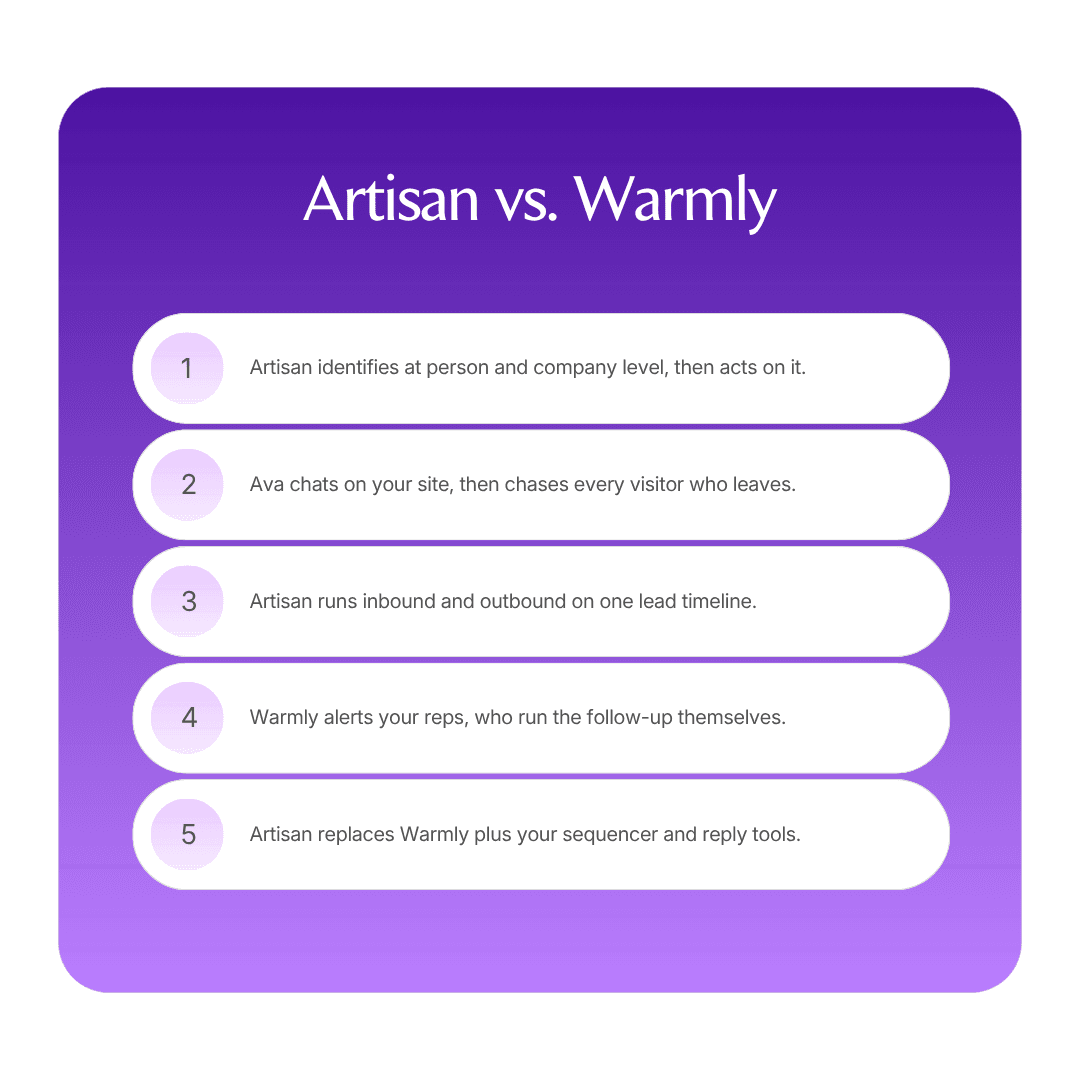
Artisan identifies at both levels too. Person-level identification runs on US traffic, where provider-published benchmarks put the reachable share at 15-30% of US traffic, top of category. Company-level identification runs globally on a 3.7B-IP identity graph with a published 92% accuracy rate. Person-level identification is US-only for privacy-rule reasons, which every honest vendor in this space shares, and there is no retroactive lookback. Per-domain budget caps keep spend predictable. For the wider category, see the best website visitor tracking tools.
On raw identification, these two are comparable, with Artisan carrying a heavier company-level graph. The real separation is what each tool does with an identified visitor. For the field, see the best website visitor identification tools.
Who works the visitor after identification?
Here is the difference that matters. Warmly identifies a visitor, can start a chat, and orchestrates plays, but the follow-through lands on your reps. Someone has to pick up an alert, write the outreach, and chase the lead. Warmly's higher tiers add more automation, but the model still assumes humans drive the motion. For a related head-to-head, see RB2B vs. Warmly.
Artisan turns identification into a workflow that Ava finishes. An identified visitor flows into campaigns with ideal customer profile (ICP) qualification. Ava greets and qualifies the ones who engage, answers their questions from the same knowledge base that powers her outbound, and books meetings with CRM-owner routing (deal owner, then contact owner, then company owner) with instant human takeover. A visitor who chats but does not book is not lost. If they left an email address, they flow straight into Ava's outbound sequences, and the same AI rep follows up automatically. Form-fill submissions receive instant follow-ups too.
So these two tools answer different questions. Warmly answers "who is on my site?" and starts the conversation. Artisan answers "who is on my site, and how do I turn them into a booked meeting without adding rep work?" This is the Artisan angle: identification, conversation, automated follow-up, and the meeting, natively, on one lead timeline.
Who books the meeting and keeps the record clean?
Both tools can route a hot visitor to a rep. Artisan books on the right rep's calendar with CRM-owner routing and logs the activity natively on the record timeline in Salesforce or HubSpot, with bidirectional owner mapping so nothing routes to the wrong person. Because inbound and outbound share one system, the identified-visitor chat, the automated follow-ups, and the booked meeting all sit on a single lead timeline rather than scattered across an identification tool, a chat tool, and a sequencer.
For a revenue team, this consolidation is the quiet win. One timeline, one owner map, one audit trail, instead of reconciling three tools' versions of the same lead.
How the pricing models compare
Warmly publishes tiered annual pricing, which is a real help to buyers. Reported figures are Deanon around $10K/year, Inbound Chat around $20K/year, and Inbound Autopilot around $30K/year, plus a free tier for a limited number of monthly visitors. If you want a low-commitment way to start deanonymizing traffic, this entry point is a genuine advantage, and it costs less to start than a full platform.
Artisan uses usage-based credits across the platform. You pay for the work Ava performs rather than for seats, and you can trial her for free. The trade is straightforward: Warmly is the cheaper on-ramp to identification alone, and Artisan is one platform that also runs the outbound, the replies, and the booking, so you are not buying a separate sequencer and reply-handling stack alongside it. Full platform pricing is at artisan.co/pricing.
Choose Warmly if...
There are real scenarios where Warmly is the sensible pick:
Your main need is identifying who is on your site, and you already have sales development representatives (SDRs) who will work the alerts.
You want a lower-cost, published-price on-ramp and are not ready to consolidate onto one platform.
You want to start on a free or entry tier and expand as identification proves out.
Inbound chat plus visitor identification is the whole job you are solving, and outbound lives elsewhere.
If these describe you, Warmly is a reasonable choice. Just be clear that the follow-through is your team's job, and price in rep time that identification-only tools quietly assume.
Choose Artisan if...
Artisan is the stronger default for most teams:
You want identification to become automated outreach and booked meetings instead of one more alert your reps have to work.
You want one AI rep to greet a visitor, answer questions on your site, chase the ones who leave, and book a meeting, all on one timeline.
You want inbound, outbound, and visitor identification on one platform and one knowledge base.
You need global company-level identification with a published accuracy rate and per-domain budget caps.
You run outbound centrally and need CRM owner mapping, an audit trail, and SOC 2 Type II compliance.
Artisan's customers describe their results in numbers. Chain of Events, the team behind RAISE Summit, sourced over $700K in annual recurring revenue (ARR) in six months with Ava, a 20x return on a $28K annual investment. When identification feeds something that actually runs the follow-up, qualified pipeline follows. For a related comparison, see Artisan vs. RB2B.
See how Ava works as your AI sales agent, learn the mechanics in how to identify anonymous website visitors and turn them into pipeline, or weigh the field in the best Warmly alternatives, and compare Leadfeeder vs. Snitcher and RB2B vs. Vector.
Frequently asked questions
Is Warmly better than Artisan for visitor identification alone?
If your only need is deanonymizing traffic at a low starting price, Warmly is a strong, published-price option, and its free tier makes it easy to try. Artisan identifies at both levels too, with a heavier global company-level graph (3.7B-IP, published 92% accuracy) and US person-level identification, and its value is that identification becomes automated outreach and booked meetings. For identification as a standalone signal, trial Warmly; for identification that runs itself to a meeting, Artisan does more.
What does Artisan do after it identifies a visitor?
Identified visitors flow into campaigns with ICP qualification. Ava greets and qualifies the ones who engage, answers from her knowledge base, and books meetings with CRM-owner routing and human takeover. Anyone who chats but does not book, and left an email address, flows into Ava's outbound sequences automatically. This automated follow-through is the main thing Warmly leaves to your reps.
How accurate is Artisan's visitor identification?
Company-level identification runs globally on a 3.7B-IP identity graph with a published 92% accuracy rate. Person-level identification runs on US traffic, where provider-published benchmarks put the reachable share at 15-30% of US traffic, top of category. Person-level identification is US-only for privacy-rule reasons that every honest vendor shares, and there is no retroactive lookback. Per-domain budget caps keep spend predictable.
How much do Artisan and Warmly cost?
Warmly publishes annual tiers, reportedly Deanon around $10K/year, Inbound Chat around $20K/year, and Inbound Autopilot around $30K/year, plus a free tier for limited monthly visitors. Artisan uses usage-based credits, so you pay for the work Ava performs rather than for seats, and you can trial her for free. See artisan.co/pricing.
Does Artisan replace both an identification tool and a chat tool?
For most teams, yes, and a sequencer too. Artisan combines visitor identification, an AI rep that greets and qualifies on your site, automated outbound follow-up, reply handling, and meeting booking on one platform. This consolidation is the point: one lead timeline and one owner map instead of reconciling an identification tool, a chat tool, and a sequencer that each hold a different version of the same lead.
Is Artisan privacy-compliant for visitor identification?
Artisan is SOC 2 Type II compliant and GDPR and CCPA compliant. Person-level identification is US-only for privacy-rule reasons, with no retroactive lookback, and company-level identification runs globally. Per-domain budget caps and suppression controls keep identification governed. A standard data processing agreement (DPA) is available to customers, and the Trust Center on artisan.co documents its security posture.
Related reading

Artisan Team
Expert insights from the team at Artisan
Our writing team blends direct operational experience, in-house data, and thorough research to bring you the very latest insights and updates about sales and GTM automation.