Artisan vs. RB2B: Which fits your team in 2026?
An honest 2026 comparison of Artisan and RB2B, from person-level visitor identification to automated outreach and booked meetings.
Key Takeaways
- RB2B identifies person-level US website visitors and pushes the names to your team, then stops at identification. It is inexpensive and fast to set up.
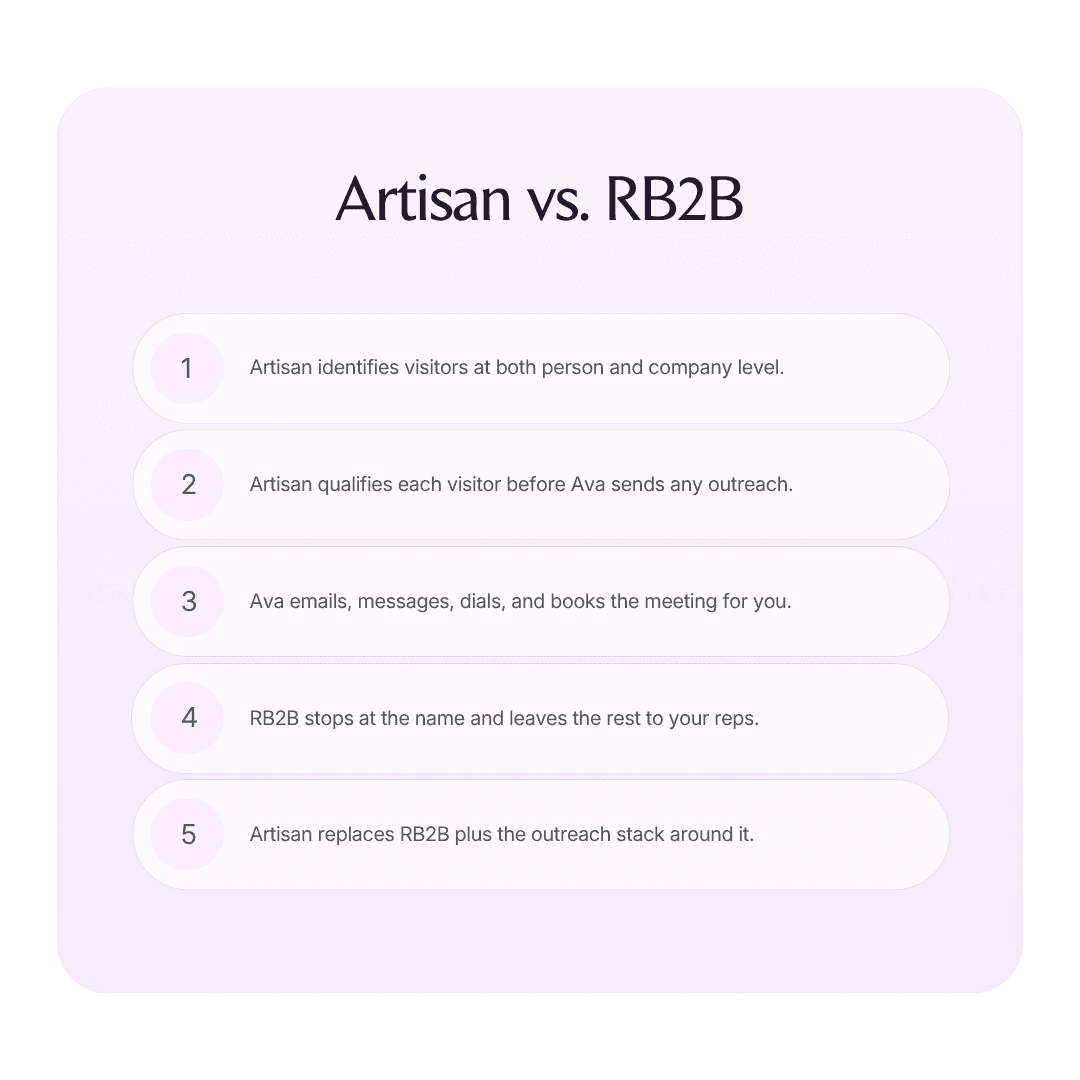
- Artisan identifies visitors at person and company level, qualifies them against your ideal customer profile (ICP), and turns them into automated multichannel outreach that Ava runs and books meetings from.
- RB2B publishes accessible pricing: Free, then Starter $79, Pro $149, and Pro+ $199/month. Artisan uses usage-based credits, with pricing tied to work performed rather than seats.
- Artisan identifies people on US traffic (provider benchmarks put person-level at 15-30% of US traffic, top of category) and companies globally on a 3.7B-IP identity graph with a published 92% accuracy rate.
- Over 90% of Artisan customers run Ava autonomously, with plain-language escalation rules and a full audit trail.
- Artisan is SOC 2 Type II compliant, GDPR and CCPA compliant, with per-domain budget caps on identification.
Artisan and RB2B both identify anonymous website visitors down to the person, but they stop in different places. RB2B pushes a name to your team and ends there, cheaply. Artisan turns that same identification into qualified, automated outreach and booked meetings. RB2B fits if you only want the signal and will act on it yourself.
RB2B did something useful. It made person-level visitor identification cheap and simple, sending named US visitors straight to your team. The question is what happens after a name lands. With RB2B, a human takes it from there. With Artisan, Ava runs the outreach. This comparison walks this journey and stays honest about where RB2B is the simpler buy.
How the two compare
Rather than an all-checkmark grid, here is the situation-to-fit map. Find the row that sounds like you.
Your situation | Better fit | Why |
You want a name pushed to your team, and reps take it from there | RB2B | Person-level US identification, then stops |
You want the smallest, cheapest way to start deanonymizing traffic | RB2B | Published tiers from $79/month |
You want identification to become automated outreach | Artisan | Ava qualifies and runs the sequence |
You want AI to book meetings, not only flag visitors | Artisan | CRM-owner routing and booking built in |
You need global company-level identification alongside US person-level | Artisan | 3.7B-IP graph, published 92% accuracy |
You want identification, outreach, and CRM logging on one platform | Artisan | One system, one lead timeline |
Who identifies the visitor?
Both tools identify visitors down to the individual person on US traffic, and RB2B deserves credit for popularizing this. Founded by Adam Robinson, who also built Retention.com, RB2B made person-level deanonymization accessible. It resolves named US visitors and delivers them to your team's workflow, including a Slack push, so reps see who is on your site in near real time. For a lot of small teams, this alone was a step change.
Artisan identifies at the person level on US traffic too, where provider-published benchmarks put the reachable share at 15-30% of US traffic, top of category. It also identifies companies globally on a 3.7B-IP identity graph with a published 92% accuracy rate. Person-level identification is US-only for privacy-rule reasons that every honest vendor shares, and there is no retroactive lookback. So on US person-level identification, these two overlap. Artisan adds a heavier global company-level layer on top.
Identification itself is not where these tools separate. What each does with a name is.
What happens after the name lands?
This is the whole comparison. RB2B, by design, stops at identification. It tells you who visited and hands the name to a human. Everything after that (deciding whether the person fits, writing the outreach, sending it, chasing a reply, booking a meeting) is your team's job. This is a deliberate, honest scope, and for teams with reps ready to pounce on a fresh name, it works.
Artisan treats an identified visitor as the start of a workflow that Ava finishes. An identified visitor is qualified against your ideal customer profile (ICP) automatically, then flows into a campaign. Ava writes and runs personalized multichannel outreach across email, social media, and dialer steps, handles the replies, and books meetings on the right rep's calendar with CRM-owner routing (deal owner, then contact owner, then company owner). You set how autonomous she is: review and approve every message, objections-only replies, or full autonomy, with a full audit trail. Over 90% of Artisan customers run her autonomously.
There is also an inbound layer. Ava can greet and qualify identified visitors who engage on your site and book them directly, with instant human takeover, and any non-booked chat with a captured email address flows into her outbound sequences.
So the split is clean. RB2B gives you a name. Artisan gives you the name, the qualification, the outreach, the reply handling, and the booked meeting, on one platform and one lead timeline.
Who keeps the CRM clean?
RB2B focuses on delivery of the identification, so CRM enrichment and logging depend on how you wire it into the rest of your stack. Artisan logs activity natively on the record timeline in Salesforce or HubSpot, with bidirectional owner mapping so identified-visitor outreach comes from the right rep's mailbox and meetings route to the right calendar. Do-not-contact enforcement runs across email, domain, social media, and phone, and suppression applies before enrichment so you are not paying to enrich contacts you will never message.
For a team that cares about a clean record and governed outreach, this native CRM depth is a real difference from a tool whose job ends at identification.
How the pricing models compare
RB2B is simpler at its entry point, and it publishes its tiers plainly: a free plan with a capped number of monthly resolutions, then Starter at $79, Pro at $149, and Pro+ at $199/month. For a small team that just wants named US visitors flowing to Slack, this is inexpensive and easy to predict.
Artisan uses usage-based credits across the platform. You pay for work performed rather than seats, and you can trial Ava for free. Enrichment charges only on success. This comparison is not really price-for-price, because these two buy different things: RB2B buys you identification, and Artisan buys you identification plus the outreach engine that acts on it. If all you want is a name, RB2B costs less. If you want that name turned into qualified pipeline without adding rep work, Artisan is doing several jobs at once. Full pricing is at artisan.co/pricing.
Choose RB2B if...
There are real scenarios where RB2B is the sensible pick:
You want person-level US visitor names pushed to your team, and your reps will handle everything after that.
You want the cheapest, simplest on-ramp to deanonymizing US traffic, with published pricing and a free tier.
Your outreach already lives in a tool you like, and you just need an identification signal feeding it.
You do not need global company-level identification or built-in outreach and booking.
If these describe you, RB2B is a smart, low-cost choice. Just price in rep time that identification-only tools assume: someone still has to qualify, write, send, and follow up.
Choose Artisan if...
Artisan is the stronger default for most teams:
You want identification to end in a booked meeting instead of one more name in a Slack channel.
You want AI to run the outreach and book meetings, so your reps spend their time selling instead of working alerts.
You need global company-level identification with a published accuracy rate, alongside US person-level.
You want identification, outreach, reply handling, and CRM logging on one platform and one lead timeline.
You run outbound centrally and need owner mapping, escalation rules, an audit trail, and SOC 2 Type II compliance.
Artisan's customers describe their results in numbers. Chain of Events, the team behind RAISE Summit, sourced over $700K in annual recurring revenue (ARR) in six months with Ava, a 20x return on a $28K annual investment. Identification only pays off when something runs the follow-up, and this is what Artisan is built to do.
See how Ava works as your AI sales agent, learn the mechanics in how to identify anonymous website visitors and turn them into pipeline, or weigh the field in the best RB2B alternatives.
Frequently asked questions
Is RB2B better than Artisan for person-level visitor identification?
For raw person-level US identification pushed to your team, RB2B is a low-cost, transparent option, and it popularized the category. Artisan does person-level US identification too, plus global company-level identification on a 3.7B-IP graph with a published 92% accuracy rate. The difference is scope: RB2B stops at a name, Artisan qualifies it and runs the outreach. If you only want the signal, RB2B; if you want it turned into qualified pipeline, Artisan.
What does Artisan do that RB2B does not?
After identifying a visitor, Artisan qualifies them against your ICP and runs personalized multichannel outreach through Ava, handles replies, and books meetings with CRM-owner routing, at whatever autonomy level you set. RB2B, by design, stops at identification and hands the name to a human. Artisan also adds global company-level identification and native CRM logging in Salesforce and HubSpot.
How much do Artisan and RB2B cost?
RB2B publishes a free plan plus Starter $79, Pro $149, and Pro+ $199/month. Artisan uses usage-based credits, so you pay for work performed rather than seats, enrichment charges only on success, and you can trial Ava for free. They price differently because they buy different things: RB2B buys identification, Artisan buys identification plus the outreach engine that acts on it. See artisan.co/pricing.
Does Artisan identify visitors outside the US?
Company-level identification runs globally on a 3.7B-IP identity graph with a published 92% accuracy rate. Person-level identification is US-only for privacy-rule reasons that every honest vendor shares, with no retroactive lookback. RB2B is person-level US-focused as well, so for international traffic Artisan's global company-level layer is the meaningful difference.
Can Artisan send an identified visitor into outbound automatically?
Yes, this is the core design. An identified visitor is qualified against your ICP and flows into a campaign, where Ava runs personalized multichannel outreach, handles the replies, and books meetings, all without a rep having to pick up the name and act on it manually. Over 90% of Artisan customers run this autonomously, with escalation rules and an audit trail for control.
Is Artisan privacy-compliant for visitor identification?
Artisan is SOC 2 Type II compliant and GDPR and CCPA compliant. Person-level identification is US-only for privacy-rule reasons, with no retroactive lookback, and company-level identification runs globally. Per-domain budget caps and suppression controls keep identification governed, and suppression applies before enrichment. A standard data processing agreement (DPA) is available to customers, with the Trust Center on artisan.co documenting its security posture.
Related reading

Artisan Team
Expert insights from the team at Artisan
Our writing team blends direct operational experience, in-house data, and thorough research to bring you the very latest insights and updates about sales and GTM automation.