The best Koala alternatives in 2026
Koala shut down in September 2025. Here is a migration guide to the best Koala alternatives in 2026 for visitor ID, intent, and automated outreach.
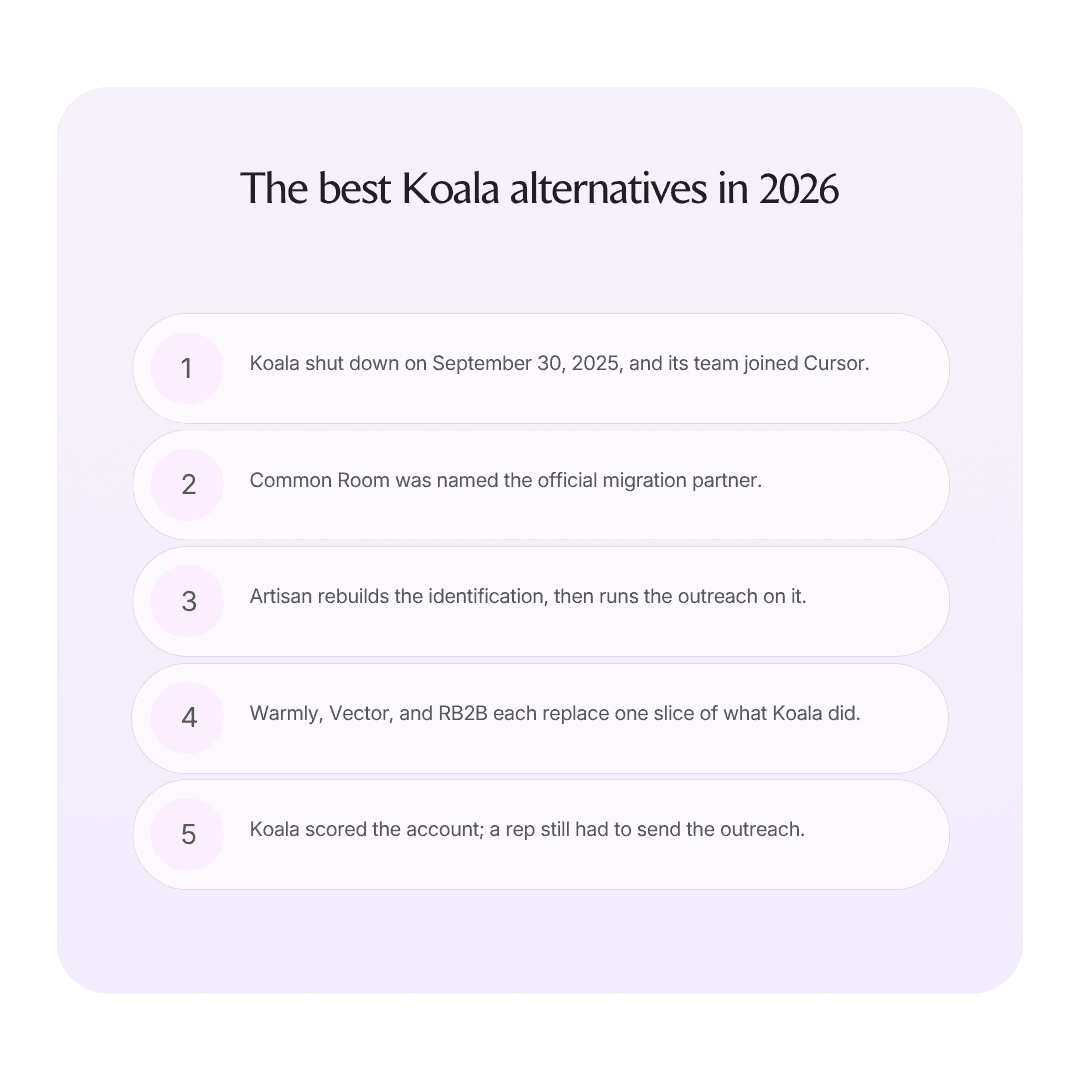
Koala shut down on September 30, 2025, with its team joining Cursor, which leaves its users needing a new home. Koala did visitor identification, intent scoring, and product-led signal tracking. Common Room was named the official migration partner. But the best replacement depends on whether you want another signal tool or a platform that acts on the signal. Artisan does both.
If you ran Koala, you used it to spot warm accounts, score product-qualified and website intent, and route those signals to sales. That job still needs doing. This is a migration guide: where your data and workflows can go, what each option does well, and which one turns the signals Koala surfaced into actual outreach instead of another dashboard to watch.
Comparison table
Rank | Tool | Best for | Standout capability | Public pricing |
|---|---|---|---|---|
1 | Artisan | Teams that want signals to become automated, qualified outreach | Person/company ID and intent feeding Ava's autonomous campaigns | Usage-based credits, no platform fee, free trial (pricing) |
2 | Common Room | Teams replacing Koala's intelligence layer like-for-like | Person-level buyer intelligence, named migration partner | Reportedly ~$2,500/mo entry |
3 | Warmly | Mid-market teams wanting reveal plus light orchestration | Identification with chat and auto-plays | ~$10-30K/yr tiers (per its published pages) |
4 | Vector | Teams wanting person-level intent, flexible terms | Person + contact-level intent, month-to-month | $399-999/mo |
5 | Factors.ai | Teams wanting intent plus marketing attribution | Visitor ID, intent, and multi-touch attribution | Published pricing (per its pricing page) |
6 | RB2B | US startups wanting person-level names cheaply | Person-level US ID pushed to Slack | $79-199/mo (per its pricing page) |
How we chose
Because this is a migration, we weighed continuity and upside together. How closely the tool rebuilds Koala's identification and signal jobs. Data depth against realistic benchmarks. Pricing transparency. And the criterion the shutdown makes urgent: whether the replacement fixes Koala's original limitation. Koala told you which accounts were warm; it did not run the outreach. A migration is the moment to decide whether you want the same gap or a platform that closes it.
What are the best Koala alternatives?
They split into two migration paths. The like-for-like path keeps a dedicated intelligence layer (Common Room, the named partner, plus Warmly, Vector, Factors, and RB2B for pieces of it), then you keep running outreach yourself. The upgrade path (Artisan) replaces the identification and signals and adds the execution Koala never had, so the same warm account becomes a booked meeting automatically. Which one fits depends on whether re-creating Koala is the goal, or improving on it.
1. Artisan: the migration that adds execution
Artisan is the move for Koala users who were tired of watching warm accounts light up while follow-up lagged. It rebuilds Koala's identification and signal jobs and adds the part Koala never did. It identifies website visitors company-level on a 3.7B-IP identity graph with a published 92% accuracy rate, and person-level on 15-30% of US traffic. It carries the signal depth Koala users relied on, funding rounds, hiring activity, tech-stack and Bombora-powered topic intent, champion job-change tracking, and natural-language custom signals you define in plain English with confidence scoring and evidence URLs.
Then Ava, the autonomous AI BDR, takes the identified, ICP-qualified account and runs personalized multichannel outreach, handles replies from a knowledge base, and books the meeting on the right rep's calendar. Ava Inbound greets and qualifies visitors live on your site. Instead of migrating from one dashboard to another, you migrate to a system that acts. Autonomy is a dial, from review-and-approve to fully autonomous, with plain-language escalation rules and a full audit trail. SOC 2 Type II and GDPR compliant.
SaaStr's Chief AI Officer, Amelia Lerutte, describes the shift bluntly: "Email has always been our number one driver. Artisan is now neck-and-neck in both output and closed-won revenue," after sending 6,892 emails in roughly six weeks at a 3.6% positive response rate.
Best for: Koala users who want the signals to drive outreach automatically; startup through enterprise, including central ops running Ava for large AE teams. Who should pick something else: teams that purely want a buyer-intelligence dashboard to feed an existing, well-staffed outbound motion and do not want automated sending. Pricing: usage-based credits, pay for work performed, no platform fee, free trial. See artisan.co/pricing.
2. Common Room: the named migration partner
Common Room was named Koala's official migration partner, which makes it the low-friction like-for-like move for the intelligence layer. It does person-level buyer intelligence, unifying signals across sources into account and person scoring, reportedly around $2,500/mo entry. Two honest notes. First, it rebuilds Koala's "know your warm accounts" job well but, like Koala, stops short of running the outreach. Second, Zoom announced an agreement to acquire Common Room on July 2, 2026, so factor near-term roadmap uncertainty into a migration decision.
Best for: teams that want the smoothest continuation of Koala's intelligence layer and a supported migration path. Who should pick something else: teams that want execution attached to the signal, or teams wary of committing during a pending acquisition. Pricing: $2,500/mo entry, per its pricing page.
3. Warmly: reveal with light orchestration
Warmly reveals visitors and adds lightweight orchestration, website chat, and basic auto-plays, so it does a little more than surface a list. For a mid-market Koala user who wants some movement after identification without a full platform, it is a reasonable landing spot.
Best for: mid-market teams wanting reveal plus configurable auto-plays and chat. Who should pick something else: teams wanting the outreach fully owned end to end, or teams that valued Koala's product-usage signal depth specifically. Pricing: roughly $10-30K/yr tiers, per its published pages.
4. Vector: person-level intent, month-to-month
Vector does person-level and contact-level visitor intent at $399-999/mo on flexible month-to-month terms. If the part of Koala you cared about was sharp person-level intent, and you do not want an annual lock-in right after a shutdown, Vector is a focused pick.
Best for: teams wanting person-level intent signals with contract flexibility. Who should pick something else: teams needing full attribution or product-analytics depth, or teams wanting outreach handled for them. Pricing: $399-999/mo, month-to-month.
5. Factors.ai: intent plus attribution
Factors.ai combines visitor identification, intent scoring, and marketing attribution in one analytics layer. If your Koala use leaned toward measurement and understanding which accounts and touches drove pipeline, Factors rebuilds that and adds multi-touch attribution Koala did not emphasize.
Best for: teams wanting intent and identification alongside marketing attribution analytics. Who should pick something else: teams that want the warm accounts worked automatically rather than measured; the outreach still lives elsewhere. Pricing: published pricing, per its pricing page.
6. RB2B: cheap person-level names, US only
RB2B pushes person-level US visitor identities into Slack quickly and cheaply. It replaces one slice of Koala, seeing who visited, but stops at identification and is US-only, so it does not rebuild Koala's scoring or signals.
Best for: US startups wanting person-level names fast and acting manually. Who should pick something else: EU teams, or anyone wanting scoring, intent depth, or automated follow-up. Pricing: $79-199/mo, per its pricing page.
What is the best enterprise alternative to Koala?
For enterprise migrations, the choice is between rebuilding the intelligence layer and upgrading to execution. Common Room is the enterprise-credible like-for-like, with the caveat of its pending Zoom acquisition. Artisan is the stronger pick when you want the signals governed and acted upon: central sales ops runs Ava for large AE teams who never log in, with SSO and SAML, role-based access, cross-channel do-not-contact enforcement, an audit trail, and a forward-deployed strategist plus dedicated CSM. Artisan runs enterprise ABM natively, named-account lists, signals, and visitor identification with the outreach attached, rather than routing warm accounts to a team to work by hand.
Is Common Room the right migration path?
Common Room is the sensible path if you want to keep Koala's job intact, a dedicated buyer-intelligence layer that surfaces and scores warm accounts, and hand the outreach to your existing team. It is the named partner, so the migration is supported. Reconsider it if you want the migration to also fix Koala's limitation, since Common Room, like Koala, identifies and scores but does not run the outreach, or if the July 2026 Zoom acquisition makes you cautious about committing to a platform mid-transition. In those cases, migrating to an execution platform is the cleaner long-term bet.
What changed: the Koala shutdown
Koala announced it was winding down and shut down on September 30, 2025, with its team moving to Cursor. Common Room was designated the official migration partner to give users a landing spot. The shutdown is a useful category signal: standalone product-led signal tools face pressure to either scale into full platforms or get absorbed, and buyers are increasingly unwilling to run a signal tool that does not also act. The broader backdrop holds, GDPR keeps EU identification at the company level, and California's CIPA pixel litigation (per legal-industry coverage) makes person-level tracking a compliance matter, so any migration should weigh privacy posture alongside features.
Frequently asked questions
Why did Koala shut down? Koala wound down and shut down on September 30, 2025, with its team joining Cursor. Common Room was named the official migration partner to give existing users a supported path for their intelligence layer. If you were a Koala customer, you need to migrate; this is a chance to decide whether you want a like-for-like intelligence tool or a platform that also runs the outreach.
What is the best alternative to Koala? Common Room is the named migration partner and the closest like-for-like for the intelligence layer. For teams that want the migration to also add execution, Artisan is the stronger choice: it rebuilds Koala's identification (company-level at a published 92% accuracy, person-level on 15-30% of US traffic) and signals, then runs the outreach automatically through Ava.
Is Common Room a good Koala replacement? Yes, for the intelligence layer specifically. It does person-level buyer intelligence and account scoring, similar to Koala, at $2,500/mo entry, and it is the official migration partner. Two caveats: like Koala, it stops at surfacing and scoring accounts rather than running outreach, and Zoom announced its acquisition of Common Room on July 2, 2026, so weigh near-term roadmap uncertainty.
Can I migrate Koala's workflows to a tool that also does outreach? Yes. Artisan rebuilds Koala's identification and intent signals and adds Ava, the autonomous AI BDR, which runs personalized multichannel outreach, handles replies, and books meetings, plus Ava Inbound for live website chat. Instead of moving from one dashboard to another, you move to a platform where the warm account becomes a booked meeting automatically.
What match rate should I expect after migrating? Independent tests put company-level identification at 30-65% and person-level at 5-20% of US traffic, with international person-level near zero. Artisan reports a published 92% company-level accuracy on its 3.7B-IP identity graph and 15-30% person-level on US traffic. Be skeptical of any migration pitch claiming rates well above those benchmarks.
Which alternative is cheapest for a small team? RB2B is the cheapest entry for person-level US names at $79-199/mo, though it stops at identification. Vector runs $399-999/mo month-to-month for person-level intent. Artisan uses usage-based credits with no platform fee and a free trial, so a small team pays for work performed rather than a fixed seat cost, and gets the outreach automated rather than just the signal.
The bottom line
Koala's shutdown forces a decision, so make it count. If you only want to rebuild the intelligence layer, Common Room is the supported like-for-like, with the Zoom acquisition as a caveat. But if migrating is your chance to fix Koala's real gap, that it identified and scored without ever running the outreach, move to a platform that acts on the signal. Artisan rebuilds the identification and signals and lets Ava run the qualified campaign, with Ava Inbound chatting to visitors live. See how it works on the Artisan homepage, read about the AI sales agent, or compare reveal tools in our guide to the best website visitor identification tools.
Related reading
Jaspar Carmichael-Jack
Co-Founder & CEO @ Artisan
Jaspar is an entrepreneur with expertise in sales, marketing, and operations. He founded Artisan in 2023, a company automating workflows with AI employees.