Artisan vs 1mind: Which fits your team?
1mind sells enterprise AI "superhuman" agents at six-figure contracts. Artisan's AI AE is part of one consolidated platform. Here's how to choose.
Key Takeaways
- 1mind builds photorealistic, named AI go-to-market (GTM) agents that qualify, demo, handle objections, join live calls, and close across web, product, and calls. It's an enterprise-only product.
- 1mind's pricing is gated and steep: reported around $100K/yr floor up to around $400K, with a six-figure average annual contract value (ACV), per TechCrunch. It's a strategic, top-down purchase.
- Artisan's AI AE (account executive) runs live personalized demos and drives the next step too, but it's one layer of a platform where Ava, the autonomous AI BDR (business development representative), already prospects, enriches, sequences, handles replies, and books.
- 1mind raised $40M total, with a $30M Series A led by Battery Ventures and a public launch in December 2025; founder Amanda Kahlow previously founded 6sense.
- Artisan has raised over $35M from investors including Y Combinator and HubSpot Ventures, and reports over 90% of its customers run Ava autonomously.
- 1mind was named the successor for Drift, whose retirement was announced in March 2026; Artisan's model is one platform for the whole funnel instead of a single premium agent.
Both offer AI agents that qualify, demo, and handle objections in front of live prospects. 1mind sells photorealistic "AI superhuman" agents to enterprises at reported six-figure contracts. Artisan's AI AE (account executive) does the demo-and-close work as one member of a consolidated platform where the same AI employees also prospect and run inbound, without a six-figure floor.
Artisan vs 1mind at a glance
Both are credible AI-in-front-of-buyers products. The split is scope and price floor.
Your situation | Better fit |
You're a large enterprise buying a strategic, top-down AI go-to-market (GTM) agent and budget isn't the constraint | 1mind |
You want the AI demo layer without a six-figure annual floor | Artisan |
You specifically want a photorealistic, named avatar agent as the face of your buying experience | 1mind |
You want prospecting, inbound, booking, and the demo to run on one platform and one knowledge base | Artisan |
You have a mature GTM stack and want one premium agent to sit on top of it | 1mind |
You're consolidating a multi-tool outbound stack and want the close layer included | Artisan |
What does 1mind do well?
1mind is ambitious, and it's built for the top of the market. Its "AI superhumans" are photorealistic, named agents that show up across your website, inside your app, and on live calls to qualify, demo, handle objections, and push toward a close. Where Supersonik and others screen-share the app, 1mind leans into a human-presenting agent as the face of the buying experience. For a large enterprise that wants a single, polished AI persona spanning multiple buyer touchpoints, this is a coherent bet. For the wider category, see the best AI GTM platforms.
The pedigree is real. Founder Amanda Kahlow previously founded 6sense, so the team knows enterprise GTM. 1mind raised $40M total, including a $30M Series A led by Battery Ventures, and launched publicly in December 2025. Its customer list skews enterprise (HubSpot, ZoomInfo, Nutanix, Coupa, Owner, Seismic), and it was named the official successor for Drift, whose retirement was announced in March 2026 through a referral partnership. If you're an enterprise that wants a strategic AI agent and you have the budget, 1mind is a serious option.
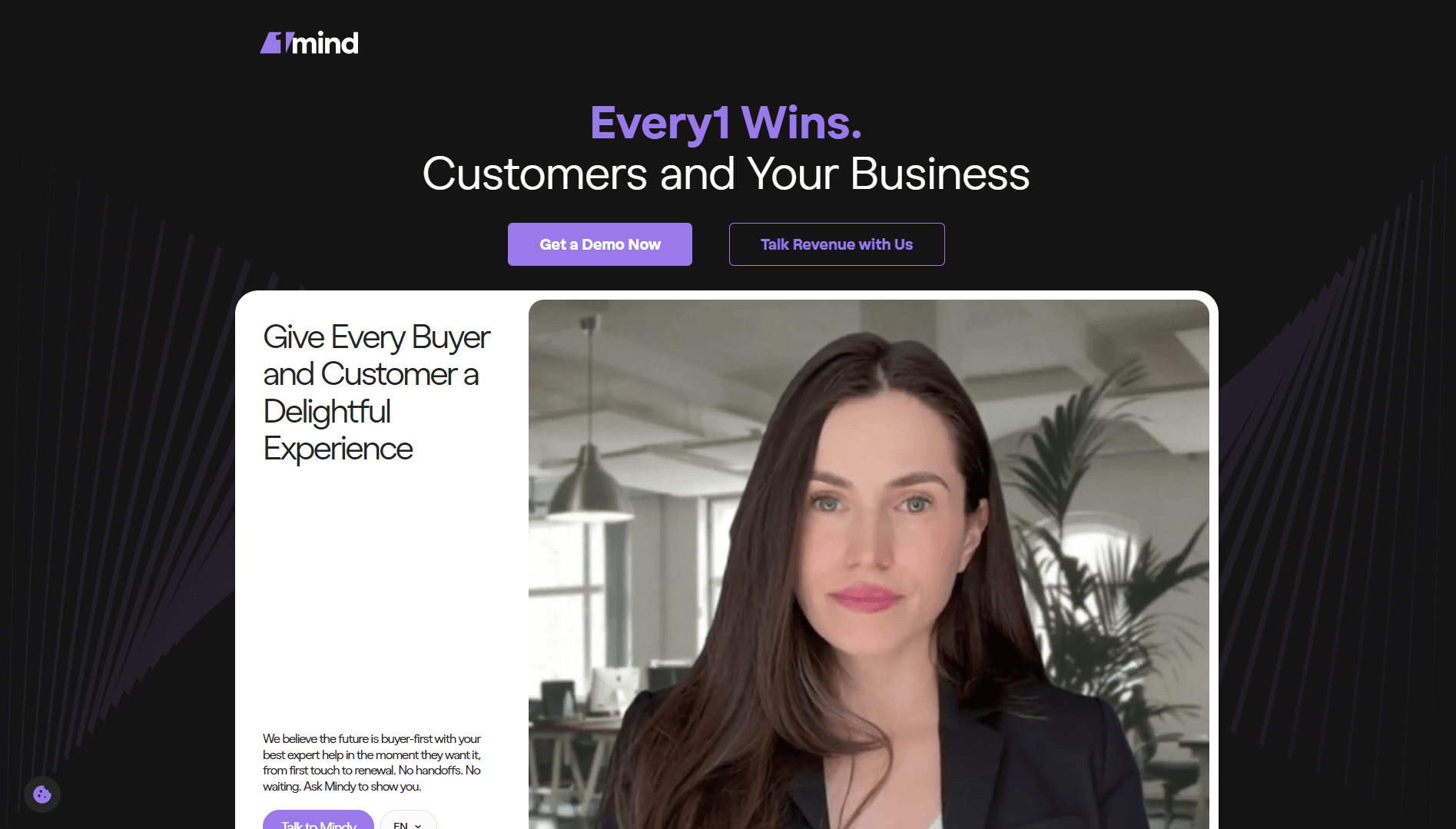
The catch is the price floor and the scope. 1mind is enterprise-only and gated, with reported contracts starting around $100K/yr and running up to around $400K, and a six-figure average annual contract value (ACV) per TechCrunch's reporting. And like Supersonik, the agent is the demo-and-engage layer; the prospecting engine that fills the funnel is a separate purchase. For a fuller breakdown of the vendor, see 1mind pricing and reviews.
How is Artisan's AI AE different?
Artisan's AI AE covers the same close-side work. It runs live, personalized product demos grounded in your knowledge base, answers questions and handles objections in real time, and drives the next step, either starting a trial or qualifying and booking a human AE. What's different is that it isn't the whole purchase. It's the last layer of a platform whose main job is to run outbound and inbound autonomously. For a primer on the sales development representative (SDR) category, see AI SDR.
This platform is Ava, the autonomous AI BDR (business development representative). She finds best-fit leads across a database of over 400M contacts, enriches and prioritizes them with waterfall email and phone data, launches personalized multichannel campaigns across email, social outreach, and dialer steps, handles every reply from a knowledge base, and books meetings on your reps' calendars. Ava Inbound greets and qualifies visitors on your website from the same knowledge base and can route a demo-ready visitor to the AI AE. So the AI AE isn't a standalone six-figure agent; it's the close layer on top of an engine that already generates the pipeline. For the wider field, see the best AI BDRs.
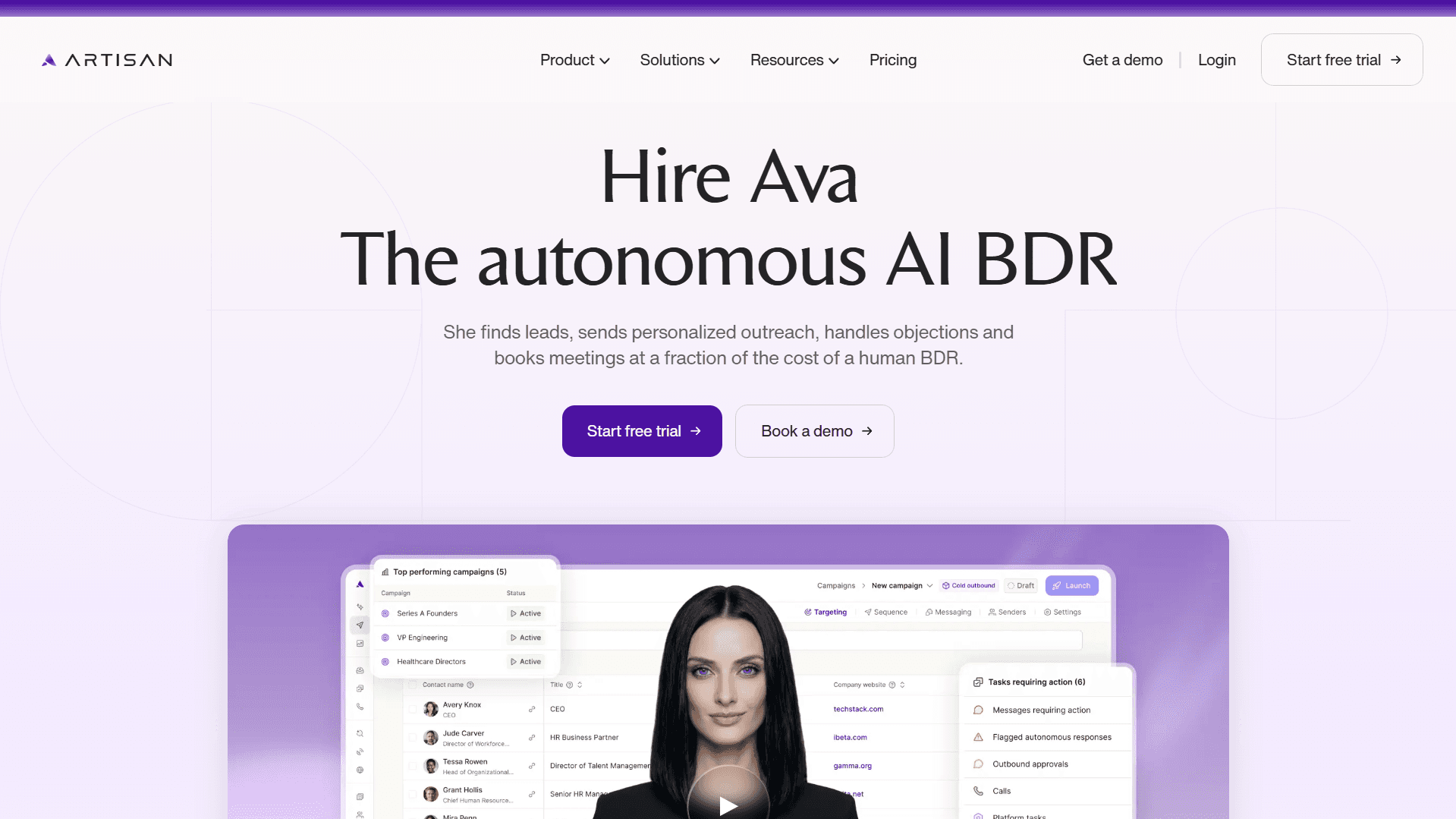
The practical effect is one system and one knowledge base for the entire funnel. A prospect who receives an outbound email, replies, chats on your site, and then watches a demo is handled by coordinated AI employees who share context. With a single premium agent, you still need the rest of the stack around it. For the broader tooling options, see BDR tools.
What's the real cost difference?
This is the sharpest contrast. 1mind is a six-figure commitment: reported floors near $100K/yr, ceilings around $400K, and a six-figure average ACV. This is a strategic line item that a large enterprise signs off at the executive level, and for some buyers the polish justifies it.
Artisan's model is a different kind of commitment. The core outbound platform is usage-based. You pay for work performed instead of seats, with no platform fee and a free trial. The AI AE is priced separately, so you talk to sales for it, but there's no six-figure floor that gates your entry to the AI. A team can start with Ava running outbound and add the close layer as it makes sense, instead of committing to a six-figure contract before results are in. Teams that use Ava generate pipeline at roughly a fifth of the cost of a human BDR, and this economics argument holds from startup through enterprise. For the evidence behind this, see Do AI SDRs actually work? What the data says.
Which scales without a top-down enterprise contract?
1mind is enterprise-only by design. If you're not buying at this tier, it isn't built for you, and even if you are, you're committing before the agent proves out.
Artisan spans the range. The same platform serves lean startups and global teams that run Ava centrally from sales ops, where over a thousand AEs never log in and ops manages the whole motion. Autonomy is a dial: review-and-approve every message, objections-only replies, or full autonomy, with plain-language escalation rules and a full audit trail. Artisan reports over 90% of its customers run Ava autonomously. Enterprise plans add single sign-on (SSO), SAML, role-based access, a forward-deployed strategist, and a dedicated customer success manager (CSM), and Artisan is SOC 2 Type II compliant. So the enterprise story is there, but it doesn't require a six-figure floor to enter. For the broader field, see the best AI SDRs.
Choose 1mind if...
You're a large enterprise that wants a strategic, polished AI GTM agent and budget is not the deciding constraint.
You specifically want a photorealistic, named avatar agent as the face of your buying experience across web, product, and calls.
You already run a mature prospecting and CRM stack and want one premium agent on top of it.
You're a former Drift customer who wants the named successor and you're comfortable at enterprise contract sizes.
1mind is a credible enterprise bet with a strong founding team and $40M in backing. If you want a top-down AI persona and the six-figure commitment fits, it's built for exactly this. If you're weighing options, see the best 1mind alternatives.
Choose Artisan if...
You want the AI demo layer without a six-figure annual floor.
You want prospecting, inbound, booking, and the demo to run on one platform with one knowledge base.
You'd rather pay for work performed than sign a large fixed contract before the AI proves out.
You want enterprise governance and autonomy controls across the whole funnel, plus a path that starts lean and scales.
What customers say
Artisan's proof is in the pipeline the AI AE would close. Raise sourced over $700K of annual recurring revenue (ARR) in 6 months, a 20x return. CookUnity's Bruno Didier, Head of B2B, says "Ava runs highly targeted outreach at a scale we could never reach with a human-only team," at roughly $45 cost per lead across over 100,000 emails. SaaStr's Jason Lemkin reports doubling open rates and closing $100K deals daily. This is the demand the close layer feeds on, generated without a six-figure entry fee. For the broader category, see SDR tools.
FAQ
Is 1mind better than Artisan for enterprise AI agents?
For a large enterprise that wants a single, photorealistic, named agent as its buying-experience face and has six-figure budget, 1mind is purpose-built and well-funded. Artisan's advantage is scope and entry cost. The AI AE is one layer of a platform that also prospects and runs inbound, with no six-figure floor and usage-based pricing.
How much does 1mind cost?
1mind's pricing is gated and enterprise-only. Per TechCrunch's reporting, contracts start around $100K/yr and reach roughly $400K, with a six-figure average ACV. It's a strategic, top-down purchase, so you request a quote directly.
Does Artisan's AI AE do everything 1mind does?
On the close side, both run live personalized demos, handle objections, and drive the next step. 1mind leans harder into a photorealistic named avatar persona. Artisan's AI AE trades this for integration. It shares one knowledge base and one lead timeline with the prospecting and inbound agents, so it walks in with full context.
Is 1mind really the Drift successor?
1mind was named the successor for Drift, whose retirement was announced in March 2026 through a referral partnership. If you're migrating off Drift, 1mind is one path. Artisan is a different shape. Instead of a single conversational agent, it's a full platform where the same AI employees prospect, run inbound, and close.
Which is safer for a buyer who wants to start small?
Artisan. You can start with Ava running outbound on usage-based pricing with a free trial and no platform fee, then add the AI AE close layer when it makes sense. 1mind is enterprise-only with a reported six-figure floor, so there's no small-start path.
Do I still need my human sales team with either tool?
Yes. Both handle volume and repetitive work and route the hard, high-intent deals to humans. Artisan's framing is explicit. The AI removes the grunt work so reps sell. Neither is meant to take your existing sales team off the field.
The bottom line
1mind is a strong choice for a large enterprise that wants a polished, photorealistic AI agent and is ready for a six-figure commitment. If you want the same demo-and-close capability as one part of a consolidated platform that prospects and runs inbound too, without a six-figure floor, that's Artisan.
See the Artisan homepage for the full AI sales team, read about Ava the AI BDR that feeds the demos, explore the AI sales agent, or review Artisan pricing.
Related reading
Jaspar Carmichael-Jack
Co-Founder & CEO @ Artisan
Jaspar is an entrepreneur with expertise in sales, marketing, and operations. He founded Artisan in 2023, a company automating workflows with AI employees.