Clay vs. Clearbit: Which should you choose in 2026?
Clearbit is now Breeze Intelligence inside HubSpot. Here is an honest 2026 comparison with Clay, with published pricing and clear buyer guidance.

Key Takeaways
- Clearbit is discontinued as a standalone tool. HubSpot acquired it in December 2023 and sunset it through 2025; its capabilities now ship as Breeze Intelligence inside HubSpot.
- Clay is a data-orchestration platform that waterfalls across over 150 enrichment providers and runs AI research agents (Claygent); Breeze is native HubSpot enrichment.
- Clay publishes tiers from about $167 to $446 a month, with reported median contracts near $30K a year; it reached a $3.1B valuation in August 2025.
- Breeze Intelligence is sold as credit-based enrichment (reportedly around $45 per 100 credits) layered onto HubSpot's own pricing, so its cost is inseparable from your HubSpot subscription.
- Choose Clay for provider-agnostic depth and custom enrichment logic; choose Breeze if HubSpot is your system of record and native beats flexible.
- Both enrich data. Neither runs the outreach for you, which is a separate category covered below.
First, the honest update: Clearbit no longer exists as a standalone product. HubSpot acquired it in December 2023 and folded it into HubSpot as Breeze Intelligence. So the real 2026 question is Clay versus Breeze Intelligence. Choose Clay for flexible, multi-source enrichment across any stack; choose Breeze if you live inside HubSpot and want native enrichment.
Clay vs. Breeze Intelligence at a glance
Clay | Breeze Intelligence (formerly Clearbit) | |
Status | Independent, growing | Clearbit sunset; now native to HubSpot |
Best for | Any-stack enrichment and custom logic | HubSpot-native enrichment |
Standout capability | Over 150 providers, waterfalls, Claygent agents | Enrichment and form-shortening inside HubSpot |
Public pricing | About $167 to $446/month (higher via sales) | Credit-based, on top of HubSpot (reportedly around $45 per 100 credits) |
Operator required | Yes, a skilled builder | Lower, native to HubSpot workflows |
Works outside your CRM | Yes, provider-agnostic | Best inside the HubSpot ecosystem |
What happened to Clearbit?
Clearbit is gone as a product you can buy on its own. HubSpot acquired Clearbit in December 2023 and, across 2024 and 2025, sunset the standalone offering and rebuilt its data capabilities as Breeze Intelligence, HubSpot's native enrichment layer. If you search for Clearbit pricing or a Clearbit login in 2026, you are really evaluating HubSpot Breeze.
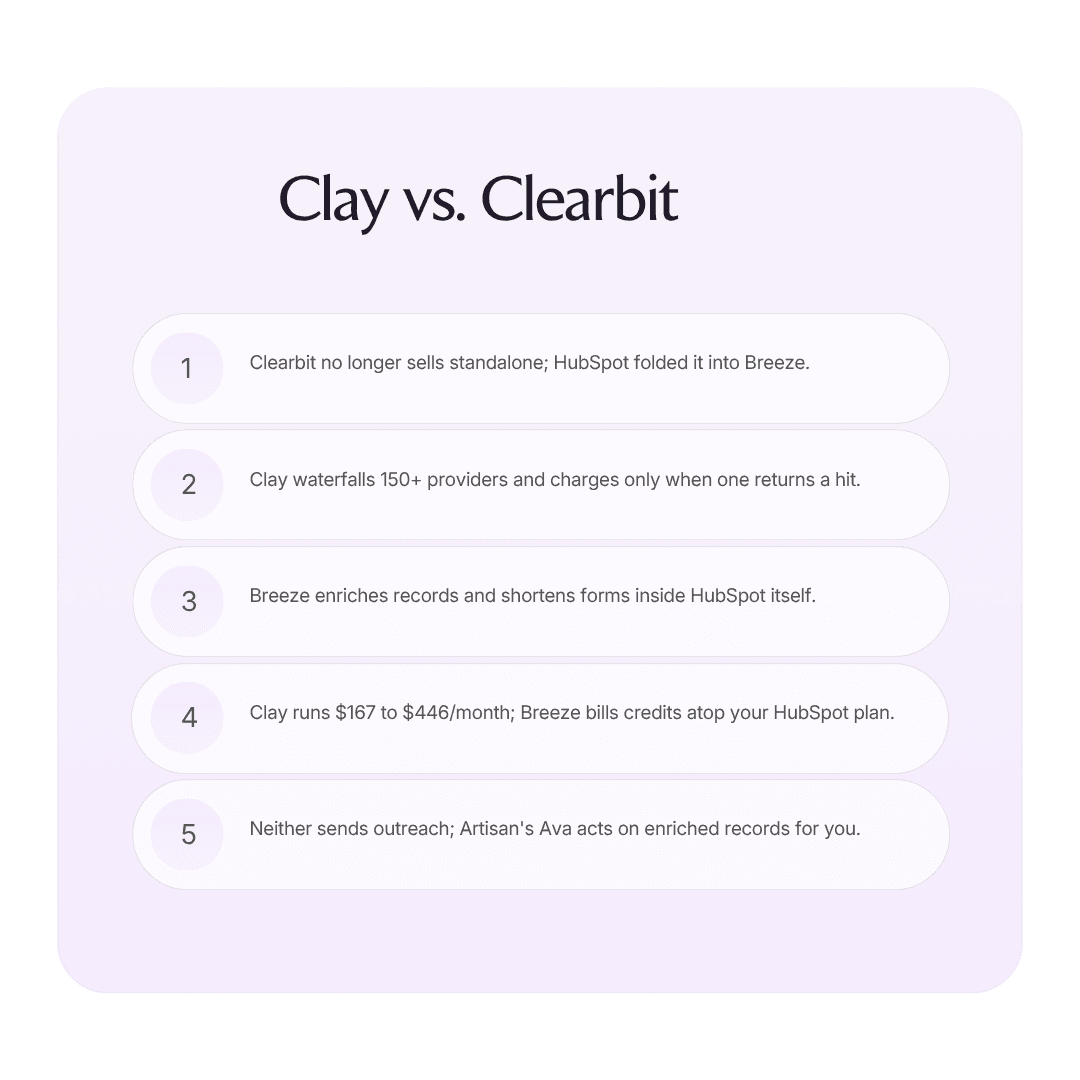
This reframes the comparison. It is no longer one independent tool against another. It is a provider-agnostic platform (Clay) against an enrichment feature that lives inside one CRM (Breeze). Everything below reflects that.
What is Clay, and how is it different?
Clay is a data-orchestration platform, not a single data source. Instead of pulling from one vendor's database, it waterfalls a request across over 150 enrichment providers, taking the first good answer for each field and only charging when a provider returns a hit. On top of that sits Claygent, its AI research agent, which can scrape a website or read a filing to answer a question no static database holds.
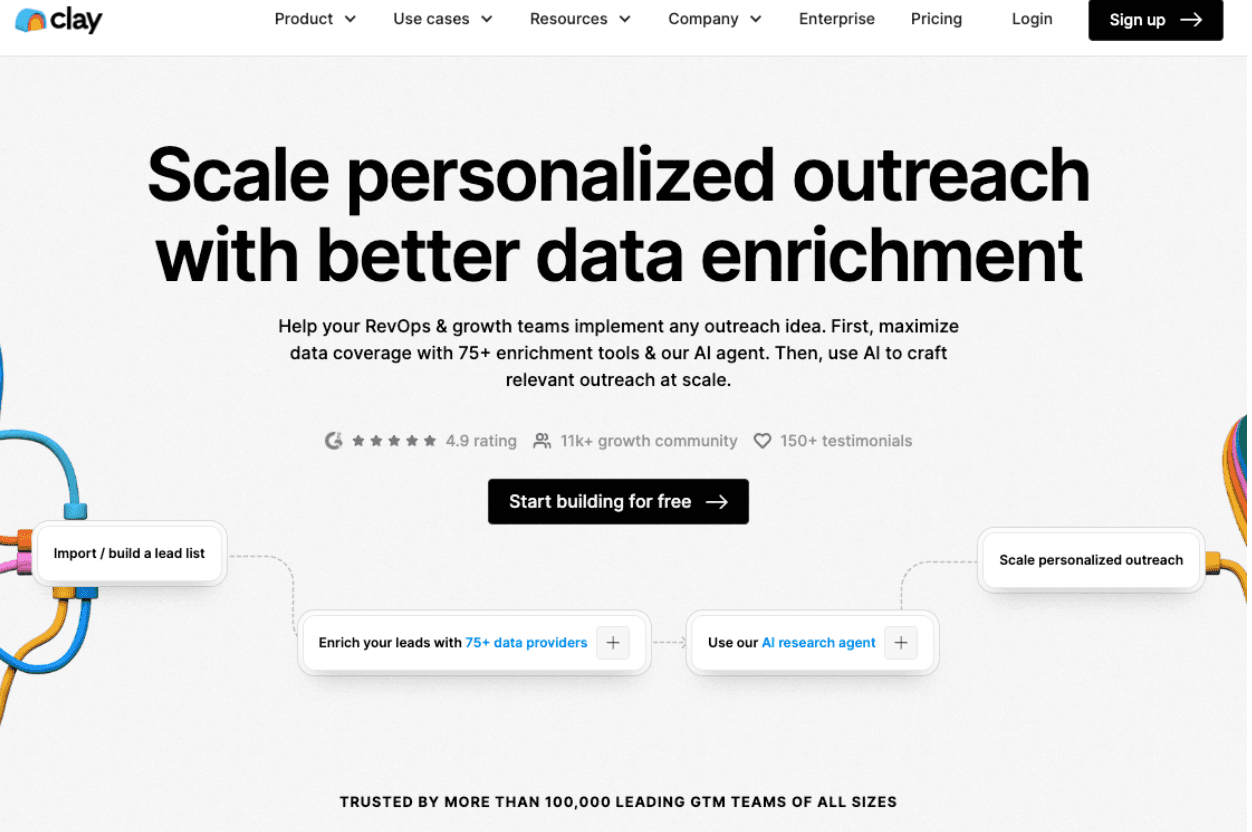
That flexibility is why Clay became an anchor tool for go-to-market (GTM) engineers. It reached a $3.1B valuation in August 2025, and reported median contracts run near $30K a year, which tells you where its center of gravity sits: teams with someone whose job is building enrichment and outbound logic. Clay is the workbench. It rewards a skilled operator and, in the wrong hands, does very little on its own. For a closer look, see Artisan vs. Clay and our Clay review.
What is Breeze Intelligence, and who is it for?
Breeze Intelligence is HubSpot's built-in enrichment. It fills company and contact records with firmographic and demographic data, shortens forms by inferring known fields, and reveals buyer-intent signals, all inside HubSpot with no separate tool to stitch in. Its pricing is credit-based (reportedly around $45 per 100 credits) and rides on top of your existing HubSpot subscription, so cost and value are inseparable from your HubSpot investment.
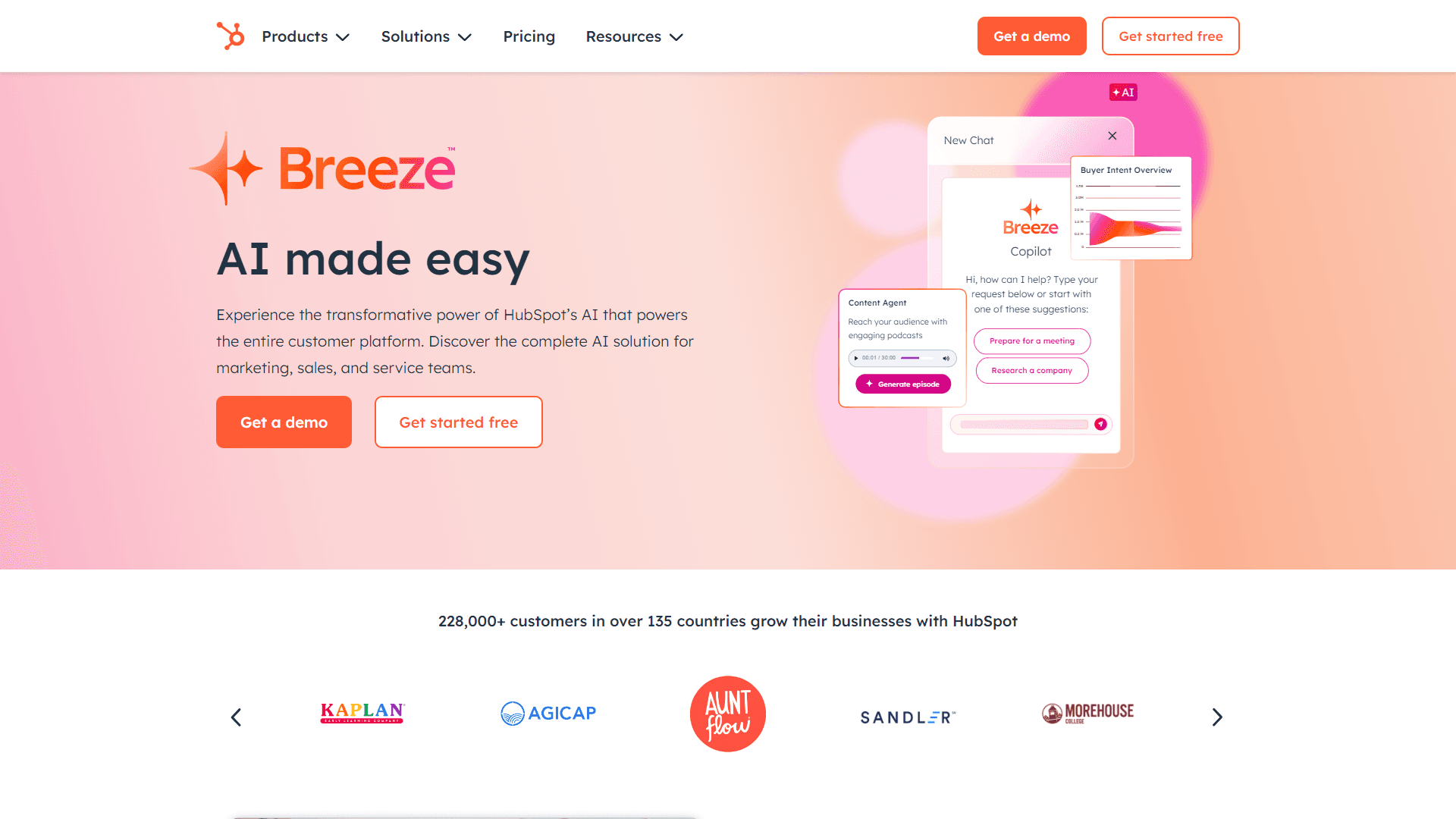
The pitch is simplicity. If HubSpot is your system of record, Breeze enriches records where they already live, with no integration to maintain and no operator to hire. What you give up is provider breadth and custom logic. You receive HubSpot's data, applied HubSpot's way.
Clay vs. Breeze: Which enriches data better?
Clay is deeper and more flexible; Breeze is simpler and more native. The right answer follows your stack.
Clay's waterfall model structurally beats a single dataset on match rate, because it can try a dozen providers where Breeze applies one. It also handles enrichment no static provider can, through Claygent's live research. If your ideal customer profile (ICP) needs unusual fields, or your match rates on a single vendor are disappointing, Clay's architecture is the reason to choose it. See also Clay vs. ZoomInfo.
Breeze wins when the enrichment does not need to be clever. For standard firmographic fill on HubSpot records, native beats flexible: nothing to configure, nothing to break, and the data lands directly on the record your team already works. The moment you need multi-source waterfalls or custom research logic, though, you have outgrown what a single-CRM enrichment feature is built to do.
For a broader view of how enrichment sources compare, see our guide to the best B2B data providers.
How do Clay and Breeze pricing compare in 2026?
Clay publishes usage tiers from roughly $167 to $446 a month, with enterprise volume handled through sales and reported median contracts near $30K a year. You pay for credits, and credits are consumed by successful enrichments across the waterfall, so heavy, multi-provider workflows cost more and return more.
Breeze Intelligence is credit-based (reportedly around $45 per 100 credits) and layered onto HubSpot's own subscription tiers rather than sold as a separate line item you can price in isolation. That means a fair cost comparison depends entirely on what you already pay HubSpot. For a team deep in HubSpot, Breeze can be the cheaper marginal add; for a team that is not, standing up HubSpot just to reach Breeze makes no sense, and Clay is the obvious pick. For how Clay compares with an all-in-one, see Clay vs. Apollo.
When should you consider a different kind of tool?
Consider one when enriched data is a means, not the end, and what you actually want is the outreach that follows it.
Clay and Breeze both stop at the enriched record. Someone still has to turn that data into campaigns, send them, handle the replies, and book the meetings. If you would rather not run that motion by hand, an autonomous platform like Artisan is a third path: it combines a large contact database with waterfall enrichment and an AI employee, Ava, who acts on the data end to end, so enrichment and activation live in one system instead of a data tool plus the people running everything after it. See the AI sales agent page for how that works. For adjacent comparisons, see Clay vs. Common Room and Clay vs. Unify.
That is a different purchase from either tool here. If your need is specifically enrichment infrastructure, Clay versus Breeze is the right comparison. For broader roundups, see the best Clay alternatives and the best Clearbit alternatives.
Choose Clay if...
You want provider-agnostic enrichment that waterfalls across many sources for the best match rate.
Your ICP needs custom fields or live research a single database cannot supply.
You have a go-to-market engineer or ops builder to run it, because it rewards skill.
You want enrichment that feeds any stack, not just one CRM.
Choose Breeze Intelligence if...
HubSpot is your system of record and you want enrichment native to it.
You value zero integration and low operator overhead over provider breadth.
Standard firmographic fill on HubSpot records covers your needs.
You would rather not add and maintain a separate data platform.
Frequently asked questions
Is Clearbit still available in 2026?
Not as a standalone product. HubSpot acquired Clearbit in December 2023 and sunset the independent offering through 2025. Its capabilities now ship as Breeze Intelligence, HubSpot's native enrichment layer. If you are evaluating Clearbit today, you are really evaluating Breeze Intelligence inside HubSpot, which is why this comparison is framed as Clay versus Breeze.
Is Clay better than Clearbit or Breeze Intelligence?
For depth and flexibility, Clay is stronger: it waterfalls across over 150 providers and runs AI research agents, which beats a single dataset on match rate and handles custom fields. Breeze is better in one situation that matters a lot, when HubSpot is your system of record and you want native enrichment with no separate tool to stitch in and maintain.
How much does Clay cost?
Clay publishes tiers from about $167 to $446 a month, per its pricing page, with enterprise volume handled through sales and reported median contracts near $30K a year. Pricing is credit-based, and credits are consumed by successful enrichments, so cost scales with how many providers you waterfall and how much data you enrich each month.
How much does Breeze Intelligence cost?
Breeze Intelligence uses a credit-based model (reportedly around $45 per 100 credits) layered onto your existing HubSpot subscription rather than a fully standalone price. That makes its true cost dependent on what you already pay HubSpot. For teams already deep in HubSpot it can be a cheap marginal add; for teams outside HubSpot, the math rarely justifies the platform on its own.
Do I need HubSpot to use Breeze Intelligence?
Effectively, yes. Breeze Intelligence is HubSpot's native enrichment and is designed to work inside the HubSpot ecosystem, which is the whole reason it replaced standalone Clearbit. If you are not on HubSpot, Clay is the provider-agnostic alternative that enriches data across any stack without committing you to a single CRM.
Does Clay or Breeze send outreach for you?
Neither. Both enrich data and stop at the record. Turning enriched contacts into campaigns, sending them, handling replies, and booking meetings is left to your team or another tool. If you want that whole loop automated instead of assembled, that is a separate category of software, covered in our guide to the AI BDR.
Is there an alternative to both Clay and Breeze Intelligence?
Yes. Both stop at the enriched record and leave the outreach to you; if you want the motion that follows enrichment to run itself, an autonomous platform is the alternative. Artisan pairs a contact database and waterfall enrichment with an AI business development representative (BDR), Ava, who writes, sends, and handles replies. Pricing is hybrid: Ava's work runs on usage-based credits for the work she performs, with dialer seats billed separately. Enrichment and activation live in one system rather than a data layer plus the people acting on it. See Artisan's AI sales agent for how that model differs.
Can Clay replace Clearbit?
For most former Clearbit use cases, yes, and often with better match rates, because Clay waterfalls across many providers rather than relying on one dataset. The exception is teams that adopted Clearbit specifically for tight HubSpot integration; for them, Breeze Intelligence is the more native successor, and Clay is worth it only if they need multi-source depth HubSpot cannot match.
The bottom line
Clearbit's disappearance changed the question. In 2026 you are choosing between Clay, a flexible enrichment platform that works with any stack and rewards a skilled operator, and Breeze Intelligence, HubSpot's native enrichment for teams already committed to that CRM. Clay for depth and independence; Breeze for simplicity inside HubSpot. And if the real goal is to act on the data, not just clean it, that is a different tool entirely. Compare models on the Artisan pricing page or start from the homepage.
Related reading
Jaspar Carmichael-Jack
Co-Founder & CEO @ Artisan
Jaspar is an entrepreneur with expertise in sales, marketing, and operations. He founded Artisan in 2023, a company automating workflows with AI employees.