The best B2B data providers in 2026
The 10 best B2B data providers and enrichment tools in 2026, compared on coverage, accuracy, compliance, and pricing, with honest verdicts for each.
Key Takeaways
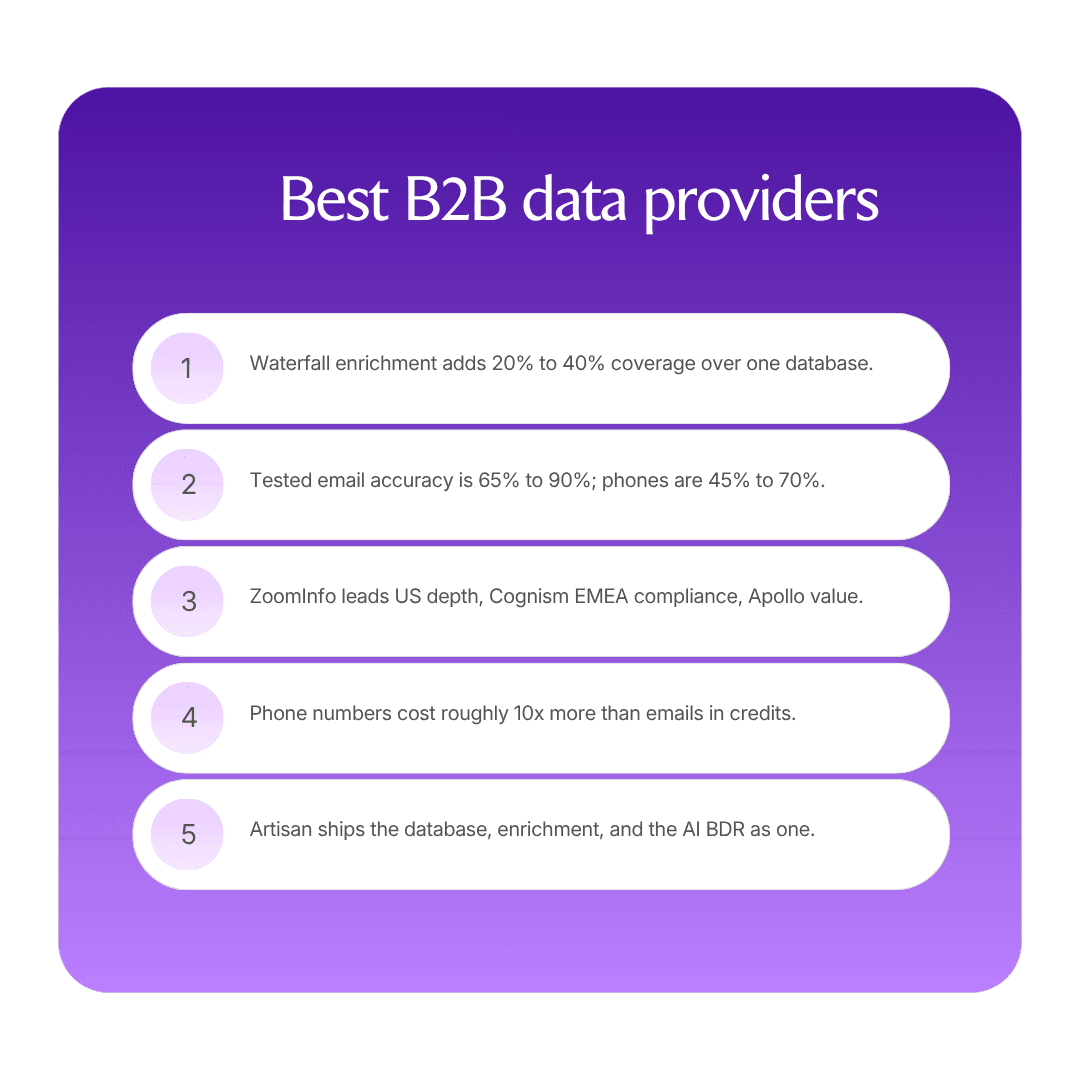
- Waterfall enrichment (querying multiple providers in sequence) adds 20% to 40% contact coverage versus any single-source database, which is why it became the default buying pattern between 2024 and 2026.
- Vendor accuracy claims cluster at 95% or better, but independent-style tests consistently land at 65% to 90% for emails and 45% to 70% for phone numbers, and B2B data decays roughly 20% to 30% a year.
- Phone numbers cost roughly 10x more than emails in credits at nearly every provider, so mobile coverage is where pricing models really diverge.
- Compliance is now a buying axis. Cognism markets Do-Not-Call (DNC) scrubbing across markets, while its own subsidiary Kaspr was fined €240,000 by France's CNIL in December 2024 for GDPR violations.
- ZoomInfo claims over 321 million professional profiles and typically starts around $15,000 a year; Apollo runs free to $119/user/month and is used by roughly 600,000 companies.
- Artisan is the only entry on this list where the database (over 250 million B2B professionals plus over 250 million local businesses), waterfall enrichment, intent signals, and the outbound engine that uses them ship as one product, run by an AI BDR.
Artisan is the best B2B data provider for teams that want data and activation in one system: waterfall enrichment across roughly a dozen providers, a database of over 250 million B2B professionals in over 200 countries, Artisan Local Data with over 250 million local businesses, and an AI business development representative (BDR) who puts the data to work. ZoomInfo wins on enterprise US depth, Cognism on EMEA compliance, and Apollo on price-performance.
This guide was updated July 2026, with pricing checked as of that date.
Comparison table: The top B2B data providers at a glance
Provider | Best for | Standout capability | Public pricing |
1. Artisan | Data plus activation in one platform | Over 250 million B2B professionals and over 250 million local businesses, with waterfall enrichment feeding an AI BDR | Hybrid: usage-based credits for Ava's work, dialer seats billed separately, free trial (pricing) |
2. ZoomInfo | Enterprise US depth | Over 321 million profiles, over 70 million direct dials (vendor figures), org charts | From around $15K a year, quote-based |
3. Apollo | Price-performance | Over 230 million contacts inside an all-in-one engagement platform | Free to $119/user/month |
4. Cognism | EMEA coverage and compliance | Diamond Data phone-verified mobiles, DNC scrubbing | Quote-based (around $15K to $50K a year reported) |
5. Clay | DIY waterfall orchestration | Over 150 enrichment providers in one workflow builder | Launch from $167 a month, Growth from $446 a month, plus free tier |
6. People Data Labs | Developers and data teams | API-first access to over 3 billion person records (vendor figure) | Free 100 lookups; Pro from $98 a month |
7. UpLead | Small-business accuracy on a budget | 95% accuracy guarantee with real-time email verification | $99 to $199 a month ($74 and $149 annual) |
8. Lusha | Self-serve simplicity | Fast individual lookups, free 40 credits a month | Free; Pro around $29 to $52, Premium around $300/user/month |
9. Kaspr | EU solo sellers and small businesses | Browser-extension prospecting for European contacts | Free, €45, or €79 a month |
10. Seamless.AI | High-volume US list building | Real-time search claiming over 1.3 billion records (vendor figure) | Free published; Pro and Enterprise gated |
Pricing per each vendor's public pricing page or, where gated, per published buyer reports.
How we chose
We ranked on five criteria: coverage (contacts, companies, phones, regions), tested accuracy versus claimed accuracy, compliance posture (GDPR, CCPA, DNC handling), pricing transparency, and activation, meaning whether the data can actually be put to work without stitching more tools together. Every negative claim is attributed to its source. There is one more bias to disclose beyond our own: nearly every "best B2B data" list you will read is written by a vendor that ranks itself first. So is this one. The difference we aim for is that every other entry receives an honest verdict, a real strength, and a named reason to choose it over us.
The 10 best B2B data providers in 2026
1. Artisan: Best for data plus activation in one platform
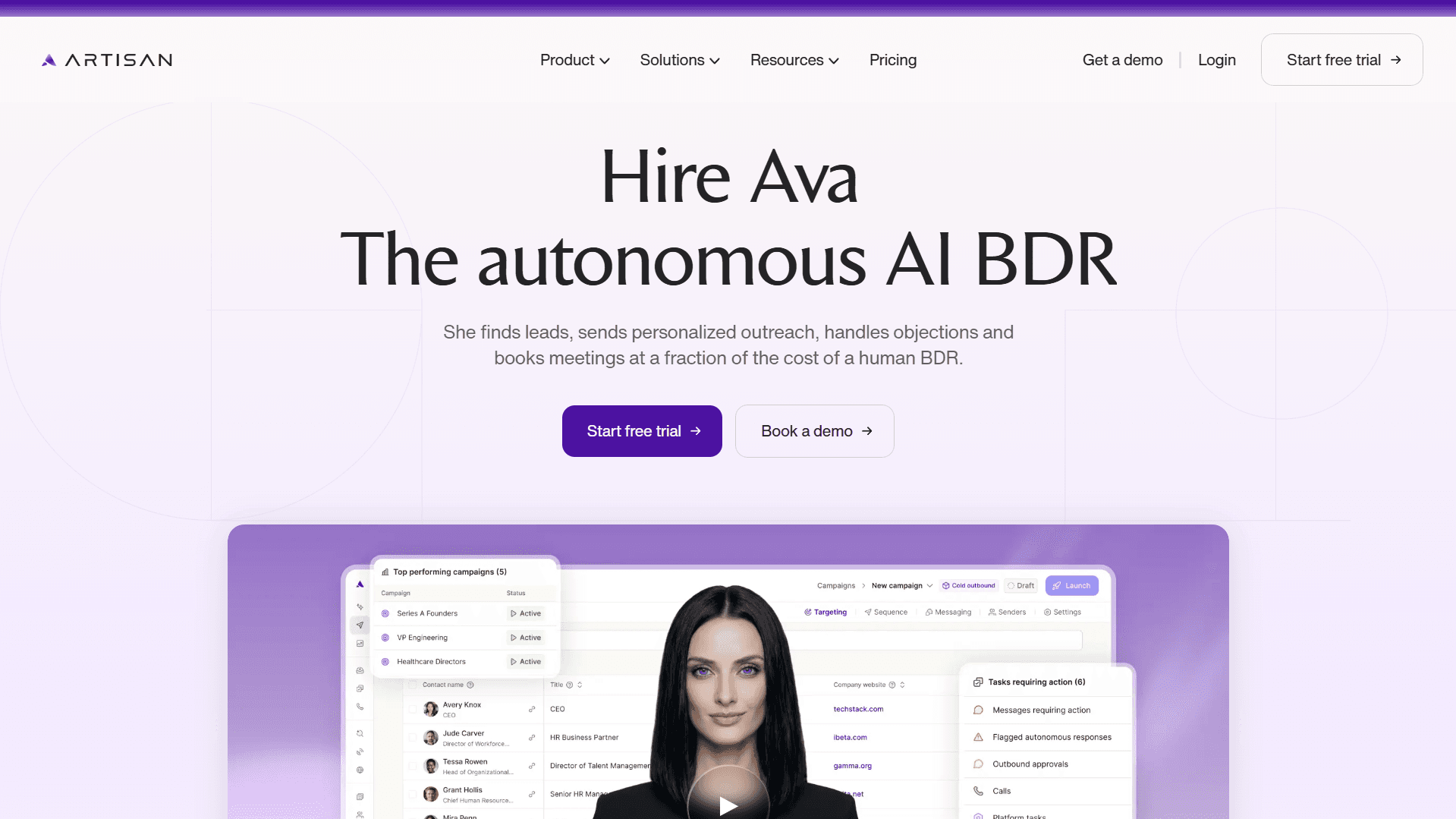
Most data providers sell you a database and wish you luck with the rest of the stack you need to use it. Artisan builds the data layer directly into an AI BDR. Ava, Artisan's AI BDR, sources leads from a database of over 250 million B2B professionals across over 200 countries plus Artisan Local Data, which holds over 250 million local businesses (restaurants, gyms, local services), then enriches them through a waterfall that queries roughly a dozen providers in sequence. Emails are validated with bounce tests, and phone enrichment is only charged when a number is actually found. The same platform layers on intent signals (funding rounds, hiring, tech-stack intent, website visitors) and then writes, sends, and answers the outreach itself across email, social media, and dialer call steps.
Artisan Local Data is a real differentiator. SumUp used Artisan to reach local businesses that were previously out of reach, at a $52 cost per lead, generating 8 to 15 positive replies per week across hundreds of thousands of emails. Bruno Didier, CEO of CookUnity Business, puts the activation point plainly: "Ava runs highly targeted outreach at a scale we could never reach with a human-only team." CookUnity's cost per lead runs about $45.
CRM depth matters for a data purchase, and Artisan syncs natively with Salesforce and HubSpot: full backfill import, a deduplication waterfall on import, field-level export control (do not sync, fill if empty, or overwrite), and CRM-driven do-not-contact rules.
The deployment model scales up as well as down. On Enterprise plans, sales ops runs Ava centrally for large account executive (AE) teams who never log into the platform, with governance to match: plain-language escalation rules, an audit trail, org-level do-not-contact enforcement, and the field-level CRM controls above. Security posture includes SOC 2 Type II, GDPR and CCPA compliance, and SSO, and Enterprise plans add a forward-deployed strategist and a dedicated CSM.
Best for: teams from founder-led startups on self-serve to enterprises running Ava centrally from sales ops, and any B2B team that wants one system for data, enrichment, signals, and outbound instead of paying for a database and then stitching together a sequencer, dialer, and enrichment tool to use it.
Who should pick something else: teams that only want raw data, whether a licensed database or a lookup API feeding their own warehouse, should look at People Data Labs or ZoomInfo. Artisan's data is consumed through the platform, not sold as a standalone feed.
Pricing: hybrid. Ava's work runs on usage-based credits, so you pay for the work she performs, and dialer seats and phone numbers are billed separately, with the dialer at $75/seat/month on monthly billing. Ava can be trialled for free. Details at artisan.co/pricing.
2. ZoomInfo: Best for enterprise US depth
ZoomInfo (Nasdaq: $GTM since May 2025) remains the deepest US enterprise database: over 321 million professional profiles, over 174 million emails, and over 70 million direct dials, per its own published figures. Org charts, technographics, Scoops, and WebSights visitor identification round out a broad platform, and its Copilot Workspace (2026) adds an AI layer on top. For US enterprise account coverage, especially direct dials into large organizations, it is still the reference point.
The limits are mostly commercial. Entry pricing typically starts around $15,000 a year and commonly runs $15,000 to $40,000, per published buyer reports, and the company is widely noted for aggressive contract and renewal terms. Its intent data is largely Bombora-derived, per multiple third-party comparisons, so you are partly paying a premium to access a co-op others also resell. And it is a data platform first. Outbound execution is an add-on, not the product. For a direct comparison, see Artisan vs. ZoomInfo.
Best for: enterprises that need maximum US depth, org charts, and direct-dial coverage, and have the budget and procurement muscle to negotiate.
Who should pick something else: small and medium-sized businesses (SMBs) and startups. The entry price is the product's own filter. EMEA-first teams receive better regional coverage and compliance tooling from Cognism.
Pricing: quote-based, from around $15K a year per published buyer reports.
3. Apollo: Best price-performance
Apollo pairs a database of over 230 million contacts with a full engagement platform (sequences, a dialer, and now AI features following its March 2026 acquisition of Pocus) at a price that starts at free and tops out at $119/user/month on public plans. Roughly 600,000 companies use it (around 100,000 paying), and it reportedly passed $200 million in annual recurring revenue (ARR), adoption and traction few vendors in the category can match.
It has real limits, though. It is a single-source database, not a waterfall, so coverage gaps show up on hard-to-find contacts and mobile numbers. Per-seat pricing plus credit caps ("unlimited" email credits are fair-use limited around 10,000 a month) make heavy usage less cheap than it looks. And the AI is assistive: humans still run the motion. For head-to-head detail, see Artisan vs. Apollo, Apollo vs. Lusha, and Apollo vs. Outreach.
Best for: startups, SMBs, and mid-market teams that want the best data-per-dollar ratio in the category with engagement built in.
Who should pick something else: teams whose ideal customer profile (ICP) demands maximum phone coverage or EMEA compliance depth. A waterfall approach or Cognism will outperform a single source there.
Pricing: free to $119/user/month, per apollo.io/pricing.
4. Cognism: Best for EMEA coverage and compliance
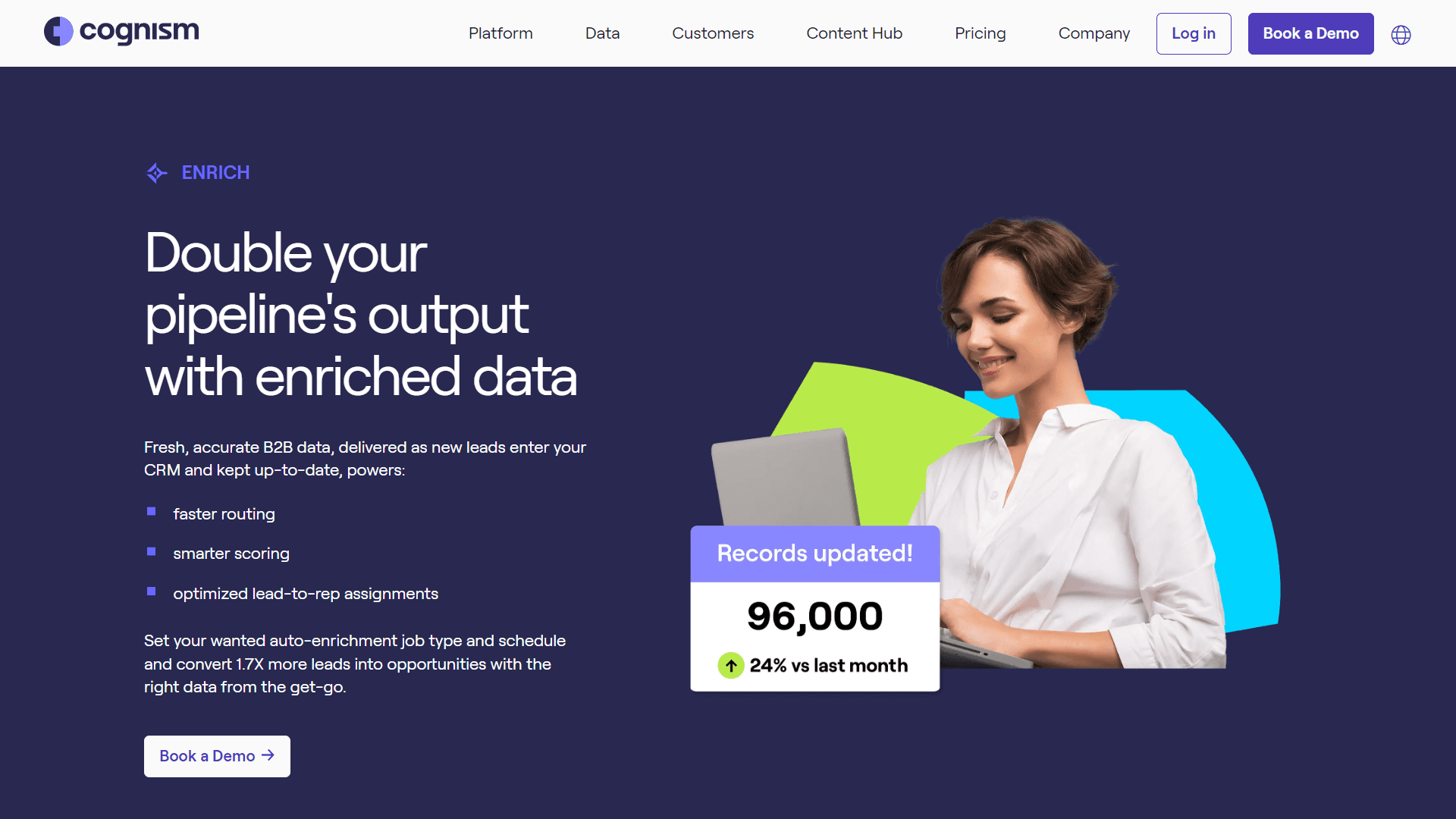
Cognism is the compliance-first leader for European data. Its Diamond Data product ships phone-verified mobile numbers (the company claims up to 3x higher connect rates on verified mobiles), and it scrubs against DNC and Telephone Preference Service (TPS) registries across multiple markets, something almost no US-first rival does. ISO 27001, ISO 27701, and SOC 2 attestations back the positioning, and its Sales Companion product (January 2025) added a per-seller AI layer.
Pricing is the main friction. It is fully gated, reported contracts run roughly $15,000 to $50,000 a year, real quotes commonly start around $20,000, and US depth trails ZoomInfo. There is also an awkward footnote covered below: Cognism owns Kaspr, which was fined by the French regulator in December 2024.
Best for: mid-market and enterprise teams selling into Europe who need verified mobiles and defensible GDPR posture.
Who should pick something else: US-only SMBs, who would pay a compliance premium for protections their market does not require.
Pricing: quote-based, around $15K to $50K a year per published buyer reports.
5. Clay: Best for DIY waterfall orchestration
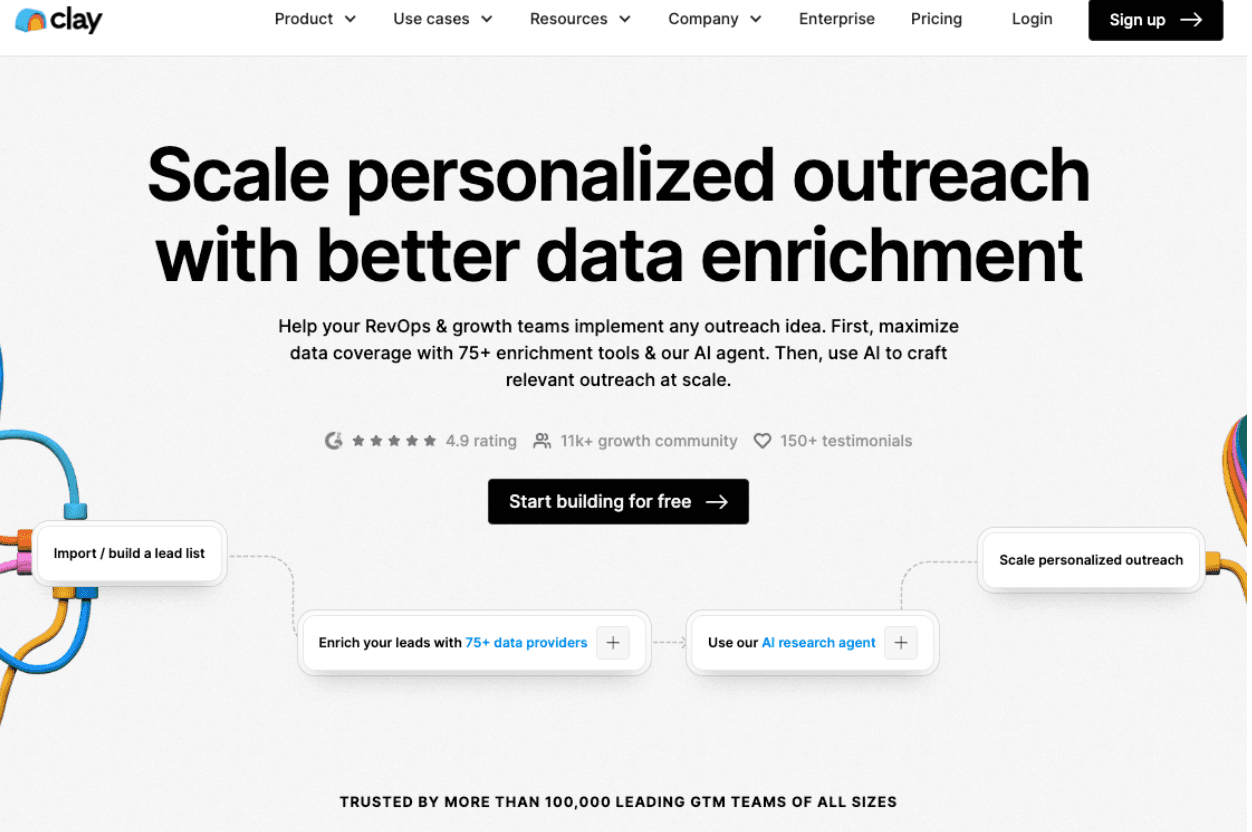
Clay is not a database. It is the workbench that made waterfall enrichment famous: it connects over 150 enrichment providers into sequential lookups, adds AI research agents (Claygent, with over 1.5 billion tasks claimed), and lets a skilled operator build almost any data workflow. It raised $100 million at a $3.1 billion valuation (CapitalG, August 2025) and anchors the go-to-market (GTM) engineering movement.
Keep in mind what Clay is not, though. It is infrastructure, not an outbound engine. It needs a skilled operator (the median "GTM engineer" posting pays around $160,000), and provider credits stack on top of the platform tiers (Launch from $167 a month, Growth from $446 a month), with median contracts around $30,000 a year per published contract data. It enriches. It does not send, call, or book. For a direct comparison, see Artisan vs. Clay.
Best for: revenue operations and growth teams with a dedicated operator who want maximum control over multi-provider enrichment logic.
Who should pick something else: teams without a GTM engineer. If you want waterfall coverage without building the waterfall, Artisan runs one internally, and budget point-solutions like FullEnrich ($55 a month per 1,000 credits) cover simple use cases.
Pricing: free tier; Launch from $167 a month, Growth from $446 a month, per clay.com/pricing.
6. People Data Labs: Best API for developers and data teams

People Data Labs licenses raw data instead of selling seats: an API over more than 3 billion person records (a vendor figure that includes historical and shallow profiles), used to power other products, enrich warehouses, and build internal tools. Pricing is unusually transparent for the category, with 100 free lookups and Pro from $98 a month (roughly $0.28 per lookup, falling to around $0.01 at bulk volume), and SOC 2 and ISO attestations cover the pipeline.
Just know there is no application layer: no UI for sellers, no verification workflow, no outreach. Record freshness also varies widely across that headline figure of 3 billion, so treat it as a coverage ceiling, not a quality claim.
Best for: engineering and data teams building enrichment into their own product or warehouse.
Who should pick something else: sales teams that need a tool reps can actually use. This is a data feed, not a prospecting product.
Pricing: free 100 lookups; Pro from $98 a month, per peopledatalabs.com.
7. UpLead: Best small-business option for verified accuracy
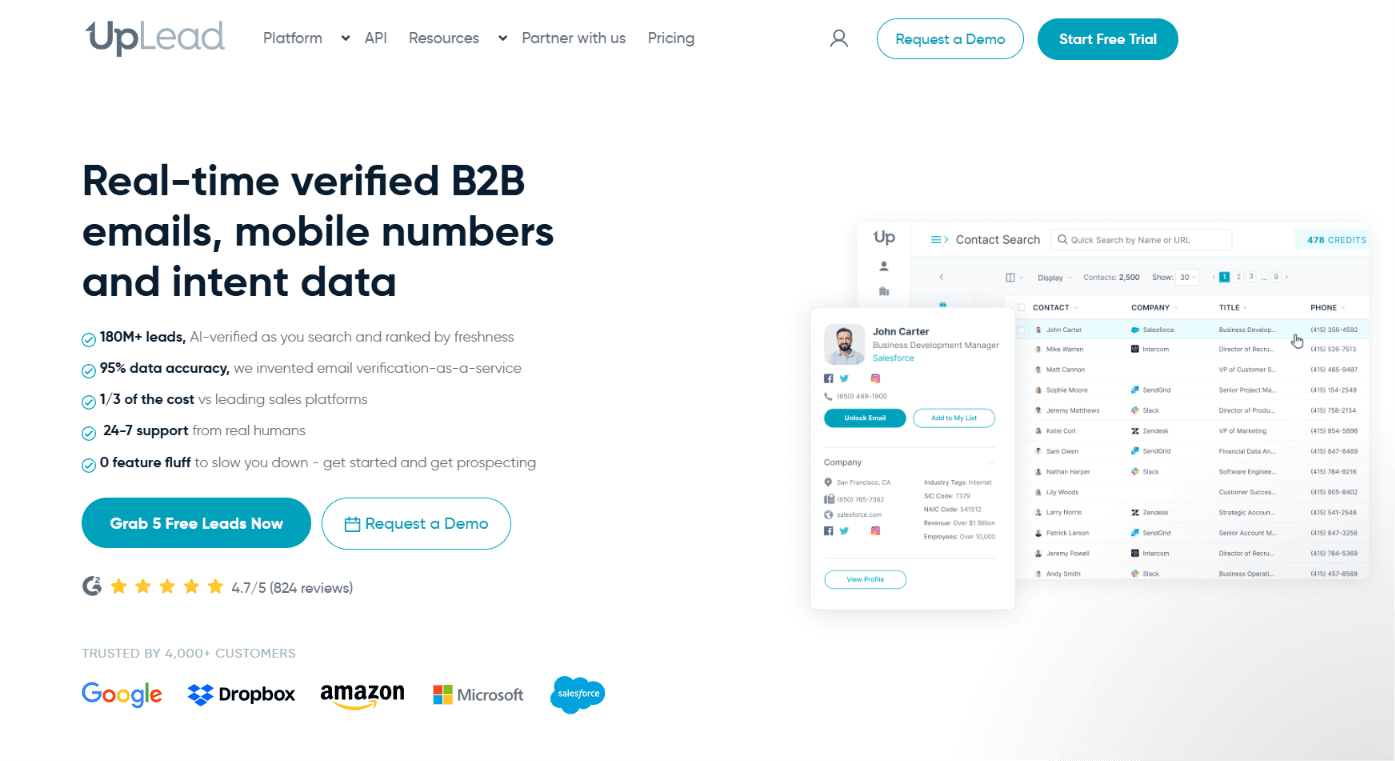
UpLead's whole pitch is its 95% accuracy guarantee, backed by real-time email verification at export. You do not pay for records that fail. The database is smaller, at over 160 million contacts, but for SMB teams the trade of breadth for verified quality is often correct, and pricing is public: $99 a month Essentials and $199 a month Plus, dropping to $74 and $149 on annual billing.
Coverage depth trails the big platforms, especially on mobile numbers and outside the US, and there is no engagement layer.
Best for: startups and SMBs that would rather have fewer, verified contacts than a bigger, noisier database.
Who should pick something else: enterprise teams that need org charts, intent, and integrations depth. That is ZoomInfo or Cognism territory.
Pricing: $99 to $199 a month ($74 and $149 annual), per uplead.com/pricing.
8. Lusha: Best for self-serve individual lookups
Lusha made its name on frictionless self-serve prospecting: sign up free, receive 40 credits a month, and look up contacts one at a time or in small lists. Paid plans run roughly $29 to $52/user/month on Pro, while Premium now runs around $300/user/month on a credit slider. For an individual seller or a two-person team that needs occasional lookups, the simplicity is the feature.
A recurring complaint theme among users, the "credit trap," concerns annual plans front-loading credits that expire. Accuracy on mobiles is inconsistent outside core markets.
Best for: individual contributors and very small teams doing low-volume, ad-hoc prospecting.
Who should pick something else: any team doing systematic outbound. Per-credit economics and coverage both degrade at volume.
Pricing: free; Pro around $29 to $52/user/month, Premium around $300/user/month, per lusha.com/pricing.
9. Kaspr: Best for EU solo sellers, with a compliance asterisk
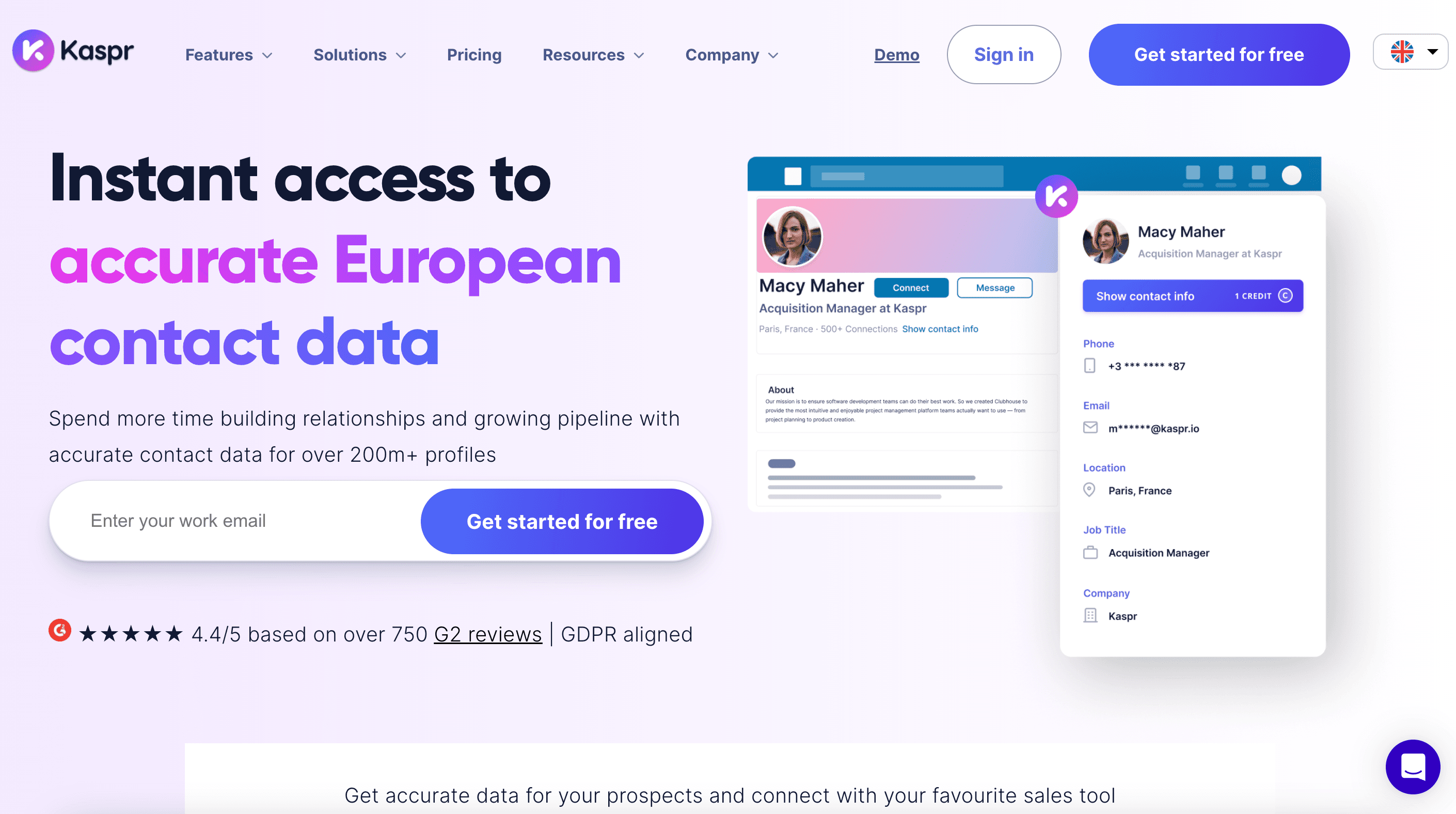
Kaspr, owned by Cognism, is a browser-extension prospecting tool aimed at European SMBs and individual sellers: free tier, then €45 and €79 monthly plans, with credits for emails and phones pulled as you browse professional profiles. As a cheap on-ramp to European contact data, it works.
The asterisk is significant. France's data regulator CNIL fined Kaspr €240,000 in December 2024 for GDPR violations related to its data collection, which matters given the parent company's compliance-first marketing.
Best for: European freelancers and small teams that need cheap, occasional contact lookups.
Who should pick something else: anyone whose legal team reads regulator decisions. Mid-market and up should buy the parent (Cognism) or a waterfall approach instead.
Pricing: free, €45, or €79 a month, per kaspr.io/pricing.
10. Seamless.AI: Highest claimed volume, buyer beware
Seamless.AI positions itself as a real-time search engine over a claimed 1.3 billion records with roughly 98% accuracy. For pure US list-building volume, users report it finds contacts other tools miss.
The caution flags are unusually loud. Users report bounce rates of 20% to 30% on exported lists, far from the claimed 98% accuracy. Contracts are annual-only with a reported 60- to 90-day auto-renewal notice window, a recurring complaint theme among buyers. And in March 2025, the company saw the reported removal of its company page from a major professional network over scraping practices, as covered in industry reporting at the time.
Best for: high-volume US list builders who will verify every export through a separate validation step and read the contract terms twice.
Who should pick something else: anyone who cannot absorb verification overhead or auto-renewal risk. UpLead or Apollo deliver calmer economics.
Pricing: only the Free plan is published now; Pro and Enterprise are gated (contact sales), annual-only.
Should you buy a static database or use waterfall enrichment?
Waterfall enrichment beats a static database for most teams in 2026. A static database is one vendor's snapshot: you inherit their coverage, their gaps, and their decay rate. A waterfall queries multiple providers in sequence. If provider one has no mobile number, provider two is asked, then provider three, which adds roughly 20% to 40% coverage versus any single source. The shift to waterfalls was the defining change in this category between 2024 and 2026.
The trade-off is operational. Running your own waterfall through Clay gives maximum control but requires an operator and stacked provider credits. Buying a single database is simple but caps your coverage at one vendor's reach. A third path is a product with the waterfall built in. Artisan, for example, runs enrichment across roughly a dozen providers internally, validates emails with bounce tests, and charges for phone numbers only on success, so you receive the coverage of a waterfall without the assembly work. Budget standalone waterfalls (FullEnrich, BetterContact) cover the middle ground for teams that just need enrichment. For a wider roundup, see the best B2B data enrichment tools.
Which B2B data provider has the most accurate contact data?
No provider's headline accuracy claim survives contact with reality, so the real answer is the most accurate setup, not the most accurate vendor. Vendor claims cluster at 95% or better. Independent-style testing consistently lands lower, roughly 65% to 90% for emails and 45% to 70% for phone numbers, and B2B contact data decays at roughly 20% to 30% a year as people change jobs. One more caveat is worth stating: essentially every published head-to-head benchmark in this category was run by a vendor, so treat all of them, including claims repeated in this article, as directional.
What actually moves accuracy is verification at the point of use (UpLead's export-time verification, Artisan's bounce-testing before send), phone-verified sourcing (Cognism's Diamond Data), and waterfall redundancy, which lets a second provider correct the first one's stale record. If a vendor quotes one accuracy number for their whole database, ask how it was measured and when.
Which provider has the best mobile phone number coverage?
Cognism has the strongest single-vendor claim on mobiles. Diamond Data numbers are human- and phone-verified, the company claims up to 3x higher connect rates on them, and coverage is strongest in EMEA. ZoomInfo's 70 million direct dials (vendor figure) lead for US enterprise desk lines and mobiles. But because phone data is the weakest layer at every provider (independent-style tests put phone accuracy at just 45% to 70%), waterfall approaches tend to beat any single vendor on total mobile coverage. That logic is why Artisan charges for phone enrichment only when the waterfall actually returns a number, and why phones cost roughly 10x email credits at nearly every provider: scarce, decaying, and expensive to verify. For tools focused on contact details, see the best email and phone number finder tools for sales.
How compliant is your B2B data provider?
Compliance became a real buying axis in 2025 and 2026, not a checkbox. The spread within a single corporate family shows how uneven the category is. Cognism markets DNC and TPS scrubbing across markets and holds ISO 27001, ISO 27701, and SOC 2 attestations, while its own subsidiary Kaspr was fined €240,000 by CNIL, France's data regulator, in December 2024 for GDPR violations. Meanwhile, Seamless.AI saw the reported removal of its company page from a major professional network over scraping practices (March 2025), per industry reporting.
A few questions separate vendors quickly. Where is the data sourced, and is there a lawful basis under GDPR? Are DNC registries scrubbed before phone records reach reps? How are deletion requests handled downstream? If your outreach platform sits on top of the data, its handling matters too. Artisan, for instance, applies suppression lists before enrichment and enforces federal DNC checks on its dialer. For teams whose security reviews extend to the outbound stack itself, see our roundup of the best AI sales development representative (SDR) tools.
What changed in the B2B data market in 2025 and 2026?
Clearbit disappeared as a standalone product. HubSpot acquired it in December 2023, it was sunset through 2025, and it now lives on only as HubSpot Breeze Intelligence (around $45 a month per 100 credits inside HubSpot), with no phones and no standalone API.
ZoomInfo repositioned around go-to-market. It changed its Nasdaq ticker to $GTM in May 2025 and shipped Copilot Workspace in 2026, repositioning from database to a go-to-market intelligence platform.
Apollo bought Pocus on March 19, 2026, pushing toward an "AI-native GTM OS" on top of its data layer, with roughly $200 million ARR reported.
The Kaspr fine landed (€240,000, CNIL, December 2024), the category's clearest regulatory shot across the bow, per the CNIL's published decision.
Seamless.AI's professional-network removal was reported in March 2025, sharpening scrutiny of scraped-data sourcing across the category.
Waterfall enrichment became table stakes, with dedicated tools (FullEnrich, BetterContact) and platforms with built-in waterfalls (Artisan) normalizing multi-provider enrichment.
FAQ
What is the best B2B data provider for startups and SMBs?
Apollo for pure data-per-dollar (free to $119/user/month, over 230 million contacts), UpLead if you value verified accuracy over volume ($74 to $149 a month on annual billing). If you want the data already attached to an outbound engine so you skip buying a sequencer and enrichment tool separately, Artisan's hybrid model charges credits for the work Ava performs, with dialer seats billed separately, so you are not buying a seat for every rep who needs data. For a small team, that is often the simpler total-cost story.
What is the best B2B data provider for enterprise sales teams?
ZoomInfo for US-centric enterprises that need maximum depth, org charts, and direct dials, with typical contracts of $15,000 to $40,000 a year per published buyer reports. Cognism for enterprises selling into EMEA, where DNC scrubbing and phone-verified mobiles matter more than raw US volume. Many enterprises now pair one of these with a waterfall layer, since even the deepest single source misses 20% to 40% of what multi-provider lookups find. Artisan covers that pairing in one contract: waterfall enrichment plus an AI BDR that sales ops runs centrally for large AE teams, with SOC 2 Type II, SSO, and a dedicated CSM on Enterprise plans.
Which tool combines B2B data, enrichment, and automated outreach?
Artisan is built specifically for this: over 250 million B2B professionals across over 200 countries, Artisan Local Data with over 250 million local businesses, waterfall enrichment across roughly a dozen providers, intent signals, and an AI BDR (Ava) who writes, sends, and answers outreach across email, social media, and dialer call steps in one system instead of a stitched stack. Apollo also bundles data with engagement, though humans still run the motion. Clay orchestrates data brilliantly but hands off the outreach to other tools. See our companion guide to the best AI sales tools.
What is the best data enrichment tool for Salesforce?
ZoomInfo has the most mature native Salesforce enrichment app for keeping CRM fields current at enterprise scale. Clay is strongest for custom enrichment logic pushed into Salesforce. Artisan approaches it from the activation side: full Salesforce backfill import, a deduplication waterfall, field-level export control (do not sync, fill if empty, or overwrite), and CRM-driven do-not-contact. That is enrichment in service of outbound instead of field hygiene alone.
Which B2B data provider has the most accurate contact data?
Treat every accuracy claim skeptically: vendors advertise 95% or better, independent-style tests find 65% to 90% for emails and 45% to 70% for phones, and data decays 20% to 30% annually. The practically accurate options are those that verify at the point of use. UpLead verifies emails at export, Cognism phone-verifies Diamond Data mobiles, and Artisan bounce-tests emails and charges for phones only on success. Waterfall setups beat any single vendor by cross-checking sources.
Is a free B2B database worth using?
Free tiers are real but narrow. Apollo's free plan is the most generous real database access; Lusha gives 40 credits a month; UpLead and most others offer trials. Free tiers work for validating that a vendor covers your ICP before buying. They do not work for running actual outbound volume. Credit ceilings and missing phone data are the point at which every vendor converts you.
How much does B2B data cost in 2026?
The spread is enormous: free (Apollo, Lusha, and Seamless.AI all publish free tiers) to $99 to $199 a month (UpLead), roughly $29 to $300/user/month (Lusha Pro to Premium), $167 to $446 a month plus provider credits (Clay's Launch and Growth tiers), and $15,000 to $50,000 a year for enterprise contracts (ZoomInfo, Cognism), per each vendor's pricing page or published buyer reports. Two rules hold consistently: phone numbers cost roughly 10x email credits, and gated pricing usually signals a four- to five-figure annual contract.
What happened to Clearbit?
Clearbit no longer exists as a standalone product. HubSpot acquired it in December 2023 and sunset the standalone offering through 2025; the technology now powers HubSpot Breeze Intelligence at roughly $45 a month per 100 credits, inside HubSpot only, with no phone numbers and no standalone API. Former Clearbit users typically migrate to Apollo or People Data Labs (API use cases), or to platforms with built-in enrichment such as Artisan.
Put the data to work
A database is only as good as the pipeline it produces. Artisan pairs the data layer (over 250 million B2B professionals, over 250 million local businesses, waterfall enrichment, intent signals) with Ava, an AI BDR who turns records into meetings. Start a free trial or see how pricing works: Ava's work runs on usage-based credits, so you pay for the work she performs, with dialer seats billed separately.
Related reading
Jaspar Carmichael-Jack
Co-Founder & CEO @ Artisan
Jaspar is an entrepreneur with expertise in sales, marketing, and operations. He founded Artisan in 2023, a company automating workflows with AI employees.