Apollo vs. Lusha: Which should you choose in 2026?
An honest, buyer-scenario comparison of Apollo and Lusha in 2026, with published pricing, data scale, and clear guidance on which fits your team.

Key Takeaways
- Apollo is a full go-to-market platform (data plus sequencing plus dialer); Lusha is a focused contact-data provider built around a browser extension.
- Apollo claims over 230M contacts and is used by more than 600,000 companies. It reported roughly $200M in annual recurring revenue (ARR) and acquired Pocus in March 2026.
- Apollo publishes seat pricing from free to about $119/user/month; Lusha publishes free, Pro, and Premium tiers with a custom Scale plan, per its pricing page.
- Lusha's differentiator is data quality and privacy posture: it markets verified mobile numbers and holds ISO 27701 alongside GDPR and CCPA compliance.
- Choose Apollo to run outreach from the same tool that holds the data; choose Lusha to feed clean contacts into a stack you already run.
- Both sell the data and leave the outreach to you. If you would rather the outreach ran itself, this is a different category (more below).
Apollo is the better fit if you want an all-in-one prospecting platform where the database, sequencing, and dialer live in one place at a low per-seat price. Lusha is the better fit if you mainly need accurate direct dials and verified emails inside a lightweight extension, with strong compliance credentials and no sequencing overhead.
Apollo vs. Lusha at a glance
Apollo | Lusha | |
Category | All-in-one prospecting platform | Contact-data provider / extension |
Best for | Teams that want data plus outreach in one seat | Teams that need accurate dials and emails only |
Standout capability | Combined database, sequencing, and dialer | Verified mobile numbers, privacy compliance |
Data scale | Over 230M contacts (vendor figure) | Over 300M contacts and over 30M companies (vendor figure) |
Published pricing | Free to about $119/user/month | Free; Pro ~$29 to $52 and Premium ~$300/user/month (credit slider); custom Scale |
Compliance notes | SOC 2, GDPR, CCPA (per its site) | ISO 27701, SOC 2, GDPR, CCPA (per its site) |
What is the core difference between Apollo and Lusha?
Apollo is a platform; Lusha is a data source. This single distinction drives every other decision.
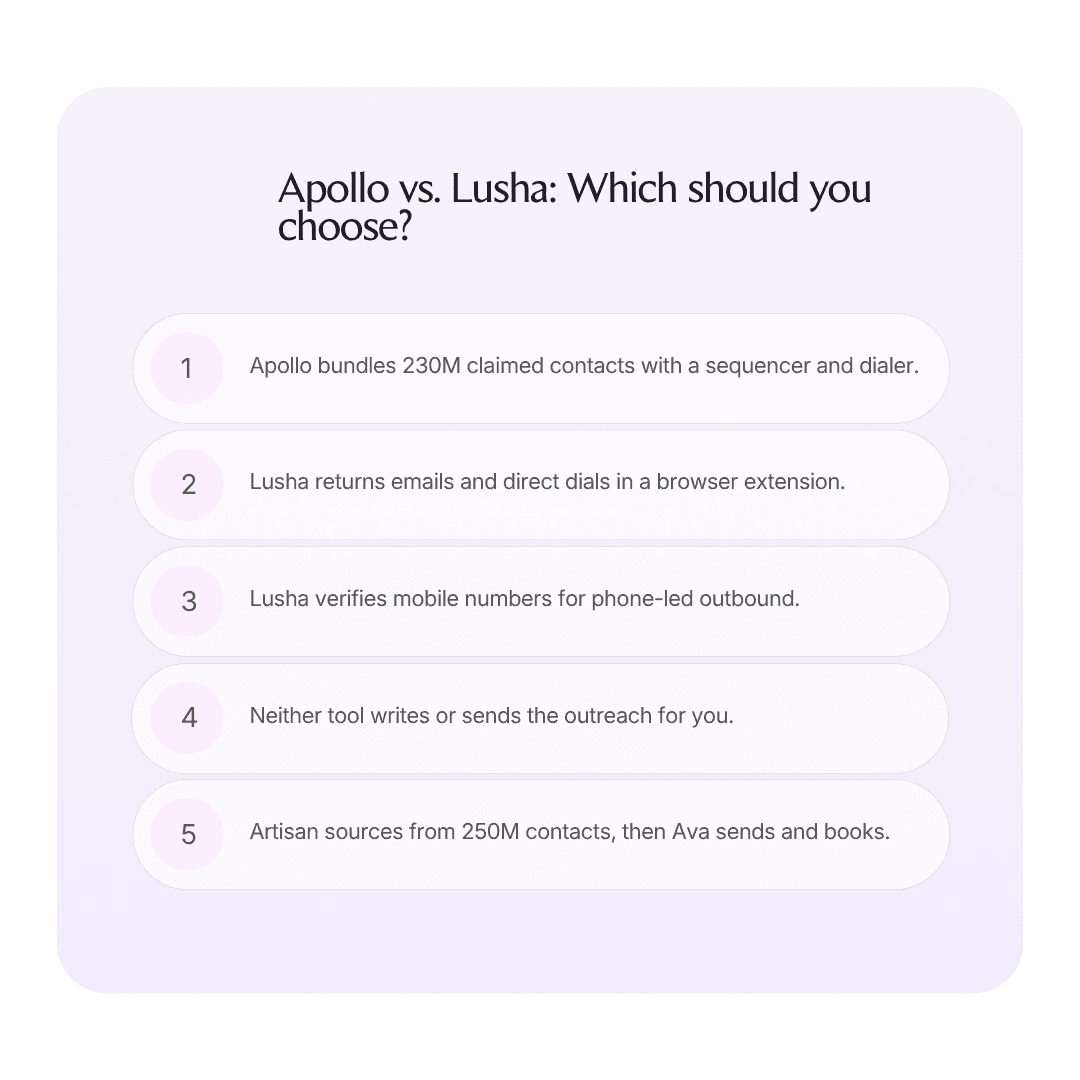
Apollo bundles a contact database with sequencing, a dialer, deal management, and assistive AI, so a rep can find an account, load it into a cadence, and start emailing and calling without leaving the tool. Apollo is used by more than 600,000 companies and reported roughly $200M in ARR, and it acquired the buyer-intent and product-signal company Pocus in March 2026 to deepen its signals layer.
Lusha does one job and aims to do it cleanly: return a verified email and, more importantly, a direct dial or mobile number for the person in front of you, usually through a browser extension that overlays company sites, social profiles, and your CRM. There is no cadence engine and no dialer. You take the data and act on it elsewhere.
Which has better B2B data, Apollo or Lusha?
It depends on whether you value breadth or verified reach. Apollo wins on raw coverage; Lusha competes on the accuracy of the hardest field to verify, the mobile number.
Apollo claims a database of over 230M contacts (a vendor figure), which makes it one of the largest self-serve databases at its price point. This breadth is why many teams treat Apollo as a low-cost data layer even when they run outreach elsewhere. For how Apollo compares with other data-first tools, see Clay vs. Apollo and Seamless vs. Apollo.
Lusha does not try to out-scale Apollo. Its pitch is that the records it returns, especially cell phone numbers, are more likely to connect, and that its data practices are auditable. Lusha markets verified mobile coverage and holds ISO 27701, the privacy-information-management standard, on top of GDPR and CCPA compliance. For teams whose outbound leans on phone connects, or who face procurement scrutiny on data sourcing, this posture matters more than the size of the index. For a like-for-like on data providers, see Cognism vs. Lusha.
If you want a deeper look at how the major providers stack up on coverage and verification, see our guide to the best B2B data providers.
How do Apollo and Lusha compare on price in 2026?
Apollo is priced to convert individual reps and small teams. Its published tiers run from a free plan up to about $119/user/month for its higher self-serve tier, per its pricing page, with credits that govern exports and enrichment. This low entry point, paired with the bundled sequencer and dialer, is Apollo's central value argument.
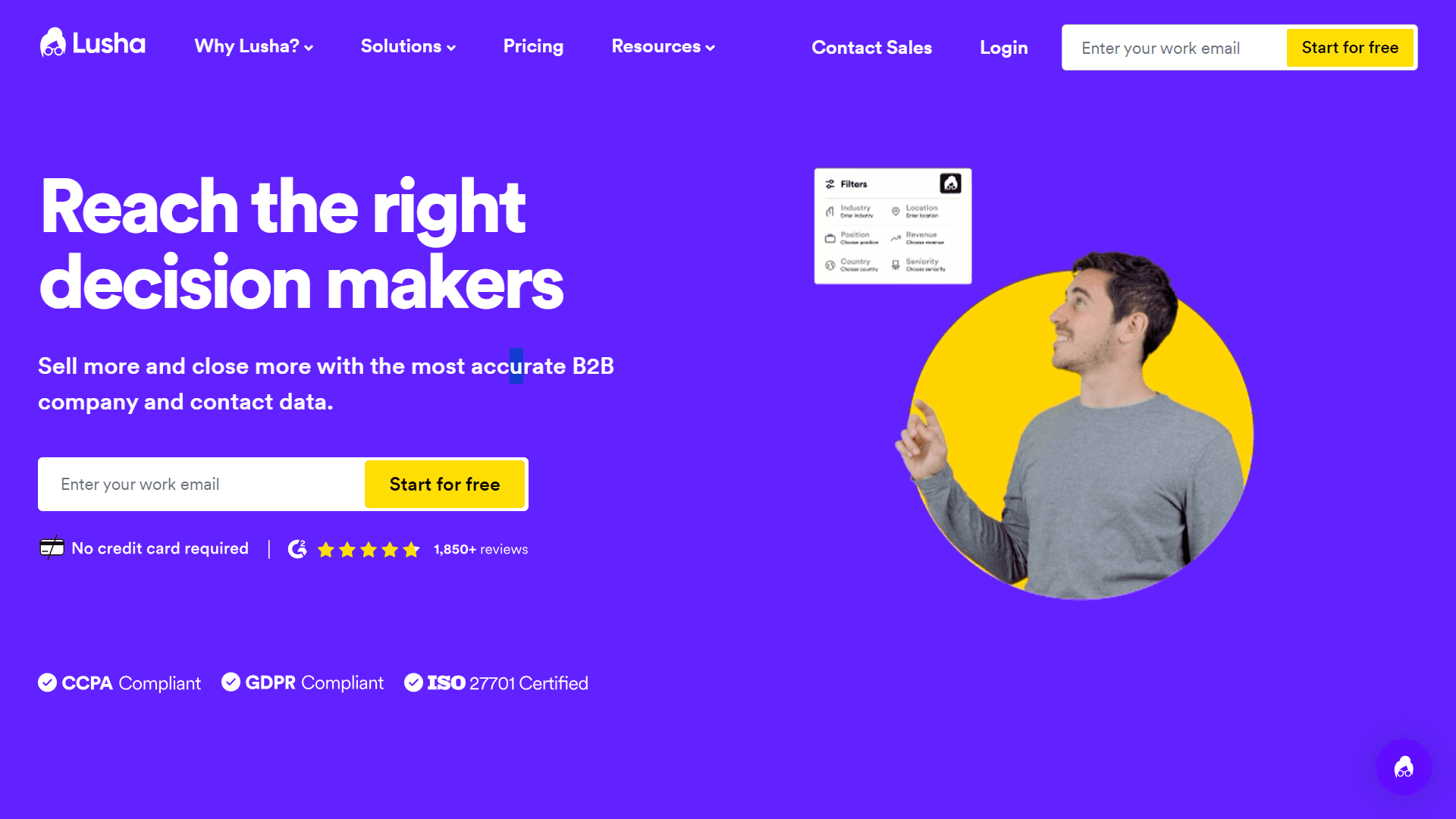
Lusha also publishes a free plan and paid tiers (Pro reported around $29 to $52 and Premium now around $300/user/month on a credit slider), with a custom Scale plan for larger teams, per its pricing page. Because Lusha sells credits for contact reveals rather than a full outreach platform, you are paying for data access, not for a place to run campaigns. On the lower Pro tier the two are close on data alone, but Lusha's Premium climbs steeply, and the gap widens further once you factor in that Apollo's price also buys you the sequencer and dialer.
Both reward discipline. Reveal only the contacts you will actually work, or the per-record cost climbs.
Which is easier to deploy and use day to day?
Lusha is the faster thing to switch on; Apollo is the more capable thing to live in.
Lusha's extension installs in minutes and starts returning data on the pages your reps already visit. There is very little to configure because there is very little surface area. This is the point.
Apollo asks for more setup because it does more: mailbox connection, sequence building, CRM sync, dialer configuration. Reviewers report that Apollo's breadth can feel busy, and that data accuracy varies by segment and region. The payoff is that once it is configured, a rep works the whole motion from one screen. If your team already lives in a separate sequencer or CRM, Apollo's platform depth is partly redundant, and Lusha's narrow focus is the cleaner add. For how Apollo's built-in outreach stacks up against a dedicated sequencer, see Apollo vs. Outreach.
When should you pick something else entirely?
When the job you actually want done is the outreach, not the lookup.
The shared limitation is easy to miss: both Apollo and Lusha are data tools. Each hands you contacts and leaves the sending, calling, and replying to your reps. This is the right model if you have people to run it.
If you would rather the prospecting motion ran itself, an autonomous platform like Artisan is a third path. It pairs a 250M-contact business-to-business database with an AI business development representative (BDR), Ava, who finds the leads, writes and sends the outreach, handles replies, and books meetings, so the data and the activation live in one system rather than two tools plus the humans in between, on usage-based pricing sized to lead volume rather than a seat per rep. See how this works on the AI sales agent page. For a direct comparison, see Artisan vs. Apollo.
This is a different purchase from either tool here. If you specifically want a database and a browser extension, Apollo and Lusha remain the relevant comparison. For broader roundups, see the best Apollo alternatives and the best Lusha alternatives.
Choose Apollo if...
You want data, sequencing, and a dialer in one low-cost seat rather than a stack.
You are a startup or SMB team standardizing your whole outbound motion on a single tool.
Broad contact coverage at an accessible price matters more than best-in-class mobile accuracy.
You want buyer and product signals in the same platform (post-Pocus).
Choose Lusha if...
You mainly need accurate direct dials and verified emails, fed into a stack you already run.
Phone connect rates are central to your outbound and mobile accuracy is the priority.
Procurement or legal cares about data sourcing and privacy certifications (ISO 27701).
You want a lightweight extension with minimal setup, not another platform to configure.
Frequently asked questions
Is Apollo or Lusha better for a startup?
For most startups standardizing on one tool, Apollo is the stronger single purchase because its tiers, from free to about $119/user/month, include sequencing and a dialer alongside the database. Lusha is the better pick when the startup already runs a separate sequencer or CRM and only needs a clean, compliant source of dials and emails to feed it.
Which has more accurate phone numbers, Apollo or Lusha?
Lusha positions accuracy of direct dials and mobile numbers as its core differentiator, backed by verification claims and ISO 27701 privacy certification. Apollo offers phone data too, but reviewers report accuracy varies by region and segment. If phone connects drive your pipeline, test both on your own target list before committing, since accuracy is territory-dependent for every provider.
Can Apollo replace Lusha?
For many teams, yes: Apollo includes contact data, so a team using Lusha purely for emails and dials could consolidate into Apollo. The case for keeping Lusha is data quality on mobile numbers and its privacy certifications. Teams that live or die by phone connects sometimes run both, using Lusha to verify the numbers that matter most.
Does either tool run outreach for you?
No. Both are prospecting and data tools. Apollo gives you a sequencer and dialer to run outreach yourself; Lusha gives you data to run outreach elsewhere. Neither writes and sends campaigns or handles replies autonomously. This autonomous model is a separate category of tool, covered in our guide to the AI BDR.
Is there an alternative to both Apollo and Lusha?
Yes. Both are data tools that leave you to run the outreach; if you would rather the whole motion ran itself, an autonomous platform is the alternative. Artisan pairs its own contact database with an AI BDR, Ava, who sources, writes, sends, and works replies end to end on usage-based pricing, so you are not buying a database plus an extension and then supplying the people to act on them. See Artisan's AI sales agent for how it differs.
How much do Apollo and Lusha cost?
Apollo publishes tiers from free to about $119/user/month, per its pricing page, with credits for exports and enrichment. Lusha publishes a free plan plus Pro and Premium tiers (reported around $29 to $52 and around $300/user/month respectively, on a credit slider) and a custom Scale plan, per its pricing page. Both use credit models, so real cost depends on how many contacts you reveal each month.
Is Lusha GDPR compliant?
Lusha markets GDPR and CCPA compliance and holds ISO 27701, the international standard for privacy information management, which is part of why it appeals to teams under procurement scrutiny. As with any data provider, compliant use also depends on how your team handles and stores the data, so confirm your own processes alongside the vendor's certifications.
Which should a phone-heavy outbound team choose?
Lusha, in most cases, if you already run a dialer elsewhere and just need the best mobile numbers to feed it. Apollo, if you want the dialer, the data, and the sequencer in one seat and can accept region-variable phone accuracy. Test connect rates on your real territory first; this number decides it more than any feature list.
The bottom line
Apollo and Lusha solve overlapping problems at different depths. Apollo is a full prospecting platform that happens to include a large database; Lusha is a focused, compliance-forward data source that happens to be very easy to deploy. Pick Apollo to run your motion from one tool at a low seat price. Pick Lusha to feed accurate, auditable contacts into a stack you already trust. And if the real goal is to stop running the outreach by hand altogether, that is a different decision, and a different kind of tool. Compare pricing models on the Artisan pricing page or start from the homepage.
Related reading
Jaspar Carmichael-Jack
Co-Founder & CEO @ Artisan
Jaspar is an entrepreneur with expertise in sales, marketing, and operations. He founded Artisan in 2023, a company automating workflows with AI employees.