Apollo vs. Outreach: Which should you choose in 2026?
An honest 2026 comparison of Apollo and Outreach across data, sequencing, governance, AI, and pricing, with clear guidance on who each one fits.
Key Takeaways
- Apollo bundles a claimed database of over 230M contacts with a sequencer and light dialing, from free to about $119/user/month, and is used by more than 600,000 companies per its own reporting.
- Outreach is a dedicated enterprise sequencing platform with mature workflow governance and reported pricing around $100 to $165/user/month. It does not include a native prospecting database.
- Apollo acquired Pocus in March 2026 to add signal-based selling, and reported annual recurring revenue (ARR) sits around $200M.
- Outreach added its Omni agent in April 2026 to bring more AI into the sequencing flow.
- Both use per-seat pricing and keep a human rep in charge of the outreach. The AI in each is assistive, not autonomous.
Apollo and Outreach both run sales sequences, but they answer different problems. Apollo is an affordable all-in-one that bundles a large contact database with sequencing and light dialing, best for teams that are assembling their first stack. Outreach is an enterprise sequencing platform with deep workflow governance, best for large sales orgs that already own their data.
The two invite comparison because their sequencing features overlap. Underneath this, they sit in different categories. Apollo starts from data and adds cadence on top. Outreach starts from cadence governance and expects you to bring data. Which one is right turns on where your team is in its growth, how disciplined your process needs to be, and whether you want to buy leads and outreach in one place. Here is the honest comparison.
How Apollo and Outreach compare
Apollo | Outreach | |
Best for | Teams that want data and cadence in one affordable tool | Large, disciplined sales orgs that need workflow governance |
Native database | Yes, over 230M contacts claimed | No, you bring your own data |
Standout capability | Bundled database plus sequencing and light dialing | Mature sequence controls, permissions, reporting |
AI layer | Assistive AI, plus Pocus signals (acquired Mar 2026) | Omni agent (added Apr 2026) |
Public pricing | Free to about $119/user/month, per its pricing page | ~$100 to $165/user/month reported |
Model | Per-seat, self-serve | Per-seat, enterprise sales-led |
What is the core difference between Apollo and Outreach?
Apollo is a data-first all-in-one. Its center of gravity is the contact database, and the sequencer, light dialing, and enrichment are built around moving those contacts into outreach cheaply. This is why smaller teams reach for it as a first stack: leads and cadence in one bill, often starting free.
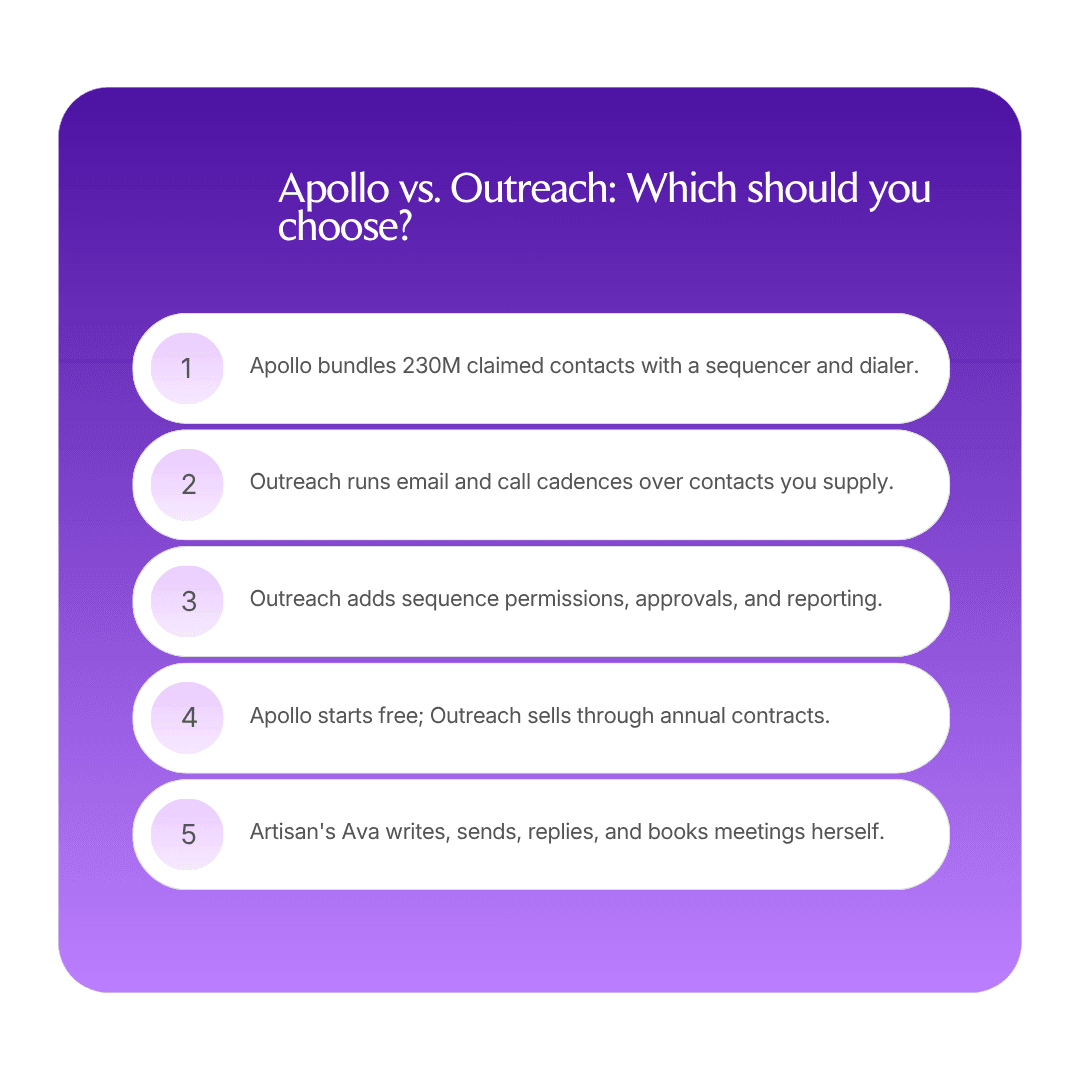
Outreach is a cadence-first enterprise platform. It assumes you already have a data source and a defined sales process, and it exists to run this process at scale with control. Sequence management, team permissions, step-level analytics, and reporting are the product. Many enterprises run Outreach on top of a separate data provider precisely because Outreach is the execution and governance layer, not the data layer.
Which has better data and prospecting?
Apollo, clearly, because a native database is its whole premise. It claims over 230M contacts and is used by more than 600,000 companies per its own figures, and its March 2026 acquisition of Pocus added signal-based selling to the prospecting side. For a team that wants to search for leads, enrich them, and drop them into a sequence in one tool, Apollo does this at a price point Outreach does not try to match. For related comparisons, see Apollo vs. Lusha and Clay vs. Apollo.
Outreach does not ship a prospecting database. It is designed to sequence contacts you supply from a CRM or a data vendor. This is not a weakness in its category; it is a deliberate scope. But if part of what you are shopping for is where the leads come from, Apollo answers this question and Outreach does not. For how Apollo stacks up against other data providers, see ZoomInfo vs. Apollo and Seamless vs. Apollo.
Which is better for enterprise sequencing and governance?
Outreach. Its reputation is built on workflow discipline for large teams: granular sequence controls, role and team permissions, approval structures, and reporting that revenue operations leaders can actually govern. When a sales org has dozens or hundreds of reps and needs consistent process enforcement, Outreach is the more mature answer, and reported pricing around $100 to $165/user/month reflects that positioning.
Apollo can run sequences at scale too, and plenty of mid-market teams do. The difference shows up in governance depth and how enterprises treat the tool. Larger buyers often use Apollo as a data layer that feeds a more controlled execution platform, rather than as the system of record for a disciplined outbound process. If tight process control across a big team is the priority, Outreach earns its premium.
What about AI features?
Both added AI, and both kept a human in the driver's seat. Apollo's AI is assistive: it helps write and research, and Pocus brings signal-based selling into the prospecting flow after the March 2026 acquisition. Outreach introduced its Omni agent in April 2026 to pull more AI into sequencing and rep workflows.
The shared limit is the model. In both tools a rep still owns the motion. The AI drafts and suggests, but a person decides, sends, and follows up. Neither is trying to run the outbound job on its own, which matters if what you actually want is fewer manual steps rather than better manual steps.
How do Apollo and Outreach compare on price?
Apollo is the cheaper entry by a wide margin. It runs from free to about $119/user/month per its pricing page, which is why first-stack teams gravitate to it. This number covers data, sequencing, and light dialing.
Outreach is an enterprise purchase. Reported pricing sits around $100 to $165/user/month, sold through a sales process rather than self-serve, and this does not include the separate data source most Outreach customers run alongside it. So the real stack cost for an Outreach shop is the seat price plus a data vendor, where Apollo folds both into one lower bill. Price alone favors Apollo; governance and scale are what justify Outreach.
A third option to know about
The shared limitation is easy to overlook when you are weighing data against governance: in both Apollo and Outreach the AI is assistive, not autonomous, and a human rep still runs the motion. You are choosing which sequencer to drive, not whether to drive one.
If neither a data-first bundle nor a rep-governance platform is really what you want, and the goal is to have the outbound work done rather than orchestrated, an autonomous platform is a third path. Artisan built Ava, an autonomous AI business development representative (BDR), to source, write, send, reply, and book meetings on her own, with a built-in dialer for the calls your reps make, on usage-based pricing sized to lead volume rather than a seat per rep. For a direct comparison, see Artisan vs. Apollo.
It is a different category from either tool here: the AI runs the sequence instead of a rep operating it.
Choose Apollo if...
You are assembling your first stack and want leads and cadence in one affordable tool.
You want a native contact database rather than paying a separate data vendor.
Your team is small to mid-market and price sensitivity matters more than deep governance.
You want to start free or self-serve and grow into paid tiers.
Signal-based prospecting through Pocus fits how you want to find accounts.
Choose Outreach if...
You run a large, disciplined sales org that needs strict sequence and permission controls.
You already have a data source and want a dedicated execution and governance layer.
Reporting and process consistency across many reps is a top requirement.
You are comfortable with an enterprise, sales-led purchase and per-seat pricing.
You want the Omni agent inside a mature, well-governed sequencing platform.
Frequently asked questions
Is Apollo or Outreach better for a small team?
Apollo, in most cases. It bundles a contact database with sequencing and light dialing from free to about $119/user/month, so a small team covers leads and cadence in one affordable tool without buying a separate data vendor. Outreach is built for large, disciplined orgs and priced accordingly at a reported $100 to $165/user/month, with data supplied separately, which is usually more platform than a small team needs.
Does Outreach include a contact database like Apollo?
No. Outreach is a cadence and governance platform that expects you to bring contacts from a CRM or a data provider. Apollo's whole premise is the native database, claimed at over 230M contacts. If having leads inside the same tool matters to you, this is a real point for Apollo; if you already have a strong data source, Outreach's execution layer is the reason to choose it. For a data-provider matchup, see Apollo vs. ZoomInfo.
Which has better AI, Apollo or Outreach?
Both added assistive AI in 2026 and both keep a human running the motion. Apollo's AI helps write and research, and its March 2026 Pocus acquisition added signal-based selling. Outreach introduced its Omni agent in April 2026 for sequencing and rep workflows. Neither runs outbound autonomously; the rep still decides and sends. If autonomous execution is the goal, both fall short of it by design.
How much do Apollo and Outreach cost?
Apollo runs from free to about $119/user/month per its pricing page. Outreach does not publish self-serve pricing; reported figures put it around $100 to $165/user/month through an enterprise sales process, and most Outreach customers pay for a separate data vendor on top. So Apollo is meaningfully cheaper once you account for the full stack.
Is there an alternative to both Apollo and Outreach?
Yes. Both keep a human rep running the sequence; if you want the outbound job done rather than orchestrated, an autonomous platform is the alternative. Artisan's AI BDR, Ava, sources, writes, sends, replies, and books meetings on her own, with a dialer your reps use for calls, on usage-based pricing sized to lead volume instead of per-seat fees, so the AI runs the motion rather than assisting a rep who does. See Artisan's AI sales agent for how that model differs from a data-first bundle or a governance platform. For other data-first options, see the best Apollo alternatives.
Can you use Apollo and Outreach together?
Some teams do, using Apollo as a data source that feeds contacts into Outreach for execution and governance. It works, but you are paying for two tools and stitching them together. If this is your setup, weigh whether Apollo's own sequencer already covers your needs, or whether a single platform that includes both data and execution would be cheaper and simpler. You might also weigh other Apollo alternatives.
Which is more future-proof given recent moves?
Both are actively investing. Apollo added Pocus in March 2026 and reports around $200M in ARR, which points to momentum on the data and signals side. Outreach shipped its Omni agent in April 2026, pushing further into AI-assisted sequencing. Neither shows the roadmap uncertainty that follows a major merger, so the choice comes down to fit rather than stability.
Jaspar Carmichael-Jack
Co-Founder & CEO @ Artisan
Jaspar is an entrepreneur with expertise in sales, marketing, and operations. He founded Artisan in 2023, a company automating workflows with AI employees.