Artisan vs. Apollo: Which fits your team?
Artisan is an AI BDR that runs outbound end to end. Apollo is a data-rich all-in-one with assistive AI. Here is how to choose between them.
Key Takeaways
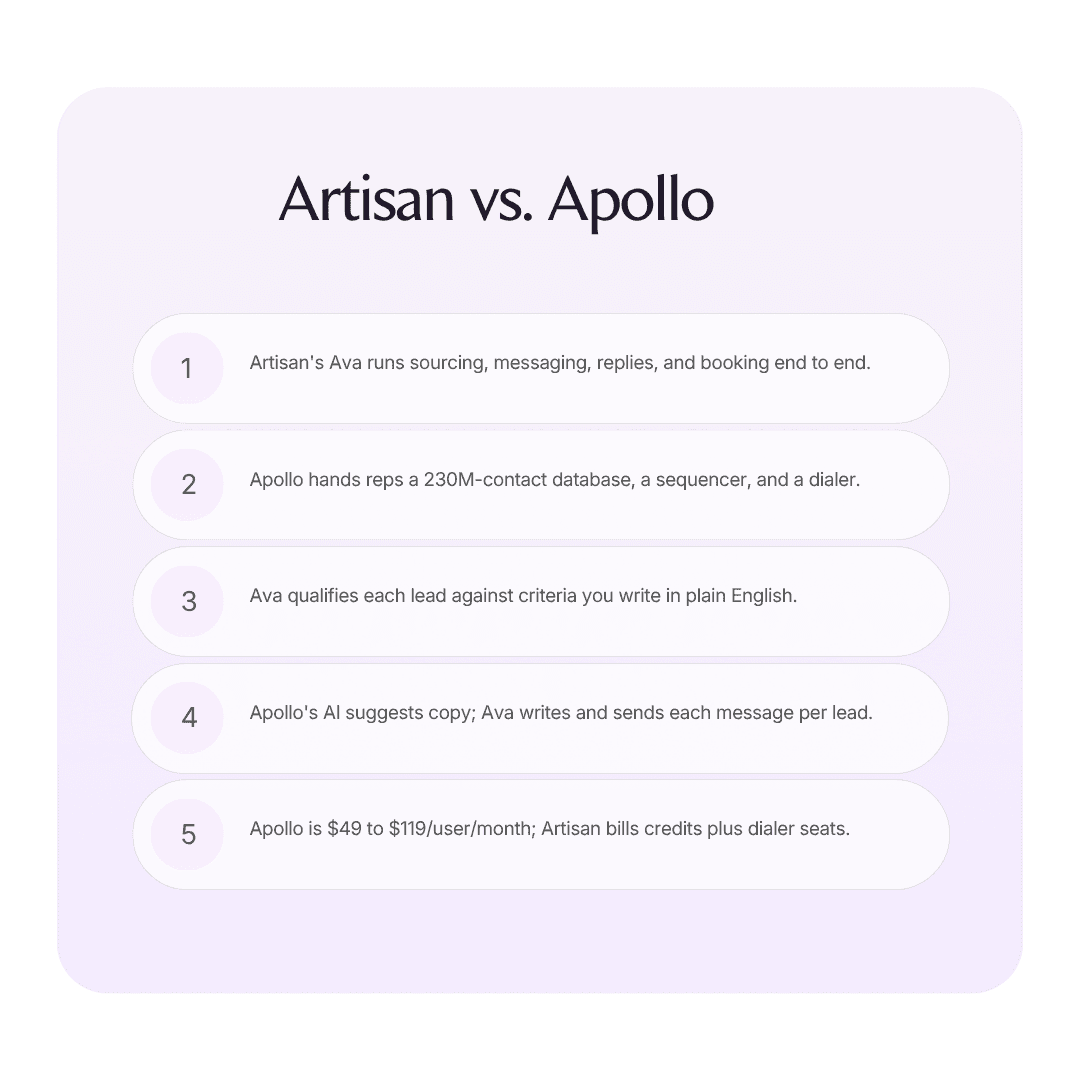
- Artisan's Ava owns the outbound job end to end and runs autonomously; Apollo gives your reps a large database plus sequencing and assistive AI they operate themselves.
- Apollo is priced for accessibility: Free, then Basic $49, Professional $79, and Organization $119/user/month on annual billing with a three-seat minimum, per its pricing page. Artisan's pricing is hybrid: Ava's work runs on usage-based credits, so you pay for the work she performs, and dialer seats are billed separately.
- Apollo's database is a real strength: over 230 million contacts, over 600,000 companies served, over 100,000 paying customers, and reported annual recurring revenue (ARR) approaching $200M. Artisan runs over 250 million B2B professionals across over 200 countries, plus a local-business database of over 250 million records.
- The core difference is autonomy. Artisan reports that over 90% of customers run Ava autonomously; Apollo's AI augments reps who remain the operators.
- Apollo acquired Pocus in March 2026, which deepened its signals and data story, and it remains the value pick for teams that want to run outbound themselves.
- Artisan consolidates a stack of five to eight outbound tools and a go-to-market (GTM) engineer into one platform, with SOC 2 Type II attestation and a full audit trail.
Artisan and Apollo both promise outbound; the split is who does the work. Artisan is an AI business development representative (BDR), Ava, who runs the whole motion: sourcing, messaging, replies, booking. Apollo is a data-rich, price-accessible all-in-one whose AI assists reps who drive it. Choose Artisan to have outbound run for you; choose Apollo for cheap data and tooling you operate.
The short version: A worker vs. a workbench
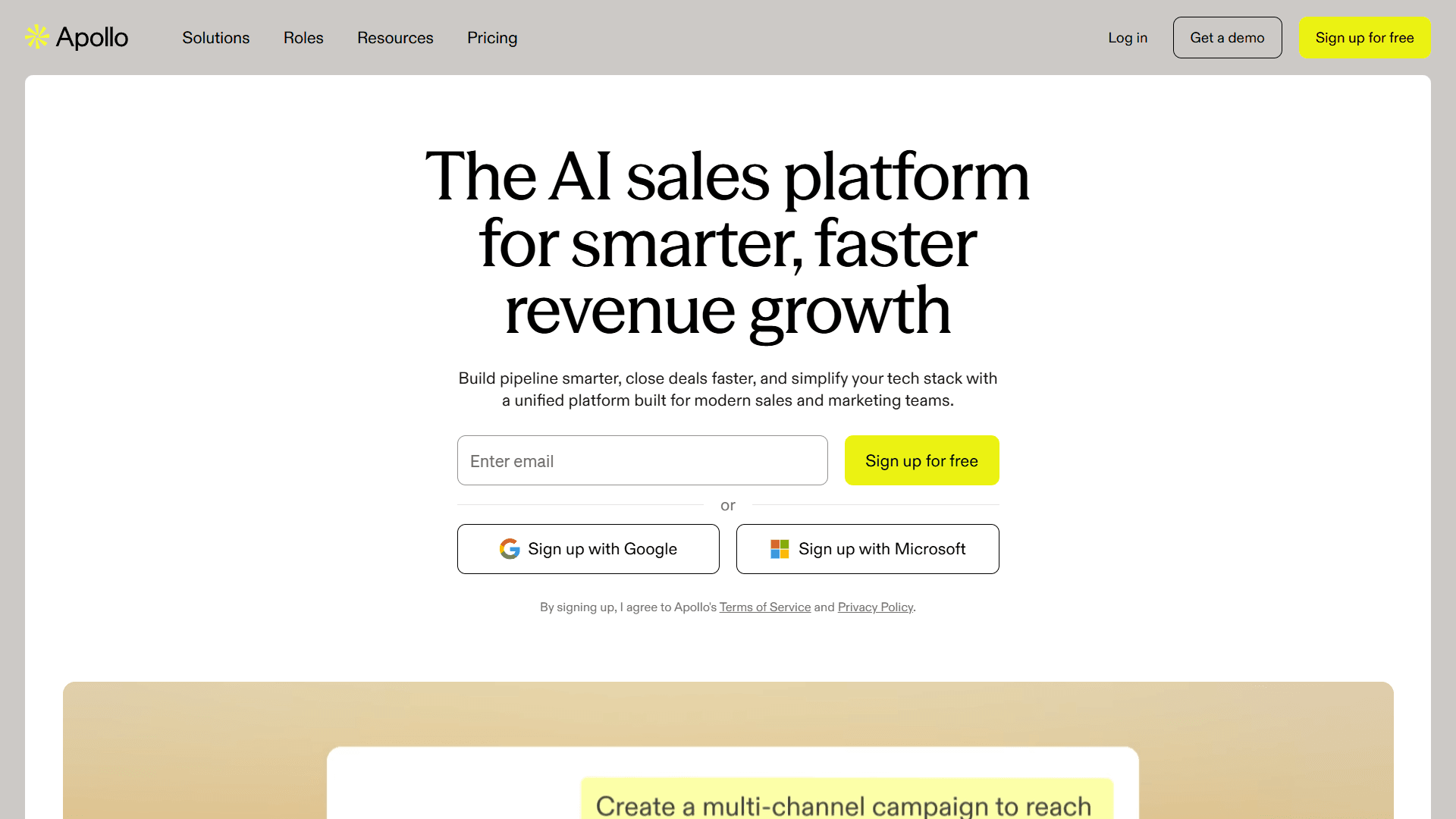
Apollo competes hard on value. For a low per-seat price, you receive a large, credible database, a working sequencer, a dialer, and a growing set of assistive AI features. Hundreds of thousands of companies use it, and over 100,000 pay for it, because it packs a lot into an accessible price. The catch sits in the verb: your reps still run it. Apollo hands them a well-stocked workbench, and the building is theirs.
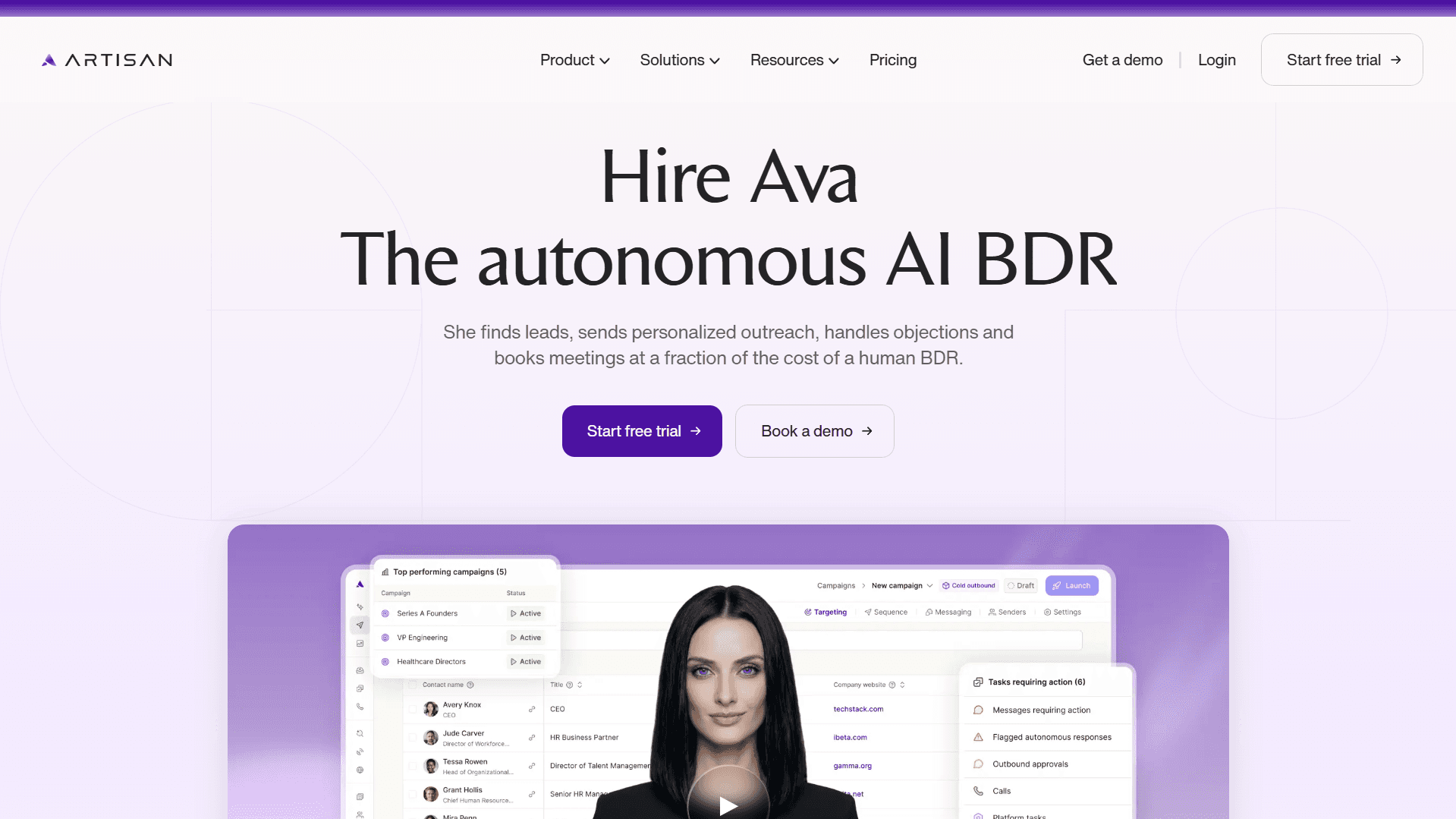
Artisan hands you a worker. Ava performs the job of a sales development representative (SDR). She finds best-fit leads, enriches them, writes and sends personalized multichannel outreach, handles the replies, and books the meetings, as autonomously as you let her. Feature-list length is the wrong test here. The question that decides it is whether you want tooling your team operates, or the outbound motion run for you. We will take this by sales-journey stage.
How do Artisan and Apollo find and prioritize leads?
Both are strong here, and the difference is who acts on the data. Apollo's database is its anchor: over 230 million contacts with filters, signals, and enrichment, and the Pocus acquisition in March 2026 added product and buying-signal depth. For a team that wants to build lists and pull contacts, Apollo is a capable data layer, which is how many larger organizations treat it.
Artisan sources from over 250 million B2B professionals across over 200 countries, plus a local-business database of over 250 million records, with natural-language search, ideal customer profile (ICP) filters, and intent signals like funding rounds, new executive hires, and active hiring. Campaigns can also draw on a CSV, a CRM list, a webhook, or your website visitors. What happens next is the real difference. In Apollo, a rep reviews the list and decides what to do with it. In Artisan, Ava enriches and ranks leads by conversion likelihood, qualifies them against criteria you write in plain English, and moves the best-fit leads straight into live campaigns without a human assembling a next step. Same raw job, different amount of it left to your team. For how Apollo's data stacks up elsewhere, see ZoomInfo vs. Apollo, Apollo vs. Lusha, and the best People Data Labs alternatives.
How do the two handle outreach?
This is the sharpest divide. Apollo gives you a sequencer and AI writing assistance: your reps build a sequence, approve or edit the AI-suggested copy, and manage the sends. The AI is assistive, so output per rep improves, but a person still steers each campaign.
Artisan writes and runs the outreach itself. Ava generates personalized messaging at a one-to-one level and launches multichannel campaigns across email, social media, and dialer call steps. Personalization runs at three depths: Lite picks a single relevant angle per lead, Deep synthesizes several signals into a richer insight, and Agentic adds a five-agent web research swarm that hunts for a unique angle on each prospect. Ava assembles every message from components you control, choosing the most relevant pain-point and solution pair for each prospect and using your calls to action verbatim, so two people in the same campaign receive two different messages rather than a template with the name swapped. She runs dozens of message variations, shifts volume toward what converts, and optimizes at the component level. Autonomy is a dial. Autonomous mode writes, personalizes, schedules, and sends without approval, while review mode holds every draft for a human. That gap separates assistive AI from an AI that owns a channel. For Apollo measured against a sales-engagement incumbent, see Apollo vs. Outreach.
What happens when a prospect replies?
Apollo logs it; a rep works it. Replies land in an inbox and your team qualifies, answers, and follows up, with Apollo's tooling supporting a process that stays human. The thinking and the typing are still yours.
Artisan works the reply for you. Autonomous replies are a separate switch, set to handle objections only or objections plus meeting booking. Ava qualifies each lead against criteria you write, answers objections from a knowledge base you control, chases follow-ups, and escalates on plain-language rules, for example when a lead asks about pricing. She can send resources you upload, such as a one-pager or a case study, and Slack notifications fire by sentiment so a human sees what matters. This is the part of outbound that quietly eats rep hours, and it is where an autonomous system pulls furthest ahead of assistive tooling. Your reps step in on the conversations that need judgment, not on every routine reply.
How do Artisan and Apollo book meetings?
Artisan books; Apollo supports a rep who books. With reply handling set to objections plus meeting booking, Ava schedules meetings for qualified leads, and outreach runs from each lead's CRM owner, so a conversation lands with the right person. Apollo provides the scheduling and CRM tooling, but a booking flow is still driven by your team.
For a team that wants to own its process and just needs good tools underneath it, Apollo's model fits. For a team that wants pipeline to arrive with less human orchestration, Artisan closes the loop and is the stronger shape.
How do the two compare on price?
They price for different models. Apollo is transparent and cheap per seat: Free, then Basic $49, Professional $79, and Organization $119/user/month on annual billing with a three-seat minimum, per its pricing page. For a team that wants a database and tooling, that is strong value, and it is a big reason Apollo has over 100,000 paying customers.
Artisan's model is hybrid. Ava's work runs on usage-based credits, so you pay for the work she actually performs: qualifying, enriching, personalizing, and sending messages. You can trial Ava for free. Dialer seats and phone numbers are billed separately from credits, at $75/seat/month on monthly billing, with a seat for each caller and roughly one phone number per 50 calls a day. See the pricing page. A seat-to-seat comparison does not hold, because the products are not the same. Apollo's per-seat cost buys tooling your reps run. Artisan's credits buy the work itself, and it consolidates the separate sourcing, sequencing, deliverability, and reply tools you would otherwise assemble, plus the operator who wires them together. Weigh total motion cost and rep time, not just a license line.
Situation to fit
Your situation | Better fit |
You want the outbound motion run for you by an AI | Artisan |
You want a cheap, deep database and tooling your reps operate | Apollo |
You are trying to cut a stack of five to eight tools and a GTM engineer into one platform | Artisan |
Your budget is tight and you mainly need contacts and a sequencer | Apollo |
You want personalized outreach written and sent autonomously | Artisan |
You have a strong team that wants to own every step and just needs good tools | Apollo |
You want replies qualified and meetings booked without rep hours | Artisan |
You mostly need Apollo as a data layer that feeds other systems | Apollo |
Choose Apollo if...
Budget is the deciding factor and you want a lot of capability for a low per-seat price. Apollo's Free through $119 tiers are priced aggressively.
You mainly need a large, credible contact database, and you are comfortable running the sequencing, replies, and booking yourself. Many larger teams use Apollo precisely as their data layer.
Your reps like owning a process, and assistive AI that speeds them up suits them better than an autonomous system that runs the motion.
You want published, self-serve pricing you can start on today without a sales conversation.
If that is your team, Apollo is a reasonable pick for that job. If Apollo is close but not quite right, weigh the best Apollo alternatives and Seamless vs. Apollo.
Where Artisan pulls ahead
Apollo is good at handing reps a workbench. Artisan is built to remove the reason you need so many reps at a workbench in the first place. Ava runs the job from sourcing to booked meeting, so a large account executive (AE) team can have sales ops operate the platform centrally while reps take the meetings that arrive. This consolidation replaces a typical outbound stack of five to eight tools and the GTM engineer who maintains it. Artisan holds SOC 2 Type II attestation and complies with GDPR and the California Consumer Privacy Act (CCPA), with a full audit trail and role-based access on Enterprise plans, so autonomy arrives with governance.
SaaStr saw the difference between assisted and autonomous first-hand. Amelia Lerutte, Chief AI Officer at SaaStr, put it plainly: "Email has always been our number one driver. Artisan is now neck-and-neck in both output and closed-won revenue." In about six weeks, Ava sent 6,892 emails, 3,574 of them to new leads, at a 3.6% positive response rate, alongside a 49.4% acceptance rate on social media connection requests. That is what an AI owning the motion looks like, next to tooling that makes a human motion faster.
So the choice comes down to the verb. Apollo helps your reps do outbound; Artisan does it. For the broader model, see how an AI BDR automates the job, how the AI sales agent serves an enterprise team, and what Artisan consolidates into one platform.
FAQ
Is Apollo better than Artisan for data?
Apollo's database is a genuine strength: over 230 million contacts, over 600,000 companies served, and reported ARR approaching $200M, with the Pocus acquisition adding signal depth. Artisan runs over 250 million B2B professionals across over 200 countries, plus a local-business database of over 250 million records, with waterfall enrichment. On raw data both are strong; the real difference is that Artisan acts on the data autonomously while Apollo hands it to your reps. Related data comparisons include Clay vs. Apollo and the best LeadIQ alternatives.
How much does Apollo cost compared to Artisan?
Apollo is per-seat and transparent: Free, then Basic $49, Professional $79, and Organization $119/user/month annually with a three-seat minimum. Artisan is hybrid: Ava's work runs on usage-based credits, so you pay for the work she performs, and you can trial her for free. Dialer seats and phone numbers are billed separately from credits, at $75/seat/month on monthly billing. Apollo is cheaper per seat because it sells tooling; Artisan prices the work the tooling would otherwise require reps to do.
Does Apollo have AI like Artisan's Ava?
Apollo has assistive AI: writing suggestions, signals, and automation that speed up reps who still run a process. Artisan's Ava is autonomous, owning sourcing, messaging, replies, and booking, with over 90% of customers running her autonomously. The distinction separates assistive AI that augments a human motion from an AI that runs the motion itself.
Can I use both Apollo and Artisan?
Yes, some teams do. A common pattern uses Apollo as a data layer while Artisan runs the autonomous outbound motion. That said, Artisan includes over 250 million B2B professionals across over 200 countries, plus a local-business database of over 250 million records, with waterfall enrichment, so for many teams it removes the need for a separate data subscription.
Which is the better fit for an enterprise?
Artisan, in most cases, because it runs the motion centrally with governance: SOC 2 Type II attestation, an audit trail, role-based access, and autonomy controls that let sales ops operate outbound for a large AE team. Apollo is widely used at enterprises too, though typically as a data and tooling layer instead of the system that runs outbound end to end. For a data-layer angle, see Apollo vs. ZoomInfo.
What did Apollo's Pocus acquisition change?
Apollo acquired Pocus in March 2026, adding product-usage and buying-signal capabilities to its data and workflow story. It strengthens Apollo as a data and signals platform. It does not change the fundamental model, in which Apollo's AI assists reps who operate a process while Artisan's Ava runs the process autonomously.
Is Artisan just a more expensive Apollo?
No, they are different products. Apollo sells a database and tooling per seat; Artisan sells the outbound work itself, priced in usage-based credits, with dialer seats billed separately. If you want your reps to run outbound with good, cheap tools, Apollo is the better value. If you want the outbound job run for you, replacing several tools and the operator who maintains them, that is what Artisan does. If you are weighing other options, browse Apollo alternatives.
Jaspar Carmichael-Jack
Co-Founder & CEO @ Artisan
Jaspar is an entrepreneur with expertise in sales, marketing, and operations. He founded Artisan in 2023, a company automating workflows with AI employees.