AiSDR vs. Alta: Which should you choose in 2026?
A fair 2026 comparison of AiSDR and Alta across pricing transparency, channels, security claims, and maturity, with published facts.

Key Takeaways
- AiSDR publishes its pricing openly: roughly $250, $900, and $2,500/month across its tiers, per its pricing page. Alta is young enough that it publishes almost no pricing.
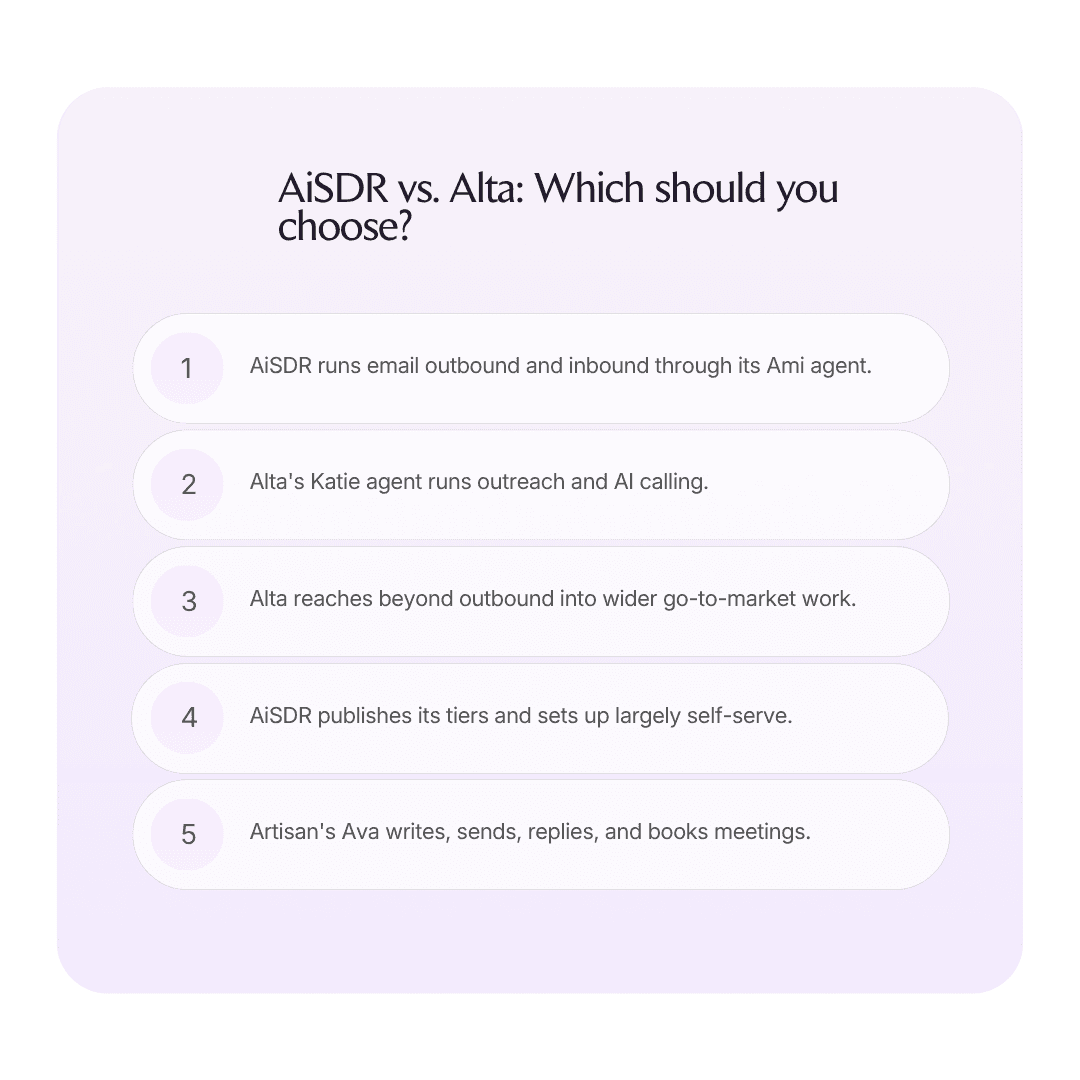
- AiSDR covers outbound and inbound with "Ami," a strategist agent, and is built for fast, largely self-serve setup.
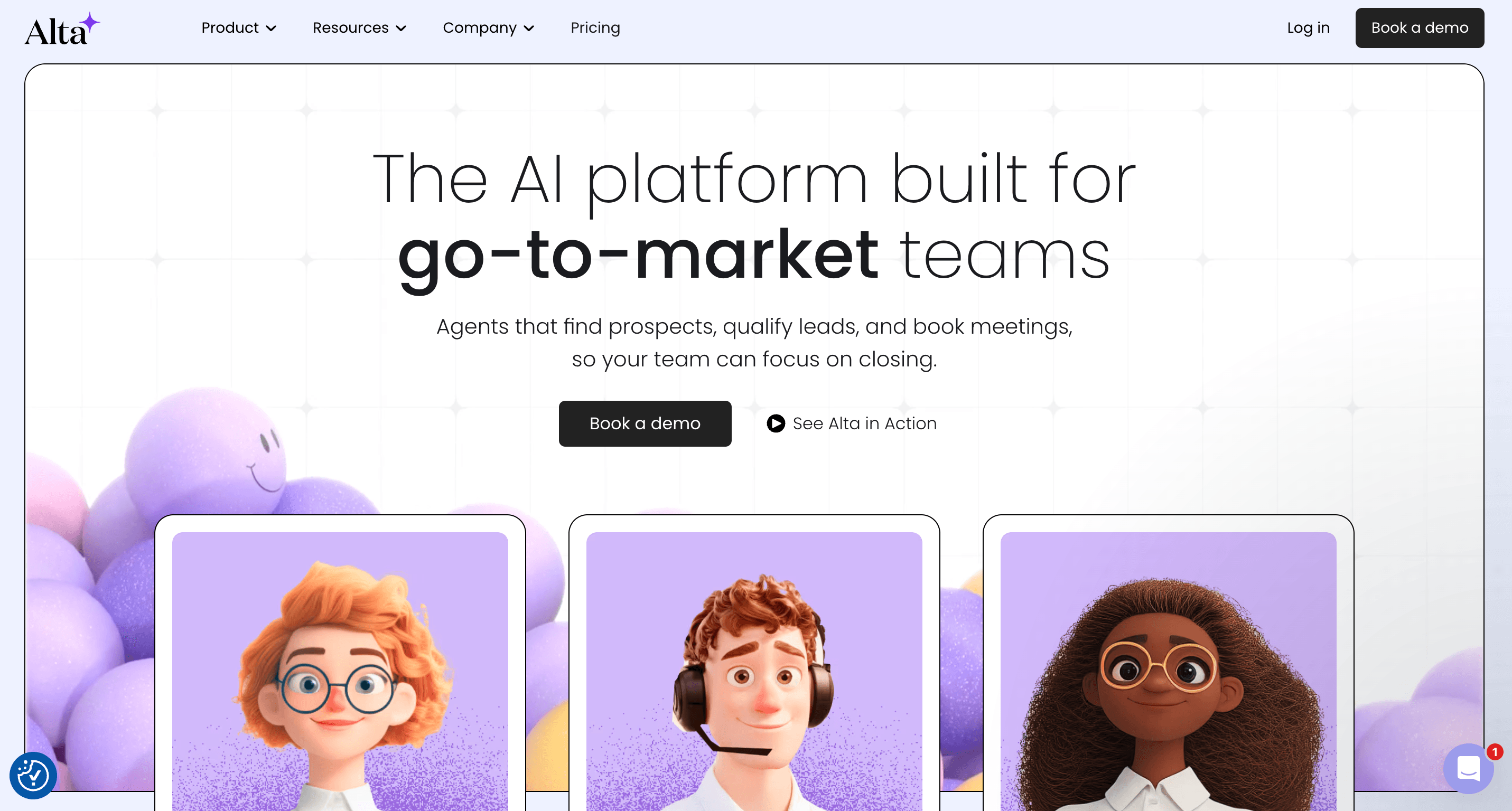
- Alta raised a $25M Series A in July 2026 and positions itself as an "AI GTM System of Actions," its label for a broad go-to-market (GTM) platform, with an SDR agent called Katie and AI calling.
- Alta claims SOC 2 and ISO 27001 compliance per its site. AiSDR's center of gravity is small and midsize business (SMB) and lower mid-market buyers, with a thinner enterprise governance story.
- AiSDR is the more established and easier-to-trial option. Alta is earlier, with a thin track record but a broader scope on paper.
- Choose AiSDR for transparent pricing and quick launch; choose Alta for a newer, wider system if its security claims verify in procurement.
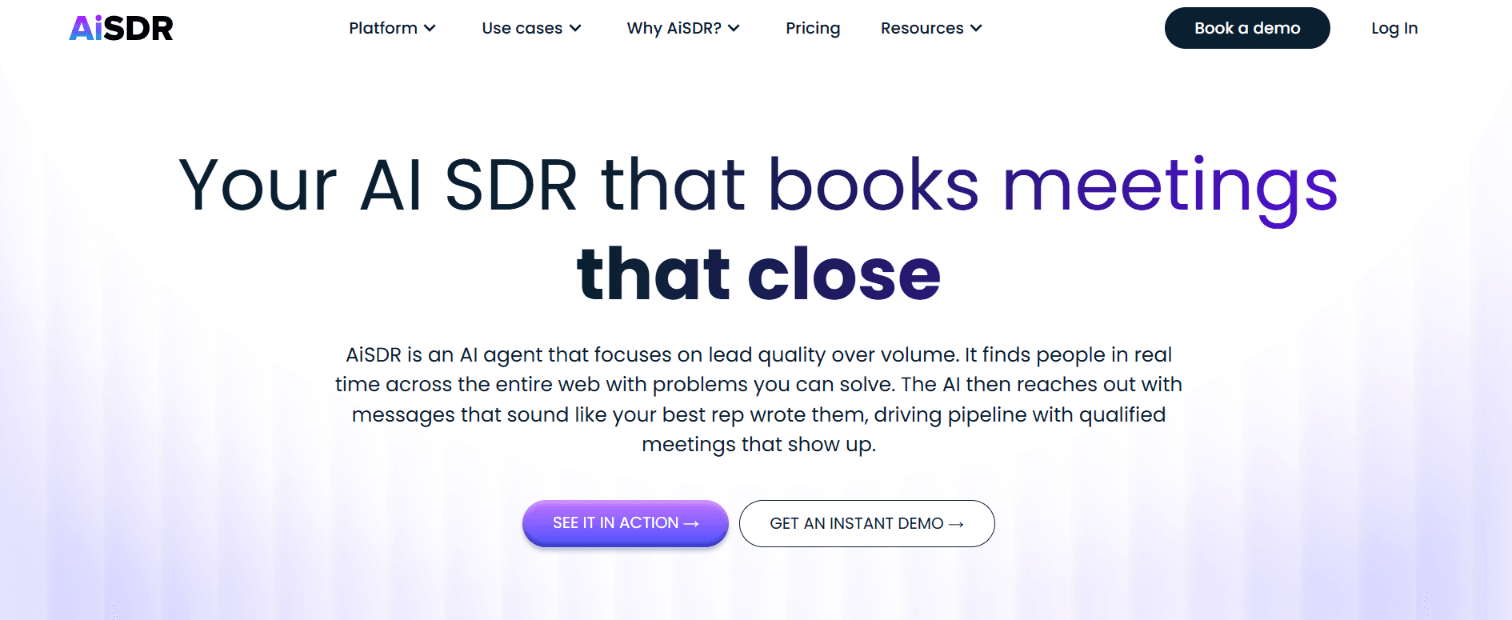
AiSDR and Alta are both AI SDR tools, software that stands in for a sales development representative (SDR) and runs outbound for you. AiSDR is the more transparent and established of the two, with published pricing from around $250/month and a fast, self-serve setup. Alta is newer, raised a $25M Series A in July 2026, and claims a broader "AI GTM System of Actions" scope on a thin track record.
In short, AiSDR wins on price transparency and speed to launch, while Alta appeals if you want a newer platform with a wider "system of actions" scope and its security claims fit your checklist. Here is the honest, scenario-by-scenario breakdown.
How AiSDR and Alta compare at a glance
AiSDR | Alta | |
Best for | Teams that want transparent pricing and fast setup | Teams that want a newer, wider AI GTM system with security claims |
Standout capability | Published tiers plus outbound and inbound with the Ami strategist agent | "AI GTM System of Actions" with Katie and AI calling |
Maturity | More established; proven self-serve motion | Young; $25M Series A, July 2026 |
Public pricing | ~$250 / $900 / $2,500/month, per its pricing page | Gated; "pay for what you use," quoted by team size |
Setup | Fast, largely self-serve | Newer; guided |
Security posture | Thinner enterprise governance story | Claims SOC 2 and ISO 27001, per its site |
What is the core difference between AiSDR and Alta?
Transparency and maturity versus scope and newness. AiSDR sells a clear, fast-to-start AI SDR: read the price, sign up, and be sending quickly, with outbound and inbound covered and Ami shaping strategy. It is proven and easy to trial. Alta is a younger company that raised its Series A in July 2026 and frames itself more broadly as a "GTM System of Actions," with Katie as its agent and AI calling in the mix.
For a buyer, AiSDR is the lower-risk, lower-friction way to test whether an AI SDR earns its place. Alta asks you to bet a little more on an earlier product with a wider ambition. The right choice depends on whether you want something proven and transparent now, or a newer platform you are willing to grow with.
How do AiSDR and Alta price?
AiSDR is the transparent one. Its pricing page lists tiers at roughly $250, $900, and $2,500/month, so you can size a plan without a sales call and defend a budget internally. This openness helps when you are comparing tools or watching spend. For the full breakdown, see AiSDR pricing and reviews.
Alta's pricing is gated. It sells on a "pay for what you use" basis quoted by team size, and routes buyers to a conversation rather than a self-serve tier. If published, predictable pricing matters to you, AiSDR is the clearer choice here. For teams that do not mind a sales process, Alta may have room to negotiate, but you trade away the certainty of a listed price. For the full breakdown, see Alta pricing and reviews.
Which is better for a team that wants to launch fast?
AiSDR. Its whole design favors speed: transparent tiers, a largely self-serve setup, and outbound plus inbound coverage out of the box. A small or mid-market team can start near $250/month, watch reply rates for a few weeks, and expand or leave with minimal friction.
Alta can also start you sending, but as a newer product with a guided motion and less published pricing, its on-ramp is less predictable. If your priority is a fast, low-commitment start, AiSDR fits this better. If you are less time-pressured and more interested in Alta's broader scope, the extra setup consideration may be worth it.
Which handles channels and calling better?
Alta leans harder into calling as part of its pitch. It offers AI calling and positions Katie across a wider set of GTM actions, so voice is part of the story from the start. AiSDR is email-led, covers outbound and inbound with Ami, and is a strong email engine that does not pitch a voice agent as a headline.
Match this to your motion. If a phone channel is central and you want it native to the platform, Alta's calling focus is worth a look, though it is the younger product. If your pipeline comes from email with inbound support, AiSDR covers this well and has the longer record, and you avoid paying for a voice channel you may not use.
Which is more established and lower risk?
AiSDR. It has a longer track record, a proven self-serve motion, and no notable public scrutiny, though its center of gravity sits in SMB and lower mid-market buyers with a thinner enterprise governance story. This is a known, ordinary limitation rather than a red flag. If AiSDR is not the fit, see the best AiSDR alternatives.
Alta is earlier. It raised its $25M Series A in July 2026 and claims SOC 2 and ISO 27001 compliance on its site, which are meaningful if verified during procurement. The honest limitation is a thin history: a young product has less evidence behind it, so references, security documentation, and a trial carry more weight before you commit. If you want the safer, more proven pick today, AiSDR is it.
When is neither AiSDR nor Alta the right fit?
Both give you an AI agent, but each still leaves you owning targeting, data quality, list building, and the surrounding stack, and both are weighted toward smaller teams. Whichever you pick, a person still steers the motion. This shared limitation is worth naming before you choose between them.
If you would rather not run either tool yourself, an autonomous platform is a third path. Artisan consolidates sourcing, enrichment, email outreach, reply handling, and meeting booking into one system where its AI business development representative (BDR), Ava, owns the workflow end to end, on usage-based pricing sized to lead volume rather than a seat per rep, and it is SOC 2 Type II certified with single sign-on (SSO) and audit logs for larger buyers. For a head-to-head, see Artisan vs. Alta.
This suits teams that want the whole job handled by a proven AI sales agent rather than a point AI SDR. For the wider field, see our guide to the best AI SDRs and our roundup of SDR tools.
Choose AiSDR if...
You want published, predictable pricing you can read without a sales call.
You need to launch fast, with a largely self-serve setup and the option to leave.
Email is your primary channel, with inbound coverage as a bonus.
You prefer a more established, lower-risk product over a newer bet.
Choose Alta if...
You want a newer platform with a broader "system of actions" scope, including AI calling.
Its SOC 2 and ISO 27001 claims map to your security checklist and verify in procurement.
You are willing to grow with an early-stage vendor and run references first.
Native calling is central to your motion and you value this focus over a proven email engine.
FAQ
Is AiSDR better than Alta?
For most teams shopping today, AiSDR is the safer pick: transparent pricing from around $250/month, fast self-serve setup, and a more established track record. Alta is newer, with a broader "AI GTM System of Actions" scope and SOC 2 and ISO 27001 claims, but a thinner history. Choose Alta only if its scope and security claims outweigh AiSDR's transparency and maturity.
How much do AiSDR and Alta cost?
AiSDR publishes tiers around $250, $900, and $2,500/month on its pricing page. Alta publishes almost no pricing and typically requires a sales conversation. If cost transparency matters, AiSDR is the clearer choice.
Which is newer, AiSDR or Alta?
Alta is the newer company and closed a $25M Series A in July 2026. AiSDR has a longer track record and a proven self-serve motion. This makes AiSDR the more established option, with Alta the earlier, less proven one.
Does Alta do cold calling?
Yes. Alta offers AI calling and positions Katie across a range of GTM actions, so voice is part of its pitch. AiSDR is email-led, covering outbound and inbound with the Ami strategist agent. If a native phone channel is central to your motion, Alta leans into it more directly, though it is the newer product.
Are AiSDR and Alta enterprise-ready?
Both sit below enterprise in their center of gravity. AiSDR is weighted toward SMB and mid-market buyers with a thinner enterprise governance story. Alta claims SOC 2 and ISO 27001 but is young enough that large teams should validate references and security documentation carefully before committing.
Is there an alternative to both AiSDR and Alta?
Yes. If you want the outbound job done rather than another agent to configure and supervise, an autonomous platform is the alternative to running either tool. Artisan's AI BDR, Ava, owns sourcing, enrichment, outreach, reply handling, and booking end to end on usage-based pricing, so you buy the outcome instead of operating the software. See Artisan's AI sales agent for how the model differs from a point AI SDR.
Can either tool replace a human SDR?
Both automate large parts of the SDR job, such as sourcing, sending, and follow-up, but you still own targeting strategy, data quality, and oversight. Treat them as tools that remove repetitive prospecting work rather than full replacements for a person. See our primer on what an AI BDR does for how the roles compare, and our guide to BDR tools.
The bottom line
Pick AiSDR for transparent pricing, fast setup, and a more established track record, especially for a small or mid-market team that wants to launch and evaluate quickly. Pick Alta if you want a newer platform with a wider scope and native calling, and its security claims verify in procurement. Transparency and maturity point to AiSDR, while scope and a native calling focus point to Alta. For related head-to-heads, see 11x vs. AiSDR and 11x vs. Alta.
Related reading
Jaspar Carmichael-Jack
Co-Founder & CEO @ Artisan
Jaspar is an entrepreneur with expertise in sales, marketing, and operations. He founded Artisan in 2023, a company automating workflows with AI employees.