11x vs. Alta: Which should you choose in 2026?
A fair 2026 comparison of 11x and Alta, two young AI SDR tools, across channels, pricing, security claims, and track record.
Key Takeaways
- 11x has raised roughly $74M from investors including a16z and Benchmark, and runs Alice for multichannel outreach plus Julian, a named AI phone agent.
- Alta raised a $25M Series A in July 2026 and positions itself as an "AI GTM System of Actions," its label for a broad go-to-market (GTM) platform, with an SDR agent called Katie and AI calling.
- Alta claims SOC 2 and ISO 27001 compliance per its site. 11x is the more capital-heavy and channel-broad of the two.
- 11x drew documented scrutiny in 2025: TechCrunch reported customer claims it could not support (March 24, 2025), its founder-CEO stepped down to non-executive chairman in May 2025, and chief technology officer Prabhav Jain became CEO. Reviewers report deliverability and CRM-sync complaints.
- Neither publishes fully self-serve pricing, and both lean toward a sales conversation. 11x now publishes a Growth tier from $3,750/month billed annually (about $45K/year), with higher tiers custom, while Alta is gated on a "pay for what you use" model quoted by team size.
- Choose 11x for channel breadth and funding stability; choose Alta if you want a newer, leaner system and its security claims match your checklist.
11x and Alta are both young AI SDR tools, software that stands in for a sales development representative (SDR) and runs outbound for you. 11x is the more established, with roughly $74M raised, multichannel outreach, and an AI phone agent, though it carries documented 2025 scrutiny. Alta is newer, raised a $25M Series A in July 2026, and claims a broader "system of actions" scope on a thin track record.
The honest read is that 11x has more funding, more channels, and a longer, bumpier history, while Alta is earlier, leaner, and less proven. Below is the scenario-by-scenario comparison, with published facts and every negative claim attributed.
How 11x and Alta compare at a glance
11x | Alta | |
Best for | Teams that want multichannel plus an AI phone agent | Teams that want a newer, lean AI GTM system with security claims |
Standout capability | Julian, a named AI phone agent, alongside Alice | "AI GTM System of Actions" with Katie, its SDR agent, and AI calling |
Maturity | More established; ~$74M raised | Young; $25M Series A, July 2026 |
Public pricing | Growth from $3,750/month annual (~$45K/yr) now public; higher tiers custom | Gated; "pay for what you use," quoted by team size |
Security posture | Enterprise-style contracts | Claims SOC 2 and ISO 27001, per its site |
Track record | 2025 scrutiny and a leadership change | Thin track record; too new to judge at scale |
What is the core difference between 11x and Alta?
Maturity and breadth. 11x is the more developed product, with more capital behind it, a wider channel set including AI voice, and a longer history, some of it rocky. Alta is a younger company that raised its Series A in July 2026 and is still building a track record. It frames itself as a broader "GTM System of Actions" rather than a single-purpose SDR, with Katie as its agent and AI calling in the mix.
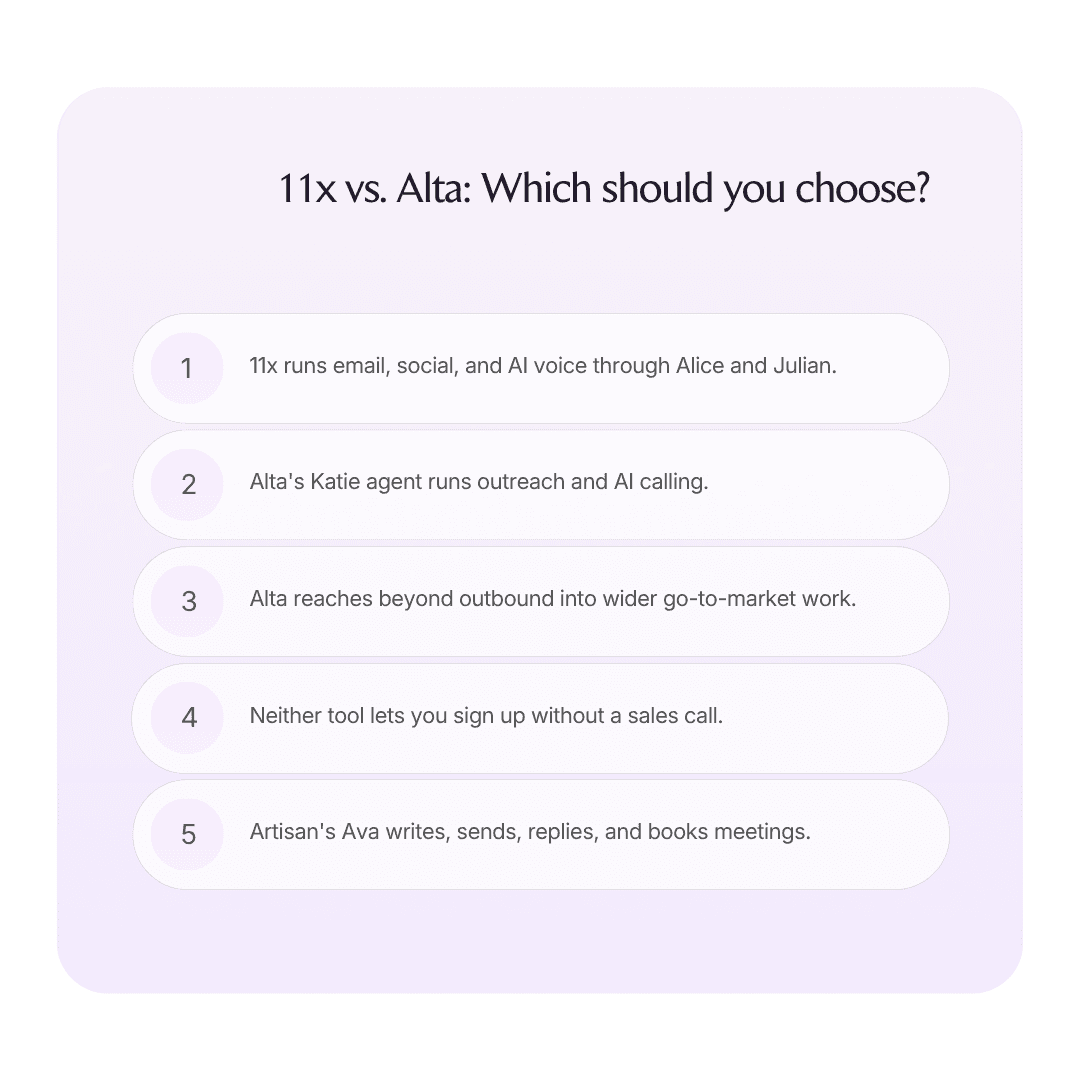
For a buyer, this means 11x offers more surface area but more baggage, while Alta offers a cleaner slate but far less evidence. Neither is a safe default. The right pick depends on how much you value a proven feature set versus a fresh start, and how much risk you can absorb on an early-stage vendor. For adjacent matchups, see 11x vs. AiSDR and AiSDR vs. Alta.
How do 11x and Alta price?
Neither tool is fully self-serve, but they differ. 11x now publishes a floor: its Growth tier starts at $3,750/month billed annually, about $45,000 a year, with Pro and Enterprise tiers still quoted through sales. Alta is gated on a "pay for what you use" basis, quoted by team size, and steers buyers toward a conversation rather than a listed tier.
So 11x gives you a public starting number where Alta does not, though both upper ends still require a sales process. If a fully published, predictable ladder is a hard requirement, neither is ideal, and you should also look at tools that list every tier openly. For teams comfortable negotiating, budget accordingly: 11x expects a larger annual commitment at a known floor, while Alta, as a newer vendor, may have more flexibility but less certainty about longevity. For the full breakdowns, see 11x pricing and reviews and Alta pricing and reviews.
Which is more established: 11x or Alta?
11x, clearly. It has raised roughly $74M from a16z, Benchmark, and others, and has been in market longer with a wider channel set. Alta closed a $25M Series A in July 2026 and remains early. If you weight funding runway, existing customer base, and feature depth, 11x is the more established of the two.
But established does not automatically mean lower risk here. 11x's history includes documented reporting and a leadership change (covered below), so its maturity comes with scrutiny. Alta's risk is simpler and more familiar: it is a young company that has not yet proven itself at scale. Decide which kind of risk you would rather carry.
Which handles channels and calling better?
11x has the broader, more proven channel set. Alice runs multichannel outreach, and Julian adds a named AI phone agent, so voice is a first-class channel. Alta also offers AI calling and positions Katie across GTM actions, but as a younger product its channel depth is less battle-tested.
If a reliable phone channel is central to your motion today, 11x's voice agent has more mileage behind it. If you are intrigued by Alta's broader "system of actions" framing and are willing to grow with an early product, its scope is ambitious, just less proven. Match the choice to whether you need something dependable now or are betting on a newer platform's trajectory.
What should you know about each vendor's track record?
For 11x, the record is documented and attributed. TechCrunch reported on March 24, 2025 that customers made performance claims the company could not support. In May 2025, its founder-CEO stepped down to non-executive chairman and chief technology officer Prabhav Jain became CEO. Reviewers have separately reported deliverability and CRM-sync complaints. 11x remains funded and active, but a multi-year commitment deserves eyes-open diligence.
For Alta, there is simply not much record yet. It raised its Series A in July 2026 and claims SOC 2 and ISO 27001 compliance on its site, which are meaningful signals if verified during procurement. The honest limitation is that a young product has a thin history, so references, security documentation, and a trial matter more than usual before you commit.
When is neither 11x nor Alta the right fit?
Both are relatively young AI SDR tools, and both leave you owning targeting, data quality, list building, and the surrounding stack. Whichever you pick, a person still steers the motion, and this shared limitation is the one neither product removes. Compare the broader categories in SDR tools and BDR tools.
If you would rather not run either tool yourself, an autonomous platform is a third path. Artisan consolidates sourcing, enrichment, email outreach, reply handling, and meeting booking into one system where its AI business development representative (BDR), Ava, owns the workflow end to end, on usage-based pricing sized to lead volume rather than a seat per rep, and it is SOC 2 Type II certified.
This suits teams that want the whole job handled by a proven AI sales agent rather than a bet on an early-stage vendor. For the wider field, see our guide to the best AI SDRs. For head-to-head detail, see Artisan vs. 11x, the best 11x alternatives, and the best Relevance AI alternatives.
Choose 11x if...
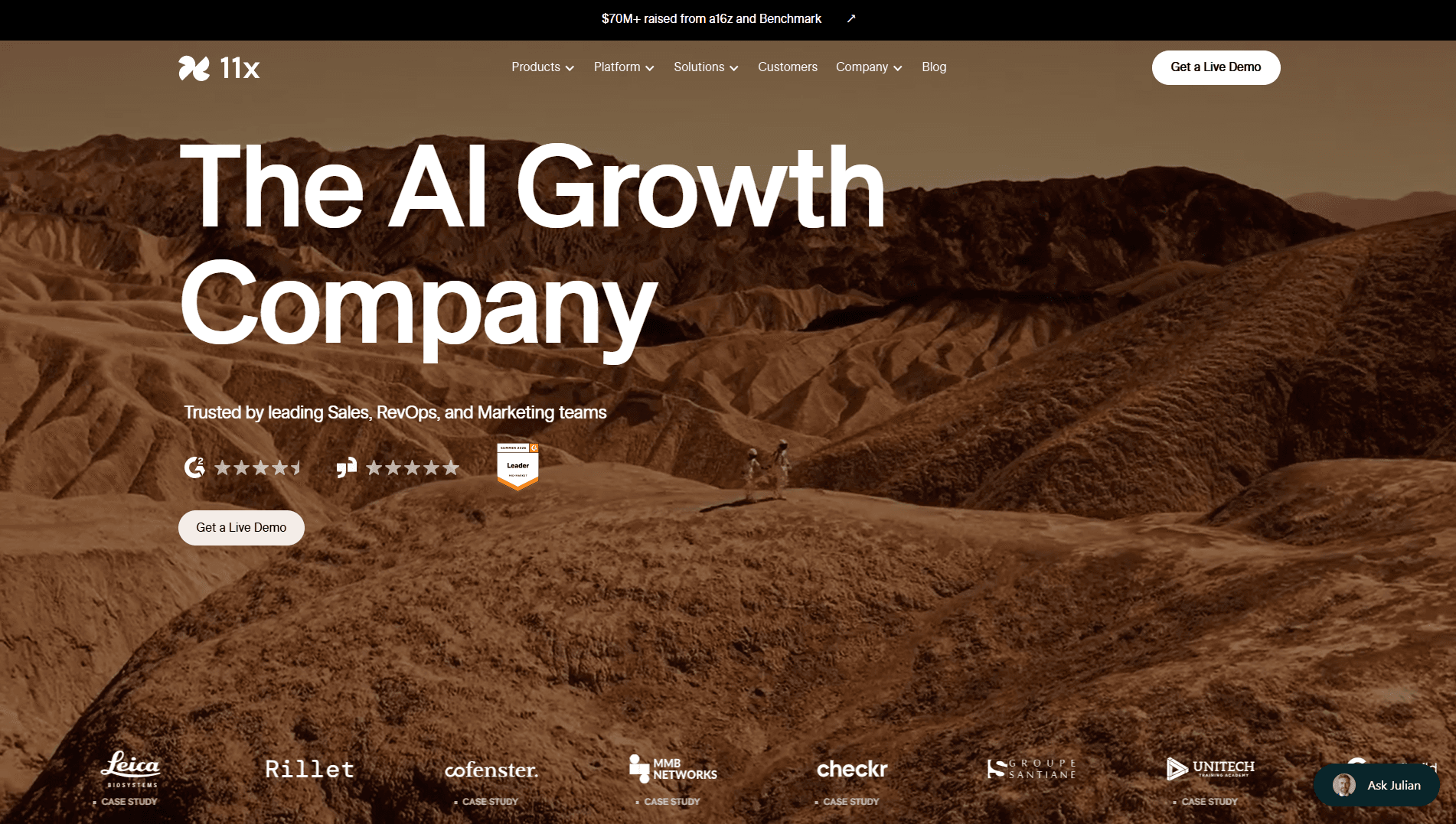
You want a broader, more proven channel set, including a named AI phone agent.
Funding runway and an existing customer base matter to your risk tolerance.
You can absorb the 2025 reporting and leadership change after diligence.
You are comfortable with an enterprise-style annual contract and guided onboarding.
Choose Alta if...
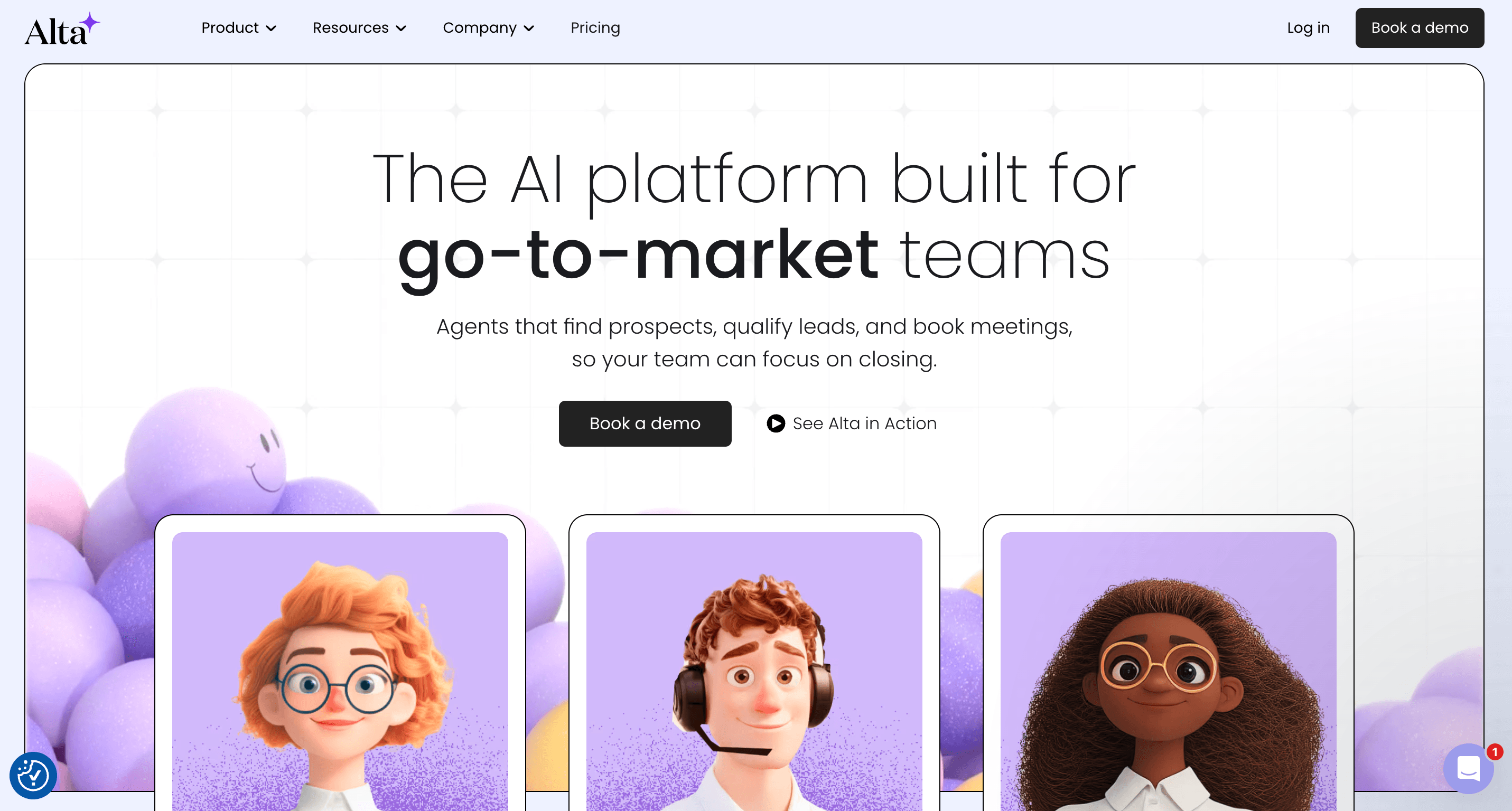
You prefer a newer, leaner product with a clean slate over one carrying public scrutiny.
Its SOC 2 and ISO 27001 claims map to your security checklist and verify in procurement.
You are willing to grow with an early-stage vendor and value its "system of actions" scope.
You want to run references and a trial before committing, and you have the patience to do so.
FAQ
Is 11x better than Alta?
Neither is a clear winner. 11x is more established, with roughly $74M raised and a wider, more proven channel set including an AI phone agent, but it carries 2025 scrutiny and a leadership change. Alta is newer and raised a $25M Series A in July 2026, with SOC 2 and ISO 27001 claims but a thin track record. Match the choice to your risk tolerance.
How much do 11x and Alta cost?
Neither is fully self-serve. 11x now publishes a Growth tier from $3,750/month billed annually (about $45K/year), with higher tiers custom. Alta is gated on a "pay for what you use" model quoted by team size, so it effectively requires a sales conversation. 11x gives you a public floor; Alta does not.
Which is newer, 11x or Alta?
Alta is the newer company and closed a $25M Series A in July 2026. 11x has been in market longer and raised roughly $74M from investors including a16z and Benchmark. This makes 11x the more established of the two, with the trade-offs that maturity brings.
Does Alta have security certifications?
Alta claims SOC 2 and ISO 27001 compliance on its site. Those are meaningful signals for a security review, but as with any young vendor you should request the actual attestation documents and validate them during procurement rather than relying on the claim alone.
What happened with 11x in 2025?
Per TechCrunch's March 24, 2025 reporting, customers made performance claims the company could not support. In May 2025, its founder-CEO stepped down to non-executive chairman and chief technology officer Prabhav Jain became CEO. Reviewers have also reported deliverability and CRM-sync issues. 11x remains funded at roughly $74M and active in the market.
Is there an alternative to both 11x and Alta?
Yes. If you want the outbound job done rather than a newer or older agent to configure and supervise, an autonomous platform is the alternative to running either tool. Artisan's AI BDR, Ava, owns sourcing, enrichment, outreach, reply handling, and booking end to end on usage-based pricing, and Artisan is SOC 2 Type II certified, so you buy the outcome instead of operating the software. See Artisan's AI sales agent for how the model differs from a point AI SDR.
Can either tool replace a human SDR?
Both automate large parts of the SDR job, but you still own targeting, data quality, and oversight. Treat them as tools that remove repetitive prospecting work rather than full replacements for a person. Our overview of what an AI BDR does explains where the automation stops and human judgment begins.
The bottom line
Pick 11x for a broader, more proven channel set and funding stability, provided you are comfortable with its 2025 history after diligence. Pick Alta if you want a newer, leaner system whose security claims fit your checklist and you are willing to grow with an early product. Both ask for a sales conversation rather than a self-serve start, so weigh channel maturity against a fresh slate and price the risk accordingly.
Jaspar Carmichael-Jack
Co-Founder & CEO @ Artisan
Jaspar is an entrepreneur with expertise in sales, marketing, and operations. He founded Artisan in 2023, a company automating workflows with AI employees.