The best AI recruiting tools in 2026
Nine AI recruiting tools compared on what the AI actually does, published pricing, hiring compliance, and who each one is wrong for.
Key Takeaways
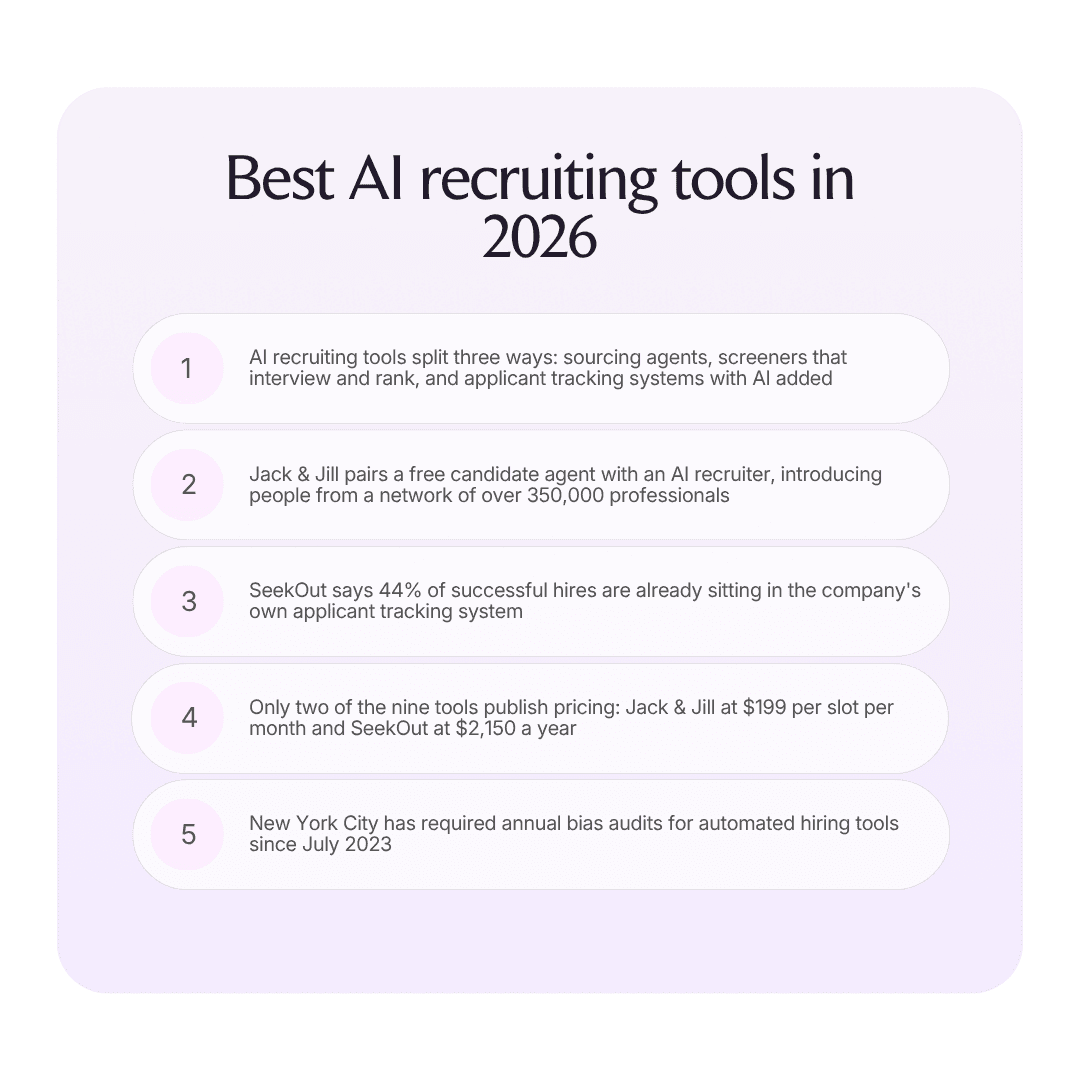
- The category splits three ways: AI recruiters that source and introduce candidates, AI screeners that interview and rank them, and applicant tracking systems that have added AI on top. Most teams end up buying from two of the three.
- Jack & Jill runs a two-sided model, a free agent for candidates and an AI recruiter for companies, and its paid tier is published at $199 per slot per month on annual billing.
- Greenhouse says applications per recruiter have risen 412% since 2023, which is the pressure driving the whole category.
- Sourcing tools now index a billion or more profiles: SeekOut and hireEZ both claim 1B+, Juicebox claims 800M+ across 30+ sources.
- Almost every screening and interviewing vendor gates its pricing. Of the nine tools here, only Jack & Jill and SeekOut publish a usable figure.
- Compliance is now a buying criterion. New York City has required annual bias audits since July 2023, Illinois added hiring-specific AI rules from January 2026, and the EU treats employment uses as high risk.
- Vendor time-to-hire claims run from 30% to 90% faster. Independent testing of resume screening has found large name-based disparities, so treat the marketing numbers as a ceiling and audit your own funnel.
Jack & Jill is the best AI recruiting tool in 2026 for fast-growing companies that want introductions rather than a pile of applications, pairing a candidate-side agent with an AI recruiter across a network of more than 350,000 professionals. Paradox owns high-volume hourly hiring, SeekOut and hireEZ own sourcing, and Greenhouse and Ashby remain the ATS backbone.
AI recruiting tools compared
Rank | Tool | Best for | Standout capability | Public pricing |
1 | Fast-growing teams that want warm introductions, not applications | Two-sided agents, candidate network of 350,000+ | Free tier, $199/slot/mo annual | |
2 | Paradox | High-volume hourly and frontline hiring | Conversational screening and scheduling over SMS | Gated, contact sales |
3 | SeekOut | Enterprise sourcing across technical talent | 1B+ profiles, surfaces candidates already in your ATS | Recruit Lite $2,150/year |
4 | hireEZ | Sourcing bolted onto an existing ATS | Natural-language search across 45+ platforms | Gated, contact sales |
5 | Juicebox | Recruiters who want to search in plain English | PeopleGPT across 800M+ profiles, 41 ATS integrations | Gated, contact sales |
6 | Greenhouse | Structured hiring at scale | Voice AI phone screens against team-built rubrics | Gated, contact sales |
7 | Ashby | Startups and mid-market wanting one system | ATS, CRM, scheduling and analytics in one | Gated by company size |
8 | HireVue | Regulated, high-volume assessment programs | Validated skills assessments plus video interviewing | Gated, contact sales |
9 | Moonhub | Early-stage teams with no recruiting function | Three agents that qualify, engage and monitor intent | Not published |
Pricing is from each vendor's own site where they publish one. Everything gated is marked as such rather than estimated.
How we chose
How much of the recruiting job the AI does. Sending a templated message is not recruiting. We weighted tools that take a brief, decide who fits, and put a real candidate in front of a hiring manager.
Where the candidates come from. A tool searching public profiles is doing something different from a tool with an opted-in network. Both work, but the response rates and the candidate experience are not comparable.
Pricing you can see. Published pricing beats gated pricing, and we say plainly which vendors make you talk to sales.
Compliance posture. Anything that screens, scores or ranks candidates now sits inside a real regulatory perimeter, so we noted where each tool leaves you exposed.
What are the best AI recruiting tools in 2026?
1. Jack & Jill: the AI recruiter that makes introductions
The best pick if your problem is that good candidates never reach you. Jack & Jill runs two agents at once. Jack is free for candidates: it builds a profile through a roughly ten-minute conversation, scans what the company describes as 15 million jobs daily, and coaches on interviews and salary. Jill works the company side, learns your hiring brief, and introduces the candidates worth meeting.
The interesting part is the network effect between the two. Because candidates come in through Jack and opt into being matched, Jill is introducing people who already want to be introduced, which is a different starting point from cold sourcing against public profiles. The company puts its network at more than 350,000 professionals, with a live counter on the homepage running higher. Jill can also search public professional profiles when the network does not cover a role, without the warm-introduction advantage.
Jack & Jill raised a $20M seed round led by Creandum, announced on October 16, 2025 and reported by TechCrunch. It is a London company, and the named references on its site are startups rather than enterprises: Marloo, Fyxer, Architect, Klute and Asterix Health. Integrations are thin, Slack and Ashby, so it fits teams whose process is light rather than teams with a heavily customized ATS.
Best for: seed to Series B companies hiring engineers and operators, and any team where the hiring manager, not a recruiting function, is doing the work.
Who should pick something else: enterprises needing deep ATS integration, audit trails and vendor security review should look at Greenhouse or SeekOut. High-volume hourly hiring belongs with Paradox. The integration list is the real constraint here, not the matching.
Pricing: Meet Jill is free with one slot and 20 introduction requests a month. Hire Jill is $199 per slot per month billed annually, or $249 monthly, with 50 introduction requests per slot. Scale Jill is custom. Source: jackandjill.ai/pricing.
2. Paradox: conversational hiring at volume
If you hire hundreds of hourly staff a month, this is the category leader and it is not close. Paradox's assistant, Olivia, runs screening, scheduling and onboarding over two-way text in more than 100 languages, which is the right medium for a candidate who will never open a desktop application form.
The numbers its customers publish are the sort the rest of the category does not have: 7-Eleven reports saving 40,000 hours a week, GM reports $2M a year, and Workday's acquisition announcement cited time-to-hire as low as 3.5 days. Workday signed a definitive agreement to acquire Paradox on August 21, 2025, so it now sits inside a much larger HR suite, which is either reassuring or a roadmap risk depending on your view of platform acquisitions.
Best for: retail, hospitality, healthcare support and logistics, anywhere the bottleneck is scheduling thousands of interviews rather than finding candidates.
Who should pick something else: professional and executive hiring. Olivia is built for volume and structure, and a senior engineering search is neither. Pricing is also gated with no published entry point.
Pricing: gated, contact sales. No figures published.
3. SeekOut: enterprise sourcing with a memory
SeekOut's most useful claim is not about its billion-plus profiles. It is that 44% of successful hires already exist in the company's own applicant tracking system, and its search reaches into that data alongside external sources including GitHub, patents and publications. If you have been hiring for five years, you have already paid to acquire most of the candidates you need.
It publishes one real price, Recruit Lite at $2,150 a year for a single seat, and gates everything above that. SeekOut names 750+ enterprises as customers, including Sony, Atlassian, Pfizer and Cisco.
Best for: enterprise talent teams hiring technical and hard-to-find roles, especially where the ATS already holds years of applicants.
Who should pick something else: teams without an ATS to search, and small companies for whom per-seat enterprise pricing makes no sense. It is a sourcing layer, not a hiring workflow.
Pricing: Recruit Lite $2,150/year for one seat, published. Team and enterprise gated. Source: seekout.com.
4. hireEZ: the sourcing layer that leaves your stack alone
hireEZ does not replace your ATS. It sits on top of it, searching over a billion profiles across 45+ platforms from natural-language instructions. Its Talent CRM handles the other half of the job, re-engaging candidates you have already spoken to, and the company says 20% to 30% of roles get filled from that owned pool.
The claim to test is "7x more qualified candidates," which is a vendor figure with no methodology attached. Pricing is gated behind a sales-led trial, and hireEZ publishes no figure at all. Named customers include Visa, Lyft, Zoom and PwC.
Best for: teams with an ATS they like and a sourcing gap they do not want to solve by hiring more sourcers.
Who should pick something else: anyone who needs published pricing to get budget approved, and teams wanting screening or interviewing rather than sourcing. There has also been no funding or product news from hireEZ in the last 18 months that we could verify.
Pricing: gated behind a sales-led trial. No published figures.
5. Juicebox: plain-English search across 800M profiles
Juicebox is the tool to try if your recruiters can describe the person they want but cannot write a Boolean string. PeopleGPT takes the description and searches 800M+ profiles across 30+ data sources, then agents run outreach sequences that the company says lift replies up to 3x. It connects to 41 applicant tracking systems and 21 CRMs, which is the widest integration list here.
It raised $80M in a Series B at an $850M valuation led by DST Global, announced March 10, 2026, following a Series A led by Sequoia. That funding is ahead of its public customer list, which is short: Omnea, Render, 1five and Chalk. Strong product, early proof at scale.
Best for: recruiting teams that want to replace sourcing headcount with search, and anyone whose ATS is on the integration list.
Who should pick something else: enterprises that need named reference customers at their own size, and teams needing screening or interview workflow. Pricing is not published, so budget conversations start with a demo.
Pricing: not published, contact sales.
6. Greenhouse: structure first, AI second
Greenhouse belongs here because the AI is attached to something that already works. Its Voice AI runs two-way phone screens scored against rubrics your team writes, rather than against a black-box model, and Real Talent handles identity verification and fraud detection, which is a real 2026 problem now that candidates use the same generative tools recruiters do. Ocado Group reports a 30% reduction in time-to-hire, and Greenhouse says 90% of candidates rate the Voice AI experience as excellent.
It announced a definitive agreement to acquire Ezra AI Labs, a voice-based interviewing company, on May 5, 2026. In the same release it published the number that explains this entire market: applications per recruiter are up 412% since 2023.
Best for: companies that want structured, auditable hiring, and anyone who has to defend a hiring decision to a regulator or a court.
Who should pick something else: small teams wanting one lightweight tool. This is a full platform with an implementation to match, and pricing is gated.
Pricing: gated, contact sales. No published figures.
7. Ashby: one system instead of four
Ashby consolidates the applicant tracking system, CRM, scheduling and analytics into a single product, with AI features spread across them rather than sold as a separate module. Its customer list is the strongest signal: Ramp, Notion, Shopify, Snowflake, Linear, Vanta and Deliveroo, which is roughly the same set of companies that a startup hiring manager is trying to compete with for candidates.
Pricing is scoped by company size across Startups, Growth and Enterprise, and none of the tiers are published, so a demo is the only route to a number.
Best for: startups and mid-market companies replacing a stack of point tools, and anyone who wants recruiting analytics without building them in a spreadsheet.
Who should pick something else: large regulated enterprises, where Greenhouse and Workday have the longer track record. Also anyone who only needs sourcing, since paying for a full ATS to get it makes no sense.
Pricing: gated and scoped by headcount. Source: ashbyhq.com.
8. HireVue: assessments with a compliance history
HireVue is the most established name here and the one that needs the most careful reading. Its strength is genuine: structured video interviewing plus skills assessments validated against job-specific competency models, which is more defensible than a model scoring a resume. Customer-published results include a 90% faster time-to-hire at National Safety Apparel and $667K in annual savings at Children's Hospital of Philadelphia. It acquired the voice-AI interviewing company Hireguide on March 10, 2026.
The caveat is attributed and material. HireVue agreed a $3.75M settlement in an Illinois Biometric Information Privacy Act class action covering video interviews from January 2017 to June 2026, reported by Top Class Actions in August 2026, with a claims deadline of October 13, 2026. Whatever your view of the underlying claims, biometric consent is now part of the diligence on any video interviewing purchase.
Best for: high-volume programs that need validated assessments and can run a proper consent and audit process.
Who should pick something else: teams without legal support for biometric consent, and small companies, since this is enterprise procurement with gated pricing.
Pricing: gated, contact sales.
9. Moonhub: three agents for teams with no recruiter
Moonhub splits the work across three agents: Qualify identifies candidates, Engage personalizes outreach, and Monitor watches candidate intent and hands off in real time. Its published claims are strong, a 50% reduction in time-to-hire and clients interviewing 80% of presented candidates, with 75% of surfaced candidates being first-time prospects.
The references are founders at small companies rather than talent leaders at large ones, which tells you where it fits. Its site also refers to the Moonhub team joining Salesforce, which we could not confirm independently, so ask directly about product continuity before signing anything.
Best for: pre-recruiting-function startups where a founder is doing the sourcing between other jobs.
Who should pick something else: anyone needing published pricing, enterprise security review, or certainty about the product's future ownership.
Pricing: not published.
What counts as an AI recruiting tool?
Three different products get sold under the same phrase, and buying the wrong one is the most common mistake in this category.
AI recruiters and sourcing tools find people. They search networks or public profiles, decide who matches a brief, and start conversations. Jack & Jill, SeekOut, hireEZ, Juicebox and Moonhub live here.
AI screening and interviewing tools evaluate people who have already applied or been contacted. They run phone or video interviews, score assessments, and rank the results. Paradox, HireVue and Greenhouse's Voice AI live here.
Applicant tracking systems with AI layers manage the process end to end and have added intelligence on top. Greenhouse and Ashby live here.
A sourcing tool will not reduce your screening load, and a screening tool will not fill an empty pipeline. Work out which half of the funnel is actually broken before you look at a demo.
How much do AI recruiting tools cost in 2026?
Less than agencies, more than the marketing suggests, and mostly invisible until you talk to sales. Of the nine tools here, only Jack & Jill and SeekOut publish a figure you could put in a budget: $199 per slot per month and $2,150 a year respectively.
For the rest, you will not have a number until you have had the sales conversation, so build that into your timeline rather than your budget.
The comparison that matters is against what you spend now. A contingency recruiting agency typically charges 15% to 25% of first-year salary, so a single $150,000 hire costs $22,500 to $37,500 in fees. Nearly every tool on this list is cheaper than two agency placements a year, which is why the category is growing regardless of whether the AI is impressive.
Do AI recruiting tools actually reduce time-to-hire?
The published numbers are real but they are ceilings, measured by vendors on their best accounts. Ocado reports 30% faster hiring with Greenhouse, Moonhub claims 50%, National Safety Apparel reports 90% with HireVue, and Workday cited 3.5 days for some Paradox customers. All four are true statements about specific programs, and none of them is a forecast for yours.
What generalizes is narrower. Scheduling and screening automation reliably removes calendar work, which is why the strongest results cluster in high-volume hourly hiring where scheduling was the bottleneck. Sourcing tools change who is in the pipeline rather than how fast it moves, and the gain shows up in quality of shortlist first.
Set your own baseline before you buy. Measure days from approved requisition to accepted offer for your last ten hires, then run the same measure 90 days after rollout. If the vendor will not agree to that as a success criterion, that tells you something.
What does the law require when AI screens candidates?
More than most buyers expect, and the rules diverge by state.
New York City Local Law 144 has been in force since July 5, 2023. If you use an automated employment decision tool on candidates in the city, you need an independent bias audit within the previous year, published results, and candidate notice.
Illinois HB 3773 took effect on January 1, 2026. It bars AI-driven discrimination across recruitment, hiring, promotion and termination, requires notice when AI is used, and specifically prohibits using ZIP code as a proxy for a protected class. Illinois also has the older AI Video Interview Act, in force since 2020, plus the biometric privacy statute behind the HireVue settlement above.
California applied its FEHA regulations to automated decision systems from October 1, 2025, bringing disparate-impact analysis to AI-driven employment decisions.
The EU AI Act classifies employment uses, including recruitment and evaluation, as high risk. The Digital Omnibus that entered into force in July 2026 pushed the compliance deadline for those obligations to December 2027, per DLA Piper's analysis, so European buyers have more time than they expected but not an exemption.
Federal guidance moved the other way. The EEOC's AI hiring guidance was removed from its website in early 2025, as reported by the National Law Review, which leaves state law as the operative constraint for most US employers.
Ask every vendor two questions: can you produce a bias audit, and what data do you collect that a biometric statute would cover.
Does AI screening introduce bias?
The independent evidence says it can, and at a scale worth taking seriously. A University of Washington study published in October 2024, funded by NIST and presented at the AAAI/ACM AIES conference, tested three open-source models across more than three million resume comparisons. White-associated names were preferred 85% of the time against 9% for Black-associated names, and male names 52% against 11% for female names. Black male names were never preferred over white male names.
Those were general-purpose open models rather than the commercial tools on this list, several of which score against structured rubrics or validated assessments precisely to avoid this failure mode. The point is not that every vendor is biased. It is that the burden of proof sits with the buyer, and "the model handles it" is not an answer you can give a regulator.
A smaller 2026 study from the University of Illinois Gies College of Business found AI screening penalized unexplained career gaps and keyword-stuffed resumes, with no significant effect from tone or prestige markers. The authors flagged the small sample themselves.
What changed in AI recruiting recently?
The category consolidated hard, and the biggest names bought their voice AI rather than building it.
August 21, 2025: Workday signed a definitive agreement to acquire Paradox, moving the leader in conversational hiring inside a full HR suite.
October 16, 2025: Jack & Jill raised a $20M seed round led by Creandum, per TechCrunch, on a two-sided model that pays candidates' side attention as much as employers'.
March 10, 2026: two deals on the same day. Juicebox raised an $80M Series B at an $850M valuation led by DST Global, and HireVue acquired the voice interviewing company Hireguide.
May 5, 2026: Greenhouse announced a definitive agreement to acquire Ezra AI Labs, another voice-based interviewing company, and published the 412% rise in applications per recruiter since 2023.
August 2026: HireVue's $3.75M Illinois biometric privacy settlement was reported, with claims open until October 13, 2026.
FAQ
What is the best AI recruiting tool overall?
Jack & Jill, for fast-growing companies that want candidates introduced rather than applications collected. Its two-sided model means candidates opt in through a free agent, so introductions land warmer than cold sourcing. Greenhouse is the better answer for enterprises that need structure and auditability, and Paradox for anyone hiring hourly staff at volume.
Do any AI recruiting tools publish their pricing?
Two of the nine here. Jack & Jill publishes a free tier and $199 per slot per month on annual billing, and SeekOut publishes Recruit Lite at $2,150 a year. Everyone else gates pricing behind a sales conversation, so build a demo cycle into your timeline.
Is an AI recruiter cheaper than a recruiting agency?
Usually, yes. Contingency agencies typically charge 15% to 25% of first-year salary, so one $150,000 hire runs $22,500 to $37,500. Most tools on this list cost less than two placements a year. The trade is that you keep the work of running the process.
Which AI recruiting tool is best for high-volume hourly hiring?
Paradox, clearly. Conversational screening and scheduling over text suits candidates who never touch a desktop form, and its customers publish the strongest operational numbers in the category, including 40,000 hours a week saved at 7-Eleven and time-to-hire as low as 3.5 days.
Do I need a bias audit if I use these tools?
If you hire in New York City and use an automated employment decision tool, yes, annually, with published results and candidate notice, under Local Law 144. Illinois, California and the EU impose their own requirements. Ask the vendor for an audit you can rely on before you sign, not after.
Can AI recruiting tools work without an applicant tracking system?
Jack & Jill and Moonhub can, since they deliver candidates to a hiring manager directly. SeekOut, hireEZ and Juicebox are designed to sit on top of an ATS and lose much of their value without one. Greenhouse and Ashby are the ATS.
How accurate are vendor claims about time-to-hire?
They are accurate about the accounts they describe and not predictive for yours. The published range runs from 30% to 90% faster. Measure days from approved requisition to accepted offer across your last ten hires, then re-measure 90 days after rollout, and treat the vendor's figure as the best case rather than the expected case.
What happened to the EEOC's guidance on AI in hiring?
It was removed from the agency's website in early 2025, as reported by the National Law Review. The practical effect is that state law now does the work, and the state rules differ, so a multi-state employer has to comply with the strictest of them rather than one federal standard.
Which tools search candidates who already applied to us?
SeekOut makes this explicit, saying 44% of successful hires are already in the company's own ATS, and hireEZ's Talent CRM targets the same pool, attributing 20% to 30% of filled roles to it. If you have years of applicant history, start there before paying to source strangers.
Where to start
If hiring managers are doing the recruiting themselves, start with Jack & Jill's free tier and see whether the introductions are people you would actually meet. If you are drowning in hourly applications, Paradox. If your pipeline is full but your shortlists are weak, SeekOut or Juicebox. If you cannot defend how a decision got made, fix that with Greenhouse before you add any more AI to the process.
Whatever you shortlist, ask for the bias audit and the consent language in the first call rather than the last. The vendors that have them ready are telling you something, and so are the ones that do not.
Related reading: how to recruit sales reps, the best alternatives to hiring more SDRs, and how to use hiring signals to time your outbound.
Jaspar Carmichael-Jack
Co-Founder & CEO @ Artisan
Jaspar is an entrepreneur with expertise in sales, marketing, and operations. He founded Artisan in 2023, a company automating workflows with AI employees.