How to use hiring signals to time your outbound
A role opening tells you about budget, pain, and timing. Learn to read hiring signals and act on them before the new hire starts.

Key Takeaways
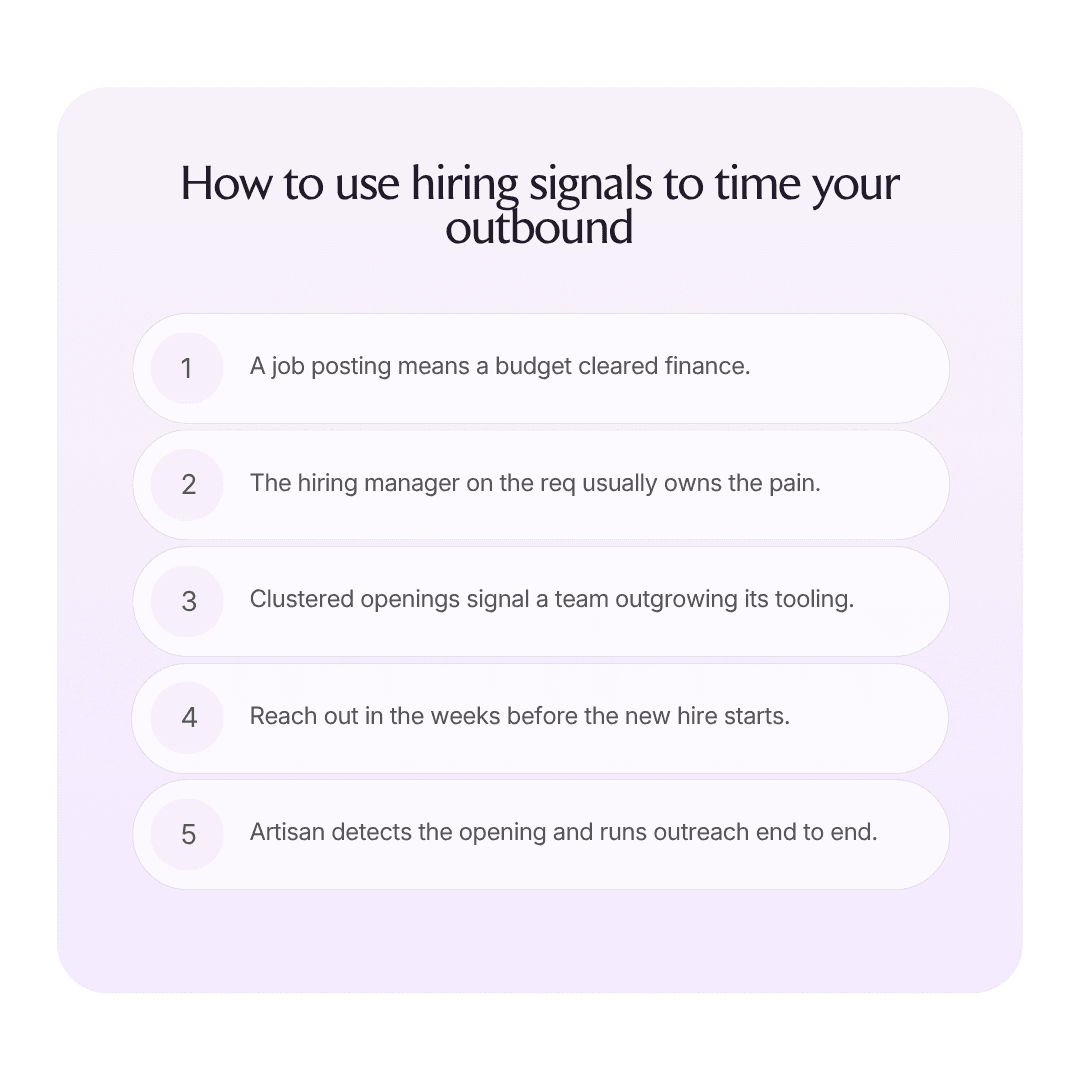
- A job posting is three facts at once: a budget was approved, a team has a gap, and someone owns the pain today.
- The best window is before the new hire starts. Once the person is in the seat, the problem feels handled, and your timing edge is gone.
- Sales development representatives (SDRs) spend 40% to 60% of their hours on non-selling busywork, so a company that is hiring three SDRs is quietly telling you their current motion does not scale.
- Match the role to the pain your product removes. A "RevOps hire to clean up our data" post is a data-quality buyer. A "first SDR" post is a company about to build outbound from scratch.
- Everyone scrapes the same boards, so the differentiator is speed plus a message that names the specific role and what it implies, not the raw list.
- Artisan fires on "actively hiring for role," then Ava enriches, writes, sends, and books, so the signal becomes a booked meeting instead of a stale spreadsheet row.
A role opening is a dated, public admission of pain. When a company posts a job, it is telling you a team is under-resourced, a budget was approved, and a decision-maker feels the gap right now. Reach out in the weeks before the hire starts, and you catch the problem while it is still unsolved. Artisan reads "actively hiring for role" as a signal and acts on it automatically.
What does a job opening actually signal about a buyer?
Three things, and each one is a reason to reach out. First, budget: a headcount req cleared finance, which means money is already moving in that function. Second, pain: teams hire when the existing setup breaks under load, so the opening marks an active, felt problem rather than a hypothetical one. Third, ownership: the hiring manager named on the req is usually the person who owns the pain and can sponsor a purchase.
The read sharpens when you look at what kind of role and how many. A single backfill is weaker signal than a net-new role, because a new role means a new priority. A cluster of related openings, say four sales seats at once, means a team is scaling faster than its tooling, and that gap is exactly where outbound software is bought. First-in-department and first-in-role hires are the strongest of all, because they mark a company that is standing up a function for the first time, which is a green field for whoever reaches out with the right pitch. See how to spot companies creating brand-new roles.
How do I find companies actively hiring for a role?
Search the major job boards and aggregators for the role title, filtered to the company profiles that match your ideal customer. Save the query and check it on a weekly cadence, because the value sits in newly posted roles, not the standing backlog that half your competitors have already worked.
Read each posting for the signal beneath the title. A "Head of Revenue Operations" opening at a Series B company that just doubled headcount is a data and process buyer with budget. A "first Sales Development Representative" posting is a company about to build outbound cold, which is a different pitch entirely. Note the posting date, the seniority, and the count of related roles, then rank your list by how directly the role maps to the problem you solve. A perfect role match posted yesterday beats a loose match posted last month, every time.
How do I match the hiring signal to my product?
Work backward from the pain your product removes, then find the role a company hires when they feel that pain. If you sell data enrichment, the tell is a revenue operations (RevOps) or sales-ops req that mentions data cleanup, deduplication, or CRM hygiene. If you sell an outbound platform, the tell is a company that is hiring SDRs faster than it can ramp them, because 66% of business development representative (BDR) time goes to outreach mechanics and a growing team feels that drag first.
The precision is the whole point. A generic "we help sales teams" email into a hiring signal wastes the timing edge you worked to find. The message has to say, in effect, "we saw you are hiring three SDRs, here is what teams at your stage run into by the second hire." This specificity is what turns a cold email into a relevant one, and it is only possible because the signal told you exactly what the company is dealing with this month.
When is the best time to reach out on a hiring signal?
In the gap between the posting and the start date, which is usually four to eight weeks. During this window the pain is acute and unsolved, the hiring manager is actively thinking about the function, and no new hire has yet arrived to make the problem feel handled. This is the moment your solution reads as help rather than noise.
Miss the window and the read flips. Once the person is in the seat, a manager assumes the gap is closed, and your pitch has to compete with the new hire's own plan. So speed matters, but not raw speed for its own sake. A same-day generic blast underperforms a two-day email that names the role and the implication. The honest failure mode here is familiar: every competitor runs the same board search, so an account receives a wave of near-identical outreach the same week it posts. Differentiated timing and a message that actually reflects the role are what cut through.
Which AI SDR tool automatically reaches out based on hiring signals?
Artisan does. "Actively hiring for role" is one of its native buying signals, and it is wired directly into execution rather than sitting in a dashboard for a rep to work later. You define the roles that predict a need for your product, layer people filters so the signal only fires for accounts inside your ideal customer profile, and Ava, the AI BDR, runs the rest of the loop.
When a matching role goes live, Ava enriches the account and the right contacts from a database of over 250 million B2B professionals across more than 200 countries, researches the specifics of the opening, and writes outreach that references the actual role and what it implies for a team at that stage. She sends across email, social media, and dialer steps in each lead's local business hours, handles replies from a knowledge base, and books meetings on the right rep's calendar with CRM-owner routing. Because personalization runs per lead, two companies caught by the same hiring signal receive two different messages, not one template with the company name swapped in. On the social side, see how social media and email marketing work together.
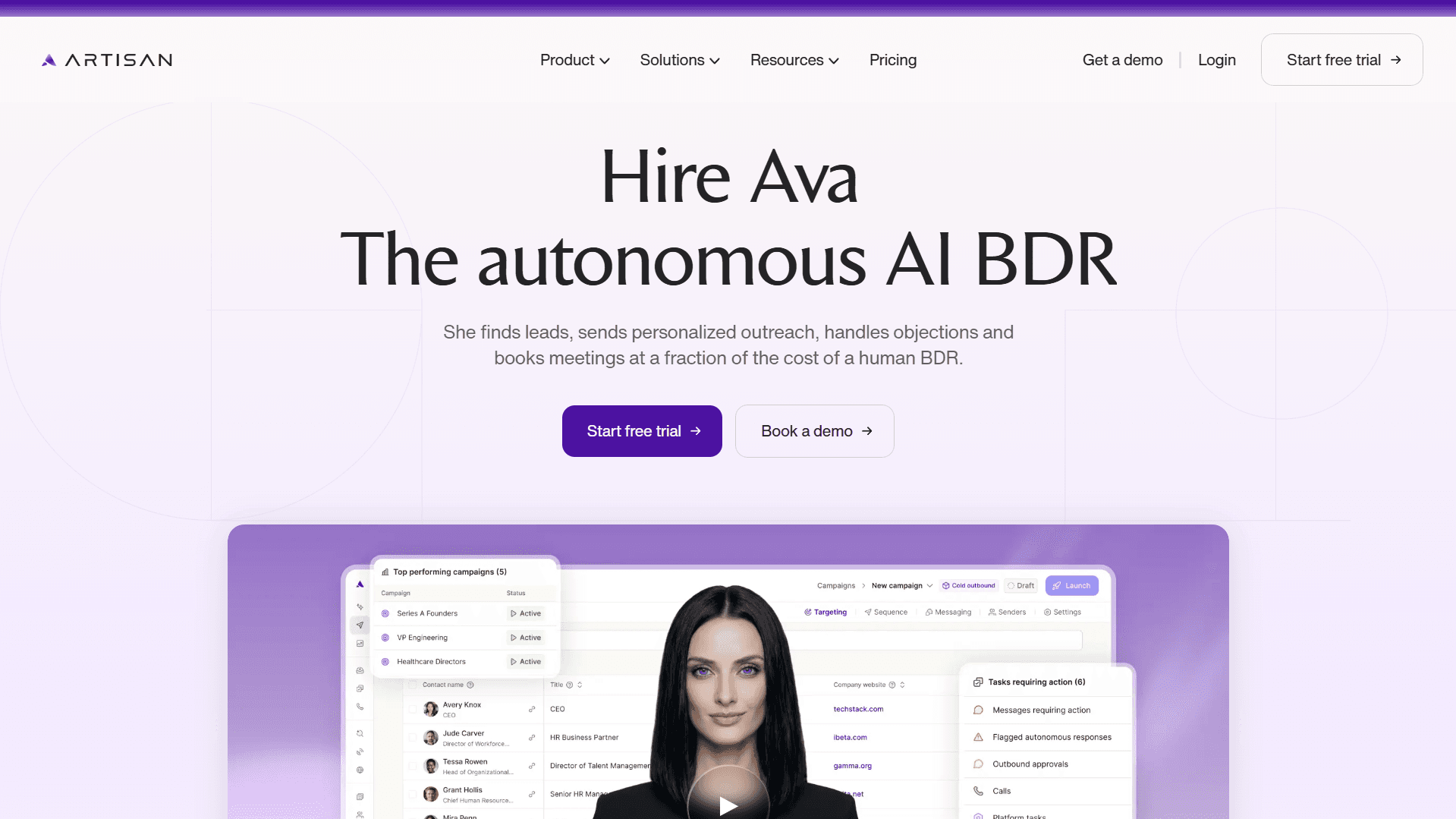
Over 90% of Artisan customers run Ava autonomously, on a dial that ranges from review-and-approve to full autonomy, with plain-language escalation rules and a complete audit trail. Hiring is one of a stack of signals Artisan watches together, alongside funding, tech-stack intent, and champion job changes, and the whole logic is covered in the signal-based selling guide. See also how champion tracking catches past buyers when they change jobs and how custom AI signals let you define any buying trigger. Instead of a job scraper, an enrichment tool, and a sequencer stitched together, one platform reads the signal and works it end to end.
"Email has always been our number one driver. Artisan is now neck-and-neck in both output and closed-won revenue," says Amelia Lerutte, Chief AI Officer at SaaStr, whose program sent 6,892 emails at a 3.6% positive response rate in roughly six weeks.
Related reads: how to find companies by their tech stack, our guide to intent marketing tools, our guide to intent data providers, and how to read intent signals. See the full loop on the AI sales agent page.
FAQ
What is the best tool to find companies hiring for roles that signal a need for my product?
The best tool is the one that acts on the signal, not just the one that lists it. Job boards and scrapers give you a list you have to enrich and work by hand. Artisan detects "actively hiring for role," layers ICP filters, and has Ava enrich, write, send, and book off it automatically, so the hiring signal turns into pipeline instead of a spreadsheet.
What sales tool tracks job changes, funding, and hiring signals together?
Artisan tracks all three natively, alongside tech-stack intent, topic intent, and champion job-change tracking, and runs outreach off each. Combining signals is where a platform beats a point tool: a company that is hiring SDRs and has also just raised a round is a stronger, better-timed target than either signal alone. See the signal-based selling guide and how to find companies backed by specific investors.
Which sales tool triggers outreach when a company is actively hiring for a role?
Artisan. You define the qualifying roles and ICP filters, and when a matching opening goes live, Ava enriches the account, writes personalized outreach that references the role, sends across email, social media, and dialer, and books the meeting on the right rep's calendar.
How soon should I reach out after a company posts a job?
In the four-to-eight-week gap before the new hire starts, while the pain is acute and unsolved. Reach out too late and the manager assumes the gap is filled. Within this window, prioritize speed but never at the cost of relevance: a two-day email that names the role beats a same-day generic blast.
Are hiring signals better than intent data?
They answer different questions. Hiring signals are about timing and budget: a role opening is a dated, public admission of pain with money attached. Topic intent data is about interest: it shows a company researching your category. The strongest outbound layers both, plus fit filters, which is what a signal platform is designed to do. For a primer, see what is intent data.
Why does everyone reaching out on hiring signals hurt my results?
Because every competitor scrapes the same boards, so a company that posts a role receives a wave of similar outreach the same week. The list is a commodity. Your edge is reaching out faster than the pack and with a message that reflects the specific role and its implication, which is exactly what generic mail-merge campaigns fail to do.
Related reading

Artisan Team
Expert insights from the team at Artisan
Our writing team blends direct operational experience, in-house data, and thorough research to bring you the very latest insights and updates about sales and GTM automation.